Thursday, May 7, 2020

Under US pressure, Mexican government vows to impose return to work and “herd immunity” policy
https://www.wsws.org/en/articles/2020/05/05/mexi-m05.html
By Andrea Lobo
5 May 2020
Hundreds of maquiladora sweatshop plants across Mexico have remained opened as the spread of the COVID-19 pandemic continues to accelerate. This includes 68 percent of those factories in Tijuana, across the border from the US state of California, according to the local government.
The manufacturing plants concentrated along the US-Mexico border have become COVID-19 outbreak epicenters, with dozens of workers dying in overwhelmed hospitals. The closings that did occur were largely due to the wave of wildcat strikes that swept across the border cities Matamoros, Reynosa, Ciudad Juarez, Tijuana and Mexicali last month. However, these plants—which are critical for the reopening of the North American auto industry, along with US defense production—have been gradually reopening over the past two weeks or have sent notices to workers to prepare to return to work soon.
As in Mexicali last Friday, where the right-wing Workers’ Congress (CT) organized a protest outside the municipality building against the premature return to work, workers must be wary of maneuvers by the establishment and so-called “independent” trade unions and associated activists. Their aim is not to defend workers’ lives but to regain their confidence in order to soften the resistance and corral them back to the plants at the first available opportunity, regardless of the risks.
As of this writing, there are 23,471 cases in Mexico and 2,154 deaths, according to the World Health Organization’s tally. While refusing to close non-essential workplaces, provide protection to medical workers or implement mass testing and other emergency measures, President Andrés Manuel López Obrador (AMLO) spent February and March kissing supporters at rallies, claiming that Mexicans should go out, trust their stronger genes, and carry religious icons and a one-dollar bill in the wallet—a lucky amulet across Latin America—as “guardians.”
With the deadly virus spreading and a wave of strikes hitting the maquiladora plants, AMLO finally declared a “health emergency” on March 30, ordering the shutdown of nonessential production and the payment of full salaries.
Even though it did not have the slightest intention of enforcing these measures, the government sought to deflect popular anger by issuing statements about protecting workers’ lives. On April 16, Finance Minister Arturo Herrera wrote in a letter to the IMF, “Notwithstanding the current uncertainty, it is of utmost importance to send a strong message that there is no trade-off between health and the economy. The global economic crisis cannot be solved until the health emergency is effectively addressed.”
That same evening, however, the Trump administration published its plan “Opening Up America Again,” and the US president called AMLO shortly afterwards to pressure him to reopen plants in Mexico.
On April 23, AMLO declared in his daily press briefing: “We’ve committed, above all to our national business owners, to analyze the opening [in the US] to little-by-little start going back to normal productivity at the border. But this has not been decided yet because the coronavirus is unfortunately affecting them very much…” He later announced that the reopening would begin on May 17.
On April 27, Herrera switched his rhetoric about prioritizing health, and said to El Pais that the government would “find the mechanism” to open suppliers to US corporations even sooner. He explained, “What epidemiologists expect is that once we move to the next phase, we’ll start getting a herd immunity with such a high percentage of the population who got it, even though many don’t. What kills the pandemic is not avoiding infections but having had enough infections at such a high amount that there is no way to transmit it since others already got it.”
This is a homicidal policy that will result, if it is carried out, in hundreds of thousands of deaths.
On Monday, the Detroit Free Press published an article titled, “US auto industry preps for restart—and it all depends on Mexico.” It noted, “With about 40% of imported auto parts coming from south of the border, and parts made in the United States that are exported to Mexico for vehicle production there, the interdependency between the two countries cannot be overstated.”
The AMLO government and US- and other foreign-based corporations hope to use economic desperation to force workers back to work.
The UK anti-hunger organization Oxfam estimated that, without government aid, 3 million businesses could be affected, leaving 28 million workers—or nearly half of Mexico’s labor force—without a job or enough income to survive. Oxfam reports that providing informal workers a minimum income for a year would cost about $24 billion, less than a quarter of the $108 billion controlled by the six richest Mexican billionaires.
AMLO has refused to provide any aid to those losing their jobs and income in the informal sector. At the same time, he has claimed he would not give handouts to banks and corporations. However, while AMLO proclaims that his priority is not raising debt, Herrera has announced “the largest issuance of bonds in Mexico’s history,” approximately $6 billion, and the government is pledging to the international markets that it will pay back the debt and interest in full.
At the same time, pressure is mounting to shut down the opposition of Mexican workers. Francisco Santini Ramos, the president of the Business Coordinating Council, the main employer organization, said corporations were being “stigmatized nationally and internationally by the protests of workers at nonessential plants and the deaths of co-workers, which could undermine the attraction of foreign investment.” Specifically referring to two Lear auto parts plants in Ciudad Juárez where at least 16 workers died of COVID-19, he said the company was not at fault and pointed to the health care system.
The daughter of a worker at the plant who recently succumbed to COVID-19 after a long fight against the disease, explained to the WSWS that the Michigan-based corporation forced workers with COVID-19 symptoms to continue working throughout the second half of March. Her father, and many workers on social media noted that the plant would have kept operating if didn’t run out of space in its warehouses due to the shutdown of Lear factories in the US. “They didn’t close the plants even when Lear closed in the US. It’s irresponsible that they kept it open and exposed their employees,” Mónica Rosales told the WSWS.
Regarding the underfunded health care system, the Mexican government has prioritized tax and property incentives for foreign capital, as well as a military buildup to prepare to defend their property and crack down on social opposition.
One of AMLO’s first policy initiatives was to create the largest free economic zone along the US-Mexico border by slashing taxes for corporations. This led to an estimated budget shortfall for the first year of US $4.23 billion. AMLO also cut federal health care personnel by 30 percent and the budget of the Epidemiology Department by nearly 10 percent in his 2020 budget.
The supposed opposition by AMLO and his Morena party to the pro-business policies of the previous governments, especially after the 2012 Pact for Mexico that centered on the privatization of oil and social cuts, increased their popularity.
The Mexican ruling class and US imperialism prevented AMLO from coming to power through electoral fraud in 2006 and 2012 in order to smother rising social expectations. In 2018, however, he was allowed to win the presidency in order to contain simmering social opposition fueled by the killing of 43 teacher students in 2014 and the murderous repression of Gasolinazo protesters in 2017.
The Stockholm International Peace Research Institute (SIPRI) reported yesterday that AMLO raised the military budget 7.9 percent in his first year to $6.5 billion. During the last decade, military spending has increased 47 percent, ostensibly to combat violent drug cartels, but homicides continue to reach higher levels. The US government has also continued to provide billions in military aid and training through the Mérida Initiative.
The main official drug enforcement official who coordinated with US agencies between 2001 and 2012 was Genaro García Luna, who has been indicted in New York for receiving millions of dollars from the Sinaloa Cartel starting as early as 2005.
On Saturday, the US ambassador at the time Roberta Jacobson, who worked closely with García Luna in the development of the Mérida Initiative, said that the former Mexican President Felipe Calderón and US governments knew of García Luna’s ties. Several of García Luna’s closest collaborators remain in top posts under the Morena federal and Mexico City governments.
The Morena government created a new National Guard, which is run by the same corrupt military command, and enshrined the military’s domestic deployment in the Constitution. After its first assignments to crack down on Central American immigrants at the behest of the fascistic Trump administration, the National Guard has been sent to harass striking auto parts workers in Matamoros and to dismantle the blockade of a railway by teachers in Puebla. A National Guard internal memorandum on the COVID-19 crisis notes that it is preparing to move against “social unrest.”
With the pandemic crisis further eroding AMLO’s popularity, the ruling class is preparing for a new stage in the class struggle involving widespread state repression. AMLO’s approval rating, according to the polling firm Mitofsky, fell to the lowest point of his administration at 48.8 percent, compared to 67.1 percent in February 2019. The return-to-work campaign, as is the case internationally, is a particularly explosive issue—with the Ipsos MORI Global Advisor finding in a poll that 65 percent of Mexicans oppose a reopening until the pandemic is totally contained.
Despite the efforts by the trade unions and pseudo-left organizations in Mexico and internationally to boost illusions in AMLO, millions of workers, small-business owners and unemployed have seen past his phony “left” populism. Like the ruling class in the US and countries across the world, the entire political establishment in Mexico is demanding that workers risk their lives for the profits of the transnational corporations and Wall Street.
The only way to protect both the lives and livelihoods of workers is through a mass political mobilization of the working class, leading all oppressed layers behind it and independently of every pro-capitalist party and trade union. The private fortunes of the ruling elite need to be expropriated to end poverty and deprivation and the domestic and foreign-owned factories transformed into public utilities under the control of the working class, as part of the socialist transformation of the economy.
In opposition to the corrupt CTM unions, workers must build rank-and-file factory and workplace committees to unite with US and Canadian workers to demand the closure of all non-essential production and full income to all laid off workers. No production should be resumed until the pandemic is contained, universal testing and contact tracing put in place, and rank-and-file safety committees, working in conjunction with public health experts committed to the interests of workers, not the corporations, can guarantee safe working environments.
With lifting of restrictions, world must brace for a second wave of the COVID-19 pandemic
https://www.wsws.org/en/articles/2020/05/05/viru-m05.html
By Benjamin Mateus
5 May 2020
The rate of COVID-19 infections in the United States continues to remain relatively flat, with approximately 25,000 to 30,000 cases per day. The number of daily fatalities has also remained steady at around 2,000 per day. These coronavirus cases continue to take a considerable toll on the health infrastructure.
As the Eastern Seaboard is seeing declining cases from the lockdown and restrictions placed into effect more than six weeks ago, the pandemic is moving westward into states like Indiana, Illinois, Wisconsin and Minnesota, where the number of daily cases continues to climb just as these states are moving to lift some restrictions. Canada, with over 60,000 cases and over 1,000 deaths, has seen the number of new cases triple over the last three weeks.
Additionally, rural communities in the US, which were initially spared, are facing the ravages of the pandemic. According to the New York Times, “As food processing facilities and prisons have emerged as some of the country’s largest case clusters, the counties that include Logansport, Indiana, South Sioux City, Nebraska, and Marion, Ohio, have surpassed New York City in cases per capita.”
Spain and Italy have made substantial efforts to decrease their daily cases, which are down by 60 percent from their peak, which occurred nearly six weeks ago. The daily cases of fatalities for these two countries have also seen a similar reduction. The United Kingdom has only managed to halt the acceleration of infections, with a current rate of about 5,000 cases per day. Daily fatalities in the UK are slowly turning downward. France and Germany have suppressed new cases and deaths by 80 percent. Portugal, Greece and Turkey have seen similar declines.
Just as in the US, there are indications that the virus is moving out of the European continent into Russia, where there are over 145,000 cases including 10,581 new cases in the last 24 hours. India, too, is seeing an acceleration of cases after a brutal five-week lockdown that caused tremendous hardship for the poorest. Despite this rise, on Monday India moved to relax restrictions, a tentative return to normal with the caveats of “social distancing and stringent hygiene standards” that will be impossible to implement.
Mexico City hospitals are expecting to see the surge peak in mid-May with an estimate of 1,800 patients in intensive care units (ICUs). In Lima, Peru, a city of 10 million people, where more than two million lack access to water and sewage services, the city is the epicenter for COVID-19, with nearly 30,000 of the 47,372 cases in the country. The metropolitan city of Chile, Santiago, has seen over 10,000 cases, accounting for 60 percent of the country’s cases.
Brazil, now with over 100,000 total cases, has seen a spike in daily cases of more than 6,000 per day. Daily reported deaths have surpassed 400 per day, a gross underestimation of the real figure. The number of fatalities in Manaus, a city near the country’s rainforest, has forced cemeteries to bury five coffins at a time in collective graves. The city has run out of ICUs for patients. The cities of Rio de Janeiro and Sao Paulo are facing similar catastrophes despite the fascistic President Jair Bolsonaro’s proclamation that the virus is just a “little cold.”
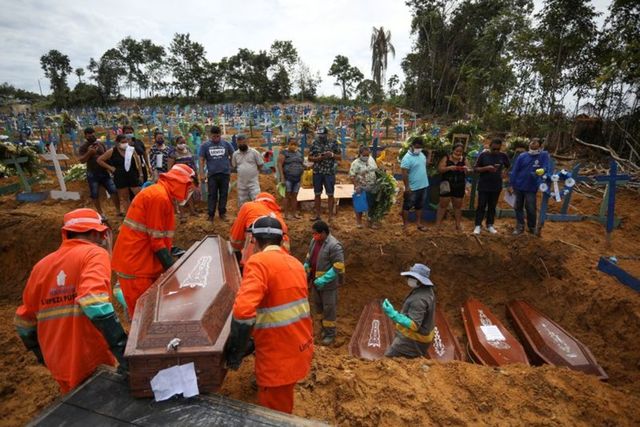 A mass grave in Manaus, Brazil
According to every epidemiologist, too little is known about the nature of this virus to predict its behavior. But the mitigation efforts have made a difference. The African continent, with few resources and underfunded health infrastructure, but years of experience with malaria, HIV, Tuberculosis and Ebola, was much quicker to implement containment measures employing the basic ABC’s of public health measures. With 47,554 total cases and 1,838 total deaths, it is the least impacted continent, though it remains still too early in the course of the pandemic.
Meanwhile, the New York Times reported that an internal White House memo projected that the daily death toll would climb back up to 3,000 by June 1 as states move to relax social distancing efforts and restrictions on businesses. Even the highly criticized University of Washington’s low estimates, often quoted by the White House Coronavirus Task Force, have been revised again to nearly 135,000 deaths in the US by the beginning of August.
On CBS News on Sunday, Dr. Scott Gottlieb, President Trump’s former Food and Drug Administration commissioner, said, “While mitigation didn’t fail, I think it’s fair to say that it didn’t work as well as we expected. We expected that we would start seeing more significant declines in new cases and deaths around the nation at this point. And we’re just not seeing that.” Such disingenuous statements are aimed at downplaying the effects of mitigation and boosting efforts to lift restrictions.
The tremendous discipline, effort and sacrifice made by the working class of many countries to stem and turn the course of the pandemic matter little to the financial markets and their political stooges, who are eager to see restrictions lifted sooner and workers sent back to work regardless of the destructive potential of a second wave. Yet, it is the working class that should be genuinely credited for any measure of success that brought the pandemic under a modicum of control.
At every turn—from failure to provide protective gear and testing kits, delays in imposing restrictions, lack of workplace safety, the collapse of essential public health infrastructure, fraudulent claims of therapeutics for COVID-19—the ruling class has thwarted any real effort to stem and curtail the pandemic. Now the markets are clamoring, “It’s been long enough!”
On Monday, Reuters announced that world leaders had pledged nearly $8 billion to research, manufacturing and equitable distribution of any possible vaccine and therapeutics for COVID-19. The joint venture between the World Health Organization and the European Investment Bank is a new initiative and a suspect one.
According to WHO Director-General Dr. Tedros Adhanom Ghebreyesus, “Combining the public health experience of the World Health Organization and the financial expertise of the European Investment Bank will contribute to a more effective response to COVID-19 and other pressing health challenges.”
This initiative is supposedly aimed at developing more effective malarial treatments and addressing the pressing concerns over growing antimicrobial resistance. Much is being made of the Trump administration abstaining from pledging any help to these efforts as the US aims to direct blame against the WHO and China to cover for their malignant negligence in face of the pandemic.
During a meeting at the end of April, European Union leaders agreed to build a trillion-euro emergency fund, a bailout, while also committing the EU to fast-tracking return-to-work policies. According to Commission President Ursula von der Leyen, the EU had so far already provided state aid worth €1.8 trillion to blunt the economic hit of the coronavirus. These measures are the European counterpart of the US government’s multitrillion-dollar bailout of the markets and big business.
The impact of coronavirus could compare to the Great Depression
And a corresponding rise in nationalism and xenophobia may follow, just as it did in the 1930s.

by William Gumede
3 May 2020
https://www.aljazeera.com/indepth/opinion/impact-coronavirus-compare-great-depression-200420070542882.html
The coronavirus crisis will be the biggest financial crisis of our generation, much larger than the 2007-2009 global financial crisis.
It is very likely that the economic impact of the coronavirus crisis will be comparable with the Great Depression, the period of devastating economic decline between 1929 and 1939, which saw mass unemployment, factory closures and the accompanying personal trauma.
The coronavirus outbreak will bring an economic depression - that is, a severe and prolonged economic decline with high levels of unemployment and company closures.
Record numbers of people will likely suffer from post-traumatic stress disorder (PTSD), the combination of stress, anxiety and depression that develops in some people who have experienced a traumatic event.
The coronavirus outbreak is already such an event. More than three million people around the world have been infected by the virus and more than 200,000 have died of it. Estimates show that the coronavirus may kill 100,000 Americans, the equivalent to double the number of Americans who died in the Vietnam War.
By comparison, the Spanish flu pandemic of 1918-1919 infected 500 million people, or one-third of the world's population, with 50 million deaths, of which 675,000 occurred in the US. The world's population in 1918-1919 was estimated at 1.5 billion. If one translates this to today's figures, with a world population of 7.8 billion, it would be the equivalent of 2.6 billion people infected and 250 million deaths.
The United Nations Conference on Trade and Development (UNCTAD), the UN's trade and development agency, says the slowdown in the global economy caused by the coronavirus outbreak is likely to cost at least $1 trillion in 2020 alone, in terms of reduced growth measured in gross domestic product (GDP).
Over time, the cost to the global economy is likely to be three or four times that figure.
As a comparison, it is estimated that the 2007-2009 global financial crisis cost the US around $4.6 trillion in terms of lost growth in GDP, or 15 percent of its GDP compared to the years before the financial crisis.
During the Great Depression, unemployment in many countries hovered around 25 percent, with one in four people in industrial countries made jobless by it. In the US, nearly half of the banks collapsed, 20,000 companies went bankrupt and 23,000 people committed suicide.
The current pandemic will cause individual economies to plunge into recession; businesses will close down and jobs will be lost at similar levels to that of the Great Depression. Moreover, the pandemic is impacting both industrial and developing countries; whereas the Great Depression was largely concentrated in industrial countries.
The International Labour Organization (ILO) has predicted that the pandemic will wipe out 6.7 percent of working hours in the second quarter of this year - the equivalent of 195 million full-time workers.
This is already playing out. In the US, more than 22 million people filed claims for jobless benefits in the four weeks ending April 11, according to the US Department of Labour. To put these latest numbers into context, in 2008, at the height of the global financial crisis, 2.6 million people in the US filed for unemployment in that year, making 2008 the year with the biggest employment loss since 1945.
Suicides, domestic violence and murders increase during times of economic hardship and this may be further exacerbated by lockdowns and self-isolation.
Wealthier countries such as Germany, the UK and the US have rolled out large aid programmes - larger than those which appeared in the aftermath of the 2008 global financial crisis - to support businesses, the self-employed and the unemployed for loss of income during the lockdown. Germany will give unlimited loans to large companies, pay 60 percent of salaries of troubled companies to allow them to reduce the working hours of employees without having to lay them off and financial support to the self-employed.
The US has unveiled a $2 trillion coronavirus rescue package for struggling companies and employees, which includes loans, equity stakes for government in businesses in strategic sectors and direct cash payments to individuals.
While these bailouts might provide interim relief, they will plunge countries, companies and families into debt for years, while we will also have to deal with the social crises of deaths, suicides and mental disintegration for a long time after the coronavirus pandemic.
After the Great Depression there was a rise in nationalism around the world - as a direct result of the financial, social and emotional hardships of the depression - creating the conditions that eventually led to the second world war.
There has been a similar rise in nationalism, populism and xenophobia during the coronavirus outbreak. Of course, this had been growing for many years before the pandemic, in part as a result of austerity measures that caused financial hardship in the aftermath of the 2007-2009 financial crisis.
The coronavirus crisis will likely make those austerity measures worse.
Although there have been pockets of solidarity in response to the coronavirus - Cuba sending medical personnel to Italy and China sending medical equipment to Poland, for example - some countries have stopped vital medicines, equipment and food from being exported to other countries.
Once the crisis has passed, some countries may continue turning themselves into fortresses, excluding outsiders, whether immigrants, refugees or foreign companies.
Nationalist, populist and extremist leaders and governments could ride the wave of post-coronavirus financial and emotional hardships, in the same way they did after the Great Depression. There is a real danger that the hardships caused by the coronavirus pandemic will lead to authoritarian governments coming to power in many countries, while those already in power become more entrenched.
If they do, the methods used to prevent the virus from spreading: sealing off borders, tracking infected individuals using surveillance technology and restricting people's movements, could be used for more menacing purposes.
3 May 2020
https://www.aljazeera.com/indepth/opinion/impact-coronavirus-compare-great-depression-200420070542882.html
The coronavirus crisis will be the biggest financial crisis of our generation, much larger than the 2007-2009 global financial crisis.
It is very likely that the economic impact of the coronavirus crisis will be comparable with the Great Depression, the period of devastating economic decline between 1929 and 1939, which saw mass unemployment, factory closures and the accompanying personal trauma.
The coronavirus outbreak will bring an economic depression - that is, a severe and prolonged economic decline with high levels of unemployment and company closures.
Record numbers of people will likely suffer from post-traumatic stress disorder (PTSD), the combination of stress, anxiety and depression that develops in some people who have experienced a traumatic event.
The coronavirus outbreak is already such an event. More than three million people around the world have been infected by the virus and more than 200,000 have died of it. Estimates show that the coronavirus may kill 100,000 Americans, the equivalent to double the number of Americans who died in the Vietnam War.
By comparison, the Spanish flu pandemic of 1918-1919 infected 500 million people, or one-third of the world's population, with 50 million deaths, of which 675,000 occurred in the US. The world's population in 1918-1919 was estimated at 1.5 billion. If one translates this to today's figures, with a world population of 7.8 billion, it would be the equivalent of 2.6 billion people infected and 250 million deaths.
The United Nations Conference on Trade and Development (UNCTAD), the UN's trade and development agency, says the slowdown in the global economy caused by the coronavirus outbreak is likely to cost at least $1 trillion in 2020 alone, in terms of reduced growth measured in gross domestic product (GDP).
Over time, the cost to the global economy is likely to be three or four times that figure.
As a comparison, it is estimated that the 2007-2009 global financial crisis cost the US around $4.6 trillion in terms of lost growth in GDP, or 15 percent of its GDP compared to the years before the financial crisis.
During the Great Depression, unemployment in many countries hovered around 25 percent, with one in four people in industrial countries made jobless by it. In the US, nearly half of the banks collapsed, 20,000 companies went bankrupt and 23,000 people committed suicide.
The current pandemic will cause individual economies to plunge into recession; businesses will close down and jobs will be lost at similar levels to that of the Great Depression. Moreover, the pandemic is impacting both industrial and developing countries; whereas the Great Depression was largely concentrated in industrial countries.
The International Labour Organization (ILO) has predicted that the pandemic will wipe out 6.7 percent of working hours in the second quarter of this year - the equivalent of 195 million full-time workers.
This is already playing out. In the US, more than 22 million people filed claims for jobless benefits in the four weeks ending April 11, according to the US Department of Labour. To put these latest numbers into context, in 2008, at the height of the global financial crisis, 2.6 million people in the US filed for unemployment in that year, making 2008 the year with the biggest employment loss since 1945.
Suicides, domestic violence and murders increase during times of economic hardship and this may be further exacerbated by lockdowns and self-isolation.
Wealthier countries such as Germany, the UK and the US have rolled out large aid programmes - larger than those which appeared in the aftermath of the 2008 global financial crisis - to support businesses, the self-employed and the unemployed for loss of income during the lockdown. Germany will give unlimited loans to large companies, pay 60 percent of salaries of troubled companies to allow them to reduce the working hours of employees without having to lay them off and financial support to the self-employed.
The US has unveiled a $2 trillion coronavirus rescue package for struggling companies and employees, which includes loans, equity stakes for government in businesses in strategic sectors and direct cash payments to individuals.
While these bailouts might provide interim relief, they will plunge countries, companies and families into debt for years, while we will also have to deal with the social crises of deaths, suicides and mental disintegration for a long time after the coronavirus pandemic.
After the Great Depression there was a rise in nationalism around the world - as a direct result of the financial, social and emotional hardships of the depression - creating the conditions that eventually led to the second world war.
There has been a similar rise in nationalism, populism and xenophobia during the coronavirus outbreak. Of course, this had been growing for many years before the pandemic, in part as a result of austerity measures that caused financial hardship in the aftermath of the 2007-2009 financial crisis.
The coronavirus crisis will likely make those austerity measures worse.
Although there have been pockets of solidarity in response to the coronavirus - Cuba sending medical personnel to Italy and China sending medical equipment to Poland, for example - some countries have stopped vital medicines, equipment and food from being exported to other countries.
Once the crisis has passed, some countries may continue turning themselves into fortresses, excluding outsiders, whether immigrants, refugees or foreign companies.
Nationalist, populist and extremist leaders and governments could ride the wave of post-coronavirus financial and emotional hardships, in the same way they did after the Great Depression. There is a real danger that the hardships caused by the coronavirus pandemic will lead to authoritarian governments coming to power in many countries, while those already in power become more entrenched.
If they do, the methods used to prevent the virus from spreading: sealing off borders, tracking infected individuals using surveillance technology and restricting people's movements, could be used for more menacing purposes.
Latest figures as countries fight to contain the pandemic
https://www.ft.com/content/a26fbf7e-48f8-11ea-aeb3-955839e06441
The human cost of the coronavirus outbreak has continued to mount, with more than 3.61m cases confirmed globally and more than 251,500 people known to have died. The World Health Organization has declared the outbreak a pandemic and it has spread to more than 190 countries around the world. This page provides an up-to-date visual narrative of the spread of Covid-19, so please check back regularly because we will be refreshing it with new graphics and features as the story evolves. LATEST CHANGES May 5: All maps and charts now include deaths away from hospitals where reported May 4: Added interactive epidemic trajectory charts and government response tracker April 29: Excess mortality charts added, showing that official Covid-19 death counts may significantly underestimate the pandemic’s true toll Europe became the focal point of the pandemic in early March when the disease spread rapidly across the continent. Italy soon became the country hardest hit by Covid-19 after China. After weeks of strict lockdown, Italy has turned the corner and the rate of deaths is beginning to decrease. The same now appears true of several other western countries, while in Australia an early lockdown has kept daily death tolls from ever reaching double digits. Many places, though, are still seeing accelerating death tolls. Foremost among these are emerging market countries such as Brazil, Russia and India, where daily deaths are on an upward trend. There are concerns, however, that reported Covid-19 deaths are not capturing the true impact of coronavirus on mortality around the world. The FT has gathered and analysed data on excess mortality — the numbers of deaths over and above the historical average — across the globe, and has found that death tolls in some countries are more than 50 per cent higher than usual. In many countries, these excess deaths exceed reported numbers of Covid-19 deaths by large margins. The picture is even starker in the hardest-hit cities and regions. In Ecuador’s Guayas province, there have been 10,000 more deaths than normal since the start of March, an increase of more than 300 per cent. London has seen overall deaths more than double, and New York City’s total death numbers since mid March are more than four times the norm. At the beginning of March, Asia accounted for more than 60 per cent of coronavirus-related deaths. Within a week, attention shifted to Europe, with Italy and Spain the new global hotspots. Although the region still accounts for more than 40 per cent of global deaths, the focus has now turned to the US, where the death toll remains consistently high. The US now has the highest number of new confirmed cases globally, and has passed 1m in total. However new confirmed case counts in some European countries have begun to plateau or start to to fall. New Zealand is foremost among several countries that have managed to keep their outbreaks from accelerating. The country has had fewer than 10 new cases per day since April 18. As Covid-19 spread beyond China, governments responded by implementing containment measures with varying degrees of restriction. Researchers at the University of Oxford’s Blavatnik School of Government have compiled data on a range of government response measures, such as school and workplace closures and restrictions on travel and gatherings, to create a stringency index. Recommended Coronavirus economic tracker: latest global fallout Exiting lockdowns: tracking governments’ changing coronavirus responses East Asian countries including South Korea and Vietnam were the first to follow China in implementing widespread containment measures, with much of Europe, North America and Africa taking much longer to bring in tough measures. India’s sudden implementation of a strict 21-day lockdown propelled it to the top of the index, making it the first country reported to have hit the index’s upper limit of 100 for more than a single day. Help the Blavatnik School of Government at Oxford university improve the stringency index used in this map by providing direct feedback. The FT is mapping the virus as it spreads. Check back for our up-to-date figures. The death toll has now passed 100 in 23 European countries. The region accounts for 40 per cent of new daily cases. Coronavirus has spread to all 50 states in the US. More than 1.19m cases and 65,200 deaths have been confirmed in the country. SOURCES The national-level data for these charts and maps come primarily from the European Centre for Disease Prevention and Control, the Covid Tracking Project and the Johns Hopkins University Center for Systems Science and Engineering. Additional data comes from Worldometers. Regional data comes from official sources or verified local aggregation projects: the Covid Tracking Project (for US states), Montera34 (Spain), the Italian Department of Civil Protection, Public Health France, Jan-Philip Gehrcke (Germany), Canton of Zurich Statistical Office (Switzerland and Liechtenstein), the Public Health Agency of Sweden, the Brazilian Ministry of Health, the National Health Commission of China, and Tom E. White (UK). Excess mortality analysis is based on data from: Statistics Austria, Sciensanto (Belgium), the Civil Registry of Brazil, Statistics Denmark, the Civil Registry of Ecuador, the French National Institute of Statistics and Economic Studies (current and historic data), the German Federal Statistical Office, Statistics Iceland, Jakarta Provincial Park and Forest Service, the Israeli Ministry of Health, the Italian National Institute of Statistics, Statistics Netherlands, Statistics Norway, the Portuguese Directorate-General for Health, the South African Medical Research Council, the Spanish Institute of Health Carlos III, Statistics Sweden, the Swiss Federal Statistics Office, Istanbul Metropolitan Municipality, the UK Office for National Statistics (current and historic data), and the US National Center for Health Statistics. Help us improve these charts: Please email coronavirus-data@ft.com with feedback, requests or tips about additional sources of national or municipal all-cause mortality data. Thank you to the many readers who have already helped us with feedback and suggestions. We continue to incorporate your suggestions and data every day. We will respond to as many people as possible. Reporting, data analysis and graphics by Steven Bernard, David Blood, John Burn-Murdoch, Max Harlow, Caroline Nevitt, Alan Smith, Cale Tilford and Aleksandra Wisniewska. Edited by Adrienne Klasa Correction: Due to a typographical error, the first paragraph of this story incorrectly stated the number of people who had died from Covid-19 for several hours on April 9. At the time, that figure should have read 87,741.
Attacking the messenger: Planet of the Humans spears sacred beliefs
https://systemicdisorder.wordpress.com/2020/05/06/attacking-messenger-planet-of-the-humans/
When it comes to global warming, there continues to be plenty of magical thinking going on. And such magical thinking is not exclusive to the conservative end of the political spectrum.
It is easy to take apart conservative denial of global warming, based as it is on ideology and a total lack of scientific grounding. In their own way, however, right-wing climate deniers are consistent on one point — they know that effectively tackling global warming means economic disruption, so their solution is to deny there is any global warming. Liberals, however, have their heads in the sand as well — too honest to deny the obvious, they instead deny there will be any cost. We’ll switch to renewable energy and continue business as usual.
The latter is not realistic. And that brings us to the new environmental film Planet of the Humans, which has certainly touched many a liberal nerve. Believing we can continue capitalist business as usual, merrily consuming far beyond the Earth’s capacity to replenish resources and enjoy infinite growth on a finite planet, leads to a disinclination to be realistic about the cost of dealing with global warming. The liberal idea that we can make a seamless switch to renewable energy and continue to use Earth’s resources and consume at the same rate humanity has been doing is fantasy.
And that is what underlies the fierce reaction to Planet of the Humans. A generally unreasonable reaction that grossly misrepresents the film.
So there is no mistaking where my perspective lies, I do believe the fastest possible switch to renewable energy should be made and we should abandon the use of fossil fuels in the shortest reasonable time. But we should be realistic about the limitations. Renewables, although part of the solution to global warming, can’t save us on their own. Humanity, at least those in the Global North, has no choice but to consume much less, including less energy. Unfortunately, there is no getting around that. The limitations of renewables will be discussed below, but first let’s dismantle the disingenuous attacks on the film, produced and directed by Jeff Gibbs, with Michael Moore as executive producer. For the record, I have watched Planet of the Humans in its entirety twice.
Should dissenting voices be silenced?
The first thing to be pointed out is that the attacks on the film are led by those whose hypocrisy was exposed. Let us acknowledge that those exposed can’t be expected to take kindly to that. But the attacks are hardly limited to the leaders of the large organizations who come under criticism, such as 350.org and the Sierra Club. Josh Fox isn’t among those mentioned, but he nonetheless was so infuriated that he circulated a letter demanding the film be banned, sadly signed by several prominent environmentalists, including Naomi Klein (who really should know better) and Michael Mann (a promoter of nuclear energy, an industry that would not exist without massive subsidies).
Mr. Fox states, “The film touts blatantly untrue fossil fuel industry talking points deceitfully misleading its audience on renewable energy, disparages and attacks important climate leaders, ignores science and policy advances in energy, downplays or denounces climate and anti-fossil fuel campaigns and employs specious techniques of misinformation to deliver a deeply cynical and erroneous message.” That’s a whole lot of accusation. Let’s unpack it.
The film frontally attacks the fossil fuel industry throughout. To imply that it is somehow aligned with the fossil fuel industry is beyond laughable. The heart of the critique was that certain prominent environmentalists are too cozy with fossil fuel interests. Further, Mr. Gibbs doesn’t “disparage” or “attack” “important climate leaders,” he allows them to speak for themselves and thus reveal themselves.
I see absolutely no evidence that Mr. Gibbs forced Bill McKibben, founder of 350.org, to repeatedly declare his enthusiastic support for biomass, which generates energy through massive burning of trees. It doesn’t seem a stretch to see that chopping down forests isn’t environmentally friendly or sustainable, given the immense scale of biomass plants. In the final credits, the film notes that Mr. McKibben says that he changed his mind on biomass after the film came out but also that biomass continues to be widely used. There has long been plenty of data demonstrating how dangerous biomass is — data that should have been known to Mr. McKibben.
Were the dangers of biomass hidden from our eyes?
Increased logging is surely not a route to reducing global warming. A paper by the British watchdog group Biofuelwatch reports:
“Increased demand for bioenergy is already resulting in the more intensive logging including very destructive whole tree harvesting or brash removal and replacement of forest and other ecosystems with monocultures. Expansion of industrial tree plantations for bioenergy is expected to lead to further land grabbing and land conflicts. At the same time, communities affected by biomass power stations are exposed to increased air pollution (particulates, nitrogen dioxide, sulphur dioxide, dioxins etc.) and thus public health risks. Meanwhile, a growing number of scientific studies show that burning wood for energy commonly results in a carbon debt of decades or even centuries compared with fossil fuels that might otherwise have been burnt.”
A Partnership for Policy Integrity study found that biomass electricity generation, which relies primarily on the burning of wood, is “more polluting and worse for the climate than coal, according to a new analysis of 88 pollution permits for biomass power plants in 25 [U.S.] states.” The partnership’s director, Mary Booth, wrote:
“The biomass power industry portrays their facilities as ‘clean.’ But we found that even the newest biomass plants are allowed to pollute more than modern coal- and gas-fired plants, and that pollution from bioenergy is increasingly unregulated.”
The Biofuelwatch report was published in 2012 and the Policy Integrity report was published in 2014, so claims of not knowing are disingenuous.
It is of course possible to aim at the wrong target. The pro-vegan film Cowspiracy, for example, consistently attacked environmental groups for not seeing animal agriculture as the solution to all problems, relentlessly mocked environmentalists for not agreeing 100 percent with its thesis and took industrial capitalism off the hook. That would be an example of an unfair hatchet job. Planet of the Humans, by contrast, aims its target at industrial capitalism and the fossil fuel industry.
Don’t grassroots activists count as environmentalists?
Like it or not, there are liberal environmental groups that promote bad environmental practices and even partner with investment funds that heavily invest in fossil fuels. Incidentally, it isn’t until the one-hour mark in a film that lasts one hour and 40 minutes before it begins to criticize mainstream liberal organizations including the Sierra Club. And it is careful to show the large gap between rank-and-file members and those group’s leaderships. Anybody who has experience in the environmental movement can tell you about how grassroots members and local leaders are often well ahead of their national leaders. That is particularly true of the Sierra Club, in my own experience.
Perhaps the most over-the-top attack on the film was conjured by Eoin Higgins and published in Common Dreams and AlterNet. Mr. Higgins goes to the extreme of accusing Mr. Gibbs of “arguing for ecofascist solutions.” I suppose it is better not to dignify such nonsense. The “review,” alas, gets no better as it drones on. We can only hope Mr. Higgins did not hyperventilate while writing his screed. It does not appear he took the trouble to actually see the film nor to grasp the immense differences between socialism and fascism.
Mr. Higgins quotes an assortment of critics peddling similarly over-the-top attacks. One, Emily Atkin, is quoted as saying, “This movie repeatedly claims that humans are better off burning fossil fuels than using renewable energy.” Once again, the film’s critique is of organizations being too closely tied to the fossil fuel industry. A basic premise of the film is that large amounts of fossil fuels are used to manufacture solar panels and especially wind-power towers and turbines, and they have to be replaced in short periods of times. The film also notes that because wind and solar are intermittent, and current battery-storage technology far from adequate, existing fossil fuel plants have to be kept online as backup sources. Power plants thus need to run continuously, you can’t switch them on and off at will. Basic science here.
Further, because most “renewable” energy is in the form of biomass, not only do you have greenhouse-gas emissions, you also lose the carbon sink of the destroyed forests, thereby constituting a double whammy. Note the effects of biomass a few paragraphs earlier — if it is true that biomass is more polluting than fossil fuels, then why use it?
Mr. Higgins goes on to allege, “In a more disturbing move, Gibbs promotes population control as the best answer to the warming of the planet,” and then quotes another critic aligning Planet of the Humans with the odious far-right website Breitbart. Thanks to watching the film on YouTube, I could stop and start at will. I added up the entire total of time in which population was discussed. It is about one minute and 30 seconds. Three professors mentioning population are given space in this brief minute and a half, and none came anywhere near advocating any eugenic ideas. The first noted there are “too many human beings using too much too fast”; one said “we have to have our abilities to consume reined in”; and all three put their remarks in the context that humanity is consuming at an unsustainable rate.
That last point ought to be obvious, but evidently isn’t, at least to Mr. Higgins. So for his benefit, Global Footprint Network (which certainly appears to me to be an environmental organization) calculates that the world is consuming the equivalent of 1.75 Earths — in other words, humanity is using natural resources 75 percent faster than they can be replenished. A figure that steadily increases. The advanced capitalist countries obviously consume at a more furious rate than the global average. That is, ahem, unsustainable. Basic mathematics informs us that either humanity learns to consume less or nature will force it on us.
Yet another “authority” is quoted by Mr. Higgins declaring, “The truth is, pinning our problems on population lets industrial capitalism off the hook.” But, once again, there was not one sentence asserting that, and the entire film was a massive indictment of capitalism. Particularly effective was a long sequence in which the film speeds up to dramatically demonstrate the massive industrial processes and heavy metals that are used to manufacture wind towers. There is an indictment of people like Mr. McKibben and organizations like the Sierra Club being far too cozy with capitalism. You really have to ask if any of these critics actually saw the film. Or perhaps they did, and seeing their magical belief that we can have business as usual exposed so throughly decided that attacking the film for things it never says would be their best response.
Is wanting a cleaner environment really “anti-working class”?
A similar line of specious attack has been launched by Leigh Phillips in Jacobin. Mr. Phillips, consistent with his belief that we can “take over the machine and run it rationally,” absurdly declares that Planet of the Humans is “anti-humanist” and “anti-working class.” I would think that desiring a clean environment would be good for working people, but perhaps Mr. Phillips has a different understanding than I. He writes, “Progress is a dangerous myth, the film argues; there are too many humans consuming too much stuff, so everyone in developed countries — including the working class — needs to consume less, while the planet as a whole must be depopulated down to a more sustainable number,” declaring such ideas “literally anti-progressive and anti-human.”
I suppose if the film actually argued what Mr. Phillips claims it does, he’d have a point. Unfortunately, as already demonstrated, the film at no point advocates forcibly reducing the population. It is necessary again to point out that you can’t have infinite growth on a finite planet, and that capitalism can’t function without constant growth. There is no way to make the irrational rational.
Because he is a target of the film, it is only fair to note Mr. McKibben’s reaction. “A Youtube video emerged on Earth Day eve making charges about me and about 350.org — namely that I was a supporter of biomass energy, and that 350 and I were beholden to corporate funding,” he writes. “I am used to ceaseless harassment and attack from the fossil fuel industry. … It does hurt more to be attacked by others who think of themselves as environmentalists.”
The film shows repeated public appearance where the 350.org leader extravagantly praises biomass. It also shows him acknowledging funding from the Rockefeller Foundation, among other corporate sources, while mostly dodging a question on the source of 350.org’s funding. Are we supposed to ignore his own words? Among his appearances were sharing a stage with a Goldman Sachs executive who talked of organizing $40 trillion to $50 trillion in “green investments.” I trust the readers of this publication are quite familiar with the vampire squid and its touching interest in the betterment of humanity.
There are many other attacks on Planet of the Humans on the Internet, each claiming that the film is full of “errors” and “misinformation.” I decided to put that to the test by selecting at random two factual statements made by the film.
One was that solar (1.5%) and wind (3.1%) combined for only 4.6% of Germany’s energy consumption. In reviewing the latest figures, for 2018 as reported by the International Energy Agency, I found that the combined figure for solar and wind is slightly less than 5%. So this checks out. (Oil, natural gas and coal are by far the biggest energy sources in Germany despite its reputation as a renewable trendsetter.) The second was that solar and wind accounted for roughly one-quarter of global renewable energy; biomass accounted for nearly two-thirds. As of 2017, again the latest I could find, solar, wind and hydro accounted for 31% of world renewable energy — close to what the film reported. (The remaining 69% was biofuels and waste.) Mr. Gibbs seems to have done his homework.
The other consistent line of attack is that groups like the Sierra Club and advocates like Al Gore would never do anything questionable. The film both quotes from materials that the groups in question have published and from U.S. Securities and Exchange filings. Mr. McKibben personally and his 350.org organization recommended investing in the Green Century Funds. At the time of examination, the funds had 0.6 percent of its capital invested in renewable energy and energy efficiency, and far more in mining, oil and gas, McDonald’s, logging companies and BlackRock, a major investor in deforestation projects. The Sierra Club partnered with Aspiration, a so-called “green fund” that in fact invests in oil and gas companies, Monsanto and Halliburton.
Is it sacrilege to point out issues with renewables?
Toward the end of the film, Mr. Gibbs says, “The takeover of the environmental movement by capitalism is now complete,” and concludes “We must take control of our environmental movement.” Once again, the filmmaker repeatedly gave space to rank-and-file members of the Sierra Club and 350.org who disagreed with their leaders’ approval of biomass and gave a platform to a series of grassroots activists fighting biomass and other destructive practices. So the over-the-top claims that the film was a broad attack on the environmental movement, and on behalf of the fossil fuel industry no less, is laughable. The target is the leadership of large organizations who are too cozy with corporate interests — that’s the critique that clearly hit home, as the intensity of the attacks demonstrate.
Or perhaps grassroots activists who don’t lead national organizations that prefer to “get along” with political insiders and corporate elites are not considered proper environmentalists?
To conclude, let’s briefly examine some of the issues surrounding renewable energy sources. (Readers wishing more detail can click on the links that will be supplied.) Even wind energy has environmental issues. The turbines used to produce electricity from wind increasingly are built with the “rare earth” element neodymium, which requires a highly toxic process to produce. Turbine magnets using neodymium are more expensive than those using ceramic, but are also more efficient. The U.S. Geological Survey estimates that an additional 380 metric tons of neodymium would be necessary if the United States is to generate 20 percent of its electricity from wind by 2030. That’s just one country. Increasing rare earth mining means more pollution and toxic waste.
How about sequestering carbon dioxide? The Intergovernmental Panel on Climate Change (IPCC) rests its belief that techno-fixes will save the day through “bioenergy with carbon dioxide capture and storage” (BECCS), the capture and sequestration of the carbon produced by bioenergy processes. The carbon dioxide would be “captured” before it escapes into the atmosphere and “permanently” stored underground or underwater, thereby removing it from the air and negating its greenhouse effects. A Biofuelwatch study reports that the IPCC, among others, counts flooding oil reservoirs with carbon dioxide, to extract otherwise inaccessible oil out of the ground, as BECCS. Hardly “carbon neutral”!
And electric vehicles are only as green as the electricity that powers them. If fossil fuels produces the electricity, then how green is it really? An electric automobile still has the metal, plastic, rubber, glass and other raw materials a gas-guzzling one has. By one estimate, 56 percent of all the pollution a vehicle will ever produce comes before it hits the road.
Critics of Planet of the Humans do make one valid point — the film is too pessimistic about the likely improvements still to come in solar panels and other renewable sources. The film implies such technologies are hopeless. As a counter-argument, it is possible to get long-term energy from hydropower, a renewable not mentioned in the film. New York State gets 17 percent of its power from two hydroplants that have operated for 60 years and are maintained well enough by a state agency that they will supply energy for decades to come. So although these giant plants obviously used much energy to build, they are large ongoing net positives in terms of greenhouse gases.
Development of renewable energy sources is necessary to bring an end to fossil fuels. But only one part. Building solar panels and other renewable equipment to last much longer is another part. But there is no achieving sustainability without consuming less — or at least those of us in the advanced capitalist countries consuming less. That is the hard truth that must be faced. The liberal belief that we can have our cake and not only eat it but make more cakes and eat them, too, is a fantasy. There are no free lunches nor limitless cakes.
Subscribe to:
Posts (Atom)