Sunday, May 3, 2020

U.S. Coronavirus Death Toll Is Far Higher Than Reported, C.D.C. Data Suggests


By Josh Katz, Denise Lu

and Margot Sanger-Katz


April 28, 2020


https://www.nytimes.com/interactive/2020/04/28/us/coronavirus-death-toll-total.html


Total deaths in seven states that have been hard hit by the coronavirus pandemic are nearly 50 percent higher than normal for the five weeks from March 8 through April 11, according to new death statistics from the Centers for Disease Control and Prevention. That is 9,000 more deaths than were reported as of April 11 in official counts of deaths from the coronavirus.

The new data is partial and most likely undercounts the recent death toll significantly. But it still illustrates how the coronavirus is causing a surge in deaths in the places it has struck, probably killing more people than the reported statistics capture. These increases belie arguments that the virus is only killing people who would have died anyway from other causes. Instead, the virus has brought a pattern of deaths unlike anything seen in recent years.

If you look at the provisional deaths from all causes, death counts in New York, New Jersey, Michigan, Massachusetts, Illinois, Maryland and Colorado have spiked far above their normal levels for the period. In New York City, the home of the biggest outbreak, the number of deaths over this period is more than three times the normal number. (Recent data suggests it could have reached six times higher than normal.)


How reported coronavirus deaths compare with deaths above normal

Numbers are from March 8 to April 11, 2020.

AREA PCT. OF NORMAL EXCESS DEATHS−REPORTED COVID-19 DEATHS=GAP

New York City 325% 11,900 − 10,261 = 1,700
New Jersey 172% 5,200 − 2,183 = 3,000
New York (excluding N.Y.C.) 142% 4,200 − 2,425 = 1,700
Michigan 121% 2,000 − 1,391 = 600
Illinois 113% 1,400 − 682 = 700
Massachusetts 120% 1,200 − 686 = 500
Maryland 115% 700 − 207 = 500
Colorado 116% 600 − 274 = 300


In New Jersey, deaths have been 172 percent of the normal number so far — more than 5,000 additional deaths, compared with an average count from the past five years. In Michigan, the partial death count is 121 percent of the count in a normal year, the equivalent of nearly 2,000 more deaths.

These numbers are preliminary because death certificates take time to be processed and collected, and complete death tallies from the Centers for Disease Control and Prevention can take up to eight weeks to become final. The speed of that data reporting varies considerably by state. In Connecticut, for example, where reported coronavirus deaths are high, the C.D.C. statistics include zero reported deaths from any cause since Feb. 1, because of reporting lags.

We compared these provisional death counts with the average number of deaths each week over the past five years. Public health researchers use the term “excess deaths” to describe a gap between recent trends and a typical level of deaths.

It’s difficult to know whether the differences between excess deaths and the official counts of coronavirus deaths reflect an undercounting of coronavirus deaths or a surge in deaths from other causes. It’s likely a mix of both.

There is evidence, in New York and other places, that the official coronavirus counts are probably too low. Tests for the illness can be hard to get, and not all who die now are being tested, particularly if they die outside a hospital. New York City recently revised its own statistics for the number of coronavirus-related fatalities, saying thousands of additional deaths were probably because of Covid-19, even though no tests had been conducted.

There is also increasing evidence that stresses on the health care system and fears about catching the disease have caused some Americans to die from ailments that are typically treatable. A recent draft paper found that hospital admissions for a major type of heart attack fell by 38 percent in nine major U.S. hospitals in March. In a normal year, cardiovascular disease is the country’s leading cause of death.

Some causes of death may actually be going down. There appear to be fewer road fatalities in California, as more U.S. residents stay at home, for example. It is possible that those reductions could cancel out coronavirus deaths in places where the virus is not yet widespread. But, in many states, any such reductions have been clearly outweighed by increases in deaths directly and indirectly related to the virus.

Demographers often use measures of total deaths, sometimes called all-cause mortality, to evaluate the effects of natural disasters, where it can be difficult to trace particular causes.

In Puerto Rico in 2017, only 64 deaths were initially attributed to Hurricane Maria. But an analysis of the additional deaths showed the way that the disaster had, directly and indirectly, led to nearly 3,000 deaths over six months. The total included the immediate deaths from mudslides and drownings, but also sepsis, diabetes and suicides that came later as the power failure stretched on for months.

Coronavirus is clearly killing more U.S. residents directly than any hurricane has, but it is also changing lives in ways that may also contribute indirectly to increased deaths — by overloading the health care system and discouraging people from seeking care.

Measures of total deaths are also commonly used in countries without detailed accounting of causes of death. Right now, they are the most useful tool, several epidemiologists said, for measuring the impact of coronavirus in the United States, too.

“It gives you an overall sense of how big things are,” said Samuel Clark, a professor of sociology at Ohio State University, whose work is in demography and epidemiology. “For now, you can basically attribute the excess mortality to Covid-19. But you also grab all the things that are not Covid at all, but are probably created by the situation.”


Around the world, the coronavirus is bringing large waves of mortality. In Spain, deaths over the last month are 66 percent higher than normal, according to New York Times reporting. In Ecuador, they are more than 80 percent higher than normal. In Paris, more than twice as many people are dying every day as normal — far more than during a typical bad flu season.

Eventually, we will get more clarity about all of the reasons that people died this year. While no mortality statistics are ever perfect, the Centers for Disease Control and Prevention uses detailed death certificates to code the causes of death for everyone who dies each year in the United States. But that process typically takes more than a year to complete.

For now, total deaths are our best glimpse into the ways the coronavirus is affecting the normal patterns of survival.

How accurate is the US coronavirus death count? Some experts say it's off by 'tens of thousands'


To get an accurate picture of the pandemic, US needs to test more of the dead.

By
Dr. Mark Abdelmalek,
Chris Francescani
and
Kaitlyn Folmer
April 30, 2020, 3:56 PM
17 min read

https://abcnews.go.com/Health/accurate-us-coronavirus-death-count-experts-off-tens/story?id=70385359


The novel coronavirus has already claimed the lives of more than 61,000 Americans. But experts fear that number could be far higher at this point in the outbreak -- perhaps by tens of thousands -- once the pandemic subsides enough for officials to go back and make a true reckoning of the dead.

Experts are urging leaders to take measures right now to preserve data and medical specimens so that science has the chance to determine the precise number of people who succumbed during one of the most severe global pandemics in memory.


"Under-counting deaths in this particular epidemic is happening all over," said Dr. Daniel Lopez-Acuna, an epidemiologist and former top World Health Organization official, who spent 30 years at the organization. "It’s almost inevitable."

Tune into ABC at 1 p.m. ET and ABC News Live at 4 p.m. ET every weekday for special coverage of the novel coronavirus with the full ABC News team, including the latest news, context and analysis.

Calculating the precise number of COVID-19 deaths is remarkably complicated for a number of reasons. But leading epidemiologists, pathologists, medical examiners, medical history professors and local, state, federal and global health officials told ABC News that more testing is the single most important factor in determining an accurate national death count.

"We need to have the testing available because the big question now with COVID-19 is the denominator -- of anything," said Dr. Alex Williamson of the College of American Pathologists. "How many people get it? How many people recover? How many are hospitalized? How many died? We don't know the true denominator. More testing is the most important thing we need to do."


Ongoing testing kit shortages in cities and states nationwide means that only clearly symptomatic patients are currently being tested in many places. There also is no uniform national system in the U.S. for investigating deaths, and until two weeks ago, the U.S. was only counting Americans who lab-tested positive, before or after death, for COVID-19.

Left out of the tally are people who died without being tested and those who died at home or some other non-healthcare facilities before they could seek medical care.

"It is an extraordinary challenge," said Dr. Sally Aiken, president of the National Association of Medical Examiners. "There just isn't really the infrastructure."

Further undermining an accurate national count are new analyses that suggest the virus was spreading in the U.S. much earlier than previously believed, likely playing a role in more deaths than currently known.
MORE: When each state's stay-at-home order lifts

California’s first known COVID-19 death to date was Patricia Cabello Dowd, 57, in Santa Clara County. Dowd died on Feb. 6 of heart complications, which were later determined to have been unleashed by the COVID-19 virus. Dowd's death -- in which an autopsy obtained by the San Francisco Chronicle listed a heart rupture "due to Covid-19 infection" -- came three weeks before the earliest previously identified American coronavirus-related death.

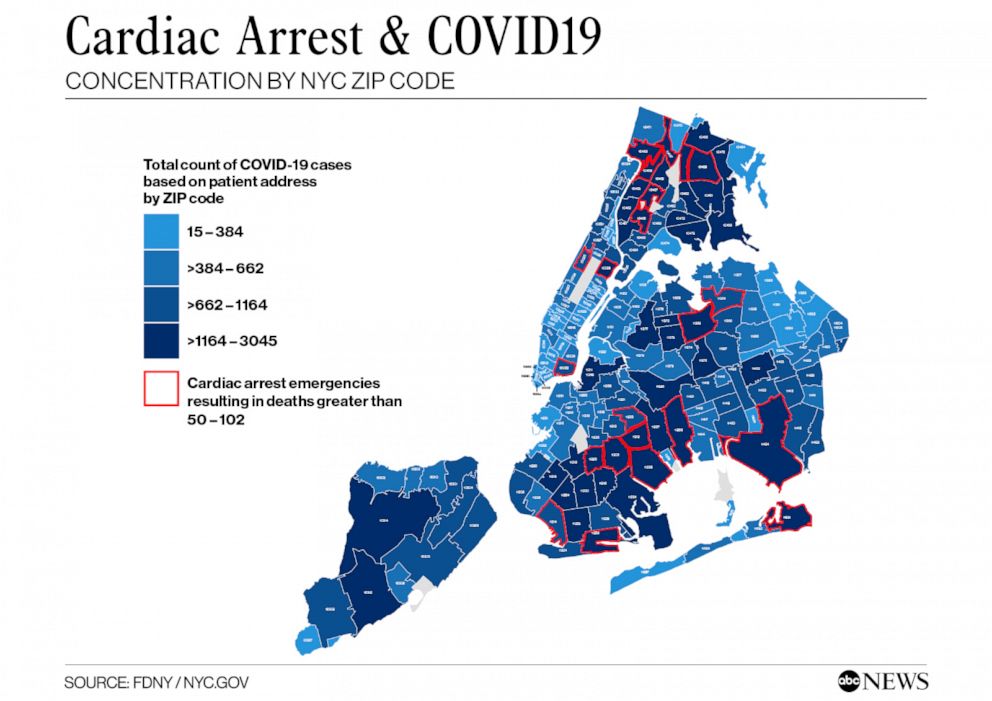
New data on cardiac arrest emergency calls reviewed by ABC News suggests that New York City’s catastrophic outbreak likely began in close-knit neighborhoods in Queens and Brooklyn as far back as mid-February.
MORE: In the 'epicenter of the epicenter,' were early heart attacks a missed coronavirus warning?


Cardiac Arrest and COVID19 Concentration by NYC Zip CodeCardiac Arrest and COVID19 Concentration by NYC Zip CodeABC News Illustration / FDNY / NYC.gov

Finally, as the cardiac arrest data suggested, scientists are contending with an ever-evolving understanding of how COVID-19 attacks the body. Initially, it was believed to primarily attack the lungs, but new research suggests it’s a danger to nearly every organ.

Experts say that many people like Dowd, who died of a nonrespiratory COVID-19 complication early in the outbreak -- before the pandemic’s impact became apparent -- may never be accurately counted.

The confusion and complications inherent in tracking pandemics have left a weary nation wondering just how high the actual U.S. death count may be -- and how bad things really are.

Less than 2% of all Americans have been tested for the coronavirus to date, according to White House figures -- nearly 5.5 million people. It's a figure that experts say is both higher than most nations and far lower per capita than where the U.S. should be at this point.

U.S. Assistant Secretary for Health and White House "testing czar" Admiral Brett Giroir told George Stephanopoulos on "Good Morning America" on Tuesday that the Trump administration doesn’t concur with a Harvard University study which concluded last week that the U.S. needs to be testing 5 million people a day in June and up to 20 million by July in order to safely re-open the country.

"We don’t believe those estimates are accurate, nor are they reasonable, " Giroir said.

Yet either way, that testing is still mostly focused on the living. Experts told ABC News that an accurate death toll is not only important to later get a better picture of what happened, but if possible, real-time or near real-time death counts can also help public health officials in their battle to contain the virus now.

History: A chilling guide

Researchers retrospectively calculate overall deaths from a pandemic by studying excess deaths year-to-year in a given region. But that’s a difficult figure to gauge until a pandemic is over.

Previous studies of other recent virus outbreaks suggest the actual number of COVID-19 deaths to date is very likely dramatically higher than the more than 60,000 deaths currently reported.

A Centers for Disease Control and Prevention (CDC) analysis of the H1N1 swine flu virus outbreak in the U.S. in 2009 and 2010 concluded two years later that the actual tally was likely 15 times higher than the officially recorded figures. A 2013 study by the U.S. National Institutes of Health determined the figure was seven times higher than the official count.

But scientists said that the current coronavirus pandemic is of an entirely different magnitude.

"I’ve never – none of us have ever – seen an infection like COVID-19, that literally stopped the world," said Williamson.

While most news organizations rely on the Johns Hopkins University figures, which are pulled directly from state and local government websites and are considered more timely picture of the problem, the National Center for Health Statistics, a branch of the CDC, is the primary agency responsible for U.S. health statistics, which are compiled by collecting data on births, deaths and health surveys.

Due to the lack of a uniform U.S. system, the NCHS system lags about two weeks behind in reporting said, Dr. Robert Anderson, chief of mortality statistics.

Daniel Weinberger, an epidemiologist from the Yale School of Public Health, analyzed NCHS death count data to estimate how many COVID-19 deaths may have gone uncounted during the five-week period from March 1 to April 3.

He concluded the official death toll in the U.S. is "probably a substantial underestimate of the true number by tens of thousands."


The actual figure, he said, may be "in the ballpark of double the reported cases."

Given the still-looming threat to the U.S., researchers are urging municipalities to maintain as much detailed data about COVID-19 records as possible.

With patchwork of reporting protocols, a 'pipe dream' to gauge actual death toll

As the pandemic rages across all 50 states and around the globe with no uniform reporting protocol in place, experts said the official death count is hard to even estimate.

"One of the difficulties is that every state does things differently," said William Hanage, an epidemiologist at Harvard University’s T.H. Chan School of Public Health. "When I look at the data, I’m sitting there thinking, ‘Okay, this is Oklahoma. What kind of modifier am I adding to that to figure out what’s going on here?’ It would be incredibly helpful not to have to do that."

He’s doubtful that a uniform national death count reporting process is possible anytime soon.

"It’s a bit of pipe dream," he said.


And that's before taking into account the ways other countries count their own death tolls.

"Even now if you’re comparing reporting among different countries, you’ve got to ask, ‘Are they reporting only deaths in hospitals? Only people they are sure had COVID? Which test did they use? What about deaths occurring elsewhere – in nursing homes and at home? Are they being counted?’"

COVID-19-related deaths in non-hospital settings -- largely nursing home deaths and deaths at home -- are also fueling revised death counts in some U.S. regions and nations around the world.

As many as half of the COVID-19 deaths in Europe may have come from nursing homes, Hans Kluge, the WHO's regional European director, said in a press briefing last week. When France added nursing homes to its tally, the nation’s death count spiked 40%, according to The Wall Street Journal.

While the U.S. is not currently counting nursing home deaths nationally, it’s estimated that thousands have died from or with COVID-19 complications in these facilities across the U.S. Last week ABC News reported that based on the reporting of 28 states, the death toll in long-term care facilities has already surged past 10,000.

Yet it was also only last week that the CDC began the laborious process of preparing to incorporate nursing home deaths into its overall death count. The agency issued a notification saying it would soon begin requiring that nursing homes report communicable disease deaths promptly to federal authorities. It’s unclear when the U.S. will begin including those figures in its national death count.

On April 14, the CDC directed all U.S. states and territories to begin counting suspected as well as lab-confirmed COVID-19 deaths.

Officials in some states have said they’ll adhere to the new CDC guidelines, but "each state has their own laws, which sometimes takes time," said Janet Hamilton, executive director Council of State and Territorial Epidemiologists (CSTE).

In mid-April, New York City released its first death count to include suspected -- not just lab-confirmed -- cases. That metric accounted for at-home deaths. The revised city figures, which added 3,700 deaths, drove up the nationwide death count by 17%.

Last week, scientists at Yale School of Public Health published a scholarly paper, which has yet to be peer-reviewed, that estimated that the actual death count in New York and New Jersey could be up to three times higher than the official tally of confirmed COVID-19 deaths or deaths that would be expected normally this time of year with respiratory diseases.

"Some states, such as Florida and Pennsylvania, might have missed deaths early on and might be under-counting deaths by a substantial degree currently," the Yale scientists concluded. "Other states, like Washington, have an accurate estimate of the mortality burden of the pandemic virus due to intense testing," the paper said. "And in states that have been hit hard by the pandemic virus, such as New Jersey and New York, the total excess mortality burden is 2-3 times that ascribed to COVID-19 in official statistics."

’The golden question’

Many U.S. states remain too overwhelmed by the outbreak or too short on supplies to perform postmortem COVID-19 testing.

Yet experts say localities’ inclusions of suspected cases in their death counts is vital going forward.

"It is critical to include both the probable and the confirmed cases so we have the full picture of the impact," said Hamilton, of CSTE. Failure to do so, she said, "would be a failure of our public health system."

Even those areas that can include probable and suspected COVID-19 deaths face challenges due to how little we yet understand about the disease, and how long the dead may carry it.

"Post-mortem, we don't know how long the [COVID-19 diagnostic] test is valid for after death," said CAP’s Williamson. "If a person is not found in their house for five days, does the COVID-19 test still work? We don't really know the answer to that."

There are two main types of death investigations in the U.S.: medical examiner autopsies and hospital-based autopsies.


rganizes bodies in the Gerard Neufeld funeral home in Queens on April 22, 2020, in New York.


Medical examiners are the most rigorously trained forensic pathologists in the death investigation field -- but even they do not have uniform national reporting protocols for COVID-19 deaths.

The CDC first introduced a common code to list COVID-19 as a cause of death on U.S. death certificates on March 24, followed by formal guidance on April 3, but the guidance will take time to take root nationwide, experts said.

Beyond a shortage of testing that is forcing hospital officials to prioritize testing of live patients over the deceased, many hospital pathologists remain wary of conducting autopsies during the pandemic because of all that is still unknown about the coronavirus, according to ABC News interviews around the nation.

Even swabbing the nose of a corpse could potentially re-introduce the virus into the air surrounding the body, pathologists said -- urging their colleagues to only conduct such testing in the proper settings.

One pathologist who spoke with ABC News on the condition of anonymity said a recurring theme online among prominent U.S. academic pathologists is that due to a limited, evolving understanding of how the virus spreads, shortages of personal protective equipment and limited autopsy rooms with appropriate precautions in hospitals, many pathologists "are scared to do the autopsies" for fear of being infected.

Yet postmortem samples and tissue can be preserved until more testing is available.

"You can freeze the nasal pharyngeal swabs and test them later," Aiken said. "And medical examiners and coroner's draw blood for toxicology. Eventually that blood could be used for antibody testing. So even though the lab tests are limited now, in the long run, they may be able to determine if deaths are COVID-19 related."

The final factor that undermines a complete COVID-19 death count, according to experts, is that many if not most of the people who have died had at least one additional underlying chronic medical condition that contributed to the deaths – particularly obesity, diabetes and hypertension.

But which factor actually caused the death?

"That’s the golden question: who died with COVID-19, and who died of COVID-19," Williamson concluded. "That’s what we still don’t know."


Funeral Directors Association Warns U.S. COVID-19 Deaths Are Underreported


https://www.democracynow.org/2020/4/23/headlines/funeral_directors_association_warns_us_covid_19_deaths_are_underreported


In New Jersey, the director of the State Funeral Directors Association believes COVID-19 has claimed far more lives than officially reported, after the Centers for Disease Control and Prevention on April 15 ordered changes in how likely deaths due to the disease are reported. 

In Britain, a review by the Financial Times found U.K. coronavirus deaths are likely more than double the official figure — with 41,000 deaths so far likely caused by the virus.


To know the real number of coronavirus cases in the US, China, or Italy, researchers say multiply by 10


https://www.businessinsider.com/real-number-of-coronavirus-cases-underreported-us-china-italy-2020-4


The world may never know the full extent of the coronavirus pandemic.

Researchers agree that the true number of COVID-19 cases is much larger than official global tally — particularly in nations with severe outbreaks like China, Italy, and the US.

In these countries, limited testing capacity and the difficulty of finding and identifying asymptomatic cases has likely caused many patients to go undiagnosed. COVID-19 tests can also produce false negatives if they aren't administered properly or if a patient isn't shedding enough virus to be detected in a sample.

Some public-health experts have suggested that the actual case totals in China, Italy, and the US could be at least 10 times higher than the current figures.

"Really nobody knows," Elizabeth Halloran, a biostatistician at Fred Hutchinson Cancer Research Center and University of Washington, told Business Insider. "A lot of people have been missed."
National outbreaks could be much larger than data suggests

Halloran said the actual number of US cases could be anywhere from 5 to 20 times the current number, based on recent models. But any model, she added, should be taken with a grain of salt.

Many coronavirus models are based on back calculations that try to determine how many people were infected several weeks ago. Researchers then extrapolate these findings to estimate the present number of cases.

So far, these methods have indicated that China, Italy, and the US are all underreporting cases by a similar order of magnitude.
Neil Ferguson, a professor of epidemiology at Imperial College London, estimated in February that China had only detected around 10% or less of its coronavirus cases.

Similarly, the head of Italy's Civil Protection Agency told the newspaper La Repubblica in March that it was "credible" to assume a ratio of one confirmed case for every 10 infections in Italy.

Trevor Bedford, an epidemiologist at Fred Hutchinson, estimated last weekend that the US was confirming between one in 10 and one in 20 infections. That would put the actual case count at around 5 million to 10 million.

A March study in the journal Science suggested that the US outbreak was five to 10 times larger than the reported number.

"A lot of the models take different methods and converge on the same results," Halloran said, though she added that "there is a lot of uncertainty."
Identifying asymptomatic patients would raise the case count

One of the biggest hurdles to getting accurate coronavirus case counts is the fact that infected people can be asymptomatic.

"We don't know how many asymptomatic infections there are," Halloran said. "Those people, we suspect, are a source of a lot of the transmission in the population."
Anthony Fauci, director of the National Institute of Allergy and Infectious Disease, recently estimated that between 25% and 50% of people infected with the coronavirus may never show symptoms but can still be contagious.

Some estimates are even higher. A study of 3,000 people in Vo'Euganeo, a village in northern Italy, found that between 50% and 75% of coronavirus patients there were asymptomatic. In a letter to Italian authorities in Tuscany, Sergio Romagnani, a professor of clinical immunology at the University of Florence, said that asymptomatic patients represent a "formidable source of contagion."

A February report from the World Health Organization found that asymptomatic cases were "relatively rare" in China, but the country's National Health Commission later determined that 78% of new infections reported on April 1 were asymptomatic. This suggests patterns from China's early data may not be reliable or widely applicable.
Testing errors and limited testing capacity obscure the reality of the pandemic

The more tests get administered, the more countries are likely to identify cases. But many nations are still struggling to provide enough tests for prospective patients. Even in Italy, which has one-fifth the population of the US and 23 times fewer people than China, tests aren't accessible to all residents.

Though Italy initially offered widespread testing, including tests for patients without any symptoms, the nation's current policy is to only test people with severe symptoms.

At the height of China's outbreak, the country also reserved tests for people who were sick enough to show up at a hospital. Since tests were initially in short supply and took days to process, Chinese doctors briefly resorted to diagnosing patients in the Hubei province via CT scans. Colin Furness, an infection control epidemiologist at the University of Toronto, told ProPublica that medics in China also started diagnosing patients based on symptoms alone.

In New York City, the epicenter of the US outbreak, hospitals are still limiting testing to patients with severe illnesses. States with major outbreaks like California and Washington have also reported a backlog in test processing and shortages of materials like swabs.
What's more, tests can be faulty. A study of more than 1,000 hospital patients in Wuhan, China, found that 75% of people whose tests came back negative likely had COVID-19 based on their CT scans.

"There are a lot of things that impact whether or not the test actually picks up the virus," Priya Sampathkumar, an infectious-diseases specialist at the Mayo Clinic, told AFP. "It depends on how much virus the person is shedding (through sneezing, coughing and other bodily functions), how the test was collected, and whether it was done appropriately by someone used to collecting these swabs, and then how long it sat in transport."

Together, these limitations contribute to a vast underreporting of cases.

Tests for current patients "need to be faster and cheaper and more reliable and available in much greater quantities," Halloran said.
Blood tests could identify more cases, but some deaths will never be counted

Public-health experts are still debating the death toll of the 1918 Spanish flu more than a century later. Some estimate that around 20 million people perished, while others believe the death count reached 100 million.

Halloran said the current pandemic will be easier to understand, since researchers will eventually be able to use a blood test to determine whether people have developed antibodies to the virus.

"We'll have to piece it together with serology afterwards," she said. "There could be a lot more people infected than we thought."
But antibody testing would have to be rolled out on a giant scale to give researchers a firm understanding of the scope of the pandemic.

"You could go around and test people that are going back to work or go out in the neighborhood or look at healthcare workers — how many of them actually had the infection and never knew it," Halloran said. "That's what we need to do to understand how widely people have been infected."

Even then, she added, there will always be some cases that are never identified.

Between March 4 and April 4, New York City reported more than twice the typical number of monthly deaths, according to the New York Times. Of the 5,330 excess deaths recorded during that month, only 3,350 were confirmed coronavirus deaths.

"We won't ever know if those 2,000 deaths were coronavirus deaths or from something else," Halloran said. "It's a single city in a single month where they probably have a two-week delay in reporting deaths. Probably the number is much greater."


U.S. CORONAVIRUS DEATH TOLL MAY ONLY BE 'TIP OF THE ICEBERG,' SAYS CDC ADVISORY COUNCIL MEMBER


BY SOO KIM


ON 4/16/20 AT 1:00 PM EDT


https://www.newsweek.com/us-coronavirus-death-toll-may-only-tip-iceberg-says-cdc-advisory-council-member-1498352


As the COVID-19 pandemic continues across the U.S., obtaining an accurate tally of cases and deaths has become a growing challenge.

Death counts may be underestimated due to several factors. Staff shortages and bureaucratic red tape around accessing death records in certain states have also reportedly added to the issue, causing delays in reporting the latest state figures to the U.S. Centers for Disease Control and Prevention (CDC).

But many potentially infected people have been dying at home. These deaths are currently unaccounted for because of a lack of testing before they died.

Several metropolitan areas of states with some of the highest death tolls in the country have reportedly seen a spike in fatalities at home that may have been from COVID-19.

Speaking to Newsweek, Mark Hayward, an expert on mortality statistics who is a member of a CDC advisory council on vital statistics, said: "The biggest challenge in obtaining an accurate tally of COVID-19 deaths is to [be able to] implement widespread testing. Locales that lack testing and where populations are rural, reside in nursing homes, or people live alone are likely to be major contributors to the undercount; note that these are not mutually exclusive categories."


He added: "There are also varying standards (and timing of rollouts) of testing by state. Cause-of death classification schemes have also been evolving and it's not always straightforward in assigning COVID-19 as a cause of death. I think the biggest barrier, though, is the lack of testing."

As of Thursday, nearly 3,263,000 people in the U.S. have been tested for the virus. This is less than 1 percent of the total population.

So the current reported U.S. death toll may only be "the tip of the iceberg," Hayward told ProPublica.

But just how underreported are the death counts across the U.S.? Hayward told Newsweek: "I do not have an actual figure of underreporting and this will vary over time as testing becomes more widespread. The degree of under-reporting will vary across localities in the U.S. and over time. The geographic and temporal variability are tightly linked because of the geographic differences in testing."

He added: "It's also hard to use other countries as standards to gauge underreporting, given differences in vital registration systems."

Getting an accurate account of deaths is vital for mitigation purposes, especially for identifying any potential hotspots and sending resources to those areas before there is an explosion of cases and deaths. That's according to the chief of the CDC's mortality statistics branch, Robert Anderson.


"One of the reasons we count deaths is to allocate resources to where they need to go. It becomes a little more time-sensitive when you're dealing with something like a pandemic," Anderson told ProPublica.

New York City, the country's most populous city with nearly 8.4 million residents, reported around 200 people a day were dying at home, a spokesperson for the medical examiner's office, Aja Worthy-Davis, told Gothamist last week.

An untold number of deaths were said to have been unconfirmed and the medical examiner's office does not test dead bodies for the virus.

A spokesperson for the city's health department, Michael Lanza, told Gothamist that the city only includes confirmed novel coronavirus deaths in official figures. "Every person with a lab-confirmed COVID-19 diagnosis is counted in the number of fatalities," he said.

"While undiagnosed cases that result in at-home deaths are connected to a public health pandemic...not all suspected COVID-19 deaths are brought in for examination by OCME [Office of Chief Medical Examiner], nor do we provide testing in most of these natural at-home deaths."
Nearly 2,192 deaths at home (equating to about 130 deaths a day) were also recorded by the Fire Department of the City of New York between March 20 and April 5.

The figure was reported to be a nearly 400 percent increase from the same period last year, when the department received 453 calls for cardiac arrest patients who died.

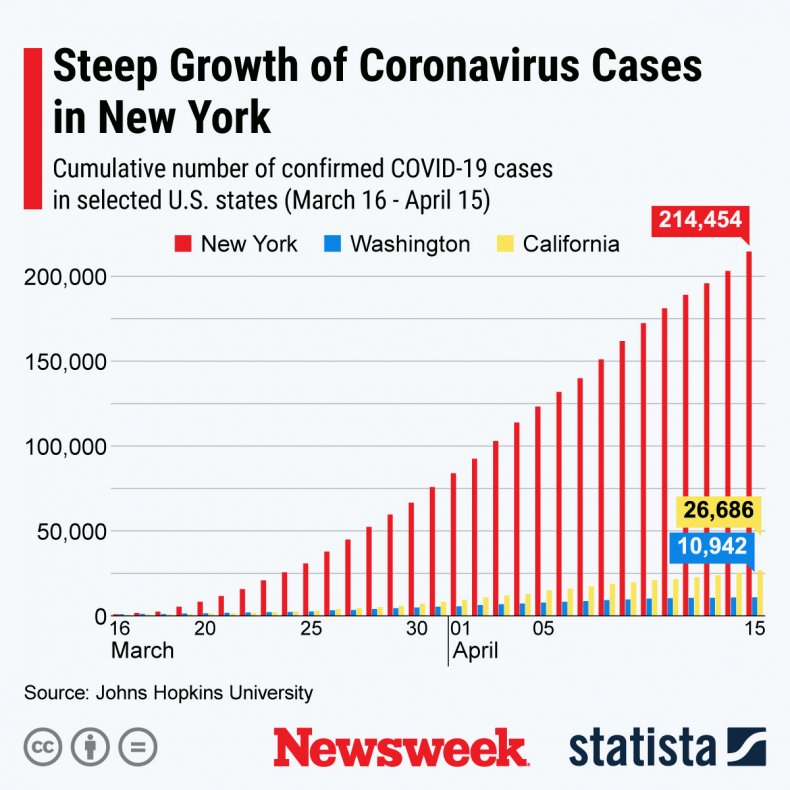
The graphic below, provided by Statista, shows the number of confirmed COVID-19 cases, the disease caused by the new strain of coronavirus, in a selection of states.
A chart provided by Statista shows the cumulative number of confirmed COVID-19 cases in New York, Washington and California from March 16 through April 15. STATISTA

Health officials in Massachusetts were said to have reported around 317 at-home deaths in March. The figure is reportedly a 20 percent increase from the same period over the past three years.

Officials in Detroit reported 150 "dead person observed" calls were received from April 1 to April 10. The number was said to be at nearly 40 during the same period for the past three years, according to city 911 call data.

It is hoped the quality of the figures will improve with further expansion of testing across the country. Hayward told Newsweek: "The CDC is responding to the need to accurately count COVID-19 deaths."

New Coronavirus Test Could Produce Results Six Times Faster Than CDC's
READ MORE

The CDC recently issued new guidelines for counting cases and deaths, which have been in effect from April 14.

"As of April 14, 2020, CDC case counts and death counts include both confirmed and probable cases and deaths," the CDC states on its website.

"State and local public health departments are now testing and publicly reporting their cases. In the event of a discrepancy between CDC cases and cases reported by state and local public health officials, data reported by states should be considered the most up to date," it adds.

Hayward noted: "The new guidelines in essence help identify probable COVID-19 deaths in the absence of testing – which is important."

The COVID-19 virus, which was first reported in Wuhan, China, has infected more than two million people across at least 185 countries and regions. Over 139,400 have died, while nearly 528,300 have recovered from infection, according to the latest figures from Johns Hopkins University.

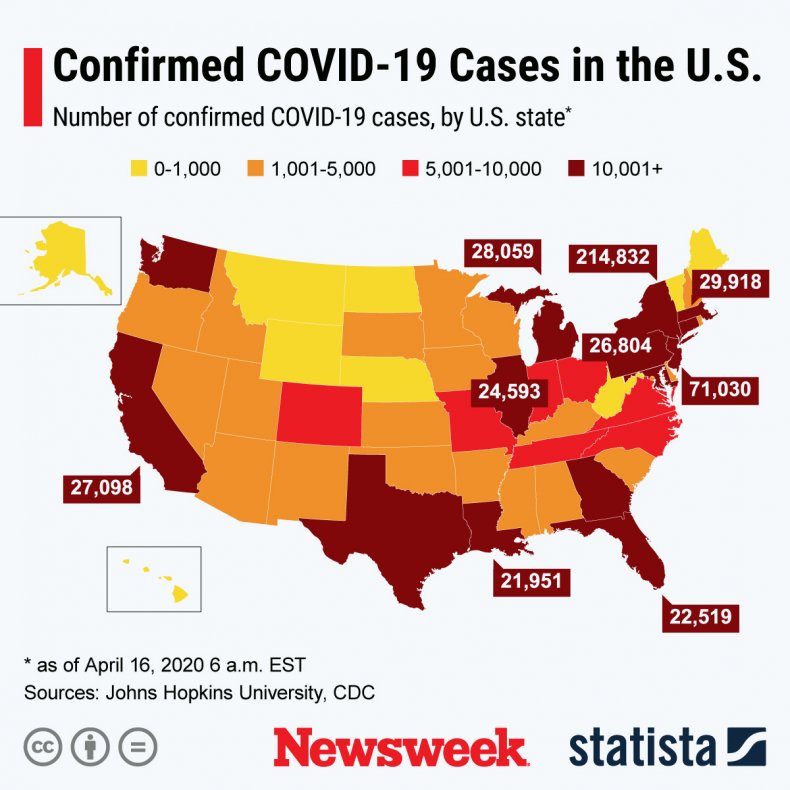
The graphic below, provided by Statista, illustrates the spread of COVID-19 across the U.S.


Failure to count COVID-19 nursing home deaths could dramatically skew US numbers


Thomas Perls


April 27, 2020 8.11am EDT


https://theconversation.com/failure-to-count-covid-19-nursing-home-deaths-could-dramatically-skew-us-numbers-137212


In New York state, 19 nursing homes have each reported 20 or more deaths from COVID-19. A nursing home in New Jersey reported 70 deaths out of its 500 residents. In the words of New York Gov. Andrew Cuomo, these homes have become a “feeding frenzy” for the virus and “the single biggest fear.”

With the clustering of people who are frail and have multiple other illnesses like heart disease, stroke, chronic lung disease and diabetes, the risk of severe illness and death from COVID-19 is much higher in nursing homes.

Yet, the United States does not know how many people are dying from COVID-19 in part because the government is only just now requiring nursing homes to start reporting numbers of presumed and confirmed cases and deaths to the federal Centers for Disease Control and Prevention.

The missing cases could dramatically skew the national death count. When France started reporting death data from some of its nursing homes, the daily COVID-19 fatality numbers almost doubled.

The Associated Press conducted its own survey in the U.S. and found there had been nearly 11,000 COVID-related nursing home deaths across the country as of April 24. However, just 23 states have been publicly reporting nursing home deaths. States also vary in how and where they are performing tests, and some count only proven cases and not also presumptive ones, leading to significant underestimates of the death toll.

As a geriatrician at Boston Medical Center and researcher at Boston University School of Medicine, I have watched in dismay as COVID-19 has become a deadly flash flood among the very old people I care for and study. I would not be surprised if the deaths in nursing homes at least double the U.S. COVID-19 death count.
In Massachusetts, 77% of nursing homes affected

Hints of what nursing homes and their residents and staff are going through have emerged from the states that have started publicly sharing data about them.

With Massachusetts Gov. Charlie Baker leading the charge, the Massachusetts Department of Public Health is providing a daily update on nursing homes where residents or staff have either tested positive or are presumed to be infected with COVID-19.

As of April 25, about 77% of Massachusetts nursing homes – 299 of 389 – had at least one case of COVID-19. That percentage will no doubt climb as the state carries out its mandated testing at nursing homes. About one-third of Massachusetts nursing homes reported more than 30 COVID-19 cases each among residents and staff.


Nursing homes are required to maintain infection prevention protocols to prevent the spread of infectious diseases into and within their facilities. But COVID-19, which is much more contagious than the flu, has punched holes in even the most careful and diligent facilities. Some nursing homes have also been in trouble for past problems with infection control.

It was initially estimated that on average, a person infected with COVID-19 led to an additional 2.5 people becoming infected. This basic reproductive number is called R0. A Los Alamos National Laboratory study released April 7 indicates that this earlier estimate is woefully low and that the R0 is more like 5.7. For comparison, the R0 for flu is around 2.

Among nursing home residents, the reproductive number is likely even higher than the average of 5.7. Many of the brave and caring staff in these nursing homes become infected, likely because of the intensity of this higher R0 and their exposure time with residents. By one report, nearly half of surveyed nursing homes reported staff staying home and not working because they had signs of or were proven to have COVID-19. The exposure to COVID-19 underscores how critical it is for nursing homes to get the adequate supplies of personal protective equipment they have been crying out for.

I believe it is likely that the majority of nursing homes throughout the U.S. and beyond have or will soon have multiple residents and staff who are COVID-19 positive. One large nursing home operator in Britain estimates that two-thirds of its homes have outbreaks.
We haven’t heard about most deaths yet

By the Centers for Disease Control and Prevention’s latest estimate, the U.S. has about 15,600 nursing homes with some 1.3 million residents. One quarter of those residents, about 425,000, are over the age of 80. In Massachusetts, the average age of death in confirmed COVID-19 cases is 82.

As of April 26, 56% of Massachusetts’ COVID-19 deaths occurred in nursing homes. The World Health Organization similarly estimates that half of COVID-19 deaths in Europe and the Baltics are among their 4.1 million nursing home residents. A minimum of 50% of the COVID-19 deaths occurring in nursing homes also agrees with the Kaiser Family Foundation’s review of data from the 23 states that are publicly reporting nursing home deaths.

The limited scope of counting people who have died from COVID-19 is not just a U.S. problem. A representative of British nursing homes, Care England, says that 7,500 people in nursing homes there have died due to COVID-19 – five times the U.K. government’s estimate of 1,600.

One indication of the high death toll from nursing homes comes from Belgium. The country has the highest per capita rate of COVID-19 deaths in the world – 57 per 100,000 people – primarily because officials there include nursing homes’ COVID-19 deaths in the national count and they are including both presumed and proven cases. Like Massachusetts, more than half of COVID-19 deaths in Belgium occur outside of hospitals.

The current U.S. rate, according to Johns Hopkins University, is 16 per 100,000, but its reports are only as reliable as its data sources, which include the CDC and state departments of health. This rate is likely lower than Belgium and 11 other countries because of the great variation across the U.S. in which data are not included, such as people who die outside of hospitals, and the data missing due to limited testing.

On April 19, the Centers for Medicare Services announced it would begin requiring U.S. nursing homes to report all confirmed or presumed COVID-19 cases to the CDC. I hope this will include past cases and deaths.

To get an accurate count, veterans’ homes, assisted living centers, group homes and other senior housing facilities must be required to report their past and current COVID-19 cases and deaths, as well.

There is plenty we still do not know about for why nursing home residents have borne the brunt of this pandemic. As Gov. Baker has indicated, “This is a topic that will get a lot of appropriate analysis after the fact.”


CONGRESS QUIETLY BOOSTS SPENDING ON LAWMAKERS’ EXCLUSIVE CONCIERGE HEALTH CLINIC


Lee Fang


https://theintercept.com/2020/04/29/coronavirus-congress-health-clinic/


IN MID-MARCH, Rep. Mario Diaz-Balart, R-Fla., became one of the first lawmakers to announce he had Covid-19, after testing positive for the disease caused by the novel coronavirus.

He received his diagnosis promptly from congressional doctors employed by the Office of the Attending Physician, and recovered by early April. Coronavirus testing was made available early and often for members of Congress, who enjoy concierge medical services courtesy of a world-class government health clinic.

Diaz-Balart, like many other voices on Capitol Hill, has denounced increased public spending on health services as a dangerous “government takeover of healthcare.” But like every lawmaker, he enjoys gold-plated medical care from OAP, which provides on-call services at taxpayer expense — and recently got a boost in funding.


Just months before the pandemic, lawmakers hiked funding for the OAP clinic, a move that has not been previously reported. The last congressional appropriations bill, passed in December, increased the budget for the office to $3,868,000 this year. Then, in March, the CARES Act, the sweeping $2.2 trillion bailout legislation, included a special provision that appropriated an additional $400,000 to the OAP clinic as part of a package of special funds to prepare the capital for coronavirus response and hygiene.

All together, the OAP budget has increased more than 25 percent over the last decade. The move to secure the health and safety of lawmakers contrasts sharply with the policy focus of Congress, which has largely faced a stalemate over the expansion of low-cost health care services over the last decade. In the first weeks of the pandemic, few had access to the same rapid Covid-19 testing that was made available to lawmakers through the clinic.

THE OAP has been described as “some of the country’s best and most efficient government-run health care.”

Lawmakers are only charged around $600 in annual fees, which covers a small fraction of the costs for OAP operations. The vast majority of the budget comes from money delegated by the federal government. Even the low flat rate isn’t necessarily required. Some lawmakers who have declined to pay the nominal fee are not turned away from the clinic, according to previous reports.

The clinic, managed by Dr. Brian Monahan, a rear admiral in the Navy, employs three doctors, a pharmacist, and over a dozen nurses and medical technicians. The clinic not only provides coronavirus testing, but routine flu vaccines, lab work, physicals, and a range of emergency treatments. Lawmakers have claimed that they use the OAP office as their primary care physician. It also also treats some medical emergencies among tourists.

Members of Congress also receive regular physical therapy care at the clinic. An on-site radiology suite provides X-rays. Specialty doctors from military hospitals routinely visit the OAP at no extra charge, while lawmakers are often referred for free outpatient care at the Walter Reed National Military Medical Center.


In recent weeks, the OAP has played a critical role in helping lawmakers respond to the rapid spread of coronavirus. Sen. Rand Paul, R-Ky., and other lawmakers who tested positive have consulted closely with doctors from the OAP on ways in which to quarantine themselves and recover.

The office has taken the lead on producing public health policies for congressional operations during the coronavirus pandemic. A recent congressional guidance issued by OAP advises the proper use of face masks in the capital and the use of the gallery space above the House of Representatives to facilitate social distancing.

The CARES Act also provided $12 million for the Capitol Police and an additional $25 million for capital construction crews to prepare sanitation supplies for the administration of congressional buildings.


Dale Fountain, the chair of Enact Universal Healthcare for California, a single payer advocacy group, said he was disappointed to learn about Congress moving to shore up its own taxpayer-funded health care.

“Speaker Pelosi has been adamant in her rejection of single payer for everyone,” said Fountain, noting that the omnibus spending bill in December repealed three tax provisions of the Affordable Care Act while boosting the OAP.

“It has been obvious for awhile that when it comes to her own healthcare and her own projects, ‘how will we pay for it?’ was never a concern,” he added.