Sunday, May 3, 2020

The coronavirus genome is like a shipping label that lets epidemiologists track where it’s been
https://theconversation.com/the-coronavirus-genome-is-like-a-shipping-label-that-lets-epidemiologists-track-where-its-been-136826
Following the coronavirus’s spread through the population – and anticipating its next move – is an important part of the public health response to the new disease, especially since containment is our only defense so far.
Just looking at an infected person doesn’t tell you where their version of the coronavirus came from, and SARS-CoV-2 doesn’t have a bar code you can scan to allow you to track its travel history. However, its genetic sequence is almost as good for providing some insight into where the virus has been.
An organism’s genome is its complete genetic instructions. You can think of a genome as a book, containing words made up of letters. Each “letter” in the genome is a molecule called a nucleotide – in shorthand, an A, G, C, T or U.
Mutations can occur every time the virus replicates its genome, so that over time mutations accumulate in the viral genome. For example, in place of the “word” CAT, the new virus has GAT. The virus carries these minor modifications as it moves from one person to the next host.
These mutations behave like a passport stamp. No matter where you go next, previous stamps in your passport still show where you’ve been.
Molecular geneticists like us can use this information to construct family trees for the coronavirus. That allows us to trace the routes the virus has traveled through space and time and start to answer questions like how quickly and easily does it spread from one person to another?
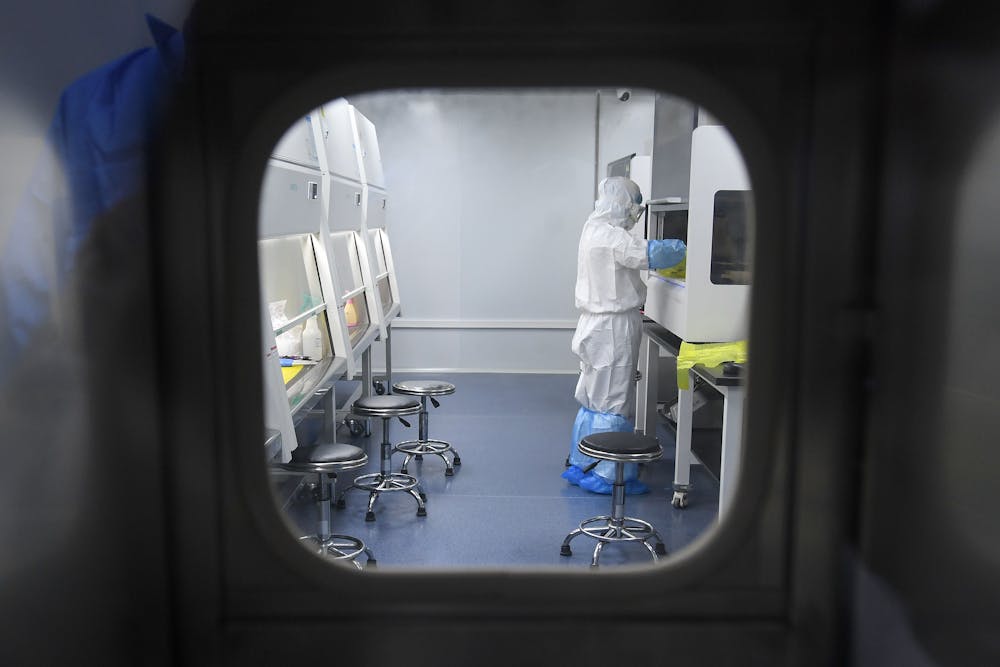 In early February, a laboratory technician works on virus samples from patients sick in Wuhan, China. STR/AFP via Getty Images
Individual patient data help paint a big picture
Online databases have been collecting SARS-CoV-2 genomic nucleotide sequences since mid-December. Whenever a patient tests positive for SARS-CoV-2, a lab can determine the genome sequence of the infecting virus and upload it. As of late April, more than 1,500 genome sequence samples have been deposited in GenBank, a publicly available database run by the National Institutes of Health, and more than 13,000 are in GISAID, the open-access Global Initiative on Sharing All Influenza Data.
Since each sequence is from a patient who is in a specific place in the world, these viral genome sequences allow scientists to compare them and track where the virus has been. The more similar the sequences from two particular viruses are, the more closely related they are and the more recently they’ve shared a common ancestor. The first SARS-CoV-2 genomic sequence uploaded to the GISAID’s website was collected from a patient in early December 2019.
Of course, the viral mutations themselves do not tell researchers which country they happened in. But since the databases record where particular patterns of mutations have been observed, scientists can determine the route that each viral strain has taken. The global map tracks the movement of the virus around the world.
The data recorded from thousands of patients show that SARS-Cov-2 originated in Wuhan China and spread from there to the rest of the world.
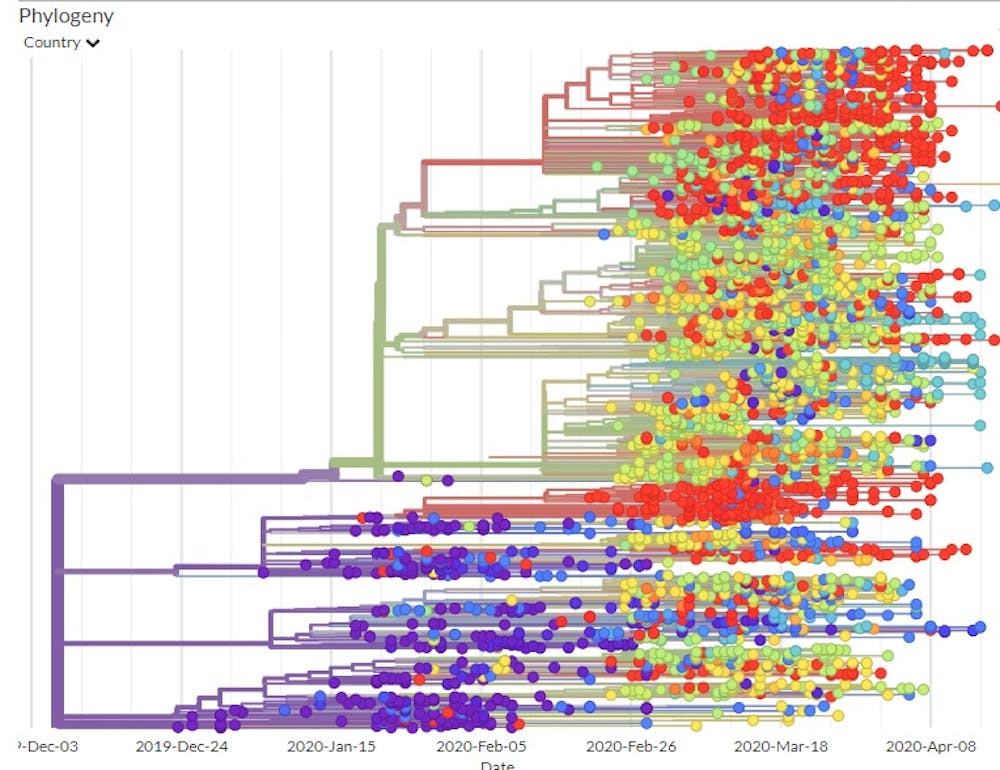 The SARS-CoV-2 phylogenetic tree – the family tree that connects all the sequenced coronavirus samples worldwide. The colors denote regional ‘branches’ of the tree. nextstrain.org, CC BY
Building maps out of sequences
The genetic data can play a big role in cracking public health mysteries, like how the coronavirus has spread through the United States.
For example, a traveler from Wuhan arrived in Seattle on Jan. 15 and tested positive for the virus on Jan. 20.
On Feb. 28, scientists sequenced a virus sample from an American patient in Seattle and found its mutation signature matched that of the virus from the Wuhan traveler, plus three new mutations. GISAID has estimated the mutation rate at about 0.45 mutations per genome per week – so three mutations between the Jan. 20 case and the Feb. 28 case fits that rate.
Based on the three new mutations, this version of the virus had been multiplying undetected for about five weeks in the Seattle area. Since each infected person can infect several other people without experiencing any symptoms themselves, the virus could have spread to more than 100 people in five weeks.
Using the genome sequences to link the virus from the Jan. 15 traveler from Wuhan with the Washington-based patient from the end of February alerted Washington state officials that the virus was silently spreading through the population. This undetected spreading of the virus in Seattle and elsewhere is one of the primary reasons public health officials are calling for the public to stay home as much as possible.
Another study detailed the path the virus took as it moved from Wuhan to Shanghai to Germany to Italy to Mexico, stowing away in infected travelers. This study tracked infected individuals and compared their viral genomic sequences. Since researchers could compare the viral mutations to those in known locations at specific times, they were able to map out the phylogenetic tree – the family tree that shows how the various virus genome sequences are related.
Using the GISAID estimated mutation rate and the phylogenetic tree, scientists think the first time the coronavirus infected a person likely occurred in Wuhan in November or early December 2019.
If the virus had been around much longer, the viruses of the first known patients would have had a larger variety of mutations than they did.
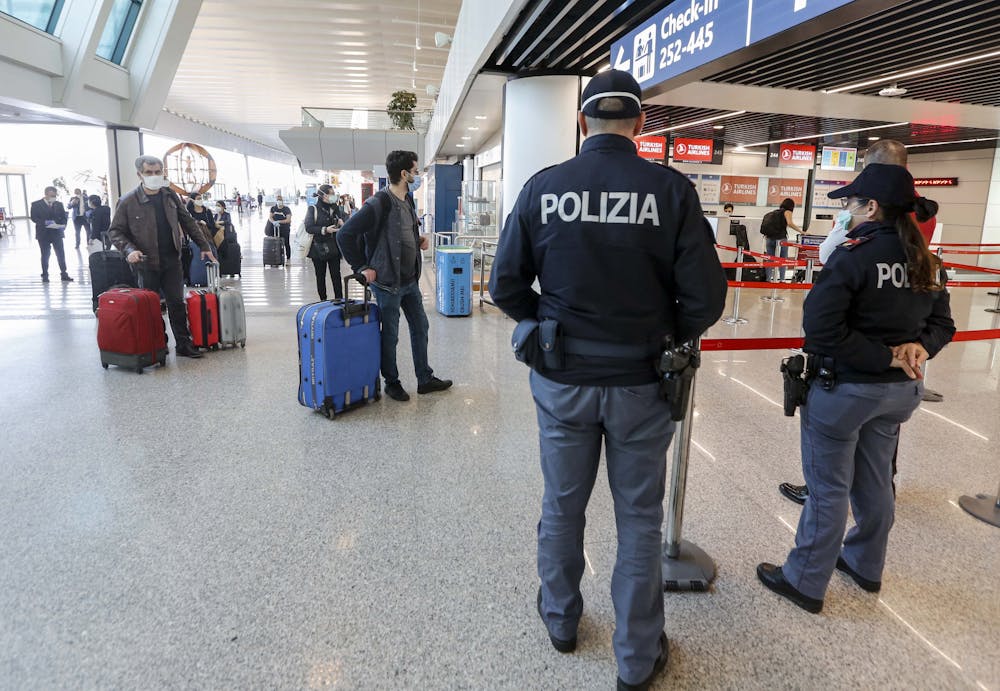 The coronavirus can travel the world by hitching a ride in an infected traveler. Anadolu Agency via Getty Images
Still tracking and learning from the sequences
The analysis of viral genomic sequences will continue to be a valuable tool for tracking and containing the spread of SARS-CoV-2.
For instance, sequencing the genome of a virus from a newly infected patient could tell you if it is a virus that has been circulating in the area for a while, or if it is a new introduction from elsewhere.
Someone who’d been in northern Italy before travel restrictions were in place brought the virus to Iceland. That initial outbreak was contained fairly quickly, but then new forms of the virus were introduced from elsewhere in Europe.
A new study pending peer-review indicates that California also had multiple introduction events with distinct viral lineages. For California, knowledge of the frequency of new introductions would be an important factor to consider as officials devise ways to contain the virus.
Viral genome sequences can be informative in other ways as well. Eventually, researchers may find that some forms of the virus are more virulent than others. In that case, the sequence of the viral genome could help physicians decide which treatment would be best for a particular patient.
Deaths and desperation mount in Ecuador, epicenter of coronavirus pandemic in Latin America
https://theconversation.com/deaths-and-desperation-mount-in-ecuador-epicenter-of-coronavirus-pandemic-in-latin-america-137015
Dead bodies are lying at home and in the streets of Guayaquil, Ecuador, a city so hard-hit by coronavirus that overfilled hospitals are turning away even very ill patients and funeral homes are unavailable for burial.
Data on deaths and infections is incomplete in Ecuador, as it is across the region. As of April 22, Ecuador – a country of 17 million people – had reported almost 11,000 cases, which on a per capita basis would put it behind only Panama in Latin America. But the true number is likely much higher.
The government of Guayas Province, where Guayaquil is located, says 6,700 residents died in the first half of April, as compared to 1,000 in a normal year. A New York Times analysis estimates Ecuador’s real coronavirus death toll may be 15 times the 503 deaths officially tallied by April 15.
In a pandemic that has largely hit wealthy countries first, Ecuador is one of the first developing countries to face such a dire outbreak.
Wealth is no guarantee of safety in an epidemic. Italy and the United States have both run short of necessary medical equipment like ventilators and dialysis machines. But experts agree poorer countries are likely to see death rates escalate quickly.
Our own academic research on Ecuadorean politics and human security in past pandemics suggests that coronavirus may create greater political and economic turmoil in a country that already struggles with instability.
Ecuador’s swift response
The coronavirus outbreak in Guayaquil, Ecuador’s largest city and economic engine, began in February, apparently with infected people returning from Spain.
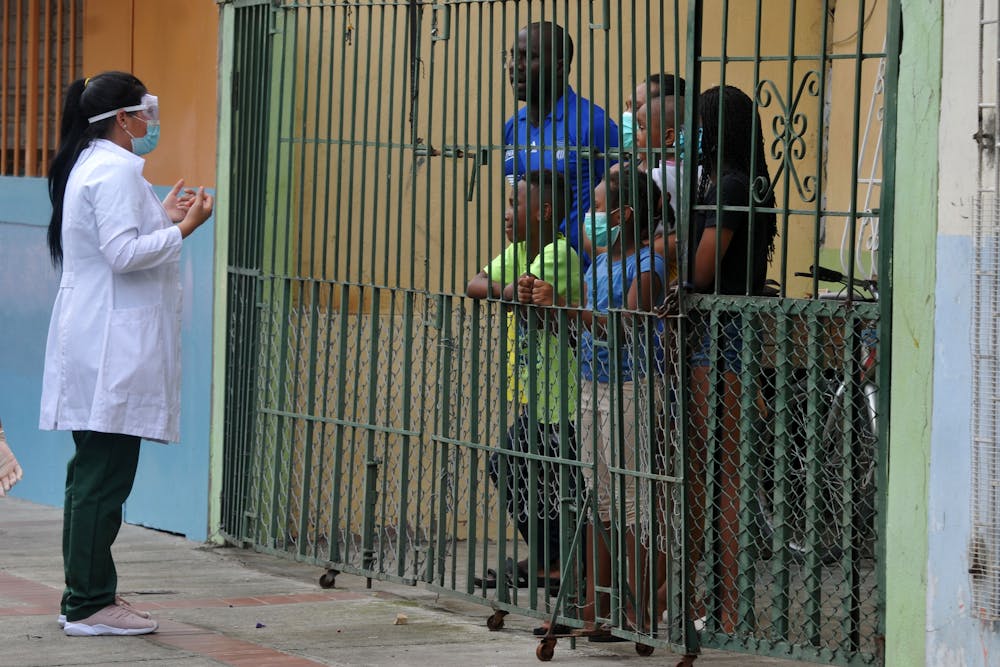 A doctor checking for COVID-19 symptoms in a family in Guayaquil, Ecuador, April 14, 2020. José Sanchez/AFP via Getty Images
Its rapid escalation prompted panicked officials to impose social isolation quickly as a containment strategy. Ecuador’s restrictions on movement are strict and getting stricter.
Ecuadorians may not leave their homes at all between the hours of 2 p.m. and 5 a.m. Outside of curfew, they may only go out to get food, for essential work or for health-related reasons, wearing masks and gloves. Public transport is canceled.
In Quito, Ecuador’s capital, people may only drive one day a week as determined by their license plate.
This is the second time in a year Quito residents have found themselves under lockdown. In October 2019, a nighttime curfew was established quell massive protests against austerity measures that were imposed in exchange for a large loan from the International Monetary Fund.
The protests, led by indigenous groups, dissipated after President Lenín Moreno backed away from austerity – but not before at least eight people were killed.
Latin America’s looming epidemic
Ecuador has been more proactive in responding to the epidemic than many neighboring countries.
In Brazil President Jair Bolsonaro has largely downplayed the severity of the coronavirus, despite thousands of new COVID-19 infections reported every day. In Venezuela the power struggle between the government of Nicolás Maduro and the opposition government of Juan Guaidó impedes any coordinated pandemic response.
Most Latin American leaders who have taken decisive action against coronavirus see stay-at-home orders as the only way to avoid collapse of their fragile, underfunded health systems.
Panama is limiting outings based on gender, allowing men and women to leave their homes three days each. Everyone stays home on Sundays.
El Salvador’s president sent soldiers to enforce a 48-hour full lockdown of the city of La Libertad that prohibited residents from leaving home for any reason – including to get food or medicine.
It’s unclear how such restrictions can persist in a region with considerable poverty and social inequality. Large numbers of Latin Americans live day-to-day on money they make from street trading and other informal work, which is now largely banned. Hunger threatens across the region.
 Colombians under mandatory quarantine hang red fabric out their windows to request food aid, Soacha, April 15, 2020. Leonardo Munoz/VIEWpress via Getty Images
Limits of Ecuador’s response
In Ecuador, where the average annual income is US$11,000, the Moreno government is giving emergency grants of $60 to families whose monthly income is less than $400. It has opened shelters to get homeless people off the streets and commandeered hotels to isolate the infected.
An active network of community organizations is also working to provide basic food and shelter to the needy, which includes most of the quarter million Venezuelan refugees who entered Ecuador in recent years.
Despite its active coronavirus response, Ecuador is unlikely to cope well if the epidemic spreads quickly from Guayaquil into the rest of the country.
Ecuador has a quarter as many ventilators per person as the United States. Testing for COVID-19 is scarce and has largely been outsourced to private corporations, making it prohibitively expensive.
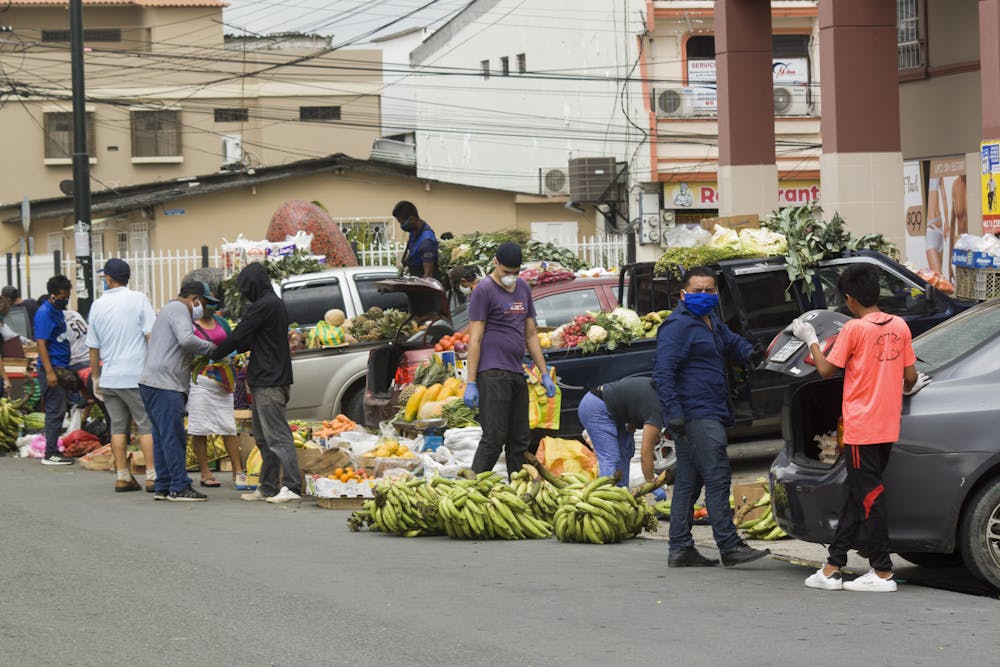 Street vendors in Guayaquil, Ecuador, April 17, 2020. Eduardo Maquilón/Agencia Press South/Getty Images
President Moreno’s expulsion of 400 Cuban doctors from Ecuador last year – part of his emphatic shift rightward for Ecuador – has left big holes in its already understaffed hospitals.
Ecuador’s economy is in crisis after the collapse in oil prices and tourism. And while last year’s deadly protests are over, politics – and political unrest – continue to polarize the nation.
On April 7 Ecuador’s highest court sentenced the popular but divisive leftist former President Rafael Correa to eight years in prison on corruption charges. Correa, who now lives in Belgium, says the charges are fabricated to ensure he cannot run for office again. His conviction increases political divisions during a crisis that calls for unity.
Ecuador’s death rate is starting to slow after more than a month of lockdown. But the specter of COVID-19 victims lying unburied at home, in hospital hallways, and on the streets, hangs as a specter across Latin America.
Guayaquil is a grim forecast of how this pandemic kills in the less wealthy world.
Don’t Believe the Debt Hawks—More Stimulus Is the Only Path to Recovery
Fear-mongering over the deficit is the absolute wrong approach to the Covid-19 crisis.
BY JOSH BIVENS
https://inthesetimes.com/article/22494/debt-deficit-stimulus-recovery-mcconnell-covid-19
As policymakers scramble to try to mitigate the economic fallout of the coronavirus shock, a predictable chorus has emerged worrying that these efforts will lead to damaging increases in the nation’s public debt. The Washington Post and New York Times have been among the outlets sounding alarms over the implications of increased government spending. And even Senate Majority Leader Mitch McConnell (R-Ky.) warned against further economic stimulus, saying: “given the extraordinary numbers that we’re racking up to the national debt … we need to be as cautious as we can be.”
Baseless fears about deficits and debt were a prime impediment to doing the smart things for spurring a fast recovery from the Great Recession following the 2008 crash, and the result was a recovery that was far weaker than it should have been.
Before we repeat the same mistake this time, we should remember two important things about federal budget deficits and public debt. First, taking on debt can be stupid or smart—it depends on context, and the debt to GDP ratio provides no such context. Second, the popular analogy between household budgets and the budget of the federal government is actively misleading.
Let’s talk first about the difference between smart and dumb additions to debt. For a household, borrowing to go gamble at the racetrack would be dumb. But borrowing to finance an education that provided you with a skill or credential to increase your lifetime earnings would be smart—even if it’s a shame we make students take on debt at all.
For the federal government, deciding to add $1.5 trillion to the debt to give corporations tax cuts back in 2017 was dumb. But in the current crisis, taking on debt to finance expansions to unemployment insurance and aid to state and local governments and investments in hospitals and testing is very smart.
So, the threshold question for deciding whether or not to add to debt should simply be: is this dumb or is it smart—does it solve a pressing social problem or not? Debt used to finance relief and recovery measures is smart.
The second thing to keep in mind is that rules that apply to households about debt don’t apply to the U.S. government. People often claim that because households reduce spending during tough times as a precautionary measure, the federal government should too. But this is a terrible analogy, because what might make sense for one household to do in the face of anxiety about the economy leads to a crisis if everybody does it. In fact, the federal government should take on more debt exactly when households are trying to take on less.
Recessions start and worsen when it’s not just one household deciding to pull back spending, but millions of households. This is because one person’s spending is another person’s income. If I decide to delay buying a new washing machine because I’m worried about the economy, this reduces the incomes of the people making and selling washing machines. If those people in turn now have to pull back their spending because I didn’t buy anything from them…you can see the vicious cycle that can start and make recessions so damaging.
As private households start pulling back spending, and as this sets off a chain reaction that worsens a recession, you need some entity in the economy to break the downward spiral by ramping up its spending as private households ramp theirs down. That’s the federal government.
Further, this spending ramp-up should be financed by debt, not higher taxes that might drag on private spending. Even better than financing with debt might be printing money—but the distinction between debt and money-printing is a lot less important than the distinction between either of those and taxes.
Don’t get me wrong, we should raise taxes substantially and in a progressive way over the long-run to build a fairer and better economy. But we don’t need to do that before properly responding to the crisis in front of us.
An effective response in the next round of stimulus should include $500 billion in aid to state and local governments, make additional investments in unemployment compensation, protect workers’ paychecks, include worker protections and invest in our democracy. Yes, these actions will increase the debt, but they’re also critical to ensuring a real and fair recovery.
Some would say that allowing the debt to GDP ratio to climb back to levels last seen in the 1940s is a radical thing to do. It’s not—it’s just smart economics. But allowing unemployment and suffering to climb back to levels last seen in the 1930s while doing none of things we now know could avert that would be truly radical.
Subscribe to:
Posts (Atom)