Sunday, May 3, 2020
Boris Johnson’s Coronavirus Lies Are Killing Britons
Sonia Faleiro
https://theintercept.com/2020/04/30/boris-johnsons-coronavirus-lies/
“THE NHS SAVED my life, no question,” Boris Johnson said earlier this month, publicly thanking Britain’s beloved National Health Service for successfully treating him for Covid-19 over a seven-day period in early April. “It’s hard to find words to express my debt,” the prime minister said, naming several nurses, and thanking two in particular for standing by his bedside for 48 hours when “things could’ve gone either way.”
Johnson’s speech, which he might have hoped would be lauded for its graciousness, served instead as a reminder that the NHS is a success despite him. When the first cases of Covid-19 in the U.K. were confirmed in late January, Johnson’s Conservative Party government claimed that it was prepared for any eventuality.
That turns out to have been a lie. The government’s failure to provide sufficient protective gear, which has so far contributed to the deaths of at least 114 health care workers in Britain, was preventable. Moreover, two separate investigations have now revealed high-level attempts to cover it up.
Earlier this week, the BBC’s Panorama showed that the British government’s pandemic stockpile lacked key equipment, such as gowns, visors, swabs, and body bags. The government was of course aware of this deficit and yet, even after the pandemic hit the country’s shores, U.K. leaders refused multiple opportunities to bulk-buy PPE. When the lack of supplies became obvious to the public, the government tried to hide the problem by inflating PPE numbers, counting one pair of gloves as two items of PPE.
Another investigation, by the Sunday Times, a decidedly right-leaning newspaper owned by Rupert Murdoch that has previously swooned over Johnson, calling him a “rockstar,” showed just how casually the prime minister confronted the pandemic. Johnson had skipped five high-level emergency meetings to discuss the virus, the newspaper reported. He insisted, in a manner reminiscent of U.S. President Donald Trump, that briefing reports be as short as possible. He went on holiday to a country estate, refused to work weekends, and attended a fundraising ball.
After his thank-you speech, Johnson retired to Chequers, the lavish 16th century, 1,500-acre manor house used by British prime ministers, where he was photographed strolling the grounds with his pregnant fiancée and their Jack Russell terrier. (The couple’s baby boy was born on Wednesday.) The world was in the grip of an unprecedented crisis, but the U.K. was without a leader.
Johnson’s NHS caregivers, meanwhile, returned to work immediately, and every day, reports stream in of front-line health workers like them who are forced to combat the highly contagious virus in clinical waste bags and plastic aprons. They are asking schools to donate science goggles. They are adapting snorkels as respirator masks. When UNISON, the U.K.’s largest public services union, opened a PPE alert hotline, it was flooded with calls from health care workers who talked about having to buy their own equipment.
Of the health care providers who have died so far, one, Abdul Mabud Chowdhury, a consultant urologist in London, had written a Facebook post appealing to Johnson to protect him and his co-workers. “I hope we are by default entitled to get this minimal support,” he wrote on March 18, five days before he was hospitalized.
Johnson is responsible for his death, and for the death of every other health care worker in the country.
THE FIRST SIGNS that Johnson was out of his depth emerged early on in the pandemic. While repeating that the government was “led by science,” the newly elected prime minister seemed to be pushing a dubious “herd immunity” strategy, hoping that exposure would build immunity among the British public, an outcome that, happily for Johnson, would require no action from his government. The meetings of the prime minister’s scientific advisory board, which strives to impartially inform the government’s response based on science, were attended by his chief adviser. The adviser is said to have actively participated, thereby undermining the neutrality of the process, and raising public concerns that decisions were made to suit political objectives rather than scientific ones.
While Johnson talked about science, his actions were those of a man convinced that he, and by extension, the country he led, possessed the magical ability to escape a disease that had brought much of the world, including neighbors like France, Spain, and Italy, to its knees.
In February, the European Centre for Disease Prevention and Control had warned that for the most serious cases of Covid-19, health workers would need around 20 sets of PPE per patient per day. The Johnson government was given as many as three opportunities to participate in an EU scheme to bulk-buy PPE. It chose not to. In fact, British officials shipped more than 200,000 units of PPE to China, then lied about choosing not to participate in the EU scheme, claiming they had “missed the emails” despite having attended meetings about the acquisition. In a TV interview, Johnson spoke of how one strategy for confronting the novel coronavirus could be to “take it on the chin.”
In early March, Johnson and his fiancée attended a rugby match. Later, he met with hospital patients, some of whom, he said, may have had Covid-19. He bragged about shaking their hands.
In March, South Korea, Taiwan, and even small Indian states like Kerala had showed how democratic societies, working doggedly, could use a dedicated World Health Organization-approved program of contact tracing, testing, and isolation to contain the virus. Some experts said that given how long it might take to develop a vaccine — as long as five years, perhaps — such a program was the only realistic way forward. New Zealand’s Jacinda Arden and Germany’s Angela Merkel also employed these tools early on; by acting quickly, they saved lives.
These countries’ successful actions were presented to Johnson on a platter. The U.K. had a head start over many others — as much as nine weeks, according to one expert, or the time between human to human virus transmission being confirmed in China and the U.K.’s first known case of local transmission on February 29. But busy with Britain’s departure from the EU on January 31, Johnson ignored every warning and squandered every opportunity to protect his country. Born and bred into the idea that he was exceptional, he endangered himself along with millions of Britons, many of whom imbibed his magical thinking.
On March 16, organizers of the four-day Cheltenham Festival, a horse racing event, cited Johnson’s presence at the rugby match earlier that month as the reason to go ahead with their event, noting that “the government guidance is for the business of the country to continue as usual.” The races attracted some 250,000 people over four days, many of whom have since tested positive for the virus. The hospitals in Gloucestershire, the county where Cheltenham is located, are now among the hardest-hit in the country.
The government also left borders open, allowing flights from Italy, China, and the U.S. without any quarantine restrictions until late this month, long after most other countries had begun to quarantine arrivals. On Johnson’s watch, the U.K. is a staggering example of what not to do.
The rising death toll in Britain, for which Johnson is personally responsible, makes it impossible to believe anything he says moving forward. To believe him could mean endangering your own life and the lives of your loved ones. In the absence of trustworthy leadership, people are being forced to make critical decisions alone. This daily struggle is taking place in the midst of another calamity — an economy that was already severely damaged as a result of Brexit is now crumbling due to the pandemic.
The UK economy will shrink by 6.8 per cent as a result of the coronavirus outbreak, and it will take three years to recover. Despite this, the U.K.’s chief Brexit negotiator has made it clear that he will not seek an extension on the December 31 deadline to reach a trade agreement with the EU. If no agreement is reached, the country will be forced to revert to World Trade Organization terms, making it liable for tariffs and border controls that will further strain the economy.
This is something Britain can ill afford. Just three weeks after the nationwide lockdown began on March 23, more than 1.5 million Britons were facing food insecurity, according to a study; this figure includes 53 percent of NHS workers. The study also said that 830,000 children could be going without the free school meals on which they relied because the government had failed to keep yet another promise — to feed children in need during the lockdown.
THE CURRENT CRISIS has been a decade in the making. Johnson and his Tory colleagues have spent years undermining the NHS, using the excuse of austerity measures to cut salaries and reduce benefits, when in reality they appear to have been trying to push the country toward a U.S.-style private health care system.
In 2011, five Tory members of parliament, three of whom are now ministers in Johnson’s government, published a pamphlet advocating for privatization. According to a Guardian investigation, private firms were given contracts worth £15 billion, about $18 billion, a jump of 89 percent since 2015. In the years that followed, Johnson’s predecessor, Theresa May, scrapped nursing grants, which help nurses with study and living costs, and rejected salary increases, voting to keep nurses’ salaries below the rate of inflation. Johnson, and virtually every other member of the Conservative Party, voted with May and cheered after the votes were announced. May explained the decision to a nurse’s face, saying in her typically bloodless way: “There isn’t a magic money tree we can shake.”
In 2016, the Tory-led Brexit referendum poisoned the atmosphere for EU citizens in the U.K. so much that more than 11,000 immigrant NHS workers, including 4,763 nurses, went back home. “It’s the National Health Service, not the International Health Service,” Matt Hancock, Johnson’s health minister, sneered on Twitter at the time. The outcome of Hancock’s shortsightedness was revealed last month, when he was reduced to begging retired health workers, including those in their 70s and 80s who are most vulnerable to the virus, to return to work to boost staff numbers. (Hancock contracted the coronavirus in March.) One of the emergency hospitals he helped set up to deal with Covid-19 has remained largely empty for lack of nursing staff.
Johnson, for his part, went out of his way to praise the two immigrant nurses who cared for him while he was ill, one from New Zealand and the other from Portugal. A new scheme aimed at boosting staff numbers during the crisis allows foreign doctors, some of whom are living as refugees in the U.K., to join the NHS, but only as support staff, not as doctors, even though they are fully qualified back home.
And all this time, the Tories were steadily undercutting the national medical stockpile, reducing its value by almost 40 percent in three years while also privatizing its management. The last rehearsal for a pandemic, in 2016, had predicted the health service would collapse, according to the Sunday Times investigation. In the years that followed, the newspaper reported, “preparations for a no-deal Brexit sucked all the blood out of pandemic planning.”
THE DEATH TOLL in the U.K. stands at 26,771 as of April 30, according to the government. (The official figures now take into account deaths in private homes and nursing homes rather than only in hospitals.) A Financial Times analysis of data from the Office of National Statistics showed that earlier figures didn’t account for these additional numbers and that as of last week, according to the paper, the true number of deaths was closer to 41,000.
It is tempting to believe that Johnson’s brush with the virus has taught him humility or that the investigations have shamed him into doing his job. But some NHS workers weren’t impressed by his expressions of gratitude.
“This outpouring of emotion helps the government gloss over the shortages,” one health worker told the BBC. “Calling us heroes just makes it OK when we die.”
On Monday, after three weeks away, Johnson returned to work. At a press conference outside 10 Downing Street, he was in a self-congratulatory mood, speaking of “real signs now that we are passing through the peak.” The numbers suggest otherwise, and there was only a passing mention of PPE.
As the U.K.’s death toll threatens to be the worst in Europe, there really is just one choice. Boris Johnson must apologize, resign, and let a real leader take charge.

SMALL FARMS, ALREADY STRESSED AND UNDERFUNDED, STRUGGLE FOR FEDERAL CORONAVIRUS RELIEF
Rachel M. Cohen
https://theintercept.com/2020/04/29/small-farms-coronavirus-aid/
BEFORE CORONAVIRUS HIT, farmers in the U.S. were already hurting from years of falling food prices, severe weather, and, more recently, President Donald Trump’s trade war. “We’ve had a record number of farm bankruptcies [in the U.S.], total farm debt is at $425 billion, [and farmer] incomes have fallen by about half since 2013,” said Eric Deeble, policy director at the National Sustainable Agriculture Coalition, which supports small and mid-sized family farms.
Now, with the global pandemic closing factories and restaurants and disrupting supply chains, already stressed farms are grappling with lower demand and fewer markets to sell in, as well as a presidential administration that favors relief for big businesses over small. Small farmers in particular — those who sell directly to farmers markets, schools, and other local food hubs — are facing an existential crisis, as they face slim odds of accessing competitive federal stimulus money.
They have reason to be pessimistic. In recent years, federal subsidies to help struggling farmers have flowed almost exclusively to large corporate farms. Of the roughly $28 billion the Trump administration has distributed to food producers to offset losses from his trade wars, almost all went to big farms.
Advocates for small farmers say this is driven in part by the preference of Trump’s agriculture secretary, Sonny Purdue, who has encouraged farmers to get bigger farms if they wanted to stay in business. “Big get bigger and small go out … and that’s what we’ve seen,” he told a group of Wisconsin dairy farmers in 2018, echoing Richard Nixon’s agriculture secretary, who infamously told farmers in the 1970s to “get big or get out.” While 91 percent of U.S. farms are small — defined by the federal government as an operation with gross cash income under $250,000 — large farms account for 85 percent of the country’s farm production.
The public health crisis has already had a devastating impact on agriculture across the country. A report released in mid-March by the National Sustainable Agriculture Coalition estimated that small farms would see a $689 million decline in sales from March to May this year due to Covid-19, leading to a payroll decline of $103 million and a total loss to the economy of $1.3 billion. Now, as the pandemic shows no sign of slowing, the coalition worries that the impact for small farmers will be even more substantial — which could lead many small farms to permanently close.
Under pressure from groups like the National Sustainable Agriculture Coalition and the National Farmers Union, Congress did work to address some of the needs of small and direct-market farmers in the $2 trillion Coronavirus Aid, Relief, and Economic Security, or CARES, Act, signed into law on March 27. While lawmakers did not include all that advocates pressed for — like emergency food purchases from small processors and direct payments to small farms — the CARES Act did allocate $9.5 billion to farmers and said some (unspecified portion) of that amount should go to “producers that supply local food systems, including farmers markets, restaurants, and schools.”
But in the weeks following the CARES Act, farmers struggled to access any relief, as the agriculture aid stalled and many farmers found themselves ineligible for the Small Business Administration emergency loans. On April 10, 33 senators sent a bipartisan letter to Purdue, urging the USDA to follow the CARES Act and distribute federal aid to small farmers specifically. A week later, when the USDA finally announced how it planned to allocate the $9.5 billion from the CARES Act, it appeared that no money would be reserved specifically for small farmers.
In a statement provided to The Intercept, a USDA spokesperson said the department planned to provide assistance to “most farms” that experienced at least a 5 percent loss. To ensure that funding will help small farms, the USDA said it “is utilizing payment limits and [adjusted gross income] eligibility criteria that were used by Congress when developing the 2018 Farm Bill” — the same bill that left small farmers in the lurch over the last two years. The spokesperson also said that the USDA planned to use a $900,000 AGI limit for those who do not make 75 percent or more of their income from farming — a notably high threshold considering that small farmers earn between $1,000 and $250,000 from their farms.
“Bailout money always goes to the big farmers, the people who produce soy and crops and sell into commodity markets,” said John Peck, executive director of Family Farm Defenders, a national organization that supports sustainable agriculture. “This is all part of our country’s cheap food policy where we basically subsidize capital-intensive, large-scale industrial farming.”
Farmers who sell directly to consumers or participate in regional food hubs typically don’t rely on federal subsidies.
“Small diversified farmers are pretty effective at doing what they do, which is finding markets and filling them, and haven’t required a lot of support,” said Deeble. “But the flip side is if you’re usually good in normal times and don’t rely much on the government, it can be harder to get government help when you need it.”
J.D. Scholten, a Democratic House candidate running in Iowa’s 4th Congressional District, said there’s still a lot of uncertainty about how the federal stimulus money will be allocated, “but what we’ve seen [since the trade wars] is that Secretary Purdue gets to dictate who gets bailed out and who doesn’t, and there’s not a lot of oversight.”
Colby Ferguson, a small farmer and the director of government and public relations for the Maryland Farm Bureau, defended the bulk of federal subsidies flowing to large farms. “They should get most of the money since they generate the most volume of our food supply,” he said. “If we didn’t help the big guys, that would also affect the small guys.”
The Farmers Market Coalition, a nonprofit that supports local markets across the country, has also been pushing for emergency aid and a federal declaration that farmers markets should be allowed to operate as essential businesses. (California has deemed farmers markets essential, but other states have shut them down or left it more ambiguous.) Advocates say open-air markets can serve as a safer way to buy groceries during the pandemic.
“If farmers markets go out of business that means local farmers lose access to those consumers,” said Ben Feldman, executive director for the Farmers Market Coalition. While American food purchasing has swiftly shifted during the pandemic from restaurants to grocery stores, it is typically much harder for small farmers to sell their products to large grocery stores.
“I don’t want to be alarmist, because farmers market operators, like the farmers who sell to them, are very resilient and adaptable and do an incredible amount with very limited resources,” said Feldman. “But this could definitely force markets to close.”
According to the USDA, local food sales more than doubled between 2012 and 2017. But profit margins for small farmers remain low or nonexistent, and most small farmers also have other jobs.
Peck of Family Farm Defenders said he worries this pandemic will be exploited by big corporations to crush the local food movement and correspondingly wreak further damage on the climate. “To feed the world and cool the planet, we need to move away from industrial agribusiness,” he said.
Some advocates say they’re cautiously optimistic that the next stimulus bill could offer more help to small farmers and noted that there’s been growing public awareness of the risks posed by our global supply chain and the need to invest in a more resilient food system.
Scholten, who has been sounding the alarm for years about the risks of monopolized agriculture, said the pandemic exposes how “dangerously dependent” we are on imports. “We’ve had these ‘get big or get off the farm’ policies for years,” he said. “But I think there’s huge potential now to regionalize our food production, localize it.”
“In the 4th District of Iowa, the second-most agricultural producing district in the nation, we have only two farm-to-table restaurants; we have small towns losing their grocery stores because Dollar General is coming in and undercutting them, but they don’t sell fresh produce and meats, and we have farmers not making a dime,” he said. “So who are we doing this [production] all for?”
The Corporate Right Is Giving Us Two Choices: Go Back to Work, or Starve
Jon Schwarz
https://theintercept.com/2020/04/29/coronavirus-government-right-bailout/?utm_medium=email&utm_source=The%20Intercept%20Newsletter
The GOP and its core constituents — conservative corporations — now face two dangers, one in the short term and one in the longer term. They’re currently using their standard playbook to smother both. Whether they succeed will determine our lives for decades.
The short-term danger is that Americans will resist the push from business to get us back on the job and making money for them. Their plan is simple: Starve us out. They know we can’t survive indefinitely without a continuing government bailout focused on regular people’s needs. So they’re going to stop that bailout from happening.
The longer-term danger they face is that we’ll make the government work for us in the short term — and then we will realize we could make it work for us all the time by removing the threat of starvation from their arsenal. This would totally change the balance of power in society. This is their deepest fear, one that’s consumed them since World War II, the first time in history that everyday people gained consciousness that it was possible for them to use the government to create a world that puts them first, not their bosses.
In the short term, they will just say that America is now, sadly, out of money. At a recent press conference, Senate Majority Leader Mitch McConnell, R-Ky., still metaphorically drenched from the firehose of cash he sprayed all over Wall Street and big American business during the past month, looked mournful. Money for state and local governments so they’re not forced to lay off massive numbers of teacher and firefighters? Hazard pay for doctors and nurses? Help for people paying rent? Sorry, no. “Until we can begin to open up the economy,” McConnell said, “we can’t spend enough money to solve the problem.” The same thinking prevails in the Trump administration, particularly about money for state and local governments.
The strategy is already bearing fruit, with states such as Florida, Georgia, Texas and Tennessee easing restrictions on business — all to the approval of various presidential tweets.
To understand the depths of this depravity, watch this local news helicopter footage of hundreds of people in Rockville, Maryland — just outside of Washington, D.C. — close together in line for free food being given out by a Megamart Supermarket. The station’s correspondent said that “in this whole plan, of what we do for people during this pandemic … these are perhaps people who are not seen.”
But this is wrong. America’s corporate right absolutely sees these people. Like any competent group of thieves robbing a bank, they see the vulnerable as hostages.

Joyce Karam
✔@Joyce_Karam
Chilling footage from Maryland, US where hundreds are lined up to get a free bag of food or $30 voucher from store.
Lines wrapping around parking lot and building itself, show extent of desperation:

17.8K
5:10 PM - Apr 17, 2020
Twitter Ads info and privacy
12.7K people are talking about this
Anyone who knows the Washington, D.C., area would find the supermarket scene nauseating, shocking, and completely predictable, all at the same time.
Rockville is in Maryland’s Montgomery County, one of the richest counties in the United States, with a median income of about $100,000. Georgetown Prep, the private school attended by Supreme Court Justice Brett Kavanaugh — current day student tuition $38,330 — is a modest stroll from this particular Megamart. The headquarters of Lockheed Martin — which paid its CEO $21.5 million in 2018 and gets 70 percent of its revenue from the federal government — is a 10-minute drive away. Then if you need a new ride, you’re not far from Bethesda Euromotors, where you can pick up a Mercedes SUV for $170,000.
The people who actually make the lives of Montgomery County’s aristocrats run are generally invisible to the aristocrats themselves. But here, many were suddenly in one place: visible and desperate. The county’s princelings and princesses are a big chunk of the elites who truly control the United States. They unquestionably have the power to end the desperation. They just won’t.
Why? It’s easy to conclude they simply don’t care whether workers live or die; certainly President Trump’s demand that meat processing plants stay open even as the people inside them get sick makes that as clear as anything could. But it’s more complex than that, and in fact more dreadful.
There are two paths forward during this pandemic. The U.S. could rationally follow the science about the novel coronavirus, as complicated and incomplete as it is. This would necessitate putting much of the economy in hibernation until we have the capacity to immediately find anyone with Covid-19 and provide them with a safe place to stay in quarantine, while doing our best to keep everyone who has to work safe. For regular people to survive, we would need government action along the lines of that proposed by Sen. Bernie Sanders, I-Vt., and Rep. Pramila Jayapal, D-Wash.: guaranteeing no one goes hungry, direct emergency cash payments to everyone, Medicare covering all health costs.
Alternately, we can follow the heart’s desire of the corporate right, and shove everyone back to work as soon as possible.
The problem for the corporate right is that the force-everyone-to-risk-death concept is unpopular. Recent polls show overwhelming support for the continuation of shelter-in-place policies until public health officials say it’s safe to lift them.
This could easily change, however, as the Rockville scenes make clear. A $1,200 stimulus check will pay for less than one month of the median U.S. rent for a two-bedroom apartment. GOP governors are already maneuvering to make it difficult for constituents scared that their job might kill them to access the expanded unemployment benefits of the CARES Act.
What we can expect to see on the right is ever-more ostentatious wailing and rending of garments about the suffering of the jobless. Jeanine Pirro has already explained on Fox that “for every percentage of increase in unemployment, there is an increase in deaths from suicide, alcoholism, domestic violence, and a loss, and depression.” USA Today columnist Glenn Harlan Reynolds wrote about the “class divide here … between the people in the political/managerial class on the one hand and the people in the working class on the other.”
This weepy concern for the unemployed will be bogus, but the suffering will be absolutely real, because the right will make sure it is.
The corporate right’s hoped-for dynamic recently was explained explicitly by Trevor Burrus of the Cato Institute, a conservative D.C. think tank: “The economic and human devastation is difficult to contemplate, and it’s only getting worse. … Many will hit a point where the trade-off will be between possibly getting COVID-19 and being able to feed their families. The disease doesn’t look so bad then.”
There it is: The choice being given to regular Americans will be to work or die.
In Adam Smith’s “The Wealth of Nations,” probably the most famous book ever written about economics, Smith explains that the “masters of mankind” (rich employers and financiers) always have known this is the choice available for most people. When workers fight back against the masters for more pay or better conditions, their efforts “generally end in nothing, but the punishment or ruin of the ringleaders.” Much of this is due to “the necessity which the greater part of the workmen are under of submitting for the sake of present subsistence.” That is, working people just can’t withdraw their labor for long, or they’ll go hungry.
The problem, from the corporate right’s perspective, is not just that business would lose its cudgel for the moment if the U.S. government pays people to stay home. (To understand why we can afford it at unusual times like this, read about Modern Monetary Theory, which is often condemned as a radical heresy but is in fact just a straightforward description of reality.) The deeper long-term peril, from the perspective of Wall Street and big business, is that normal Americans will realize they can use the government to eliminate the “necessity” of which Smith wrote — and thereby permanently alter who holds power in U.S. society.
This was famously explained in a 1943 essay by Michal Kalecki, a Polish economist, titled “Political Aspects of Full Employment.” At that moment, World War II was demonstrating for everyone with eyes to see that governments could end depressions and create economic booms via the straightforward method of spending money on basic human needs. There was no technical reason this couldn’t continue after the war, Kalecki wrote. But there was a huge political problem: An economy in which people could live without fear of unemployment would mean employers would no longer hold the whip hand.
As Kalecki put it, in a standard capitalist economy, the level of employment depends on the “confidence” of employers, and hence they must be catered to constantly. However, “once the government learns the trick of increasing employment by its own purchases, this powerful controlling device loses its effectiveness. Hence budget deficits necessary to carry out government intervention must be regarded as perilous.”
Kalecki’s key insight was that big business cares more about power than money. “It is true that profits would be higher under a regime of full employment than they are on average under laissez-faire,” he said, “but ‘discipline in the factories’ and ‘political stability’ are more appreciated than profits by business leaders. Their class instinct tells them that lasting full employment is unsound from their point of view.”
This perspective — that governmental power was enormous and could be used for the many rather than the few — was obvious at the time in 1940s. But it was forgotten over the next few decades, because powerful people wanted it forgotten. At various points, it’s been rediscovered, as by the civil rights movement during the 1970s. What we need now is slightly different than what Kalecki described: “full employment” with many people essentially “working” at not getting sick or infecting others. But the principle is the same, as is the terror that this possibility elicits on the right. They will do everything possible to make sure we forgot they just suspended all of their purported rules for as long as it took for them to unlock the U.S. Treasury and help themselves to trillions of dollars.
Now, with that accomplished, Republicans and the corporate right will pretend it never happened, suddenly reimpose the “rules,” and fight to the death against any genuine bailout for regular people. This will be the case even if such a bailout would probably be more profitable for business than a shambolic, disastrous reopening of the economy. From the point of view of the masters of humankind, it’s worth any number of dead Americans to stop us from asking: If we can use the power of the government on a huge scale in a crisis like this, what else can we do?
THEY WERE WARNED NOT TO TAKE SICK DAYS. THEN SIX WORKERS AT THEIR WAREHOUSE DIED OF CORONAVIRUS
Gabriel Thompson
https://theintercept.com/2020/04/30/coronavirus-warehouse-deaths-broadridge/?utm_medium=email&utm_source=The%20Intercept%20Newsletter
AT LEAST SIX people who worked in a Long Island, New York, warehouse leased by Broadridge Financial Solutions have died of Covid-19, according to their family members and news reports.
Earlier this month, The Intercept and Type Investigations reported that employees of TMG Mail Solutions, a Broadridge contractor that prints and mails financial documents, had been pressured to work during the Covid-19 pandemic even as some of their co-workers tested positive for the virus. The workers also expressed concerns that delays in the provision of personal protective equipment like masks and gloves made an outbreak inevitable.
Broadridge Financial Solutions is a global financial services company that made nearly $4.4 billion in revenue last year. The production floor of the warehouse is staffed by Broadridge employees and TMG employees, along with employees of Randstad, a multinational staffing firm that has an office inside the building.
Four of the deceased workers were Broadridge employees, according to their families, and two were employees of Randstad.
Randstad declined to answer questions, noting that “personal employee information is considered confidential.” Broadridge declined to provide the number of employees who have contracted Covid-19 or the number who have died from the virus, citing privacy concerns.
“Our thoughts are with the families and co-workers at this difficult time,” Broadridge spokesperson Gregg Rosenberg wrote in an email. “This is a terrible loss for the Broadridge community. The health and safety of our employees, their families, and our community are our highest priority, and we have implemented extraordinary safety measures to keep workers safe in advance of public health guidelines.”
A representative of TMG said that fewer than 10 of its employees at the Broadridge warehouse had tested positive for the virus and that none had died.
ONE OF THE Randstad employees, Jose Bonilla Flores, had worked at the company for more than a decade, according to his wife, Ana Menjivar, who works for TMG. She described him as a diligent and tireless worker, someone who didn’t mind the 12-hour shifts, seven days a week that they both worked during the busy spring season when proxy statements were printed and shipped. The couple, from El Salvador, had met at the warehouse four years ago and have a 3-year-old son, Jonathan.
Like many warehouse workers, Flores and Menjivar were anxious about the coronavirus and had heard rumors that it was spreading among workers. “We were scared — that’s all we talked about,” Menjivar said. “At the same time, we didn’t want to lose work.”
Menjivar said she had been among the TMG workers to receive a flyer on the warehouse floor. As The Intercept and Type Investigations previously reported, the flyer warned, “If you don’t show up for work you will not be paid and after two days you will be considered to have abandoned your job.” The flyer also discouraged TMG employees from wearing masks or gloves unless they were sick or had compromised immune systems.
Flores, 53, had a slight cough and lost his sense of smell and taste but continued to work until April 2, when he developed a fever. The following day, he visited Brentwood Medical Center, where he was diagnosed with suspected Covid-19. A test determined he was positive. By then, Menjivar had also come down with symptoms of Covid-19 and was instructed by the same doctor to quarantine at home.
Over the next two weeks, Menjivar, whose symptoms were less severe, cared for her husband. He was weak and bedridden, she said, but his condition appeared to be stable until April 17, when he was suddenly unable to speak. She immediately called 911, but by the time the paramedics arrived, he had already died from a heart attack caused by the virus, a trend among Covid-19 patients that is alarming cardiac experts.
Menjivar said that neither she nor Flores had been provided masks or gloves to wear at work. She said that Flores’s final day at work was April 2 and hers was April 3. “The only thing that the companies care about is production,” she said over the phone between sobs. “They didn’t start giving people masks until he was already sick.”
Another Randstad employee, Lucio Acosta, 64, also died in April of Covid-19. His daughter, Mayra Acosta, said that her father had worked for Randstad for many years and that he had tested positive for Covid-19 at Southside Hospital in Bay Shore, New York. A close friend and co-worker, Luis Flores, also confirmed that Acosta worked for Randstad.
A Randstad spokesperson, Madison Southall, declined to say if or when employees were provided personal protective equipment like masks and gloves, stating that the company was “following applicable state and local orders as well as guidance from the Centers for Disease Control and Prevention (CDC) and public health authorities with respect to providing employees with protective equipment.”
Rosenberg, the Broadridge spokesperson, previously told The Intercept and Type Investigations that, in early April, the company provided gloves, masks, and hand sanitizer to its own employees and, a week later, offered the protective gear to all workers in the warehouse. In response to a recent inquiry, however, Rosenberg said that this had been a miscommunication. He said that Broadridge managers had handed out masks on March 26 to all workers on the production floor — including workers for TMG, Randstad, and Broadridge — and strongly encouraged them to wear them.
Menjivar and three other current TMG employees, all of whom work on the production floor, contradicted Rosenberg’s account. Menjivar, who worked until April 3, said she never received a mask nor was encouraged to wear one. Three other current TMG employees also reported that they were not provided protective equipment until April, after The Intercept and Type Investigations first contacted Broadridge. Menjivar also said that she saw one TMG worker wearing a mask brought from home. A supervisor confronted the worker and made them remove it, she said, saying that masks were prohibited unless the worker had a doctor’s note saying it was necessary.
An attorney representing TMG, James Prusinowski, did not respond to Menjivar’s account, stating that the company cannot discuss specific employee matters. He also declined to state if or when TMG employees were provided masks and gloves. “TMG is following and has followed all applicable CDC guidelines and NY requirements regarding social distancing, use of PPEs and other protocols to ensure employees remain safe during this period,” he wrote in an email.
IN ADDITION TO the Randstad employees, four employees of Broadridge have died from Covid-19, according to family members. Among the deceased is Juan Gonzalez, a broad-shouldered 49-year-old who worked in the quality control department, his sister said. Gonzalez had served in the Navy, she said, and worked at Broadridge more than a dozen years. He died on the same date as Flores, April 17, after being on a ventilator in the hospital for two weeks.
“A couple of days before he was hospitalized, he told me that someone in the building had tested positive,” said Johanna Medina, Gonzalez’s sister. She said that after the positive test, he told her that some Broadridge workers had been sent home but that he had remained. “I told him to take precautions.” She described her brother, who was married and had a 17-year-old son and an older stepdaughter, as a strong and healthy person who loved to barbecue. “It’s still unbelievable that he’s gone,” she said.
Anthony DeNoyior, a senior production operations manager at Broadridge, died from Covid-19 two days after Gonzalez. According to his LinkedIn profile, the 55-year-old had worked at the company since 1990. DeNoyior was also a volunteer auxiliary police captain in New York’s Suffolk County, and a Newsday obituary reported that he was married with two sons. A GoFundMe page has been established to raise funds that the family will dedicate to charitable organizations to honor his legacy.
Another Broadridge employee, Astrid Echenique, whose LinkedIn profile identifies her as a data entry clerk for the company, also died from Covid-19 complications, according to her family. A close relative who did not wish to be named said one of Echenique’s family members, who also works for Broadridge, tested positive for Covid-19 as well, but recovered. Echenique, the family member said, had lupus, a chronic autoimmune disease that makes fighting off infections more difficult.
A fourth Broadridge employee, Aleyamma Kuriakose, died from Covid-19, according to family members, co-workers, and news stories published in India West and The Tribune.
The New York State Attorney General’s Office began looking into labor conditions at the Broadridge warehouse in early April, after being contacted by The Intercept and Type Investigations. Informed of the recent deaths, a spokesperson for the office said it had received multiple complaints from workers at the warehouse and continues to gather information from workers and their families.
For David Michaels, the former head of the Occupational Safety and Health Administration during the Obama administration, the dangers faced by workers during the Covid-19 pandemic have been exacerbated by OSHA’s failure to take action.
“Some employers are only now providing the proper PPE to Covid-exposed workers, and far too many still provide no PPE or even adequate social distancing,” he said. “They can get away with it because OSHA refuses to issue an emergency standard requiring employers to protect their employees from this deadly virus.” OSHA did not respond to a request for comment by publication time.
At her home in Brentwood, Menjivar is struggling to piece her life back together, overwhelmed by the sudden loss of her husband. “It’s so hard to be alone,” she said, as her toddler cried in the background. She said that a representative of Randstad had recently called her to express their condolences and said they would be sending her a basket of food.
Scientists find highest ever level of microplastics on seafloor
April 30, 2020
University of Manchester
Researchers have found the highest levels of microplastic ever recorded on the seafloor, with up to 1.9 million pieces in a thin layer covering just one square meter.
https://www.sciencedaily.com/releases/2020/04/200430150213.htm
An international research project has revealed the highest levels of microplastic ever recorded on the seafloor, with up to 1.9 million pieces in a thin layer covering just 1 square metre.
Over 10 million tons of plastic waste enters the oceans each year. Floating plastic waste at sea has caught the public's interest thanks to the 'Blue Planet Effect' seeing moves to discourage the use of plastic drinking straws and carrier bags. Yet such accumulations account for less than 1% of the plastic that enters the world's oceans.
The missing 99% is instead thought to occur in the deep ocean, but until now it has been unclear where it actually ended up. Published this week in the journal Science, the research conducted by The University of Manchester (UK), National Oceanography Centre (UK), University of Bremen (Germany), IFREMER (France) and Durham University (UK) showed how deep-sea currents act as conveyor belts, transporting tiny plastic fragments and fibres across the seafloor.
These currents can concentrate microplastics within huge sediment accumulations, which they termed 'microplastic hotspots'. These hotspots appear to be the deep-sea equivalents of the so-called 'garbage patches' formed by currents on the ocean surface.
The lead author of the study, Dr Ian Kane of The University of Manchester said: "Almost everybody has heard of the infamous ocean 'garbage patches' of floating plastic, but we were shocked at the high concentrations of microplastics we found in the deep-seafloor.
"We discovered that microplastics are not uniformly distributed across the study area; instead they are distributed by powerful seafloor currents which concentrate them in certain areas."
Microplastics on the seafloor are mainly comprised of fibres from textiles and clothing. These are not effectively filtered out in domestic waste water treatment plants, and easily enter rivers and oceans.
In the ocean they either settle out slowly, or can be transported rapidly by episodic turbidity currents -- powerful underwater avalanches -- that travel down submarine canyons to the deep seafloor (see the group's earlier research in Environmental Science & Technology). Once in the deep sea, microplastics are readily picked up and carried by continuously flowing seafloor currents ('bottom currents') that can preferentially concentrate fibres and fragments within large drifts of sediment.
These deep ocean currents also carry oxygenated water and nutrients, meaning that seafloor microplastic hotspots can also house important ecosystems that can consume or absorb the microplastics. This study provides the first direct link between the behaviour of these currents and the concentrations of seafloor microplastics and the findings will help to predict the locations of other deep-sea microplastic hotspots and direct research into the impact of microplastics on marine life.
The team collected sediment samples from the seafloor of the Tyrrhenian Sea (part of the Mediterranean Sea) and combined these with calibrated models of deep ocean currents and detailed mapping of the seafloor. In the laboratory, the microplastics were separated from sediment, counted under the microscope, and further analysed using infra-red spectroscopy to determine the plastic types. Using this information the team were able to show how ocean currents controlled the distribution of microplastics on the seafloor.
Dr Mike Clare of the National Oceanography Centre, who was a co-lead on the research, stated: "Our study has shown how detailed studies of seafloor currents can help us to connect microplastic transport pathways in the deep-sea and find the 'missing' microplastics. The results highlight the need for policy interventions to limit the future flow of plastics into natural environments and minimise impacts on ocean ecosystems."
Dr Florian Pohl, Department of Earth Sciences, Durham University, said: "It's unfortunate, but plastic has become a new type of sediment particle, which is distributed across the seafloor together with sand, mud and nutrients. Thus, sediment-transport processes such as seafloor currents will concentrate plastic particles in certain locations on the seafloor, as demonstrated by our research."
Story Source:
Materials provided by University of Manchester. Note: Content may be edited for style and length.
Journal Reference:
Ian A. Kane, Michael A. Clare, Elda Miramontes, Roy Wogelius, James J. Rothwell, Pierre Garreau, Florian Pohl. Seafloor Microplastic Hotspots Controlled by Deep-Sea Circulation. Science, 2020 DOI: 10.1126/science.aba5899
NASA space laser missions map 16 years of ice sheet loss
Ice loss from Antarctica and Greenland account for roughly a half-inch of sea level rise between 2003 and 2019
May 1, 2020
NASA/Jet Propulsion Laboratory
Using the most advanced Earth-observing laser instrument NASA has ever flown in space, scientists have made precise, detailed measurements of how the elevation of the Greenland and Antarctic ice sheets have changed over 16 years.
https://www.sciencedaily.com/releases/2020/05/200501135243.htm
The results provide insights into how the polar ice sheets are changing, demonstrating definitively that small gains of ice in East Antarctica are dwarfed by massive losses in West Antarctica. The scientists found the net loss of ice from Antarctica, along with Greenland's shrinking ice sheet, has been responsible for 0.55 inches (14 millimeters) of sea level rise between 2003 and 2019 -- slightly less than a third of the total amount of sea level rise observed in the world's oceans.
The findings come from NASA's Ice, Cloud and land Elevation Satellite 2 (ICESat-2), which launched in 2018 to make detailed global elevation measurements, including over Earth's frozen regions. By comparing the recent data with measurements taken by the original ICESat from 2003 to 2009, researchers have generated a comprehensive portrait of the complexities of ice sheet change and insights about the future of Greenland and Antarctica.
The study found that Greenland's ice sheet lost an average of 200 gigatons of ice per year, and Antarctica's ice sheet lost an average of 118 gigatons of ice per year.
One gigaton of ice is enough to fill 400,000 Olympic-sized swimming pools or cover New York's Central Park in ice more than 1,000 feet (300 meters) thick, reaching higher than the Chrysler Building.
"If you watch a glacier or ice sheet for a month, or a year, you're not going to learn much about what the climate is doing to it," said Ben Smith, a glaciologist at the University of Washington and lead author of the new paper, published online in Science on April 30. "We now have a 16-year span between ICESat and ICESat-2 and can be much more confident that the changes we're seeing in the ice have to do with the long-term changes in the climate."
ICESat-2's instrument is a laser altimeter, which sends 10,000 pulses of light a second down to Earth's surface and times how long it takes to return to the satellite -- to within a billionth of a second. The instrument's pulse rate allows for a dense map of measurement over the ice sheet; its high precision allows scientists to determine how much an ice sheet changes over a year to within an inch.
The researchers took tracks of earlier ICESat measurements and overlaid the tracks of ICESat-2 measurements from 2019, and took data from the tens of millions of sites where the two data sets intersected. That gave them the elevation change, but to get to how much ice has been lost, the researchers developed a new model to convert volume change to mass change. The model calculated densities across the ice sheets to allow the total mass loss to be calculated.
"These first results looking at land ice confirm the consensus from other research groups, but they also let us look at the details of change in individual glaciers and ice shelves at the same time," said Tom Neumann, ICESat-2 project scientist at NASA Goddard.
In Antarctica, for example, the detailed measurements showed that the ice sheet is getting thicker in parts of the continent's interior as a result of increased snowfall, according to the study. But the loss of ice from the continent's margins, especially in West Antarctica and the Antarctic Peninsula, far outweighs any gains in the interior. In those places, the loss is due to warming from the ocean.
In Greenland, there was a significant amount of thinning of coastal glaciers, Smith said. The Kangerdulgssuaq and Jakobshavn glaciers, for example, have lost 14 to 20 feet (4 to 6 meters) of elevation per year -- the glacial basins have lost 16 gigatons per year and 22 gigatons per year, respectively. Warmer summer temperatures have melted ice from the surface of the glaciers and ice sheets, and in some basins the warmer ocean water erodes away the ice at their fronts.
"The new analysis reveals the ice sheets' response to changes in climate with unprecedented detail, revealing clues as to why and how the ice sheets are reacting the way they are," said Alex Gardner, a glaciologist at NASA's Jet Propulsion Laboratory in Southern California, and co-author on the Science paper.
The study also examined ice shelves -- the floating masses of ice at the downstream end of glaciers. These ice shelves, which rise and fall with the tides, can be difficult to measure, said Helen Amanda Fricker, a glaciologist at Scripps Institution of Oceanography at the University of California San Diego, and co-author on the Science paper. Some of them have rough surfaces, with crevasses and ridges, but the precision and high resolution of ICESat-2 allows researchers to measure overall changes.
This is one of the first times that researchers have used laser altimetry to measure loss of the floating ice shelves around Antarctica simultaneously with loss of the continent's ice sheet.
The researchers found ice shelves are losing mass in West Antarctica, where many of the continent's fastest-moving glaciers are located as well. Patterns of thinning over the ice shelves in West Antarctica show that Thwaites and Crosson ice shelves have thinned the most, an average of about 16 feet (5 meters) and 10 feet (3 meters) of ice per year, respectively.
Ice that melts from ice shelves doesn't raise sea levels, since it's already floating -- just like an ice cube in a full cup of water doesn't overflow the glass when it melts. But the ice shelves do provide stability for the glaciers and ice sheets behind them.
"It's like an architectural buttress that holds up a cathedral," Fricker said. "The ice shelves hold the ice sheet up. If you take away the ice shelves, or even if you thin them, you're reducing that buttressing force, so the grounded ice can flow faster."
For more information on ICESat-2, visit:
https://nasa.gov/icesat-2
https://icesat-2.gsfc.nasa.gov
Story Source:
Materials provided by NASA/Jet Propulsion Laboratory. Note: Content may be edited for style and length.
Related Multimedia:
YouTube video: NASA Mission Maps 16 Years of Ice Loss
Journal Reference:
Ben Smith, Helen A. Fricker, Alex S. Gardner, Brooke Medley, Johan Nilsson, Fernando S. Paolo, Nicholas Holschuh, Susheel Adusumilli, Kelly Brunt, Bea Csatho, Kaitlin Harbeck, Thorsten Markus, Thomas Neumann, Matthew R. Siegfried, H. Jay Zwally. Pervasive ice sheet mass loss reflects competing ocean and atmosphere processes. Science, 2020; eaaz5845 DOI: 10.1126/science.aaz5845
NEW RESEARCH SUGGESTS SIGNIFICANT UNDERCOUNT OF CHILDREN WITH CORONAVIRUS
https://theintercept.com/2020/05/01/coronavirus-children-undercount/
IN THE U.S., the vast majority of serious Covid-19 cases — and eight out of 10 deaths — occur in people who are at least 65. Yet newly tabulated data show that the virus is also affecting young people across the country — and in very rare cases, killing them.
At least 201 infected children under age 18 have been admitted into pediatric intensive care units in the U.S., according to data from a national registry called Virtual Pediatric Systems. And at least 20 people under the age of 20 have died from the coronavirus. In New York state, which has the largest number of children severely affected by the virus, 10 children who tested positive had died as of April 30, and at least 56 children had been admitted into pediatric intensive care units.
Across the U.S., more than 24,000 children have tested positive for the new coronavirus, according to state health department data compiled by a new project, CovKid, which tracks the effects of Covid-19 on children. That total represents everyone under age 20 and includes data from New York City but not New York state and Nebraska, which have not yet reported the age breakdown of coronavirus cases. While most states are not reporting the race and ethnicity of children with the coronavirus, data from California and Illinois show that more than one third of 3,049 children who tested positive were Latino.
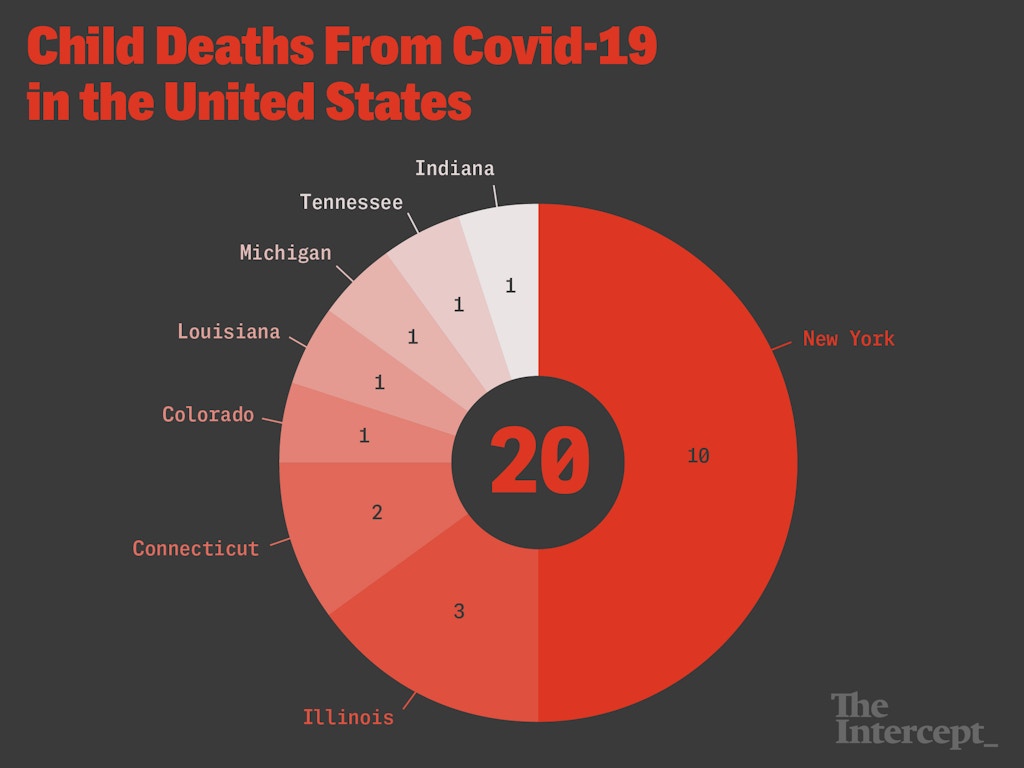
As of April 30, eight states reported 20 deaths from Covid-19 among children and teens. Data reported by state health departments and compiled by the CovKid Project.
Graphic: Soohee Cho/The Intercept
While the number of kids testing positive for the virus in the U.S. is greater than the total number of confirmed cases in many countries, including Singapore, Ireland, and Mexico, it is probably only a small fraction of all who have the disease, because of a shortage of tests and very limited testing of children. “The big question is how many kids are being tested?” said Elizabeth Pathak, an epidemiologist and director of the CovKid project. Without that information, it’s impossible to know how many are infected. So Pathak and several colleagues used clinical data from China to gauge infection rates in the U.S. and estimate that the total number of children infected in the U.S. is now at least 478,000.
The newly compiled data, which has not been previously reported, comes amid reports of the emergence of an inflammatory syndrome in children that appears to be linked to coronavirus infections. Doctors in six countries, including the U.K., Spain, and Italy, have described clusters of inflammatory disease in children that have the coronavirus. In the U.S., doctors in New York, Washington, Pennsylvania, California, and Minnesota have encountered similar cases, which some news reports have described as cases of Kawasaki disease, a common and treatable illness frequently diagnosed in children.
But while the children with the new syndrome may have many of the same symptoms as those with Kawasaki disease, it is more likely a manifestation of the coronavirus, according to pediatrician Mark Schleiss. “It’s something that looks very much like Kawasaki,” said Schleiss, professor of pediatrics at University of Minnesota Medical School. Children with Kawasaki disease have a fever that lasts several days, along with at least four other symptoms that may include a rash, red eyes, swollen lymph nodes, and puffy hands and feet.
But Schleiss said that the recently described phenomenon is likely just another manifestation of the new coronavirus. “Some children present with what looks like aseptic meningitis. Some present with diarrhea. It’s a challenging virus because it can look like a lot of different things,” he said. “Before you treat a child for Kawasaki, you now have to step back and say, ‘Is this Covid-19?’”
The most common symptoms of coronavirus infections in children are cough and fever, which occur in over half of patients who become sick. Many children also have sore throats and coughs, according to an international review of studies of Covid-19 in children published last week, which also noted that about 10 percent of children sick with the virus have diarrhea or vomiting.
As with adults, some of the children who suffer the worst effects of coronavirus seem to have particular vulnerabilities. Among those who have died from the infection are two infants and a 16-year-old girl in Denver named Jaqueline Paisano, who had lost the ability to walk and talk at an early age after having a brain tumor. The youngest publicly identified victim of the coronavirus in Detroit, a 5-year-old named Skylar Herbert, did not appear to have any underlying conditions before she was diagnosed with the infection after complaining of a headache.
Because of the lack of testing, it’s still unclear what proportion of children with Covid-19 develop serious or life-threatening illnesses. “We need more testing of kids even with mild symptoms before we can know the scope of the problem in this country,” said Pathak.
“At some point, we’re going to open schools back up. Camps are already clamoring to be permitted to open. And once that starts happening, we need to have surveillance in place so we can catch any uptick in hospitalizations and cases.”
Subscribe to:
Comments (Atom)