Monday, May 4, 2020

Diary of Samuel Pepys shows how life under the bubonic plague mirrored today’s pandemic


Ute Lotz-Heumann


https://theconversation.com/diary-of-samuel-pepys-shows-how-life-under-the-bubonic-plague-mirrored-todays-pandemic-136222


In early April, writer Jen Miller urged New York Times readers to start a coronavirus diary.

“Who knows,” she wrote, “maybe one day your diary will provide a valuable window into this period.”

During a different pandemic, one 17th-century British naval administrator named Samuel Pepys did just that. He fastidiously kept a diary from 1660 to 1669 – a period of time that included a severe outbreak of the bubonic plague in London. Epidemics have always haunted humans, but rarely do we get such a detailed glimpse into one person’s life during a crisis from so long ago.

There were no Zoom meetings, drive-through testing or ventilators in 17th-century London. But Pepys’ diary reveals that there were some striking resemblances in how people responded to the pandemic.
A creeping sense of crisis

For Pepys and the inhabitants of London, there was no way of knowing whether an outbreak of the plague that occurred in the parish of St. Giles, a poor area outside the city walls, in late 1664 and early 1665 would become an epidemic.

The plague first entered Pepys’ consciousness enough to warrant a diary entry on April 30, 1665: “Great fears of the Sickenesse here in the City,” he wrote, “it being said that two or three houses are already shut up. God preserve us all.”

Portrait of Samuel Pepys by John Hayls (1666). National Portrait Gallery

Pepys continued to live his life normally until the beginning of June, when, for the first time, he saw houses “shut up” – the term his contemporaries used for quarantine – with his own eyes, “marked with a red cross upon the doors, and ‘Lord have mercy upon us’ writ there.” After this, Pepys became increasingly troubled by the outbreak.

He soon observed corpses being taken to their burial in the streets, and a number of his acquaintances died, including his own physician.

By mid-August, he had drawn up his will, writing, “that I shall be in much better state of soul, I hope, if it should please the Lord to call me away this sickly time.” Later that month, he wrote of deserted streets; the pedestrians he encountered were “walking like people that had taken leave of the world.”
Tracking mortality counts

In London, the Company of Parish Clerks printed “bills of mortality,” the weekly tallies of burials.

Because these lists noted London’s burials – not deaths – they undoubtedly undercounted the dead. Just as we follow these numbers closely today, Pepys documented the growing number of plague victims in his diary.

At the end of August, he cited the bill of mortality as having recorded 6,102 victims of the plague, but feared “that the true number of the dead this week is near 10,000,” mostly because the victims among the urban poor weren’t counted. A week later, he noted the official number of 6,978 in one week, “a most dreadfull Number.”

By mid-September, all attempts to control the plague were failing. Quarantines were not being enforced, and people gathered in places like the Royal Exchange. Social distancing, in short, was not happening.

He was equally alarmed by people attending funerals in spite of official orders. Although plague victims were supposed to be interred at night, this system broke down as well, and Pepys griped that burials were taking place “in broad daylight.”
Desperate for remedies

There are few known effective treatment options for COVID-19. Medical and scientific research need time, but people hit hard by the virus are willing to try anything. Fraudulent treatments, from teas and colloidal silver, to cognac and cow urine, have been floated.

Although Pepys lived during the Scientific Revolution, nobody in the 17th century knew that the Yersinia pestis bacterium carried by fleas caused the plague. Instead, the era’s scientists theorized that the plague was spreading through miasma, or “bad air” created by rotting organic matter and identifiable by its foul smell. Some of the most popular measures to combat the plague involved purifying the air by smoking tobacco or by holding herbs and spices in front of one’s nose.

Tobacco was the first remedy that Pepys sought during the plague outbreak. In early June, seeing shut-up houses “put me into an ill conception of myself and my smell, so that I was forced to buy some roll-tobacco to smell … and chaw.” Later, in July, a noble patroness gave him “a bottle of plague-water” – a medicine made from various herbs. But he wasn’t sure whether any of this was effective. Having participated in a coffeehouse discussion about “the plague growing upon us in this town and remedies against it,” he could only conclude that “some saying one thing, some another.”A 1666 engraving by John Dunstall depicts deaths and burials in London during the bubonic plague. Museum of London

During the outbreak, Pepys was also very concerned with his frame of mind; he constantly mentioned that he was trying to be in good spirits. This was not only an attempt to “not let it get to him” – as we might say today – but also informed by the medical theory of the era, which claimed that an imbalance of the so-called humors in the body – blood, black bile, yellow bile and phlegm – led to disease.

Melancholy – which, according to doctors, resulted from an excess of black bile – could be dangerous to one’s health, so Pepys sought to suppress negative emotions; on Sept. 14, for example, he wrote that hearing about dead friends and acquaintances “doth put me into great apprehensions of melancholy. … But I put off the thoughts of sadness as much as I can.”

Balancing paranoia and risk


Humans are social animals and thrive on interaction, so it’s no surprise that so many have found social distancing during the coronavirus pandemic challenging. It can require constant risk assessment: How close is too close? How can we avoid infection and keep our loved ones safe, while also staying sane? What should we do when someone in our house develops a cough?

During the plague, this sort of paranoia also abounded. Pepys found that when he left London and entered other towns, the townspeople became visibly nervous about visitors.

“They are afeared of us that come to them,” he wrote in mid-July, “insomuch that I am troubled at it.”

Pepys succumbed to paranoia himself: In late July, his servant Will suddenly developed a headache. Fearing that his entire house would be shut up if a servant came down with the plague, Pepys mobilized all his other servants to get Will out of the house as quickly as possible. It turned out that Will didn’t have the plague, and he returned the next day.

In early September, Pepys refrained from wearing a wig he bought in an area of London that was a hotspot of the disease, and he wondered whether other people would also fear wearing wigs because they could potentially be made of the hair of plague victims.

And yet he was willing to risk his health to meet certain needs; by early October, he visited his mistress without any regard for the danger: “round about and next door on every side is the plague, but I did not value it but there did what I could con ella.”

Just as people around the world eagerly wait for a falling death toll as a sign of the pandemic letting up, so did Pepys derive hope – and perhaps the impetus to see his mistress – from the first decline in deaths in mid-September. A week later, he noted a substantial decline of more than 1,800.

Let’s hope that, like Pepys, we’ll soon see some light at the end of the tunnel.


What antibody studies can tell you (ProPublica links)


Where we are now


Researchers have begun to publish studies about coronavirus antibodies, and our ace health care reporter Caroline Chen breaks down what these studies can tell us — and more importantly, what they can’t. Even a test that is very good can give out more false positives than true positives when the prevalence of a disease is very low in a population.
My ProPublica Illinois colleague Haru Coryne looked at how coronavirus has spread in Chicago. His analysis found that crowded conditions within homes, rather than housing density, may better explain why some areas of the city see higher infection rates.
Taken together, these two stories help us understand how the coronavirus is spreading and how we can find a path forward.


Holding companies accountable


At a time when much of the retail sector is collapsing, Amazon is strengthening its competitive position in ways that could outlast the pandemic — and raise antitrust concerns, Renee Dudley reported.
One thing that hasn’t fully stopped during the pandemic: Aggressive medical-debt collection. U.S. hospitals are in the spotlight for being on the front line of fighting COVID-19. But Alec MacGillis found that in the shadows, debt collection operations continue, often by the same institutions treating coronavirus patients.
Meanwhile at health insurance giant Cigna, executives told analysts the pandemic wouldn’t hurt its business, but a trade group that represents Cigna and other insurers asked Congress for aid.


Holding government accountable


FEMA has helped pay for the burials of victims of past disasters. But months into the coronavirus pandemic, the Trump administration has sat on similar requests. Families of COVID-19 victims have been forced to turn to religious centers and GoFundMe. So far, approximately 30 states and territories have requested the funding.
Sen. Richard Burr, who is under investigation for his stock trading, is not just a friend to the health care industry. He’s also a stockholder. He regularly flips health care stocks even as he pushes for legislation to help the industry. Burr has denied doing anything improper.
All vote by mail systems are not created equal, Ryan McCarthy reported, and whether the ballot you mail is counted may depend on where you vote. Disputes between policymakers in at least six states cast doubt about whether states can make a smooth and equitable shift from in-person to mail-in ballots by November.


Can You Get COVID-19 From Delivery Food?


https://www.iflscience.com/health-and-medicine/can-you-get-covid19-from-delivery-food/


As one-third of humanity is cooped up in their homes and people are forced to eat their own cooking, food delivery services are seeing increased sales during the COVID-19 pandemic.

Like other coronaviruses, SARS-CoV-2 is thought to mainly spread from person-to-person through respiratory droplets that are expelled from an infected person when they cough, sneeze, or talk. People can become infected with the virus through close contact with an infected individual or through touching contaminated surfaces and then touching their face, according to the Centers for Disease Control and Prevention (CDC).

But can takeout also serve as a vector?

To date, there is no evidence that SARS-CoV-2, the virus that causes COVID-19, can be transmitted through eating food. However, there is a possible risk that the virus may persist on food packaging like plastic for up to 72 hours, according to a study published last month in the New England Journal of Medicine. On cardboard, researchers found no viable evidence of the virus after 24 hours. On all surfaces, the virus degrades quickly and is seen to drop by half within just under seven hours on plastic and within about three hours on cardboard.

“There are two important messages on handling food and food safety at this time. One is about preventing COVID-19 spread and shopping for food and the other is about keeping your food safe and preventing food poisoning at home,” said Cathy Moir, council chair for the Food Safety Information Council, in a statement.

COVID-19 is not considered a foodborne illness and it is not believed to be transmitted through food. However, there is a risk that SARS-CoV-2 can be transmitted by surface cross-contamination. There are varying reports of how long COVID-19 can remain on surfaces. The World Health Organization, for example, says that it is not certain how long the virus can last on a surface, but based on its behavior similar to other coronaviruses, it may persist for a few hours or up to several days, though that timeframe may vary under different environmental conditions and the type of surface. One report found that the virus persisted on cruise ship surfaces for up to 17 days.


“Currently there is no evidence of food or food packaging being associated with the transmission of COVID-19. Like other viruses, it is possible that the virus that causes COVID-19 can survive on surfaces or objects. For that reason, it is critical to follow the 4 key steps of food safety – clean, separate, cook, and chill,” writes the US Department of Agriculture. The agency adds that there is also no evidence to suggest that food produced within the country can transmit COVID-19, nor can goods that are imported from other nations.

When home from shopping or after grabbing takeout, the Institute for Food Safety says that individuals should first place shopping bags on the floor and immediately wash their hands. Discard or recycle any single-use bags. Wash your hands but keep in mind that there is no need to discard or sanitize any part of the actual food packaging. Best practices follow that fruits and vegetables should be rinsed and foods with a hard surface, like apples or carrots, should be scrubbed. “NEVER” use soap or bleach as these may have negative health impacts if left on food and accidentally consumed. The institute adds that the coronavirus is killed by “cooking to the safe minimum cooking temperatures specified by the FDA and USDA.”

When it comes to cooking, the US Food and Drug Administration (FDA) reminds consumers that foodborne gastrointestinal viruses, like norovirus and hepatitis A, can still make people ill through contaminated food. People preparing to stay home for extended periods of time need to practice basic food safety and hygiene measures, like washing hands and surfaces often, separating raw meat from other foods, cooking to the right temperature, and refrigerating foods, according to a tipsheet provided by the USDA.


Why America is probably undercounting coronavirus deaths


April 20, 2020


https://www.advisory.com/daily-briefing/2020/04/20/covid-count


CDC relies on state-by-state tallies of death certificates to calculate the number of U.S. deaths from the new coronavirus, but state officials warn that the process is riddled with inaccuracies—and experts say the number of Americans who've died from the virus is likely higher than CDC's official count.

Covid-19 weekly webinar: What you need to know in 45 minutes
US Covid-19 death toll tops 30K

As of Monday morning, U.S. officials had reported 753,317 cases of Covid-19, the disease caused by the new coronavirus and 36,109 U.S. deaths linked to the new coronavirus.


Covid-19 death count strategies vary between states

But health experts say inconsistent counting methods and a lengthy national data-gathering strategy likely mean the nationwide estimates of Covid-19 cases and deaths are inaccurate.

Until last week, CDC's national Covid-19 case and death counts only included cases and deaths that were confirmed with a laboratory test. However, CDC on Tuesday announced that it would begin including "probable [Covid-19] cases and deaths" in the totals because testing shortages hampered some states' ability to test every patient suspected of having Covid-19.

For instance, New York City—which is an epicenter of the United States' Covid-19 epidemic—this week began including presumed Covid-19 deaths in its count, which led to a significant spike in the number of Covid-19 deaths the city has reported. Officials said the additional deaths occurred among individuals who did not have lab tests confirming they were positive for the new coronavirus, but whose death certificates list Covid-19 as their suspected cause of death based on their medical histories and symptoms.

Delaware, Connecticut, Maryland, Ohio, and Pennsylvania also have started including probable cases and deaths in their reported tallies.

Other states have included probable cases and deaths in their tallies since they first began reporting the numbers, the Washington Post reports. Colorado, for instance, has included "epidemiologically linked" cases, or cases among people who were never tested for the new coronavirus but had contact with an infected person and showed symptoms of the disease, in its statewide death count since March. "Epidemiologically linked" cases accounted for about 3% of the state's Covid-19 death count as of Thursday.

In comparison, other states have unique counting strategies that can sometimes exclude even laboratory-confirmed cases of Covid-19 from their death tallies, the Post reports.

For example, in Alabama, a physician reviews the medical records of people who died and tested positive for Covid-19 to determine whether the death should be attributed to Covid-19 or to another underlying health condition. According to Karen Landers, a spokesperson for the state's Department of Public Health, Alabama's death count often excludes people who tested positive for Covid-19 but had no respiratory symptoms as well as people who experienced another health event, like a heart attack, when they had the disease.

As a result, out of the 110 people in Alabama who had tested positive for Covid-19 and died as of Thursday, 73 were included in the statewide death tally sent to CDC, the Post reports. Another 12 deaths were excluded, and 25 other deaths are still under review, according to the Post.

Deborah Birx, a physician who's leading the White House's coronavirus task force, said Alabama's strategy conflicts with CDC's approach to tallying Covid-19-realted deaths. "[W]e've taken a very liberal approach to mortality," she said. "[I]f someone dies with Covid-19, we are counting that as a Covid-19 death."

However, health experts said the nature of the disease, which can be mild and even asymptomatic in some, and the nation's testing hurdles inevitably will result in discrepancies in how Covid-19 cases and deaths are counted.

"Can there be disagreement in how these things are concluded? Absolutely," said Jonathan Arden, a forensic pathologist and chair of the board of the National Association of Medical Examiners. "You are talking about medical judgments, a diagnostic process that means you are arriving at an opinion."
Officials suspect underreporting of Covid-19

Meanwhile, city officials have told ProPublica that an increase in the rate of at-home deaths across the country could imply that the official U.S. Covid-19 death count is excluding a number of deaths that are occurring outside of hospitals.

ProPublica in a review compiled data from health agencies, police departments, 911 call centers, and vital-records departments to analyze overall death rates in states that house Covid-19 hot zones, including Massachusetts, Michigan, New York, and Washington. According to ProPublica, New York City officials last week recorded about 200 deaths per day that occurred outside of nursing homes and hospitals, compared with an average of about 35 such deaths per day between 2013 and 2017. Similarly, in Detroit, officials received more than 150 "dead person observed" phone calls within the first 10 days of April, compared with an average of about 40 during the same time period in recent years.

And in Middlesex County, Massachusetts, officials reported 317 at-home deaths in March this year, representing a 20% increase when compared with the number of at-home deaths reported during March in recent years, ProPublica found. The official Covid-19 death rate for the state was 89 in March, according to Massachusetts' Department of Public Health.

According to ProPublica, health experts have said the large increases in at-home deaths in these states could stem from deaths occurring among people who were infected with the new coronavirus, but who were not included in the states' overall Covid-19 death count due to a lack of access to treatment or testing.

However, some experts cautioned that the increases in at-home deaths in these states also could be tied to growth in the number of people dying at home from other conditions, such as heart attacks, because they either couldn't get to a hospital or were afraid to seek hospital care because of the Covid-19 epidemic.
'Just the tip of the iceberg'?

Still, Mark Hayward, a sociology professor at the University of Texas-Austin, said the discrepancies likely mean America's current official Covid-19 death count represents "just the tip of the iceberg" of how deadly the disease has been in country. "[T]he undercount is going to be really high" at the start of the epidemic, he said.

Robert Anderson, chief of CDC's mortality statistics branch, said national death counts based on death certificates always are an underestimate, even for common illnesses like the flu. Eventually, CDC likely will adjust its national death count for Covid-19 by comparing the total deaths recorded during the epidemic to historic death rates, Anderson said (Brown et al., Washington Post, 4/16; Bowden, The Hill, 4/16; Gillum, ProPublica, 4/14).


U.S. Coronavirus Death Toll Is Far Higher Than Reported, C.D.C. Data Suggests


By Josh Katz, Denise Lu

and Margot Sanger-Katz


April 28, 2020


https://www.nytimes.com/interactive/2020/04/28/us/coronavirus-death-toll-total.html


Total deaths in seven states that have been hard hit by the coronavirus pandemic are nearly 50 percent higher than normal for the five weeks from March 8 through April 11, according to new death statistics from the Centers for Disease Control and Prevention. That is 9,000 more deaths than were reported as of April 11 in official counts of deaths from the coronavirus.

The new data is partial and most likely undercounts the recent death toll significantly. But it still illustrates how the coronavirus is causing a surge in deaths in the places it has struck, probably killing more people than the reported statistics capture. These increases belie arguments that the virus is only killing people who would have died anyway from other causes. Instead, the virus has brought a pattern of deaths unlike anything seen in recent years.

If you look at the provisional deaths from all causes, death counts in New York, New Jersey, Michigan, Massachusetts, Illinois, Maryland and Colorado have spiked far above their normal levels for the period. In New York City, the home of the biggest outbreak, the number of deaths over this period is more than three times the normal number. (Recent data suggests it could have reached six times higher than normal.)


How reported coronavirus deaths compare with deaths above normal

Numbers are from March 8 to April 11, 2020.

AREA PCT. OF NORMAL EXCESS DEATHS−REPORTED COVID-19 DEATHS=GAP

New York City 325% 11,900 − 10,261 = 1,700
New Jersey 172% 5,200 − 2,183 = 3,000
New York (excluding N.Y.C.) 142% 4,200 − 2,425 = 1,700
Michigan 121% 2,000 − 1,391 = 600
Illinois 113% 1,400 − 682 = 700
Massachusetts 120% 1,200 − 686 = 500
Maryland 115% 700 − 207 = 500
Colorado 116% 600 − 274 = 300


In New Jersey, deaths have been 172 percent of the normal number so far — more than 5,000 additional deaths, compared with an average count from the past five years. In Michigan, the partial death count is 121 percent of the count in a normal year, the equivalent of nearly 2,000 more deaths.

These numbers are preliminary because death certificates take time to be processed and collected, and complete death tallies from the Centers for Disease Control and Prevention can take up to eight weeks to become final. The speed of that data reporting varies considerably by state. In Connecticut, for example, where reported coronavirus deaths are high, the C.D.C. statistics include zero reported deaths from any cause since Feb. 1, because of reporting lags.

We compared these provisional death counts with the average number of deaths each week over the past five years. Public health researchers use the term “excess deaths” to describe a gap between recent trends and a typical level of deaths.

It’s difficult to know whether the differences between excess deaths and the official counts of coronavirus deaths reflect an undercounting of coronavirus deaths or a surge in deaths from other causes. It’s likely a mix of both.

There is evidence, in New York and other places, that the official coronavirus counts are probably too low. Tests for the illness can be hard to get, and not all who die now are being tested, particularly if they die outside a hospital. New York City recently revised its own statistics for the number of coronavirus-related fatalities, saying thousands of additional deaths were probably because of Covid-19, even though no tests had been conducted.

There is also increasing evidence that stresses on the health care system and fears about catching the disease have caused some Americans to die from ailments that are typically treatable. A recent draft paper found that hospital admissions for a major type of heart attack fell by 38 percent in nine major U.S. hospitals in March. In a normal year, cardiovascular disease is the country’s leading cause of death.

Some causes of death may actually be going down. There appear to be fewer road fatalities in California, as more U.S. residents stay at home, for example. It is possible that those reductions could cancel out coronavirus deaths in places where the virus is not yet widespread. But, in many states, any such reductions have been clearly outweighed by increases in deaths directly and indirectly related to the virus.

Demographers often use measures of total deaths, sometimes called all-cause mortality, to evaluate the effects of natural disasters, where it can be difficult to trace particular causes.

In Puerto Rico in 2017, only 64 deaths were initially attributed to Hurricane Maria. But an analysis of the additional deaths showed the way that the disaster had, directly and indirectly, led to nearly 3,000 deaths over six months. The total included the immediate deaths from mudslides and drownings, but also sepsis, diabetes and suicides that came later as the power failure stretched on for months.

Coronavirus is clearly killing more U.S. residents directly than any hurricane has, but it is also changing lives in ways that may also contribute indirectly to increased deaths — by overloading the health care system and discouraging people from seeking care.

Measures of total deaths are also commonly used in countries without detailed accounting of causes of death. Right now, they are the most useful tool, several epidemiologists said, for measuring the impact of coronavirus in the United States, too.

“It gives you an overall sense of how big things are,” said Samuel Clark, a professor of sociology at Ohio State University, whose work is in demography and epidemiology. “For now, you can basically attribute the excess mortality to Covid-19. But you also grab all the things that are not Covid at all, but are probably created by the situation.”


Around the world, the coronavirus is bringing large waves of mortality. In Spain, deaths over the last month are 66 percent higher than normal, according to New York Times reporting. In Ecuador, they are more than 80 percent higher than normal. In Paris, more than twice as many people are dying every day as normal — far more than during a typical bad flu season.

Eventually, we will get more clarity about all of the reasons that people died this year. While no mortality statistics are ever perfect, the Centers for Disease Control and Prevention uses detailed death certificates to code the causes of death for everyone who dies each year in the United States. But that process typically takes more than a year to complete.

For now, total deaths are our best glimpse into the ways the coronavirus is affecting the normal patterns of survival.


How accurate is the US coronavirus death count? Some experts say it's off by 'tens of thousands'


To get an accurate picture of the pandemic, US needs to test more of the dead.

By
Dr. Mark Abdelmalek,
Chris Francescani
and
Kaitlyn Folmer
April 30, 2020, 3:56 PM
17 min read

https://abcnews.go.com/Health/accurate-us-coronavirus-death-count-experts-off-tens/story?id=70385359


The novel coronavirus has already claimed the lives of more than 61,000 Americans. But experts fear that number could be far higher at this point in the outbreak -- perhaps by tens of thousands -- once the pandemic subsides enough for officials to go back and make a true reckoning of the dead.

Experts are urging leaders to take measures right now to preserve data and medical specimens so that science has the chance to determine the precise number of people who succumbed during one of the most severe global pandemics in memory.


"Under-counting deaths in this particular epidemic is happening all over," said Dr. Daniel Lopez-Acuna, an epidemiologist and former top World Health Organization official, who spent 30 years at the organization. "It’s almost inevitable."

Tune into ABC at 1 p.m. ET and ABC News Live at 4 p.m. ET every weekday for special coverage of the novel coronavirus with the full ABC News team, including the latest news, context and analysis.

Calculating the precise number of COVID-19 deaths is remarkably complicated for a number of reasons. But leading epidemiologists, pathologists, medical examiners, medical history professors and local, state, federal and global health officials told ABC News that more testing is the single most important factor in determining an accurate national death count.

"We need to have the testing available because the big question now with COVID-19 is the denominator -- of anything," said Dr. Alex Williamson of the College of American Pathologists. "How many people get it? How many people recover? How many are hospitalized? How many died? We don't know the true denominator. More testing is the most important thing we need to do."


Ongoing testing kit shortages in cities and states nationwide means that only clearly symptomatic patients are currently being tested in many places. There also is no uniform national system in the U.S. for investigating deaths, and until two weeks ago, the U.S. was only counting Americans who lab-tested positive, before or after death, for COVID-19.

Left out of the tally are people who died without being tested and those who died at home or some other non-healthcare facilities before they could seek medical care.

"It is an extraordinary challenge," said Dr. Sally Aiken, president of the National Association of Medical Examiners. "There just isn't really the infrastructure."

Further undermining an accurate national count are new analyses that suggest the virus was spreading in the U.S. much earlier than previously believed, likely playing a role in more deaths than currently known.
MORE: When each state's stay-at-home order lifts

California’s first known COVID-19 death to date was Patricia Cabello Dowd, 57, in Santa Clara County. Dowd died on Feb. 6 of heart complications, which were later determined to have been unleashed by the COVID-19 virus. Dowd's death -- in which an autopsy obtained by the San Francisco Chronicle listed a heart rupture "due to Covid-19 infection" -- came three weeks before the earliest previously identified American coronavirus-related death.

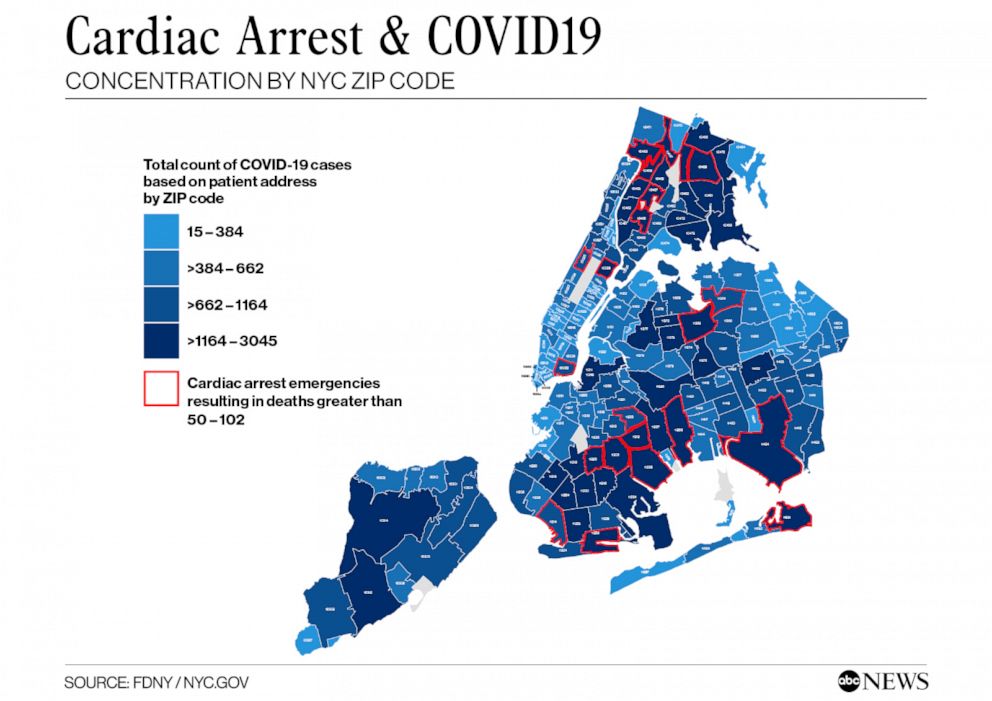
New data on cardiac arrest emergency calls reviewed by ABC News suggests that New York City’s catastrophic outbreak likely began in close-knit neighborhoods in Queens and Brooklyn as far back as mid-February.
MORE: In the 'epicenter of the epicenter,' were early heart attacks a missed coronavirus warning?


Cardiac Arrest and COVID19 Concentration by NYC Zip CodeCardiac Arrest and COVID19 Concentration by NYC Zip CodeABC News Illustration / FDNY / NYC.gov

Finally, as the cardiac arrest data suggested, scientists are contending with an ever-evolving understanding of how COVID-19 attacks the body. Initially, it was believed to primarily attack the lungs, but new research suggests it’s a danger to nearly every organ.

Experts say that many people like Dowd, who died of a nonrespiratory COVID-19 complication early in the outbreak -- before the pandemic’s impact became apparent -- may never be accurately counted.

The confusion and complications inherent in tracking pandemics have left a weary nation wondering just how high the actual U.S. death count may be -- and how bad things really are.

Less than 2% of all Americans have been tested for the coronavirus to date, according to White House figures -- nearly 5.5 million people. It's a figure that experts say is both higher than most nations and far lower per capita than where the U.S. should be at this point.

U.S. Assistant Secretary for Health and White House "testing czar" Admiral Brett Giroir told George Stephanopoulos on "Good Morning America" on Tuesday that the Trump administration doesn’t concur with a Harvard University study which concluded last week that the U.S. needs to be testing 5 million people a day in June and up to 20 million by July in order to safely re-open the country.

"We don’t believe those estimates are accurate, nor are they reasonable, " Giroir said.

Yet either way, that testing is still mostly focused on the living. Experts told ABC News that an accurate death toll is not only important to later get a better picture of what happened, but if possible, real-time or near real-time death counts can also help public health officials in their battle to contain the virus now.

History: A chilling guide

Researchers retrospectively calculate overall deaths from a pandemic by studying excess deaths year-to-year in a given region. But that’s a difficult figure to gauge until a pandemic is over.

Previous studies of other recent virus outbreaks suggest the actual number of COVID-19 deaths to date is very likely dramatically higher than the more than 60,000 deaths currently reported.

A Centers for Disease Control and Prevention (CDC) analysis of the H1N1 swine flu virus outbreak in the U.S. in 2009 and 2010 concluded two years later that the actual tally was likely 15 times higher than the officially recorded figures. A 2013 study by the U.S. National Institutes of Health determined the figure was seven times higher than the official count.

But scientists said that the current coronavirus pandemic is of an entirely different magnitude.

"I’ve never – none of us have ever – seen an infection like COVID-19, that literally stopped the world," said Williamson.

While most news organizations rely on the Johns Hopkins University figures, which are pulled directly from state and local government websites and are considered more timely picture of the problem, the National Center for Health Statistics, a branch of the CDC, is the primary agency responsible for U.S. health statistics, which are compiled by collecting data on births, deaths and health surveys.

Due to the lack of a uniform U.S. system, the NCHS system lags about two weeks behind in reporting said, Dr. Robert Anderson, chief of mortality statistics.

Daniel Weinberger, an epidemiologist from the Yale School of Public Health, analyzed NCHS death count data to estimate how many COVID-19 deaths may have gone uncounted during the five-week period from March 1 to April 3.

He concluded the official death toll in the U.S. is "probably a substantial underestimate of the true number by tens of thousands."


The actual figure, he said, may be "in the ballpark of double the reported cases."

Given the still-looming threat to the U.S., researchers are urging municipalities to maintain as much detailed data about COVID-19 records as possible.

With patchwork of reporting protocols, a 'pipe dream' to gauge actual death toll

As the pandemic rages across all 50 states and around the globe with no uniform reporting protocol in place, experts said the official death count is hard to even estimate.

"One of the difficulties is that every state does things differently," said William Hanage, an epidemiologist at Harvard University’s T.H. Chan School of Public Health. "When I look at the data, I’m sitting there thinking, ‘Okay, this is Oklahoma. What kind of modifier am I adding to that to figure out what’s going on here?’ It would be incredibly helpful not to have to do that."

He’s doubtful that a uniform national death count reporting process is possible anytime soon.

"It’s a bit of pipe dream," he said.


And that's before taking into account the ways other countries count their own death tolls.

"Even now if you’re comparing reporting among different countries, you’ve got to ask, ‘Are they reporting only deaths in hospitals? Only people they are sure had COVID? Which test did they use? What about deaths occurring elsewhere – in nursing homes and at home? Are they being counted?’"

COVID-19-related deaths in non-hospital settings -- largely nursing home deaths and deaths at home -- are also fueling revised death counts in some U.S. regions and nations around the world.

As many as half of the COVID-19 deaths in Europe may have come from nursing homes, Hans Kluge, the WHO's regional European director, said in a press briefing last week. When France added nursing homes to its tally, the nation’s death count spiked 40%, according to The Wall Street Journal.

While the U.S. is not currently counting nursing home deaths nationally, it’s estimated that thousands have died from or with COVID-19 complications in these facilities across the U.S. Last week ABC News reported that based on the reporting of 28 states, the death toll in long-term care facilities has already surged past 10,000.

Yet it was also only last week that the CDC began the laborious process of preparing to incorporate nursing home deaths into its overall death count. The agency issued a notification saying it would soon begin requiring that nursing homes report communicable disease deaths promptly to federal authorities. It’s unclear when the U.S. will begin including those figures in its national death count.

On April 14, the CDC directed all U.S. states and territories to begin counting suspected as well as lab-confirmed COVID-19 deaths.

Officials in some states have said they’ll adhere to the new CDC guidelines, but "each state has their own laws, which sometimes takes time," said Janet Hamilton, executive director Council of State and Territorial Epidemiologists (CSTE).

In mid-April, New York City released its first death count to include suspected -- not just lab-confirmed -- cases. That metric accounted for at-home deaths. The revised city figures, which added 3,700 deaths, drove up the nationwide death count by 17%.

Last week, scientists at Yale School of Public Health published a scholarly paper, which has yet to be peer-reviewed, that estimated that the actual death count in New York and New Jersey could be up to three times higher than the official tally of confirmed COVID-19 deaths or deaths that would be expected normally this time of year with respiratory diseases.

"Some states, such as Florida and Pennsylvania, might have missed deaths early on and might be under-counting deaths by a substantial degree currently," the Yale scientists concluded. "Other states, like Washington, have an accurate estimate of the mortality burden of the pandemic virus due to intense testing," the paper said. "And in states that have been hit hard by the pandemic virus, such as New Jersey and New York, the total excess mortality burden is 2-3 times that ascribed to COVID-19 in official statistics."

’The golden question’

Many U.S. states remain too overwhelmed by the outbreak or too short on supplies to perform postmortem COVID-19 testing.

Yet experts say localities’ inclusions of suspected cases in their death counts is vital going forward.

"It is critical to include both the probable and the confirmed cases so we have the full picture of the impact," said Hamilton, of CSTE. Failure to do so, she said, "would be a failure of our public health system."

Even those areas that can include probable and suspected COVID-19 deaths face challenges due to how little we yet understand about the disease, and how long the dead may carry it.

"Post-mortem, we don't know how long the [COVID-19 diagnostic] test is valid for after death," said CAP’s Williamson. "If a person is not found in their house for five days, does the COVID-19 test still work? We don't really know the answer to that."

There are two main types of death investigations in the U.S.: medical examiner autopsies and hospital-based autopsies.


rganizes bodies in the Gerard Neufeld funeral home in Queens on April 22, 2020, in New York.


Medical examiners are the most rigorously trained forensic pathologists in the death investigation field -- but even they do not have uniform national reporting protocols for COVID-19 deaths.

The CDC first introduced a common code to list COVID-19 as a cause of death on U.S. death certificates on March 24, followed by formal guidance on April 3, but the guidance will take time to take root nationwide, experts said.

Beyond a shortage of testing that is forcing hospital officials to prioritize testing of live patients over the deceased, many hospital pathologists remain wary of conducting autopsies during the pandemic because of all that is still unknown about the coronavirus, according to ABC News interviews around the nation.

Even swabbing the nose of a corpse could potentially re-introduce the virus into the air surrounding the body, pathologists said -- urging their colleagues to only conduct such testing in the proper settings.

One pathologist who spoke with ABC News on the condition of anonymity said a recurring theme online among prominent U.S. academic pathologists is that due to a limited, evolving understanding of how the virus spreads, shortages of personal protective equipment and limited autopsy rooms with appropriate precautions in hospitals, many pathologists "are scared to do the autopsies" for fear of being infected.

Yet postmortem samples and tissue can be preserved until more testing is available.

"You can freeze the nasal pharyngeal swabs and test them later," Aiken said. "And medical examiners and coroner's draw blood for toxicology. Eventually that blood could be used for antibody testing. So even though the lab tests are limited now, in the long run, they may be able to determine if deaths are COVID-19 related."

The final factor that undermines a complete COVID-19 death count, according to experts, is that many if not most of the people who have died had at least one additional underlying chronic medical condition that contributed to the deaths – particularly obesity, diabetes and hypertension.

But which factor actually caused the death?

"That’s the golden question: who died with COVID-19, and who died of COVID-19," Williamson concluded. "That’s what we still don’t know."


Funeral Directors Association Warns U.S. COVID-19 Deaths Are Underreported


https://www.democracynow.org/2020/4/23/headlines/funeral_directors_association_warns_us_covid_19_deaths_are_underreported


In New Jersey, the director of the State Funeral Directors Association believes COVID-19 has claimed far more lives than officially reported, after the Centers for Disease Control and Prevention on April 15 ordered changes in how likely deaths due to the disease are reported. 

In Britain, a review by the Financial Times found U.K. coronavirus deaths are likely more than double the official figure — with 41,000 deaths so far likely caused by the virus.