Hardly any other company is profiting so massively from the coronavirus pandemic as the international logistics company Amazon, whose owner and CEO, Jeff Bezos, has increased his wealth to $120 billion. While Bezos has amassed over $25 billion during the pandemic, Amazon workers remain exposed to great danger many weeks after the pandemic began.
In Amazon’s HAM2 Winsen distribution centre, located south of Hamburg, at least 68 of 1,800 employees were infected with COVID-19 by April 23, first reported in an April 23 article in Manager-Magazin. Only on that day did the management react by handing out masks to some workers.
Winsen is a new and ultra-modern site that’s equipped with hi-tech robots. It should have the best conditions to establish workflows to ensure the safety of critical workers. Nevertheless, even at this location, workers are insufficiently protected.
Like everywhere else, Amazon allowed work to continue almost unrestricted during the lockdown, and the virus was able to spread unhindered. For a long time, workers were forced to work in highly unsafe conditions—without face masks, gloves, goggles or COVID-19 testing—and this has remained virtually unchanged to this day.
It was already known two weeks ago that “more than a dozen employees had fallen ill with COVID-19”, as the Elbe-Geest weekly reported on April 17. On March 25, a report by news weekly Der Spiegel said there had been at least three confirmed cases of coronavirus in the Winsen logistics warehouse. Management simply placed markings on the floors indicating social distancing, staggered the start and break times and used more plant buses than usual to take staff to the station in order to reduce overcrowding.
At the same time, the company implemented hourly bonuses of two euros in Germany and Austria and 60 cents in Poland, in order to create an incentive for employees not to take sick leave. This contributed to the fact that many of those urgently in need of the money did not stay at home, even when they were already ill. When the Winsen facility opened two years ago, many unemployed people and refugees were hired, who are dependent on every euro.
Almost all Amazon employees are now worried that they could become infected and pass this on to their families. This is evident from letters received by the amazon-watchblog.de website and other media. Several employees anonymously criticise the fact that washrooms in the distribution centre are cleaned far too rarely. Crowds and congestion are still forming at the time clocks, turnstiles and entrance gates. Anyone who leaves the workplace a few minutes too early to avoid standing in line faces a deduction from their working time.
Amazon workers cannot rely on the service sector union Verdi in any way whatsoever. As employees from Winsen reported, management worked with the works council to conceal the first positively tested COVID-19 case in the dispatch centre for almost 14 days.
In order for Amazon to accept the introduction of a works council in one of its thirteen warehouses in Germany, Verdi officials dutifully comply with all of management’s machinations. The attendance bonus of two euros per hour, which obviously contributed to the spread of COVID-19, was also approved by Verdi works council representatives. A member of the works council at the Leipzig distribution center told the newspaper taz that the works council had no conception of how to deal with coronavirus and was “waiting for the worst case” to happen.
A trial before the Wesel Labour Court revealed that even the surveillance cameras in the halls are operated with the consent of Verdi and the works council. Amazon had boasted that they would monitor the “social distancing” in the halls by surveillance camera, adding that the data would be transferred abroad and made anonymous.
Amazon Rheinberg’s works council had apparently successfully filed a complaint against this last step—the transfer of the data to servers abroad. In a report on the ruling, the court said that it “assumed that the transfer of the data abroad was contrary to the works agreement on the installation and use of surveillance cameras in force at the company.” It found that this “violated the works council’s rights of co-determination.” In other words, an agreement with the works council on camera surveillance had already existed for a long time.
The total number of the 13,000 Amazon employees in German logistics centres who have been infected by COVID-19 has not been established, because unlike the professional players in the German football league, and like all ordinary workers, they are only tested when acute cases are already causing a stir in their surroundings.
In the United States, Italy, France and Spain, several Amazon employees have already spontaneously refused to work, so as not to be exposed to the coronavirus danger. Through spontaneous strikes, they have also defended employees who had been dismissed for their brave protests. Following strikes in New York City, Chicago and Detroit, Amazon workers also stopped work in Minneapolis on April 27 to protest the firing of one of their colleagues. At least two Amazon workers in the US have already died of COVID-19, both in California.
In France, a court decision last week forced Amazon to temporarily close six shipping centres and clean them up because the risk of coronavirus infection affecting nearly 10,000 workers was so obvious. Previously, hundreds of Amazon workers in France had used their legal right to stay away from work if they were at risk.
The International Committee of the Fourth International (ICFI) and its section in Germany, the Sozialistische Gleichheitspartei (Socialist Equality Party, SGP), call on Amazon workers to join together in action committees independent of the unions like Verdi, to fight together with Amazon colleagues around the world, for the following demands: Immediate cessation of operations in Winsen with full pay for all workers in quarantine! Full medical care for every single sick person, protection of the families and full financial security! Security for both refugees and temporary workers!
Continuation of work at Amazon only for socially critical items, under conditions that guarantee maximum safety for the employees. It is necessary to equip every employee with personal protective equipment and provide regular tests for all.
Regular cleaning of all distribution centres under the control of workers’ committees, which work independently of the company and trade union and are advised by reliable medical experts, virologists, etc.
The trillion-dollar corporation has all the means and possibilities to easily meet these demands, but as an Amazon worker in the US said, “The corporation only cares about profits, it doesn’t care about our lives.” Therefore, it is urgent that this vast network of distribution centres and be transformed into public enterprises and placed under the democratic control of the working class—without compensation for their owners and large shareholders. There is no reason why this wafer-thin layer of the super-wealthy should be enriched by the distribution of vital goods.
The World Socialist Web Site calls on all Amazon workers: Write to us, report on the situation in your distribution centre and expose the criminal indifference of management, the works councils and unions like Verdi to the coronavirus pandemic.
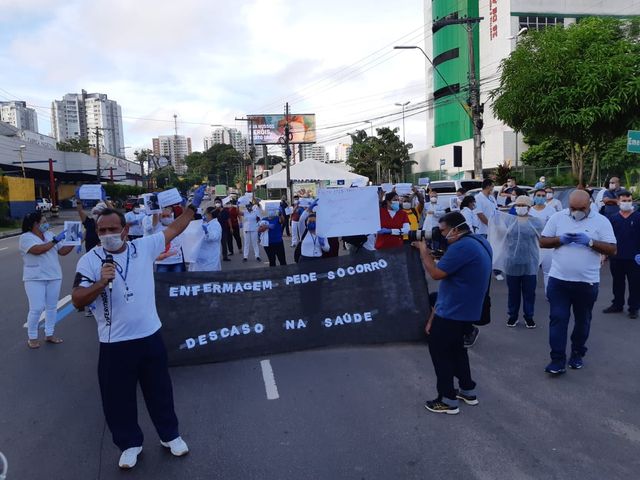
Thirteen Brazilian nurses were fired after participating in a strike Monday, along with hundreds of their colleagues at the 28 de Agosto Hospital, in the Amazonian capital of Manaus, which has seen one of the worst outbreaks of the coronavirus pandemic in Brazil. They will supposedly be reassigned to other health care units.
Hospital 28 de Agosto is the largest hospital and treatment center for COVID-19 in Amazonas and is operating under extremely precarious conditions for both patients and health care professionals. The strike was an act of revolt against the lack of personal protective equipment (PPE), which has led to widespread illness and the deaths of several health care workers, as well as the failure to pay nurses’s salaries, in some cases for up to eight months.
Since the weekend before the strike, nurses were already being threatened by the administration, which was appointed by Amazonas’ extreme right-wing governor, Wilson Lima, of the Christian Social Party (PSC). On Saturday, a worker posted an online video in which he claimed to have received calls from the 28 de Agosto management demanding that he delete an earlier post defending the strike.
Fired nurses kept waiting in the Health Department of Amazonas [Twitter].
These threats were not enough to repress the nurses’ protest. As one of them said during Monday’s demonstration: “We don’t have to end [the demonstration], no. We have to have courage, as we are having now.”
The same tone has dominated the workers’ responses to the firing of their colleagues, posted under the hashtags #naovaonoscalar (they won’t shut us up) and #devolvamnossoscolegas (return our colleagues). In one of these tweets, which got more than 700 shares in 24 hours, a hospital employee says: “There is already a lack of employees, because we are contaminating ourselves and others are dying. The 28 de Agosto administration returned the professionals who were at the demonstration and the temporaries are being fired. Revolt against this management.”
A professional from another hospital responded to the post saying: “They are not persecuting people, they are persecuting a class! We will not remain silent.”
One of the fired nurses, Tatiane Lima, declared in an interview with G1: “We held the demonstration and we will hold as many as it takes, because our main objective is to provide working conditions for everyone on the team, and give quality care to the patients.”
The nurses’ struggle arose amid the collapse of the health care system in Manaus, long before the epidemic has reached its peak. The latest government figures, presented on Thursday, record 5,254 cases of the disease in Amazonas and 3,273 of them in Manaus. However, the government itself acknowledges that due to the absence of even minimally adequate testing, the real numbers are tremendously higher.
The same is true for deaths. While backhoes are digging mass graves for thousands of people in Manaus, officially only 312 have died of COVID-19 in the capital of Amazonas. One estimate indicates that in the week of April 21–28 alone, more than 700 people may have died of the disease.
Nurses strike in Manaus, Amazonas. The banner reads: "Nursing Calls For Help. Negligence in Health Care".
Health professionals account for a significant share of those infected. According to the government, more than 400 have been diagnosed with the disease. But on Monday alone, when a drive-thru testing system was set up exclusively for health professionals, more than 90 of them tested positive for the coronavirus.
The fired nurse Tatiane Lima said about 25 percent of the employees at the Hospital 28 de Agosto were sent home with symptoms of the disease.
Underlying the firing of the strikers is the state government’s effort to stifle any opposition under conditions in which it has been undermined by charges of corruption directly linked to the coronavirus crisis.
Governor Lima is accused of making an overpriced purchase of 28 respirators, which were strangely acquired from a company specializing in wine distribution. The government paid four times the market price for the respirators, using the state of emergency to avoid bidding. In addition, medical associations reported that the devices are only support respirators, inadequate for COVID-19 treatment, which requires mechanical ventilators.
The Lima government also paid more than 2.5 million Brazilian reals (around US$500,000) to rent a deactivated private hospital for three months and turn it into a specialized treatment unit for COVID-19. Questions have been raised as to why this money was not used to equip the collapsing public health system.
In his defense, Wilson Lima declared to the TV show Conexão Repórter that “everyone is a [victim of exploiters] at the moment... It is the law of the market, the law of supply. Today everyone is looking for it, so it’s a price that increases significantly.”
It is possible that Lima’s arguments hold some truth. Amazonian workers are most likely the victims of two different crimes, but with the same essential source: government corruption and the profit interests of the capitalist economy, which override the interests of the working masses.
Similar cases of corruption involving the purchase of ventilators and the transfer of funds from the fight against COVID-19 to the private sector have been registered in several states, including São Paulo, Rio de Janeiro and Santa Catarina. These corrupt governments are all conspiring to organize a “return to work” that will generate new profit streams for the banks and companies and result in the massacre of thousands of workers.
On Monday, a day after a record 140 burials were recorded in a single day in the Amazonian capital, Harley Davidson resumed its production of motorcycles at its plant in Manaus. On Thursday, it was Yamaha’s turn. Honda and BMW plan to resume their activities at the Manaus industrial zone on May 18, when the pandemic is likely to reach its peak.
The coronavirus crisis has made it clear that in order to defend their most basic right to survival, the working class must openly confront the capitalist class. Workers around the world need to unify their struggles against the murderous resumption of economic activities in all countries, which is aimed at benefiting the major shareholders of the giant transnational corporations.
In hospitals, health care professionals need adequate equipment to ensure their safety and infrastructure to treat their patients. Workers need to expropriate the wealth of the super-rich and allocate it to meet public interests; and they need to establish control over production, democratically defining what production is necessary and under what conditions it will be carried out.
The response of the ruling class and capitalist governments throughout the world to the coronavirus pandemic is producing a growing wave of walkouts, sick-outs, demonstrations and other forms of social unrest.
In the United States, a global epicenter of the pandemic, there have been at least 140 wildcat strikes since the beginning of March, according to Payday Report, which aggregates local news accounts.
A broad array of workers from every part of the country have participated, including bus drivers in Detroit (March 16); postal workers in Oklahoma (March 19); sewerage workers in Cleveland (March 20); postal workers in Dallas (March 31); Nabisco snack workers in Portland (April 9); Boeing airplane workers in Washington (April 20); building construction workers in New York City (April 28); recycling plant workers in Illinois (April 28); and transit workers in North Carolina (April 29). A center of social unrest is now among workers at meatpacking plants, where there has been a wave of coronavirus cases and at least 20 deaths. Workers at Smithfield Foods pork plant in Nebraska walked off the job in a wildcat strike on Tuesday after company executives announced that they would not implement previously announced plans to close the plant. On Monday, workers at a Cold Spring chicken plant in Minnesota walked off the job after several workers tested positive for COVID-19.
There have also been widespread strikes and protests by Amazon, Whole Foods, McDonald’s, Starbucks, Lyft and Instacart workers throughout the country. Over the weekend, fifty workers at Amazon’s Shakopee warehouse in Minnesota walked after several positive tests and after one worker was reportedly fired for staying at home.
Developments in the United States are part of an international growth of social unrest. The past month has seen strikes and walkouts of nurses in Papua New Guinea; doctors in Zimbabwe; sanitation and clothing workers in the UK; distribution and shipping workers in Australia; garment workers in Bangladesh; call center workers in Brazil; and maquiladora factory workers south of the US-Mexico border, to name just a few.
There are many specific issues motivating these protests, but all revolve around the basic reality: For the working class, the fight against the pandemic and for their lives is at the same time a fight against capitalism. The logic of these struggles raises the question of political power—who shall control society, the capitalist ruling elite or the working class?
Many of the struggles have centered on the lack of adequate safety measures and protective equipment for workers on the job. Despite persistent warnings from scientists and epidemiologists, nothing was done to prepare for the pandemic.
Decades of ruling class policy decimated social and health care infrastructure, while deregulation has given corporations a free hand to force workers to labor under unsafe conditions. The proliferation of part-time work in the “gig economy” means that large sections of the working class work for poverty-level wages, with no benefits or safety protections.
Other struggles were aimed at shutting down production at non-essential workplaces. The initial response of the ruling class to the pandemic was to try to downplay it, to keep businesses operating as normal. In mid-March, autoworkers in the US and across the border in Canada launched a series of wildcat walkouts that forced the closure of auto plants throughout North America. Even as the pandemic overwhelmed health care systems, large sections of non-essential production remained in operation.
Increasingly, the struggles of workers are centered on the efforts of the ruling elites to force a return to work even as the pandemic spreads. On Tuesday, Trump invoked the Defense Production Act to force meatpacking workers back to work. Far from protecting workers from the spread of the virus, Trump’s order instead protects meatpacking companies from legal liability from workers who report that they are being forced to work in unsafe conditions.
In other words, Trump is telling corporate America: Kill your employees, and you will face no consequences. What is being done for meatpacking workers will be repeated in different forms for the entire working class.
The class conflict will intensify enormously in the coming weeks and months. The financial oligarchy has utilized the pandemic to transfer trillions of dollars to Wall Street, with the unanimous support of the entire political establishment, Democrat and Republican. All of this will be paid through cuts in social programs, education, and health care, along with a massive intensification of the exploitation of the working class.
Already, Boeing—which sent workers back to work at the beginning of last week—has announced that it is cutting 10 percent of its workforce. Other companies will follow suit. The ruling elite will attempt to use the economic desperation of millions of workers not only to force them back to work, but also to get them to agree to cuts in wages and benefits.
This policy will encounter mass opposition. The actions of the ruling class have not gone unnoticed. The wave of walkouts and protests, generally isolated in different cities, workplaces and countries, is only the initial expression of the pent-up anger.
How can this opposition be developed?
First, it must be organized and unified. This requires the establishment of rank-and-file factory, workplace and neighborhood committees. All the opportunities provided by modern technology, including social media, must be used to connect the separate struggles of workers into a common counter-offensive of the entire working class. These committees must be absolutely independent of the pro-capitalist trade unions, which have done nothing to organize opposition and are working closely with corporations and the capitalist state to get workers back on the job.
Second, the struggle of workers must be unified across all racial, gender and national lines. The pandemic is a global problem that requires a global solution. The response of capitalist governments throughout the world is the same, and the interests of workers in every country are identical. It is necessary to reject all efforts to divert social anger along national lines, including through the anti-China campaign being whipped up by the Trump administration and the Democrats.
Third, industrial action must be connected to a new political perspective, which begins with an understanding that the fundamental problem is capitalism—a social and economic system that subordinates everything to the interests of profit and the accumulation of wealth by the corporate and financial elite.
The response of governments to the pandemic has at every stage been aimed at preserving and advancing the interests of the capitalist oligarchs. The priority has not been saving lives, but saving profits. It is this that has prevented any scientific, rational and globally coordinated response to the pandemic.
The alternative to capitalism is socialism—the restructuring of social and economic life, on a world scale, to meet social need, not private profit.
At the beginning of 2020, in its statement “The decade of socialist revolution begins,” the World Socialist Web Site wrote, “The objective conditions for socialist revolution emerge out of the global crisis. The approach of social revolution has already been foreshadowed in the mass demonstrations and strikes that swept across the globe in 2019.”
Only a few months into the year, the correctness of this analysis has been confirmed. The fight of the working class against the pandemic must be transformed into the revolutionary struggle for socialism.
On May 2, the International Committee of the Fourth International and the World Socialist Web Site are holding an online rally to mark May Day, the historic day of international working class solidarity. We urge all of our readers to register today.
Donald Trump has spent a lifetime exploiting chaos for personal gain and blaming others for his losses. The pure madness in America’s response to the coronavirus pandemic – shortages of equipment to protect hospital workers, dwindling supplies of ventilators and critical medications, jaw-dropping confusion over how $2.2 trillion of aid in the recent coronavirus law will be distributed – has given him the perfect cover to hoard power and boost his chances of reelection.
As the death toll continues to climb and states are left scrambling for protective gear and crucial resources, Trump is focused on only one thing: himself.
He’s told governors to find life-saving equipment on their own, claiming the federal government is “not a shipping clerk” and subsequently forcing states and cities into a ruthless bidding war.
Governors have been reduced to begging FEMA for supplies from the dwindling national stockpile, with vastly different results. While we haven’t seen what “formula” FEMA supposedly has for determining who gets what, reports suggest that Trump’s been promising things to governors who can get him on the phone.
Our narcissist-in-chief has ordered FEMA to circumvent their own process and send supplies to states that are “appreciative”.
Michigan and Colorado have received fractions of what they need while Oklahoma and Kentucky have gotten more than what they asked for. Colorado and Massachusetts have confirmed shipments only to have them held back by FEMA. Ron DeSantis, the Trump-aligned governor of Florida, refused to order a shelter-in-place mandate for weeks, but then received 100% of requested supplies within 3 days. New Jersey waited for two weeks. New York now has more cases than any other single country, but Trump barely lifted a finger for his hometown because Governor Andrew Cuomo is “complaining” about the catastrophic lack of ventilators in the city.
A backchannel to the president is a shoe-in way to secure life-saving supplies. Personal flattery seems to be the most effective currency with Trump; the chain of command runs straight through his ego, and that’s what the response has been coordinated around.
He claims that as president he has “total authority” over when to lift quarantine and social distancing guidelines, and threatens to adjourn Congress himself so as to push through political appointees without Senate confirmation.
And throughout all of this, Trump has been determined to reject any attempt of independent oversight into his administration’s disastrous response.
When he signed the $2 trillion emergency relief package into law, he said he wouldn’t agree to provisions in the bill for congressional oversight – meaning the wheeling-and-dealing will be done in secret.
He has removed the inspector general leading the independent committee tasked with overseeing the implementation of the massive bill.
He appointed one of his own White House lawyers, who helped defend him in his impeachment trial, to oversee the distribution of the $500 billion slush fund for corporations. That same day, he fired Inspector General Michael Atkinson – the inspector general who handed the whistleblower complaint to Congress that ultimately led to Trump’s impeachment.
There should never have been any doubt that Trump would try to use this crisis to improve his odds of re-election.
Stimulus checks going to the lowest-income earners were delayed because Trump demanded each one of them bear his name. As millions of the hardest-hit Americans scrambled to put food on the table and worried about the stack of bills piling up, Trump’s chief concern was himself.
It doesn’t matter that this is a global pandemic. Abusing his power for personal gain is Trump’s MO.
Just three and a half months ago, Trump was impeached on charges of abuse of power and obstructing investigations. Telling governors that they need to “be appreciative” in order to receive life-saving supplies for their constituents is the same kind of quid pro quo that Trump tried to extort from Ukraine, and his attempts to thwart independent oversight are the same as his obstruction of Congress.
Trump called his impeachment a “hoax.” He initially called the coronavirus a “hoax.” But the real hoax is his commitment to America. In reality he will do anything—anything—to hold on to power.
To Donald Trump, the coronavirus crisis is just another opportunity.
BANGKOK – In the rubble of the 1997-98 Asian financial crisis, as many as 1-2 million Thai laborers lost their jobs as thousands of Bangkok-based factories and service companies went bankrupt, forcing many workers to return to their countryside homes.
Then, Thailand’s rural sector provided a much-needed safety net for the unemployed masses, with many returning to their agrarian family roots.
Fast forward to the Covid-19 crisis and an estimated seven million Thais will become unemployed as Bangkok and provincial cities impose lockdowns to slow the pandemic’s spread and economic devastation awaits on the other side.
The looming Covid-19 economic crisis has triggered a similar diaspora to rural areas, but this time the kingdom’s rural safety-net has big gaping holes which many will inevitably fall through into poverty.
“In 1998 agriculture was a good safety net but now it isn’t because most agricultural households in fact now depend on non-farm employment,” said Nipon Poapongsakorn, distinguished fellow at the Thailand Development Research Institute, a private think tank.
Back in 1997-98, an estimated 50% of rural household incomes came from farming, while 45% came from non-farm activities such as services and remittances from relatives who had migrated to Bangkok and other urban centers to work in the formal and informal sectors.
In today’s Thai economy, 65% of rural household incomes come from non-farm activities, said Nipon. “So those who are now unemployed come back to the villages to eat up 35% of the income,” he said.
Many are returning to parched economic prospects. Thailand has experienced two years of drought, which on top of low global commodity prices means that revenue from traditional cash crops like rice, sugar, tapioca and rubber has been in decline.
“Agriculture has not improved so people are living on the brink of survival, and then having more people return to the village – that’s hard,” said Buapun Promphakping, associate professor at the Social Development Department of Khon Kaen University in Thailand’s northeastern region.
Many of the urban returnees have resorted to picking up their hoes again, albeit with diminished farming skills, according to anecdotal reports. Planting of Thailand’s main rice crop usually begins in May, with the advent of the rainy season, but no one expects better crop prices.
“This year the cultivation area is going to be more, because so many people have moved back to the countryside,” said Charoen Laothamatas, president of the Thai Rice Exporters Association, a trade group.
“But it doesn’t mean we can export more, because our price is still $70-$80 per ton above the competition because of government subsidies, so we will accumulate another huge stockpile,” he predicted.
At the onset of the Covid-19 scare, some Asian countries were fearful of domestic shortfalls. Vietnam, one of Thailand’s main rivals in rice exports, announced a halt on its rice exports but quickly rescinded the ban when fears subsided.
India and China, which both have huge stockpiles of rice, have rejoined the export market with China already undermining Thailand’s competitive advantage in Africa, a major importer of Thai par-boiled rice, Charoen said.
Prime Minister Prayut Chan-ocha’s former coup-installed regime (2014-2019) was widely credited for selling down a huge 18 million ton rice stockpile accumulated under the rule of former prime minister Yingluck Shinawatra.
Her Peau Thai Party, later overthrown in a Prayut-led coup, rose to power partly on a platform of promising to buy “every grain of rice” grown by Thai farmers at prices that ended up being 40% above global market rates.
The boondoggle populist scheme undermined Thai rice exports, lowered rice quality, lost the state billions of dollars and was plagued by charges of corruption that helped the military to justify the May 2014 coup.
Prayut’s coup regime attempted to reform the rice sector by encouraging farmers to shift to other crops and create larger-scale rice cooperatives, while at the same time continuing to subsidize rice prices to keep farmers content.
Both schemes largely failed because Thai rice farmers don’t like pooling their land plots and enjoy the financial stability that comes with state subsidies, analysts say.
“The evidence is that a large number of farmers who applied for the diversification program opted out of it, and stayed in rice because the subsidy from the rice program is higher than what you get from restructuring and diversifying your crops,” said Nipon, who sits on the government’s rice committee.
Prayut’s elected government, which came to power in 2019, has continued to heavily subsidize rice and other commodity crops. But this won’t likely be enough to bolster the rural safety net and prevent a jump in poverty, which was already on the rise under Prayut’s previous military regime.
According to a recent World Bank report, Thailand’s poverty rate grew from 7.21% in 2015 to 9.85% in 2018, rising from 4.85 million to more than 6.7 million people. That figure is expected to skyrocket this year due to the economic disruption caused by Covid-19.
A government program to pass out 5,000 baht (US$154) checks for three months to people hardest hit by the pandemic, expected to draw 9-10 million people, instead attracted 27 million applicants, or 38% of the 70 million population and 79% of the 34 million labor force.
After distributing the largesse to about 4 million people, and prompting at least one suicide attempt by one disqualified recipient, the government has now pledged to pass out relief funds to between 15-16 million people.
That desperate demand highlights the lack of a safety net in Thailand, especially for those in the informal sector, i.e. anyone who is not a civil servant or company employee entitled to social insurance schemes and pension programs.
“We have to build a social safety net for this informal sector, which is about 14-15 million now,” said TDRI’s Nipon. “Otherwise if we are hit by another crisis the government has to use the fiscal budget to pay for more unemployment, like this time – 5,000 baht for three months, which is a huge amount of money.”
Covid-19 and the exodus of millions of Thais to the countryside has underscored the need to enhance Thailand’s provincial economies. To do so, observers say, will require a revival of abandoned decentralization policies outlined in the previous liberalizing 1997 constitution.
That now shredded charter gave provincial and village elected leaders greater say over local budget distribution, undermining the powers of centrally appointed provincial governors.
“Decentralization originally started in the late 1990s and continued through to the 2014 coup,” said Chris Baker, a historian and co-author of numerous books on Thailand’s politics and economics.
“Now (under Prayut) the governor is back. He runs everything … We are back basically to a colonial system of governing the provinces that was borrowed from colonial India and Java,” Baker said.
“This Covid-19 crisis could change the tenor of development,” academic Buapun said. “If we don’t need to stay together in the big cities and we need to spread out [for social distancing] I think that would be a good opportunity for Thailand to build on that.”
Last week the Boston Review (BR) published an exchange on a wealth tax that included a proposal from Berkeley economists Emmanuel Saez and Gabriel Zucman, with a number of responses, including one from me. I was critical of the proposal for both political reasons and because I think avoidance and evasion will be massive problems.
On the political side, in addition to the difficulty of getting a wealth tax through Congress, there is the virtual certainty that the current Supreme Court will rule it unconstitutional. This is not an abstract question of whether a wealth tax should be viewed as constitutional. I realize that many legal scholars have argued that such a tax is not inconsistent with the power to tax granted to Congress by the constitution. This is a very concrete question as to whether the current Supreme Court would rule that a wealth tax is constitutional. I don’t think anyone with a straight face could argue that it would.
We can of course talk about various plans to pack the court, either by adding new justices or through some rotation scheme of judges across federal courts. These may be interesting and worthwhile strategies to pursue against a corrupt court, but if we’re thinking of a timeline of a presidential term in which we hope to get important legislation passed, they are not likely to be helpful.
Even if we can implement an effective strategy for ending the right-wing lock on the court, it is not likely to be quick enough to allow a measure like a wealth tax to be implemented in the same presidential term. If this is at the center of a progressive president’s agenda, they will have to find a way to get re-elected without passing this important measure.
My other reason for objecting is that I think a wealth tax will prove very difficult to enforce. We have experience with income taxes and estate taxes. The enforcement of these is far from perfect, but at least the apparatus is in place. We would be starting from scratch with a wealth tax and the rich will have a very strong incentive to avoid or evade it. My guess is that they would be fairly successful, undermining the goal of the tax as well as confidence in the tax system.
As I pointed in the BR piece, one foolproof mechanism for avoidance is renouncing citizenship. While Saez and Zucman have a 47 percent exit tax as part of their proposal, this would not apply to people who renounce their citizenship before the tax is enacted. In their response, Saez and Zucman suggest that the tax could be imposed even on those who have already left. While they have a good moral argument, as a practical matter, the probability of collecting large amounts of retroactive taxes from someone who has fled to a tax haven does not seem very high.
Stopping Extreme Wealth at Its Source
While I don’t think a wealth tax is an effective mechanism to contain excessive wealth, I strongly agree with Saez and Zucman that it is a serious problem for both economic and political reasons. However, I have focused my own work on changing the economic structures that allow for the accumulation of extreme wealth.
I won’t go through the whole story here (this is the point of Rigged [it’s free]), but the basic argument is that over the last four decades we have structured the economy in ways that allow for the accumulation of massive amounts of wealth. There is nothing inevitable about this structuring, we can structure the economy differently so that its benefits are more broadly shared instead of flowing so disproportionately to those at the top.
My poster child for the impact of the structuring of the economy is Bill Gates. Gates is one of the richest people in the world because we have patent and copyright monopolies. If the government didn’t grant these monopolies, and anyone who wanted to could freely copy Microsoft’s software, Bill Gates would probably still be working for a living.
Patents and copyrights serve a purpose, they provide an incentive for innovation and creative work, but there are other ways to provide these incentives. And even if we decide to use patent and copyright monopolies, they could be shorter and weaker, so that they don’t redistribute so much income to their holders.
The place where I have spent the most effort combatting these government-granted monopolies is with prescription drugs. This is both where they cause the greatest amount of corruption — think of the opioid crisis, a direct result of the incentive created by patent monopoly prices to push drugs — and where they lead to the most obscene outcomes: people being unable to afford cheap drugs because patent monopolies make them expensive.
The pandemic should provide a great opportunity to challenge patent monopolies in prescription drugs. There is an unprecedented amount of international cooperation, as well as public funding, in the efforts to develop treatments and an effective vaccine against the coronavirus. Given this collective effort, it would be utterly absurd to give the company that happened to be the first to the patent office a monopoly on a treatment or vaccine.
The only sensible solution is that the drugs and vaccines that are developed through this collective effort be in the public domain so that they can be sold as cheap generics, where the price is the cost of manufacturing and distribution, and a normal profit. We should not be in the position of begging a patent holder to make a drug or vaccine available at an affordable price.
If we could go this route with the coronavirus then it should raise the obvious question of why this should not be the standard practice – publicly funded, open-source research with everything placed in the public domain. And, what is really neat about this approach is that we don’t even have to stop drug companies from pursuing patent-supported research. They would just face the risk that any drugs they do develop will face competition from a drug that is as good or better and selling as a generic at one percent of the price they planned to charge. That risk would likely shut down most patent-supported research very quickly.
The amount at stake here is enormous, as I continually point out. In the case of prescription drugs alone, it is close to $400 billion a year, roughly 20 percent of all corporate profits.
I could be wrong, but it strikes me as a far smaller political lift to say that the government should increase its funding for the development of prescription drugs (we already spend $40 billion a year through NIH), and have everything developed in the public domain, than imposing a wealth tax. And there is no issue of its constitutionality.
As I point out in Rigged, there are also measures we can do to radically reduce the big fortunes built-in finance, most obviously by imposing a modest financial transaction tax. We can hugely reduce Mark Zuckerberg’s fortune by repealing Section 230 of the Communications Decency Act, thereby subjecting Facebook and other Internet intermediaries to the same legal liabilities as their competitors in traditional media.
We don’t need to structure our economy in a way that leads to massive inequality. There has been a conscious choice made by those designing policy in the last four decades. Our top priority should be to change this design.
Leveling the Political Playing Field
Saez and Zucman are entirely correct in pointing out that the enormous amount of wealth at the top gives these people hugely outsized political influence. While this is true, we are not going to be able to easily reverse this, even with a wealth tax. Jeff Bezos and Bill Gates could still wield ridiculous amounts of political influence if we managed to tax away half of their wealth.
Our efforts can’t be focused just on bringing the top down, we have to bring everyone else up. Fortunately, there are models for doing this. Seattle gives every voter a $75 voucher to support the candidate(s) of their choice in city council elections. Several cities now have super-matches, where small campaign contributions are matched three or four to one. I have outlined a plan where everyone would have a $100 voucher to support journalism or any other creative work they choose.
There are many other directions in which these sorts of proposals can be developed, but the point is that, with a relatively small amount of public funds, we can hugely democratize politics, as well as journalism and creative work more generally. Getting more input from those at the middle and bottom is likely to be a far more productive path towards counterbalancing the influence of the rich than trying to take away their money. And, this can be done piecemeal, one city or state at a time.
Keeping Our Eye on the Ball
In contrast to the right, progressives get relatively few bites at the apple. The right can have a George W. Bush, who lied us into a pointless war in Iraq and then allowed the economy to collapse under his watch and then get back in control of the White House and both houses of Congress eight years later. If a progressive presidency had led to similar foreign policy and domestic disasters, the left could look forward to a half-century in the wilderness, maybe longer.
For this reason, we have to make sure our bites at the apple are all good ones. A huge political battle for a wealth tax that ultimately ended in defeat in Congress or a loss at the Supreme Court would be a disaster. We need battles that are winnable and produce tangible near-term results. There are an infinite number of ways that we can turn to reverse the upward redistribution of the last four decades. This should be the focus of progressive economic policy.


 United States
 Worldwide