Saturday, April 25, 2020

BRAZIL JUSTICE MINISTER RESIGNS OVER BOLSONARO’S INTERFERENCE IN INVESTIGATIONS — AND IMPEACHMENT TALK RAMPS UP
Andrew Fishman, Cecília Olliveira
https://theintercept.com/2020/04/24/bolsonaro-impeachment-moro-resigns-brazil/
AS THE COUNTRY slept Friday morning, far-right Brazilian President Jair Bolsonaro fired the Federal Police Director Maurício Valeixo, bringing to a head a long-simmering battle with Justice Minister Sergio Moro. Moro, in turn, promptly resigned — in a new, major episode of deepening chaos in Brazilian politics.
The official notice firing the Federal Police head bears Moro’s digital signature, but in a press conference Friday morning, the outgoing justice minister claimed that he was not informed of the move and did not sign the document. This and other revelations made by Moro could serve as grounds for impeachment, if the Brazilian body politic can muster the political will to support such a drastic measure. Members of Congress are already gathering signatures for a congressional inquiry into Moro’s allegations.
In his press conference, Moro suggested that Bolsonaro removed Valeixo because the president opposed investigations being conducted by the Federal Police. “He was concerned about investigations underway in the Federal Supreme Court and that a change would also be opportune at the Federal Police,” Moro said of Bolsonaro’s thinking. Moro said Bolsonaro’s concerns were not a reasonable justification for firing Valeixo, but added that he nonetheless searched for “an alternative solution, to avoid a political crisis during a pandemic.” In the end, Moro said, “I understood that I could not set aside my commitment to the rule of law.”
Notably, the Federal Police are conducting several investigations that could impact Bolsonaro, his politician sons, and several members of their inner circle.
Moro loomed large over Brazilian politics during the past several years, even before he accepted Bolsonaro’s offer to serve as justice minister. He was the judge at the center of the influential Operation Car Wash anti-corruption investigation that put former President Luiz Inácio Lula da Silva in prison, removing the popular politician from the 2018 presidential election and clearing the way for Bolsonaro’s victory.
When he entered government, Moro was among the most popular political figures in the country and was seen as an important ally for Bolsonaro, but also as a potential rival in the 2022 elections. The ex-judge’s standing, however, was seriously weakened after The Intercept began publishing an explosive series, in English and Portuguese, on malfeasance and potential illegal actions by Moro and Car Wash prosecutors. As a result of the series, Lula was eventually released from prison.
Though the fate of Valeixo had been a source of long-simmering tension between Moro and Bolsonaro, the clash heated up in recent days. Last August, Bolsonaro threatened to oust Valeixo, whom Moro had handpicked for the post, but eventually relented after Moro had threatened to resign, provoking an institutional crisis. In recent days, Bolsonaro made clear to aides that he was looking to fire Valeixo, and Moro restated his threat to resign. By Thursday evening, it appeared that Bolsonaro had again backed off, but then the notoriously capricious president made the move, prompting Moro to quit.
Investigations Into Bolsonaro and Sons
The Federal Police and Supreme Court are conducting multiple investigations that threaten Bolsonaro and his politician sons directly, as well as key allies in their orbit. A Federal Police investigation into fake news attacks directed at the Supreme Court recently began looking into the so-called Office of Hate, a pro-Bolsonaro online messaging operation run by the president’s son, Rio City Council Member Carlos Bolsonaro.
The Public Prosecutor’s Office requested on Monday that the Supreme Court investigate whether a rally in Brasília last Sunday violated national security laws. The demonstration was held in opposition to quarantine measures and called for a military coup and the forced shutdown of Congress. Bolsonaro spoke at the rally, and some of his allies in Congress reportedly helped organize it.
Sen. Flávio Bolsonaro, the president’s son, is also under investigation for an alleged money-laundering scheme and has repeatedly appealed to the Supreme Court to halt the investigation on technicalities. The case connects him directly to a gangster who was a key suspect in the assassination of Rio City Council Member Marielle Franco. (The gangster was killed in a police raid on his hideout in February, after months on the run.) Last August, Bolsonaro removed the financial oversight agency that first identified the suspicious transactions from Moro’s portfolio.
And the list of police and judicial probes into the Bolsonaros and their allies doesn’t end there. The various investigations have led to calls for more dramatic actions against the government.
Vladimir Aras, an influential member of the Public Prosecutor’s Office — who worked closely with Car Wash investigators for years and was briefly a member of the task force — tweeted, “The facts narrated by [Moro] are very serious. There were reports of forgery, obstruction of justice and crimes of responsibility” — referring to the standard for impeachable offenses, the equivalent of “high crimes and misdemeanors” in the U.S. Aras added that the allegations must be investigated by the Public Prosecutor and Congress.
Fernando Haddad, the presidential candidate from Lula’s Workers’ Party who lost to Bolsonaro in 2018, echoed these concerns, but called on government ministers to quit and force Bolsonaro to resign, rather than drag the country through a drawn-out impeachment process. And former President Fernando Henrique Cardoso also called for Bolsonaro’s resignation.
Political Crisis During a Pandemic
Last Thursday, Bolsonaro fired Health Minister Henrique Mandetta, who had publicly opposed the president’s overt denialism of the risks of the coronavirus crisis, which undermined Brazil’s early response strategy. The health system in multiple Brazilian states are currently in collapse, with long lines for intensive care beds in hospitals and mass graves being dug for the victims. The new health minister focused his messaging on the path to reopening the economy and easing quarantine regulations, which are already being relaxed in multiple states and had nonetheless been poorly enforced nationwide.
Bolsonaro is also at odds with the other most influential member of his cabinet, Finance Minster Paulo Guedes. Guedes, a hard-right former adviser to Chilean dictator Augusto Pinochet, opposed government spending to ease the financial crisis and insisted that Brazil must continue to enact neoliberal reforms that would cut public spending, regulation, and taxes.
Guedes chafed this week at the announcement of a new plan to spend $37.7 billion over five years in public works. The project was endorsed by the increasingly powerful cohort of former military leaders that occupy the majority of important positions in the administration. Guedes did not attend the press conference to announce the package. In response that night, a Bolsonaro-aligned media outlet used three minutes of prime time television to attack Guedes, saying that he “lost relevance in the government during the fight against Covid-19.” Meanwhile, the Brazilian stock market is down 38 percent from an all-time high in January, and foreign investors are pulling their money out of Brazil at the fastest rate in all of Latin America.
When Bolsonaro came into office, his political support emanated from three key groups of power brokers: the center-right, who fiercely opposed Lula’s Workers’ Party and were represented by Moro; oligarchs and international capital, who put their faith in Guedes’s reform agenda; and the military elite, who long distrusted Bolsonaro, a retired Army captain, but saw him as a vehicle to quickly secure political power democratically. Bolsonaro’s natural base is the far right: extremists who are vocal online, but have never before had much influence in national politics.
The president’s public approval rating plummeted since the onset of the coronavirus crisis and key allies have been jumping ship. With Moro gone and Guedes on the ropes, the far-right extremists cannot keep the government afloat and the military — most influentially represented in the administration by presidential chief of staff Gen. Walter Braga Netto — has filled the vacuum of leadership, despite the generals’ own serious misgivings about Bolsonaro’s erratic behavior.
Whether or not the far-right Bolsonaristas get the military coup that many of them are out in the streets demanding, for the time being it would appear that the military is now calling the shots in Brazil.
Even if Bolsonaro is impeached — a subject that is increasingly discussed in Brazil lately — Bolsonaro’s replacement would effectively implement de facto military rule through constitutional means. Impeachment would result in Vice President Hamilton Mourão, a retired general and proud admirer of the military dictatorship that ruled the country from 1964 to 1985, would take power — an option that even some on the left are wearily looking at as the lesser of two evils.
OVERWHELMED MORGUE WORKERS STRUGGLE TO GIVE CORONAVIRUS VICTIMS DEATH WITH DIGNITY
Sharon Lerner
https://theintercept.com/2020/04/22/coronavirus-morgue-new-york-city/
WHILE PROTESTERS WERE railing against coronavirus lockdowns and Republican governors in Georgia, South Carolina, and Tennessee announced plans to open back up their states, Devin Speak was loading bodies onto a refrigerated truck in Brooklyn. A veteran of the U.S. Coast Guard who distributed food and water in Puerto Rico after Hurricane Maria, Speak is one of thousands of first responders who have volunteered to help New York City through the Covid-19 crisis, which continues to test the city’s ability to care for both its living and its dead.
Although Speak imagined he would be using his disaster training to help keep people alive, he was asked to work in “mortuary response,” which involves helping a hospital store the bodies of patients who have fallen to the virus. The three refrigerated trucks where he has been spending most of his shifts are parked at a loading dock at the back entrance of a Brooklyn hospital, where the in-house morgue was beyond capacity. (Speak asked The Intercept not include the name of the hospital because he is not authorized to speak on its behalf.)
The trucks are among 45 “mobile morgues” the city recently purchased to accommodate the surging number of Covid-19 casualties. But, even with their ability to store 3,500 bodies on top of the city’s usual capacity, New York is still struggling to keep up with the deaths, which had reached more than 14,000 at press time.
Armed with paper suits, masks, plastic face shields, gloves, and a desire to ease the strain on hospital staff, Speak and fellow workers have had to make ghastly workarounds that, just two months ago, would have seemed unimaginable to anyone familiar with the city’s system for processing the dead. While the wooden shelves that line the trucks are clearly designed to hold just a single body each, for the past two weeks, they have been putting two on each shelf, arranging them head to toe to make them fit.
“They’re literally getting stacked on each other,” Speak said.
Speak emphasized that, even in the face of such gruesome logistical challenges, he and his fellow volunteers strive to treat the bodies with the utmost respect and caution. “The worst part is the fact that these people are alone,” he said, noting that family members most often can’t visit coronavirus patients in the hospital — or be with them when they die. “It’s weird, but we talk to them sometimes when we’re moving them,” he added. “We sort of take care of them — put a hand on their forehead or on their hand. Especially the ones that have died within 30 minutes or so.”
But a shortage of supplies and the sheer numbers have made it difficult to give the dead the dignity they’re due. For one thing, there aren’t enough body bags. And while some of inadequate supply are durable, others are of lower quality. “The cheap bags will tear, and the pooled fluids spill out onto the bottom of the truck,” said Speak. When they run out of even these flimsier bags, Speak and his co-workers tear up garbage bags and tape up the bodies with the plastic and bed sheets.
Meanwhile, funeral homes are also straining to keep up with the relentless pace of deaths. “We’ll get a funeral home roll by and they’ll pick up four or five, but as soon as they’re gone, we replace them with people off the floor,” said Speak, who noted that the workers were sometimes transporting several bodies in minivans and pickup trucks rather than hearses. Because of the backlog, some bodies remain on the shelves of the mobile morgue for weeks. To make matters worse, the trucks haven’t been as cool as they should be. The refrigeration is especially weak in one particular unit, which has begun to smell.
After leaving a grisly shift, it can seem unimaginable that people are pondering reopening the country without a clear strategy for avoiding a resurgence of deadly coronavirus infections. The idea that people would risk their lives and those of others is “insane,” said Speak. “If they want to work so badly, they should come help me handle a few hundred bodies.”
PROGRESSIVE GROUPS ARE OUTRAGED WITH “PATHETIC” CORONAVIRUS DEAL. CONGRESSIONAL DEMOCRATS ARE DOING LITTLE TO IMPROVE IT.
Aída Chávez
https://theintercept.com/2020/04/22/coronavirus-stimulus-pelosi-phase35-democrats/
PROGRESSIVE GROUPS ARE outraged with the nearly $500 billion interim coronavirus rescue package the Senate passed on Tuesday, urging House Democrats to oppose the “pathetic” deal they say doesn’t come close to providing the relief vulnerable people need while giving away all Democratic leverage for future legislation.
The “Phase 3.5” bill, which is expected to sail through the House this week, left out almost everything Democratic leaders were advocating for. There’s no additional funding for state and local governments, no expanded food stamp benefits, no hazard pay for front-line workers, and no money for the U.S. Postal Service, which have all been basic Democratic priorities. The lack of progressive opposition in Congress has been especially noteworthy, after members of the Progressive Caucus promised to help make future legislation more comprehensive following the hastily passed Phase 3 bill.
While some progressive advocates argue that Democrats didn’t have much leverage on the package to begin with, others note that Democrats control the House and House Speaker Nancy Pelosi could have led the party to pass its own bill.
“Just as importantly as the inadequate policy provisions, this bill gives away all Democratic leverage,” Ezra Levin, co-executive director of Indivisible, said in an emailed statement. “We fought so hard to win back the House in 2018 — to make sure that we had a voice in negotiations like this. So far we’ve heard silence from the House. This bill may be our last chance to get the things we need. [Republican Senate Majority Leader] Mitch McConnell has already said he doesn’t want to push through another bill, and if he does, it won’t be for weeks.”
Progressive groups, including the Center for Popular Democracy, Social Security Works, Sunrise, Demand Progress, and People’s Action have also come out against the interim package. Some of the organizations, to varying degrees, are asking House Democrats to vote against it.
With discussions for a potential Phase 4 package heating up now, the advocacy groups are planning a public pressure campaign to get members and Pelosi on board with policy priorities that address the scope of the crisis.
Join Our Newsletter
Original reporting. Fearless journalism. Delivered to you.
I’m in
Meanwhile, Republicans are escalating attacks on Pelosi, blaming her and Senate Minority Leader Chuck Schumer, D-N.Y., for holding up the Phase 3.5 bill and keeping money away from small businesses. President Donald Trump’s reelection campaign released a digital ad targeting Pelosi for showcasing her expensive refrigerator full of fancy ice cream while people around the country are suffering the consequences of the pandemic. It’s possible that Pelosi has been letting the Senate run the show out of fear of being labeled an obstructionist or jeopardizing the reelection of moderate Democrats in competitive seats.
SO FAR, Rep. Alexandria Ocasio-Cortez, D-N.Y., is the only Democrat in Congress to come out against the interim package, arguing that progressives shouldn’t “bow to the logic that a crumb is better than nothing.” Ocasio-Cortez is also the only House Democrat known to oppose the previous multitrillion-dollar coronavirus bailout, which passed the chamber on an unrecorded voice vote after just three hours of debate.
The freshman lawmaker’s district, which covers some of the most diverse neighborhoods in the country, has been especially devastated by the coronavirus outbreak, fueling her rejection of incrementalism. “It is insulting to think we can pass such a small amount of money in the context of not knowing when Congress is even going to reconvene, pat ourselves on the back, and then leave town again,” she said.
Ocasio-Cortez, without criticizing leadership directly, expressed frustration with letting the Senate set the agenda during an Instagram livestream Tuesday night. She pointed to previous “messaging bills” the House had passed — like last year’s gun control legislation — as an example of the “first thing” the chamber should have done in response to the pandemic, adding that there’s plenty of bold, existing legislation that could have been put to a vote.
 Read Our Complete CoverageThe Coronavirus Crisis
For example, Reps. Rashida Tlaib, D-Mich., and Pramila Jayapal, D-Wash., introduced the Automatic BOOST to Communities (ABC) Act earlier this month to immediately provide recurring cash payments, funded directly from the Treasury by minting two $1 trillion coins. And Rep. Ilhan Omar, D-Minn., introduced a bill to cancel rent and mortgage payments during the pandemic.
“Instead of playing small ball, Congress should immediately pass Rep. Omar’s bill to cancel rent and mortgage payments for the duration of the crisis; Rep. Jayapal’s bill to provide emergency health care coverage during the pandemic; and Reps. Jayapal’s and Tlaib’s bill to provide $2,000 cash assistance to every person, every month, for the duration of the crisis,” People’s Action Director George Goehl said.
The interim package, which would replenish funds for an emergency small business lending program, also includes an additional $75 billion for hospitals and $25 billion for coronavirus testing — two necessities that have been framed as GOP concessions. House Majority Leader Steny Hoyer said the legislation is everything they were expecting. “When you look at the package that is going to be passed, it’s almost exactly like the one we asked for two weeks ago, or 12 days ago,” he told reporters on Tuesday.
THE CONGRESSIONAL Progressive Caucus released its own list of legislative priorities for the next coronavirus response package, including a vote-by-mail requirement for 2020 federal elections, expanded health coverage for all during the pandemic, increased financial relief, and a national moratorium on evictions and foreclosures. CPC members — with allied progressive groups like MoveOn, United We Dream, and Community Change Action, among others — have been pushing these demands under the banner #PutPeopleFirst. New polling from Data for Progress found that their four policy planks receive broad bipartisan support.
 Share Your Coronavirus StoryClick here to learn about contacting a reporter securely, or email us at coronavirus@theintercept.com
In a virtual press conference that featured Progressive Caucus co-chairs Jayapal and Rep. Mark Pocan, D-Wisc., as well as all four members of “the Squad,” lawmakers voiced concerns with the interim package and tried to set the stage for their CARES-2 policy demands. “We have real concerns about giving away leverage now without getting some of the priorities that we need,” Jayapal said on Monday. “It’s going to be very difficult to support a package that doesn’t have some of the desperate relief we need for state and local governments, for people.”
Despite their rhetoric, CPC leaders have not vocally opposed the Phase 3.5 legislation or presented an alternative, believing that their role is to influence the end result of the package. Yet their demands, like vote-by-mail and extending relief to undocumented immigrants, haven’t been seriously considered. When asked whether the Progressive Caucus would attempt to block the bill, Jayapal replied, “What you are hearing is the level of concern with what has been proposed.”
Though it’s true that Democratic leadership often locks out progressives, the CPC’s lack of leverage is a problem of its own making, critics say. One House Democratic aide, who requested anonymity for fear of reprisal, argued that progressives like Jayapal and Pocan help set narratives but need to “step up” and organize as a bloc if there’s a Phase 4. The aide said it would mirror “a successful tactic we’ve seen from the Freedom Caucus time and time again,” referring to an influential right-wing bloc of Republicans in the House.
Kaniela Ing, the director of People’s Action’s Climate Justice Campaign, has also been frustrated with the “missed opportunities.” Then again, he added, a lot of their grassroots members have been focusing on mutual aid. “We’re busy just trying to find money and give it to people in our community who are dying and going homeless and have been without jobs for almost a month now,” Ing said.
“Even the Congressional Progressive Caucus, our members on the Hill, like do they really have power?” Ing said. “Even if we were to move them, if we’re not moving like Pelosi and Schumer — and the Republicans are maybe harder to reach — but if we’re not moving them what’s the point? A lot of people are feeling that jadedness. So they’re focusing on fights they know they can win, local- and state-level fights, and mutual aid.”
AS TRUMP URGES DOCTORS TO LIE ON LIVE TV, FEDERAL OFFICIAL SAYS HE WAS FIRED FOR LIMITING HYDROXYCHLOROQUINE USE
Robert Mackey, Sharon Lerner
https://theintercept.com/2020/04/22/trump-urges-doctors-lie-live-tv-federal-official-says-fired-limiting-use-hydroxychloroquine/
DONALD TRUMP TRIED and failed on Wednesday to coerce two of the government’s top medical experts to endorse his claim that a second wave of Covid-19 infections in the fall is unlikely, hours after a federal whistleblower said he was fired by the administration for limiting the use of an unproven drug treatment touted by the president.
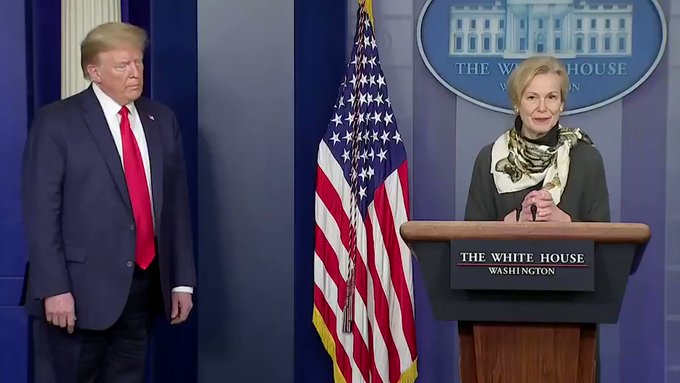
During a televised briefing on the Covid-19 pandemic, the president publicly displayed the political pressure he puts on government scientists by badgering Dr. Deborah Birx, the White House coronavirus response coordinator, to agree with his rosy projection that the virus “might not come back at all.”

The Washington Post
✔@washingtonpost
Trump asks Birx if there's a "good chance that covid will not come back" in the fall.
453
6:16 PM - Apr 22, 2020
Twitter Ads info and privacy
474 people are talking about this
“Doctor, wouldn’t you say there’s a good chance that Covid will not come back?” Trump asked Birx. As she began to respond, saying, “We don’t know–” Trump cut her off to add, “and if it comes back, it’s in a very small, confined area that we put out.”
“The great thing is, we’ll be able to find it earlier,” Birx said, diplomatically declining to endorse Trump’s unscientific theory. The best-case scenario, she added, is that widespread surveillance of new infections could enable the country “to stay in containment” mode later in the year, rather than being forced back into lockdowns to check the spread of infection.
Trump’s failed effort to put words in the doctor’s mouth came minutes after he had pressed Dr. Robert Redfield, the director of the Centers for Disease Control, to recant comments he made on Tuesday to The Washington Post, when he warned of the “possibility that the assault of the virus on our nation next winter will actually be even more difficult than the one we just went through.” The reason for that, the newspaper quoted Redfield as saying, is that, “We’re going to have the flu epidemic and the coronavirus epidemic at the same time.”
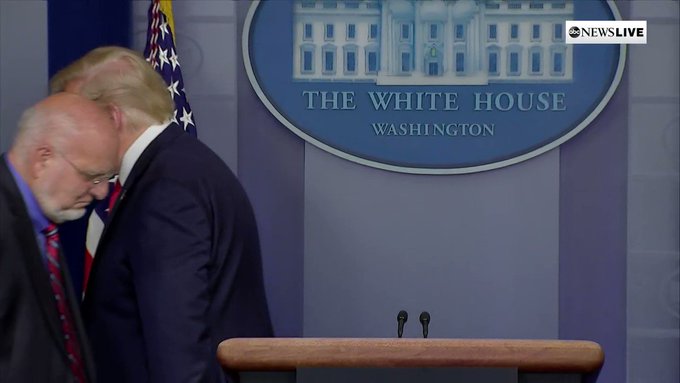
After the president claimed that Redfield had been misquoted, he called the doctor to the podium to make a statement. Choosing his words carefully, Redfield said: “I didn’t say that this was going to be worse; I said it was going be more … difficult and potentially complicated, because we’ll have flu and coronavirus circulating at the same time.”
Moments later, however, when Jonathan Karl of ABC News read the full quote from the newspaper to Redfield, the CDC director acknowledged that he had been “accurately quoted in The Washington Post.”

Amee Vanderpool@girlsreallyrule
Trump tries to say that coronavirus could just disappear, but CDC Director Redfield warned in WaPo a second wave of COVID-19 in the winter could be worsened because it’s also flu season. Redfield confirms: “I’m accurately quoted in The Washington Post."
658
5:59 PM - Apr 22, 2020
Twitter Ads info and privacy
302 people are talking about this
“We will have coronavirus in the fall, I am convinced of that,” Dr. Anthony Fauci said shortly after Redfield’s Galileo moment. “What happens with that will depend on how we’re able to contain it when it occurs. What we’re saying is that in the fall, we will be much, much better prepared to do the kind of containment compared to what happened to us this winter.”
THIS LIVE DISPLAY of political pressure from the president on government scientists came just after one of the nation’s leading vaccine development experts, Dr. Rick Bright, accused the Trump administration of firing him because he refused to approve the widespread use of the drug hydroxychloroquine, which was heavily promoted until recently by Trump as a potential “game-changer” for Covid-19 patients.
In a statement released by his lawyers, Bright said that he was removed this week as the director of the Department of Health and Human Services’ Biomedical Advanced Research and Development Authority, or BARDA, and as the deputy assistant secretary for preparedness and response, in retaliation for his insistence on limiting the use of hydroxychloroquine.
Bright was transferred to a lesser role at the National Institutes of Health. “I believe this transfer was in response to my insistence that the government invest the billions of dollars allocated by Congress to address the COVID-19 pandemic into safe and scientifically vetted solutions, and not in drugs, vaccines and other technologies that lack scientific merit,” Bright said. “I am speaking out because to combat this deadly virus, science — not politics or cronyism — has to lead the way.”
Read Our Complete CoverageThe Coronavirus Crisis“I also resisted efforts to fund potentially dangerous drugs promoted by those with political connections,” Bright added. “Specifically, and contrary to misguided directives, I limited the broad use of chloroquine and hydroxychloroquine, promoted by the Administration as a panacea, but which clearly lack scientific merit.”
The doctor also said that he had “resisted efforts to provide an unproven drug on demand to the American public,” and “insisted that these drugs be provided only to hospitalized patients with confirmed COVID-19 while under the supervision of a physician.”
“These drugs,” Bright noted, “have potentially serious risks associated with them, including increased mortality observed in some recent studies in patients with COVID-19.”
As The Intercept reported earlier this month, the American College of Cardiology released guidance warning that the combination of hydroxychloroquine, a drug normally used to treat malaria and lupus, along with the antibiotic azithromycin raises the risk for some patients of dangerous irregular heartbeats that could be fatal.
“I will request that the Inspector General of the Department of Health and Human Services investigate the manner in which this Administration has politicized the work of BARDA and has pressured me and other conscientious scientists to fund companies with political connections as well as efforts that lack scientific merit,” Bright said. “Rushing blindly towards unproven drugs can be disastrous and result in countless more deaths. Science, in service to the health and safety of the American people, must always trump politics.”
Bright’s lawyers, Debra Katz and Lisa Banks, who previously represented Christine Blasey Ford when she accused then-Supreme Court nominee Brett Kavanaugh of sexual assault, said that they would ask for the doctor’s “unlawful forced transfer” to be put on hold pending an investigation by the Health and Human Services inspector general.
Bright’s complaint came after a panel of experts convened by the the National Institute of Allergy and Infectious Diseases advised against treating Covid-19 patients with a combination of hydroxychloroquine, a commonly used antimalaria drug, and the antibiotic azithromycin — an unproven treatment Trump recommended repeatedly until last week.
While the results of randomized clinical trials of the drug treatment are still not in, a study of the records of 368 Veterans Affairs patients, released on Tuesday, found “no evidence” that hydroxychloroquine, with or without azithromycin, kept those infected with Covid-19 from needing ventilators. The study also found that 27.8 percent of those who were treated with hydroxychloroquine alone died, compared to 11.4 percent who received standard treatment without the drug.
Just a few weeks ago, hydroxychloroquine was Trump’s darling drug. The president was enamored with the medicine that has been used for malaria, which he called “one of the biggest game changers in the history of medicine” in a tweet that was retweeted more than 100,000 times. When asked at an April 5 press conference about throwing his support behind an unproven treatment, he told reporters that the drug “doesn’t kill people,” going on to ask what he posed as a rhetorical question: “What do you have to lose?”
Less than three weeks later, after hospitals have given hydroxychloroquine to untold thousands of coronavirus patients, we have an answer to that question in the form of the study showing that veterans who were treated with the drug were significantly more likely to die than those who didn’t get it. So, despite what Trump has described as his “natural ability” to understand medical science, it turns out the drug actually might kill severely ill Covid-19 patients — or at least dramatically increase their chances of dying.
The short and disappointing story of this one possible coronavirus treatment heightens the many dangers of having a president who is not a doctor but sometimes plays one on TV and, more broadly, of letting hype and politics rather than science drive medical decisions. Among the questions we need to be asking amid the desperation to combat the new coronavirus is not just what patients might have to lose from getting drugs based on the enthusiasm rather than science, but what others might have to gain.
BARDA, THE DIVISION of the Department of Health and Human Services Bright led until this week, is at the heart of the government response to the pandemic. Charged with developing treatment and prevention options against a wide range of specified threats, it has already issued at least 25 contracts worth almost $1.5 billion for products related to the coronavirus. Since 2019, when BARDA’s budget was $561 million, its spending has roughly tripled.
The biggest grants — worth more than $939 million — have gone to Janssen and Moderna Therapeutics for their work on potential coronavirus vaccines. While there are more than 70 candidates for a coronavirus vaccine, the criteria for selecting these companies for funding and the terms of their agreements are unclear. The BARDA contracts aren’t open to bidding, as many other government contracts are, and may not include the usual oversight and accountability protections for taxpayers under the Bayh-Dole Act. And BARDA has not made them public. A FOIA request for the contracts from The Intercept is pending.
James Love, director of Knowledge Ecology International, a watchdog on pharmaceutical patent abuse, said he was concerned about a lack of transparency at BARDA. “They’ve been unwilling to share basic information to make the agency and its contractors more accountable,” said Love.
“There’s been a lot of deference to the institutions that work on these biomedical issues with the assumption that they’re above reproach. But with something like this, where the president thinks the entire election hinges on this disease, it’s more political than ever.”
While the science behind BARDA’s decisions remains obscure, it’s clear that several of the companies that have recently received contracts have the personal support of the president. Executives from Moderna Therapeutics, Regeneron, and Johnson & Johnson, the parent company of Janssen, all of which recently received funding for coronavirus-related products through BARDA, were among a handful of pharmaceutical executives who met with Trump at the White House in early March. The president described the companies as “the biggest in the world, most prestigious, the ones that get down to the bottom line very quickly.”
Trump, who already had a relationship with Johnson & Johnson CEO Alex Gorsky, singled out that company as “among the greatest in the world.” Later that month, the administration announced it was giving the company a $456 million contract to work on “a new vaccine asset” for the virus.
According to a March 29 news release from the HHS office Bright helped run, Sandoz, a drug manufacturer, donated 30 million doses of hydroxychloroquine to the Strategic National Stockpile, a collection of lifesaving supplies for public health emergencies, which is overseen by BARDA, and Bayer donated 1 million doses of the drug. Earlier in March, Bayer also donated 3 million tablets of its drug Resochin, a chloroquine phosphate treatment developed in 1934 which has recently been available only in Pakistan. The FDA, reportedly under pressure from Trump, issued an emergency use authorization for the donated hydroxychloroquine and chloroquine to be used in the United States.
Tax law allows for deductions for charitable contributions to government “if the contribution or gift is made for exclusively public purposes.” According to the law, the deduction is generally capped at 10 percent of a corporation’s income.
Last week, Trump met for 40 minutes with people who had recovered from Covid-19 after taking hydroxychloroquine and pressed them to credit him for touting the drug.
“So you took the hydroxy?” he asked one of the survivors. “Why did you take the hydroxy? Why did you do that? You saw it on television?”
“So you might have said,” Trump pressed the husband of one African-American patient who picked up her prescription for hydroxychloroquine late at night, “When you started that walk or run, ‘What the hell do I have to lose?’ Right?”
“You know my expression, ‘What do I have to lose?'” Trump asked, referring to a phrase he first used to urge black voters to support him in 2016, and recently repurposed to promote the experimental hydroxychloroquine treatment.
“I thought about that — what you said,” the man said. “Yeah.”
Subscribe to:
Comments (Atom)