Monday, April 13, 2020

Country singer-songwriter John Prine dies in pandemic
By Hiram Lee and Matthew Brennan
13 April 2020
https://www.wsws.org/en/articles/2020/04/13/prin-a13.html
The death of beloved country music singer-songwriter John Prine from COVID-19 seems especially cruel. The 73-year old musician, known for his empathetic portraits of working-class life, had been hospitalized since March 26 at Vanderbilt Medical Center in Nashville, Tennessee, where he needed the assistance of a ventilator to breathe. He finally succumbed to the illness on April 7.
Prine was a wonderful songwriter and by all accounts a decent man. His music contained genuine moments of beauty, pathos and humor. In his art and his very personality, Prine pursued an existence entirely opposed to the sort led by those whose criminal negligence made possible his death from COVID-19.
Born in 1946, Prine grew up in Maywood, Illinois, in the Chicago metropolitan area. His parents had moved there from Kentucky in the 1930s. In Maywood, Prine’s father went to work at an American Can Company factory and became a union organizer. In his song “Paradise,” Prine wrote memorably of the Kentucky coal town his parents had left behind, destroyed by the strip mining of the Peabody Coal Company. He sang:
Daddy won’t you take me back to Muhlenberg County
Down by the Green River where Paradise lay
Well, I’m sorry my son, but you’re too late in asking
Mister Peabody’s coal train has hauled it away
Before his career in music got going, Prine spent six years working for the post office. In 1966, with US operations escalating in Vietnam, Prine was drafted into the army along with several of his friends. During an appearance on the television show Bobby Bare and Friends in the 1980s, Prine remembered how the experience changed them all. He recalled that one friend, home for little more than a month, was undergoing shock treatments. Others had drug problems. “A lot of the ones that came home, it never seemed like they came back,” he said, “A lot of them still ain’t home.”
These experiences led Prine to write several songs opposing both the war and American nationalism. The best-known was “Sam Stone,” about a soldier who returns from Vietnam addicted to heroin. The opening lines of the chorus are devastating: “There’s a hole in daddy’s arm where all the money goes / Jesus Christ died for nothin’ I suppose.”
When the veteran finally overdoses, Prine sings:
There was nothing to be done
But trade his house that he bought on the G. I. Bill
For a flag draped casket on a local heroes’ hill.
Prine had an uncanny ability to get inside of a life and write about it from there. The stories he told may not always have been his own, and yet he seemed to know them in intimate detail. He took what appeared to be the private sufferings of individuals and rendered them general and relatable. In what the singer-songwriter offered large numbers of people, they were able to see and understand something of their own experience more deeply.
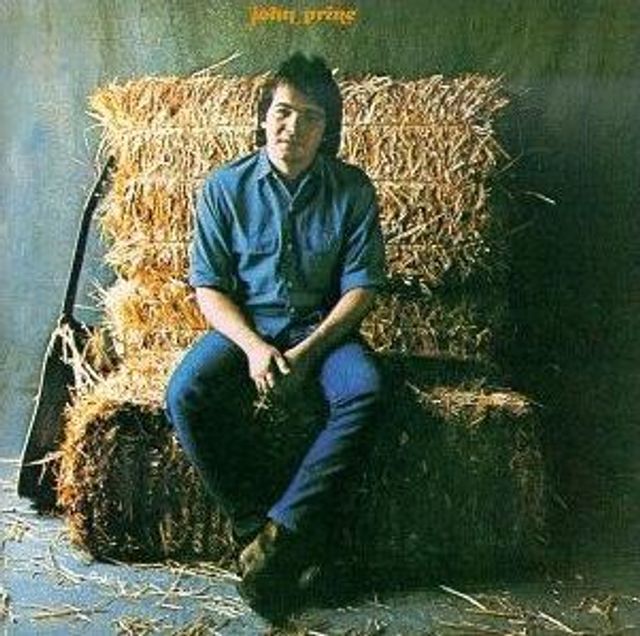
John Prine (1971)
At their best, Prine’s vivid lyrics sat perfectly in their songs. Each word fell in the right place. When he finished a verse or completed a rhyme, it was something like the effect of a gymnast who sticks the landing at the end of an elaborate routine. That speaks to something more than simply an individual accomplishment. Powerful social urges, thoughts and feelings find a voice through such singers and performers.
It is remarkable that, while still in his early 20s, Prine could write a song like “Hello in There,” imagining the lives of an elderly couple whose children had all left home, one of them lost in the Korean War. “Angel from Montgomery” examined similar territory of unfulfilled longing. Singer Bonnie Raitt recorded the definitive version in 1974.
Next to the poignant tragedies were Prine’s comedies, though the lines between the two often become blurred. In “Please Don’t Bury Me,” Prine sang:
Please don’t bury me
Down in that cold cold ground
No, I’d druther have ‘em cut me up
And pass me all around
Throw my brain in a hurricane
And the blind can have my eyes
And the deaf can take both of my ears
If they don’t mind the size
In “That’s the Way the World Goes Round,” he sings:
I was sitting in the bathtub counting my toes,
when the radiator broke, water all froze.
I got stuck in the ice without my clothes,
naked as the eyes of a clown.
I was crying ice cubes hoping I’d croak,
when the sun come through the window, the ice all broke.
I stood up and laughed thought it was a joke
That’s the way that the world goes ‘round.
Prine wrote too many moving and remarkable tunes to list, but one should not leave out “Speed of the Sound of Loneliness” and “Christmas in Prison.”
These and other songs bring out the liveliness and optimism embedded in much of Prine’s work. While tragedy had a presence, self-pity did not appear to exist in his world. Later in life, Prine suffered serious medical setbacks. In 1998, he had surgery to remove a tumor in his neck, which left his vocal cords and tongue damaged. In 2013, part of a lung was removed during a surgery to treat another cancer. When he recovered and returned to work, Prine looked and sounded different. But he went on. Some of his best work was still ahead of him.
At their best, Prine’s vivid lyrics sat perfectly in their songs. Each word fell in the right place. When he finished a verse or completed a rhyme, it was something like the effect of a gymnast who sticks the landing at the end of an elaborate routine. That speaks to something more than simply an individual accomplishment. Powerful social urges, thoughts and feelings find a voice through such singers and performers.
It is remarkable that, while still in his early 20s, Prine could write a song like “Hello in There,” imagining the lives of an elderly couple whose children had all left home, one of them lost in the Korean War. “Angel from Montgomery” examined similar territory of unfulfilled longing. Singer Bonnie Raitt recorded the definitive version in 1974.
Next to the poignant tragedies were Prine’s comedies, though the lines between the two often become blurred. In “Please Don’t Bury Me,” Prine sang:
Please don’t bury me
Down in that cold cold ground
No, I’d druther have ‘em cut me up
And pass me all around
Throw my brain in a hurricane
And the blind can have my eyes
And the deaf can take both of my ears
If they don’t mind the size
In “That’s the Way the World Goes Round,” he sings:
I was sitting in the bathtub counting my toes,
when the radiator broke, water all froze.
I got stuck in the ice without my clothes,
naked as the eyes of a clown.
I was crying ice cubes hoping I’d croak,
when the sun come through the window, the ice all broke.
I stood up and laughed thought it was a joke
That’s the way that the world goes ‘round.
Prine wrote too many moving and remarkable tunes to list, but one should not leave out “Speed of the Sound of Loneliness” and “Christmas in Prison.”
These and other songs bring out the liveliness and optimism embedded in much of Prine’s work. While tragedy had a presence, self-pity did not appear to exist in his world. Later in life, Prine suffered serious medical setbacks. In 1998, he had surgery to remove a tumor in his neck, which left his vocal cords and tongue damaged. In 2013, part of a lung was removed during a surgery to treat another cancer. When he recovered and returned to work, Prine looked and sounded different. But he went on. Some of his best work was still ahead of him.
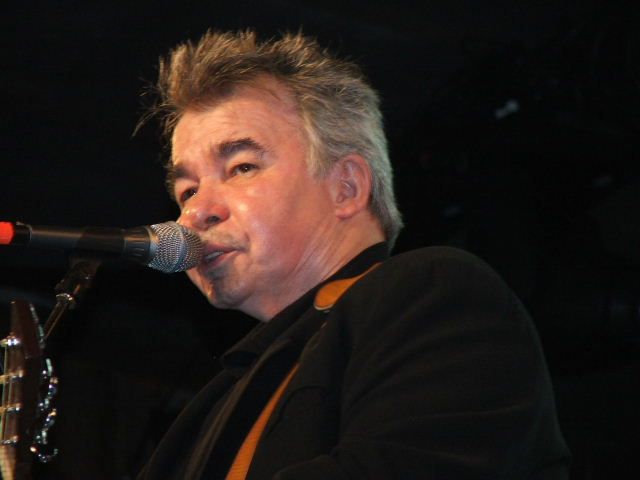
John Prine in 2006 (Photo credit–Ron Baker)
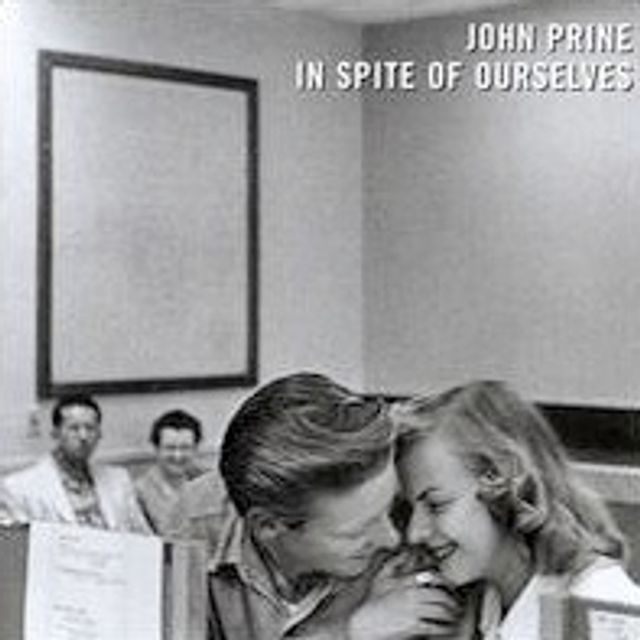
In his later career, Prine recorded two memorable albums of duets, In Spite of Ourselves (1999) and For Better, Or Worse (2005). The duets with Iris DeMent, including the funny title track from In Spite of Ourselves, about two uncouth eccentrics who fall in love, were especially memorable.
In 2005’s “Some Humans Ain’t Human,” Prine sang of the social types that staffed the administration of George W. Bush, who appears as the “cowboy from Texas.” He sang:
Some humans ain’t human
Though they walk like we do
They live and they breathe
Just to turn the old screw
Prine’s final album The Tree of Forgiveness, released in 2018, was yet another strong addition to his catalogue. Along with more serious songs, it included the amusing “Egg & Daughter Nite, Lincoln Nebraska, 1967,” about eager young country boys running off to meet farmers’ daughters at the local roller skating rink.
In his later career, Prine recorded two memorable albums of duets, In Spite of Ourselves (1999) and For Better, Or Worse (2005). The duets with Iris DeMent, including the funny title track from In Spite of Ourselves, about two uncouth eccentrics who fall in love, were especially memorable.
In 2005’s “Some Humans Ain’t Human,” Prine sang of the social types that staffed the administration of George W. Bush, who appears as the “cowboy from Texas.” He sang:
Some humans ain’t human
Though they walk like we do
They live and they breathe
Just to turn the old screw
Prine’s final album The Tree of Forgiveness, released in 2018, was yet another strong addition to his catalogue. Along with more serious songs, it included the amusing “Egg & Daughter Nite, Lincoln Nebraska, 1967,” about eager young country boys running off to meet farmers’ daughters at the local roller skating rink.
In Spite of Ourselves (1999)
Half a century into his career, Prine was still creating meaningful music that entertained and enriched listeners. He befriended and mentored many young country artists along the way. One of them, the talented Sturgill Simpson, has also tested positive for COVID-19.
What seems to have been a basic goodness came through in everything John Prine did. Iris DeMent put it well in a comment published April 10 in Rolling Stone, writing, “We all know that John ennobled the characters in his songs. Any of us lucky enough to have seen one of his shows knows he also did this for his audience. I, for one, happen to know he did it at truck stops and Dairy Queens, too. John was one of the all-time great ennoblers of others.”
There is no question but that, at the age of 73, his life was cut short.
Half a century into his career, Prine was still creating meaningful music that entertained and enriched listeners. He befriended and mentored many young country artists along the way. One of them, the talented Sturgill Simpson, has also tested positive for COVID-19.
What seems to have been a basic goodness came through in everything John Prine did. Iris DeMent put it well in a comment published April 10 in Rolling Stone, writing, “We all know that John ennobled the characters in his songs. Any of us lucky enough to have seen one of his shows knows he also did this for his audience. I, for one, happen to know he did it at truck stops and Dairy Queens, too. John was one of the all-time great ennoblers of others.”
There is no question but that, at the age of 73, his life was cut short.
As COVID-19 death toll mounts, US ruling class demands a more rapid return to work
By Bryan Dyne
13 April 2020
https://www.wsws.org/en/articles/2020/04/13/covi-a13.html
After a week in which more than 10,000 Americans died from COVID-19, the US media and political establishment have launched a concerted effort to get workers back to work, even as the pandemic continues to spread and kill in the United States and internationally.
This effort is being spearheaded above all by the Trump administration. During the most recent coronavirus task force media briefing, Trump claimed that country as a whole is “doing really well” and “doing much better than we thought it would.”
Task force coordinator Deborah Birx said the White House was “ensuring that everybody gets optimal care,” a claim that went unchallenged by the press even as hospitals such as Elmhurst in New York City were still inundated with patients.
Throughout the week, Trump repeatedly called for US businesses to “open with a big bang.” Members of the administration have claimed that Trump is seeking to reopen much of the American economy on May 1.
These demands contradict the warnings of global health officials. Last week, Dr. Hans Kluge, the UN body’s regional director for Europe, stated bluntly, “Now is not the time to relax measures. … This is not the time to lower our guard,” he added, pointing to a danger of a resurgence of the pandemic.
Trump’s demands to prematurely reopen businesses are being echoed internationally. Spain is planning to restart construction and manufacturing. Canadian Prime Minister Justin Trudeau has eyed summer for a loosening of lockdowns and a return to work.
Little mention is being made of the actual figures in the United States. The total number of coronavirus cases nears 560,000, and the deaths are just under 22,000. Significantly, the number of recovered patients is less than 32,000, an indication both of the length of time those infected must suffer and a warning of how many are still sick and may die from the pandemic.
Dr. Anthony Fauci, the US public health adviser under Trump, told CNN’s Jake Tapper, “When one starts to relax some of those restrictions, we know that there will be people getting infected.” Nonetheless, the administration was considering “rolling re-entry” of individual states back into normal economic operations, “maybe next month.”
Tapper did not ask, and Fauci did not explain, how states will handle workers traveling from those that are not locked down to those that are, and back again, continuing the spread of the pandemic.
Various news outlets have amplified the return-to-work message.
On the segment “Global Public Square,” Fareed Zakaria criticized early predictions that the number of needed hospital beds was “way too high.” He did not attempt to reconcile that statement with the mass graves for COVID-19 corpses being dug on Hart Island in New York City or the shortage of body bags at Sinai-Grace Hospital in Detroit.
Zakaria claimed, “In the places with the best testing … the numbers of who are actually infected suggest a fatality rate similar to the seasonal flu.” This would result in “fewer than 40,000 deaths,” rather than the 100,000 to 240,000 earlier predicted by the Trump administration. He concluded by intoning that while this “is still a tragedy” and “we should be glad that the work we’ve done to abide by social distancing has done some good … it has come at a price.”
The “price” for Zakaria and his ilk is not the lives lost to the disease, but the collapse of the Dow Jones in March and the fact that the markets have not since recovered to their record highs of February. Billions of dollars in profits have been and will be lost, reflected in projections by Goldman Sachs that the US gross domestic product will contract by 24 percent from April to June of this year.
In the ruling class, there is no genuine concern for the price of the pandemic being placed on workers. It was reported Friday by the Washington Post that Labor Secretary Eugene Scalia is using his authority to limit who qualifies for the supposedly expanded unemployment benefits passed by Trump, even as nearly 17 million workers have been forced off the job.
Under Scalia’s orders, “gig economy” workers such as Uber and Lyft drivers are less likely to get benefits, and companies now have an easier time denying their employees coronavirus-related sick and family leave.
Nor is there any mention made of the massive budget shortfalls at the state and local levels. New York, Ohio and Illinois are estimated to lose billions in tax revenue and coronavirus costs, while cities including Phoenix, San Antonio and Washington, D.C. are predicting shortfalls of tens of millions. Nationally, states and municipalities are expected to lose between $158 billion and $203 billion through 2021.
State and local governments are already eyeing massive social cuts to make up for these deficits, including schools, art programs, public libraries, as well as pensions for state employees. Pennsylvania has withheld payroll for 9,000 of its workers who have been forced to stay at home. “I do think cities across the country are looking at some degree of austerity,” San Antonio Mayor Ron Nirenberg said.
What none of the mayors, governors, members of the media or the White House are discussing seriously is what is actually needed for workers to return to their jobs safely. World Health Organization Director-General Dr. Tedros Adhanom Ghebreyesus said on Friday, “Important factors to consider are, first, the transmission is controlled; second, that sufficient public health and medical services are available; third, that outbreak risks in special settings like longterm care facilities are minimized; fourth, that preventive measures are in place in workplaces, schools and other places where it’s essential for people to go.”
None of these conditions exist in the US or in any other of the countries hardest hit by the pandemic. At most, the Centers for Disease Control and Prevention has stated that employers “should” provide masks, gloves and other protective equipment and that they “may” want to provide their workers with sick leave. Similar “guidance” has been provided by the public health organizations in other countries.
Without the resources being spent to put these measures in place, any back-to-work order will be a bloodbath for workers. The unsafe and unsanitary conditions will expose millions to the disease, and rapidly accelerate a pandemic from one that has infected millions to one that will infect tens or hundreds of millions of people around the globe.
Former OSHA Officials Voice Alarm as Trump Tells Corporations They Don't Have to Record Coronavirus Cases Among Their Workers
"If you work in a grocery store or factory then sorry, the coronavirus cases there probably aren't being reported."
by
Jake Johnson, staff writer
77 Comments
https://www.commondreams.org/news/2020/04/12/former-osha-officials-voice-alarm-trump-tells-corporations-they-dont-have-record
President Donald Trump's Labor Department has quietly issued guidance informing most employers in the United States that they will not be required to record and report coronavirus cases among their workers because doing so would supposedly constitute an excessive burden on companies.
The new rules, released Friday by the Occupational Safety and Health Administration (OSHA), were met with alarm by public health experts and former Labor Department officials who said the new rules are an absurd attack on transparency that could further endanger frontline workers.
Because COVID-19 is officially classified as a recordable illness, employers would typically be required to notify OSHA of coronavirus cases among their workers.
The Trump administration's new regulatory guidelines state that—with some exceptions—employers outside of the healthcare industry, law enforcement and firefighting, and corrections will not be required to report coronavirus cases among their employees because companies "may have difficulty making determinations about whether workers who contracted COVID-19 did so due to exposures at work."
"This enforcement policy will help employers focus their response efforts on implementing good hygiene practices in their workplaces, and otherwise mitigating COVID-19’s effects, rather than on making difficult work-relatedness decisions in circumstances where there is community transmission," the guidance states.
David Michaels, who served as head of OSHA between 2009 and 2017, expressed astonishment at the new rules on Twitter.
Jordan Barab, the former deputy assistant secretary at OSHA, also ripped the department's guidance.
"So all you infected bus drivers, grocery store clerks, poultry processors—you didn't get it at work," Barab tweeted.
When a Twitter user speculated that the move could be designed to "let worker's compensation insurance carriers off the hook, so that the suffering worker bears more of the expense for treatment," Barab responded, "And, of course, employers who pay workers comp premiums."
As HuffPost's Dave Jamieson reported Saturday, "if employers don’t have to try to figure out whether a transmission happened in the workplace, it could leave both them and the government in the dark about emerging hotspots in places like retail stores or meatpacking plants."
"The announcement is part of an ongoing fight between the Trump administration and occupational safety experts who say OSHA is failing to fulfill its obligations under the president," Jamieson noted. "Employer record keeping has been a key issue in that spat. Early in his presidency, Donald Trump loosened the recording requirements employers must follow, a move critics said would make it easier for companies to fudge their data and hide their injuries."
OSHA's updated rules come as the Trump Labor Department, headed by former corporate lawyer Eugene Scalia, is facing growing backlash over its business-friendly handling of the new coronavirus stimulus law. In recent guidances, Scalia has scaled back paid leave provisions and limited who can qualify for expanded unemployment benefits as the coronavirus outbreak continues to cause unprecedented mass layoffs across the nation.
The Washington Post reported Friday that Scalia is also facing internal criticism over his management of OSHA during such a critical moment for workplace safety.
"The CDC has issued recommendations for the public and businesses to follow practices such as social distancing and sanitizing workstations. OSHA could make those guidelines mandatory for all employers or for all essential employees but has not done so," the Post reported. "Under Scalia, OSHA has also decided against issuing safety requirements to protect hospital and healthcare workers, including rules that would mandate nurses and other providers be given masks and protective gear recommended by the CDC when at risk of exposure."
Subscribe to:
Comments (Atom)