Thursday, April 9, 2020
CORONAVIRUS HASN’T STOPPED JARED KUSHNER’S REAL ESTATE EMPIRE FROM HOUNDING TENANTS WITH DEBT COLLECTION, EVICTION LAWSUITS
Lee Fang
April 4 2020, 6:00 a.m.
https://theintercept.com/2020/04/04/jared-kushner-real-estate-company-evictions/
JARED KUSHNER’S family real estate company, which owns and manages thousands of apartment units, continued its aggressive eviction practices and debt collection lawsuits as Americans wait for government relief. Well into the coronavirus crisis, which has led to skyrocketing unemployment, court records show properties owned by Kushner Companies are still filing new eviction lawsuits.
At least 15 tenants in New Jersey and Maryland have been on the receiving end of lawsuits from Kushner-owned properties even after both states declared states of emergency. Govs. Phil Murphy, D-N.J., and Larry Hogan, R-Md., have both called for a moratorium on evictions and courts have been closed, postponing hearing dates for a range of debt collection-related activities.
The Maryland and New Jersey moratoriums on evictions, however, do not prevent debt collectors from filing new lawsuits.
On March 25, Westminster Management, a unit of Kushner Companies, filed a lawsuit requesting sheriff services to enforce an eviction against a man residing at the company’s Harbor Point Estate apartment in Essex, Maryland. Days later, on March 30, Kushner’s company filed a collection lawsuit against another man in the same complex.
The previous week, on March 19, Oxford Arms, a Kushner-owned apartment complex in Edison, New Jersey, filed six lawsuits against tenants. Other lawsuits have been filed in recent weeks against tenants by legal entities tied to the Whispering Woods complex in Middle River, Maryland; the Cove Village complex in Essex, Maryland; and the Pier Village building in Long Branch, New Jersey — all of which are owned by Kushner.
Experts say the continued collection filings and letters threatening financial penalties in the near future could cause undue stress during a period in which Americans are already reeling from the trauma of mass layoffs, social isolation, and health care issues fueled by the pandemic.
“Not being able to sleep, eat, stress with the marriage, and stress with the family is typical for somebody being hounded by a debt collector,” said Peter Holland, a consumer rights attorney based in Annapolis, Maryland, “and I can only imagine it’s even more typical now.”
Kushner, President Donald Trump’s son-in-law, serves as a senior adviser at the White House. His role in the Covid-19 response effort has come under fire in recent days after the promise of a nationwide network of drive-through testing sites never materialized. Kushner also tapped his brother Joshua to build a federal response website promised by Trump, which was ultimately scrapped.
Kushner, whose estimated net worth is around $800 million, has said in the past that he has stepped away from day-to-day management of the real estate firm, though he has not relinquished his ownership stake. Ethics disclosures show that he still receives millions of dollars a year in income from rent collected by his assorted real estate portfolio, including the chain of apartment buildings.
Kushner Companies, as well as New Jersey and Maryland attorneys representing Kushner’s real estate subsidiaries, did not respond to requests for comment.
“We’re doing all we can for tenants. I’m not answering any questions, OK?” said a staff member at one Kushner-owned apartment complex in Baltimore County.
Kushner Companies owns a vast array of commercial and residential real estate units around the country. The firm, founded by Kushner’s father, has come under fire for predatory business practices. Maryland Attorney General Brian Frosh, in a lawsuit filed last year, accused the company of failing to address rodent infestations while forcing tenants to pay illegitimate fees.
The real estate firm’s debt collection practices, which involve hundreds of lawsuits pursuing tenants often for small amounts of debt, have been detailed in reporting in ProPublica and the Baltimore Sun. In the past, Kushner’s attorneys have gone so far as to pursue civil arrest warrants for at least 105 tenants over unpaid fees and rent.
Last month, Netflix released “Slumlord Millionaire,” a mini-documentary about the abusive practices of Kushner’s real estate companies. The feature describes Kushner as a “tier one predator,” who has used harassment tactics to drive tenants out of rent-stabilized apartments in New York, while systematically imposing hefty fees on tenants in Maryland. The feature shows tenants dealing with debt collection letters, eviction notices, water damage, mold, fire code violations, and shoddy maintenance.
The court docket of March cases in New Jersey and Maryland list a variety of eviction and landlord-initiated collection lawsuits. Some of the filings do not list the underlying reason for the case. New Jersey law, for instance, allows eviction lawsuits over unpaid rent, drug conviction, or a violation of the terms of the lease agreement.
The Wall Street Journal reported that Kushner Companies is pivoting to suburban markets without rent control laws. After offloading 666 Fifth Avenue, a New York commercial real estate building in Manhattan plagued by vacancies and soaring debt in 2018, the firm increased its low- and middle-income housing portfolio. Last year, the company spent over $1 billion to purchase 6,000 suburban apartment units in Maryland and Virginia from Lone Star Funds, a Texas private equity fund. The acquisition was funded in part by Freddie Mac, the government mortgage provider.
Laurent Morali, president of Kushner Companies, has said that the new multifamily apartment building units will drive growth because rent can be increased by about 3 percent annually.
The Kushner real estate interests, responsible for the family’s vast wealth, have notably benefitted widely from government largesse. The Baltimore Sun found that three Maryland apartment complexes owned by the family have received $6.1 million in federal rent subsidies from 2015 through 2017.
The bailout could be an even bigger boon for the business. Under the new CARES Act, mortgage payments for low- and middle-income housing developments may be suspended in exchange for freezing evictions on those who cannot afford rent. The law applies to units purchased with government-backed mortgages, which may apply to the apartment units purchased through Freddie Mac last year, as well as another tranche of apartment units purchased by Kushner in 2012. It’s not clear whether Kushner meets the statutory threshold to qualify, and his company has not responded to reporters’ questions on the issue.

Wall Street Wins Again
https://consortiumnews.com/2020/04/07/covid-19-wall-street-wins-again/
By Nomi Prins
TomDispatch.com
 To say that these are unprecedented times would be the understatement of the century. Even as the United States became the latest target of Hurricane Covid-19, in “hot spots” around the globe a continuing frenzy of health concerns represented yet another drop down the economic rabbit hole.
Stay-at-home orders have engulfed the planet, encompassing a majority of Americans, all of India, the United Kingdom, and much of Europe. A second round of cases may be starting to surface in China. Meanwhile, small- and medium-sized businesses, not to speak of giant corporate entities, are already facing severe financial pain.
I was in New York City on 9/11 and for the weeks that followed. At first, there was a sense of overriding panic about the possibility of more attacks, while the air was still thick with smoke. A startling number of lives were lost and we all did feel that we had indeed been changed forever.
Nonetheless, the shock was momentary. Small businesses, even in the neighborhood of the Twin Towers, reopened quickly enough while, in the midst of psychic chaos, President George W. Bush urged Americans to continue to fly, shop, and even go to Disney World.
Think of the coronavirus, then, as a different kind of 9/11. After all, the airlines are all but grounded, restaurants and so many other shops closed, Disney World shut tight, and the death toll is already well past that of 9/11 and multiplying fast. The concept of “social distancing” has become omnipresent, while hospitals are overwhelmed and medical professionals stretched thin. Pandemic containment efforts have put the global economy on hold. This time, we will be changed forever.
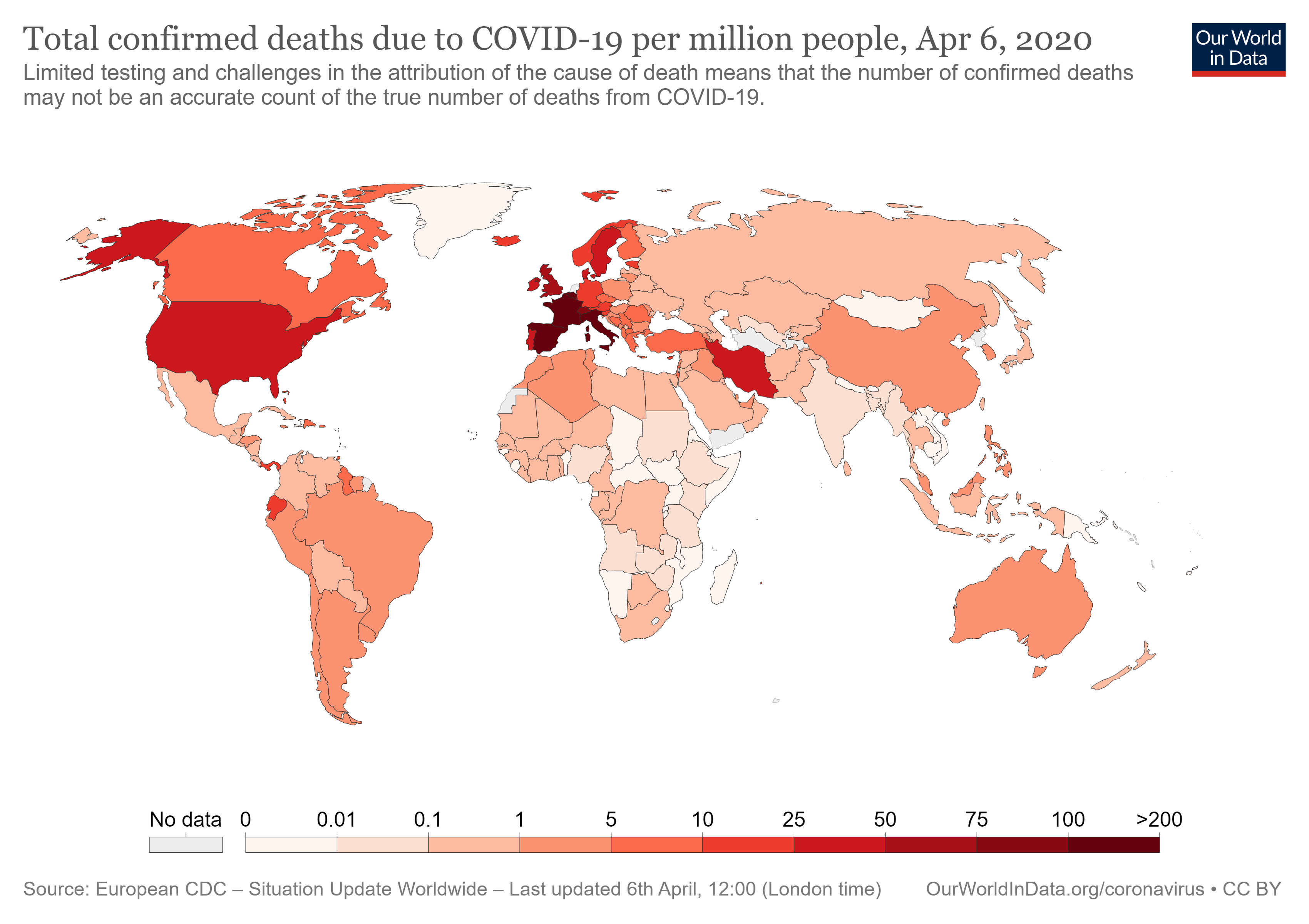
(Our World in Data, CC BY 4.0, Wikimedia Commons)
Figures on job cuts and business closures could soon eclipse those from the aftermath of the financial collapse of 2008. The U.S. jobless rate could hit 30 percent in the second quarter of 2020, according to Federal Reserve Bank of St. Louis President James Bullard, which would mean that we’re talking levels of unemployment not seen since the Great Depression of the 1930s. Many small companies will be unable to reopen. Others could default on their debts and enter bankruptcy.
After all, about half of all small businesses in this country had less than a month’s worth of cash set aside as the coronavirus hit and they employ almost half of the private workforce. In truth, mom-and-pop stores, not the giant corporate entities, are the engine of the economy. The restaurant industry alone could lose 7.4 million jobs, while tourism and retail sectors will experience significant turmoil for months, if not years, to come.
In the first week of coronavirus economic shock, a record 3.3 million Americans filed claims for unemployment. That figure was nearly three times the peak of the 2008 recession and it doubled to 6.6 million a week later, with future numbers expected to rise staggeringly higher.
As sobering as those numbers were, Treasury Secretary Steve “Foreclosure King” Mnuchin branded them “not relevant.” Tone-deafness aside, the reality is that it will take months, once the impact of the coronavirus subsides, for many people to return to work. There will be jobs and possibly even sub-sectors of the economy that won’t rematerialize.
This cataclysm prompted Congress to pass the largest fiscal relief package in its history. As necessary as it was, that massive spending bill was also a reminder that the urge to offer corporations mega-welfare not available to ordinary citizens remains a distinctly all-American phenomenon.
Reflections from 2008 Financial Crisis
The catalyst for this crisis is obviously in a different league from that of 2008, since a viral pandemic is hardly nature’s equivalent of a subprime meltdown. But with an economic system already on the brink of crashing, one thing will prove similar: instability for a vulnerable majority is likely to be matched by nearly unlimited access to money for financial elites who, with stupendous subsidies, will thrive no matter who else goes down.
Once the virus recedes, stock and debt bubbles inflated over the past 12 years are likely to begin to grow again, fueled as then by central bank policies and federal favoritism. In other words, we’ve seen this movie before, but call the sequel: Contagion Meets Wall Street.
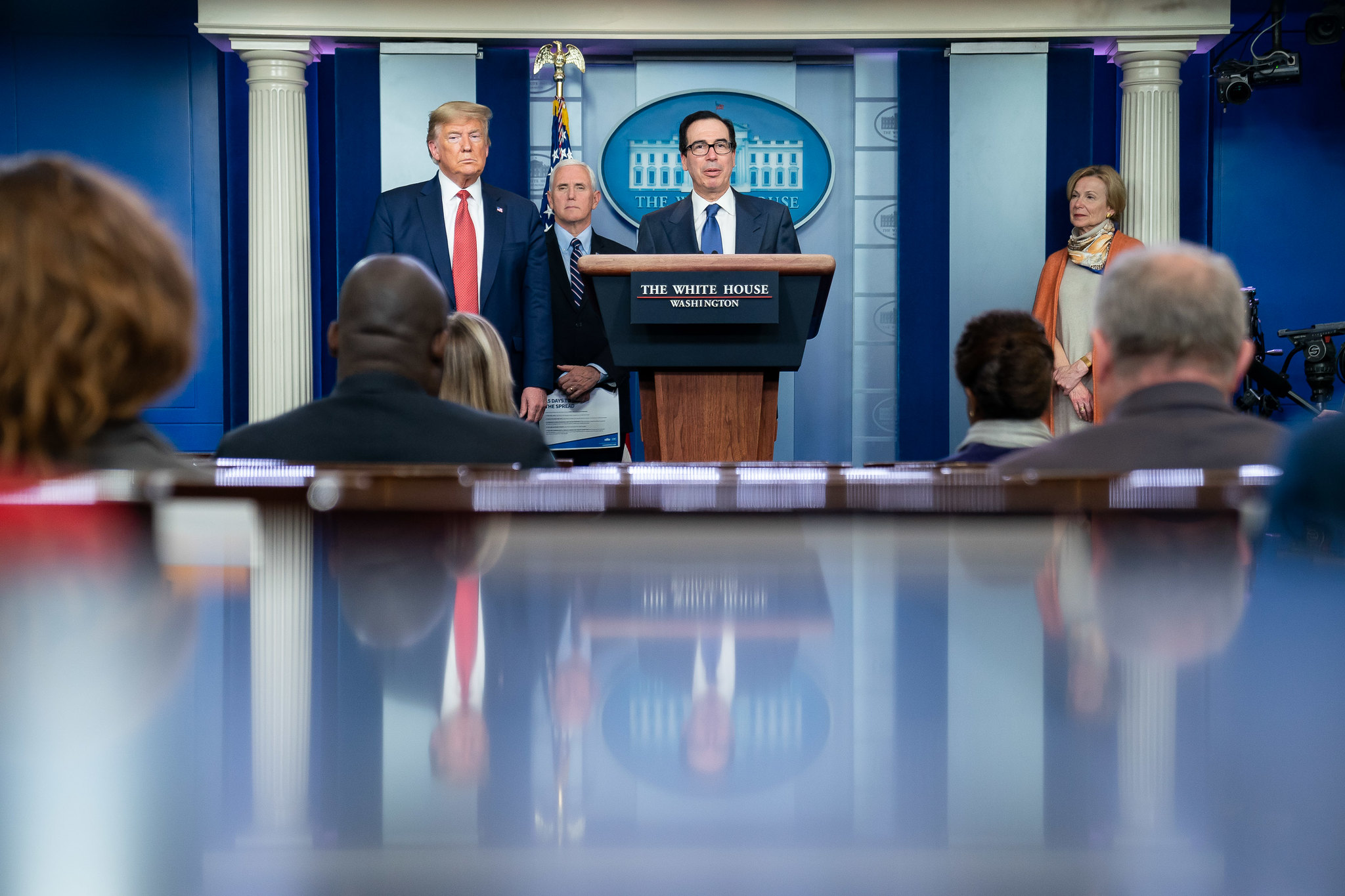
Secretary of the Treasury Steven Mnuchin discusses Covid-19 stimulus package, March 25, 2020. (White House, Tia Dufour)
Unlike in 2020, in the early days of the 2008 financial crisis, economic fallout spread far more slowly. Between mid-September of that year when Lehman Brothers went bankrupt and October 3rd, when the Troubled Asset Relief Program, including a $700 billion Wall Street and corporate bailout package, was passed by Congress, banks were freaked out by the enormity of their own bad bets.
Yet no one then should have been surprised, as I and others had been reporting that the amount of leverage, or debt, in the financial system was a genuine danger, especially given all those toxic subprime mortgage assets the banks had created and then bet on. After Bear Stearns went bankrupt in March 2008 because it had borrowed far too much from other big banks to squander on toxic mortgage assets, I assured listeners on Democracy Now! that this was just the beginning — and so it proved to be. Taxpayers would end up guaranteeing JPMorgan Chase’s buyout of Bear Stearns’s business and yet more bailouts would follow — and not just from the government.
Leaders of the Federal Reserve would similarly provide trillions of dollars in loans, cheap money, and bond-buying programs to the financial system. And this would dwarf the government stimulus packages under both George W. Bush and Barack Obama that were meant for ordinary people.
As I wrote in “It Takes a Pillage: An Epic Tale of Power, Deceit, and Untold Trillions,” instead of the Fed buying those trillions of dollars of toxic assets from banks that could no longer sell them anywhere else, it would have been cheaper to directly cover subprime mortgage payments for a set period of time. In that way, people might have kept their homes and the economic fallout would have been largely contained. Thanks to Washington’s predisposition to offer corporate welfare, that didn’t happen — and it’s not happening now either.
None of this is that complicated: when a system is steeped in so much debt that companies can’t make even low-rate debt payments and have insufficient savings for emergencies, they can crash — fast. All of this was largely forgotten, however, as a combination of Wall Street maneuvering, record-breaking corporate buybacks, and ultra-low interest rates in the years since the financial crisis lifted stock markets globally.
Below the surface, however, an epic debt bubble was once again growing, fostered in part by record corporate debt levels. In 2009, as the economy was just beginning to show the first signs of emerging from the Great Recession, the average American company owed $2 of debt for every $1 it earned. Fast forward to today and that ratio is about $3 to $1. For some companies, it’s as high as $15 to $1. For Boeing, the second largest recipient of federal funding in this country, it’s $37 to $1.
What that meant was simple enough: anything that disrupted the system was going to be exponentially devastating. Enter the coronavirus, which is now creating a perfect storm on Wall Street that’s guaranteed to ripple through Main Street.
Trillions on the Line
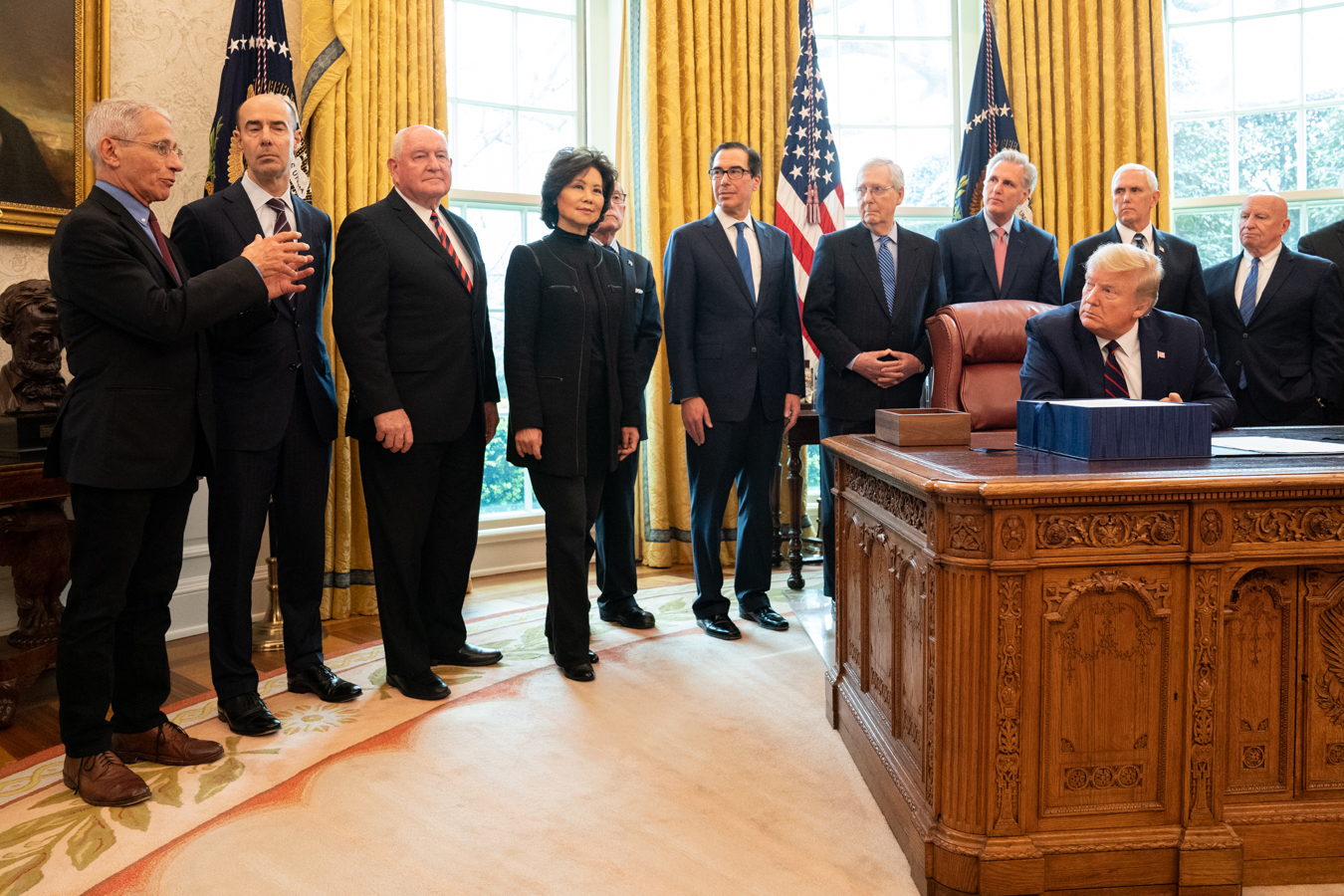
President Donald Trump surrounded by advisers during $2.2 trillion CARES Act signing. (White House, Shealah Craighead)
In total, the CARES Act that Congress passed offers about $2.2 trillion in government relief. As President Donald Trump noted while signing the bill into law, however, total government coronavirus aid could, in the end, reach $6.2 trillion. That’s a staggering sum. Unfortunately, you won’t be surprised to learn that, given both the Trump administration and the Fed, the story hardly ends there.
More than $4 trillion of that estimate is predicated on using $454 billion of CARES Act money to back Federal Reserve-based corporate loans. The Fed has the magical power to leverage, or multiply, money it receives from the Treasury up to 10 times over. In the end, according to the president, that could mean $4.5 trillion in support for big banks and corporate entities versus something like $1.4 trillion for regular Americans, small businesses, hospitals, and local and state governments. That 3.5 to 1 ratio signals that, as in 2008, the Treasury and the Fed are focused on big banks and large corporations, not everyday Americans.
In addition to slashing interest rates to zero, the Fed announced a slew of initiatives to pump money (“liquidity”) into the system. In total, its life-support programs are aimed primarily at banks, large companies, and markets, with some spillage into small businesses and municipalities.
Its arsenal consists of $1.5 trillion in short-term loans to banks and an alphabet soup of other perks and programs. On March 15th, for instance, the Fed announced that it would restart its quantitative easing, or QE, program. In this way, the U.S. central bank creates money electronically that it can use to buy bonds from banks. In an effort to keep Wall Street buzzing, its initial QE revamp will enable it to buy up to $500 billion in Treasury bonds and $200 billion in mortgage-backed securities — and that was just a beginning.
Two days later, the Fed created a Commercial Paper Funding Facility through which it will provide yet more short-term loans for banks and corporations, while also dusting off its Term Asset-Backed Securities Loan Facility (TALF) to allow it to buy securities backed by student loans, auto loans, and credit-card loans. TALF will receive $10 billion in initial funding from the Treasury Department’s Emergency Stabilization Fund (ESF).
And there’s more. The Fed has selected asset-management goliath BlackRock to manage its buying programs (for a fee, of course), including its commercial mortgage and two corporate bond-buying ones (each of which is to get $10 billion in seed money from the Treasury Department’s ESF). BlackRock will also be able to purchase corporate bonds through various Exchange Traded Funds, of which that company just happens to be the biggest provider.
Surpassing measures used in the 2008 crisis, on March 23, the Fed said it would continue buying Treasury securities and mortgage-backed securities “in the amounts needed to support smooth market functioning.” In other words, unlimited quantitative easing. As its chairman, Jerome Powell, told the “Today Show,” “When it comes to this lending, we’re not going to run out of ammunition, that doesn’t happen.” In other words, the Fed will be dishing out money like it’s going out of style — but not to real people.
By March 25, the Fed’s balance sheet had already surged to $5.25 trillion, larger than at its height — $4.5 trillion — in the aftermath of the global financial crisis and it won’t stop there. In other words, the 2008 playbook is unfolding again, just more quickly and on an even larger scale, distributing a disproportionate amount of money to the top tiers of the business world and using government funds to make that money stretch even further.
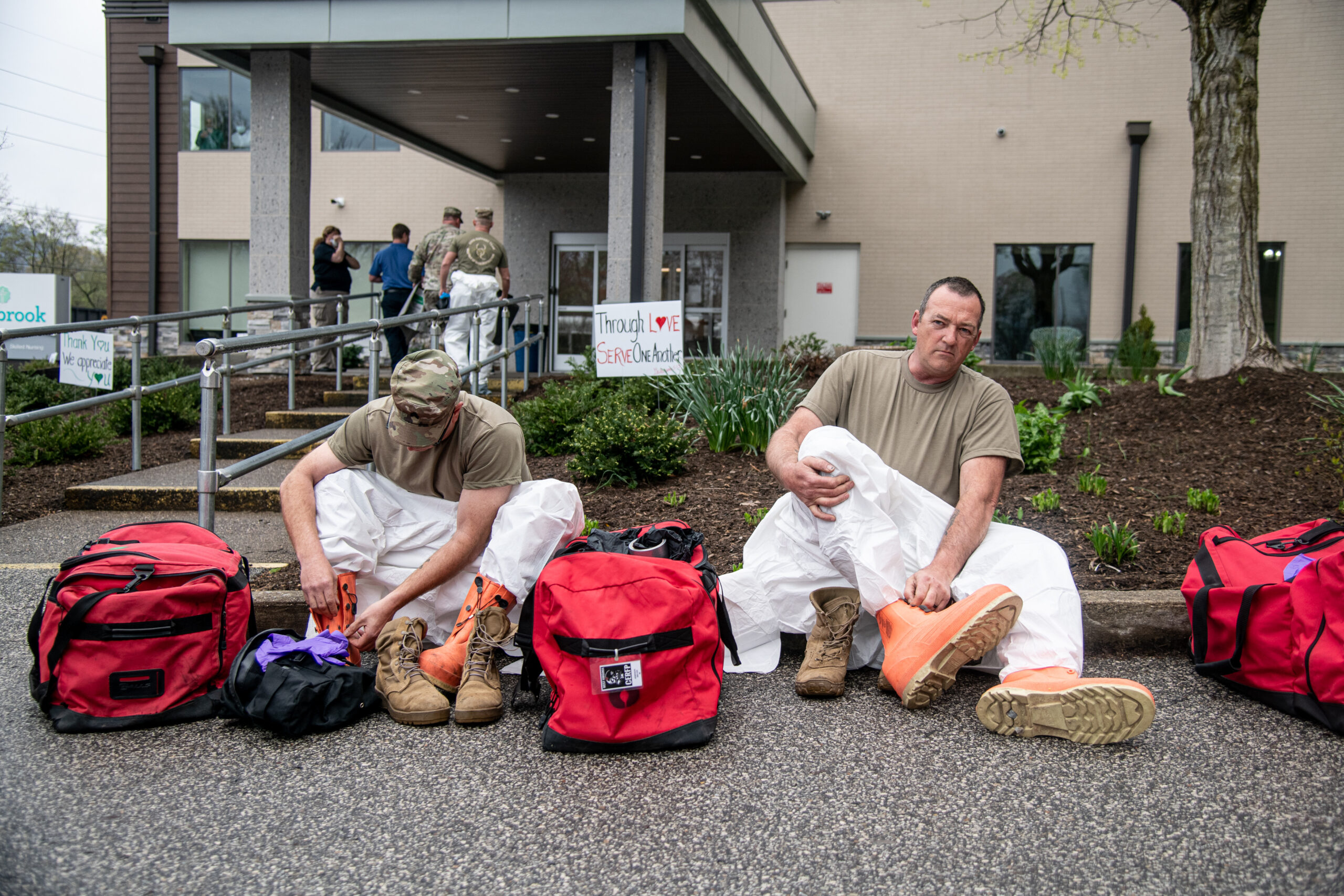
Members of West Virginia National Guard assist with Covid-19 testing at a Charleston nursing home, April 6, 2020. (U.S. Army, Edwin L. Wriston)
Relief Package for Whom?
By now, in our unique pandemic moment, something seems all too familiar. As in 2008, the most beneficial policies and funding will be heading for Wall Street banks and behemoth corporations. Far less will be going directly to American workers through tangible grants, cheaper loans, or any form of debt forgiveness. Even the six months of student-loan payment relief (only for federal loans, not private ones) just pushes those payments down the road.
The historic $2.2 trillion coronavirus relief package is heavily corporate-focused. For starters, a quarter of it, $500 billion, goes to large corporations. At least $454 billion of that will back funding for up to $4.5 trillion in corporate loans from the Fed and the remainder will be for direct Treasury loans to big companies. Who gets what will be largely Treasury Secretary Mnuchin’s choice. And mind you, we may never know the details since President Trump is committed to making this selection process as non-transparent as possible.
There’s an additional $50 billion that’s to be dedicated to the airline industry, $25 billion of which will be in direct grants to airlines that don’t place employees on involuntary furlough or discontinue flight service at airports through September. Right after the bill passed, the airline industry announced that more workforce cuts are ahead (once it gets the money).
Another $17 billion is meant for “businesses critical to maintaining national security,” one of which could eventually be White House darling Boeing. There’s also a corporate tax credit worth about $290 billon to corporations that keep people on their payrolls and can prove losses of 50 percent of their pre-coronavirus revenue.
More than $370 billion of that congressional relief package will go into Small Business Administration loans meant to cover existing loans and operating and payroll costs as well. Yet receiving such loans will involve a byzantine process for desperate small outfits. Meanwhile, the big banks will get a cut for administering them.
About $150 billion is pegged for the healthcare industry, including $100 billion in grants to hospitals working on the frontlines of the coronavirus crisis and other funds to jumpstart the production of desperately needed (and long overdue) medical products for doctors, nurses, and pandemic patients. Another $27 billion is being allocated for vaccines and stockpiles of medical supplies.
An extra $150 billion will go to cities and states to prop up budgets already over-stretched and in trouble. Those on unemployment benefits will get an increase of $600 per week for four months in a $260 billion unemployment expansion.
Ultimately, however, the relief promised will not cover the basic needs of the majority of bereft Americans. With Main Street’s economy sinking right now, it won’t arrive fast enough either. In addition, the highly publicized part of Congress’s relief package that promises up to $1,200 per person, $2,400 per family, and $500 per child, will be barely enough to cover a month of rent and utilities, let alone other essentials, for the typical working family when it finally arrives. Since disbursement will be based on information the Internal Revenue Service has on each individual and family, if you haven’t filed tax returns in the last year or so or if you filed them by mail, funds could be slower to arrive — and don’t forget that the IRS is facing coronavirus-based workforce challenges of its own.
Best Offense Is a Good Defense
The global economic freeze caused by the coronavirus has crushed more people in a shorter span of time than any crisis in memory. Working people will need far more relief than in the last meltdown to keep not just themselves but the very foundations of the global economy going.
The only true avenue for such support is national governments. Central banks remain the dealers of choice for addicted big corporations, private banks, and markets. In other words, given congressional (and Trumpian) sponsored bailouts and practically unlimited access to money from the Fed, Wall Street will, in the end, be fine.
If ground-up solutions to help ordinary Americans and small businesses aren’t adopted in a far grander way, one thing is predictable: once this crisis has been “managed,” we’ll be set up for a larger one in an even more disparate world. When the clouds from the coronavirus storm dissipate, those bailouts and all the corporate deregulation now underway will have created bank and corporate debt bubbles that are even larger than before.
The real economic lesson to be drawn from this crisis should be (but won’t be) that the best offense is a good defense. Exiting this self-induced recession or depression into anything but a less equal world would require genuine infrastructure investment and planning. That would mean focusing post-relief efforts on producing better hospitals, public transportation networks, research and development, schools, and far more adequate homeless shelters.
In other words, actions offering greater protection to the majority of the population would restart the economy in a truly sustainable fashion, while bringing back both jobs and confidence. But that, in turn, would involve a bold and courageous political response providing genuine and proportionate stimulus for people. Unfortunately, given Washington’s 1-percent tilt and Donald Trump’s CEO empathy, that is at present inconceivable.
Subscribe to:
Posts (Atom)