Sunday, April 5, 2020

Saturday, April 4, 2020
New York AG Denounces 'Immoral and Inhumane' Firing of Amazon Worker Who Led Protest Over Lack of Coronavirus Protections
"Taking action cost me my job," said Chris Smalls. "Because I tried to stand up for something that's right, the company decided to retaliate against me."
by
Jake Johnson, staff writer
https://www.commondreams.org/news/2020/03/31/new-york-ag-denounces-immoral-and-inhumane-firing-amazon-worker-who-led-protest-over
New York Attorney General Letitia James late Monday condemned as "immoral and inhumane" Amazon's firing of a Staten Island fulfillment center employee who organized a walkout protesting the retail giant's failure to provide workers with adequate protections against the coronavirus outbreak.
James said in a statement that her office is considering taking legal action against Amazon and called on the National Labor Relations Board to investigate the firing of Chris Smalls, who accused the company of retaliating against him for Monday's demonstration.
"The conditions there are horrific. The items that we use to clean up the building are scarce... We don't have the proper masks, we don't have the latex gloves."
—Chris Smalls, fired Amazon employee
"It is disgraceful that Amazon would terminate an employee who bravely stood up to protect himself and his colleagues," said James. "At the height of a global pandemic, Chris Smalls and his colleagues publicly protested the lack of precautions that Amazon was taking to protect them from COVID-19. Today, Chris Smalls was fired."
Amazon, owned by world's richest man Jeff Bezos, said in a statement that it terminated Smalls for "violating social distancing guidelines" by returning to the Staten Island fulfillment center after he was asked to self-quarantine for 14 days following his exposure to a worker infected by COVID-19.
In an interview with Bloomberg Monday, Smalls called Amazon's claim "ridiculous."
"Taking action cost me my job," said Smalls, who was an assistant manager. "Because I tried to stand up for something that's right, the company decided to retaliate against me."
Thus far, only one worker at the Staten Island fulfillment center has officially tested positive for the novel coronavirus, but Smalls told Bloomberg he believes more employees have been infected and condemned the company's failure to take necessary precautions.
"The conditions there are horrific," said Smalls. "The items that we use to clean up the building are scarce... We don't have the proper masks, we don't have the latex gloves."
"It's all false, it's all sugarcoated," Smalls said of Amazon's insistence that it has put in place adequate safety procedures. "We have plenty of workers that haven't been to work for the entire month of March because they're scared for their lives... We have people that have Lupus, we have people that have asthma, we have people that have infants at home, that have people that's pregnant."
As Common Dreams reported, dozens of employees at Amazon's Staten Island warehouse walked off the job Monday afternoon to protest the facility's unsanitary conditions.
"We're not asking for much," Smalls told CNN ahead of the protest. "We're asking the building to be closed and sanitized, and for us to be paid [during that process]."
McConnell Draws Outrage for 'Ridiculous' Excuse That Trump Impeachment Trial Prevented Action on Coronavirus Crisis
While Trump ignored warnings from experts, critics noted, "he played a lot of golf, hitting the links at least five times from mid-January through early March. Did impeachment cause that?"
by
Jake Johnson, staff writer
https://www.commondreams.org/news/2020/04/01/mcconnell-draws-outrage-ridiculous-excuse-trump-impeachment-trial-prevented-action
Republican Senate Majority Leader Mitch McConnell on Tuesday offered a new—and, according to critics, "ridiculous" and baseless—excuse for the failure of the White House and the federal government more broadly to take early action against the coronavirus outbreak: The impeachment trial of President Donald Trump got in the way.
"And I think it diverted the attention of the government, because everything, every day, was all about impeachment," McConnell claimed.In an appearance on NBC News contributor Hugh Hewitt's talk show, McConnell said the coronavirus outbreak "came up while we were, you know, tied down in the impeachment trial."
But as Inae Oh and Dan Friedman of Mother Jones wrote Tuesday, the Kentucky Republican's argument "ignores reality on multiple counts."
First, there's the fact that senior administration officials, according to the Washington Post, spent weeks in January warning Trump about the virus' potential for disaster in the United States. "Donald Trump may not have been expecting this, but a lot of other people in the government were—they just couldn't get him to do anything about it," one official told the Post. "The system was blinking red."
While Trump ignored those national security warnings, he played a lot of golf, hitting the links at least five times from mid-January through early March. Did impeachment cause that?
McConnell's attempt to blame the Trump impeachment trial—which ended in acquittal on Feb. 5—for Senate inaction also doesn't fit the facts, Oh and Friedman noted.
"The trial didn't stop the Senate's health committee from receiving a briefing about the virus from U.S. public health officials on January 24," they wrote. "If impeachment really had prevented McConnell from taking action on coronavirus, one would have expected him to deal with the issue immediately after the trial concluded on February 5. He did not. The first thing senators did after acquitting Trump was take a five-day weekend. Upon their return, the Senate did not turn to pandemic preparation measures."
Asked about McConnell's claim during a press briefing Tuesday evening, Trump said the impeachment trial "probably did" hinder his response to the coronavirus outbreak, which has been widely condemned as slow and inadequate.
But Trump went on to say that he doesn't think he "would have acted any faster" had he not been impeached by the House of Representatives.
Watch:
Addressing McConnell's comments, Senate Minority Leader Chuck Schumer (D-N.Y.) tweeted Tuesday night that the Kentucky Republican "may have been distracted by impeachment from acting to fight coronavirus, but not everyone was."
"I called for President Trump to declare a public health emergency to fight coronavirus on January 26!" Schumer said.
In his "Popular Information" newsletter Wednesday morning, Judd Legum wrote that "if the federal government failed to respond to an imminent pandemic because it was too concerned about the political fate of Trump, it would be an outrage. But the reality is even worse."
"Years before Trump was impeached, he decimated the government's capacity to respond to a pandemic," Legum noted. "Moreover, while Trump's impeachment and trial were ongoing, Trump found time for his priorities—holding campaign rallies and playing golf. And after Trump was acquitted by the Senate on February 5, Trump continued to downplay the threat of the coronavirus and for many weeks."
Medicare for All Support Surges to 9-Month High in New Poll After Coronavirus Exposes Horrors of Private Insurance
"How can it be that we spend 18% of our GDP on healthcare but still lack the beds, masks, ventilators, gowns, gloves, and test kits we need to adequately respond to this crisis?" asked Sen. Bernie Sanders.
by
Jake Johnson, staff writer
https://www.commondreams.org/news/2020/04/01/medicare-all-support-surges-9-month-high-new-poll-after-coronavirus-exposes-horrors
Support for Medicare for All among U.S. voters has reached a nine-month high in a Morning Consult/Politico tracking poll as the deadly and ongoing coronavirus pandemic lays bare the horrors and systemic inefficiencies of America's profit-driven healthcare system.
The survey (pdf), released Wednesday, found that 55 percent of U.S. voters support Medicare for All, a nine-point jump since February. While support for Medicare for All is highest among Democratic voters at 75%, a majority of Independents—52%—also support the policy, along with 31% of Republicans.
"With the discussion of enacting a universal healthcare system in the United States intensifying, 43 percent of voters say they are more likely to support reforms to grant all Americans health insurance from the government because of the coronavirus outbreak," Murad noted. "Notably, that support does not include the frontrunner in the Democratic presidential primary election—former Vice President Joe Biden."Morning Consult's Yusra Murad wrote that the poll, conducted between March 27-29, "suggests progressive lawmakers may have an opportunity to sway key demographics—support for Medicare for All grew among people in the $50,000-$100,000 income bracket, voters between 45 and 54 years old, and black voters by roughly 10 points each."
As Common Dreams reported, Biden on Monday doubled down on his opposition to Medicare for All, telling MSNBC that single-payer healthcare would "not solve" the coronavirus crisis.
Sen. Bernie Sanders (I-Vt.), Biden's only remaining opponent in the Democratic presidential primary race, has repeatedly argued in recent weeks—alongside many other experts and advocates—that the coronavirus outbreak and the resulting economic meltdown bolsters the case for Medicare for All, the Vermont senator's signature policy proposal.
Sanders' Medicare for All plan would provide everyone in the U.S. with comprehensive healthcare for free at the point of service and virtually eliminate the private insurance system which has left 80 million Americans uninsured or underinsured—a number that is rising rapidly as millions lose their jobs due to the coronavirus outbreak.
"How can it be that we spend 18% of our [gross domestic product] on healthcare—more than any other major country on Earth—but still lack the beds, masks, ventilators, gowns, gloves, and test kits we need to adequately respond to this crisis?" Sanders asked in a tweet on Wednesday.
"We must transform our dysfunctional healthcare system," said Sanders.
Even During a Pandemic, Plutocrats Prioritize Profits Over People
These 24 billionaires, executives, and right-wing pundits are urging a premature rollback of social distancing, risking millions of American lives.
by
Rick Claypool
https://www.commondreams.org/views/2020/04/02/even-during-pandemic-plutocrats-prioritize-profits-over-people
It’s become a truism, almost trite, that with the coronavirus crisis, “we’re all in this together.”
But not everyone agrees.
A small but highly influential group of billionaires, executives and right-wing pundits have a different view: Some of them urge that we must “normalize” the economy as soon as possible, implicitly – and in some cases, explicitly – accepting that this would mean sacrificing lives. Others, apparently, just don’t care about those risks, or conveniently believe against evidence that they are not real or overblown
Proponents paint this callous approach as the kind of “tough” decision that strong leaders must make. They have had a dangerous influence on policy. And although their recommendations have been shunted aside for now, there’s a great risk that save-the-economy-and-let-the-chips fall-where-they-may chorus again gains the president’s favor, with potentially horrifying consequences.
On March 16, the Trump administration announced its “15 Days to Slow the Spread” initiative. Surgeon General Jerome Adams conceded 15 days would likely not be enough time. Treasury Secretary Steven Mnuchin said to expect social distancing measures to last at least through late May or mid-June.
Less than a week into the “15 Days” initiative, Trump posted a tweet that seemed to signal his growing impatience with social distancing and frustration with its impact on the market.
Two days later, the president and Vice President Mike Pence reportedly huddled with billionaire Wall Street executives including:
Stephen Schwarzman, CEO of the Blackstone Group, which holds $545 billion in assets. Schwarzman’s net worth is $15.2 billion;
Robert F. Smith, founder of Vista Equity Partners, a firm with $50 billion. Smith’s net worth is $5 billion;
Kenneth Griffen, founder of Citatel, a hedge fund that manages $32 billion. Griffen’s net worth is $12.2 billion. (Griffen started a new fund to take advantage of the stock volatility caused by the coronavirus crisis.)
Daniel Loeb, founder of the $15 billion hedge fund Third Point. Loeb’s net worth is $2.8 billion;
Paul Tudor Jones, founder of the hedge fund Tudor Investment Corporation with a net worth of $5.1 billion;
John Paulson, founder of the hedge fund Paulson & Co. with a net worth of $4.2 billion; and
Jeffrey Sprecher, the CEO of the Intercontinental Exchange, whose compensation over the past five years is more than $100 million. (Sprecher is the husband Sen. Kelly Loeffler (R-Ga.), who dumped millions in stock following a private coronavirus briefing.)
According to CNBC reporter Kayla Tausche, Vice President Mike Pence’s former chief of staff arranged the call and was “running backchannel” between the White House and corporate America.
After the meeting, Trump held a press conference to announce he intended to push for a hastened end to the social distancing measures, saying “America will again — and soon — be open for business. […] Very soon, a lot sooner than three or four months that somebody was suggesting. A lot sooner. We cannot let the cure be worse than the problem itself.”
In the meantime, a chorus of corporate executives, free-market extremists and right-wing ideologues started backing the president’s push to hasten the resumption of normal business activity.
When criticized for this reckless, aggressive timeline despite credible forecasts that millions could die absent aggressive measures, Trump doubled down and accused the experts pushing back on his Easter reopening date of being politically motivated. “I think there are certain people that would like it not to open so quickly […] I think there are certain people that would like [the economy] to do financially poorly, because they think that would be very good as far as defeating me at the polls.”
Dr. Anthony Fauci, the top federal authority on infectious diseases, pushed back against the president’s arbitrary timeline on CNN: “And you’ve got to understand that you don’t make the timeline, the virus makes the timeline. So you’ve got to respond, in what you see happen. And if you keep seeing this acceleration, it doesn’t matter what you say. One week, two weeks, three weeks – you’ve got to go with what the situation on the ground is.”
Several days later, Trump relented and postponed his aspirational reopening of the country to June 1 after his health advisors persuaded him the casualty cost could be massive. Trump ally Sen. Lindsey Graham (R-S.C.) reportedly told the president he would own the deaths if coronavirus lockdowns are prematurely ended.
For the moment, Trump has decided to avoid the worst-case scenario and listen to public health experts instead of Wall Street billionaires.
But it’s still a scandal that the profiteers’ advice to the president – which could have cost millions of lives – was taken so seriously that the nation’s top public health experts had to force a course correction in order to avert that catastrophe.
The heartlessness undergirding the advice to end or diminish social distancing is jaw-dropping. What’s plain is that, despite a few members of the chorus saying they are willing to sacrifice themselves, purportedly to assist the younger generation, the proponents of a “return to normalcy” are treating coronavirus deaths as a statistical abstraction. They don’t imagine that actual humans’ lives are in the balance, or at least not the lives of anyone they know.
Perhaps the super wealthy believe that in their bubble they can protect themselves. This in fact may be true to some extent (the super rich are rushing to second homes in the Hamptons and elsewhere and some billionaires are opting to self-isolate on super-yachts). It’s a certainty in our harshly unequal society that the coronavirus will take a far worse toll on lower-income communities.
But it’s not just the callousness of the ”return the economy to normal” advocates that is so shocking. So too is their blinkered outlook. The economic costs of lockdowns and social distancing are in fact severe, catastrophically so for many, and impose their own health costs. There is good reason to believe these costs could have been significantly ameliorated if the United States had responded far more aggressively to the coronavirus, including especially with scaled-up testing. Somehow, the billionaires and pundits who want to re-start the economy seem to ignore this point. They also seem oblivious to the stark reality that the economy cannot simply be re-started, no matter what Trump or anyone else decrees.
The real problem is the virus, not the restrictions. Loosening social distancing restrictions would spike the public health disaster we are facing and bring disastrous economic consequences almost surely as severe as what we now are experiencing. At some point in the future, it will be possible to loosen restrictions – but making sensible decisions on this score and being able to maintain a less restrictive environment requires adequate testing, which is still unavailable, as well as having in place a massive system to do contact tracing. People who are serious about doing everything possible about getting the economy going as soon as possible, without sacrificing hundreds of thousands of lives or more, would be demanding on these fronts and screaming about the administration’s patent and ongoing failures.
Here is a sampling of those voices who recklessly pushed to suspend life-saving social distancing measures during the coronavirus crisis. Many are millionaires and billionaires with great influence in Washington, and with the Trump White House in particular. Some are more crass than others. A few of them come right out and admit that they are OK with seeing more deaths so that the economy can get going again. The milder voices call for partial social distancing suspensions – at best, a foolish undermining of medical advice. The worst peddle outright conspiracy theories that the lockdowns are politically driven. Generally, they couch their concern as helping everyday Americans avoid the real economic pain caused by social distancing, but it is very hard to avoid the conclusion that their concerns are with profit and an ideological zeal for unregulated markets.
Surely there is nothing patriotic about their call to sacrifice American lives during a global pandemic in a self-defeating effort to return to normalcy. This is not a normal time.
Billionaires and Corporate Executives
1. Lloyd Blankfein
Former CEO of Goldman Sachs
Net worth: $1.3 billion
2. Gary Cohn
Former Goldman Sachs executive and former Trump administration economic advisor
Net worth: $252 million – $611 million
Reportedly spoke “for many on Wall Street arguing for a need to ‘normalise’ the economy. ‘Decision will be difficult but it must be made,’ he said. (Source: Financial Times)
3. Tilman Fertitta
Owner, Golden Nugget casinos, Houston Rockets, Bubba Gump Shrimp
Net worth: $3.2 billion
Feritta complains his company is “doing basically no business” wants authorities to let businesses reopen in a limited capacity by mid-April. (Source: Bloomberg News)
4. Tom Golisano
Founder and chairman of Paychex, Inc.
Net worth: $3 billion
“The damages of keeping the economy closed as it is could be worse than losing a few more people.” Golisano has subsequently apologized for his comments. (Source: Bloomberg News)
5. Charles Koch and Americans for Prosperity
Chairman and CEO of Koch Industries; founder and funder of Americans for Prosperity
Net worth: $40.3 billion
While Charles Koch has personally been silent on the pandemic, the organization he heavily backs, Americans for Prosperity, has forcefully pushed back against governors ordering the closures of non-essential businesses. Emily Seidel, the group’s CEO, released a statement opposing the closures and arguing that, “Rather than blanket shutdowns, the government should allow businesses to continue to adapt and innovate to produce the goods and services Americans need, while continuing to do everything they can to protect the public health.”
The group’s state chapters have followed suit, with both the Pennsylvania and Michigan state directors opposing state closures of nonessential businesses.
Unlike millions of frontline workers, Americans for Prosperity employees, it should be noted, can work from home, as the organization reportedly has gone “totally remote” in light of social distancing requirements. (Source: The Intercept)
6. Dick Kovacevich
Former CEO and chairman of Wells Fargo & Co.
Compensated more than $188 million over last five years at Wells Fargo (2002-2007)
Regarding requiring workers aged 55 and younger to return to work: “We’ll gradually bring those people back and see what happens. Some of them will get sick, some may even die, I don’t know. […] Do you want to suffer more economically or take some risk that you’ll get flu-like symptoms and a flu-like experience? Do you want to take an economic risk or a health risk? You get to choose.” (Source: Bloomberg News)
7. Elon Musk
CEO, Tesla, SpaceX
Net worth: $32 billion
Musk has repeatedly downplayed the coronavirus pandemic in an email to employees on March 13, comparing the death toll to the death toll from car crashes.
Since March 21, Musk seems to have taken a turn, and has subsequently distributed 1,000 ventilators from China to Los Angeles and pledged to repurposing Tesla factories to produce ventilators. (Source: Buzzfeed News / Vox)
8. Michael Saylor
CEO of MicroStrategy
Net worth: Once worth $7 billion and dubbed “the richest person in Washington, D.C.,” Saylor famously lost $6 billion in one day when the tech bubble burst.
In a March 16 email to 2,000 MicroStrategy employees saying he expected them to keep coming to the office despite public health warnings, Saylor said:
[T]he “economic damage” of social distancing and quarantines was greater than “the theoretical benefit of slowing down a virus” and suggested that it would make more sense to “quarantine the 40 million elderly retired, immune compromised people who no longer need to work or get educated” and described “the absolutely worse case” as “the overall life expectancy worldwide would click down by a few weeks … Instead of 79.60 years to live we would have 79.45 years to live. 1 out of 500 people will pass on a bit sooner, or not, or die from a celebrated disease instead of just old age.”
After numerous media outlets reported on the email, Saylor sent another message to employees allowing them to work from home.
(Source: The Guardian / The Wall Street Journal)
9. Barry Sternlicht
Founder of investment firm Starwood Capital Group and donor to South Bend, Ind., Mayor Pete Buttigieg’s presidential campaign
Net worth: $3 billion
“I kind of agree with the president, frankly, because you cannot kill the economy, the largest economy in the world. We don’t have enough money to fix it, and it’s not fixable. It’s a balance, is all I’m saying. I’ve never seen a counter of deaths every day of my life. I’ve never seen that. And if I saw it for the flu, I’d probably freak out, for regular flu I’d probably be freaking out too. […] To say we’re going to shut the economy down for two years or 18 months is just ridiculous. I mean it is a flu. It will pass. […] Let’s get on with it.” (Source: CNBC)
10. Mark Wilson
President and CEO of the Florida Chamber of Commerce
Led the Florida Chamber of Commerce’s effort of lobbying Florida Gov. Ron DeSantis against a statewide shutdown of nonessential businesses. “We’re recommending that the governor continue to do what he’s doing […] I don’t think the data says we need to do a statewide shutdown.” Gov. DeSantis was among the governors holding out against announcing a statewide shutdown of nonessential businesses until finally relenting on April 1. (Source: Tampa Bay Times)
Conservative Leaders and Pundits
1. Glenn Beck
Former Fox News Channel host and CEO of The Blaze
Net worth: At least $100 million
“I’m in the danger zone. I would rather have my children stay home and all of us who are over 50 go in and keep this economy going and working, even if we all get sick, I would rather die than kill the country. ‘Cause it’s not the economy that’s dying, it’s the country.” (Source: Media Matters)
2. John Cardillo
Newsmax TV host
3. Sean Davis
Co-founder of The Federalist, former staffer for Texas Gov. Rick Perry and Sen. Tom Coburn (R-Okla.) On Twitter, Davis attacked Dr. Scott Gottlieb, a physician, former pharmaceutical executive and FDA commissioner under President Trump until 2019.
It is not known who funds The Federalist, which published an article declaring, “It seems harsh to ask whether the nation might be better off letting a few hundred thousand people die. Probably for that reason, few have been willing to do so publicly thus far. Yet honestly facing reality is not callous, and refusing even to consider whether the present response constitutes an even greater evil than the one it intends to mitigate would be cowardly.”
4. Tom Fitton
President of Judicial Watch, a conservative activist group
Fitton has made numerous posts agitating for an end to the closure of nonessential businesses resulting from social distancing measures.
In another post, Fitton links to a blog post showing top epidemiologist Dr. Anthony Fauci praising Hilary Clinton with a video of himself saying, “Well isn’t that interesting,” fueling conspiracy theories that Fauci is seeking to undermine President Trump. (Source: The New York Times)
5. Rudy Giuliani
Personal attorney for President Trump and former mayor of New York City
Net worth: $45 million
Posted a tweet quoting Candace Owens, a former director of urban engagement for the right-wing group Turning Point USA, minimizing the number of deaths caused by the coronavirus outbreak.
6. Ed Henry
Fox News Channel host
“The best estimate of the mortality rate is less than 1%, every life matters, and you don’t want to minimize any of them, *but* when the mortality rate is that low, what is the balance” (Source: MediaMatters)
7. Brit Hume
Fox News Channel political analyst
“He is saying, for his own part, that he’d be willing to take a risk of getting the disease if that’s what it took to allow the economy to move forward. And he said that because he’s late in life, you know, that he would be perhaps more willing then he might’ve been and a younger age. Which seems to me to be an entirely reasonable viewpoint.” (Source: MediaMatters)
8. Steve Hilton
Fox News Channel host and former advisor to David Cameron, Prime Minister of the United Kingdom
“You know that famous phrase, ‘The cure is worse than the disease?’ That is exactly the territory we are hurting towards. […] You think it is just the coronavirus that kills people? This total economic shutdown will kill people. […] “Save small businesses. Flatten the curve, but not the economy, and do it before it’s too late.” (Source: The Hill)
9. Ron Johnson (R-Wis.)
Net worth: Holds assets worth at least $10.8 million
“Every premature death is a tragedy, but death is an unavoidable part of life. More than 2.8 million die each year — nearly 7,700 a day. The 2017-18 flu season was exceptionally bad, with 61,000 deaths attributed to it. Can you imagine the panic if those mortality statistics were attributed to a new virus and reported nonstop?” (Source: USA Today op-ed)
10. Charlie Kirk
Founder and president of Turning Point USA, a right-wing group that does on-campus organizing.
11. Dan Patrick
Lieutenant Governor of Texas
“No one reached out to me and said, ‘As a senior citizen, are you willing to take a chance on your survival in exchange for keeping the America that all America loves for your children and grandchildren?’ And if that is the exchange, I’m all in […] My messages is that let’s get back to work, let’s get back to living. Let’s be smart about it and those of us who are 70+, we’ll take care of ourselves. But don’t sacrifice the country.” (Source: CNN)
12. Bill Mitchell
Host of a right-wing talk show YourVoice America (“We’re all MAGA all the time!”)
13. David McIntosh
President of Club for Growth
“We need to act to contain the virus, but at the same time more people would be hurt and have terrible health and life consequences if they don’t reopen the economy,” Mr. McIntosh said. “They have to put an end to the social distancing some time in the near future to restore economic activity.” (Source: The New York Times)
14. Buck Sexton
Host of The Buck Sexton Show, a conservative talk show
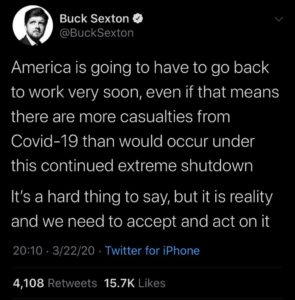
Sexton posted and then later deleted a tweet that said, “America is going to have to go back to work very soon, even if that means there are more casualties from Covid-19 than would occur under this continued extreme shutdown[.] It’s a hard thing to say, but it is reality and we need to accept and act on it.”
Medicare for Each of Us in the Age of the Coronavirus
The U.S. public—and increasingly the business community—are becoming acutely aware of the rising costs and inadequacies of our current for-profit system, particularly as the current epidemic unfolds. There is no other choice but Medicare for All.
by
Peter S. Arno, Philip Caper
https://www.commondreams.org/views/2020/04/03/medicare-each-us-age-coronavirus
Over the past two weeks, the explosive growth of the coronavirus pandemic has forced nearly 10 million Americans to file for unemployment benefits. Along with their jobs, many have lost their health insurance, if they had any to begin with. Aside from possibly spelling disaster for these newly unemployed workers and their families, this situation puts both the public health and economic wellbeing of our country at great risk. A clearer rationale for universal, affordable, lifetime health coverage as exemplified under a Medicare For All framework would be hard to find.
In this article we outline the need for a universal health plan, its historical context, and the obstacles raised by the medical-industrial complex that must be overcome.
There is a large elephant in the room in the national discussion of Medicare for All: the transformation of the US health care system’s core mission from the prevention, diagnosis, and treatment of illness—and the promotion of healing—to an approach dominated by large, publicly traded corporate entities dedicated to growing profitability and share price, that is, the business of medicine.
The problem is not that these corporate entities are doing something they shouldn’t. They are simply doing too much of what they were created to do—generate wealth for their owners. Unlike any other wealthy country, we let them do it. The dilemma of the US health care system is due not to a failure of capitalism or corporatism per se, but a failure to implement a public policy that adequately constrains their excesses.
This commercialized, commodified, and corporatized model is driving the US public’s demand for fundamental reform and has elevated the issue of health care to the top of the political agenda in the current presidential election campaign.Since the late 1970s, US public policy regarding health care has trended toward an increasing dependence on for-pofit corporations and their accompanying reliance on the tools of the marketplace—such as competition, consolidation, marketing, and consumer choice—to expand access and assure quality in the provision of medical care.
Costs have risen relentlessly, and the quality of and access to care for many Americans has deteriorated. The cultural changes accompanying these trends have affected every segment of the US health care system, including those that remain nominally not-for-profit. Excessive focus on health care as a business has had a destructive effect on both patients and caregivers, leading to increasing difficulties for many patients in accessing care and to anger, frustration, and burnout for many caregivers, especially those attempting to provide critical primary care.
As a result, the ranks of primary care providers have eroded, and that erosion continues. One of the major reasons for burnout in this group is the clash between its members’ professional ethics (put the patient first and “first do no harm”) and the profit-oriented demands of their corporate employers. Applying Band-Aids can’t cure the underlying causes of disease in medicine or public policy. Ignoring the underlying pathology in public policy, as in clinical medicine, is destined to fail.
Many of the symptoms of our dysfunctional health care system are not in dispute:
We pay more than twice as much per person on total health care spending and on prescription drugs in comparison to other developed countries. This spending totals nearly 18 percent of our economy
Between 2008 and 2018, premiums for employer-sponsored insurance plans increased 55 percent, twice as fast as workers’ earnings (26 percent). Over the same time period, the average health insurance deductible for covered workers increased by 212 percent
An average employer-sponsored family health insurance policy now exceeds $28,000 per year, with employers paying about $16,000 and employees paying about $12,000
Almost half (45 percent) of US adults ages 19 to 64, or more than 88 million people, were inadequately insured over the past year (either they were uninsured, had a gap in coverage, or were underinsured; that is, they had insurance all year but their out-of-pocket costs were so high that they frequently did not receive the care they needed).
Compared to other developed countries, the US ranks near the bottom on a variety of health indicators including infant mortality, life expectancy, and preventable mortality.
We must therefore ask: How is it that we spend more on health care than any other nation, yet have arrived at such a sorry state of affairs?
The answer is that only in the United States has corporatism engulfed so much of medical care and come so close to dominating the doctor-patient relationship. Publicly traded, profit-driven entities—under constant pressure from Wall Street—control the financing and delivery of medical care in the US to an extent seen nowhere else in the world. For instance, seven investor-owned publicly traded health insurers now control almost a trillion dollars ($913 billion) of total national health care spending and cover half the US population. In 2019, their revenue increased by 31 percent, while their profits grew by 66 percent.
The corporatization of medical care may be the single most distinguishing characteristic of the modern US health care system and the one that has had the most profound impact on it since the early 1980s. The theology of the market and the strongly held—but mistaken—belief that the problems of US health care can be solved if only the market could be perfected have effectively obstructed the development of a rational, efficient, and humane national health care policy.
There are three main reasons to pursue a public policy that embraces genuine health care reform:
Saving lives: To simplify our complex and confusing health care system while providing universal affordable health care coverage;
Affordability: To rein in the relentless rise in health care costs that are cannibalizing private and public budgets; and
Improving quality: To eliminate profitability and share price as the dominant and all-consuming mission of the entities that provide health care services and products when that mission influences clinical decision making. Profitability should be the servant of any health care system’s mission, not its master as seems to be increasingly the case in the US.
What Is The Best Approach To Reform?
It is not an exaggeration to say that no reform other than publicly financed, single-payer universal health care will solve the problems of our health care system. This is true whether we are talking about a public option, a Medicare option, Medicare buy-in, Medicare extra, or any other half-measure. The main reason is because of the savings that are inherent only in a truly universal single-payer plan. Specifically, the administrative and bureaucratic savings gained by eliminating private insurers are the largest potential source of savings in a universal single-payer framework, yet all the “option” reforms listed above leave largely intact the tangle of wasteful, inefficient, and costly private commercial health insurers. The second largest source of savings comes through reducing the cost of prescription drugs by using the negotiating leverage of the federal government to bring down prices, as is done in most other developed countries. The ability, will, and policy tools (such as global budgeting) to restrain these and other costs in a single-payer framework are the key to reining in the relentless rise in health care expenditures and providing universal coverage.
The various “option” reform proposals will not simplify our confusing health care system nor will they lead to universal coverage. None have adequate means to restrain health care costs. So why go down this road? Is it too difficult for the US to guarantee everyone access to affordable care when every other developed country in the world has done so?
The stated reason put forth in favor of these mixed option approaches is that Americans want “choice.” But choice of what? We know with certainty from former insurance company executives such as Wendell Potter that the false “choice” meme polls well with the US public and was used to undermine the Clinton reform efforts more than 25 years ago. It is being widely used today to manipulate public opinion.
But choice in our current system is largely an illusion. In 2019, 67.8 million workers across the country separated from their job at some point during the year—either through layoffs, terminations, or switching jobs. This labor turnover data leaves little doubt that people with employer-sponsored insurance are losing their insurance constantly, as are their spouses and children. And even for those who stay at the same job, insurance coverage often changes. In 2019, more than half of all firms offering health benefits reported shopping for a new health plan and, among those, nearly 20 percent actually changed insurance carriers. Trading off choice of doctors or hospitals for choice of insurance companies is a bad bargain.
The other major objection to a universal single-payer program is cost. Yet, public financing for health care is not a matter of raising new money for health care but of reducing total health care outlays and distributing payments more equitably and efficiently. Nearly every credible study concludes that a single-payer universal framework, with all its increased benefits, would be less costly than the status quo, more effective in restraining future cost increases, and more popular with the public—as 50 years of experience with Medicare has demonstrated.
The status quo generates hundreds of billions of dollars in surplus and profits to private stakeholders, who need only spend a small portion (millions of dollars) to influence legislators, manipulate public opinion, distort the facts, and obfuscate the issues with multiple competing reform efforts.
Conclusion
The real struggle for a universal single-payer system in the US is not technical or economic but almost entirely political. Retaining the status quo (for example, the Affordable Care Act) is the least disruptive course for the existing medical-industrial complex, and therefore the politically easiest route. Unfortunately, the status quo is disruptive to the lives of most Americans and the least effective route in attacking the underlying pathology of the US health care system—corporatism run amok. Following that route will do little more than kick the can down the road, which will require repeatedly revisiting the deficiencies in our health care system outlined above until we get it right.
The US public and increasingly the business community are becoming acutely aware of the rising costs and inadequacies of our current system, particularly as the current epidemic unfolds. It is the growing social movement, which rejects the false and misleading narratives, that will lead us to a universal single-payer system—truly the most effective way to reform our health care system for the benefit of the American people.
Subscribe to:
Comments (Atom)