Sunday, February 23, 2020
Where Have You Gone, Smedley Butler?
Maj. Danny Sjursen
https://www.truthdig.com/articles/where-have-you-gone-smedley-butler/
This piece originally appeared on TomDispatch.
There once lived an odd little man — five feet nine inches tall and barely 140 pounds sopping wet — who rocked the lecture circuit and the nation itself. For all but a few activist insiders and scholars, U.S. Marine Corps Major General Smedley Darlington Butler is now lost to history. Yet more than a century ago, this strange contradiction of a man would become a national war hero, celebrated in pulp adventure novels, and then, 30 years later, as one of this country’s most prominent antiwar and anti-imperialist dissidents.
Raised in West Chester, Pennsylvania, and educated in Quaker (pacifist) schools, the son of an influential congressman, he would end up serving in nearly all of America’s “Banana Wars” from 1898 to 1931. Wounded in combat and a rare recipient of two Congressional Medals of Honor, he would retire as the youngest, most decorated major general in the Marines.
A teenage officer and a certified hero during an international intervention in the Chinese Boxer Rebellion of 1900, he would later become a constabulary leader of the Haitian gendarme, the police chief of Philadelphia (while on an approved absence from the military), and a proponent of Marine Corps football. In more standard fashion, he would serve in battle as well as in what might today be labeled peacekeeping, counterinsurgency, and advise-and-assist missions in Cuba, China, the Philippines, Panama, Nicaragua, Mexico, Haiti, France, and China (again). While he showed early signs of skepticism about some of those imperial campaigns or, as they were sardonically called by critics at the time, “Dollar Diplomacy” operations — that is, military campaigns waged on behalf of U.S. corporate business interests — until he retired he remained the prototypical loyal Marine.
But after retirement, Smedley Butler changed his tune. He began to blast the imperialist foreign policy and interventionist bullying in which he’d only recently played such a prominent part. Eventually, in 1935 during the Great Depression, in what became a classic passage in his memoir, which he titled “War Is a Racket,” he wrote: “I spent thirty-three years and four months in active military service… And during that period, I spent most of my time being a high class muscle-man for Big Business, for Wall Street, and for the Bankers.”
Seemingly overnight, the famous war hero transformed himself into an equally acclaimed antiwar speaker and activist in a politically turbulent era. Those were, admittedly, uncommonly anti-interventionist years, in which veterans and politicians alike promoted what (for America, at least) had been fringe ideas. This was, after all, the height of what later pro-war interventionists would pejoratively label American “isolationism.”
Nonetheless, Butler was unique (for that moment and certainly for our own) in his unapologetic amenability to left-wing domestic politics and materialist critiques of American militarism. In the last years of his life, he would face increasing criticism from his former admirer, President Franklin D. Roosevelt, the military establishment, and the interventionist press. This was particularly true after Adolf Hitler’s Nazi Germany invaded Poland and later France. Given the severity of the Nazi threat to mankind, hindsight undoubtedly proved Butler’s virulent opposition to U.S. intervention in World War II wrong.
Nevertheless, the long-term erasure of his decade of antiwar and anti-imperialist activism and the assumption that all his assertions were irrelevant has proven historically deeply misguided. In the wake of America’s brief but bloody entry into the First World War, the skepticism of Butler (and a significant part of an entire generation of veterans) about intervention in a new European bloodbath should have been understandable. Above all, however, his critique of American militarism of an earlier imperial era in the Pacific and in Latin America remains prescient and all too timely today, especially coming as it did from one of the most decorated and high-ranking general officers of his time. (In the era of the never-ending war on terror, such a phenomenon is quite literally inconceivable.)
Smedley Butler’s Marine Corps and the military of his day was, in certain ways, a different sort of organization than today’s highly professionalized armed forces. History rarely repeats itself, not in a literal sense anyway. Still, there are some disturbing similarities between the careers of Butler and today’s generation of forever-war fighters. All of them served repeated tours of duty in (mostly) unsanctioned wars around the world. Butler’s conflicts may have stretched west from Haiti across the oceans to China, whereas today’s generals mostly lead missions from West Africa east to Central Asia, but both sets of conflicts seemed perpetual in their day and were motivated by barely concealed economic and imperial interests.
Nonetheless, whereas this country’s imperial campaigns of the first third of the twentieth century generated a Smedley Butler, the hyper-interventionism of the first decades of this century hasn’t produced a single even faintly comparable figure. Not one. Zero. Zilch. Why that is matters and illustrates much about the U.S. military establishment and contemporary national culture, none of it particularly encouraging.
Why No Antiwar Generals
When Smedley Butler retired in 1931, he was one of three Marine Corps major generals holding a rank just below that of only the Marine commandant and the Army chief of staff. Today, with about 900 generals and admirals currently serving on active duty, including 24 major generals in the Marine Corps alone, and with scores of flag officers retiring annually, not a single one has offered genuine public opposition to almost 19 years worth of ill-advised, remarkably unsuccessful American wars. As for the most senior officers, the 40 four-star generals and admirals whose vocal antimilitarism might make the biggest splash, there are more of them today than there were even at the height of the Vietnam War, although the active military is now about half the size it was then. Adulated as many of them may be, however, not one qualifies as a public critic of today’s failing wars.
Instead, the principal patriotic dissent against those terror wars has come from retired colonels, lieutenant colonels, and occasionally more junior officers (like me), as well as enlisted service members. Not that there are many of us to speak of either. I consider it disturbing (and so should you) that I personally know just about every one of the retired military figures who has spoken out against America’s forever wars.
The big three are Secretary of State Colin Powell’s former chief of staff, retired Colonel Lawrence Wilkerson; Vietnam veteran and onetime West Point history instructor, retired Colonel Andrew Bacevich; and Iraq veteran and Afghan War whistleblower, retired Lieutenant Colonel Danny Davis. All three have proven to be genuine public servants, poignant voices, and — on some level — cherished personal mentors. For better or worse, however, none carry the potential clout of a retired senior theater commander or prominent four-star general offering the same critiques.
Something must account for veteran dissenters topping out at the level of colonel. Obviously, there are personal reasons why individual officers chose early retirement or didn’t make general or admiral. Still, the system for selecting flag officers should raise at least a few questions when it comes to the lack of antiwar voices among retired commanders. In fact, a selection committee of top generals and admirals is appointed each year to choose the next colonels to earn their first star. And perhaps you won’t be surprised to learn that, according to numerous reports, “the members of this board are inclined, if not explicitly motivated, to seek candidates in their own image — officers whose careers look like theirs.” At a minimal level, such a system is hardly built to foster free thinkers, no less breed potential dissidents.
Consider it an irony of sorts that this system first received criticism in our era of forever wars when General David Petraeus, then commanding the highly publicized “surge” in Iraq, had to leave that theater of war in 2007 to serve as the chair of that selection committee. The reason: he wanted to ensure that a twice passed-over colonel, a protégé of his — future Trump National Security Advisor H.R. McMaster — earned his star.
Mainstream national security analysts reported on this affair at the time as if it were a major scandal, since most of them were convinced that Petraeus and his vaunted counterinsurgency or “COINdinista” protégés and their “new” war-fighting doctrine had the magic touch that would turn around the failing wars in Iraq and Afghanistan. In fact, Petraeus tried to apply those very tactics twice — once in each country — as did acolytes of his later, and you know the results of that.
But here’s the point: it took an eleventh-hour intervention by America’s most acclaimed general of that moment to get new stars handed out to prominent colonels who had, until then, been stonewalled by Cold War-bred flag officers because they were promoting different (but also strangely familiar) tactics in this country’s wars. Imagine, then, how likely it would be for such a leadership system to produce genuine dissenters with stars of any serious sort, no less a crew of future Smedley Butlers.
At the roots of this system lay the obsession of the American officer corps with “professionalization” after the Vietnam War debacle. This first manifested itself in a decision to ditch the citizen-soldier tradition, end the draft, and create an “all-volunteer force.” The elimination of conscription, as predicted by critics at the time, created an ever-growing civil-military divide, even as it increased public apathy regarding America’s wars by erasing whatever “skin in the game” most citizens had.
More than just helping to squelch civilian antiwar activism, though, the professionalization of the military, and of the officer corps in particular, ensured that any future Smedley Butlers would be left in the dust (or in retirement at the level of lieutenant colonel or colonel) by a system geared to producing faux warrior-monks. Typical of such figures is current chairman of the Joint Chiefs of Staff Army General Mark Milley. He may speak gruffly and look like a man with a head of his own, but typically he’s turned out to be just another yes-man for another war-power-hungry president.
One group of generals, however, reportedly now does have it out for President Trump — but not because they’re opposed to endless war. Rather, they reportedly think that The Donald doesn’t “listen enough to military advice” on, you know, how to wage war forever and a day.
What Would Smedley Butler Think Today?
In his years of retirement, Smedley Butler regularly focused on the economic component of America’s imperial war policies. He saw clearly that the conflicts he had fought in, the elections he had helped rig, the coups he had supported, and the constabularies he had formed and empowered in faraway lands had all served the interests of U.S. corporate investors. Though less overtly the case today, this still remains a reality in America’s post-9/11 conflicts, even on occasion embarrassingly so (as when the Iraqi ministry of oil was essentially the only public building protected by American troops as looters tore apart the Iraqi capital, Baghdad, in the post-invasion chaos of April 2003). Mostly, however, such influence plays out far more subtly than that, both abroad and here at home where those wars help maintain the record profits of the top weapons makers of the military-industrial complex.
That beast, first identified by President Dwight D. Eisenhower, is now on steroids as American commanders in retirement regularly move directly from the military onto the boards of the giant defense contractors, a reality which only contributes to the dearth of Butlers in the military retiree community. For all the corruption of his time, the Pentagon didn’t yet exist and the path from the military to, say, United Fruit Company, Standard Oil, or other typical corporate giants of that moment had yet to be normalized for retiring generals and admirals. Imagine what Butler would have had to say about the modern phenomenon of the “revolving door” in Washington.
Of course, he served in a very different moment, one in which military funding and troop levels were still contested in Congress. As a longtime critic of capitalist excesses who wrote for leftist publications and supported the Socialist Party candidate in the 1936 presidential elections, Butler would have found today’s nearly trillion-dollar annual defense budgets beyond belief. What the grizzled former Marine long ago identified as a treacherous nexus between warfare and capital “in which the profits are reckoned in dollars and the losses in lives” seems to have reached its natural end point in the twenty-first century. Case in point: the record (and still rising) “defense” spending of the present moment, including — to please a president — the creation of a whole new military service aimed at the full-scale militarization of space.
Sadly enough, in the age of Trump, as numerous polls demonstrate, the U.S. military is the only public institution Americans still truly trust. Under the circumstances, how useful it would be to have a high-ranking, highly decorated, charismatic retired general in the Butler mold galvanize an apathetic public around those forever wars of ours. Unfortunately, the likelihood of that is practically nil, given the military system of our moment.
Of course, Butler didn’t exactly end his life triumphantly. In late May 1940, having lost 25 pounds due to illness and exhaustion — and demonized as a leftist, isolationist crank but still maintaining a whirlwind speaking schedule — he checked himself into the Philadelphia Navy Yard Hospital for a “rest.” He died there, probably of some sort of cancer, four weeks later. Working himself to death in his 10-year retirement and second career as a born-again antiwar activist, however, might just have constituted the very best service that the two-time Medal of Honor winner could have given the nation he loved to the very end.
Someone of his credibility, character, and candor is needed more than ever today. Unfortunately, this military generation is unlikely to produce such a figure. In retirement, Butler himself boldly confessed that, “like all the members of the military profession, I never had a thought of my own until I left the service. My mental faculties remained in suspended animation while I obeyed the orders of higher-ups. This is typical…”
Today, generals don’t seem to have a thought of their own even in retirement. And more’s the pity…

Study: Twitter Bots Amplified Climate Denial Messages to Help Trump
Jessica Corbett / Common Dreams
https://www.truthdig.com/articles/study-suggests-twitter-bots-amplified-climate-denial-messages/
Editor’s note: This article originally appeared on Common Dreams.
A new analysis of 6.5 million tweets from the days before and after U.S. President Donald Trump announced his intention to ditch the Paris agreement in June 2017 suggests that automated Twitter bots are substantially contributing to the spread of online misinformation about the climate crisis.
RELATED ARTICLES

Australia Offers a Preview of the World to Come
BY TOM ENGELHARDT / TOMDISPATCH

The Depressing Numbers Behind the GOP's Climate Denialism
BY ILANA NOVICK
Brown University researchers “found that bots tended to applaud the president for his actions and spread misinformation about the science,” according to the Guardian, which first reported on the draft study Friday. “Bots are a type of software that can be directed to autonomously tweet, retweet, like, or direct message on Twitter, under the guise of a human-fronted account.”
As the Guardian summarized:
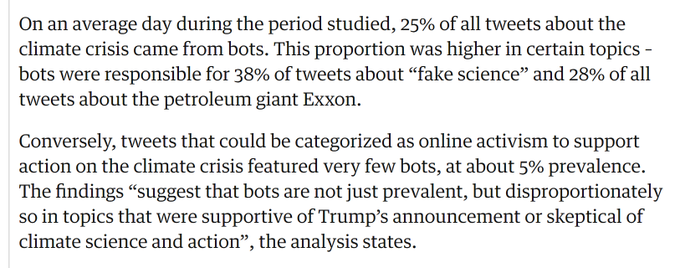
On an average day during the period studied, 25% of all tweets about the climate crisis came from bots. This proportion was higher in certain topics—bots were responsible for 38% of tweets about “fake science” and 28% of all tweets about the petroleum giant Exxon.
Conversely, tweets that could be categorized as online activism to support action on the climate crisis featured very few bots, at about 5% prevalence. The findings “suggest that bots are not just prevalent, but disproportionately so in topics that were supportive of Trump’s announcement or skeptical of climate science and action,” the analysis states.
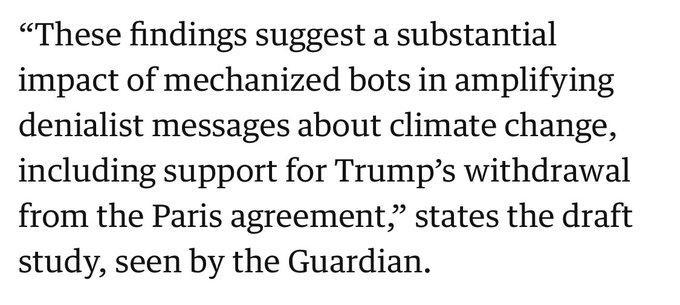
More broadly, the study adds, “these findings suggest a substantial impact of mechanized bots in amplifying denialist messages about climate change, including support for Trump’s withdrawal from the Paris agreement.”

Andrew Stroehlein
✔@astroehlein
Pro-Trump, anti-environment bots are dominating a significant part of the climate discussion on Twitter. (A better approach to anonymity would help change this.)
https://www.theguardian.com/technology/2020/feb/21/climate-tweets-twitter-bots-analysis …
11
9:44 AM - Feb 21, 2020
Twitter Ads info and privacy
15 people are talking about this
Thomas Marlow, the Brown Ph.D. candidate who led the study, told the Guardian that his team decided to conduct the research because they were “always kind of wondering why there’s persistent levels of denial about something that the science is more or less settled on.” Marlow expressed surprise that a full quarter of climate-related tweets were from bots. “I was like, ‘Wow that seems really high,'” he said.
In response to the Guardian report, some climate action advocacy groups reassured followers that their tweets are written by humans:

Friends of the Earth
 @friends_earth
This tweet has been written by a human, but a QUARTER of all tweets about the #ClimateCrisis are produced by bots, according to a new study.
The result? A distortion of the online conversation to "include far more climate science denialism..."https://www.theguardian.com/technology/2020/feb/21/climate-tweets-twitter-bots-analysis …

Revealed: quarter of all tweets about climate crisis produced by bots
Draft of Brown study says findings suggest ‘substantial impact of mechanized bots in amplifying denialist messages’theguardian.com
26
4:49 AM - Feb 21, 2020
Twitter Ads info and privacy
21 people are talking about this

Energy Watch Group@EWGnetwork
25% of tweets about #climatechange are made by bots - study by @BrownUniversity.
This can distort the public debate on this issue, especially as bots often spread #climatedenialism@EWGnetwork can proudly promise all our tweets are human-made.https://www.theguardian.com/technology/2020/feb/21/climate-tweets-twitter-bots-analysis …
Revealed: quarter of all tweets about climate crisis produced by bots
Draft of Brown study says findings suggest ‘substantial impact of mechanized bots in amplifying denialist messages’theguardian.com
2
4:14 AM - Feb 21, 2020
Twitter Ads info and privacy
See Energy Watch Group's other Tweets
Other climate organizations that shared the Guardian‘s report on Twitter weren’t surprised by the results of the new research:

Greenpeace EU
✔@GreenpeaceEU
wow it's ALMOST as if there are a few rich and powerful companies who are extremely invested people not taking the #ClimateEmergency seriouslyhttps://www.theguardian.com/technology/2020/feb/21/climate-tweets-twitter-bots-analysis …
Revealed: quarter of all tweets about climate crisis produced by bots
Draft of Brown study says findings suggest ‘substantial impact of mechanized bots in amplifying denialist messages’theguardian.com
21
4:29 AM - Feb 21, 2020
Twitter Ads info and privacy
15 people are talking about this

Extinction Rebellion Guildford@XRGuildford
#ClimateCrisis denial is largely BOTS! In news that won't surprise anyone with Twitter, fake accounts are driving #climatedenial.
Another tool used by the mega rich to stop us coming together to drive change for a fair, safe future. #ClimateChangehttps://www.theguardian.com/technology/2020/feb/21/climate-tweets-twitter-bots-analysis …
Revealed: quarter of all tweets about climate crisis produced by bots
Draft of Brown study says findings suggest ‘substantial impact of mechanized bots in amplifying denialist messages’theguardian.com
24
5:59 AM - Feb 21, 2020
Twitter Ads info and privacy
20 people are talking about this
“The Brown University study wasn’t able to identify any individuals or groups behind the battalion of Twitter bots, nor ascertain the level of influence they have had around the often fraught climate debate,” the Guardian noted. “However, a number of suspected bots that have consistently disparaged climate science and activists have large numbers of followers on Twitter.”
Cognitive scientist John Cook, who has studied online climate misinformation, told the Guardian that bots are “dangerous and potentially influential” because previous research has shown “not just that misinformation is convincing to people but that just the mere existence of misinformation in social networks can cause people to trust accurate information less or disengage from the facts.”
As Cook, a research assistant professor at the Center for Climate Change Communication at George Mason University, put it: “This is one of the most insidious and dangerous elements of misinformation spread by bots.”
Naomi Oreskes is a Harvard University professor and science historian who also has studied climate misinformation, including an October 2019 report (pdf) co-authored by Cook about the fossil fuel industry’s decades of efforts to mislead the American public. In a tweet Friday, Oreskes called the new research “important work” but added “I wish they’d published it before going to the media.”

Ketan Joshi
✔@KetanJ0
This is a draft, unpublished study so take with
 but it is an amazing finding on the role of automation to amplify messages on climate on social media.
Bots are used mostly in tweets critical of action or supportive of Trump -->> https://www.theguardian.com/technology/2020/feb/21/climate-tweets-twitter-bots-analysis?utm_campaign=Carbon%20Brief%20Daily%20Briefing&utm_medium=email&utm_source=Revue%20newsletter …
16
5:16 AM - Feb 21, 2020
Twitter Ads info and privacy
See Ketan Joshi's other Tweets
The Guardian report on Marlow and his colleagues’ analysis came just a few months after the Trump administration formally began the one-year process of withdrawing from the Paris accord, which critics said sent “a signal to the world that there will be no leadership from the U.S. federal government on the climate crisis—a catastrophic message in a moment of great urgency.”
The findings also came about a month after the Bulletin of Atomic Scientists issued a historic warning about the risk of global catastrophe by setting the Doomsday Clock at 100 seconds to midnight. The bulletin warned in its statement announcing the clock’s new time that “humanity continues to face two simultaneous existential dangers—nuclear war and climate change—that are compounded by a threat multiplier, cyber-enabled information warfare, that undercuts society’s ability to respond.”
“Focused attention is needed to prevent information technology from undermining public trust in political institutions, in the media, and in the existence of objective reality itself,” the bulletin added. “Cyber-enabled information warfare is a threat to the common good. Deception campaigns—and leaders intent on blurring the line between fact and politically motivated fantasy—are a profound threat to effective democracies, reducing their ability to address nuclear weapons, climate change, and other existential dangers.”
Ilhan Omar Has a Plan to Revolutionize U.S. Foreign Policy
Greg Wilpert / The Real News Network
https://www.truthdig.com/articles/ilhan-omar-has-a-plan-to-revolutionize-u-s-foreign-policy/
What follows is a conversation between Win Without War’s Kate Kizer and Greg Wilpert of The Real News Network. Read a transcript of their conversation below or watch the video at the bottom of the post.
GREG WILPERT: It’s The Real News Network. I’m Greg Wilpert in Arlington, Virginia.
Congresswoman Ilhan Omar of Minnesota introduced a package of seven bills last week, which she calls the Pathway to Peace. This legislation, if it were passed, would mean nothing short of a revolution in the way that U.S. foreign policy is conducted. Last year, Omar already said that she plans to make U.S. foreign policy more ethical.
ILHAN OMAR: I want to make sure that here in the United States we understand that there are other countries who take in so many people of the world’s most pained people, and in the United States we could do better.
GREG WILPERT: The package of seven bills would end arm sales to countries that violate human rights, provide foreign aid to youth in developing countries, shift $5 billion from the Pentagon to the state department for a global peace building fund and grant Congress oversight over U.S. economic sanctions. Also, the bills would have the U.S. sign the UN Convention on the Rights of the Child, a global migration agreement, and the Rome Statute on the International Criminal Court.
Joining me now to analyze Representative Ilhan Omar’s proposal is Kate Kizer. She’s the Policy Director at Win Without War, a national grassroots advocacy organization that works to help establish a more progressive foreign policy for the United States. Thanks for joining us today, Kate.
KATE KIZER: Thanks for having me.
GREG WILPERT: The chances that this package of bills would be approved by congress, particularly by the Republican controlled senate, and then not be vetoed by the president, is pretty slim. So what’s the significance of Representative Omar’s Pathway to Peace?
KATE KIZER: It’s a really important marker of what Progressive’s want to see on foreign policy. For a long time there’s been little to no debate within the Democratic Party of how we would actually reform U.S. foreign policy to meet the values that the U.S. says it stands for. So it’s very exciting to see Representative Omar lay down such bold markers of how we would change U.S. engagement with the world, and not only to socialize these ideas amongst her peers in Congress, even if they won’t end up becoming law this year, but also to signal what we would expect to see from a progressive White House in the future.
GREG WILPERT: Now, in an article that you wrote for The American Prospect about the Pathway to Peace, you point out that the United States has historically pushed for a rules-based international system, but you also point out that the U.S. has at the same time considered itself to be an exception to these rules and not bound by them. For example, the U.S. is the only country in the world not to have signed the UN Convention on the Rights of the Child, and one of the few that hasn’t supported the International Criminal Court or the UN compact on migration.
Now, getting the U.S. to abide by these UN conventions would imply a significant shift in U.S. foreign policy. Is there support among the Democratic Party and presidential candidates for such a shift, and if not, how might such support be built?
KATE KIZER: In rhetoric, I think there absolutely is support for these ideas of being an internationalist, of being a multilateralist in foreign policy. The U.S. government says it supports the multilateral system, but as you just mentioned, it’s my analysis that we actually act to undermine it, which weakens that system, and prevents us from actually positively reforming the system to meet the needs of the 21st century.
So it’s been very exciting to see Senator Warren and Senator Sanders on the campaign trail really stake out an internationalist position that supports multilateralism, and it would absolutely require the U.S. to not only join these international conventions that set out the rule of the road, but also to establish more norms and standards that it not only holds itself accountable to but other countries. Without holding ourselves accountable to these standards, we can’t then act for accountability for other countries. Ultimately, that undermines any U.S. power to implement these rules of the road.
GREG WILPERT: Now currently, not only hasn’t the U.S. signed these conventions that we mentioned, but it also flaunts international law when it imposes unilateral economic sanctions on countries such as on Venezuela, Russia, or Iran. That is, according to the UN charter it is illegal for countries to engage in collective punishment. Now, the Pathway to Peace includes a bill that would require Congress to approve of economic sanctions, but it would still mean that sanctions could violate international law actually. I mean wouldn’t a bill that would outlaw all non-UN-approved sanctions be better?
KATE KIZER: I think that the fact that U.S. sanctions has really become a reflexive tool in the toolkit that many policymakers don’t see as a form of warfare, is very problematic. I think Congresswoman Omar recognized this. She’s obviously been an advocate for an end to U.S. blanket sanction regimes that violate international law and cause undue hardship to regular people in sanctioned countries. But I think she’s strategic in that she recognizes that many members of Congress in particular are not ready to just do away with all U.S. sanctions power.
So what she is doing is really staking out what a first step in sanctions reform look like. First Congress must A, have to affirmatively vote to approve any sanctions. In doing so it would force Congress with having to reckon with whether or not sanctions actually can achieve the policy goals that they say they want to achieve, which the academic literature indicates they can’t and don’t. And they would also have to reckon with the humanitarian impact of sanctions, which Congress largely ignores at this point, and it has led to some of the world’s worst humanitarian crises as we’re seeing in Venezuela, and North Korea, and Iran.
GREG WILPERT: Now, while the U.S. sanctions governments it does not like, it actually arms governments that it does like such as Saudi Arabia, and it arms them to the teeth even when they violate human rights or wage war. Now, one of these bills in Omar’s package, the Stop Arming Human Rights Abusers Act, would dramatically change this practice, and require the president to certify whether countries engage in human rights abuses lest they be cut off from U.S. arms.
Now, if this bill were to become law, we can though be fairly certain I would say that a president such as Trump would not rule a country such as Israel or Saudi Arabia to be a violator of human rights. Wouldn’t it be better to have an independent commission make such a judgment on human rights abuses?
KATE KIZER: Actually, the Stop Arming Human Rights Abusers Act would establish an independent human rights commission that’s been modeled off of the international commission for religious freedom. How that works in practice is, there is independent commissioners who evaluate the human rights records and evidence of human rights abuses of a subject country, and they would essentially tier them on whether or not they meet the threshold for a cutoff of assistance.
The nice thing about this bill is, despite the fact that there are human rights protections in current U.S. foreign assistance and arm sales laws, they’re not regularly enforced because they’re so broadly and generally written that they’re difficult to enforce, and the incentive at the state department and the department of defense is to continue sending out weapons and other assistance to countries versus trying to halt assistance.
So this would take those decisions out of the hands of those bureaucracies and instead provide independent analysis to determine whether or not countries are violating the thresholds that Miss Omar’s bill identifies. So, again, it would be a really strong step in the right direction in that it would essentially provide a huge way for civil society to influence whether or not the U.S. is providing security assistance, police officer training, or weapons to a subject country, and create a much more transparent process.
GREG WILPERT: Okay. Well, we’re going to leave it there for now, but we’ll continue to see how this bill fares in Congress. I was speaking to Kate Kizer, Policy Director at Win Without War. Thanks for joining us today Kate.
KATE KIZER: Thanks for having me Greg.
GREG WILPERT: Thank you for joining The Real News Network.
Alexandria Ocasio-Cortez Endorses Slate of Progressive Female Candidates
Julia Conley / Common Dreams
https://www.truthdig.com/articles/alexandria-ocasio-cortez-endorses-slate-of-progressive-women-candidates/
Rep. Alexandria Ocasio-Cortez on Friday released her first slate of endorsements through her political action committee, Courage to Change, announcing her backing of seven progressive women running for congressional seats.
Several of the candidates primary challengers to more centrist Democrats who have the support of the Democratic Congressional Campaign Committee (DCCC) and other establishment Democrats.

Alexandria Ocasio-Cortez
✔@AOC
Today @CouragetoChange is announcing its first endorsements of newcomers to Congress:
SENATE
Cristina Tzintzún Ramirez (TX)
HOUSE
Teresa Fernandez (NM)
Kara Eastman (NE)
Georgette Gomez (CA)
Marie Newman (IL)
Jessica Cisneros (TX)
Samelys Lopez (NY)https://secure.actblue.com/donate/aoc-ctc-social-2020220?refcode=launchtw …

Reward Courage | Donate to Our Candidates
Will you split a donation to bolster each of these incredible campaigns?secure.actblue.com
16K
9:17 AM - Feb 21, 2020
Twitter Ads info and privacy
4,356 people are talking about this
Ocasio-Cortez’s list includes House candidates Teresa Fernandez of New Mexico, Samelys López of New York, and Georgette Gómez of California, who are all running for open seats. López, who has experienced homelessness in the past, called Ocasio-Cortez’s support “a great honor.”

Samelys López for NY-15
 (Bronx)
✔@SamelysLopez
As a directly impacted person who has experienced homelessness and many other issues our neighbors in #NY15 are facing, receiving the endorsement of @AOC's @CouragetoChange is a great honor.
We can't do this without you. Chip in $27 now to help fuel us!http://Actblue.com/donate/lftpctct

663
8:33 AM - Feb 21, 2020
Twitter Ads info and privacy
195 people are talking about this
The congresswoman also endorsed Kara Eastman, who is challenging Rep. Don Bacon (R-Neb.); and Cristina Tzintzún Ramirez, a labor activist who is challenging Democrat M.J. Hegar and several other candidates for the Senate seat held by Texas Republican John Cornyn. Hegar is supported by the Democratic Senatorial Campaign Committee (DSCC) and Senate Minority Leader Chuck Schumer (D-N.Y.).
Tzintzún Ramirez was also recently endorsed by Lone Star Forward PAC, a committee with ties to Way to Win, another progressive organization.
Courage to Change also officially announced its endorsement of two more progressives who are challenging longtime conservative Democratic lawmakers: Marie Newman of Illinois and Jessica Cisneros of Texas. Ocasio-Cortez said last year that she was endorsing the two candidates.
All of the endorsed candidates back progressive priorities like Medicare for All and the Green New Deal and environmental justice.
“One of our primary goals is to reward political courage in Congress and also to help elect a progressive majority in the House of Representatives,” Ocasio-Cortez told the New York Times. “There’s kind of a dual nature to this: One is opening the door to newcomers, and the other is to reward members of Congress that are exhibiting very large amounts of political courage.”
Courage to Change was set up in January with the aim of helping “working-class champions” and working people get elected to public office. Ocasio-Cortez worked in the service industry just months before her surprise primary victory against former Rep. Joe Crowley in New York’s 14th congressional district.
“All of our endorsed candidates refuse corporate PAC donations and center their movements on an inclusive message that puts working-families first—not wealthy donors,” wrote Ocasio-Cortez in an email to supporters Friday. The congresswoman began her PAC after the DCCC announced it would blacklist any political consultants who advised primary challengers to incumbent Democrats.
Ocasio-Cortez has refused to pay dues to the DCCC due to the blacklist, declining to contribute to a fund which could harm Newman’s and Cisneros’s campaigns, and has instead raised money on her own for progressives.
“If we’re going to build an economy that works for all, a democracy that includes everyone, and a society that centers working-class families, things must change,” Ocasio-Cortez wrote Friday, “And that starts by electing new progressive leaders who exemplify political courage, who refuse to bow to corporate interests, and who will fight for social, racial, economic, and environmental justice for all.”
At What Point Does Bloomberg’s Unprecedented Ad Spending Amount to Bribery of the Media?
Bloomberg has already spent $400 million on ads, making hardly a dent in his $60 billion fortune.
BY JULIANNE TVETEN
http://inthesetimes.com/article/22316/michael-bloomberg-political-campaign-ad-spending-media?link_id=6&can_id=50af4a83af05135e8d7750e0c3d68401
Reaching staggering heights, billionaire and former New York City Mayor Michael Bloomberg’s Democratic presidential campaign has exceeded $400 million in spending for television, radio and online advertising. In early February, the campaign announced plans to dramatically increase that number—still a paltry fraction of Bloomberg’s fortune of over $60 billion.
It’s hardly unorthodox for a presidential candidate to devote millions of dollars to advertising. Historically, major candidates have spent roughly comparable amounts—regardless of the sources of their donations—generating a relatively level playing field in financial terms. In 2016, for example, Democratic presidential candidate Bernie Sanders’ campaign spent a reported $73.7 million on TV ads, while Democratic opponent Hillary Clinton spent $62.6 million. Republican candidates Marco Rubio and Jeb Bush spent $72.7 million and $66.9 million respectively.
Yet these numbers are a mere sliver of Bloomberg’s totals. In fact, Bloomberg’s expenditures aren’t just astronomical; they’re unprecedented, amounting to what many critics have called an act of grand-scale bribery in pursuit of the world’s most powerful political position.
Bloomberg formally entered the presidential race comparatively late, in November of 2019. Since then, he has eschewed the traditional campaigning methods used by opponents Bernie Sanders, Elizabeth Warren, Pete Buttigieg, Joe Biden and Amy Klobuchar, such as town halls in the earliest primary states like Iowa, New Hampshire and Nevada, relying instead on a colossal advertising budget. As part of that strategy, Bloomberg reportedly plans to concentrate on highly populous Super Tuesday states like California and Texas; Florida, whose primaries are on March 17; and New York and Pennsylvania, which hold primaries on April 28.
Currently, a hefty portion of Bloomberg’s ad spending is devoted to TV commercials in preparation for Super Tuesday on March 3, when more than one-third of the electorate is expected to vote. According to data from FiveThirtyEight, the campaign has produced at least 39 commercials, costing more than $300 million as of February 14. FiveThirtyEight displays 10 ads, most of which have aired hundreds of times in Texas, California and Florida. For comparison, Tom Steyer, another billionaire in the Democratic race and the second-highest ad buyer, has spent an estimated $133 million on commercials as of February 14.
Additionally, Bloomberg has far outpaced his opponents in digital ad expenditures. The campaign has spent at least $42 million on more than 90,000 ads, according to its latest disclosures. Bloomberg’s Facebook advertising has accelerated precipitously; the campaign’s daily Facebook ad expenses are now over $1.3 million. Bloomberg’s spending reached its greatest heights in the largest states: From November 14 to February 11, the campaign spent north of $4.2 million, $5.5 million and $13.4 million in Texas, California and Florida respectively. Again, Steyer is a distant second, hovering around $100,000 per day. As of February 14, Sanders’ one-day expenditure followed at approximately $70,800; Buttigieg at $42,600; Warren at $26,000; Klobuchar at $13,800 and Biden at $7,600.
Meanwhile, as of mid-February, Bloomberg ranked first among political ad buyers on Google, with a total of 33,869 ads costing nearly $37 million. Similar to his TV and Facebook ads, Bloomberg’s Google ads appear to be courting the Super Tuesday vote. While expenditures peaked in mid-January, ad spends were again on the rise moving into February. This considerably surpasses Steyer’s campaign, the second-highest-spending Democratic campaign on Google, which has bought over $7 million worth of advertising, as well as the campaigns of Buttigieg ($6.36 million), Sanders ($5.3 million), Warren ($4.27 million), Biden ($1.64 million) and Klobuchar ($1.6 million).
The ad blitz appears to have been chillingly effective, throwing into sharp relief the immense influence the super-wealthy wield in U.S. politics. Since the ads began, Bloomberg’s poll numbers have soared. According to RealClearPolitics, Bloomberg’s polling average was 4.9% as of December 24; as of January 23, it had climbed to 7.7%. In a February 10 Quinnipiac national poll of Democratic candidates, Bloomberg placed third, at 15%. A day later, a Morning Consult poll showed the candidate had risen to 17%.
Bloomberg’s ad flurry has also been a boon to the broadcast industry. CNBC reported that Bloomberg’s spending “has created a windfall for local TV broadcasters.” The report elaborated: “Shares of publicly traded companies that own local broadcasters have also risen a welcome surprise for an industry that’s being eroded by digital media. Shares of Nexstar Media Group, the largest of the local broadcasting companies, are up over 20% since news of Bloomberg’s run broke in late November. Shares of Gray Television are up about 10%.”
Other broadcast corporations have confirmed Bloomberg’s effect on their profits. According to The Intercept, Christopher Ripley, president and CEO of Sinclair Media Group, which owns over 190 television stations throughout the United States, said the “amount of fundraising that’s happened through this year has broken all records.” He added that Sinclair is “already benefiting tremendously from that and the entrance of players like Bloomberg.” In addition, Patrick McCreery, an executive of media firm Meredith Corporation, said, “Bloomberg is certainly having an impact across most of our footprint.” This means that media channels—in addition to Bloomberg L.P., the mass media company Bloomberg owns—have an incentive to prolong Bloomberg’s candidacy in a blatant conflict of interest.
Bloomberg’s ability to spend with such abandon stems from his personal wealth, which is the sole source of his campaign funding. The billionaire—a former Republican whose ideology has manifested in rank racism, transphobia, misogyny and animus toward the poor—touts this donor-free model as proof of his financial and ideological independence from “special interests.” But his strategy to fund his own candidacy is no sign of virtue; Bloomberg has a record of leveraging his monstrous wealth into political viability.
On account of his self-funding, Bloomberg didn’t qualify for the Democratic presidential debates in November, December, January and early February, which required participants to reach a certain threshold of donations. Yet, last January, the Democratic National Committee suspiciously eliminated the fundraising criteria for the next debate on February 19, replacing it with a minimum polling requirement of 10 percent in four polls released from January 15 to February 18, or 12 percent in two polls conducted in Nevada or South Carolina—a benchmark Bloomberg has met, thanks entirely to his plutocratic status.
This dovetails with Bloomberg’s history of purchasing political alliances. Through a series of so-called philanthropic municipal initiatives, including grants and other monetary “support packages,” Bloomberg has ingratiated himself with current and former mayors throughout the country, garnering endorsements from at least two dozen officials, including Washington, D.C. Mayor Muriel Bowser; San Francisco Mayor London Breed; and former Flint, Michigan Mayor Karen Weaver. According to the New York Times, at least four of his endorsers received funding from Bloomberg “worth a total of nearly $10 million.” Accompanying the endorsements, appropriately enough, is an outpour of uncritical media coverage.
It’s far from hyperbolic to suggest that Bloomberg is attempting to buy the presidency from an all-too-eager political media apparatus. If recent developments are any indication, it’s likely that Bloomberg’s visibility will only grow for the foreseeable future. As that happens—if indeed it does—it will be imperative to question why it was ever allowed.
“I Would Love Medicare for All”: A Nevada Culinary Union Member on Why She Supports Bernie Sanders
While the powerful Culinary Workers Union in Nevada is attacking Sanders’ universal healthcare plan, a rank-and-file worker says “a lot of members want Bernie” and support Medicare for All.
BY REBECCA BURNS
http://inthesetimes.com/article/22317/medicare-for-all-nevada-culinary-union-bernie-sanders-healthcare?link_id=7&can_id=50af4a83af05135e8d7750e0c3d68401
Bernie Sanders is leading in the Nevada polls, but he faces a major obstacle: One of the most powerful actors in state politics has come out swinging against his signature proposal—Medicare for All.
The 60,000-member Culinary Workers Union announced last Thursday that it will remain neutral in the Democratic primary this year. But in the past week, the union has sent out a series of communications to members warning, both directly and indirectly, that Sanders’ plan threatens its hard-won healthcare benefits.
One flyer circulated by the union read, “Some politicians promise … ‘You will get more money for wages from the company if you give up Culinary Health Insurance.’ These politicians have never sat at our bargaining table … We will not hand over our healthcare for promises.”
Sanders’ opponents have seized on the opening to double down on arguments for preserving private health insurance—a position the union shares.
“There are 14 million union workers in America who have fought hard for strong, employer-provided health benefits,” tweeted former South Bend Mayor Pete Buttigieg. “Medicare for All Who Want It protects their plans and union members' freedom to choose the coverage that's best for them.”
Billionaire Tom Steyer, meanwhile, has started airing an ad in Nevada telling voters that “unions don’t like” Sanders’ healthcare plan.
Known nationally as a standard-bearer for militant workplace organizing, the Culinary Union hasn’t just won healthcare benefits—it runs its own 24-hour healthcare center and pharmacy, exclusively for members.
But some members are disillusioned that the union is flexing its muscle against a healthcare policy they believe could deliver a windfall to unions by freeing them to focus on other issues at the bargaining table.
In These Times spoke to Marcie Wells, a shop steward with Culinary Workers 226 who has worked at Jimmy Buffet’s Margaritaville inside the Flamingo Hotel and Casino for 16 years. Wells discussed Medicare for All, the union’s endorsement decision and her support for Bernie Sanders.
There was a lot of speculation as to whether the union might still endorse Joe Biden. What was your reaction to the decision not to endorse anyone in the primary?
[Union leaders] said early on that they were not sure if they were going to endorse. When they called this press conference, everyone expected that they were going to go ahead and endorse Biden, because they already said they weren’t endorsing. So why would you put together all that just to repeat yourself?
The literature they put out the night before was not so subtle. It had the words “one, two, three,” and three candidates in order [Editor’s note: Joe Biden, Pete Buttigieg and Amy Klobuchar are listed first on the flyer]. Everyone knows in the caucus, you rank your top three choices. But they’re not officially endorsing.
I think it sends mixed signals, and it’s disappointing that they’re not being straightforward.
Did the union poll members about the endorsement?
No, they didn’t. Typically, I get called for those types of things, because I’m a shop steward.
Talking one-on-one, a lot of members want Bernie. But when we’re in the setting of citywide meetings or things that are exclusive to shop stewards, there’s a clear message that, “the person who wants Medicare for All wants to take away our hard work.”
It’s disappointing as a progressive.
At a town hall the union held with Sanders in December, some members heckled over the issue of healthcare. Can you describe what you saw happen?
At this type of event, all the questions are planned. When Bernie started talking about healthcare, almost on cue, a group started chanting, “Union healthcare! Union healthcare!”
When a speaker said, “I don’t want to give up my insurance,” I yelled back, “I do!”
But aside from what felt like a staged protest, Bernie got a great reception, people were cheering. I mean, he’s the frickin’ union guy.
The culinary union has the reputation of having some of the best healthcare in Las Vegas. How well does it work for you?
Relatively speaking, it is some of the best. But it doesn’t work well for me, because I have chronic illness. I have ankylosing spondylitis and bilateral uveitis that’s recurring. I’ve had this condition since high school, and I’ve been misdiagnosed, delayed diagnosed, not believed as a Black woman, told that I was exaggerating my symptoms.
Most recently, my eyes were so inflamed that my eye doctor called a rheumatologist in the Culinary network, and she wasn’t going to be able to see me for 7 months. I had to do a GoFundMe to pay for a doctor outside of my network so I could not go blind.
I don’t think the private insurance market is good for people with chronic illnesses, and I think it’s pretty ableist to pretend that it is. If I’m waiting 8 months to see a specialist but I’m having symptoms throughout that time, nine times out of 10 I’m going to get fired for missing work. And to even start getting that insurance in the first place, you have to work 360 hours within a certain time frame.
There’s also a copay every time I go to a specialist. More likely than not, I’ll skip something most months. I would love Medicare for All right about now.
Why do you think the union has come out so strongly against Medicare for All?
I think there’s a conflict of interest there. We have a labor union, and a political lobby with a PAC, and a healthcare business, all wrapped up in one.
They built the Culinary Health Center, so that’s theirs. Word on the street is they’ve already paid for the parcel of land to build the next one. So they’re in the business now—they’re the establishment to an extent. So I think capitalism is the reason that they’re coming out against Medicare for All, and it’s just really troubling.
Nevada’s uninsured rate is 14%, and there are big racial disparities in who doesn’t have insurance—in Nevada it’s indigenous people, Black people, Latino people. Medicare for All is a racial justice issue. For the union to have an 80% demographic of [people of color] and be pulling this, it’s just unbelievable. I’m disgusted.
Do you think the messaging against Medicare for All will impact how members vote in the primary?
That’s what’s shitty about this whole thing. Some of these people are going to vote against their best interest because they trusted the Culinary Union.
But a lot of members do want Bernie. The younger members, the members whose young kids are getting them involved. I think I flipped a dishwasher the other day. So we’re all doing our best, but it’s just disheartening that we’re fighting against both the GOP and the union.
Subscribe to:
Posts (Atom)