Sunday, February 23, 2020

BLOOMBERG MONEY MANAGER STEVEN RATTNER USES MEDIA APPEARANCES TO ATTACK HIS BOSS’S RIVALS
Michael Massing
February 21 2020, 5:00 a.m.
https://theintercept.com/2020/02/21/mike-bloomberg-steven-rattner-corruption/
ON NOVEMBER 4, financier Steven Rattner published an op-ed in the New York Times headlined “The Warren Way Is the Wrong Way.” An Elizabeth Warren presidency is “a terrifying prospect,” Rattner wrote, for “she would extend the reach and weight of the federal government far further into the economy than anything even President Franklin Roosevelt imagined.” Warren might call herself a capitalist, but her “panoply of minutely detailed plans” shows that she would “turn America’s uniquely successful public-private relationship into a dirigiste, European-style system. If you want to live in France (economically), Elizabeth Warren should be your candidate.”
The Times identified Rattner thus: “Steven Rattner, a counselor to the Treasury secretary in the Obama administration, is a Wall Street executive and a contributing writer.” It did not mention Rattner’s current position: chair and CEO of Willett Advisors, which manages the personal and philanthropic assets of Michael Bloomberg. At the time, Bloomberg was very publicly considering a run for president. With Rattner attacking one of Bloomberg’s rivals, readers deserved to know of his financial relationship to him. (Since November 24, when Bloomberg entered the race, two columns by Rattner have mentioned the Willett connection.)
Rattner also appears regularly on MSNBC’s “Morning Joe” (and, from time to time, on “Hardball With Chris Matthews,” “All In With Chris Hayes,” and “The Last Word with Lawrence O’Donnell”). Only recently has Morning Joe begun to mention Rattner’s Bloomberg connections, and then but briefly. On January 28, Rattner went after Bernie Sanders on “Morning Joe.” While Elizabeth Warren’s Medicare for All plan had been closely scrutinized, Rattner said, Sanders’s version — though even more expensive — had not. He displayed a chart showing how much federal spending would (by his estimate) increase under each candidate over 10 years: 1.5 percent for Joe Biden, 2 percent for Pete Buttigieg, 12 percent for Warren, and 20 percent for Sanders. No one was discussing this, Rattner complained. The main reason, he ventured, is that Sanders is “like everybody’s eccentric uncle. We all have an eccentric uncle. Not a lot of people thought he was a serious contender for the nomination and so he has not been subjected, I don’t believe, to the same dissection of his plans and policies.” Rattner’s role as Bloomberg’s money manager was fleetingly noted.
Yet that description does not begin to capture the depth of the ties between the two men. Bloomberg, in fact, helped rescue Rattner’s career when it was on the verge of collapsing. The two men move in the same ostentatiously wealthy, socially entitled, politically connected circles in New York. While Bloomberg is an overlord in that world, Rattner is a courtier, cultivating rich and powerful people who can help enlarge his own income and influence. He exemplifies the Democratic Party’s capture by a privileged caste divorced from ordinary working people.
Raised on Long Island, the son of a paint manufacturer, Rattner attended Brown. After graduating, in 1974, he joined the New York Times. After a stint as a general assignment reporter in New York, he was assigned to the Washington bureau. Focusing on energy and the economy, he got to know some senior Wall Street figures working in the Carter administration. Also in the bureau was Arthur Sulzberger Jr., who was learning the reporting ropes in anticipation of succeeding his father as publisher of the paper; he and Rattner became close. In 1981, Rattner was assigned to the paper’s London bureau. But as his future wife Maureen White later told the Washington Monthly, Rattner was growing tired of writing about people who had more money and power than him but were no smarter or more capable.
And so in 1982, Rattner left journalism to work in investment banking: first for Lehman Brothers, then for Morgan Stanley, then for Lazard Frères. At Lazard, he specialized in media mergers and acquisitions, helping to broker some of the largest deals in the industry and earning staggering fees in the process. “The premier investment banker of his generation,” Vanity Fair called him in a 1994 profile that gushed about his polish, focus, judgment, and “gift of expression” — and which caused much envy on Wall Street.
Rattner rose to No. 2 at Lazard, but his way to the top was blocked, so in 2000 he and three other Lazard partners left to form Quadrangle, a private equity firm. He convinced friends like Mortimer Zuckerman, Barry Diller, Henry Kravis, and telecom mogul Craig McCaw to invest in the company, and with their money he arranged leveraged buyouts of media companies (another way of saying that he helped promote media concentration). The Grill Room of the Four Seasons, located in the same building as Quadrangle’s office, became Rattner’s cafeteria. In 2008, Michael Bloomberg chose Quadrangle to manage the investments of his fortune.
Rattner and his wife magnified their social and political influence by throwing dinner parties in their palatial apartment on Fifth Avenue overlooking the Metropolitan Museum of Art. When needing fresh air, they could visit either their horse farm in bucolic North Salem in northern Westchester County, where Bloomberg was a neighbor, or their 15,000-square-foot home in Martha’s Vineyard, where Brian Roberts, the CEO of Comcast (which owns NBC), lived nearby. They flew to the island in their private jet. Rattner served as the chair of the Educational Broadcasting Corporation, the parent of Channel Thirteen, and on the board of the Brookings Institution. Maureen White served as the national finance chair of the Democratic National Committee and was so successful at it that New York magazine called her the “DNC’s ATM.” The couple was close to Chuck Schumer and the Clintons and raised money for Hillary when she ran in 2008, but they moved seamlessly to support Obama when he won the nomination.
After Obama’s election, Tim Geithner, his Treasury secretary, recruited Rattner to head the presidential task force on restructuring the auto industry, and in February 2009, he moved to Washington. His efforts to resuscitate GM and Chrysler were controversial; the companies themselves praised his work, but hundreds of car dealerships were eliminated, and thousands of jobs went with them. Nonetheless, there was talk of Rattner getting a more senior post.
That spring, however, his name surfaced in connection with investigations undertaken by both the SEC and New York Attorney General Andrew Cuomo into a “pay to play” scheme in which private equity firms (including Quadrangle) offered kickbacks to middlemen to secure investments from New York state’s $130-billion retirement fund. Cuomo had initially offered Rattner immunity because the emails he turned over indicated that he had not played a personal part in the matter. After Rattner left Quadrangle, however, the firm found emails Rattner had not submitted and sent them to Cuomo’s office. When he saw them, Cuomo exploded, since they suggested far greater involvement on Rattner’s part than he had acknowledged. Obama officials quietly distanced themselves from him, and in July he left the administration to write a book about his experiences as car czar.
Over the next year, Cuomo and Rattner engaged in a vitriolic feud, with Cuomo accusing Rattner of lying to him and Rattner charging Cuomo of using tactics close to extortion. A settlement was finally reached in December 2010, with Rattner agreeing to a payment of $10 million and a five-year ban on appearing before state pension boards. Rattner, said Cuomo, “was willing to do whatever it took to get his hands on pension fund money, including paying kickbacks, orchestrating a movie deal, and funneling campaign contributions.” Rattner settled separately with the SEC, agreeing to pay $6.2 million and consenting to a ban on “associating with any investment adviser or broker-dealer” for at least two years. Rattner, said the SEC, “delivered special favors and conducted sham transactions that corrupted the Retirement Fund’s investment process.” Quadrangle, which itself had to pay $12 million to settle charges against it, was no less scathing: “We wholly disavow the conduct engaged in by Steve Rattner. That conduct was inappropriate, wrong, and unethical. Mr. Rattner is no longer with the firm and is not part of today’s settlement.” (Rattner did not admit wrongdoing in either the New York or the SEC case.)
Such an abrupt fall from grace would have crushed most mortals, but Rattner was already engineering his comeback. He kept up a busy schedule of charity benefits and social events. According to a column in Reuters, he and his wife held a dinner party whose guests included Charlie Rose, Financial Times editor Gillian Tett, TV executive Mark Whitaker, literary agent Amanda Urban, and Bloomberg. In September 2010, Rattner’s book “Overhaul” came out, and to celebrate it, Bloomberg and Sulzberger co-hosted a party in the Grill Room of the Four Seasons; in attendance were such luminaries as Jamie Dimon, Lloyd Blankfein, Henry Kravis, and Robert Rubin. In July 2011, Rattner began contributing regularly to the Times, and he soon began appearing on “Morning Joe.”
With Rattner no longer at Quadrangle and Wall Street mostly off-limits to him, Bloomberg moved his money out of the fund and set up Willett Advisors as a new entity to manage it, and he carved out a role for his friend. The move came at a time when Bloomberg was looking to expand his philanthropic giving and the influence it could bring; Rattner, with his connections, was clearly in a position to help.
Full absolution for Rattner (who did not respond to a request for comment) finally came in February 2013, in the form of a column by Times financial writer and editor Andrew Ross Sorkin. “A Reputation, Once Sullied, Acquires a New Shine,” ran the headline. According to Sorkin, Bloomberg was the one friend who stuck by Rattner throughout his ordeal. The column included this priceless quote from Bloomberg: “I never heard anyone say they wouldn’t invite Steven Rattner to a party because of what was happening.”
That comment nicely sums up the clubby, entitled universe these two men inhabit. It’s a world of sumptuous galas and power lunches, strategic philanthropy and prestigious boards, private planes and grand estates, insider deals and mutual favors. Among the favors Rattner is now providing Bloomberg is attacking his rivals in the presidential race. Their relationship embodies the rigged system that people like Sanders and Warren are fighting.
When Bloomberg News’s Reporting on China Was Challenged, Bloomberg Tried to Ruin Me for Speaking Out
Leta Hong Fincher
February 18 2020,
https://theintercept.com/2020/02/18/mike-bloomberg-lp-nda-china/
I AM ONE of the many women Mike Bloomberg’s company tried to silence through nondisclosure agreements. The funny thing is, I never even worked for Bloomberg.
But my story shows the lengths that the Bloomberg machine will go to in order to avoid offending Beijing. Bloomberg’s company, Bloomberg LP, is so dependent on the vast China market for its business that its lawyers threatened to devastate my family financially if I didn’t sign an NDA silencing me about how Bloomberg News killed a story critical of Chinese Communist Party leaders. It was only when I hired Edward Snowden’s lawyers in Hong Kong that Bloomberg LP eventually called off their hounds after many attempts to intimidate me.
In 2012, I was working toward a Ph.D. in sociology at Tsinghua University in Beijing, and my husband, Michael Forsythe, was a lead writer on a Bloomberg News article about the vast accumulation of wealth by relatives of Chinese President Xi Jinping, part of an award-winning “Revolution to Riches” series about Chinese leaders.
Soon after Bloomberg published the article on Xi’s family wealth in June 2012, my husband received death threats conveyed by a woman who told him she represented a relative of Xi. The woman conveying the threats specifically mentioned the danger to our whole family; our two children were 6 and 8 years old at the time. The New Yorker’s Evan Osnos reports a similar encounter in his award-winning book, “Age of Ambition: Chasing Fortune, Truth and Faith in the New China,” when the same woman told Osnos’s wife: “He [Forsythe] and his family can’t stay in China. It’s no longer safe,” she said. “Something will happen. It will look like an accident. Nobody will know what happened. He’ll just be found dead.”
The experience was especially terrifying because it came just months after the murder of a British businessman, Neil Heywood, who was poisoned by the wife of a senior Chinese leader, Bo Xilai, according to Chinese state media. His body was reportedly discovered in a hotel in the southwestern Chinese city of Chongqing. While our family spent the kids’ summer vacation in 2012 outside of China, Bloomberg executives kept my husband busy in nonstop conference calls about how to maintain our security. I had recurring nightmares about my young children getting beaten up or killed. I desperately wanted to speak publicly about the death threats, feeling it would give us stronger protection, but Bloomberg News wanted us not to say anything about it while the company conducted its own internal investigation. I had been loyal to the company ever since my husband and I married in 2002, and I didn’t want to jeopardize his job. I stayed silent until October 26, 2012, when another (unrelated) story was published in defiance of the Chinese government. I decided to tweet that we had received death threats after the Bloomberg story on Xi Jinping.
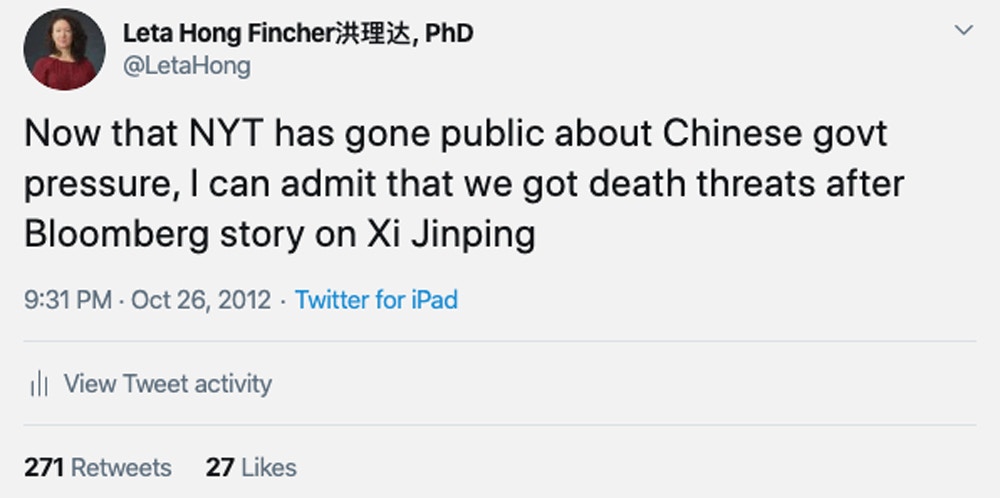
Screenshot: Leta Hong Fincher
Within hours of my tweets — the original and my replies to questions — a Bloomberg manager called my husband and said, “Get your wife to delete her tweets.” I did not delete them, but I also did not tweet or speak publicly about the death threats again. I did not want to anger the company because we needed it to relocate us to Hong Kong, where our children would be safe. As we finished the remainder of our time in Beijing, applying for schools in Hong Kong and preparing for our move, I lived in constant fear. Would someone get to our children while they were on their way to or from school? Who was watching and listening to us? I obsessively pulled down all our window blinds at night in case Chinese security agents were watching us. I was careful not to speak loudly about our plans in our home or on my phone in case we were bugged.
In August 2013, I finally relaxed as we flew out of Beijing and moved to a temporary apartment in Hong Kong. I thought that our yearlong nightmare had ended. But things would soon get even worse.
My husband had been working for many months on another investigative report for Bloomberg about financial ties between one of China’s richest men, Wang Jianlin, and the families of senior Communist Party officials, including relatives of Xi. Bloomberg editors had thus far backed the story. A Bloomberg managing editor, Jonathan Kaufman, said in an email in late September 2013, “I am in awe of the way you tracked down and deciphered the financial holdings and the players. … It’s a real revelation. Looking forward to pushing it up the line,” according to an account published by the Financial Times.
Then Bloomberg killed the story at the last minute, and the company fired my husband in November after comments by Bloomberg News editor-in-chief Matt Winkler were leaked. “If we run the story, we’ll be kicked out of China,” Winkler reportedly said on a company call.
Mike Bloomberg, then New York City mayor and majority owner of Bloomberg LP, was asked on November 12, 2013, about reports that his company had self-censored out of fear of offending the Chinese government and he dismissed the question.
“Nobody thinks that we’re wusses and not willing to stand up and write stories that are of interest to the public and that are factually correct,” Bloomberg told a press conference.
Yet, days after Bloomberg made those comments to reporters in New York, Bloomberg lawyers in Hong Kong threatened to devastate my family financially by forcing us to repay the company for our relocation fees to Hong Kong from Beijing and the advance on my husband’s salary that we took out, leave us with no health insurance or income, and take me to court if I did not sign a nondisclosure agreement — even though I had never been a Bloomberg employee.
The law firm representing Bloomberg, Mayer Brown JSM, sent a letter to my lawyer on December 6, 2013, threatening a court injunction if I didn’t agree to their confidentiality terms within seven days.
I told my husband’s lawyer that I did not want to sign a gag order, so Bloomberg summoned me and my husband to a meeting on December 16 at Mayer Brown JSM’s office in central Hong Kong. We sat around a fancy conference table with some Bloomberg senior editors and Mayer Brown lawyers and spoke via videoconference with a lawyer from Willkie, Farr & Gallagher, representing Bloomberg in New York. My husband’s lawyer said that I did not possess any recordings or emails that might be damaging evidence about the company’s practices.
“But what about all the evidence that is in her head?” said the outsized man on the video screen. When Bloomberg’s lawyer in New York uttered those words, I suddenly pictured him holding a giant vacuum cleaner, trying to suck all the memories out of my brain. I told everyone that I needed to leave the room and I walked out of the building, determined to go down fighting.
On December 20, they sent a letter to my husband demanding that I sign a nondisclosure agreement. If I didn’t agree, we might owe the company thousands of dollars. I might even have had to pay Bloomberg’s legal bills. The thought of Bloomberg possibly ruining our family financially if I didn’t give in to their threats made me sick, but I was also infuriated that they had kept us in harm’s way after we received threats, forbidden me from speaking publicly about the death threats we received in Beijing, and now were trying to take away my freedom of speech forever.
It was only when I hired Snowden’s lawyers in Hong Kong — Albert Ho and Jonathan Man offered me a low rate because it was a “good cause” — that Bloomberg finally backed off. In the meantime, they had sent me several more threatening letters. One letter from Mayer Brown JSM on January 8, 2014, spelled out that “by virtue of the knowledge that she retains (in her head) of our client’s [Bloomberg’s] Confidential Information she has an ongoing duty of confidentiality to our client.” They demanded that I sign away my right to speak out about things such as “unpublished drafts of an article prepared for our client; documents concerning our client’s newsgathering, editorial processes and editorial judgment …; any emails and other communications (including oral discussions) between and among our client’s employees concerning our client’s newsgathering editorial processes and editorial judgment.”
Ho, a veteran Hong Kong pro-democracy legislator and activist who has been assaulted twice over the years, told me that if Bloomberg didn’t back down, we could hold a press conference to shame them. Fortunately, it didn’t come to that and in February 2014, Bloomberg finally stopped sending me legal threats. I returned to Tsinghua University to finish my Ph.D. and published my first book about women in China. My husband joined the New York Times, re-reported the entire story on the Chinese businessman, Wang, which Bloomberg claimed was “not ready for publication,” and his story was published on the front page of the New York Times in late April 2015.
I never wanted to seek publicity about Bloomberg’s threatening behavior and was genuinely terrified of financial ruin, so in spite of preserving my freedom of speech, I have never written about my experience before. I am speaking out now because unlike so many other women, I am not bound by a nondisclosure agreement. Given the large number of women silenced by NDAs, it’s clear that there has been an environment of sexism at Bloomberg’s company. Bloomberg managers and lawyers treated me as though I were a piece of company property, an appendage of my husband, using intimidation and threats to try to bully me into submission. I agonized over whether to sign the NDA and I remember feeling physically suffocated, as though my mouth were stuffed with cotton balls. I haven’t met any of the other women, but I imagine that they, too, may have experienced the same terror of being threatened by a multibillion-dollar corporation, which could ruin their lives if they did not comply. Even now, I am nervous about the consequences of speaking out. But the more of us speak out, the stronger we are.
Trump's friend, Erik Prince, investigated by FBI for weaponizing crop-dusters
Matthew Cole
February 20 2020, 2:08 p.m.
https://theintercept.com/2020/02/20/erik-prince-fbi-investigation-trump-barr/
LAST MAY, SHORTLY after Congress accused Erik Prince of lying under oath and referred criminal charges to the Justice Department, an associate approached the Blackwater founder to offer help and commiserate about Prince’s potential legal jeopardy.
Prince, who once moved to the United Arab Emirates to avoid being caught up in a federal prosecution, immediately dismissed the associate’s concerns. He was untouchable, he bragged, and would face no legal troubles.
“Not under this guy,” Prince said referring to President Donald Trump, according to a person with direct knowledge of the exchange.
Prince’s connections to Trump reflect the netherworld of deniability in which he operates: He has no official role with the White House or Trump campaign, but appears to benefit from the association. Prince donated $250,000 to help elect the president and worked to help his campaign dig up dirt on Hillary Clinton, according to the Mueller report. Prince also worked closely with Steve Bannon, then Trump’s campaign manager, trying to shape Trump’s foreign policy and national security positions throughout the campaign.That assumption is about to be tested.
Prince, an heir to a billion-dollar fortune who is widely viewed as a shadow adviser to the president, is under federal investigation for his 2015 attempt to modify two American-made crop-dusting planes into attack aircraft — a violation of arms trafficking regulations — two people familiar with the investigation told The Intercept. The planes became part of private military services Prince proposed to sell or use in mercenary operations in Africa and Azerbaijan, as The Intercept has previously reported.
The investigation into the modified crop dusters is one of several ongoing probes targeting Prince. Another focuses on the allegations that he lied to Congress during the House Intelligence Committee’s investigation into Russia’s 2016 presidential election interference; a third concerns a 2017 armed aviation proposal to the UAE, according to the Wall Street Journal.
The investigation of Prince coincides with heightened scrutiny of Attorney General William Barr, who has been heavily criticized for intervening in two other prominent criminal cases involving friends and associates of Trump. The Prince investigations, and decisions about whether or not to charge him, are perhaps the most politically charged of all.
That Prince’s efforts to arm and sell the two American-made crop dusters are part of the FBI’s investigation into his activities has not been previously reported.
The FBI did not respond to a request for comment. A lawyer for Prince also did not respond to a request for comment.
After the election, Trump appointed Betsy DeVos, Prince’s sister, as his secretary of education. Prince then met with a Russian banker in the Seychelles in an apparent effort to establish a backchannel between the incoming Trump administration and the Russian government, according to the Mueller report. That meeting later became the focus of Prince’s testimony before the House Intelligence Committee. The Mueller report described details of the meeting that appeared to contradict Prince’s sworn testimony and triggered the committee’s criminal referral to the Justice Department.
Prince has also visited the White House several times to pitch privatizing wars in Afghanistan and the Middle East, as well as how to confront Iran, according to two people familiar with Prince’s efforts.
Barr, the nation’s top law enforcement official, has faced extensive criticism for his efforts to oversee cases involving Trump’s advisers and associates. Last week, after career prosecutors requested seven to nine years in prison for Roger Stone, a longtime Trump associate, Trump tweeted his disgust, calling the sentence “a miscarriage of justice.” Stone was convicted of seven felony counts of lying, obstruction of justice, and witness tampering related to a congressional investigation into Russian interference in the 2016 presidential election; the sentence prosecutors had requested was in line with federal guidelines.
A few hours later, Barr overruled his line prosecutors, seeking a lesser prison sentence for Stone. The move led the four career federal lawyers handling the Stone case to quit the prosecution, and one of them resigned from the Justice Department altogether. More than 2,400 former Justice Department employees have since called for Barr’s resignation. On Thursday, a federal judge sentenced Stone to three years and four months in prison.
Barr also appointed a close colleague as U.S. attorney in Washington, D.C., and recently brought in outside federal prosecutors to supervise the work of career government attorneys in several high-profile cases overseen by that office, according to the Washington Post. Among the cases being reviewed are those involving former Trump national security adviser Michael Flynn and Prince.
Mary McCord, a former senior Justice Department official during the Obama and Trump administrations who now teaches at Georgetown Law School, told The Intercept that Barr had already damaged the department’s ability to investigate politically sensitive criminal cases when he mischaracterized the Mueller Report before it was released publicly. With Barr stepping into the Stone and Flynn cases, whatever outcome the Justice Department announces in the Prince investigations will be subject to criticism about political interference.
“It’s really troublesome, McCord said. “The approach to any case connected to Trump is now fraught given the appearance that the department is a tool for the president to wield in favor of his friends and against his detractors.”
In 2015, Frontier Services Group, a Hong Kong-based logistics company founded by Prince, hired a U.S. law firm to review the company’s legal exposure to violations of U.S. law on weapons sales and the export of defense services to foreign governments and militaries. The attorneys concluded that Prince had likely violated the International Traffic in Arms Regulations, known as ITAR. The legal assessment, which was conducted by King & Spalding, also recommended that the American personnel at FSG report the violations to the Justice Department, which happened a few month later in 2016.
“The potential violations stem principally from conduct of Mr. Prince, a U.S. person,” Frontier Services Group CEO Gregg Smith wrote to the director of the State Department’s Directorate of Defense Trade Controls, which regulates the export of defense articles and services, in a letter obtained by The Intercept.
In 2018, an FSG spokesperson, responding on behalf of the company and Prince, told The Intercept: “Any assertion that FSG or Mr. Prince violated any laws in this matter is categorically false.”
It is unclear why the FBI took more than three years to investigate Prince for the modification of two crop dusters. Prince has long sought to convert the single-engine agricultural aircraft into light attack planes, which he believes can revolutionize how small wars are fought. The two planes, manufactured by Thrush Aircraft in Albany, Georgia, were the first prototypes Prince built in an effort to create a low-cost air force for his vision of privatized warfare.
Prince has never been charged with a crime in the United States. But his career as a private security entrepreneur has been marked by atrocities like the murder of four Blackwater personnel in Fallujah in April 2004 and the Nisour Square massacre of 2007, both of which gave rise to federal proceedings. A civil lawsuit brought by the families of the American contractors killed in 2004 resulted in a confidential settlement; a federal criminal trial against four Blackwater personnel for murder and manslaughter yielded convictions. In each case, Prince escaped personal liability.
In 2012 Blackwater, under a new corporate name, ownership, and management, entered into a deferred prosecution agreement with federal prosecutors and paid a $42 million fine for a series of weapons trafficking and ITAR-related offenses. Prince admitted no wrongdoing and walked away from U.S. government contracts but eventually lost his ITAR license. Despite that, he has since gone on to provide or offer defense services in at least 10 countries, mostly in Africa and the Middle East, according to documents and people with knowledge of the various plans.

Related
Blackwater’s Founder Is Under Investigation for Money Laundering, Ties to Chinese Intel, and Brokering Mercenary Services
Subscribe to:
Posts (Atom)