Sunday, February 23, 2020
LEAKED REPORTS SHOW EU POLICE ARE PLANNING A PAN-EUROPEAN NETWORK OF FACIAL RECOGNITION DATABASES
Zach Campbell, Chris Jones
https://theintercept.com/2020/02/21/eu-facial-recognition-database/
A POLICE INVESTIGATOR in Spain is trying to solve a crime, but she only has an image of a suspect’s face, caught by a nearby security camera. European police have long had access to fingerprint and DNA databases throughout the 27 countries of the European Union and, in certain cases, the United States. But soon, that investigator may be able to also search a network of police face databases spanning the whole of Europe and the U.S.
According to leaked internal European Union documents, the EU could soon be creating a network of national police facial recognition databases. A report drawn up by the national police forces of 10 EU member states, led by Austria, calls for the introduction of EU legislation to introduce and interconnect such databases in every member state. The report, which The Intercept obtained from a European official who is concerned about the network’s development, was circulated among EU and national officials in November 2019. If previous data-sharing arrangements are a guide, the new facial recognition network will likely be connected to similar databases in the U.S., creating what privacy researchers are calling a massive transatlantic consolidation of biometric data.
The report was produced as part of discussions on expanding the Prüm system, an EU-wide initiative connecting DNA, fingerprint, and vehicle registration databases for mutual searching. A similar system exists between the U.S. and any country that is part of the Visa Waiver Program, which includes the majority of EU countries; bilateral agreements allow U.S. and European agencies to access one another’s fingerprint and DNA databases.
Although new legislation following the report’s recommendation is not yet on the table, preparatory work is ongoing. Information provided by the European Commission to the European Parliament last November shows that almost 700,000 euros (about $750,000) are going to a study by consultancy firm Deloitte on possible changes to the Prüm system, with one part of the work looking at facial recognition technology. The European Commission has also, separately, paid 500,000 euros to a consortium of public agencies led by the Estonian Forensic Science Institute to “map the current situation of facial recognition in criminal investigations in all EU Member States,” with the aim of moving “towards the possible exchange of facial data,” according to a project presentation sent to national representatives in Brussels.
“This is concerning on a national level and on a European level, especially as some EU countries veer towards more authoritarian governments,” said Edin Omanovic, advocacy director for Privacy International. Omanovic worries about a pan-European face database being used for “politically motivated surveillance” and not just standard police work. The possibility of pervasive, unjustified, or illegal surveillance is one of many critiques of facial recognition technology. Another is that it is notoriously inaccurate, particularly for people of color.
“Without the transparency and legal safeguards for facial recognition technology to be lawful,” said Omanovic, “there should be a moratorium on it.”
The EU has taken big steps to connect a host of migration and security databases in recent years. New legislation passed last April established a database that will hold the fingerprints, facial images, and other personal data of up to 300 million non-EU nationals, merging data from five separate systems. According to the report by 10 police forces, Deloitte consultants proposed doing the same with police facial images, but the idea was met with unanimous opposition from law enforcement officials.
Nonetheless, the report recommends linking all of EU member states’ facial databases, which would seem to have the same practical effect. In another internal EU police report — this one from a working group on Prüm that looked at the exchange of drivers’ license data — police note that “a network of interconnected national registers can be regarded as a virtual European register.”
To the police, the advantages of interlinked facial recognition databases are clear. The Austria-led report views the technology as a “highly suitable” biometric tool for identifying unknown suspects and suggests that the databases should be created and linked “as quickly as possible.” It also recognizes the need for data protection safeguards, such as human verification of any automated matches, but privacy experts argue that the creation of any such system is the first step toward greater sharing and linking of data where such controls are inadequate.
European moves to consolidate police facial recognition data closely resembles similar efforts in the U.S., said Neema Singh Guliani, senior legislative counsel at the American Civil Liberties Union. Many U.S. law enforcement agencies work out of “fusion centers,” where they are co-located and able to share data. If you have an information-sharing agreement with the FBI or the Department of Homeland Security, said Guliani, “there’s a risk that functionally the information may be shared with additional levels of U.S. law enforcement.”
“It raises many questions,” she added. “How police are using facial recognition and gathering images, as well as in the U.S. with regard to due process and First Amendment expression. Given existing information sharing relationships, it’s very likely that the U.S. would want access to that information.”
As far back as 2004, the U.S. Embassy in Brussels was calling for a relationship with the EU that allowed “expansive exchanges and sharing all forms of data, including personal data.” In recent years, efforts toward that goal have intensified. According to a Government Accountability Office report, in 2015, the Department of Homeland Security began demanding the implementation of the data-sharing agreements required of Visa Waiver Program countries. This has included the FBI providing assistance to other states to set up the necessary computer networks.
Austria, to take one example, began checking fingerprints against the FBI’s criminal fingerprint databases in October 2017, explained Reinhard Schmid, a senior official in the Austrian criminal intelligence service. Since then, about 12,000 individuals’ prints have been cross-checked, leading to 150 matches. “Around 20 of these identified persons were under investigation and suspected of membership of terrorist organizations,” while in 56 cases individuals had attempted to use a false identity, said Schmid.
“Their logic here is, ‘When I have a serious crime and I want to run someone’s photo against a database, why shouldn’t I have this?’” said Guliani. Yet, she added, the privacy implications were enormous. “Once you have the access, you ultimately have the ability to identify almost anyone, anywhere.”
The report by 10 police forces calls for Europol, the EU agency for police information and intelligence sharing, to play a role in exchanging facial recognition and other biometric data with non-EU states. This echoes recommendations from European governments themselves: A July 2018 declaration called for the commission to consider “broadening the scope” of the Prüm network and for Europol to take the lead on data sharing with third countries.
The FBI and Europol did not respond to questions about data-sharing agreements between the EU and the U.S. A spokesperson for the European Commission acknowledged the prospect of adding facial recognition data to the Prüm network, but declined to go into more detail.

Homeland Security Algorithm Revokes U.S. Visa of War Crimes Investigator Eyal Weizman
 Robert Mackey
February 20 2020
https://theintercept.com/2020/02/20/homeland-security-algorithm-revokes-u-s-visa-war-crimes-investigator-eyal-weizman/?
EYAL WEIZMAN, an Israeli-born British architect who uses visual analysis to investigate war crimes and other forms of state violence, was barred from traveling to the United States this week for an exhibition of his work after being identified as a security risk by an algorithm used by the Department of Homeland Security.
Weizman, a professor at Goldsmiths, University of London, where his human rights research agency Forensic Architecture is based, frequently travels to the U.S. to lecture and exhibit work. Last year, Forensic Architecture was selected to take part in the Whitney Biennial and produced an investigation — in collaboration with Intercept co-founder Laura Poitras — of how a Whitney board member profited from the manufacture of tear gas used against civilians in a dozen countries, including at the U.S.-Mexico border.
But last week, as he prepared to travel to Miami for the opening of a major survey exhibition of Forensic Architecture’s work, “True to Scale,” at the Museum of Art and Design at Miami Dade College, Weizman was informed by email that he had been removed from a visa-waiver scheme and would not be permitted to board his flight.
“The revocation notice stated no reason, and the situation gave me no opportunity to appeal or to arrange for an alternative visa,” Weizman explained in a statement read at the Miami opening on Wednesday night.
“It was also a family trip. My wife, professor Ines Weizman, who was scheduled to give talks in the U.S. herself and our two children traveled a day before I was supposed to go,” the architect added. “They were stopped at JFK airport in New York, where Ines was separated from our children and interrogated by immigration officials for two and a half hours before being allowed entry.”
When he visited the U.S. Embassy in London to find out what happened, Weizman said in an interview, an officer told him that his authorization to travel had been revoked because “the algorithm” had identified an unspecified security threat associated with him.
As my colleague Sam Biddle reported in 2018, Homeland Security paid an automated machine learning firm, DataRobot, $200,000 that year to test “predictive models to enhance identification of high-risk passengers” at foreign airports, with the aim of developing a software algorithm capable of making real-time predictions in less than one second about who is a potential terrorist.
Weizman told The Intercept that the officer at the U.S. Embassy in London who denied him a visa said that he had no idea what triggered his rejection by the algorithm. “I don’t see what the system flagged up, but you need to help me figure it out,” the officer said. He then asked Weizman to supply the embassy with additional information, including 15 years of his travel history and “the names of anyone in my network whom I believed might have triggered the algorithm.”
Weizman refused to provide that information, given the fact that his work investigating state-sponsored human rights violations “means being in contact with vulnerable communities, activists and experts, and being entrusted with sensitive information.”
As Weizman pointed out in our phone conversation, the very nature of the type of open-source investigation he helped to pioneer — the painstaking work of collaborating online to verify and evaluate testimony and visual evidence of human rights abuses shared by witnesses — requires researchers “to create very varied and very diverse sets of networks,” putting them in contact with sources in places like Syria, Gaza, or Pakistan that a computer might be trained to view with suspicion. And, to a computer looking for suspect patterns of behavior, the interactions of a person posing a genuine security threat might be indistinguishable from the activities of an open-source investigator or a journalist.
“If there is an associative algorithm, it looks for relations between people and things: travel, patterns of communication,” Weizman said. “If it is associative, our open-source research will always be vulnerable to this sort of policing, where it’s not what you do, it’s the pattern of what you do that gets policed.”
A perfect example, Weizman said, was the kind of research his team did on the chemical attack in the Syrian town of Douma in 2018, which led to sophisticated architectural modeling of the site of the attack. (That work was also used by the New York Times in its visual investigation of the attack, which concluded that it had been carried out by the Syrian government.)
“We go online, we look at the effects of chlorine,” Weizman said. “After we look at that, we go to certain channels on YouTube that are operated by people on the ground, close to the resistance, who are uploading video. Sometimes we are DMing with people in Syria. We don’t necessarily go to Syria, but we are in touch with refugees and activists.”
Weizman discussed his approach to the investigation of the attack in Douma in an Intercept video report last year.
For another project, a new investigation of a 2015 shipwreck off the coast of Greece that took the lives of at least 43 migrants, mainly Syrian refugees, Weizman said his team contacted witnesses to the tragedy without ever asking those people if anyone else on the boat, or in their extended networks of friends, relations, or acquaintances back in the war zone, might have had militant links. “Who wants to ask when you are in touch with survivors of a shipwreck in the Aegean, who was on the boat?” Weizman said.
“This much we know: We are being electronically monitored for a set of connections — the network of associations, people, places, calls, and transactions — that make up our lives,” Weizman said in his statement to the opening in Miami he was unable to attend. “These networks are the lifeline of any investigative work.”
The lack of information about why exactly the computer software had barred Weizman from traveling to the U.S. led to speculation that the algorithm might have been gamed by false information provided to American authorities by his critics.
Another prominent open-source researcher, Eliot Higgins of Bellingcat, suggested in an email on Thursday that Weizman could also have been the victim of anonymous complaints to U.S. authorities from a cohort of online activists angered by his work implicating forces loyal to Syrian President Bashar al-Assad in chemical attacks. “Forensic Architecture certainly got their attention between their Douma and Khan Sheikhoun work, so they might have wanted to cause him problems,” Higgins speculated. “It’s rather like swatting.” Swatting is a form of harassment associated with online communities in which false reports to law enforcement are used to target victims.
As Higgins noted, the technique has been deployed previously by pro-Assad Twitter trolls and bloggers against reporters and activists who have documented war crimes by Syrian and Russian government forces.
In January, Oz Katerji, a British journalist who covered the war in Syria, reported that he was contacted by the counterterrorism unit of London’s Metropolitan Police force after allegations about him were phoned in to a confidential hotline. “They told me they believe the reports against me are baseless and malicious in intent, and there is no case against me,” Katerji wrote on Twitter. “They did however confirm to me that this false report was a result of the vindictive Islamophobic online trolling campaign against me for my reporting on Syria.”
Katerji also posted a screenshot showing that Vanessa Beeley, a pro-Assad blogger boosted by Russian state television, had encouraged her followers to report him and a list of other journalists and news outlets critical of Assad — including the BBC, Channel 4 News, and The Guardian — to the authorities for supposedly violating the U.K. Terrorism Act.

Katerji added that “one of the allegations against me was that I am a supporter of the White Helmets, a Syrian humanitarian medical organization partially funded by the U.K. Foreign and Commonwealth Office.”
As Muhammad Idrees Ahmad, a lecturer in digital journalism at the University of Stirling in Scotland, pointed out in an interview, there is evidence that similar efforts have been successful in the U.S. as well.
In 2016, Raed Al Saleh, the head of Syria Civil Defense — a Western-backed rescue organization, known for its White Helmets, that searches for survivors of bombings in rebel-held parts of Syria — was denied entry into the United States when he was due to accept an award in Washington. Video recorded by the rescue group was, for much of the conflict in Syria, one of the only sources of information about the impact of Syrian and Russian airstrikes on rebel-held territory. That led to an orchestrated campaign, featured heavily on Russian state channels, to discredit the group by claiming that it was an arm of the Islamist rebel groups.
After Saleh was barred from the U.S., another pro-Assad blogger boasted on Twitter that he had reported him and the group giving him the award to Homeland Security “and organized others to do so as well.”
Despite his exclusion from the U.S. Weizman explained that, in conjunction with the exhibition of Forensic Architecture investigations in Miami, his group plans to train local activists to apply its techniques to investigate “human rights violations in the Homestead detention center in Florida … where migrant children have been held in what activists describe as ‘regimented, austere, and inhumane conditions.'”
The ban on Weizman’s travel was denounced on Thursday by Margaret Huang, the executive director of Amnesty International USA. “Stopping Eyal Weizman from entering the United States does a grave disservice to human rights documentation efforts,” Huang said in a statement. “It would be ludicrous to suggest that Eyal Weizman poses a security threat, and it’s an embarrassment for the U.S. to bar him.”
“Invoking the results of an algorithm cannot disguise the spurious nature of this visa decision, and, in fact, it heightens our concerns about how the decision was taken,” Huang added. “This is ideological exclusion via algorithm, a troubling indicator of the bias and irrationality of the high-tech security state.”
TV EXECUTIVES CELEBRATE UNPRECEDENTED FLOOD OF BLOOMBERG CAMPAIGN SPENDING
Lee Fang
February 15 2020, 4:00 a.m.
https://theintercept.com/2020/02/15/mike-bloomberg-campaign-spending-media-executives/?utm
FOX NEWS HOSTS regularly bash former New York City Mayor Mike Bloomberg as a globalist demagogue intent on seizing Americans’ firearms and big gulp sodas. High-level executives at the company, however, are much more enthusiastic about the billionaire politician and Democratic presidential candidate.
Lachlan Murdoch, the chief executive of Fox Corp., the parent company of Fox News, is one of several media executives to welcome Bloomberg’s unprecedented spending spree on television advertisements. In a February 5 briefing for investors, Murdoch noted that he had heard “the Bloomberg campaign has expected to sort of double its advertising spend earlier this week.” The billionaire’s campaign, Murdoch noted, makes purchases on a week-to-week basis, making it difficult to project the ultimate benefit for his company.
“But obviously,” he added, “we expect it to be very strong and particularly, as I mentioned, in the markets of our local TV stations.”
Bloomberg, the ninth wealthiest person in the world, with a fortune estimated at almost $62 billion, has upended the Democratic presidential primary with an infusion of cash that has smashed through historical records in a matter of weeks. Advertising Analytics, which tracks campaign spending, reported Thursday that Bloomberg has already spent $363 million on cable, broadcast, and radio advertisements alone.
The 2020 campaign is shaping up to be an incredible financial opportunity for media companies, with one market research firm recently estimating that nearly $7 billion of paid advertising be spent this year, up over 60 percent since the 2016 presidential race.
Bloomberg alone has enticed media executives to see the race as a golden opportunity.
“The political is going to be huge this year,” boasted Christopher Ripley, president and chief executive of Sinclair Broadcast Group, one of the largest owners of television stations in the country, speaking last month at the Citi 2020 Global TMT West conference in Las Vegas. “The amount of fundraising that’s happened through this year has broken all records. And the good news about politicians is they never return the money, they spend it,” Ripley quipped.
Sinclair, said Ripley, is “already benefiting tremendously from that and the entrance of players like Bloomberg.”
Meredith Corporation — which owns television stations in several states, including Oregon, Alabama, Georgia, Missouri, and Arizona — also reported its quarterly results this month. “Bloomberg is certainly having an impact across most of our footprint,” beamed Patrick McCreery, an executive with Meredith, during the call with investors.
“If the headlines are to be believed,” said McCreery, “he’s going to double the spending, and that will be beneficial certainly.”
Since Bloomberg’s announcement last November, shares of publicly traded media conglomerates, including Nexstar Media Group and Gray Television, have been on the rise.
“When politicians go to war, own the arms dealers,” Steven Cahall, an analyst with Wells Fargo, wrote in a recent report cited by CNBC. Broadcasting corporations, Cahall noted, “are jazzed to have Bloomberg in the fray.” The billionaire mogul has already caused “a meaningful uptick in Q4 political revenue vs. company plans.”
The use of private funds for campaign spending — a practice banned or sharply restricted in most industrialized countries — creates an inherent tension with the private, for-profit U.S. media market. The same media companies voters turn to for help to make thoughtful decisions about the candidates rely heavily on campaign advertisements designed to manipulate viewers with provocative, low-information emotional appeals and other forms of deceptive electioneering.
The National Association of Broadcasters, a trade group that lobbies for broadcasters, has long fought to maintain the status quo, opposing efforts over the years to require television and radio stations to provide free air time to candidates. The group successfully lobbied to block both the Federal Communications Commission and Congress from enacting rules that would have provided even two hours of public air time to candidates.
In recent months, the NAB has pushed back against FCC efforts to increase enforcement of relatively minor disclosure requirements for television broadcasters to publish invoices from groups or candidates spending money on political advertisements.
The frenzy for presidential campaign cycle profits likely shaped the media environment for Donald Trump’s election.
In the early days of Trump’s candidacy, media executives openly celebrated his entry, hoping for a bonanza in ratings and political ad-buying. “The more they spend, the better it is for us and: Go Donald! Keep getting out there,” said Les Moonves, the former chief executive of the CBS Corporation, which is now known as ViacomCBS.
Moonves, who later stepped down over numerous allegations of sexual harassment, summed up his thoughts about Trump at a meeting in San Francisco’s Palace Hotel during the 2016 campaign. Trump’s campaign “circus” he said, “may not be good for America, but it’s damn good for CBS, that’s all I got to say.”
FOREIGN-FUNDED DARK-MONEY GROUPS LOBBY IRS TO REPEAL REMAINING REPORTING REQUIREMENTS
Lee Fang
February 15 2020, 5:00 a.m.
https://theintercept.com/2020/02/15/dark-money-irs-reporting-501c/?utm
DARK-MONEY GROUPS backed by foreign corporate donors are supporting the Trump administration’s decision to roll back one of the last remaining ways for authorities to monitor the flow of unlawful campaign cash in American elections.
In recent years, 501(c) nonprofits have become the entities of choice for secret campaign spending. These nonprofit groups, which do not have to report any donor information to the public, can receive unlimited contributions from any source and, thanks to the Supreme Court’s 2010 Citizens United decision, spend unlimited amounts on elections.
Foreign spending, whether by a foreign national or a foreign-owned corporation, is still illegal under federal law. But the law has been poorly enforced, and the few instances in which penalties have been applied in recent years have come in reaction to publicly reported foreign corporate spending to Super PACs, such as The Intercept’s reporting on Chinese corporate donations in 2016 and the recent federal indictment over a shell company owned by a Russian national that gave to President Donald Trump’s Super PAC in 2018.
The one check on foreign contributions to dark-money groups has been the Schedule B form, which reports 501(c) donor information confidentially to the Internal Revenue Service. Under a new rule proposed last September by the Treasury Department and the IRS, nonprofits will no longer be required to report donor information, even to the government, allowing an unprecedented level of secrecy.
Lobbyists for foreign-funded groups have pushed the administration to move forward with the rule, which is close to being finalized.
The U.S. Chamber of Commerce, the largest business lobby organization in the world, spent over $10 million to influence the last 2018 midterm election cycle using its general fund. The group, which has foreign corporate donors, has lobbied in support of the IRS rule to repeal the Schedule B requirement, claiming in a letter to officials that the accidental leak of donors could reduce corporate free speech rights.
“Identifying, harassing, and intimidating the organization’s supporters is a chief means of silencing that organization’s speech,” wrote Caroline L. Harris, the Chambers’ chief tax policy counsel, and Ryan P. Meyers, the deputy general counsel of the group, in a regulatory letter to officials overseeing the rule change. “The Chamber applauds the work of Treasury and the Internal Revenue Service (IRS) in eliminating onerous reporting requirements.”
The National Association of Manufacturers, which counts several corporations based in foreign countries as members, in a letter to IRS officials, similarly called the Schedule B requirement an “unnecessary administrative filings that raise the potential for misuse in a way that chills protected speech.”
Both NAM and the Chamber of Commerce, which spends more than $160 million a year, are organized as 501(c)(6) trade associations and under no obligation to disclose donor money to the public — only to the government through the annual Schedule B form to its 990 annual filing. After the Citizens United decision, the two groups led an effort to defeat the DISCLOSE Act, legislation that would have forced groups engaged high-dollar election advocacy to reveal donor information. The Chamber also lobbied successfully to stop President Barack Obama from issuing an executive order to force government contractors to disclose grants to 501(c) groups.
Foreign-based firms such as Brazilian petrochemical firm Braskem, Al Zayani Investments in Bahrain, and Turkish conglomerate Tekfen are listed on the Chamber’s website as dues-paying members. Faced with criticism in the past that its foreign funding might bleed into the Chamber’s vast domestic lobbying and campaign spending budget, the group has claimed that any foreign donations are walled off from domestic funds, and that foreign donors make up a small percentage of its overall budget.
But the removal of the Schedule B requirement could make those claims impossible to verify. A large foreign national firm could provide multimillion-dollar donations for use in U.S. elections to the Chamber under the new rule and such giving would never be reported to government officials.
That’s precisely the danger of removing Schedule B forms, campaign finance experts warn. The Campaign Legal Center, a campaign finance watchdog that has filed the ethics complaints that led to enforcement action on foreign money in the past, cautioned the IRS that the rule would simply open the door to more foreign spending.
“Congress has failed to pass new transparency legislation, and the FEC has failed to enforce the transparency laws that are on the books,” said Brendan Fischer, director of Campaign Legal Center’s federal reform program. “As a result, the only donor disclosure reports that dark-money groups file with any federal agency are the confidential Schedule B reports filed with the IRS. These confidential donor reports are one of the few ways that federal agencies could detect and deter foreign money in U.S. elections.”
It’s not hard to comprehend the many ways in which completely secret legal entities could incentivize illegal election behavior. In 2016, reporters from the Telegraph conducted a sting operation on a Republican campaign operative working in support of Trump. The operative was offered a $2 million check from a Chinese businessman by the reporters. He responded by offering a plan for how to conceal the money, suggesting that it be routed through his consulting firm to a pair of 501(c)4 groups and then to a pro-Trump Ssuper PAC.
The FBI is also investigating the National Rifle Association over allegations that the group, which is organized as a 501(c)4, may have received financial support from Russian sources. McClatchy reported that counterintelligence officials believe that Russian interests may have contributed to the NRA’s $30 million election advertising campaign in 2016.
Foreign firms increasingly finance major American business associations. As The Intercept has previously reported, a major Chinese chemical company joined the American Chemistry Council, a 501(c)6 that routinely lobbies lawmakers and spends money in elections.
The Trump administration had originally tried to remove the Schedule B form last summer in a surprise decision. A federal judge in Montana, however, ruled that the IRS had failed to follow proper regulatory procedure and ordered the agency to conduct a formal rule-making to allow the public and stakeholders to weigh in on the change.
“The rise of ‘dark money’ in U.S. elections has made it easy for foreign entities to contravene these laws by funneling money into U.S. elections through groups that that [sic] do not publicly disclose their donors, such as 501(c)(4) social welfare organizations and 501(c)(6) trade associations,” wrote the Campaign Legal Center in a letter to the IRS. “This change would further enable foreign entities to donate millions of dollars to such organizations for the purpose of influencing U.S. elections without any risk of scrutiny by federal regulators.”
Republican-aligned think tanks have joined the business-backed push to eliminate the Schedule B. Several nonprofits backed by billionaire Charles Koch, including his marquee group Americans for Prosperity, testified on February 7 in support of the rule change. FreedomWorks, a conservative grassroots group backed by business interests, has also mobilized hundreds of letters to the agency.
Hans von Spakovsky, a former Federal Election Commission member now with the Heritage Foundation, appeared at the hearing alongside other conservative activists in support of the rule change.
Von Spakosvsky, an avowed critic of campaign finance regulations and voting rights laws, testified that “their claim that this will somehow allow foreign money to suddenly flood into American elections is absurd,” according to a transcript of his remarks. Von Spakovsky said the FEC had plenty of authority and expertise in combating foreign money during his tenure, despite the fact that the agency has historically only intervened to investigate foreign money through disclosed political action committees on a few occasions in its 45-year history. He did not cite any examples of the FEC investigating 501(c) groups.
ALEXANDRIA OCASIO-CORTEZ ENDORSES CRISTINA TZINTZÚN RAMIREZ IN TEXAS SENATE PRIMARY, BUCKING CHUCK SCHUMER
Ryan Grim
February 21 2020, 8:39 a.m.
https://theintercept.com/2020/02/21/ocasio-cortez-cristina-tzintzun-ramirez-texas-senate/?utm
EARLY ON IN the Texas Senate primary, the political arm of Senate Minority Leader Chuck Schumer, a Democrat from New York, decided that it would put its weight behind 2018 House candidate M.J. Hegar, a veteran whose viral ad in 2018 powered her to a massive fundraising haul — but not to victory — in the general election.
Despite the efforts of Schumer’s Democratic Senatorial Campaign Committee to muscle out challengers for GOP Sen. John Cornyn’s seat, a crowded field has formed. Among them is a former chief organizer for the Senate campaign of Beto O’Rourke, Cristina Tzintzún Ramirez. On Friday, Tzintzún Ramirez won the endorsement of Schumer’s fellow New Yorker and potential rival, Rep. Alexandria Ocasio-Cortez.
The endorsement was one of seven Ocasio-Cortez announced as part of her new political action committee aimed at supporting progressive candidates like Tzintzún Ramirez who the party discourages from running.
“It’s important for us to create mechanisms of support because so much of what is happening in Washington is driven by fear of loss,” Ocasio-Cortez told the New York Times. “We can really create an ecosystem that makes people more comfortable into making the leap to make politically courageous choices.”
On top of the support from the DSCC, Hegar, an Air Force helicopter pilot, is getting outside help from a super PAC run by the group VoteVets. This week, a group of wealthy progressive donors launched a super PAC to put ads on the air for Tzintzún Ramirez, though it is reported to be spending only in the low six figures between now and March 3, Super Tuesday, when the primary will be held.
If no candidate in the crowded field eclipses 50 percent, a runoff election will take place. Hegar is likely destined for the top spot, with Tzintzún Ramirez battling against a number of rivals to make second. Ocasio-Cortez’s endorsement will go a long way to pushing her into the runoff. Also this week, Tzintzún Ramirez picked up the support of Rep. Joaquin Castro, and already had the backing of his mother, Rosie Castro, a civil rights leader in the state.
Tzintzún Ramirez co-founded the Workers Defense Project and founded the organization Jolt, aimed at registering voters in Texas. The low moment of her campaign came last month when she apologized for joking that her name, Tzintzún, is “more Mexican than any Garcia or Lopez.”
Sema Hernandez, who challenged O’Rourke in the 2018 primary, is running again, and has an energetic following on Twitter, though it has yet to translate in the race. Money isn’t everything, but Texas is a big state and as of her most recent filing, Hernandez reported raised a mere $7,551, not enough to hire staff or run an organizing operation.
Four candidates, including Tzintzún Ramirez, have raised at least $800,000.
Ocasio-Cortez’s PAC, Courage to Change, also announced support for Teresa Fernandez in New Mexico, Samelys López in New York, and Georgette Gómez in California, all running for open congressional seats, rather than challenging incumbents. The PAC will also back, she said, Kara Eastman, challenging a Republican incumbent in Omaha, and Marie Newman, taking on incumbent Democrat Rep. Dan Lipinski in Illinois.
February 21 2020, 8:39 a.m.
https://theintercept.com/2020/02/21/ocasio-cortez-cristina-tzintzun-ramirez-texas-senate/?utm
EARLY ON IN the Texas Senate primary, the political arm of Senate Minority Leader Chuck Schumer, a Democrat from New York, decided that it would put its weight behind 2018 House candidate M.J. Hegar, a veteran whose viral ad in 2018 powered her to a massive fundraising haul — but not to victory — in the general election.
Despite the efforts of Schumer’s Democratic Senatorial Campaign Committee to muscle out challengers for GOP Sen. John Cornyn’s seat, a crowded field has formed. Among them is a former chief organizer for the Senate campaign of Beto O’Rourke, Cristina Tzintzún Ramirez. On Friday, Tzintzún Ramirez won the endorsement of Schumer’s fellow New Yorker and potential rival, Rep. Alexandria Ocasio-Cortez.
The endorsement was one of seven Ocasio-Cortez announced as part of her new political action committee aimed at supporting progressive candidates like Tzintzún Ramirez who the party discourages from running.
“It’s important for us to create mechanisms of support because so much of what is happening in Washington is driven by fear of loss,” Ocasio-Cortez told the New York Times. “We can really create an ecosystem that makes people more comfortable into making the leap to make politically courageous choices.”
On top of the support from the DSCC, Hegar, an Air Force helicopter pilot, is getting outside help from a super PAC run by the group VoteVets. This week, a group of wealthy progressive donors launched a super PAC to put ads on the air for Tzintzún Ramirez, though it is reported to be spending only in the low six figures between now and March 3, Super Tuesday, when the primary will be held.
If no candidate in the crowded field eclipses 50 percent, a runoff election will take place. Hegar is likely destined for the top spot, with Tzintzún Ramirez battling against a number of rivals to make second. Ocasio-Cortez’s endorsement will go a long way to pushing her into the runoff. Also this week, Tzintzún Ramirez picked up the support of Rep. Joaquin Castro, and already had the backing of his mother, Rosie Castro, a civil rights leader in the state.
Tzintzún Ramirez co-founded the Workers Defense Project and founded the organization Jolt, aimed at registering voters in Texas. The low moment of her campaign came last month when she apologized for joking that her name, Tzintzún, is “more Mexican than any Garcia or Lopez.”
Sema Hernandez, who challenged O’Rourke in the 2018 primary, is running again, and has an energetic following on Twitter, though it has yet to translate in the race. Money isn’t everything, but Texas is a big state and as of her most recent filing, Hernandez reported raised a mere $7,551, not enough to hire staff or run an organizing operation.
Four candidates, including Tzintzún Ramirez, have raised at least $800,000.
Ocasio-Cortez’s PAC, Courage to Change, also announced support for Teresa Fernandez in New Mexico, Samelys López in New York, and Georgette Gómez in California, all running for open congressional seats, rather than challenging incumbents. The PAC will also back, she said, Kara Eastman, challenging a Republican incumbent in Omaha, and Marie Newman, taking on incumbent Democrat Rep. Dan Lipinski in Illinois.
BLOOMBERG SPENT A DECADE DEMANDING CUTS TO SOCIAL SECURITY. HIS CAMPAIGN PLAN DOESN’T RULE THEM OUT.
Jon Schwarz
February 19 2020, 6:17 p.m.
https://theintercept.com/2020/02/19/mike-bloomberg-social-security/?utm
A REVIEW OF Michael Bloomberg’s many statements on Social Security over the last 10 years makes two things clear.
First, Bloomberg deeply and sincerely believes that the well-being of the United States requires cuts to Social Security benefits.
Second, Bloomberg has no idea how Social Security works. Instead, his head is filled with a hodgepodge of right-wing talking points about the program.
On Sunday, Bloomberg’s presidential campaign released his official proposal for Social Security and retirement more generally. It’s written to give the impression that if elected, Bloomberg would not cut Social Security for anyone, and in fact, would expand benefits for everyone. However, the plan leaves the door open to benefit cuts for some beneficiaries — just as Bloomberg has advocated for years.
The former New York City mayor’s plan does include some ideas that, from the perspective of America’s middle and working class, are a big improvement. He calls for upping Social Security’s cost-of-living adjustments, because there appears to be a higher rate of inflation for the goods and services needed by the elderly than by the younger population. He also advocates an increase in benefits for the poorest beneficiaries.
Interestingly, Bloomberg also proposes that the U.S. create a new “public-option retirement savings plan, with automatic employer and employee contributions.” This would essentially be a government-run 401(k) plan for all workers who don’t have access to one through their jobs — including a matching government contribution akin to those provided by many employers.
While this may sound something like President George W. Bush’s 2005 proposal for privatizing Social Security, it’s significantly superior. Under Bloomberg’s plan, the accounts would be run by the government, allowing for super-low fees that would be collected by Washington. Bush wanted the accounts to be run by Wall Street, which would have generated a gusher of high fees flowing to downtown Manhattan. (At the time, a financial blogger wrote that a former co-worker at a huge investment bank told him, “I want that dumb public money coming across my desk.”)
But the rest of Bloomberg’s plan must be read skeptically. The campaigns of Sen. Bernie Sanders, I-Vt., Sen. Elizabeth Warren, D-Mass., and former South Bend Mayor Pete Buttigieg explicitly rule out any cuts to Social Security benefits.
By contrast, Bloomberg’s proposal does not. Bloomberg’s campaign did not respond when asked whether he is taking all benefit cuts off the table.
Instead, Bloomberg uses language similar to a 2010 proposal from Alan Simpson and Erskine Bowles, the chairs of a deficit reduction commission set up by President Barack Obama. Bloomberg vociferously supported the commission at the time.
According to Bloomberg’s proposal, “Mike will strengthen entitlement programs.” Simpson and Bowles said their mixture of minor benefit increases and significant cuts would “strengthen Social Security.” Today, Bloomberg wants to “put the system on sound financial footing.” In 2010, Simpson and Bowles proclaimed that their goal was to “ensure Social Security’s soundness.”
Like Bloomberg today, Simpson and Bowles proposed increasing Social Security benefits for the poorest beneficiaries. Unlike Bloomberg, they explicitly advocated cuts that would have reduced the benefits of those further up the income ladder. This would have reduced overall costs and made the program more like traditional welfare — an outcome that would have weakened political support for Social Security and made it vulnerable to further cuts in the future.
The lack of a straightforward disavowal of cuts from the Bloomberg campaign, combined with Bloomberg’s history, suggests that his plan shares significant genetics with Simpson-Bowles.
Unsettling Comparisons
Social Security is one of the simplest and most efficient programs ever created by the U.S. government. Essentially, it deducts money from the paychecks of today’s workers and sends it to retirees (plus some widows, orphans, and people with disabilities), providing them with a modest but completely secure income. The current contribution rate is 12.4 percent of everyone’s salary up to $137,700.
After decades of propaganda by the corporate right, Americans have become convinced that Social Security faces a terrifying day of reckoning. It does not. It does need some minor adjustments, but that’s something that’s happened many times before and is unremarkable in the context of a program that is 85 years past its initial enactment.
The central issue is straightforward. The Social Security Administration projects that, mostly thanks to the retirement of the baby boomers, the cost of the program will increase from 4.9 percent of the U.S. gross domestic product in 2019 to about 5.9 percent by 2039. Then it will stay there indefinitely. In other words, if we can figure out some way to send one additional dollar out of every hundred in the American economy to retirees, there’s no need to cut benefits.
This is where Bloomberg comes in. Like many at the top of the U.S. pyramid, Bloomberg is transfixed by the idea that the U.S. and its citizens are wildly profligate and that unless we sober up, the country will someday be punished for our wantonness.
After the extraordinary success of his Wall Street terminal business made him a billionaire, Bloomberg was elected mayor of New York in 2001 at age 59. This immediately gave him a place on the national political stage. Bloomberg, then a registered Republican, spoke at the 2004 GOP convention in New York and endorsed Bush. To his credit, Bloomberg disavowed Bush’s plan to privatize Social Security the next year.
But Bloomberg was still in office during Obama’s first term as the U.S. tried to recover from the near depression caused by the housing bubble. The deficit spending necessary to prevent complete economic collapse filled billionaires and CEOs with anxiety, and they became obsessed with shrinking it as soon as possible.
At the end of 2010, the Simpson-Bowles plan failed to secure enough votes from their own commission to fast-track it through Congress. By February 2011, Bloomberg was explaining to Time magazine that Social Security was essentially fraudulent. “Everybody just thought, Where did [Bernie] Madoff get the idea?” Bloomberg said. “A cynic would say Social Security, [though] I would never say that. But it’s exactly the same thing, isn’t it?”
This is an unsettling thing to hear from a billionaire would-be president. The idea that Social Security is a Ponzi scheme has obsessed the U.S. right since the program was founded in 1935. They believe that the fact that Social Security requires a continuing new supply of “investors” (i.e., workers) who just hand their money to previous investors (i.e., retirees) makes it inherently Ponzi-like.
But this is true of any kind of saving for retirement, Social Security or cash or shares in a mutual fund. If you want to stop working in 30 years but still continue eating food, you don’t buy $1,000 worth of dried figs and store them in a cave to await your hungry arrival in 2050. Instead, you hand your $1,000 over to someone today in order to establish a claim on food produced in 2050.
If there are no young workers available to make food for you in 2050, your whole “saving for retirement” scheme will indeed experience a Ponzi-like collapse. But that’s true whether it’s Social Security or anything else. The only difference between a Ponzi scheme and sober, rational retirement planning is the promised rate of return on your investment.
What rate of return is plausible depends on how many young workers there are to support you and how productive they are. Here again Bloomberg is flummoxed by the basic facts of Social Security.
In May 2011, he went on “Meet the Press.” “What the Democrats have to understand,” Bloomberg said, “is you’re never going to balance the budget unless you make meaningful changes in entitlements. We used to have 30-odd people supporting every retiree, today it’s three people or something like that supporting every retiree. … You have to have some combination of cuts in expenses and some revenue enhancements.”
This indeed sounds bad, until you think about it for one second. According to Social Security’s official numbers, there were 41.9 workers for every beneficiary in 1945. By 1950, there were 16.5, then 3.7 in 1970, and 2.9 when Bloomberg was speaking in 2011.
In other words, the number of workers per retiree had already declined by the time Bloomberg was fretting about it on TV. Yet Social Security checks were still going out like clockwork. The whole system kept working because workers in 2011 were much, much more productive than in 1945. Consider that 150 years ago, 50 percent of all Americans worked on farms. Today, only 2 percent do. Yet overall, the rest of America does not suffer from a lack of food.
Similarly, we’ve done fine going from the 1945 Social Security ratio to 2011’s to today’s, which is 2.7. It’s projected to decline further, to 2.1, by the end of the 21st century. But given our prior experience, there’s no reason to fear that 2095’s workers won’t be able to support 2095’s beneficiaries.
A Morass of Miscomprehension
Yet Bloomberg kept on pushing, and kept on misunderstanding how Social Security works. In November 2011, he delivered a major address at the liberal Center for American Progress in Washington, D.C. It included his previous shtick on Social Security with something new tacked on.
“I believe the time has come,” Bloomberg declared, “to embrace the spending cuts in Simpson-Bowles largely in their entirety, including their Social Security reforms.” Specifically, he said, the U.S. needed to make “modest adjustments to future benefits now, by slowly phasing in a higher retirement age over the next six decades” and reducing Social Security’s cost-of-living adjustments (i.e., the opposite of the increase in the cost-of-living adjustment that his campaign advocates today).
The numbers made this clear, he explained. “In 1950, there were 16 workers for every one retiree, which kept taxes reasonably low for each worker. … Fifteen years from now, that number is expected to be only two workers per retiree. … Americans will be spending more and more of each day working to support other people’s retirement, instead of supporting their own families if you do the math — 50-50, 50 percent for other families, 50 percent for their own.”
This was wildly off-base. The next year, Bloomberg would become co-chair of Fix the Debt, a project of the Committee for a Responsible Federal Budget. CRFB has an online calculator that allows anyone to fiddle around with different ways of making Social Security solvent. Again, today’s payroll tax rate is 12.4 percent. As the calculator shows, raising it to 15 or 16 percent — that is, nowhere near 50 percent — would cover all promised benefits until the dawn of the 22nd century. The official 2019 Social Security report projects that an increase of 2.78 percent is all that is needed.
Meanwhile, thanks to productivity increases, workers paying a higher Social Security tax rate in the future would still be taking home after-tax wages much higher than workers today — just as workers now have a higher after-tax income than workers in 1960, even though the Social Security tax then was half what it is today.
Throughout 2012, Bloomberg continued to play the same dirge. On March 28, he wrote an op-ed in the Wall Street Journal that emphasized the importance of “slowing the growth of entitlement costs including Social Security.” The next day, he appeared on CBS to make the case that America needed to “decrease the benefits or raise the eligibility age for Medicare and for Social Security.”
Later that year, he contributed a piece to the Washington Post. He was encouraged, he said, that the Obama administration and Congress were talking about tax increases and cuts to Social Security and Medicare — even if “the tax revenue and entitlement cuts being discussed are both less than what I and many others believe are necessary.”
In early 2013 Bloomberg went on the “Charlie Rose” show with Bill Gates, one of the handful of people on Earth richer than him. Bloomberg again said it was necessary to “raise the age where these programs [Social Security and Medicare] kick in” and nattered on about the worker-to-retiree ratio.
Then he added one last burst of confusion: “But when they say the Social Security trust fund, there is no Social Security trust fund. The government takes this money and just throws it into the pile with everything else and they spend it on their favorite programs. … [Benefits] will have to come out of current revenue because we haven’t remotely put aside enough money to fund it.”
The Social Security trust fund is a strange, perplexing concept, and there are two legitimate ways of looking at it. What you shouldn’t do is talk about it in both ways simultaneously, which is what Bloomberg did.
The first, simplest way is to consider the federal government as one unified entity. The last time Social Security was overhauled was in the 1980s. Payroll taxes were raised to a level greater than needed to pay benefits at the time. The extra money was used to buy government bonds, which now belonged to the Social Security trust funds, currently with reserves of $2.8 trillion.
But if the federal government is one entity, these bonds were not real assets, in the same way that you haven’t increased your wealth if one of your pockets borrows $5 from another. In that sense, as Bloomberg said, “There is no Social Security trust fund.”
From this first perspective, however, there’s no way for any part of the government to “save” for the future in the way individuals can, or go broke. It therefore made no sense for Bloomberg to get angry that benefits would “have to come out of current revenue because we haven’t remotely put aside enough money to fund it.” Here he switched to the second perspective on the Social Security trust fund, that it is separate from the rest of the government and can save for the future and “put aside money.” If so, there are Social Security trust funds. The whole thing is a morass of miscomprehension on Bloomberg’s part.
In any case, by the middle of Obama’s second term, the momentum for cutting entitlements was waning. The 2016 Democratic Party platform affirmatively called for expansion of Social Security and no cuts.
Bloomberg’s billions make him essentially his own party, however. And despite his glaring lack of understanding of how Social Security works, his desire to reduce benefits appears quite genuine. His plan seems carefully designed to give him wiggle room to do so. So voters may be wise not to take his current effusiveness for the program at face value.
February 19 2020, 6:17 p.m.
https://theintercept.com/2020/02/19/mike-bloomberg-social-security/?utm
A REVIEW OF Michael Bloomberg’s many statements on Social Security over the last 10 years makes two things clear.
First, Bloomberg deeply and sincerely believes that the well-being of the United States requires cuts to Social Security benefits.
Second, Bloomberg has no idea how Social Security works. Instead, his head is filled with a hodgepodge of right-wing talking points about the program.
On Sunday, Bloomberg’s presidential campaign released his official proposal for Social Security and retirement more generally. It’s written to give the impression that if elected, Bloomberg would not cut Social Security for anyone, and in fact, would expand benefits for everyone. However, the plan leaves the door open to benefit cuts for some beneficiaries — just as Bloomberg has advocated for years.
The former New York City mayor’s plan does include some ideas that, from the perspective of America’s middle and working class, are a big improvement. He calls for upping Social Security’s cost-of-living adjustments, because there appears to be a higher rate of inflation for the goods and services needed by the elderly than by the younger population. He also advocates an increase in benefits for the poorest beneficiaries.
Interestingly, Bloomberg also proposes that the U.S. create a new “public-option retirement savings plan, with automatic employer and employee contributions.” This would essentially be a government-run 401(k) plan for all workers who don’t have access to one through their jobs — including a matching government contribution akin to those provided by many employers.
While this may sound something like President George W. Bush’s 2005 proposal for privatizing Social Security, it’s significantly superior. Under Bloomberg’s plan, the accounts would be run by the government, allowing for super-low fees that would be collected by Washington. Bush wanted the accounts to be run by Wall Street, which would have generated a gusher of high fees flowing to downtown Manhattan. (At the time, a financial blogger wrote that a former co-worker at a huge investment bank told him, “I want that dumb public money coming across my desk.”)
But the rest of Bloomberg’s plan must be read skeptically. The campaigns of Sen. Bernie Sanders, I-Vt., Sen. Elizabeth Warren, D-Mass., and former South Bend Mayor Pete Buttigieg explicitly rule out any cuts to Social Security benefits.
By contrast, Bloomberg’s proposal does not. Bloomberg’s campaign did not respond when asked whether he is taking all benefit cuts off the table.
Instead, Bloomberg uses language similar to a 2010 proposal from Alan Simpson and Erskine Bowles, the chairs of a deficit reduction commission set up by President Barack Obama. Bloomberg vociferously supported the commission at the time.
According to Bloomberg’s proposal, “Mike will strengthen entitlement programs.” Simpson and Bowles said their mixture of minor benefit increases and significant cuts would “strengthen Social Security.” Today, Bloomberg wants to “put the system on sound financial footing.” In 2010, Simpson and Bowles proclaimed that their goal was to “ensure Social Security’s soundness.”
Like Bloomberg today, Simpson and Bowles proposed increasing Social Security benefits for the poorest beneficiaries. Unlike Bloomberg, they explicitly advocated cuts that would have reduced the benefits of those further up the income ladder. This would have reduced overall costs and made the program more like traditional welfare — an outcome that would have weakened political support for Social Security and made it vulnerable to further cuts in the future.
The lack of a straightforward disavowal of cuts from the Bloomberg campaign, combined with Bloomberg’s history, suggests that his plan shares significant genetics with Simpson-Bowles.
Unsettling Comparisons
Social Security is one of the simplest and most efficient programs ever created by the U.S. government. Essentially, it deducts money from the paychecks of today’s workers and sends it to retirees (plus some widows, orphans, and people with disabilities), providing them with a modest but completely secure income. The current contribution rate is 12.4 percent of everyone’s salary up to $137,700.
After decades of propaganda by the corporate right, Americans have become convinced that Social Security faces a terrifying day of reckoning. It does not. It does need some minor adjustments, but that’s something that’s happened many times before and is unremarkable in the context of a program that is 85 years past its initial enactment.
The central issue is straightforward. The Social Security Administration projects that, mostly thanks to the retirement of the baby boomers, the cost of the program will increase from 4.9 percent of the U.S. gross domestic product in 2019 to about 5.9 percent by 2039. Then it will stay there indefinitely. In other words, if we can figure out some way to send one additional dollar out of every hundred in the American economy to retirees, there’s no need to cut benefits.
This is where Bloomberg comes in. Like many at the top of the U.S. pyramid, Bloomberg is transfixed by the idea that the U.S. and its citizens are wildly profligate and that unless we sober up, the country will someday be punished for our wantonness.
After the extraordinary success of his Wall Street terminal business made him a billionaire, Bloomberg was elected mayor of New York in 2001 at age 59. This immediately gave him a place on the national political stage. Bloomberg, then a registered Republican, spoke at the 2004 GOP convention in New York and endorsed Bush. To his credit, Bloomberg disavowed Bush’s plan to privatize Social Security the next year.
But Bloomberg was still in office during Obama’s first term as the U.S. tried to recover from the near depression caused by the housing bubble. The deficit spending necessary to prevent complete economic collapse filled billionaires and CEOs with anxiety, and they became obsessed with shrinking it as soon as possible.
At the end of 2010, the Simpson-Bowles plan failed to secure enough votes from their own commission to fast-track it through Congress. By February 2011, Bloomberg was explaining to Time magazine that Social Security was essentially fraudulent. “Everybody just thought, Where did [Bernie] Madoff get the idea?” Bloomberg said. “A cynic would say Social Security, [though] I would never say that. But it’s exactly the same thing, isn’t it?”
This is an unsettling thing to hear from a billionaire would-be president. The idea that Social Security is a Ponzi scheme has obsessed the U.S. right since the program was founded in 1935. They believe that the fact that Social Security requires a continuing new supply of “investors” (i.e., workers) who just hand their money to previous investors (i.e., retirees) makes it inherently Ponzi-like.
But this is true of any kind of saving for retirement, Social Security or cash or shares in a mutual fund. If you want to stop working in 30 years but still continue eating food, you don’t buy $1,000 worth of dried figs and store them in a cave to await your hungry arrival in 2050. Instead, you hand your $1,000 over to someone today in order to establish a claim on food produced in 2050.
If there are no young workers available to make food for you in 2050, your whole “saving for retirement” scheme will indeed experience a Ponzi-like collapse. But that’s true whether it’s Social Security or anything else. The only difference between a Ponzi scheme and sober, rational retirement planning is the promised rate of return on your investment.
What rate of return is plausible depends on how many young workers there are to support you and how productive they are. Here again Bloomberg is flummoxed by the basic facts of Social Security.
In May 2011, he went on “Meet the Press.” “What the Democrats have to understand,” Bloomberg said, “is you’re never going to balance the budget unless you make meaningful changes in entitlements. We used to have 30-odd people supporting every retiree, today it’s three people or something like that supporting every retiree. … You have to have some combination of cuts in expenses and some revenue enhancements.”
This indeed sounds bad, until you think about it for one second. According to Social Security’s official numbers, there were 41.9 workers for every beneficiary in 1945. By 1950, there were 16.5, then 3.7 in 1970, and 2.9 when Bloomberg was speaking in 2011.
In other words, the number of workers per retiree had already declined by the time Bloomberg was fretting about it on TV. Yet Social Security checks were still going out like clockwork. The whole system kept working because workers in 2011 were much, much more productive than in 1945. Consider that 150 years ago, 50 percent of all Americans worked on farms. Today, only 2 percent do. Yet overall, the rest of America does not suffer from a lack of food.
Similarly, we’ve done fine going from the 1945 Social Security ratio to 2011’s to today’s, which is 2.7. It’s projected to decline further, to 2.1, by the end of the 21st century. But given our prior experience, there’s no reason to fear that 2095’s workers won’t be able to support 2095’s beneficiaries.
A Morass of Miscomprehension
Yet Bloomberg kept on pushing, and kept on misunderstanding how Social Security works. In November 2011, he delivered a major address at the liberal Center for American Progress in Washington, D.C. It included his previous shtick on Social Security with something new tacked on.
“I believe the time has come,” Bloomberg declared, “to embrace the spending cuts in Simpson-Bowles largely in their entirety, including their Social Security reforms.” Specifically, he said, the U.S. needed to make “modest adjustments to future benefits now, by slowly phasing in a higher retirement age over the next six decades” and reducing Social Security’s cost-of-living adjustments (i.e., the opposite of the increase in the cost-of-living adjustment that his campaign advocates today).
The numbers made this clear, he explained. “In 1950, there were 16 workers for every one retiree, which kept taxes reasonably low for each worker. … Fifteen years from now, that number is expected to be only two workers per retiree. … Americans will be spending more and more of each day working to support other people’s retirement, instead of supporting their own families if you do the math — 50-50, 50 percent for other families, 50 percent for their own.”
This was wildly off-base. The next year, Bloomberg would become co-chair of Fix the Debt, a project of the Committee for a Responsible Federal Budget. CRFB has an online calculator that allows anyone to fiddle around with different ways of making Social Security solvent. Again, today’s payroll tax rate is 12.4 percent. As the calculator shows, raising it to 15 or 16 percent — that is, nowhere near 50 percent — would cover all promised benefits until the dawn of the 22nd century. The official 2019 Social Security report projects that an increase of 2.78 percent is all that is needed.
Meanwhile, thanks to productivity increases, workers paying a higher Social Security tax rate in the future would still be taking home after-tax wages much higher than workers today — just as workers now have a higher after-tax income than workers in 1960, even though the Social Security tax then was half what it is today.
Throughout 2012, Bloomberg continued to play the same dirge. On March 28, he wrote an op-ed in the Wall Street Journal that emphasized the importance of “slowing the growth of entitlement costs including Social Security.” The next day, he appeared on CBS to make the case that America needed to “decrease the benefits or raise the eligibility age for Medicare and for Social Security.”
Later that year, he contributed a piece to the Washington Post. He was encouraged, he said, that the Obama administration and Congress were talking about tax increases and cuts to Social Security and Medicare — even if “the tax revenue and entitlement cuts being discussed are both less than what I and many others believe are necessary.”
In early 2013 Bloomberg went on the “Charlie Rose” show with Bill Gates, one of the handful of people on Earth richer than him. Bloomberg again said it was necessary to “raise the age where these programs [Social Security and Medicare] kick in” and nattered on about the worker-to-retiree ratio.
Then he added one last burst of confusion: “But when they say the Social Security trust fund, there is no Social Security trust fund. The government takes this money and just throws it into the pile with everything else and they spend it on their favorite programs. … [Benefits] will have to come out of current revenue because we haven’t remotely put aside enough money to fund it.”
The Social Security trust fund is a strange, perplexing concept, and there are two legitimate ways of looking at it. What you shouldn’t do is talk about it in both ways simultaneously, which is what Bloomberg did.
The first, simplest way is to consider the federal government as one unified entity. The last time Social Security was overhauled was in the 1980s. Payroll taxes were raised to a level greater than needed to pay benefits at the time. The extra money was used to buy government bonds, which now belonged to the Social Security trust funds, currently with reserves of $2.8 trillion.
But if the federal government is one entity, these bonds were not real assets, in the same way that you haven’t increased your wealth if one of your pockets borrows $5 from another. In that sense, as Bloomberg said, “There is no Social Security trust fund.”
From this first perspective, however, there’s no way for any part of the government to “save” for the future in the way individuals can, or go broke. It therefore made no sense for Bloomberg to get angry that benefits would “have to come out of current revenue because we haven’t remotely put aside enough money to fund it.” Here he switched to the second perspective on the Social Security trust fund, that it is separate from the rest of the government and can save for the future and “put aside money.” If so, there are Social Security trust funds. The whole thing is a morass of miscomprehension on Bloomberg’s part.
In any case, by the middle of Obama’s second term, the momentum for cutting entitlements was waning. The 2016 Democratic Party platform affirmatively called for expansion of Social Security and no cuts.
Bloomberg’s billions make him essentially his own party, however. And despite his glaring lack of understanding of how Social Security works, his desire to reduce benefits appears quite genuine. His plan seems carefully designed to give him wiggle room to do so. So voters may be wise not to take his current effusiveness for the program at face value.
NSA WHISTLEBLOWER REALITY WINNER SUBMITS CLEMENCY PETITION ALONGSIDE MORE THAN 4,000 LETTERS OF SUPPORT
Taylor Barnes
February 17 2020, 12:07 p.m.
https://theintercept.com/2020/02/17/reality-winner-clemency-petition/?utm
ON MONDAY, A Texas civil rights attorney launched a clemency petition for National Security Agency whistleblower Reality Winner in Dallas.
The attorney, Alison Grinter, encountered Winner through Crystal Mason, a Texas mother who served time alongside Winner in a Fort Worth federal prison after receiving a five-year sentence for “illegal voting” in the 2016 presidential election. Mason and Winner became friends in the facility’s newsroom, where they spent long hours watching TV news and debating current events.
After hearing about Winner from Mason, Grinter began corresponding with the whistleblower’s mother, Billie Winner-Davis, on Twitter. Last year, the two women drove hours across the state of Texas — Winner-Davis up from the panhandle, and Grinter down from Dallas — to meet at an Austin restaurant, where they spoke late into the night.
“It was incredible talking to her,” Winner-Davis said of Grinter, “because she had the same dream and vision that I had and the kind of passionate energy about it.”
Grinter pulled together a petition — signed by Winner and delivered to the Trump administration’s Office of the Pardon Attorney — that invokes the whistleblower’s military service; her health conditions and inadequate treatment behind bars; and the circumstances of her case. Winner, who was reported to have leaked an NSA document detailing attempted Russian cyberattacks against U.S. election systems, is serving the longest federal sentence ever given to a journalistic source under the Espionage Act, World War I-era legislation increasingly used in recent years to prosecute government insiders who share classified information with journalists.
“Our country was attacked by a hostile foreign power,” Grinter said at a Monday press conference in Dallas alongside Winner’s family. “Our national healing process cannot begin until we forgive our truth tellers and begin the job of rebuilding what was taken from us: election security, accountability for those who endeavor to undermine our democracy, and safeguarding the American right to government by and for the people. None of this can begin in earnest while we are still punishing those who tell us the truth.”
Winner was widely reported as the source for a June 2017 article in The Intercept on an NSA document that detailed phishing attacks by Russian military intelligence on local U.S. election officials. The Intercept received the document anonymously; The Intercept’s parent company, First Look Media, contributed to Winner’s legal fund through the Press Freedom Defense Fund after learning of her arrest.
Like Winner’s sentence, Mason’s penalty had also sparked widespread outrage. Mason, who was on supervised release from an earlier prison sentence, said she did not know she was ineligible to vote when she cast the provisional ballot that ended up never being counted. That new conviction for “illegal voting” sent her back to prison for violating the conditions of her release.
“We were both sitting up in here as a political prisoner,” Mason told The Intercept of the solidarity she felt with Winner. “She shouldn’t be in prison. She was doing what anybody should have done if they had any kind of value in our country,” said Mason. “She’s really a hero.”
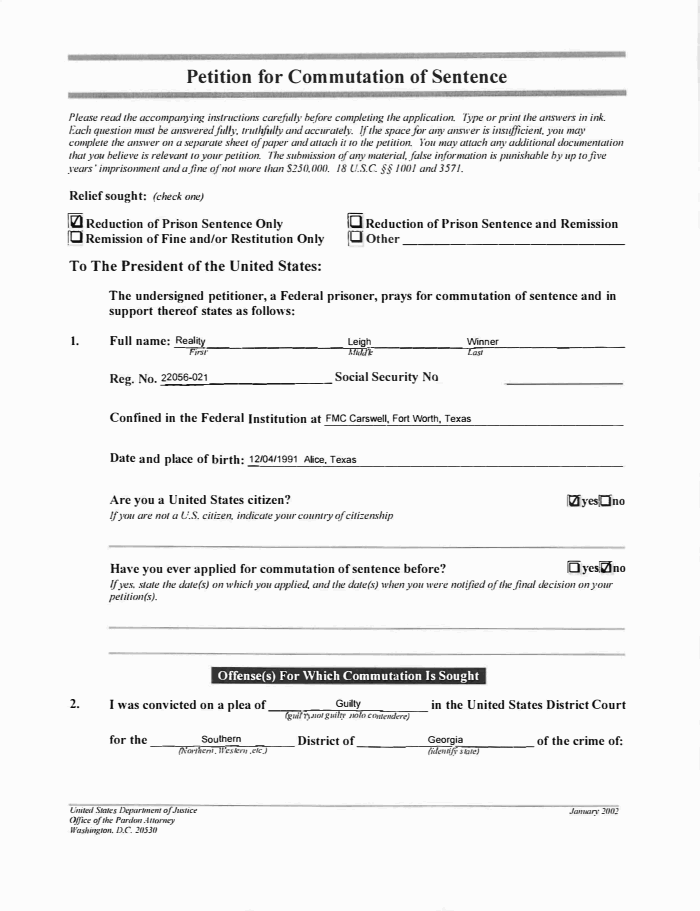
NSA Whistleblower Reality Winner's Petition for Clemency7 pages
IN ADDITION TO the petition, Grinter will also send the Justice Department’s Office of the Pardon Attorney Winner’s Air Force commendation for “meritorious service” and some 4,500 letters of support — including ones from privacy and press freedom advocates; an Obama-era NSA whistleblower; Jim Risen and Kate Myers of the Press Freedom Defense Fund; and a Republican candidate for Congress who met Winner during their at the NSA.
The fellow former NSA analyst, Jon Ivy, a Mandarin linguist, told The Intercept that Winner was known among her colleagues as one of the agency’s most talented analysts. He recalled a co-worker praising her for not just “actually understanding the languages that she was dealing with, but also understanding the context and the implications.”
During his campaign as a self-described “progressive Republican” in California’s 7th Congressional District — Ivy calls for ending post-9/11 wars; bolstering voters’ rights and election security; and redirecting Pentagon spending to investments on infrastructure projects — he became a rare person who knew Winner professionally to speak out on her behalf.
“She was trained, as we all are, to put the greater good above our own safety,” Ivy wrote in a letter supporting clemency for Winner, which also called for improving internal paths for whistleblowing in the intelligence community. “If someone trained in that way is facing a choice between doing what they believe is right and facing a possible death sentence — I don’t think they’ll shy away from the braver (albeit criminal) path.”
The clemency petition emphasizes the young veteran’s military service and says that Winner, who was diagnosed with bulimia when she was a young cryptolinguist working 12-hour shifts translating the intercepted communications of terror suspects in the drone program, does not receive adequate medical treatment in prison for her eating disorder, depression, and anxiety. The petition also says that, though her conviction is under the Espionage Act, Winner did not conspire against her country by working with a foreign agent, nor did she seek financial compensation for the information she sent to a media outlet with the intent that it become public knowledge.
“The continued imprisonment of Reality Leigh Winner serves no social or preventative purpose,” the petition says. “Her continued incarceration is costly. unnecessary to protect the public, burdensome to her health and wellbeing, and not commensurate with the severity of her offense.”
Winner, who joined the military at age 18 and was 25 when she was arrested in 2017, has already served about 30 months of her 63-month sentence. She will serve nearly two more years before her December 30, 2021 release.
The executive branch holds the power to grant clemency and pardons to people in federal prisons; the petition refers to a favorable 2018 tweet from President Donald Trump, who in 2018 called Winner’s record sentence for a media leak “unfair” for someone who is “small potatoes” compared to his 2016 campaign opponent Hillary Clinton, and criticized then-Attorney General Jeff Sessions for her harsh prosecution.
“The president, as he has shown time and time again, can use this process however he sees fit,” Grinter said, adding that she hopes he will “pluck this out of the pile.”
And if the White House changes hands in January 2021, Grinter added, “I’ll certainly resend it.”
February 17 2020, 12:07 p.m.
https://theintercept.com/2020/02/17/reality-winner-clemency-petition/?utm
ON MONDAY, A Texas civil rights attorney launched a clemency petition for National Security Agency whistleblower Reality Winner in Dallas.
The attorney, Alison Grinter, encountered Winner through Crystal Mason, a Texas mother who served time alongside Winner in a Fort Worth federal prison after receiving a five-year sentence for “illegal voting” in the 2016 presidential election. Mason and Winner became friends in the facility’s newsroom, where they spent long hours watching TV news and debating current events.
After hearing about Winner from Mason, Grinter began corresponding with the whistleblower’s mother, Billie Winner-Davis, on Twitter. Last year, the two women drove hours across the state of Texas — Winner-Davis up from the panhandle, and Grinter down from Dallas — to meet at an Austin restaurant, where they spoke late into the night.
“It was incredible talking to her,” Winner-Davis said of Grinter, “because she had the same dream and vision that I had and the kind of passionate energy about it.”
Grinter pulled together a petition — signed by Winner and delivered to the Trump administration’s Office of the Pardon Attorney — that invokes the whistleblower’s military service; her health conditions and inadequate treatment behind bars; and the circumstances of her case. Winner, who was reported to have leaked an NSA document detailing attempted Russian cyberattacks against U.S. election systems, is serving the longest federal sentence ever given to a journalistic source under the Espionage Act, World War I-era legislation increasingly used in recent years to prosecute government insiders who share classified information with journalists.
“Our country was attacked by a hostile foreign power,” Grinter said at a Monday press conference in Dallas alongside Winner’s family. “Our national healing process cannot begin until we forgive our truth tellers and begin the job of rebuilding what was taken from us: election security, accountability for those who endeavor to undermine our democracy, and safeguarding the American right to government by and for the people. None of this can begin in earnest while we are still punishing those who tell us the truth.”
Winner was widely reported as the source for a June 2017 article in The Intercept on an NSA document that detailed phishing attacks by Russian military intelligence on local U.S. election officials. The Intercept received the document anonymously; The Intercept’s parent company, First Look Media, contributed to Winner’s legal fund through the Press Freedom Defense Fund after learning of her arrest.
Like Winner’s sentence, Mason’s penalty had also sparked widespread outrage. Mason, who was on supervised release from an earlier prison sentence, said she did not know she was ineligible to vote when she cast the provisional ballot that ended up never being counted. That new conviction for “illegal voting” sent her back to prison for violating the conditions of her release.
“We were both sitting up in here as a political prisoner,” Mason told The Intercept of the solidarity she felt with Winner. “She shouldn’t be in prison. She was doing what anybody should have done if they had any kind of value in our country,” said Mason. “She’s really a hero.”
NSA Whistleblower Reality Winner's Petition for Clemency7 pages
IN ADDITION TO the petition, Grinter will also send the Justice Department’s Office of the Pardon Attorney Winner’s Air Force commendation for “meritorious service” and some 4,500 letters of support — including ones from privacy and press freedom advocates; an Obama-era NSA whistleblower; Jim Risen and Kate Myers of the Press Freedom Defense Fund; and a Republican candidate for Congress who met Winner during their at the NSA.
The fellow former NSA analyst, Jon Ivy, a Mandarin linguist, told The Intercept that Winner was known among her colleagues as one of the agency’s most talented analysts. He recalled a co-worker praising her for not just “actually understanding the languages that she was dealing with, but also understanding the context and the implications.”
During his campaign as a self-described “progressive Republican” in California’s 7th Congressional District — Ivy calls for ending post-9/11 wars; bolstering voters’ rights and election security; and redirecting Pentagon spending to investments on infrastructure projects — he became a rare person who knew Winner professionally to speak out on her behalf.
“She was trained, as we all are, to put the greater good above our own safety,” Ivy wrote in a letter supporting clemency for Winner, which also called for improving internal paths for whistleblowing in the intelligence community. “If someone trained in that way is facing a choice between doing what they believe is right and facing a possible death sentence — I don’t think they’ll shy away from the braver (albeit criminal) path.”
The clemency petition emphasizes the young veteran’s military service and says that Winner, who was diagnosed with bulimia when she was a young cryptolinguist working 12-hour shifts translating the intercepted communications of terror suspects in the drone program, does not receive adequate medical treatment in prison for her eating disorder, depression, and anxiety. The petition also says that, though her conviction is under the Espionage Act, Winner did not conspire against her country by working with a foreign agent, nor did she seek financial compensation for the information she sent to a media outlet with the intent that it become public knowledge.
“The continued imprisonment of Reality Leigh Winner serves no social or preventative purpose,” the petition says. “Her continued incarceration is costly. unnecessary to protect the public, burdensome to her health and wellbeing, and not commensurate with the severity of her offense.”
Winner, who joined the military at age 18 and was 25 when she was arrested in 2017, has already served about 30 months of her 63-month sentence. She will serve nearly two more years before her December 30, 2021 release.
The executive branch holds the power to grant clemency and pardons to people in federal prisons; the petition refers to a favorable 2018 tweet from President Donald Trump, who in 2018 called Winner’s record sentence for a media leak “unfair” for someone who is “small potatoes” compared to his 2016 campaign opponent Hillary Clinton, and criticized then-Attorney General Jeff Sessions for her harsh prosecution.
“The president, as he has shown time and time again, can use this process however he sees fit,” Grinter said, adding that she hopes he will “pluck this out of the pile.”
And if the White House changes hands in January 2021, Grinter added, “I’ll certainly resend it.”
Subscribe to:
Posts (Atom)