Friday, February 21, 2020
'Barbaric': 8 Million Americans Have Been Forced to Start Crowdfunding Campaigns to Cover Medical Costs, Survey Shows
"No one should have to beg for money to get the healthcare they need in the richest country on Earth."
Jake Johnson, staff writer
8 Comments
https://www.commondreams.org/news/2020/02/19/barbaric-8-million-americans-have-been-forced-start-crowdfunding-campaigns-cover?
An estimated eight million people in the U.S. have started a crowdfunding campaign to help pay for their own or a member of their household's healthcare costs, according to a survey released Wednesday.
The poll, which was conducted by the National Opinion Research Center (NORC) at the University of Chicago, also found that in addition to the millions who have launched crowdfunding efforts for themselves or a member of their household, at least 12 million more Americans have started crowdfunding efforts for someone else.
Fifty million Americans have donated to such fundraising efforts, the survey showed.
"As annual out-of-pocket costs continue to rise, more Americans are struggling to pay their medical bills, and millions are turning to their social networks and crowdfunding sites to fund medical treatments and pay medical bills," Mollie Hertel, senior research scientist at NORC, said in a statement. "Although about a quarter of Americans report having sponsored or donated to a campaign, this share is likely to increase in the face of rising premiums and out-of-pocket costs."
Sen. Bernie Sanders (I-Vt.), a 2020 Democratic presidential candidate, tweeted in response to the survey that "no one should have to beg for money to get the health care they need in the richest country on Earth."
"Enough is enough," Sanders wrote. "Medicare for All now."
The survey found that 60% of Americans believe the government—not charities, family members, or friends—has a "great deal or a lot of responsibility" to provide "help when medical care is unaffordable."
"I have to presume that most crowdfunding campaigns fail," tweeted single-payer advocate Tim Faust. "So here's the future of American healthcare: costs keep going up; they keep being pushed onto patients by insurers; whether you drown in medical debt is a function of luck, popularity, and how much sympathy you can garner."
As she introduced the House version of the Medicare for All Act of 2019 last February, Rep. Pramila Jayapal (D-Wash.) lamented that "GoFundMe is becoming one of the most popular insurance plans in the country."
"It comes down to a profit-making motive that is baked into a system—a system that puts profits over patients," said Jayapal.

Bernie Releases Video Contrasting His Social Security Record With Bloomberg

NEWS: Bernie Releases Video Contrasting His Social Security Record With Bloomberg
The video sets the stage for tonight's presidential primary debate in Nevada
David Sirota Feb 19


In advance of tonight’s presidential debate in Nevada, Bernie 2020 released a new video spotlighting billionaire Michael Bloomberg’s efforts to raise the Social Security and Medicare eligibility age, and to raise Medicaid co-pays so that it is harder for low-income families to access medical care. The new video contrasts Bloomberg’s record with Bernie’s efforts to stop those policies.
Click here to watch the video.
Bloomberg’s record pushing to cut Social Security, Medicare and Medicaid is particularly important because Bloomberg News’ own correspondent Steven Dennis recently reported that “McConnell has told me he hopes to work with next Democratic President to trim Social Security, Medicare, Medicaid. Says you need bipartisan deal to do so.”
The new video from the Bernie 2020 campaign comes out on the same day as a new report details Bloomberg’s efforts to demonize the AARP. That report in the American Prospect details Bloomberg’s consistent attacks on Social Security and Medicare. Here is an excerpt:
In February 2011 (Bloomberg) told TIME magazine that Social Security was like Bernie Madoff’s Ponzi scheme. He told Fox News in April 2011 that Medicare, Medicaid, and Social Security “need to be addressed,” and praised Ryan again, because “at least people are now talking about whether we can afford to continue to do what we've been doing.” In a signature speech at the Center for American Progress that November, he proposed $8 trillion in deficit reduction to balance the federal budget, including endorsing the recommendation of the Bowles-Simpson committee to gradually increase the retirement age. He described it as “reasonable entitlement reform.”
This continued in 2012, in an appearance on the now-defunct online news channel HuffPost Live. Bloomberg said that “we just can’t continue” with Medicare as it is, adding, “if we don’t do things like increasing the age at which you qualify for Social Security, you qualify for Medicare, or copays on Medicare and Medicaid so people think twice and only do things that are necessary, we’re just not going to be able to afford it.” He made the same call for rationing public insurance coverage to prevent the poor from accessing “too much” care with his friend, disgraced journalist Charlie Rose, on CBS News that year. He wanted to make sure “the services [Medicare and Medicaid recipients] use will be those that are really needed and not stuff that would be nice to have.” By the end of that year, Bloomberg was saddened in a Washington Post op-ed that proposed cuts to entitlements were “less than what I and many others believe are necessary to maximize long-term growth.”
Bern after reading,
Sirota
The Lee Camp Ledger for this week
Before we begin: to get around the suppression of anti-war, anti-corporate voices I’ve started a brand new YouTube page. (Don’t worry, the old page will not change at all!) So would you help me out by following this link to subscribe to Moment Of Clarity (and don’t forget to press the bell icon after subscribing). Thanks!
Pete Buttigieg is the spooks’ choice for president & his professional history demonstrates this — on Redacted Tonight
The co-founder of Direct Action Everywhere faces federal charges for acting to protect animals from abuse on factory farms — on VIP
The Wet’suwet’en are indigenous to Canada & they are fighting to protect their land from the fossil fuel industry — learn how on Moment Of Clarity
I know how the DNC plan on screwing Bernie Sanders out of their presidential nomination — on this installment of Moment Of Clarity
CNBC is done with fossil fuel investments! You have to see it to believe it! — on the latest episode of Moment Of Clarity
Mike Bloomberg has bought his way into the DNC’s primary race. I hate that racist billionaire & I’ll enjoy bringing him down — on Common Censored
A CIA spy did a fatal hit & run on a British teen before fleeing the UK. The US is refusing to extradite her while demanding that Britain send Julian Assange over here to face a kangaroo court — on The Grayzone
The Venezuelan Embassy Protectors ended their trial with a hung jury after being persecuted for defending international law — on MintPress News
A new study has found that global inaction on climate change threatens the futures of young people everywhere — on Common Dreams
Wealth has always been about POWER
https://rwer.wordpress.com/2020/02/20/wealth-has-always-been-about-power/
What has confused economists for centuries is that they’ve focused on what’s inside the fence of property rights, not the fence itself. And who can blame them? Historically, the things that were owned were easy to see. In contrast, the act of ownership — the institutional fence of private property — was abstract. And so economists tied wealth to property, not the property-rights fence.
The confusion dates back to the physiocrats. They saw agricultural land and proposed that it was the source of all value. The physiocrats couldn’t see that it was the landowner’s (institutional) fence that made him wealthy, not the land itself.
Then came the neoclassical economists. They saw capital (machines and factories) and proposed that it was a source of value. The neoclassical economists couldn’t see that it was the capitalist’s (institutional) fence that made him wealthy, not capital itself.
Then came the digital revolution. New companies emerged (like Facebook and Google) that owned nothing but algorithms. Wealth had suddenly become non-material. Or so it seemed to economists.
In reality, wealth had always been non-material — a social relation of exclusion. The digital revolution just laid this fact bare because it emptied out property, leaving only the fence of property rights. The digital revolution got rid of land. It got rid of physical capital. It got rid of all the physical things on which to pin wealth. All that was left (in digital tech firms) was the fence of property rights. And this fence was put up around the most non-material of things — ideas themselves.
Blair Fix
Has Wealth Gone Digital?
https://economicsfromthetopdown.wordpress.com/2019/10/01/has-wealth-gone-digital/
A revolution is underway around us and it’s called the digital. And it’s changing everything. More than 80% of wealth is now non-material.
— Charles Foran in Just don’t say his name: the modern left on Karl Marx’s place in politics (41:30)
Has wealth gone digital?
Both critics and cheerleaders of capitalism claim it has. The critics see non-material wealth as a problem. Digital wealth, they say, is fictitious. It’s lost touch with reality.
The cheerleaders of capitalism see the same thing as a boon. Non-material wealth, they say, will decouple the economy from physical constraints. So the economy can grow forever!
Which side is right?
Neither, in my opinion.
Instead, both sides misunderstand the nature of wealth. Wealth is not becoming non-material. No. Wealth has always been non-material. So the digital revolution isn’t changing the nature of wealth. It’s just laying bare the facts that have always been there.
What is wealth?
We use the word ‘wealth’ all the time. We say things like “Bill Gates is wealthy”, or “The United States is a wealthy nation”. But what do we mean by this? What exactly is ‘wealth’?
When we stop to think about the word ‘wealth’, we find that it has two meanings.
Sometimes we use the word ‘wealth’ to mean stuff — a stock of goods. So wealthy people are those who have lots of stuff. They own mansions, sports cars, yachts and private jets. Think of the opulence showcased on the 1980s show Lifestyles of the Rich and Famous.
But wealth can also mean money. If I have a billion dollars in the bank, I’m wealthy — even if I have no stuff at all.
So is wealth stuff? Or is it money?
Mainstream economists say it’s both. Wealth, they say, has two sides. It’s both a ‘real’ stock of goods and a symbolic stock of money. The key, economists say, is that the two sides are related. The monetary side of wealth quantifies the material side. Conversely, the material side of wealth is what ‘backs’ the monetary side.
Wealth distortions
Because (say economists) wealth has two sides, this opens the door for ‘distortions’. A distortion occurs when the two sides of the wealth coin don’t add up. Somehow monetary wealth gets out of whack with material wealth.
When monetary wealth overstates material wealth, economists say there’s a bubble. Conversely, when monetary wealth understates material wealth, economists say that assets are ‘undervalued’. In either case, monetary value isn’t doing its job correctly. It’s distorting (rather than representing) the ‘true’ stock of material wealth.
The idea of a wealth distortion is used by people of all political stripes. Curiously, their claims are often mutually contradictory.
Mainstream economists use the idea of wealth distortions to advocate free markets. Government intervention, they claim, ‘distorts’ prices. If the government would just let the market be, wealth distortions would go away and ‘true’ prices would be restored. At least, that’s what economists tell us.
Critics of capitalism turn this logic on its head. They see wealth distortions as a sign that capitalism (not government) has run amok. Companies like Facebook and Google, critics observe, are worth billions of dollars. But these companies don’t produce anything ‘real’. And so the critics claim that wealth is becoming fictitious. And this, in turn, is a sign that capitalism is in trouble. It’s lost touch with material reality.
In contrast, techno-optimists think digital wealth is good for capitalism. It’s a sign that companies are learning to produce (real) wealth without using resources. So we should celebrate, because wealth is becoming decoupled from material constraints.
Nearly everybody, it seems, uses the idea of wealth distortions to promote their (mutually contradictory) agendas. This is a sure sign that there’s a problem with our concept of wealth. Ideas that are infinitely malleable usually turn out to be wrong. Or worse, they’re not even wrong (they can never be tested).
The duality of wealth probably falls into both categories.
It’s not even wrong because there is no single way to objectively measure the material side of wealth. Any material definition of wealth is based on subjective decisions about the dimension of analysis. And these decisions affect the resulting stock of ‘real’ wealth. (See The Aggregation Problem for an explanation of this dilemma). So the idea that monetary value could misrepresent the stock of ‘real’ wealth is untestable.
The duality of wealth is also just plain wrong. It’s based on a misunderstanding of the nature of wealth. Wealth is not about property — the stuff that is owned. Instead, wealth is about the act of ownership. Wealth is about property rights.
Property vs. property rights
What’s the difference between property and property rights? Think of the difference between a fence and whatever it surrounds. The fence represents property rights. The stuff inside the fence is property.
This distinction is important, because the value of wealth doesn’t stem from property. It stems from property rights. Without the fence of property rights, anyone can use your property for free. And when it’s free, your property has no value. So monetary wealth depends on property rights, not property itself.
Skeptical? Think about this real-life example. A hotshot programmer creates a new operating system. The OS is heralded as revolutionary and is adopted by millions of people.
Does the programmer become wealthy?
It depends on property rights.
Suppose our programmer is Bill Gates. When he released MS-DOS (and later Windows), Gates fiercely enforced property rights. He patented his software and made people pay to use it. Through a series of shrewd deals with manufacturers, Microsoft eventually gained a near monopoly on PC operating systems. And as we all know, Gates became a wealthy man.
Now suppose our programmer is Linus Torvalds. In the 1990s, Torvalds created the Linux operating system. Although adoption was slow at first, Linux now dominates the server market. And through its derivative, Android, Linux also dominates the smartphone market.
So Torvalds got rich, right? Actually no. Torvalds released Linux as open source software, meaning it’s free for anyone to use. Because Torvalds didn’t enforce property rights, he didn’t get rich like Bill Gates.
The lesson here is that without property rights, goods and services don’t have a price. And without a price, they don’t get counted as ‘wealth’.
Don’t look inside the fence
Property rights are the fence that gives property value. Now here’s the important thing. When it comes to determining value, it doesn’t matter what’s inside the fence. It could be a house. It could be machinery. It could be knowledge. What matters is the fence itself. The fence — the ability to enforce property rights — is the source of the owner’s monetary wealth.
To illustrate that it doesn’t matter what’s inside the fence of property rights, Jonathan Nitzan and Shimshon Bichler compare Microsoft and General Motors. The chart below shows different features of each company.
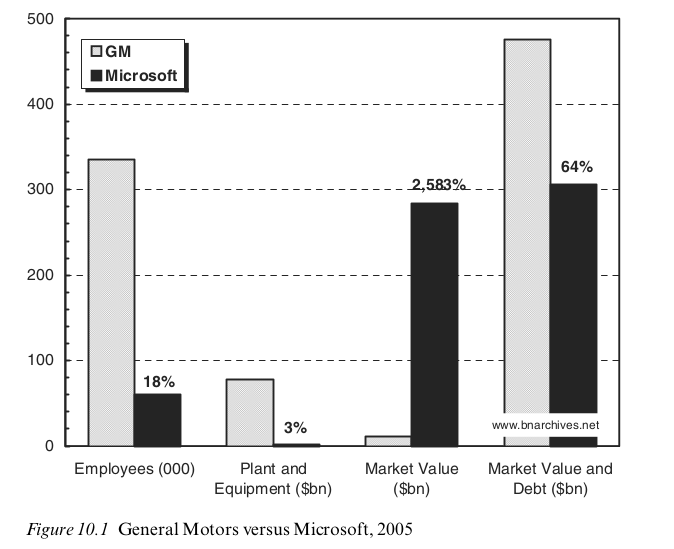
Source: Nitzan and Bichler, Capital as Power
In 2005, Microsoft’s market value was 2,583% greater than that of General Motors. Mainstream economists would say that Microsoft therefore had more property than GM. But more of what? Nitzan and Bichler point out that when we look under the hood of market value, there’s nothing ‘real’ to back it up. Microsoft, for instance, has only 18% as many employees as GM. And it owns only 3% as much equipment (in dollar terms).
So is this a distortion? Is it a sign that Microsoft’s wealth is fictitious? No, say Nitzan and Bichler. Wealth isn’t about material property. Instead, they argue that wealth is a commodification of property rights. So Microsoft’s greater market value stems from its greater ability to convert property rights into income. That Microsoft can do this without owning bricks and mortar is interesting, but not surprising. As intellectual property teaches us, property rights need not be attached to anything physical.
The power of owners
If monetary wealth stems from property rights, how should we interpret its value? Jonathan Nitzan and Shimshom Bichler have a provocative answer. The value of property rights, they argue, indicates the relative power of owners.
Nitzan and Bichler’s reasoning is simple. Property rights are about exclusion. And exclusion is about power:
The most important feature of private ownership is not that it enables those who own, but that it disables those who do not. Technically, anyone can get into someone else’s car and drive away, or give an order to sell all of Warren Buffet’s shares in Berkshire Hathaway. The sole purpose of private ownership is to prevent us from doing so. In this sense, private ownership is wholly and only an institution of exclusion, and institutional exclusion is a matter of organized power. (Nitzan and Bichler in Capital as Power)
If we think like Nitzan and Bichler, we realize that wealth is not a thing. It’s an act. Wealth is the commodification of an act of exclusion — an act we call property rights.
When only the fence is left
If Nitzan and Bichler are right (and I think they are), then the digital revolution is not making wealth non-material. Instead, it’s just laying bare the fact that wealth has always been non-material. Wealth has always been about power.
What has confused economists for centuries is that they’ve focused on what’s inside the fence of property rights, not the fence itself. And who can blame them? Historically, the things that were owned were easy to see. In contrast, the act of ownership — the institutional fence of private property — was abstract. And so economists tied wealth to property, not the property-rights fence.
The confusion dates back to the physiocrats. They saw agricultural land and proposed that it was the source of all value. The physiocrats couldn’t see that it was the landowner’s (institutional) fence that made him wealthy, not the land itself.
Then came the neoclassical economists. They saw capital (machines and factories) and proposed that it was a source of value. The neoclassical economists couldn’t see that it was the capitalist’s (institutional) fence that made him wealthy, not capital itself.
Then came the digital revolution. New companies emerged (like Facebook and Google) that owned nothing but algorithms. Wealth had suddenly become non-material. Or so it seemed to economists.
In reality, wealth had always been non-material — a social relation of exclusion. The digital revolution just laid this fact bare because it emptied out property, leaving only the fence of property rights. The digital revolution got rid of land. It got rid of physical capital. It got rid of all the physical things on which to pin wealth. All that was left (in digital tech firms) was the fence of property rights. And this fence was put up around the most non-material of things — ideas themselves.
Changing power
If the digital revolution isn’t making wealth non-material, what is it doing?
Like previous revolutions, the digital revolution is changing who has power in our society. Tech firms are wrestling power from industrial firms. Two hundred years ago the industrial revolution did something similar. In it, the captains of industry wrestled power from the landed aristocracy.
Nitzan and Bichler’s insight is to realize that we can study the power of different types of owners using the value of their property rights. This is an exciting research area that we’re only beginning to investigate.
So yes, the value of property rights is increasingly dominated by tech firms. But no, this doesn’t mean that wealth is becoming non-material. Wealth is the commodification of a social relation — the right of owners to exclude everyone else. As such, wealth has always been non-material.
Michael Moore on Bloomberg
Bloomberg.
In 1999 he called me up and asked me to be his “date” at the annual White House Correspondents Dinner. I said,"Yes." When I got there he was with his other “date” — Charlie Rose. Disgusting. Those two were peas in a pod. Two years later Bloomberg was Mayor. He took Rudy’s “Stop and Frisk” program and put it on steroids. 12 long Bloomberg years of rounding up, apprehending and assaulting 5 million innocent black and brown men from 2001 to 2013. Yes, that’s right: FIVE MILLION black and brown boys and young men (a number that just screams incomprehensible!) — and THAT is why I beg everyone to shun Bloomberg in this election year.
In police states past and present, in order to make it easy for the police to identify the subhumans they seek to terrorize, the authorities require the hunted to carry ID papers, or wear a “scarlet letter” or have an identifying emblem sewn onto their clothes. None of this was needed in New York City. The mark of their status as “permanent suspect” was already on them — their skin. It covered their whole body. It could not be removed. A permanent stain for the permanent suspects. It made it so easy to grab them and nail them and instill in them a sick fear that they were forced to carry with them every time they stepped outside their homes. That, of course, was the true intention of Bloomberg & Co. — let a race of people be reminded on a daily basis who’s in charge, who’s to bow their heads and obey the orders, who’s to shut their mouths about their lack of decent housing, livable income, health care or going to a great school. Hunt, stalk, neutralize, zip-tie. Then release and let them go home to sink into further despair, trapped in their misery, imprisoned even if not inside an actual prison, the Bloomberg brand of kids in cages. I speak these truths as I’ve witnessed them. My RUMBLE podcast, the Bloomberg episode, just posted.
Thursday, February 20, 2020
Message from Common Dreams
Donald Trump just handed Democrats an issue that should end the entire 2020 election.
He just proposed cutting Social Security, Medicare, and Medicaid by more than $1.7 trillion—breaking one of his most famous campaign promises.
Going after senior citizens who always vote, just months before an reelection? That's political suicide.
There's only one problem: The corporate media is almost totally ignoring the story.
The 1% who own and operate the corporate media could not be more out of touch with the kitchen table concerns of regular people. Nearly three-quarters of Americans oppose cutting in Medicare and Social Security, but if you only got your news from the media elites on Morning Joe or CNN, you'd think that “entitlement reform”—their code for cutting Social Security and Medicare—is downright popular.
Common Dreams is not about to give Donald Trump a free pass for going after Social Security and Medicare. We covered it as headline news, and we'll continue to shine a bright light on the key issues that the corporate media ignores.
Will you make a donation to help fund our ongoing coverage of Trump's attacks on Social Security, Medicaid, and Medicare—and all the issues that matter for the 99%?
DONATE NOW
With thanks,
Jon Queally
Managing Editor
For the whole Common Dreams news team
Subscribe to:
Posts (Atom)