skip to main |
skip to sidebar
A stark climate warning from the green swan
February 10th, 2020, by Kieran Cooke
The green swan is unambiguous: Expect the unexpected. Image: By Ehud Neuhaus on Unsplash
The green swan brings a clear message from people who should know: bankers say the climate crisis means major change lies ahead.
LONDON, 10 February, 2020 − There’s more than a touch of déjà-vu about The green swan, another alarm call from the serious world of senior bankers about what the future is likely to hold.
Way back in 2006 the British economist Lord Nicholas Stern wrote his review warning of the serious impacts of climate change, in particular its effect on the global economy and the world’s financial systems.
For a brief period it seemed people were listening. Then, in 2008, the global financial crisis came along – a crisis caused, not by climate change but primarily by reckless bank lending, weak regulation and a sustained bout of greed.
World leaders panicked as the financial sector went into meltdown. Multi-billion dollar rescue packages were thrown about like confetti. Amid the panic, Stern’s warnings were largely forgotten.
It’s only recently that bankers and financiers have been revisiting his work and waving their own red flags about the dire consequences of a warming world.
The publisher of this book – the Bank of International Settlements (BIS) – is the central bank to the world’s central banks, its goal to preserve overall global monetary and financial stability. It is a conservative, some might say staid, institution, its utterances normally carefully calibrated and moderate in tone.
“Green swan events may force central banks to intervene as ‘climate rescuers of last resort’ and buy large sets of devalued assets”
The green swan is different: it graphically describes the sense of urgency now evident in banking boardrooms about global warming, the dire state of the planet and the consequent effects on the finance sector.
“Exceeding climate tipping points could lead to catastrophic and irreversible impacts that would make quantifying financial damages impossible”, say the authors.
“Avoiding this requires immediate and ambitious action towards a structural transformation of our economies, involving technological innovations that can be scaled, but also major changes in regulations and social norms.”
In other words, in non-banking terminology, expect the unexpected. Unless major international action is taken, climate change is going to cause lasting damage to the global economic and financial systems.
The “green swan” in the book’s title is a mutation of the concept of the “black swan” made famous by Nicholas Taleb in a 2007 book of the same name.
Key differences
Taleb used the term black swan to characterise random, unexpected events such as terrorist attacks or natural catastrophes and their impact on economies and financial systems. Uncertainty becomes a major factor: calculating risk in such circumstances is a very difficult, if not impossible, business.
This book’s authors characterise climate change in a similar way, talking of green swan events. But they draw some important distinctions.
Though the effects of global warming are highly uncertain, there is a high degree of certainty that major change is on the way. There is also certainty about the need for urgent action.
“Climate catastrophes are even more serious than most systemic financial crises”, say the authors.
“The complex chain reactions and cascade effects associated with both physical and transition risks could generate fundamentally unpredictable environmental, geopolitical, social and economic dynamics.”
The authors warn about central banks being caught in what they refer to as the uncharted waters of climate change. If government and other agencies don’t take action, the world’s central banks might not be able to ensure financial and price stability.
Ending fossil fuel
Fossil fuel companies could go to the wall. While this might be good for the climate, it would create financial turmoil.
“Green swan events may force central banks to intervene as ‘climate rescuers of last resort’ and buy large sets of devalued assets, to save the financial system once more.”
The warnings from the BIS are only the latest broadside from central bank authorities on the dangers of a warming world. Late last year the Bank of England, the UK’s central bank, announced it would be subjecting the country’s banks and insurance companies to a climate change-related stress test.
In recent days Singapore’s central monetary authority has introduced similar measures to test finance institutions’ preparedness in the face of global warming.
The overall message is clear: if you see a green swan, beware. A big climate change event is happening, and turmoil is on the way.
by Caitlin Johnstone
The world's first laboratory-grown presidential candidate Pete Buttigieg met with boos and chants of "Wall Street Pete" at a recent Democratic Party event in New Hampshire for taking a dig at the revolution-minded rhetoric favored by Bernie Sanders and his supporters.
“We cannot risk dividing Americans’ future further, saying that you must either be for a revolution or you must be for the status quo,” Buttigieg said. “Let’s make room for everybody in this movement.”
This is a talking point that the tightly scripted and focus group-tested Buttigieg has been repeatedly regurgitating all month, so it's worth taking a look at.
Pete is just the latest model in a long line of CIA-funded counterrevolutions pic.twitter.com/PBAbIIzoxP
— Samuel D. Finkelstein II (@CANCEL_SAM) February 9, 2020
Claiming that it isn't necessary to choose between revolution and the status quo is claiming that you can change the status quo without any kind of revolution. You are saying that the establishment which has created and reinforced the status quo can now suddenly, for some strange and mysterious reason, be counted upon to change it. That the status quo will change the status quo.
Anyone who has paid attention to US politics for more than a few years already knows that this is objectively false. From administration to administration, regardless of who sits in the Oval Office or who controls the House or the Senate, the status quo has been adamantly enforced along a rigid trajectory toward ever-increasing military expansionism, exploitative neoliberal economic policies, income and wealth inequality, police militarization, mass-scale imprisonment, Orwellian surveillance programs and increasing restrictions on journalism and free speech.
Change is not going to come from those institutions, it's going to come from the people using the power of their numbers to force important changes that those institutions do not want to make. And Pete Buttigieg knows this. And so do the spooks and oligarchs who are backing him.
It is very appropriate that a military intelligence officer with ties to the CIA, who is beloved by intelligence/defense agency insiders and who appears to have been groomed by national security mandarins from the very beginning of his career, should be actively working to kill a revolutionary zeitgeist. After all, backing counter-revolutionaries is a favorite CIA activity.
#PeteButtigieg just mocked @BernieSanders @OurRevolution and then everyone started shouting. #WallStreetPete-(Source: Fiorella Isabel) pic.twitter.com/FYkxIPw612
— KaeySonPoint (@KaeySonPoint) February 9, 2020
Progressives already got suckered into forfeiting their revolutionary spirit in exchange for flowery prose and empty rhetoric the last time they elected Pete Buttigieg for president, back when Pete Buttigieg was named Barack Obama. It was literally the exact same script they're trying to recycle with Puppet Pete: a plucky young underdog with a knack for sparkly verbiage overcomes the frontrunner in Iowa in a stunning upset, then rides the momentum from that initial victory on to the Democratic nomination.
And now we're seeing the Democratic Party officially award Buttigieg the largest delegate count in Iowa, after a massive scandal and despite countless unresolved discrepancies in the numbers, and establishment narrative managers are now preparing their heartwarming David-and-Goliath stories about the small town mayor knocking out the big bad socialist frontrunner for a second consecutive time in New Hampshire in defiance of the odds and polling expectations. If that falls through they've got Nevada, where shit really started to get crazy in 2016, and where they're preparing to implement a brand new caucus app which they keep trying to say is not an app but a "tool" made for iPads (which is the thing that an app is).
All this to install a man who has managed to pack an astonishing amount of corruption and scandal into a relatively brief, small-scale political career.
That's what not choosing between revolution and the status quo looks like. It looks like continuing the status quo.
Which is why it's so dumb when Buttigieg says “Let’s make room for everybody in this movement.” Movement? What movement? You don't get to call it a "movement" when its entire agenda is to prevent any movement. Use a different word. "Let’s make room for everybody in this inertia," or “Let’s make room for everybody in this stasis” or something.
Things that are more real than Pete Buttigieg:
- Milli Vanilli
- aspartame
- astroturf
- boobs in LA
- smiles at a Martha's Vineyard cocktail party
- the Gulf of Tonkin incident
- Bryan Williams' helicopter crash
- Joy Reid's time travelling hackers
- Epstein's suicide
— Caitlin Johnstone  (@caitoz) February 10, 2020
As I've said many times before, I'm interested in this presidential election not because I am under the delusion that presidential elections tend to change things, but because the attempts to manipulate it, and the public's response to those manipulations, could shake something loose that actually might. If enough people in the world's most powerful nation wake up to the fact that they don't have the kind of political system they were taught about in school, if they realize that everything they've been told about how their government operates is a lie, if they realize their lives have been made so unnecessarily difficult by a ruling oligarchic class with a vested interest in keeping them impoverished and distracted, well, then we're looking at an actual transformative force.
Then we're looking at the possibility of a real revolution. Not a violent revolution; those always result in a continuation of the same ills under a different system, and there's nothing revolutionary about that.
I'm talking about a real revolution. One where people begin to open their eyes to the reality that their entire understanding of what's going on in the world has been the result of mass psychological manipulation throughout their entire lives at the hands of the school system, the billionaire-controlled news media, and the political establishment. One where people open their eyes so wide to the power of narrative control that they become impossible to propagandize. One where people begin weaving their own narratives. Their own understandings of the world. Built not for the benefit of the powerful, but for the benefit of the people.
We're seeing a lot of movement already in 2020, and it's just getting started. I see the potential for a lot of light to reach a lot of new areas between the cracks which open up in that movement. And I see the guardians of the status quo having a harder and harder time maintaining the state of stasis. Their increasingly ham-fisted manipulations, such as installing a jarringly phony puppet like Pete Buttigieg, say a lot about their desperation.
Find ways of forcing them to overextend themselves and overplay their hand. Let's show everyone what they're hiding behind the puppet theater.
F.D.R. Proposes a Second Bill of Rights: A Decent Job, Education & Health Care Will Keep Us Free from Despotism (1944)
in History, Politics | August 16th, 2017 17 Comments
593kSHARES
FacebookTwitterReddit
It’s difficult to appraise the complicated legacy of Franklin D. Roosevelt. His New Deal policies are credited for lifting millions out of destitution, and they created opportunities for struggling artists and writers, many of whom went on to become some of the country’s most celebrated. But Roosevelt also compromised with racist southern senators like Mississippi’s Theodore Bilbo, and underwrote housing segregation, job and pay discrimination, and exclusions in his economic recovery aimed most squarely at African-Americans. He is lauded as a wartime leader in the fight against Nazism. But he built concentration camps on U.S. soil when he interned over 100,000 Japanese Americans after Pearl Harbor. His commitment to isolationism before the war and his “moral failure—or indifference” to the plight of European Jews, thousands of whom were denied entry to the U.S., has come under justifiable scrutiny from historians.
Both blame and praise are well warranted, and not his alone to bear. Yet, for all his serious lapses and wartime crimes, FDR consistently had an astute and idealistic economic vision for the country. In his 1944 State of the Union address, he denounced war profiteers and “selfish and partisan interests,” saying, “if ever there was a time to subordinate individual or group selfishness to the national good, that time is now.”
He went on to enumerate a series of proposals “to maintain a fair and stable economy at home” while the war still raged abroad. These include taxing “all unreasonable profits, both individual and corporate” and enacting regulations on food prices. The speech is most extraordinary, however, for the turn it takes at the end, when the president proposes and clearly articulates a “second Bill of Rights,” arguing that the first one had “proved inadequate to assure us equality in the pursuit of happiness.”
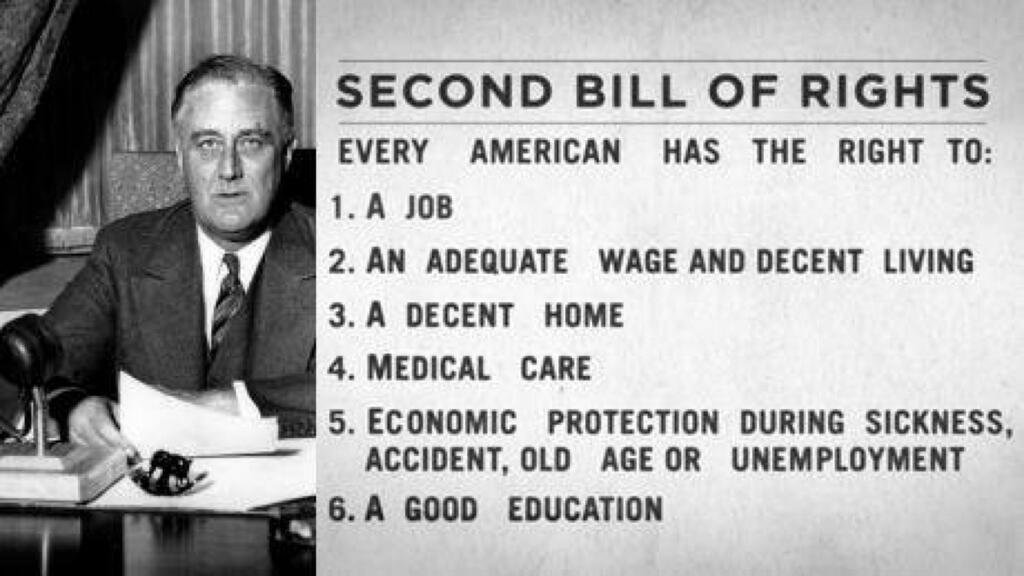
Roosevelt did not take the value of equality for granted or merely invoke it as a slogan. Though its role in his early policies was sorely lacking, he showed in 1941 that he could be moved on civil rights issues when, in response to a march on Washington planned by Bayard Rustin, A. Philip Randolph, and other activists, he desegregated federal hiring and the military. In his 1944 speech, Roosevelt strongly suggests that economic inequality is a precursor to Fascism, and he offers a progressive political theory as a hedge against Soviet Communism.
“We have come to a clear realization,” he says, “of the fact that true individual freedom cannot exist without economic security. ‘Necessitous men are not free men.’ People who are hungry and out of a job are the stuff of which dictatorships are made. In our day these economic truths have become accepted as self-evident.” In the footage at the top of the post, you can see Roosevelt himself read his new Bill of Rights. Read the transcript yourself just below:
We have accepted, so to speak, a second Bill of Rights under which a new basis of security and prosperity can be established for all regardless of station, race, or creed.
Among these are:
The right to a useful and remunerative job in the industries or shops or farms or mines of the Nation;
The right to earn enough to provide adequate food and clothing and recreation;
The right of every farmer to raise and sell his products at a return which will give him and his family a decent living;
The right of every businessman, large and small, to trade in an atmosphere of freedom from unfair competition and domination by monopolies at home or abroad;
The right of every family to a decent home;
The right to adequate medical care and the opportunity to achieve and enjoy good health;
The right to adequate protection from the economic fears of old age, sickness, accident, and unemployment;
The right to a good education.
All of these rights spell security. And after this war is won we must be prepared to move forward, in the implementation of these rights, to new goals of human happiness and well-being.
Roosevelt died in office before the war ended. His successor tried to carry forward his economic and civil rights initiatives with the "Fair Deal," but congress blocked nearly all of Truman's proposed legislation. We might imagine an alternate history in which Roosevelt lived and found a way through force of will to enact his “second Bill of Rights," honoring his promise to every “station, race” and “creed.” Yet in any case, his fourth term was nearly at an end, and he would hardly have been elected to a fifth.
But FDR's progressive vision has endured. Many seeking to chart a course for the country that tacks away from political extremism and toward economic justice draw directly from Roosevelt’s vision of freedom and security. His new bill of rights is striking for its political boldness. Its proposals may have had their clearest articulation three years earlier in the famous “Four Freedoms” speech. In it he says, “the basic things expected by our people of their political and economic systems are simple. They are:
Equality of opportunity for youth and for others.
Jobs for those who can work.
Security for those who need it.
The ending of special privilege for the few.
The preservation of civil liberties for all.
The enjoyment of the fruits of scientific progress in a wider and constantly rising standard of living.
These are the simple, the basic things that must never be lost sight of in the turmoil and unbelievable complexity of our modern world. The inner and abiding strength of our economic and political systems is dependent upon the degree to which they fulfill these expectations.
Guaranteeing jobs, if not income, for all and a "constantly rising standard of living" may be impossible in the face of automation and environmental degradation. Yet, most of Roosevelt's principles may not only be realizable, but perhaps, as he argued, essential to preventing the rise of oppressive, authoritarian states.
Related Content:
Franklin D. Roosevelt Says to Moneyed Interests (EG Bankers) in 1936: “I Welcome Their Hatred!”
Rare Footage: Home Movie of FDR’s 1941 Inauguration
Striking Poster Collection from the Great Depression Shows That the US Government Once Supported the Arts in America

