Saturday, December 7, 2019
Wealthy Nations Are Condemning Hundreds of Millions to Suffer
Vijay Prashad / Independent Media Institute
DEC 05, 2019
OPINION
https://www.truthdig.com/articles/wealthy-nations-are-condemning-hundreds-of-millions-to-suffer/
In Madrid, Spain, the 2019 UN Climate Change Conference—known as COP25—began on December 2. Representatives of the world’s countries gathered to discuss what is decidedly a serious problem for the planet; no one, except dangerous political forces in the neofascist right, denies the reality of climate change. What prevents a transfer from carbon-based fuel to other fuels is not the stubbornness of this or that country. The main problems are three:
The right wing that denies climate change;
Sections of the energy industry that have a vested interest in the continuation of the use of carbon-based fuels;
The refusal by the Western advanced countries to admit both that they have caused the problem and that they should use their vast wealth to finance the transfer from carbon-based fuels to other fuels in countries whose wealth has been siphoned off to the West.
The first two blockages—the right wing and sections of the climate industry—are related, since it is often money from the climate industry (the Koch brothers, for instance) that finances the climate deniers and sows confusion about the immense reality that confronts us.
The third blockage is serious, and it has prevented the United Nations process from bearing fruit. At the Rio Earth Summit of 1992, the countries of the world negotiated a UN Framework Convention on Climate Change. In that document—which was ratified at the General Assembly two years later—the governments agreed to a key principle, namely that the impact of colonialism cannot be divorced from discussions of the climate crisis.
“The global nature of climate change,” the parties wrote, “calls for the widest possible cooperation by all countries and their participation in an effective and appropriate international response, in accordance with their common but differentiated responsibilities and respective capabilities and their social and economic conditions.”
Common and Differentiated Responsibilities
The main phrase here to consider is “common but differentiated responsibilities.” This means that the problem of climate change is something that is common to all countries, and that no one is immune to its deleterious impact; at the same time, the responsibility of countries is not identical, and some countries—which benefited for centuries from colonialism and carbon fuel—have a greater responsibility for the transition to a less damaging energy system.
There is little scholarly debate on the fact that certain countries—the West—benefited inordinately from both colonialism and carbon fuel. A look at the data from the Carbon Dioxide Information Analysis Center’s Global Carbon Project shows that the United States of America—by itself—has been the largest dispenser of carbon dioxide emissions since 1750. The main carbon emitters were all colonial powers, namely European states and the United States of America. From the 18th century, these countries have not only dispensed the bulk of the carbon into the atmosphere, but they also continue to exceed their share of the Global Carbon Budget.
Carbon-fueled capitalism—enriched by the wealth stolen through colonialism—enabled the countries of Europe and North America to enhance the well-being of their populations. The extreme inequalities between the standard of living for the average European (742 million people) and the average Indian (1.4 billion people) is as stark as it was a century ago. The reliance by China, India, and other developing countries on carbon—particularly coal—is high; but even this use of carbon has not raised the per capita emissions of China and India above that of the United States, whose per capita emissions are almost twice as much as China’s per capita emissions.
Green Climate Fund
The Framework Convention recognized the importance of colonialism, the geographical divergence of industrial capitalism, and its impact on the carbon budget. That is why the countries at Rio agreed to create a Green Climate Fund. The West was asked to make substantial contributions to the fund, whose capital would then be used to assist developing countries to “leapfrog” carbon-fueled social development.
It was hoped that the fund would draw in $100 billion—at a minimum—by 2020. The United States pledged $3 billion but has only contributed $1 billion. Trump has blocked any further contributions to the fund (Bernie Sanders, in contrast, said he would pay $200 billion into the fund, while the UK’s Jeremy Corbyn pledged to use his country’s leverage over the World Bank’s Climate Investment Funds toward “climate justice for the Global South”). Australia and Russia have also paused contributions. No real appetite exists to expand this fund; there is little expectation that it—or the concept of leapfrogging—will be taken seriously at COP25.
The $100 billion figure is very conservative. The International Energy Agency suggests each year in its World Energy Outlook that the actual figure is in the trillions. None of the Western powers has intimated anything like a commitment of that scale to the fund.
Attack on Coal
It is far easier to attack China and India, and other developing countries.
In early November, UN Secretary-General António Guterres addressed the press after his participation in the UN-ASEAN (Association of Southeast Asian Nations) meeting in Bangkok, Thailand. He mentioned neither the concept of “common but differentiated responsibility” nor the Green Climate Fund.
Tellingly, the secretary-general made three proposals, each of which says nothing to the main principle of “differentiated responsibility”:
Taxes must be placed on carbon emissions.
Trillions of dollars of subsidies for fossil fuels must end.
Construction of coal-fired power stations must end by 2020.
None of these proposals per se would raise eyebrows. In fact, given the gravity of the reports coming in from the Intergovernmental Panel on Climate Change, there is no doubt that action is necessary.
But what kind of action? These three proposals would directly strike at the energy sources for countries that have not yet provided electrification for their populations, or where their people are far from the UN’s Sustainable Development Goals. Southeast Asia, where Guterres made these remarks, only anticipates full electrification of the region by 2030.
Advanced industrial states—such as the United Kingdom and Germany—have said that they will phase out coal by 2040. These are countries that have created the Powering Past Coal Alliance (backed by the Bloomberg New Energy Finance, one of the major capital funds that seeks to make money off the Green New Deal). There is money to be made here for venture capitalists; they are not going to contribute the billions needed for the Green Climate Fund. No philanthropy by the billionaires will be willing to donate their money into the fund; the tax-free money they make on the “green transition” will eclipse the tiny amounts of money they will donate for a non-carbon future.
Ugly Choice
Meanwhile, developing countries have an ugly choice before them: to forgo carbon, the cheapest fuel, and then forgo social development for their populations; or to continue to use carbon and threaten the planet. These are the only choices if the advanced industrial states refuse to fund the Green Climate Fund, and if they refuse to transfer technology for wind and solar to countries without any financial obligation.
A Green New Deal in the West is not going to be sufficient if this deal does not include trillions of dollars into the UN’s Green Climate Fund and the transfer of technology as a social practice and not for profit.

The Activists Guiding Us Through These Dark Days
Amy Goodman and Denis Moynihan
DEC 05, 2019
https://www.truthdig.com/articles/the-activists-guiding-us-through-these-dark-days/
STOCKHOLM — Over 1,000 people packed into the historic Cirkus Arena in downtown Stockholm Wednesday night. It wasn’t for the building’s original purpose, an actual circus, or for a rock concert, which is one of the contemporary uses of the building. What drew this remarkable cross section of Swedish society, as well as people from around the world? Activism. Courage. Passion.
Each year for the past four decades, in the short, dark days of December, people have gathered in Sweden’s capital to celebrate change-makers, whistleblowers and resistance leaders: recipients of the Right Livelihood Award. The award recognizes four individuals or organizations, to “honor and support courageous people solving global problems.”
It is no accident that the award ceremony falls at about the same time as the Nobel Prizes. The Nobels recognize lifetime achievements in medicine, chemistry, physics, literature, economics and peace. “The Nobel Foundation started a sixth Nobel Prize, in economics in 1969,” Right Livelihood Foundation executive director Ole von Uexkull explained on the “Democracy Now!” news hour. “My uncle, Jakob von Uexkull, began to think, if you can start new Nobel categories, it shouldn’t just be one in economics. There should be Nobel Prizes also for people who work for the environment and for the interest of the poor majority in the world.”
This year’s new Right Livelihood laureates are Aminatou Haidar of Western Sahara; Guo Jianmei of China; Davi Kopenawa and the Hutukara Yanomami Association of Brazil; and Sweden’s own Greta Thunberg.
Aminatou Haidar is an indigenous Sahrawi woman. Western Sahara is often called Africa’s last colony, as it has been violently occupied by the Kingdom of Morocco since 1975. Haidar is one of the most prominent leaders of the nonviolent resistance to the Moroccan occupation, and has defended human rights in Western Sahara for decades. For this, Morocco imprisoned and tortured her for years.
Guo Jianmei was honored “for her pioneering and persistent work in securing women’s rights in China,” the Right Livelihood Foundation said its announcement earlier this year. She is the first public interest lawyer working in legal aid in China, with a strong focus on women’s issues, like domestic violence and equal pay for equal work. Her legal aid law office has been shut down by the Chinese government, and she was absent from the award ceremony.
“She could not travel from China to attend the award presentation here in Stockholm,” von Uexkull told “Democracy Now!” “It is a sign of the shrinking space for civil society around the world. We have seen that in recent years with laureates from other countries as well. We are in constant contact with her, and we have agreed that we are not commenting on the exact reasons.”
Greta Thunberg, the 16-year-old climate activist who is actually from Stockholm, also missed the award ceremony, but for very different reasons. Greta refuses to fly in airplanes because of the vast amounts of carbon emissions they spew into the atmosphere. In September, she traveled across the Atlantic in a zero-emissions sailboat, arriving in New York City in time for the United Nations Climate Action Summit. There she admonished world leaders:
“You have stolen my dreams and my childhood with your empty words. … People are suffering. People are dying. Entire ecosystems are collapsing. We are in the beginning of a mass extinction, and all you can talk about is money and fairy tales of eternal economic growth. How dare you!”
She then crisscrossed the United States and Canada, and was heading to Santiago, Chile, to attend the United Nations climate summit, known as COP 25. When the Chilean president canceled the COP due to mass protests against austerity and inequality, it was moved to Madrid, Spain.
Determined to make the summit, Greta then reversed course and set sail again, back to Europe, making landfall near Lisbon, Portugal, the day before the Right Livelihood award ceremony.
This year’s U.N. climate summit was moved not once, but twice. Before it was scheduled for Chile, it had been slated for Brazil. After right-wing extremist Jair Bolsonaro won the presidency, one of his first acts in office was to cancel Brazil’s role as host. He, like U.S. President Donald Trump, calls climate change a hoax.
The fourth and final of this year’s Right Livelihood Award recipients is a leading defender of the Amazon from Brazil, Davi Kopenawa, along with the organization he co-founded, the Hutukara Yanomami Association. Davi said on “Democracy Now!” [translated], “The president of the United States, they exterminated our indigenous peoples who lived over there. [Bolsonaro] is doing just the same. He is repeating it. He wants to kill my people. He wants to get rid of the forest. He wants to destroy our health.”
Aminatou Haidar. Guo Jianmei. Greta Thunberg. Davi Kopenawa. Each truly pursues ethical living, a right livelihood. Their examples should guide us through these dark days.
Bernie Sanders Pulls Ahead in Crucial Primary
DEC 05, 2019
NEWS
Jake Johnson / Common Dreams
https://www.truthdig.com/articles/bernie-sanders-pulls-ahead-in-crucial-primary/
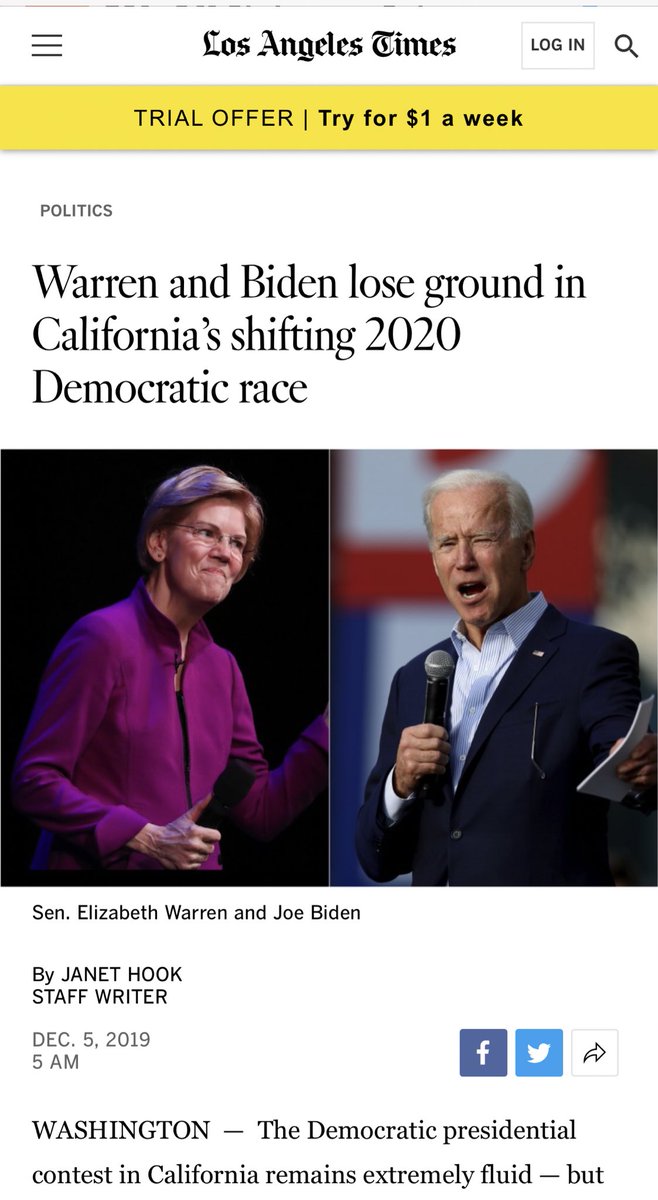
A new poll released Thursday found that Sen. Bernie Sanders is leading the 2020 Democratic presidential field in California—but you wouldn’t have known it by reading the Los Angeles Times’ original headline on the survey, which mentioned Sen. Elizabeth Warren and former Vice President Joe Biden, but not the senator from Vermont.
“Warren and Biden lose ground in California’s shifting 2020 Democratic race,” read the newspaper’s initial headline which, in the face of backlash, was later changed to, “Warren and Biden lose ground, Sanders moves ahead in California’s shifting 2020 Democratic race.”
While the Times changed its headline, it did not alter the body of the story, which doesn’t mention Sanders until the third paragraph.
“The Democratic presidential contest in California remains extremely fluid—but not enough, at least so far, to provide an opening for Michael Bloomberg,” reads the story’s lede paragraph.
The poll, conducted for the Times by the U.C. Berkeley Institute of Governmental Studies, found that Sanders is leading the California presidential primary race at 24% support and has gained 5% since September.
Warren polled in second place at 22% (down 7% since September), Biden in third at 14% (down 6% since September), and South Bend, Indiana Mayor Pete Buttigieg in fourth at 12% (up 6% since September). The survey’s margin of error is plus or minus 4%.

Ari Rabin-Havt
✔@AriRabinHavt
Here are the results of this poll:
Sanders 24%
Warren 22%
Biden 14%
Buttigieg 12%
Now look at the headline.
It takes the LA Times three paragraphs to mention who is leading.https://www.latimes.com/politics/story/2019-12-05/democrats-2020-race-california-poll …
7,374
7:32 AM - Dec 5, 2019
Twitter Ads info and privacy
2,158 people are talking about this
“The person who gained ground is not allowed to be in the headline,” Faiz Shakir, Sanders’ campaign manager, tweeted in response to the Times original headline.
Despite Sanders’ jump since September, the Times framed the survey solely around Warren and Biden’s fall.
“That erosion has benefited Sen. Bernie Sanders of Vermont, who narrowly tops the primary field,” the Times reported.
The new survey, the Times noted, also found that Sanders is leading 2020 Democratic field in California “on three other attributes—being the candidate who would bring the right kind of change to Washington (28%), the one who comes closest to sharing voters’ values (27%) and the candidate who best understands the problems of ‘people like you’ (28%).”
The newspaper’s treatment of Sanders on this poll was for many observers just the latest example of a trend by many mainstream outlets of ignoring, sidelining, or otherwise downplaying the Sanders presidential campaign—a phenomenon some refer to as the #BernieBlackout.
U.S. Considers Sending Several Thousand More Troops to Mideast
DEC 05, 2019
NEWS
MATTHEW LEE / The Associated Press
https://www.truthdig.com/articles/u-s-considers-sending-several-thousand-more-troops-to-mideast/
WASHINGTON — The Pentagon is considering sending several thousand additional troops to the Middle East to help deter Iranian aggression, amid reports of escalating violence in Iran and continued meddling by Tehran in Iraq, Syria and other parts of the region.
John Rood, defense undersecretary for policy, told senators Thursday that Defense Secretary Mark Esper “intends to make changes” to the number of troops deployed in the region. Other officials said options under consideration could send between 5,000 and 7,000 troops to the Middle East, but they all stressed that there have been no final decisions yet. The officials spoke on condition of anonymity to discuss internal deliberations.
The troop deliberations follow several decisions since spring to beef up the U.S. presence in the Middle East because of a series of maritime attacks and bombings in Saudi Arabia that the U.S. and others have blamed on Iran.
President Donald Trump has approved those increases, even though he also routinely insists that he is pulling U.S. troops out of the Middle East and withdrawing from what he calls “endless wars” against extremists. In October, Trump told his supporters that despite the sacrificing of U.S. lives in Iraq and other parts of the Middle East, the region is less safe and stable today. “The single greatest mistake our country made in its history,” he said, “was going into the quicksand of the Middle East.”
Asked about a possible troop increase, Trump told reporters Thursday that “We’ll announce whether we will or not. Certainly there might be a threat. And if there is a threat, it will be met very strongly. But we will be announcing what we may be doing — may or may not be doing.”
Military leaders have argued that the U.S. needs to increase its presence in the region in order to deter Iran from conducting more and broader attacks. Rood provided no details to back up why the additional troops are needed, but said the U.S. is concerned about recent intelligence indications suggesting an increased threat from Iran.
Rood was asked several times about reports that 14,000 more troops could be sent to the region. He repeatedly said Esper hasn’t made a decision yet, but didn’t specifically confirm or deny the number, so his answers appeared only to confuse senators. Shortly after the hearing, Pentagon press secretary Alyssa Farah sent out a statement flatly denying the 14,000 number, saying Esper told the Senate committee chairman Thursday morning that “we are not considering sending 14,000 additional troops” to the region.
The troop discussions came as the Trump administration on Thursday accused Iranian security forces of killing more than 1,000 people in crackdowns against recent protests that have swept the country.
The estimated death toll is significantly higher than previously estimates from human rights groups and others, and the administration did not present documentary evidence to back up the claim. But Brian Hook, the U.S. special representative for Iran, told reporters the tally was based on a variety of reports coming out of Iran as well as intelligence analyses.
Speaking at the State Department, Hook said the U.S. had received and reviewed video of one specific incident of repression in the city of Mahshahr in which the Iranian Revolutionary Guards Corps had mowed down at least 100 protesters with machine-gun fire.
He said the video was one of tens of thousands of submissions the U.S. has gotten since Secretary of State Mike Pompeo appealed last month for Iranians to submit evidence of atrocities by the authorities in putting down the protests. In it, he said IRGC forces can be seen opening fire on protesters blocking a road and then surrounding those who fled to nearby marshlands where they were sprayed with bullets.
“In this one incident alone the regime murdered as many as 100 Iranians and possibly more,” Hook told reporters at the State Department. He did not display the video but said the actions it depicted corresponded to accounts of a brutal nationwide crackdown on the demonstrations, which started in response to gasoline price increases and rationing.
“We have seen reports of many hundreds more killed in and around Tehran,” he said. “And, as the truth is trickling out of Iran, it appears the regime could have murdered over 1,000 Iranian citizens since the protests began.” The dead include 13- and 14-year-old children, he said.
Speaking at the White House, Trump said Iran had “killed hundreds and hundreds of people in a very short period of time” and called for international pressure to be applied. “They are killing protesters. They turned off their internet system. People aren’t hearing what’s going on,” he told reporters while hosting a lunch for the ambassadors of U.N. Security Council members.
Iran’s mission to the United Nations did not immediately respond to a request for comment, and there was no immediate comment on state media in Iran.
There was no known public video that supported Hooks’ allegation of a massacre in Mahshahr, although he said the State Department had gotten more than 32,000 responses to Pompeo’s appeal for videos and other evidence using the encrypted messaging app Telegram, which is popular in Iran.
Nor has there been any widely accepted claim matching Hook’s death toll of more than 1,000. Amnesty International believes at least 208 people have been killed and that the number could be higher. Iran has disputed that figure, but has refused to offer any nationwide statistics of the number of injuries, arrests or deaths from the unrest.
However, Hook’s numbers appear to match a figure put out late Wednesday by the Iranian exile group called the Mujahedeen-e-Khalq, which has paid Trump’s personal lawyer Rudy Giuliani for speeches at its events in the past.
The MeK alleged late Wednesday that more than 1,000 people had been killed. It published a list of 320 people it said it had identified so far as having been killed but did not provide proof.
Iran has alleged MeK supporters and those backing exiled Crown Prince Reza Pahlavi, the son of the country’s late shah, of being behind the unrest alongside foreign powers. It has not offered evidence to support those allegations.
In addition to the deaths, Hook said more than 7,000 protesters had been detained, with many sent to two prisons. Hook said that Pompeo had notified Congress on Thursday that both prisons would be hit with U.S. sanctions for gross human rights abuses. It was not immediately clear when those designations would occur.
Hook’s comments come as the U.S. steps up its “maximum pressure campaign” on Iran that it began after withdrawing from the landmark 2015 nuclear deal last year. That campaign has been highlighted by the imposition of increasingly tough sanctions and an increase in rhetoric critical of Tehran and its leadership.
As part of the pressure campaign, Hook announced that the U.S. is offering a reward of up to $15 million for information leading to the whereabouts of a top IRGC commander now believed to be supporting rebels in Yemen. He said Abdul Reza Shahalai was responsible for numerous attacks against U.S. forces in Iraq and had been behind a foiled plot to murder the Saudi ambassador to the United States in a Washington restaurant.
Even as 500,000 March in Madrid, Greta Thunberg Warns Climate Movement Has 'Achieved Nothing' Until Emissions Fall
Friday, December 06, 2019
Common Dreams
"We cannot afford more days going by without real action being taken."
Andrea Germanos, staff writer
25 Comments
https://www.commondreams.org/news/2019/12/06/even-500000-march-madrid-greta-thunberg-warns-climate-movement-has-achieved-nothing
Before taking part in a 500,000-strong climate march in Madrid, teen activist Greta Thunberg spoke plainly yet forcefully Friday about the impact the global climate strike movement has had thus far and reiterated the demand of the climate justice movement for global leaders to act with the urgency the planet's ecological emergency mandates.
Speaking to reporters at the cultural center La Casa Encendida in Madrid, Spain—where COP 25 is underway—Thunberg called herself "just... a climate activist—a small part of a big movement" that needs even more activists to effect change.
Global delegates attending the UN Climate Change Conference, Thunberg said, must heed the young marchers' call and commit to real action.
"I sincerely hope that the COP 25 will lead to something concrete and that will lead to also an increase in awareness among people in general." She said she hopes that those in power "grasp the urgency of the climate crisis because right now it doesn't seem like they are."
As such, the global Fridays for Future movement will continue sounding the alarm, said Thunberg.
"I know that we will do everything we can to make sure that this is something that cannot be ignored anymore, that they cannot just hide away anymore," Thunberg said. Some world leaders "are afraid of change," she said, but the status quo must be disrupted.
"Some people want everything to continue like now, and change is what we young people are bringing. And that's why they are trying to silence us. But that is just proof that we are having an impact, that our voices are being heard," Thunberg said, and is the reason powerful opponents "try so desperately to silence us."
Thunberg suggested that COP 25 may be viewed "as a kind of middle year," with next year's COP 26 seen as "the big event."
"But we cannot afford middle years," the Swedish teen said. "We cannot afford more days going by without real action being taken." COP 25, said Thunberg, mustn't be brushed off "because every chance we get to improve the situation we must take."
Speaking more about the school strike for climate actions—which have drawn millions of young people to the streets worldwide—Thunberg said the model is simply not sustainable.
"We have been striking now for over a year and still, basically, nothing has happened," said Thunberg. "The climate crisis is still being ignored by those in power and we cannot go on like this. It is not a sustainable solution that children skip school."
The strikers, Thunberg said, "don't want to continue. We would love some action from the people in power... because people are suffering and dying from the climate and ecological emergency today and we cannot wait any longer."
A lot has been achieved, added Thunberg. "We have have raised public awareness and we have created opinion and that is a big step in the right direction. But of course it's nowhere near enough."
"The CO2 emissions aren't reducing. They are in fact increasing," Thunberg continued, "so of course there is no victory because the only thing we want to see is real action and real action has not been happening. So of course we have achieved a lot," she added, "but if you look at it from a certain point of view we have achieved nothing."
Thunberg and other climate activists brought their demand for climate justice to the streets of Madrid later on Friday, a protest Fridays for Future Germany said showed that "The climate justice movement is bigger and closer than ever."
In a tweet from the march and rally, Thunberg said the marchers may have numbered as many as half a million—a figure echoed by Greenpeace Germany.
Calling Him Only 2020 Candidate Whose Plan 'Can Save Our Planet,' US Youth Climate Strike Leaders Endorse Bernie Sanders for President
Friday, December 06, 2019
Common Dreams
As sit-ins targeted establishment Democrats nationwide to demand the Green New Deal, Sanders stood with climate campaigners in Iowa on Friday and applauded striking youth worldwide who are saying: "Hey, we want a planet that we can grow up in and have kids in that is healthy and inhabitable."
Jon Queally, staff writer
https://www.commondreams.org/news/2019/12/06/calling-him-only-2020-candidate-whose-plan-can-save-our-planet-us-youth-climate
As Sen. Bernie Sanders stood with activists striking for climate in Iowa on Friday morning, the act of solidarity was repaid in kind later in the day as key leaders of the youth-led movement in the U.S. officially endorsed the Vermont senator's 2020 presidential bid.
As youth members of the Sunrise Movement targeted Democrats who have refused to endorse the Green New Deal with sit-ins nationwide on Friday, Sanders joined climate strikers near the Capitol Building in Des Moines to bolster their demand for bold action on the crisis that is impacting people around the world, including rural regions in the United States.
"You're seeing planting seasons decline, and harvests decline, because farmers cannot grow crops when their fields are underwater or when they have drought," Sanders told the crowd of young people and allies.
"We're looking not only in Iowa, not only in the Midwest, not only in America—we're looking all over the world about a serious crisis in food production," Sanders said. "That's the bad news. But here is the good news. If we have the courage to take on the fossil fuel industry and other special interests, if we have the courage to pass a Green New Deal, we can create up to 20 million good-paying jobs transforming our energy system."
Along with local youth climate leaders, Sanders addressed the need for a broad and bold vision to address the emergency and applauded those around the globe rising to demand action.
"Young people all over the world, not just here in Iowa or in the United States, but all over the world are telling their leaders, 'Hey, we want a planet that we can grow up in and have kids in that is healthy and inhabitable,'" Sanders said at the Des Moines event. "When that global movement spreads, maybe, just maybe, we can tell world leaders all over the planet that instead of spending $1.8 trillion a year on weapons of destruction designed to kill each other, maybe we can pool our resources and combat our common enemy which is climate change."
Watch:
Later on Friday, several leaders of the U.S. Youth Climate Strike group—namely co-founder and partnerships director Isra Hirsi, executive director Felíquan Charlemagne, political director Daylon Prochaska, and creative director Pujan Patel—all stepped forward to officially endorse Sanders for president.
"Historically, movements have had young people at the forefront and the climate movement is no exception," Hirsi said. "Bernie has been there since day one fighting alongside all the young people across the country."
Sanders' plan for a Green New Deal, added Charlemagne, "is the only plan that addresses the climate crisis to the scale it needs to be addressed. It is the only plan that sets our goals to 2030. It is the only plan that has such a consideration of climate migrants, the only plan that has such a consideration of climate justice. It's the only plan that can save our planet."
Sanders' Green New Deal has been heralded by climate experts as the gold standard among those currently running for president. With a goal of reaching 100 percent renewable energy for electricity and transportation by no later than 2030, his campaign says the proposal aims to ensure "justice for frontline communities" and vows to build on the organizing and demands set forth by climate justice movement that gives priority to young people, workers, indigenous people, and communities of color.
"When Bernie talks about this being a global crisis where we need to come together as one planet, this is what he means," Pujan said. "A grassroots movement where the working class stands up and tells the government that we have a say and that we deserve to survive."
Meanwhile, Sunrise activists who have championed Sanders and other lawmakers leading the charge in Congress, but said those standing in the way—whether President Donald Trump, other Republicans, or Democrats still downplaying the need for urgent action—can no longer be tolerated.
"We need a Green New Deal. All these other watered down ideas are a waste of time," said Wally Mazon, 25, a Sunrise organizer in Iowa. "When my people from the LGBTQ community are under attack, when people can't get healthcare, when people can't vote, I can no longer live in a world of apathy on the part of our government. The Green New Deal is about fighting for the world we should be living in, but was stolen from us by a handful of greedy people."
According to Sunrise statement early Friday afternoon, sit-ins were underway at the offices of Rep. Axne in Iowa, Gov. Charlie Baker in Massachusetts, Rep. Chris Pappas in New Hampshire, and the Asheville City Council in North Carolina, with more to come throughout the day. Young people also die-ins and banner drops in major cities including Chicago, San Francisco, and Houston.
With the United Nations climate talks at the COP 25 conference taking place in Madrid, Spain this week and next, there were massive Fridays for Future protests across Europe and elsewhere. In Madrid itself, an estimated half million people rallied in the streets.
In a tweet on Friday, Sunrise's executive director Varshini Prakash, said, "Big Oil wants us to believe we're too young, that we can't win, that we're powerless. Because for every person disillusioned, despairing and in denial that's another dollar in their pockets. We won't give that to them. We are rising. The young people will win a Green New Deal."
'Now Let's Do This Everywhere': Kansas City, Missouri Approves Free Public Transit for All
Friday, December 06, 2019
Common Dreams
Measure championed as "visionary" way to reduce inequality and better serve everyone in the community.
Julia Conley, staff writer
https://www.commondreams.org/news/2019/12/06/now-lets-do-everywhere-kansas-city-missouri-approves-free-public-transit-all
Lawmakers in Kansas City, Missouri took a "visionary step" on Thursday by unanimously voting to make public transportation in the city free of charge, setting the stage for it to be the first major U.S. city to have free public transit.
The Kansas City Council voted to direct the city manager to set aside $8 million to eliminate the $1.50 per ride fare that currently applies to the city's bus system.
Some frequent riders could save about $1,000 per year under the new plan, according to KCUR, the city's public radio station.
"It'd help me out a lot," college student Michael Mumford, who rides the city's buses at least once per day, told the station. "Put some change in my pocket…buy some books for class."
The Kansas City Area Transportation Authority also expressed approval, with CEO Robbie Makinen telling KCUR that residents will be able to put the money they save on transportation toward other necessities, boosting the economy.
The city still needs to work out details of the proposal, including how it will be funded and where that money will come from, according to local news station KSHB.
Supporters of the measure on social media pointed out that free public transit could have positive impacts on economic inequality, the city's efforts to fight the climate crisis, and mass incarceration—as other cities, like New York, are cracking down on public transit fare evasion.
Free public transit has been shown to drastically reduce automobile use and emissions elsewhere, such as in Tallinn, Estonia, wrote economic researcher Curtis Myers.
City council member Eric Bunch, who co-sponsored the measure, told the local press that he aims to help marginalized communities access the city.
"When we're talking about improving people's lives who are our most vulnerable citizens, I don't think there's any question that we need to find that money," Bunch said.
"I don't want to do it for any sort of national recognition, I want to do it because it's the right thing to do, I believe that people have a right to move about this city," he told KCUR.
The move did win national recognition, with lawmakers in other large cities praising the initiative and saying they aimed to push for similar programs for their constituents.
"Now let's do this everywhere," tweeted Matt Haugen, a member of the Democratic Socialists of America environmental steering committee.
Subscribe to:
Comments (Atom)