Saturday, October 26, 2019

The top 1% own 45% of all global personal wealth; 10% own 82%; the bottom 50% own less than 1%


Michael Roberts


The annual Credit Suisse report on global wealth has just been released. This report remains the most comprehensive and explanatory analysis of global wealth (not income) and inequality of wealth. Every year the CS global wealth report analyses the household wealth of 5.1 billion people across the globe. Household wealth is made up of the financial assets (stocks, bonds, cash, pension funds) and property (houses etc) owned.  And the report measures this net of debt. The report’s authors are James Davies, Rodrigo Lluberas and Anthony Shorrocks.  Professor Anthony Shorrocks was my university flatmate, where we both graduated in economics (although he has the much better mathematical skills!).
Global wealth grew during the past year by 2.6% to USD 360 trillion and wealth per adult reached a new record high of USD 70,850, 1.2% above the level of mid-2018 with Switzerland topping the biggest gains in wealth per adult this year. The US, China, and Europe contributed the most towards global wealth growth with USD 3.8 trillion, USD 1.9 trillion and USD 1.1 trillion respectively.
As in every year it has been published, the report reveals the extreme inequality of personal wealth globally.  The bottom half of adults in the world accounted for less than 1% of total global wealth in mid-2019, while the richest decile (the top 10% of adults) possessed 82% of global wealth and the top percentile (1%) owned nearly half (45%) of all household assets. Wealth inequality is lower within individual countries: typical values would be 35% for the share of the top 1% and 65% for the share of the top 10%. But these levels are still much higher than the corresponding figures for income inequality, or any other broad-based welfare indicator.
While advances by emerging markets continued to narrow the gaps between countries, inequality within countries grew as economies recovered after the global financial crisis. As a result, the top 1% of wealth holders increased their share of world wealth. But this trend appears to have abated since 2016 and global inequality has edged downward slightly.  Whereas the top 1% of wealth holders had 50% of the world’s personal wealth in 2016, up from 45% in 2006, that ratio has slipped back to 45%. Today, the share of the bottom 90% accounts for 18% of global wealth, compared to 11% in 2000.

[IMAGE 1]
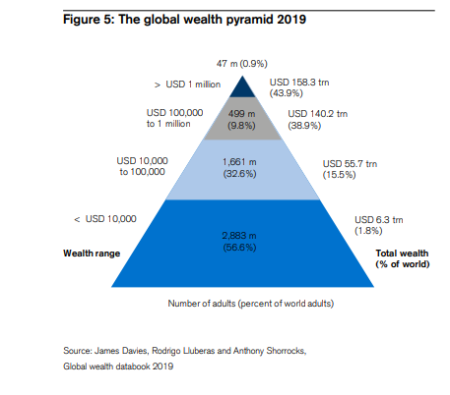
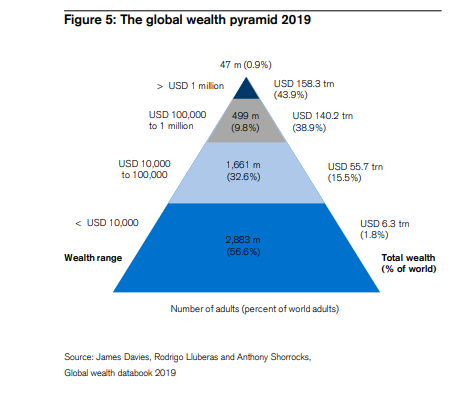
The wealth pyramid captures the wealth differences between adults. Nearly 3bn adults – 57% of all adults in the world – have wealth below USD 10,000 in 2019. The next segment, covering those with wealth in the range USD 10,000–100,000, has seen the biggest rise in numbers this century, trebling in size from 514 million in 2000 to 1.7 billion in mid-2019. This reflects the growing prosperity of emerging economies, especially China. The average wealth of this group is USD 33,530, still less than half the level of average wealth worldwide, but considerably above the average wealth of the countries in which most of the members reside. This leaves the final group of countries with wealth below USD 5,000, which are heavily concentrated in central Africa and central and south Asia.
So here’s the staggering thing. If you live in one of the advanced capitalist countries and you own your house and have some savings, then you will be among the top 10% of all wealth holders in the world.  That’s because the vast majority of households in the world have little or no wealth at all.
A person needs net assets of just USD 7,087 to be among the wealthiest half of world citizens in mid-2019! However, USD 109,430 is required to be a member of the top 10% of global wealth holders and USD 936,430 to belong to the top 1%.  African and Indian citizens are concentrated in the base segment of the wealth pyramid, China in the middle tiers, and North America and Europe in the top percentile. But also evident is a significant number of North American and European residents in the bottom global wealth decile, as younger adults acquire debt in advanced economies, resulting in negative net wealth.
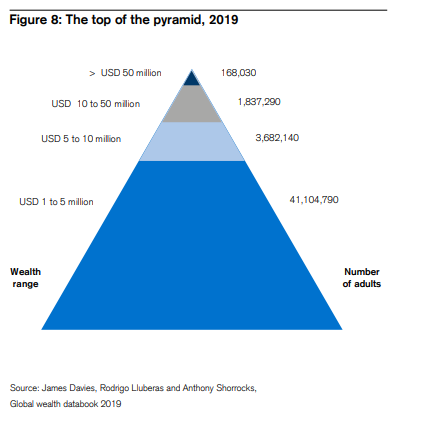
And inequality gets wider at the top of the pyramid.  There are 46.8 million millionaires in the world in mid-2019, but most have wealth between USD 1 million and USD 5 million: 41.1 million or 88% of the millionaires. Another 3.7 million adults (7.9%) are worth between USD 5 million and 10 million, and almost exactly two million adults now have wealth above USD 10 million. Of these, 1.8 million have assets in the USD 10–50 million range, leaving 168,030 Ultra High Net Worth (UHNW) individuals with net worth above USD 50 million in mid-2019.  In effect, these are the ruling elite of the world.

[IMAGE 2]
 
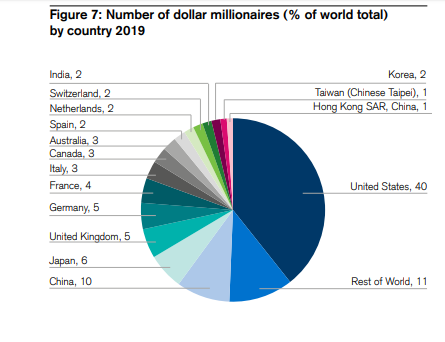
The United States has by far the greatest number of millionaires: 18.6 million, or 40% of the world total. For many years, Japan held second place in the millionaire rankings by a comfortable margin. However, Japan is now in third place with 6%, overtaken by China (10%). Next come the United Kingdom and Germany with 5% each, followed by France (4%), then Italy, Canada and Australia (3%).

[IMAGE 3]
 
Switzerland (USD 530,240), Australia (USD 411,060) and the United States (USD 403,970) again head the league table according to wealth per adult. The ranking by median average wealth per adult favours countries with lower levels of wealth inequality. This year, Australia (USD 191,450) edged ahead of Switzerland (USD 183,340) into first place.  So Australia has the highest median wealth per adult in the world (that’s mainly house values).
Financial assets suffered most during the financial crisis of 2008-9 and then recovered in the early post-crisis years. This year, their value rose in every region, contributing 39% of the increase in gross wealth worldwide, and 71% of the rise in North America. However, non-financial assets (property) provided the main stimulus to overall growth in recent years. Over the 12 months to mid-2019, they grew faster than financial assets in every region. Non-financial wealth accounted for the bulk of new wealth in China, Europe and Latin America, and almost all new wealth in Africa and India. But household debt rose even faster, at 4.0% overall. Household debt increased in all regions, and at a double-digit rate in China and India. The debt squeeze is coming.


Žižek: "if Europe betrays Kurds, it will betray itself"


Slovenian philosopher Slavoj Žižek wrote in The Independent that "if Europe will turn its eyes away from Kurds, it will betray itself."


Well known Slovenian philosopher Slavoj Žižek wrote in The Independent: "The fate of the Kurds makes them the exemplary victim of the geopolitical colonial games: spread along the borderline of four neighboring states (Turkey, Syria, Iraq, Iran), their (more than deserved)  full autonomy was in nobody’s interest, and they paid the full price for it."
Žižek added: "Do we still remember Saddam’s mass bombing and gas-poisoning of Kurds in the north of Iraq in the early 1990s? More recently, for years, Turkey plays a well-planned military-political game, officially fighting ISIS but effectively bombing Kurds who are really fighting ISIS."
Žižek continued: "In the last decades, the ability of the Kurds to organize their communal life was tested in almost clear-cut experimental conditions: the moment they were given a space to breath freely outside the conflicts of the states around them, they surprised the world.
[...] In northern Syria, the Kurdish enclave centered in Rojava was a unique place in today’s geopolitical mess: when Kurds were given a respite from their big neighbors who otherwise threatened them all the time, they quickly built a society that one cannot but designate an actually-existing and well-functioning utopia."
According to Žižek: "It is our duty to fully support the resistance of the Kurds to the Turkish invasion, and to rigorously denounce the dirty games Western powers play with them. While the sovereign state around them are gradually sinking into a new barbarism, Kurds are the only glimmer of hope."
And it’s not only about Kurds, said Žižek "that this struggle is fought, it’s about ourselves, it’s about what kind of global new order is emerging. If Kurds will be abandoned, it will be a new order in which there will be no place for the most precious part of the European legacy of emancipation. If Europe will turn its eyes away from Kurds, it will betray itself. The Europe which betrays Kurds will be the true Europastan!"


European leftists are rejecting the Kurds over their reliance on the US. It is just another disgusting betrayal


Must they sacrifice themselves on the altar of anti-imperialist solidarity? While the sovereign states around them are gradually sinking into a new barbarism, Kurds are the only glimmer of hope


Well over a hundred years ago, Karl May wrote a bestseller, Through Wild Kurdistan, about the adventures of a German hero, Kara Ben Nemsi. This immensely popular book established the perception of Kurdistan in central Europe: a place of brutal tribal warfare, naïve honesty and sense of honour, but also superstition, betrayal, and permanent cruel warfare. It was almost a caricature of the barbaric Other in European civilization. 

If we look at today’s Kurds, we cannot but be surprised by the contrast to this cliché – in Turkey, where I know the situation relatively well, I have noticed that the Kurdish minority is the most modern and secular part of society, at a distance from every religious fundamentalism, with developed feminism, etc. (Let me just mention a detail that I learned in Istanbul: restaurants owned by Kurds have no tolerance for any sign of superstition…)  

The stable genius (Trump’s self-designation) justified his recent betrayal of Kurds (he effectively condoned the Turkish attack on the Kurdish enclave in northern Syria) by noting that “Kurds are no angels”. Of course, since, for him, the only angels in that region are Israel (especially on the West Bank) and Saudi Arabia (especially in Yemen). However, in some senses, the Kurds ARE the only angels in that part of the world. 

The fate of the Kurds makes them the exemplary victim of the geopolitical colonial games: spread along the borderline of four neighboring states (Turkey, Syria, Iraq, Iran), their (more than deserved) full autonomy was in nobody’s interest, and they paid the full price for it.

Do we still remember Saddam’s mass bombing and gas-poisoning of Kurds in the north of Iraq in the late 1980s? More recently, for years, Turkey has played a well-planned military-political game, officially fighting Isis but effectively bombing Kurds who are really fighting Isis.

In the last decades, the ability of the Kurds to organize their communal life was tested in almost ideal experimental conditions: the moment they were given a space to breathe freely outside the conflicts of the states around them, they surprised the world. 

After Saddam’s fall the Kurdish enclave in northern Iraq develop into the only safe part of Iraq with well-functioning institutions and even regular flights to Europe. In northern Syria, the Kurdish enclave centered in Rojava was a unique place in today’s geopolitical mess: when Kurds were given a respite from their big neighbors who otherwise threatened them all the time, they quickly built a society that one cannot but designate as an actually-existing and well-functioning utopia. 

From my own professional interest, I noticed the thriving intellectual community in Rojava where they repeatedly invited me to give lectures – these plans were brutally interrupted by military tensions in the area. 

But what especially saddened me was the reaction of some of my “Leftist” colleagues who were bothered by the fact that Kurds also had to rely on the US military protection. 

What should they have done, caught in the tensions between Turkey, Syrian civil war, the Iraqi mess and Iran? Did they have any other choice? Should they sacrifice themselves on the altar of anti-imperialist solidarity? 

This “Leftist” critical distance was no less disgusting than the same distance towards Macedonia. A couple of months ago, the discussion was around how to resolve the problem of the name “Macedonia”.

The solution proposed was to change the name to “North Macedonia,” but this was instantly attacked by radicals in both countries. Greek opponents insisted that “Macedonia” is an old Greek name, and Macedonian opponents felt humiliated by being reduced to a “Northern” province since they are the only people who call themselves “Macedonians.” 

Imperfect as it was, this solution offered a glimpse of an end to a long and meaningless struggle with a reasonable compromise. But it was caught in another “contradiction”: the struggle between big powers (the US and EU on the one side, Russia on the other). 

The West put pressure on both sides to accept the compromise so that Macedonia could quickly join the EU and NATO, while, for exactly the same reason (seeing in it the danger of its loss of influence in the Balkans), Russia opposed it, supporting rabid conservative nationalist forces in both countries. 

So which side should we take here? I think we should decidedly take the side of the compromise, for the simple reason that it is the only realist solution to the problem – Russia opposed it simply because of its geopolitical interests, without offering another solution, so supporting Russia here would have meant sacrificing the reasonable solution of the singular problem of Macedonian and Greek relations to international geopolitical interests. (Now that France has vetoed the fast-track inclusion of North Macedonia into the EU, will they be responsible for an unpredictable catastrophe in that part of Balkans?) Will the Kurds be dealt the same blow from our anti-imperialist “Leftists”? 

That’s why it is our duty to fully support the resistance of the Kurds to the Turkish invasion, and to rigorously denounce the dirty games Western powers play with them.

While the sovereign states around them are gradually sinking into a new barbarism, Kurds are the only glimmer of hope. And it’s not only about Kurds that this struggle is fought, it’s about ourselves, it’s about what kind of global new order is emerging.

If Kurds will be abandoned, it will be a new order in which there will be no place for the most precious part of the European legacy of emancipation. If Europe turns its eyes away from the Kurds, it will betray itself. The Europe which betrays Kurds will be the true Europastan! 


Slavoj on Chile's political crisis


https://www.youtube.com/watch?v=_Ue8B88RBLc


Trump's Emoluments Mess


https://www.youtube.com/watch?v=xw3GLhIxjVU&feature=em-uploademail


Demonstrations to Support Chile Take Place from Caracas to London


https://www.youtube.com/watch?v=fip9ioZunH8&feature=em-uploademail


End Corporate Greed Town Hall: Marshalltown, Iowa


https://www.youtube.com/watch?v=C6W4pwv6mok&feature=em-lbcastemail