Friday, October 25, 2019

How Donald Trump Turned to a Comics Titan to Shape the VA


OCT 23, 2019


Isaac Arnsdorf / ProPublica


President Donald Trump personally directed administration officials to report to one of his largest donors, Marvel Entertainment chairman Ike Perlmutter, according to a new book by former Secretary of Veterans Affairs David Shulkin.
Starting with Shulkin’s interview for the cabinet post, Trump routinely dialed Perlmutter into meetings and asked if the secretary was keeping Perlmutter informed and happy, Shulkin wrote. Perlmutter would call Shulkin as often as multiple times a day, and White House officials such as Stephen Miller would scold Shulkin for not being in close enough contact with Perlmutter and two of his associates at Mar-a-Lago, Trump’s private club in Florida.
“I didn’t reach out to these guys — these guys had a prior relationship with the president and were advising him,” Shulkin, who was fired by tweet in March 2018, said in an interview. “There probably wasn’t too many times I met with the president when he didn’t say, ‘What’s happening with Ike?’”
The unusual influence over the VA wielded by Perlmutter, along with doctor Bruce Moskowitz and lawyer Marc Sherman, was first revealed by a ProPublica investigation in August 2018, prompting ongoing investigations by the House Veterans’ Affairs Committee and the Government Accountability Office. But Shulkin’s book provides new details on Trump’s direct role in initiating and encouraging the arrangement.
“There was a ‘second track’ of VA decision-making led by the president’s alternative advisers that didn’t include me,” Shulkin wrote in the book, the first inside account by a former member of Trump’s cabinet. “Ike, Bruce and Marc had the president’s ear in ways that I did not, even as his cabinet secretary.”
The White House didn’t immediately respond to requests for comment. In a statement, Perlmutter, Moskowitz and Sherman said they had no official role or responsibilities at the agency. “We were informal advisors offering our help in service of a cause we believe in,” they said. “The fact that Mr. Shulkin chose to read political tea leaves and interpreted our role otherwise is disappointing, but ultimately those were mistakes he needs to account for, not us.”
In one incident, Shulkin attended a dinner with then-Defense Secretary Jim Mattis at the White House. Perlmutter, his wife and Moskowitz were already there, visiting with Trump in the residence. (Mattis didn’t respond to a request for comment.)
“This was the first time it hit me just how much the Mar-a-Lago crowd was going to be involved in my new life and in my ability to lead the VA,” Shulkin wrote. “I didn’t need written instructions to understand this two-tiered social event — the guests who waited downstairs and the guests who were entertained upstairs — as a directive. Essentially, ‘These people are my friends and confidants, and I expect you to listen to them and make them happy.’”
Perlmutter and his wife contributed almost $7.5 million to Republican causes in 2016, ranking them among Trump’s biggest backers, according to federal data compiled by the Center for Responsive Politics. In 2018, the couple donated $2 million to Ron DeSantis, a close Trump ally, in his successful race to become governor of Florida. They also lent him their private plane. Perlmutter shuns publicity, refusing interviews and photographs, but occasionally surfaces in court proceedings, including an acrimonious neighborhood feud and a New York police officer’s testimony that he got tickets to Marvel premieres and helped Perlmutter renew his gun permit. He frequents Mar-a-Lago and, at his nearby oceanfront apartment, collects exotic fish; Shulkin (a physician by training) observed that the Perlmutters’ aquarium required so much special equipment that “it looked like they were operating a fish intensive care unit.”
Trump gave Perlmutter and his associates sweeping influence over the VA — the second-largest federal agency, with a $200-plus billion budget and almost 400,000 employees providing health care services and compensation benefits to 9 million veterans — despite their lack of any relevant experience. None of them has ever worked in government or served in the U.S. military (Perlmutter served in the Israeli Army in the 1967 war).
Perlmutter was familiar with much-publicized scandals at the VA’s hospitals and had a rosy view of private health care, Shulkin said. On one of their first calls, Shulkin wrote, Perlmutter suggested they go around the country showing up at VA hospitals unannounced “to see what was really going on.” When Shulkin said he didn’t think it would be appropriate for a private citizen to be conducting unplanned inspections, Perlmutter said, “OK, we’ll give them 10 minutes’ notice.”
“Often their advice was unusable, because none of these men seemed to have much of an understanding of how the VA worked, nor did they possess any health system management experience,” wrote Shulkin, who led the VA’s health division before becoming secretary and previously ran private hospitals. “Most concerning was that these VA ‘advisers’ had never even been to a VA facility (which was also true of the president and his senior staff).”
When Shulkin did bring Perlmutter on a tour of the VA in West Palm Beach, Perlmutter seemed genuinely surprised by the appearance and orderliness of this facility. Perlmutter pressed patients for complaints — “he seemed adamant about finding dissatisfaction, or better yet, horror stories,” Shulkin wrote — but heard only praise, according to the book.
The book recounts that Shulkin and the trio structured their interactions to avoid triggering disclosure requirements. Shulkin said he asked the agency’s lawyers about the propriety of the Mar-a-Lago trio’s involvement, since a Watergate-era sunshine law requires federal agencies to disclose input from outside advisers. Shulkin said he explained the law to Perlmutter and Moskowitz, and they didn’t want the obligations of becoming an official advisory committee. So they agreed to give advice “as individuals.”
“I also knew the limitations placed on private citizens meddling in government affairs, and I was always cautious to make sure that these three did not cross the line,” Shulkin wrote.
Since the Mar-a-Lago advisers had no official positions, they were not subject to laws requiring federal employees to disclose and divest assets to avoid conflicts of interest. Still, Shulkin said he never saw them use their influence for personal gain. “Truthfully,” he wrote, “I think they mostly wanted to feel useful.”
And they were useful to Shulkin, at least at first, as a sounding board and conduit to Trump. But they later grew frustrated that Shulkin wasn’t communicating enough and told him he’d lost their confidence. The three aligned themselves with other political appointees at the VA who distrusted Shulkin because he served in the Obama administration and accused him of undermining Trump’s campaign promise to push more veterans’ health care into the private sector. During one visit to Mar-a-Lago, Sherman followed Shulkin into the men’s room and, after checking that no one else was around, told him: “Don’t touch the politicals. You’re playing with fire.”
Once the “politicals” impugned Shulkin to Perlmutter, according to the book, Perlmutter poisoned the president’s view of him. Trump had always been publicly effusive toward Shulkin, but after one trip to Mar-a-Lago he wouldn’t acknowledge him and avoided eye contact. John Kelly, then the chief of staff, told Shulkin that Trump was upset with him because of what he heard from his friends in Florida. (Kelly didn’t respond to a request for comment.)
Asked whether he was referring to Perlmutter, according to the book, Kelly responded, “Yes, that guy tells POTUS what to do despite not knowing what he’s talking about.”
Shulkin called Perlmutter and demanded, “What did you do?” but Perlmutter refused to respond, Shulkin wrote.
Shulkin’s interactions with the Mar-a-Lago trio are just one thread in a detailed, diarylike account of his tumultuous tenure at the VA. He also recounts the policy and organizational changes he led. And Shulkin defends himself against findings, in a report by the agency’s inspector general, that he misused government funds on a European trip, a scandal that became ammunition for his internal enemies.
“Obviously I decided that it was important to describe the relationship with the Mar-a-Lago people, but I really don’t want that to be the legacy of this book,” Shulkin said in the interview. “I spent three years working hard to fix the system, and I actually felt like we were making progress and we were on a path to making this a sustainable modern system. And then my time got cut short. So I felt like it was an obligation of mine to put down on paper what I felt was working and how I was doing it so that hopefully people in the future might refer to it and learn something from it.”
The stakes for veterans could not be higher, Shulkin wrote, since the VA’s other Trump appointees were determined to privatize more of their health care. Shulkin believes that’s not the best outcome for veterans, he wrote, but it’s exactly the path the agency has taken since his ouster.
Shulkin’s successor, Robert Wilkie, has denied having an agenda to privatize the VA. But in June he approved new rules to dramatically expand the circumstances when the agency will pay to send veterans to private doctors instead of treating them in government-run health centers. Shulkin said this approach will cost more and result in worse care. A VA spokeswoman said, “That’s a false, fringe view.”
“Empowering political appointees, with no experience in health care, no interest in involving industry experts, and no accountability to voters, will prove to be one of the larger mistakes of the Trump administration,” he wrote. “The path now chosen, if allowed to continue, will leave veterans with fewer options, a severely weakened VA, and a private health care system not designed to meet the complex requirements of high-need veterans. While largely unaware of his political appointees’ scheming, President Trump was most likely pleased with the result, because it fit well into a political sound bite and was consistent with his campaign platform. Most likely he does not realize the long-term implications.”


Americans overwhelmingly reject anti-BDS laws, poll finds


23 October 2019


Americans overwhelmingly reject laws designed to penalize supporters of BDS – the boycott, divestment and sanctions movement for Palestinian rights, according to a new poll.
More than 70 percent of respondents oppose laws that target BDS activism as an infringement on the constitutional right to free speech.
That opposition rises to 80 percent among Democrats but is still remarkably high among Republicans, at 62 percent.
With the encouragement of Israel and its lobby groups, 27 US states have adopted anti-BDS laws.
Similar measures pending in Congress face strong opposition from civil liberties groups.
The University of Maryland Critical Issues poll asked a representative sample of more than 3,000 Americans in September about their attitudes towards Middle East issues.
Among respondents, about half had heard something about BDS.
Of those, 26 percent support BDS. Another 26 percent neither supports or opposes it.
Meanwhile, 47 percent – fewer than half – say they oppose BDS.
Following recent trends, there is strong party polarization: Just 8 percent of Republicans support BDS compared with 48 percent of Democrats.
Just 15 percent of Democrats oppose BDS, according to the poll.
Confirming that the boycott message is reaching the party’s progressive base, 77 percent of the Democrats who have heard of the movement agreed that BDS “is a legitimate, peaceful way of opposing Israeli occupation of the Palestinian territories.”
Only 19 percent of the Democrats agreed with the statement – typical of Israeli government claims – that BDS is an “anti-Israel organization attempting to weaken Israel and to undermine its legitimacy,” and that some of its supporters are anti-Semitic.
Positions were reversed among Republicans, with just 13 percent agreeing that BDS is legitimate and 85 percent viewing it as “anti-Israel.”
This poll confirms long-term trends where support for Palestinian rights is gaining strength in the base of the Democratic Party.
This is playing out in the ongoing primary campaign.
Minnesota Senator Amy Klobuchar – who polls between one and two percent – faced stinging criticism from progressives for calling Israel “a beacon of democracy” during last week’s televised debate.
Such unquestioning praise of Israel had until recent years been standard fare for ambitious politicians of either main party.
But the leading Democrats are heading in the other direction.
Senator Elizabeth Warren said this week for the first time that reducing aid to Israel would be “on the table” if Israel did not stop building settlements on occupied Palestinian land – a war crime.
Warren has for years been loath to make any commitment to holding Israel accountable.
Pete Buttigieg, the mayor of South Bend, Indiana, did not go as far.
Answering a question at the University of Chicago over the weekend, he said, “I think that the aid is leverage to guide Israel in the right direction.”
But he suggested that as president he would only reduce aid if Israel proceeded with formal annexation of settlements.
Until this week, Vermont Senator Bernie Sanders has been the only major candidate seeking the Democratic nomination to state clearly that he would withhold military aid from Israel.
Former Senator Mike Gravel, who dropped out of the race in August, had pledged to end military aid to Israel.


US troops are staying in Syria to 'keep the oil' - and have already killed hundreds over it


Hundreds of American soldiers are remaining in Syria to occupy its oil reserves and block the Syrian government from revenue needed for reconstruction. Trump said openly, “We want to keep the oil.”

By Ben Norton


US President Donald Trump has reassured supporters that he is “bringing soldiers home” from the “endless” war in Syria. But that is simply not the case.
While Trump has ordered a partial withdrawal of the approximately 1,000 American troops on Syrian territory — who have been enforcing an illegal military occupation under international law — US officials and the president himself have admitted that some will be staying. And they will remain on Syrian soil not to ensure to safety of any group of people, but rather to maintain control over oil and gas fields.
The US military has already killed hundreds of Syrians, and possibly even some Russians, precisely in order to hold on to these Syrian fossil fuel reserves.
Washington’s obsession with toppling the Syrian government refuses to die. The United States remains committed to preventing Damascus from retaking its own oil, as well as its wheat-producing breadbasket region, in order to starve the government of revenue and prevent it from funding reconstruction efforts.
The Washington Post noted in 2018 that the US and its Kurdish allies were militarily occupying a massive “30 percent slice of Syria, which is probably where 90 percent of the pre-war oil production took place.”
Now, for the first time, Trump has openly confirmed the imperialist ulterior motives behind maintaining a US military presence in Syria.
We want to keep the oil,” Trump confessed in a cabinet meeting on October 21. “Maybe we’ll have one of our big oil companies to go in and do it properly.”
Three days earlier, the president tweeted, “The U.S. has secured the Oil.”


Just spoke to President @RTErdogan of Turkey. He told me there was minor sniper and mortar fire that was quickly eliminated. He very much wants the ceasefire, or pause, to work. Likewise, the Kurds want it, and the ultimate solution, to happen. Too bad there wasn’t.....

.....this thinking years ago. Instead, it was always held together with very weak bandaids, & in an artificial manner. There is good will on both sides & a really good chance for success. The U.S. has secured the Oil, & the ISIS Fighters are double secured by Kurds & Turkey....

The New York Times confirmed the strategy on October 20. Citing a “senior administration official,” the newspaper reported:
“President Trump is leaning in favor of a new Pentagon plan to keep a small contingent of American troops in eastern Syria, perhaps numbering about 200, to combat the Islamic State and block the advance of Syrian government and Russian forces into the region’s coveted oil fields.
… A side benefit would be helping the Kurds keep control of oil fields in the east, the official said.”
Trump then explicitly reiterated this policy in a White House press briefing on the Syria withdrawal on October 23.
“We’ve secured the oil (in Syria), and therefore a small number of US troops will remain in the area where they have the oil,” Trump said. “And we’re going to be protecting it. And we’ll be deciding what we’re going to do with it in the future.”
Using ISIS as an excuse to occupy Syria’s oil fields
US Secretary of Defense Mark Esper – the former vice president of government relations at top weapons manufacturer Raytheon, before being promoted by Trump to the head of the Pentagon – revealed the actual US policy on Syria in a press conference on the 21st:
“We have troops in towns in northeast Syria that are located next to the oil fields. The troops in those towns are not in the present phase of withdrawal.
… Our forces will remain in the towns that are located near the oil fields.”
Esper added that the US military is “maintaining a combat air patrol above all of our forces on the ground in Syria.”
Unlike Trump, Esper offered an excuse to justify the continued US military occupation of Syria’s oil fields. He insisted that American soldiers remain to help the Kurdish-led Syrian Democratic Forces (SDF) hold on to the resources and prevent ISIS jihadists from taking them over.
This led mainstream corporate media outlets like CNN to report, “Defense secretary says some US troops will temporarily stay in Syria to protect oil fields from ISIS.”
But any observer who carefully parsed Esper’s comments during his press conference would have been able to detect the real goal behind the prolonged US presence in northeastern Syria. As Esper said, “A purpose of those [US] forces, working with the SDF, is to deny access to those oil fields by ISIS and others who may benefit from revenues that could be earned.”
An excerpt from the Pentagon’s official transcript of the Mark Esper press conference
“And others who may benefit from their revenues earned” is a crucial qualifier. In fact, Esper used this language – “ISIS and others” – two more times in his presser.
Who exactly Esper meant by “others” is clear: The US strategy is to prevent Syria’s UN-recognized government and the Syrian majority that lives under its control from retaking their own oil fields and reaping the benefits of their revenue.
US military massacred hundreds to keep control of Syrian oil fields
This is not just speculation. CNN made it plain when it reported the following in an undeniably blunt passage, citing anonymous US senior military officials:
“The US military has long had military advisers embedded with the Syrian Democratic Forces near the Syrian oil fields at Deir Ezzoir ever since the area was captured from ISIS. The loss of those oil fields denied ISIS a major source of revenue, a one-time source of funds that has differentiated the organization from other terror groups.
The oil fields are assets that have also been long sought after by Russia and the Assad regime, which is strapped for cash after years of civil war. Both Moscow and Damascus hope to use oil revenues to help rebuild western Syria and solidify the regime’s hold.
In a bid to seize the oil fields, Russian mercenaries attacked the areas, leading to a clash that saw dozens if not hundreds of Russian mercenaries killed in US airstrikes, an episode that Trump has touted as proof he is tough on Russia. That action helped deter Russian or regime forces from making similar bids for the oil fields.
The US forces near the oil fields remain in place and senior military officials had previously told CNN that they would likely be among the last to leave Syria.”
CNN thus acknowledged that the US military had killed up to “hundreds” of Syrian and Russia-backed fighters seeking to gain access to Syria’s oil fields. It massacred these fighters not for humanitarian reasons, but to prevent the Syrian government from using “oil revenues to help rebuild western Syria.”
This shockingly direct admission flew in the face of the popular myth that the US was keeping troops in Syria to protect Kurds from an assault by NATO member Turkey.
The CNN report was an apparent reference to the Battle of Khasham, a little known but important episode in the eight-year international proxy war on Syria.
The battle unfolded on February 7, 2018, when the Syrian military and its allies launched an attack to try to retake major oil and gas reserves in Syria’s Deir ez-Zour governorate, which were being occupied by American troops and their Kurdish proxies.
The New York Times seemed to revel in the news that the US military massacred 200 to 300 fighters after hours of “merciless airstrikes from the United States.”
The Times repeatedly stressed that Deir ez-Zour is “oil-rich.” And it cited anonymous US officials who claimed that many of the slaughtered fighters were Russian nationals from the private military company the Wagner Group. These unnamed “American intelligence officials” told the Times that the alleged Russian fighters were “in Syria to seize oil and gas fields and protect them on behalf of the Assad government.”
The Times noted that US special operations forces from JSOC were working with Kurdish forces at an outpost next to Syria’s important Conoco gas plant. The Kurdish-led SDF had seized this facility from ISIS in 2017 with the help of the US military. The Wall Street Journal noted at the time that the “plant is capable of producing nearly 450 tons of gas a day,” and was one of ISIS’ most important sources of funding.
The newspaper added, “The Kurdish-led Syrian Democratic Forces, backed by U.S.-led coalition airstrikes, are racing against the regime of President Bashar al-Assad for territorial gains in Syria’s east.” The commodities monitoring websites MarketWatch and OilPrice.com were closely following the story and analyzing which forces would take over one of Syria’s most important gas plants.
Starving Syria of oil and wheat, the basics of survival
For the Syrian government, regaining control over its oil and gas reserves in the eastern part of its territory is crucial to paying for reconstruction efforts and social programs — especially at a time when suffocating US and EU sanctions have crippled the economy, caused fuel shortages, and severely hurt Syria’s civilian population.
The US has aimed to prevent Damascus from retaking profitable territory, starving it of natural resources from fossil fuels to basic foodstuffs.
In 2015, then-President Barack Obama deployed US troops to northeastern Syria on the grounds of helping the Kurdish militia the People’s Protection Units (YPG) fight ISIS. What started as several dozen US special operations forces quickly ballooned into some 2,000 troops, largely stationed in northeastern Syria.
As these US soldiers enabled the YPG retake territory from ISIS, they solidified Washington’s control over nearly one-third of Syrian sovereign territory — territory that just so happened to include 90 percent of Syria’s oil, as well as 70 percent of its wheat.
The US subsequently forced the Kurdish-led YPG to rebrand as the SDF, and then treated them as proxies to try to weaken the Syrian government and its allies Iran and Russia.
In June, Reuters confirmed that Kurdish-led authorities had agreed to stop selling wheat to Damascus, after the US government pressured them to do so.
The Grayzone has reported how the Center for a New American Security, a leading Democratic Party foreign policy think tank bankrolled by the US government and NATO, proposed using the “wheat weapon” to starve Syria’s civilian population.
A former Pentagon researcher-turned-senior fellow at the think tank declared openly, “Wheat is a weapon of great power in this next phase of the Syrian conflict.” He added, “It can be used to apply pressure on the Assad regime, and through the regime on Russia, to force concessions in the UN-led diplomatic process.”
Donald Trump appeared to echo this strategy in his October 21 cabinet meeting.
“We want to keep the oil, and we’ll work something out with the Kurds so that they have some money, have some cashflow,” he said. “Maybe we’ll have one of our big oil companies to go in and do it properly.”
While Trump has pledged to bring US soldiers home and end their military occupation of Syrian territory – which is illegal under international law – it is evident that the broader regime change war continues.
A brutal economic war on Damascus is escalating, not only through sanctions but through the theft of Syria’s natural treasures by foreign powers.


Trump admits US troops are staying in Syria to take its oil


https://www.youtube.com/watch?v=BBiJCEmHe_k&w=420&h=237


Here’s How Bad Antibiotic Resistance Has Gotten Over the Past 20 Years


By Julia Ries


Antibiotic resistance has doubled in the last 20 years.
Additionally a new study found one patient developed resistance to a last resort antibiotic in a matter of weeks.
Health experts say antibiotic prescriptions should only be given when absolutely necessary in order to avoid growing resistance.
Over the past decade, antibiotic resistance has emerged as one of the greatest public health threats.
Antibiotics have been used to prevent and treat bacterial infections since the 1940s when doctors first discovered the powerful drugs could save people's lives.
But in recent decades overuse and misuse has resulted in infectious bacteria becoming resistant to these common drugs. Today, researchers have more details on just how severe antibiotic resistance has become and found evidence that we've reached a frightening new milestone.
New research published in the journal Antimicrobial Agents and Chemotherapy today discovered that resistance to one of the last resort drugs used to treat extremely drug-resistant Pseudomonas aeruginosa can develop a lot more quickly than we originally thought.
A patient infected with Pseudomonas aeruginosa (P. aeruginosa) — a bacteria that can cause a range of infections, including urinary tract infections, bone and joint infections, and respiratory infections — developed resistance to the antibiotic ceftolozane-tazobactam in just 22 days.
This discovery follows another European study, which found that resistance to antibiotics commonly used to treat a range of stomach infections has nearly doubled in 20 years
In fact, resistance to commonly used antibiotics — such as clarithromycin — is increasing at 1 percent each year, according to those findings, which researchers presented Monday at UEG Week Barcelona 2019.
Resistance Has Soared
Antibiotics can be extremely helpful and even lifesaving when used appropriately. But many health experts are concerned that if we continue to overuse and misuse them, they'll lose their abilities to treat infections.
"There is concern that continued antibiotic resistance could lead us to a 'post-antibiotic world' in which infections are no longer treatable. This problem has been likened to a global public health threat on the level of that presented by climate change," Dr. Stanley Deresinski, an infectious disease doctor with Stanford Health Care, told Healthline.
To measure just how resistant the population has become to antibiotics and identify which treatments can be used in the future, researchers conducted surveys on how effectively people responded to various antibiotics in 1998, 2008 and most recently, in 2018.
For the 2018 survey, the researchers studied 1,232 patients from 18 countries in Europe who had contracted a Helicobacter pylori (H. pylori) infection, a harmful bacterium associated with gastric ulcer, lymphoma and gastric cancer.
The researchers determined that resistance to the antimicrobial clarithromycin — which is commonly used to treat H. pylori — had grown from 9.9 percent in 1998 to 21.6 percent in 2018.
In addition, resistance to other powerful antibiotics has grown significantly as well. The resistance rate for levofloxacin has risen to 17 percent, and the rate for metronidazole to 42 percent.
Lastly, the researchers noticed that resistance to amoxicillin, tetracycline and rifampicin compounds increased as well.
According to the study, the rates of resistance were highest in Southern Italy (37 percent), Croatia (35 percent) and Greece (30 percent).
Meanwhile, resistance rates in the United States have also soared, according to health experts.
"To see some countries with over 1/3 of all H. pylori infections resistant to clarithromycin (one of a combination of antibiotics used to treat H. pylori) is shocking. Things have been moving this way in the U.S., with estimates of clarithromycin resistance bordering 19 percent," says Dr. Arun Swaminath, the director of the inflammatory bowel disease program at Lenox Hill Hospital in New York.
If the United States doesn't become more prudent with antibiotic use, what's happening in southern Italy and Croatia could soon be our own future, Swaminath said.
Here’s Why It Happens
The more we use antibiotics, the higher the prevalence of antimicrobial resistance is, explains Dr. Richard Martinello, a Yale Medicine infectious diseases expert.
"The use of antibiotics forces the evolution of resistant bacteria, and growth of these resistant bacteria are favored when antibiotics are present," says Martinello.
Essentially, that bacteria mutates into a version that's developed resistance, allowing them to survive and multiply in the presence of antibiotics.
And, as microbes become more resistance to antibiotics, doctors encounter a higher number of patients with infections that cannot be treated with antibiotics, Martinello said, adding that this can frequently lead to death or other potentially permanent health complications.
What Can Be Done
According to the health experts, we need to slow down the use of antibiotics and use them only when necessary.
"Physicians prescribing antibiotics need to exercise discretion and only prescribe antibiotics when they may help patients. It has been estimated that in the upwards of 50 percent of prescriptions for antibiotics are for health conditions, such as colds, which will not be helped by antibiotics," Martinello said.
Additionally, patients also need to recognize the limitations of antibiotics.
"There is a patient expectation that antibiotics are cure-alls for colds, sore throats, URIs, diarrhea to name a few," says Dr. Theodore Strange, the associate chair of medicine at Staten Island University Hospital.
Patients must only use them as prescribed and should return any unused antibiotics to their pharmacy.
"Antibiotics are necessary only when indicated for specific bacterial diseases and should be of the appropriate type, in the appropriate dose, [for] the appropriate amount of time," Strange said. "They are not 'cure-alls' for all."
The Bottom Line
Antibiotic resistance has emerged as one of the greatest threats to public health in recent years. Now, new research shows just how big of a threat it is.
A new study found that resistance to commonly used antibiotics has nearly doubled in 20 years. Another found that resistance to antibiotics is developing faster than ever, with one patient becoming resistant in just 22 days.
Health experts agree that in order to mitigate the issue, people need to use antibiotics only when necessary.


The top 1% own 45% of all global personal wealth; 10% own 82%; the bottom 50% own less than 1%


Michael Roberts


The annual Credit Suisse report on global wealth has just been released. This report remains the most comprehensive and explanatory analysis of global wealth (not income) and inequality of wealth. Every year the CS global wealth report analyses the household wealth of 5.1 billion people across the globe. Household wealth is made up of the financial assets (stocks, bonds, cash, pension funds) and property (houses etc) owned.  And the report measures this net of debt. The report’s authors are James Davies, Rodrigo Lluberas and Anthony Shorrocks.  Professor Anthony Shorrocks was my university flatmate, where we both graduated in economics (although he has the much better mathematical skills!).
Global wealth grew during the past year by 2.6% to USD 360 trillion and wealth per adult reached a new record high of USD 70,850, 1.2% above the level of mid-2018 with Switzerland topping the biggest gains in wealth per adult this year. The US, China, and Europe contributed the most towards global wealth growth with USD 3.8 trillion, USD 1.9 trillion and USD 1.1 trillion respectively.
As in every year it has been published, the report reveals the extreme inequality of personal wealth globally.  The bottom half of adults in the world accounted for less than 1% of total global wealth in mid-2019, while the richest decile (the top 10% of adults) possessed 82% of global wealth and the top percentile (1%) owned nearly half (45%) of all household assets. Wealth inequality is lower within individual countries: typical values would be 35% for the share of the top 1% and 65% for the share of the top 10%. But these levels are still much higher than the corresponding figures for income inequality, or any other broad-based welfare indicator.
While advances by emerging markets continued to narrow the gaps between countries, inequality within countries grew as economies recovered after the global financial crisis. As a result, the top 1% of wealth holders increased their share of world wealth. But this trend appears to have abated since 2016 and global inequality has edged downward slightly.  Whereas the top 1% of wealth holders had 50% of the world’s personal wealth in 2016, up from 45% in 2006, that ratio has slipped back to 45%. Today, the share of the bottom 90% accounts for 18% of global wealth, compared to 11% in 2000.

[IMAGE 1]
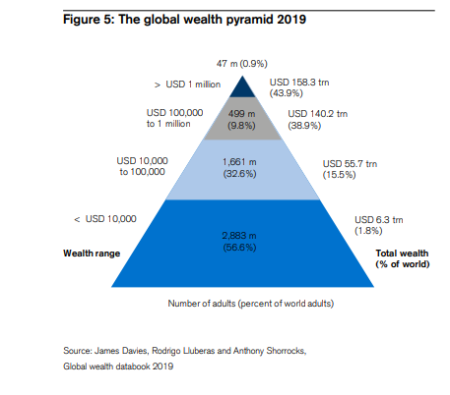
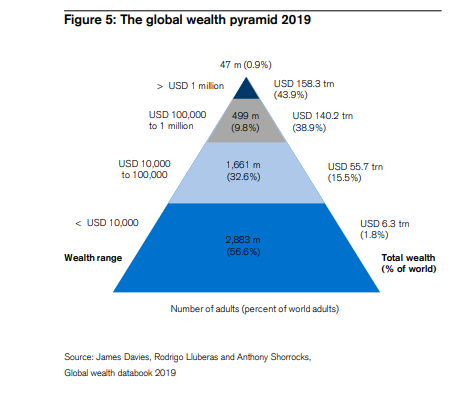
The wealth pyramid captures the wealth differences between adults. Nearly 3bn adults – 57% of all adults in the world – have wealth below USD 10,000 in 2019. The next segment, covering those with wealth in the range USD 10,000–100,000, has seen the biggest rise in numbers this century, trebling in size from 514 million in 2000 to 1.7 billion in mid-2019. This reflects the growing prosperity of emerging economies, especially China. The average wealth of this group is USD 33,530, still less than half the level of average wealth worldwide, but considerably above the average wealth of the countries in which most of the members reside. This leaves the final group of countries with wealth below USD 5,000, which are heavily concentrated in central Africa and central and south Asia.
So here’s the staggering thing. If you live in one of the advanced capitalist countries and you own your house and have some savings, then you will be among the top 10% of all wealth holders in the world.  That’s because the vast majority of households in the world have little or no wealth at all.
A person needs net assets of just USD 7,087 to be among the wealthiest half of world citizens in mid-2019! However, USD 109,430 is required to be a member of the top 10% of global wealth holders and USD 936,430 to belong to the top 1%.  African and Indian citizens are concentrated in the base segment of the wealth pyramid, China in the middle tiers, and North America and Europe in the top percentile. But also evident is a significant number of North American and European residents in the bottom global wealth decile, as younger adults acquire debt in advanced economies, resulting in negative net wealth.
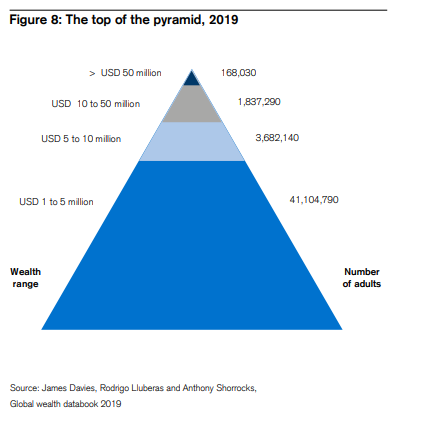
And inequality gets wider at the top of the pyramid.  There are 46.8 million millionaires in the world in mid-2019, but most have wealth between USD 1 million and USD 5 million: 41.1 million or 88% of the millionaires. Another 3.7 million adults (7.9%) are worth between USD 5 million and 10 million, and almost exactly two million adults now have wealth above USD 10 million. Of these, 1.8 million have assets in the USD 10–50 million range, leaving 168,030 Ultra High Net Worth (UHNW) individuals with net worth above USD 50 million in mid-2019.  In effect, these are the ruling elite of the world.

[IMAGE 2]
 
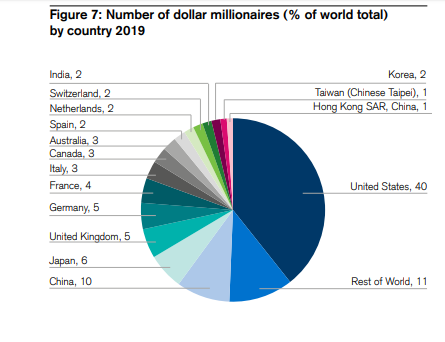
The United States has by far the greatest number of millionaires: 18.6 million, or 40% of the world total. For many years, Japan held second place in the millionaire rankings by a comfortable margin. However, Japan is now in third place with 6%, overtaken by China (10%). Next come the United Kingdom and Germany with 5% each, followed by France (4%), then Italy, Canada and Australia (3%).

[IMAGE 3]
 
Switzerland (USD 530,240), Australia (USD 411,060) and the United States (USD 403,970) again head the league table according to wealth per adult. The ranking by median average wealth per adult favours countries with lower levels of wealth inequality. This year, Australia (USD 191,450) edged ahead of Switzerland (USD 183,340) into first place.  So Australia has the highest median wealth per adult in the world (that’s mainly house values).
Financial assets suffered most during the financial crisis of 2008-9 and then recovered in the early post-crisis years. This year, their value rose in every region, contributing 39% of the increase in gross wealth worldwide, and 71% of the rise in North America. However, non-financial assets (property) provided the main stimulus to overall growth in recent years. Over the 12 months to mid-2019, they grew faster than financial assets in every region. Non-financial wealth accounted for the bulk of new wealth in China, Europe and Latin America, and almost all new wealth in Africa and India. But household debt rose even faster, at 4.0% overall. Household debt increased in all regions, and at a double-digit rate in China and India. The debt squeeze is coming.


Žižek: "if Europe betrays Kurds, it will betray itself"


Slovenian philosopher Slavoj Žižek wrote in The Independent that "if Europe will turn its eyes away from Kurds, it will betray itself."


Well known Slovenian philosopher Slavoj Žižek wrote in The Independent: "The fate of the Kurds makes them the exemplary victim of the geopolitical colonial games: spread along the borderline of four neighboring states (Turkey, Syria, Iraq, Iran), their (more than deserved)  full autonomy was in nobody’s interest, and they paid the full price for it."
Žižek added: "Do we still remember Saddam’s mass bombing and gas-poisoning of Kurds in the north of Iraq in the early 1990s? More recently, for years, Turkey plays a well-planned military-political game, officially fighting ISIS but effectively bombing Kurds who are really fighting ISIS."
Žižek continued: "In the last decades, the ability of the Kurds to organize their communal life was tested in almost clear-cut experimental conditions: the moment they were given a space to breath freely outside the conflicts of the states around them, they surprised the world.
[...] In northern Syria, the Kurdish enclave centered in Rojava was a unique place in today’s geopolitical mess: when Kurds were given a respite from their big neighbors who otherwise threatened them all the time, they quickly built a society that one cannot but designate an actually-existing and well-functioning utopia."
According to Å½ižek: "It is our duty to fully support the resistance of the Kurds to the Turkish invasion, and to rigorously denounce the dirty games Western powers play with them. While the sovereign state around them are gradually sinking into a new barbarism, Kurds are the only glimmer of hope."
And it’s not only about Kurds, said Å½ižek "that this struggle is fought, it’s about ourselves, it’s about what kind of global new order is emerging. If Kurds will be abandoned, it will be a new order in which there will be no place for the most precious part of the European legacy of emancipation. If Europe will turn its eyes away from Kurds, it will betray itself. The Europe which betrays Kurds will be the true Europastan!"