Monday, October 7, 2019
El Salvador busts police ring accused of dozens of killings
AP. September 30, 2019
SAN SALVADOR, El Salvador (AP) — Authorities in El Salvador say they have broken up a criminal network involving police officers — including some elite forces — that allegedly carried out more than two dozen contract killings.
Justice Minister Rogelio Rivas says 11 people were arrested in connection with the group, which is said to have operated in the eastern departments of Usulutan and San Miguel.
Thirty-nine warrants were issued.
The alleged crimes include 20 individual murders plus multiple killings of up to five people as well as three kidnappings, all committed in 2016-2017.
Chief Prosecutor Raúl Melara said Monday the suspects are accused of aggravated homicide and illicit association.
He added that the suspects are “people who were supposed to protect the life of Salvadorans (and) do not deserve to call themselves police.”

Guns from the United States are stoking a homicide epidemic in Mexico
KATE LINTHICUM. Los Angeles Times. October 6, 2019
The sun had not yet risen when dozens of gunmen stormed into the town of Ocotito in southern Mexico and started shooting.
Salvador Alanis Trujillo tried to fight back, but his shotgun was no match for their assault rifles. So he and his family fled.
This rugged stretch of Guerrero state had always been a little lawless, home to cattle rustlers and highway bandits. But by the time the gunmen seized Ocotito in 2013, the region was overrun with dozens of criminal groups battling for territory.
There was another key difference: The criminals were now packing AR-15s, AK-47s and other weapons of war.
Mexico is in the grips of a deadly arms race.
It began as part of an escalating conflict among major criminal groups, and it accelerated in 2006 after Mexico’s military went to battle with the cartels.
Today, millions of weapons are in private hands — in direct violation of Mexico’s strict gun laws.
Some of those firearms once belonged to the military or police and were sold into the underworld. But the vast majority were smuggled from the world’s largest gun market: the United States.
The arms buildup has helped fuel record levels of violence. Last year, Mexico saw 20,005 gun homicides — nearly seven times as many as in 2003.
Impunity in Mexico, where 95% of killings go unpunished, has spurred more people to take up arms — and carry out their own justice.
After Alanis was forced to abandon his property, which he had bought with savings from a stint as an auto mechanic in North Carolina, he went to state authorities for help.
When none arrived, he and others who had been displaced formed what they describe as a community police force — and began acquiring the most powerful guns available on the black market.
The group’s aim is to eventually take back Ocotito, a town of 6,000 at the base of a verdant mountain range, using an arsenal that includes dozens of machine guns.
In the meantime, Alanis and his group — the United Front of Community Police of the State of Guerrero — have been steadily taking territory.
They say they are cleansing the countryside of predatory gangs, a mission that they acknowledge sometimes employs the same brutal tactics of their enemies.
They have incurred, and inflicted, many losses in a conflict that Alanis said can only be described as a “civil war.”
“The assassins that kill us are Mexican,” said Alanis, 40. “And the people we shoot are Mexican.”
As for the weapons, that’s another story. He pointed to the words stamped on the barrel of a Colt Match Target assault rifle slung across the chest of a teenage fighter: “HARTFORD, CONN, U.S.A.”
“We kill each other,” he said. “And you send the bullets.”
The only gun store in all of Mexico is located on a heavily guarded army base.
Before entering the Directorate of Arms and Munitions Sales on the outskirts of Mexico City, customers must undergo months of background checks and present six documents verifying their identity.
The process is so onerous that last year the store sold just 15,754 firearms. None were assault rifles, which are illegal here.
In contrast, an estimated 13.1 million guns were sold in the United States by tens of thousands of licensed firearms dealers. That includes readily available military-style rifles.
The exact number of firearms trafficked to Mexico is unknown, but in one of the few academic studies of the issue, researchers at the University of San Diego estimated that more than 750,000 guns were purchased in the United States between 2010 and 2012 to be smuggled into Mexico.
Data collected by the U.S. Bureau of Alcohol, Tobacco, Firearms and Explosives also make clear where criminals in Mexico are getting their firearms.
Of the 132,823 guns recovered at crime scenes in Mexico from 2009 to 2018, fully 70% were found to have originated in the U.S. — primarily in Southwest border states, most commonly Texas.
Most firearms trafficked to Mexico are bought legally at gun shows or stores by people known as “straw purchasers,” who then hand them off to cartels or middlemen.
Moving weapons across the border is simple. More than a million people and about $1.7 billion in commerce cross the border legally each day, and Mexico rarely checks goods heading south.
As a result, the black market for guns in Mexico is well stocked.
On a recent afternoon in Tepito, a crowded, crime-ridden neighborhood near downtown Mexico City, an arms dealer was at home preparing to make a sale. As he cleaned three of the guns he had recently acquired, his family members shuffled around the darkened kitchen, preparing lunch.
The dealer, who spoke on condition of anonymity, said he buys pistols and revolvers on the black market and resells them for up to $800. High-powered rifles such as AK-47s fetch up to $2,500.
A few blocks away, in Tepito’s bustling market, other entrepreneurs rent guns for around $50 a day.
The dealer said he got swept up in gang life as a teenager in the 1990s. Back then, people fought with knives or fists. “Now it’s bullets,” he said.
On occasion, he said, he has worked as a hired killer, charging $5,000 a hit.
He picked up a shiny Smith & Wesson pistol manufactured in Massachusetts that he said had been smuggled from the United States. Then he placed it in a white shoulder bag and headed out to meet his customer.
##
Gun control is one of the most divisive political issues in the United States, but the debate rarely considers how lax American gun laws have fueled violence in Mexico.
Experts, activists and Mexican officials trace the beginning of the arms race to a major change in U.S. gun regulations: the 2004 expiration of a congressional ban on high-powered assault weapons.
Overnight, any adult with a clean record could walk into a store in all but a few states that maintained their own bans and walk out with guns that in most of the world are reserved for military use.
The University of San Diego researchers found that U.S. gun dealers experienced an immediate rise in sales of guns destined for Mexico — and that by 2012 annual purchases were triple the pre-ban totals.
The increase came at a precarious time. Mexican drug traffickers had been openly clashing since 2000, when the long-ruling Institutional Revolutionary Party lost power and the cartels lost crucial political protection.
The massive influx of weapons added tinder to those conflicts.
In 2004, a quarter of Mexico’s homicides were committed with a gun. Today, guns are to blame in 72% of killings.
With more guns on the streets, “things got crueler,” said Jose Manuel Martinez Hernandez, a forensic scientist in the Guerrero state prosecutor’s office.
Martinez well remembers the shock he felt in 2006 when he was called to investigate a shootout in the seaside resort of Acapulco that many viewed as a inflection point in the violence.
Bullets had flown for nearly an hour at an intersection known as La Garita, leaving four drug traffickers dead and the street littered with casings from assault weapons. When Martinez turned over one body, he found eight grenades strapped to the man’s chest.
“These are weapons of war,” he said he thought.
Eventually, such scenes became normal, and Mexico’s most popular beach resort became known instead as one of the most violent cities on Earth.
##
By the time President Felipe Calderon was sworn into office in late 2006, he was facing growing pressure to do something about the violence.
At a dinner that year with U.S. Ambassador Antonio Garza, Calderon “expressed his grave concern over the security situation in Mexico,” according to diplomatic cables released by WikiLeaks.
Shortly after, Calderon deployed the first of what would be tens of thousands of soldiers and marines to fight Mexico’s drug traffickers — and asked President George W. Bush for America’s help.
The resulting agreement was the Merida Initiative, a multibillion-dollar security partnership based on a “shared responsibility” to combat trafficking.
Under the program, the United States provided Black Hawk helicopters and surveillance planes and training in counterinsurgency tactics. At the same time, Mexico began importing record numbers of legal weapons for the army and police.
U.S. exports of firearms, ammunition, explosives and gun parts to Mexico rose to roughly $40 million a year, according to the advocacy group Stop U.S. Arms to Mexico. The Mexican army also vastly increased its own production of firearms.
But the influx of weapons had an unintended consequence: A better equipped military and police spurred the cartels to improve their arsenals, primarily by smuggling even more weapons from the U.S.
Gangs such as the Zetas, which was founded by deserters of the Mexican army’s special forces, became known for their enormous caches of weapons, including homemade “narco tanks” designed to withstand grenade attacks and machine gun fire.
John Lindsay-Poland, the director of Stop U.S. Arms to Mexico, said the arms buildup has trapped Mexico in a perverse cycle.
“If you go after armed violence with armed violence, you will increase armed violence,” he said.
By 2012, the year Calderon left office, he was begging the U.S. to reinstate the assault weapons ban.
“Many of these guns are not going to honest American hands,” he said in an address that year to the U.S. Congress. “Instead, thousands are ending up in the hands of criminals.”
But the U.S. gun lobby prevailed in opposing a reinstatement of the ban.
Calderon was frustrated, too, with a botched U.S. law enforcement operation dubbed Fast and Furious that allowed weapons from the U.S. to pass into the hands of suspected gun smugglers in an attempt to identify top cartel members in Mexico. The ATF, which ran the operation, lost track of hundreds of weapons, some of which were used to kill.
Eight months before he stepped down because of term limits, Calderon erected a massive billboard in the border city of Ciudad Juarez angled toward Texas.
The letters, formed using crushed guns seized by authorities, spelled out in English: “No more weapons.”
##
Meanwhile, criminals were discovering another source of firearms: the Mexican police.
More than 22,000 firearms purchased by state and federal police were reported lost or stolen between 2000 and 2015, according to Mexican military documents.
In Guerrero, police reported that 1 in 5 of the firearms they acquired between 2010 and 2016 were lost or stolen.
Last year, the municipal police force in Acapulco was temporarily disarmed by federal authorities after its officers could not account for 20% of their armament. State officials said the force had been infiltrated by organized crime.
Police have also been caught selling guns seized by authorities.
In Tepito, the arms dealer dialed one of his regular suppliers: a local police official who sells weapons recovered from crime scenes to neighborhood criminals.
“Commander,” the dealer sang cheerfully into the phone. “Do you have what I asked for?”
“Not yet,” the commander said. Then he began talking about other guns that were available for sale.
Enrique Peña Nieto, who succeeded Calderon as president, continued to hit on the issue of American guns in conversations with his U.S. counterparts. Yet seizures of illegal weapons fell precipitously during his six-year term, in part because he largely abandoned a Calderon-era push to inspect more vehicles heading south into Mexico.
Current Mexican President Andres Manuel Lopez Obrador has vowed to bring back inspections. And in July, the foreign secretary, Marcelo Ebrard, said Mexico’s military would coordinate with U.S. authorities to launch anti-gun-smuggling operations along the border.
At the same time, in Guerrero and other parts of Mexico where the government has lost control, authorities often overlook flagrant violations of gun laws, and in some cases have been known to supply vigilantes with weapons.
Alanis said his community police group purchases weapons and bullets from members of Mexico’s armed forces. He said he pays a former marine to train his men how to shoot.
Last fall, the group that Alanis directs laid siege to a poppy-growing town called Filo de Caballos. The confrontation lasted seven hours, killed seven people and left homes and stores pocked with hundreds of bullet holes. To reach the town today, visitors must past through multiple checkpoints patrolled by armed men.
Alanis said his group freed the small mountain hamlet from a drug gang called the Cartel del Sur, which he asserted had been extorting from residents and controlling local heroin production for years.
Just as Alanis had done five years before in Ocotito, hundreds of residents fled the violence. Some claimed that Alanis had taken over the town because he wanted to dominate the poppy industry himself, as well as access to lucrative local mines.
Alanis doesn’t own up to illegal activity, but also doesn’t deny it. He admits that his crusade has at times been guided more by vengeance than by principle.
His wife left him several years ago. Now Alanis sleeps at his group’s base in Filo de Caballos in the bullet-pocked former headquarters of the town’s municipal government.
He and his troops rest in shifts. When they do finally lie down, it is always with a weapon by their side.
“Instead of embracing your woman, you embrace your gun.”
Thatcher sent Pinochet finest scotch during former dictator's UK house arrest
Mat Youkee. The Guardian. October 5, 2019
While he was under house arrest in Surrey in 1999, the former Chilean military dictator Augusto Pinochet received a fine malt from an old friend.
“Scotch is one British institution that will never let you down,” read the accompanying note from its sender: the former British prime minister Margaret Thatcher.
The detail, revealed this week in the third volume of Charles Moore’s biography of Baroness Thatcher, adds further colour to the close relationship between Thatcher and the man responsible for the death of more than 2,000 people and the torture of many more.
Thatcher was appalled that the Labour government had allowed the arrest of Pinochet while he was in London for medical treatment, overriding his diplomatic immunity.
“I don’t know when or how this tragedy will end,” Thatcher told the 1999 Conservative party conference to warm applause, “but we will fight on for as long as it takes to see Senator Pinochet returned safely to his own country. The British people still believe in loyalty to their friends.”
Although they never met in power, Thatcher was impressed by the success of Chile’s neoliberal economic program and Pinochet’s bloody stance against communism in Latin America.
Above all she felt a “great debt for [Pinochet’s] secret actions during the Falklands war”, according to Moore.
During the conflict, Pinochet installed a military radar in southern Chile to update British intelligence on the movements of Argentina’s air force. He also provided safe passage for SAS troops following a botched reconnaissance mission on mainland Argentina.
But for survivors of Chile’s dictatorship, the relationship between the two leaders is still cause for anger.
“For a British authority figure to publicly support the most bloody dictator in Latin America violated the memory of the thousands of Chileans who were killed, imprisoned and tortured under the dictatorship” said Alicia Lira, the president of the Association for Relatives of the Executed.
“Her words were an offense to the Chilean people.”
According to Chile’s truth and reconciliation commission, 2,279 people were murdered by Pinochet’s military regime, and a further 27,255 were tortured between 1973 and 1990.
Thanks to public pressure from figures such as Lira, whose husband was killed by the military in 1982, former members of the regime continue to stand trial. On Wednesday, Chilean courts sentenced one of Pinochet’s former bodyguards, Cristián Labbé, to three years in prison for the 1973 torture of a political prisoner.
Pinochet’s taste in tipples was for years kept under wraps by US secret services.
When an uncensored version of a Defense Intelligence Agency profile of the dictator was released under pressure from the National Security Archive at George Washington University, one of the details previously deemed too sensitive to release was : “Drinks scotch and pisco sours; smokes cigarettes; likes parties.”
After the return to democracy however, Pinochet retained the support of many rightwing Chileans. In response to his arrest in the UK, a group of conservative senators demanded a boycott of British goods – including whisky.
There Was a Solution to the Corruption of Bond Rating Agencies: Timothy Geithner Killed It
Dean Baker
October 2
http://cepr.net/blogs/beat-the-press/there-was-a-solution-to-the-corruption-of-bond-rating-agencies-timothy-geithner-killed-it
The Wall Street Journal ran a lengthy piece on how bond rating agencies are again giving inflated ratings, in this case to collateralized loan obligations that include tranches of a variety of bonds and loans. Inflated ratings were a major problem in the housing bubble years, with the major rating agencies giving investment-grade ratings to mortgage-backed securities that were filled with subprime mortgages.
The piece notes the basic incentive problem that the issuer pays the rating agency. This gives rating agencies an incentive to give higher ratings as a way to attract business.
There actually is a simple solution to this incentive problem: have a third party pick the rating agency. Senator Al Franken proposed an amendment to the Dodd-Frank bill that would have had the Securities and Exchange Commission (SEC) pick rating agencies rather than issuers. The amendment passed the Senate with 65 votes, getting strong bi-partisan support.
Under this provision, if JP Morgan wanted to have a new issue rated, instead of calling Moody's or Standard and Poor, it would call the SEC, which would then decide which agency should do the rating. This means that rating agencies would have no incentive to inflate ratings to gain customers.
In spite of the strong bipartisan support in the Senate, then-Treasury Secretary Timothy Geithner did not want the provision to be included in the bill. As he boasts in his autobiography, he arranged to have it killed in the House-Senate conference.
So, when we see the problem of inflated bond ratings re-emerging, we should all be saying "Thank you, Secretary Geithner."

Bernie Sanders Is America's Beating Heart
Norman Solomon
https://www.truthdig.com/articles/bernies-heart-is-his-secret-weapon/
Along with being where all blood goes, the heart is an enduring metaphor. As Bernie Sanders recovers from a heart attack, now might be a good time to consider some literal and symbolic meanings.
Bernie immediately used his heart trouble to advance a central mission. From the hospital, he tweeted: “I’m fortunate to have good health care and great doctors and nurses helping me to recover. None of us know when a medical emergency might affect us. And no one should fear going bankrupt if it occurs. Medicare for All!”
That’s the kind of being “on message” we so badly need. It’s fully consistent with Bernie’s campaign and his public life. (“Not me. Us.”) He has never been a glad-hander or much of a showman. He’s always been much more interested in ending people’s pain than proclaiming that he feels it.
About 10 years ago, I was lucky enough to dialogue with Bernie during an “in conversation with” event in San Francisco, where several hundred people filled the room. Before we went on stage, there was a gathering in a makeshift green room that raised a small amount of money for his senatorial campaign coffers. “I’ve never been good at raising money,” he told me.
I thought about that comment when the news broke a few days ago that the Bernie 2020 campaign raised a whopping $25.3 million during the last quarter, with donations averaging just $18. Bernie never went after money. It went after him; from the grassroots.
From the middle of this decade onward, as the popularity of Bernie and his political agenda has grown, so has the hostility from corporate media. The actual Bernie campaign is in sharp contrast with cable TV coverage as well as press narratives.
The campaign looks set to fully resume soon. When Bernie left the hospital on Friday, NBC News quoted the chief of cardiology at the UC San Diego School of Medicine, Ehtisham Mahmud, who said that the three-day length of hospitalization indicates the senator “probably had a small heart attack” — and “they require really a very short recovery time.”
So, from all indications, Bernie will soon be back on the campaign trail — once again hammering on grim realities that are evaded or excused by the political and media establishment, like the fact that just three individuals (Jeff Bezos, Warren Buffett and Bill Gates) have as much wealth as the bottom half of the entire U.S. population.
Last month, in an interview about his proposal to greatly increase taxes on the extremely rich, Bernie said: “What we are trying to do is demand and implement a policy which significantly reduces income and wealth inequality in America by telling the wealthiest families in this country they cannot have so much wealth.” Such concentrations of wealth — and the political power that goes with it — are antithetical to genuine democracy.
For his entire adult life, Bernie Sanders has been part of social movements intent on challenging such profit-mad industries as corporate health care, financial services, mass incarceration and the military-industrial complex that cause so much opulence for the few and so much suffering for the many. The enormous inequalities of wealth and power are systemic and ruthless — with devastating effects on vast numbers of people.
That’s where the heart as metaphor is apt. Bernie has a huge and eternally healthy heart, filled with the lifeblood of empathy and dedication. In essence, that’s what the Bernie 2020 campaign is all about. As he has been the first to say, it’s not about him, it’s about us. How much compassion and commitment can we find in our hearts?
September 2019 Was Earth's Hottest September on Record
Olivia Rosane
Oct. 07, 2019 06:45AM EST
https://www.ecowatch.com/earth-hottest-months-recorded-2640870848.html
September 2019 was the hottest September on record, the EU's Copernicus Climate Change Service reported Friday. This makes it the fourth month in a row this year to be the hottest or near hottest of its kind.
June 2019 was the hottest June on record, July 2019 was the hottest month ever recorded and August was the second-hottest August, according to Copernicus data reported by The Washington Post's Capital Weather Gang.
"The recent series of record-breaking temperatures is an alarming reminder of the long-term warming trend that can be observed on a global level. With continued greenhouse gas emissions and the resulting impact on global temperatures, records will continue to be broken in the future," Jean-Noël Thépaut, director of Copernicus at the European Center for Medium-Range Weather Forecasts, said in a statement reported by The Washington Post.

Copernicus ECMWF@CopernicusECMWF
 September #temperature highlights from #Copernicus #C3S:
 Globally, this year had the warmest September in our records, although it wasn't much warmer than September 2016European temperatures above 1981-2010 average in most areas
More detail
 http://bit.ly/2ImMMKN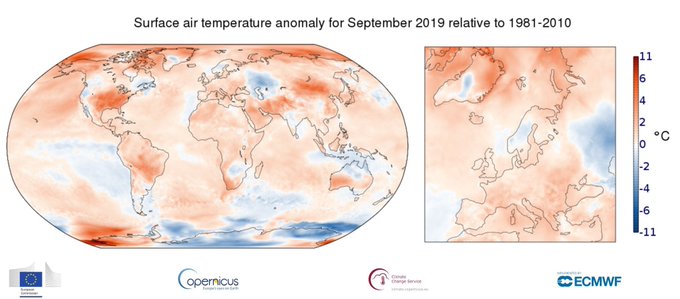
47
5:38 AM - Oct 5, 2019
Twitter Ads info and privacy
35 people are talking about this
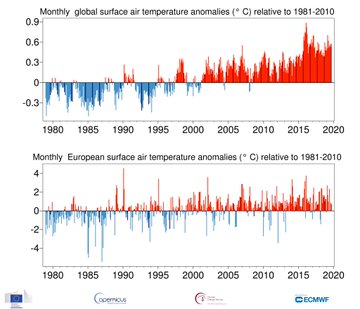
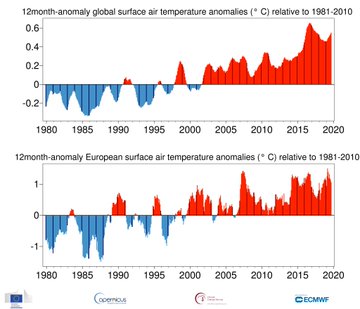
September 2019 was 0.57 degrees Celsius warmer than the average for the month from 1981-2010, Coepernicus found. It was also about about 1.2 degrees Fahrenheit above the preindustrial average, according to The Washington Post. It was only around 0.04 degrees Fahrenheit warmer than September 2016, meaning the two months were "virtually on a par," Copernicus said. However, The Washington Post pointed out that in 2015 and 2016, there was a powerful El Niño event driving up temperatures. No such event occurred this year.
Places that saw higher than average temperatures this September included much of Europe, much of the Arctic, most of the U.S., Iran, Afghanistan, Mongolia, northern China, central South America, South Africa, southwestern Australia and West Antarctica, Copernicus announced. Marine temperatures were also higher than average, especially over the northeastern Pacific and many seas in the Arctic and Western Antarctic.
Only southwestern Russia, the Central Asian Republics and parts of Antarctica saw temperatures markedly below average. Norway, Sweden and far-eastern Europe also saw below average temperatures.

Copernicus EU@CopernicusEU
 September 2019 was 0.57°C warmer than the average September from 1981-2010! Regions most markedly above average temperatures include parts of the USA
  and the #Arctic.
September
highlights from Copernicus #ClimateChange Service (#C3S) are out! https://bit.ly/30RLwpy 

32
10:20 AM - Oct 4, 2019
Twitter Ads info and privacy
44 people are talking about this
CBS News climate and weather contributor Jeff Berardelli said that heat waves are more closely linked to the climate crisis than any other extreme weather event. That is because masses of hot air "pool" extra warming, he told CBS News.
"There is no doubt in the scientific community that heatwaves will continue to get worse in the future due to human-caused climate change," Berardelli said.
And heat waves are also the type of extreme weather event most deadly to humans, according to CBS News.
The U.S. National Aeronautics and Space Administration and National Oceanic and Atmospheric Administration (NOAA) will both release their September temperature data later this month, USA Today reported.
However, a preliminary NOAA tally found that the U.S. recorded 2,491 daily record highs in September, but only 82 daily record lows, as The Weather Channel reported.
More than 100 U.S. cities experienced one of their three warmest Septembers and more than 50 recorded their warmest September ever. Among them was Utqiagvik, Alaska, which recorded a monthly average of 40.8 degrees Fahrenheit, the first time a month other than July or August has averaged more than 40 in the northern city.

Enviro Voter Project@Enviro_Voter
Vote, organize, volunteer. Climate action is the best remedy for climate despair. https://www.ecowatch.com/july-hottest-month-noaa-2639856116.html … #ActOnClimate #ClimateCrisis

July 2019 Was the Hottest Month Ever Recorded, NOAA Confirms
July was the hottest month since records began in 1880, the US National Oceanic and Atmospheric Administration (NOAA) has confirmed. The heat also melted Arctic Sea ice to record lows.ecowatch.com
2
1:45 PM - Aug 16, 2019
Twitter Ads info and privacy
See Enviro Voter Project's other Tweets
Subscribe to:
Posts (Atom)