Friday, July 12, 2019

A way out from rock bottom: Economic policies can reduce deaths of despair


William H. Dow, Anna Godøy, Chris Lowenstein, Michael Reich 07 July 2019


Policymakers and researchers have sought to understand the causes of and effective policy responses to recent increases in mortality due to alcohol, drugs, and suicide in the US. This column examines the role of the minimum wage and the earned income tax credit – the two most important policy levers for raising incomes for low-wage workers – as tools to combat these trends. It finds that both policies significantly reduce non-drug suicides among adults without a college degree, and that the effect is stronger among women. The findings point to the role of economic policies as important determinants of health. 


Since 2014, overall life expectancy in the US has fallen for three years in a row, reversing a century-long trend of steadily declining mortality rates. This decrease in life expectancy reflects a dramatic increase in deaths from so-called ‘deaths of despair’ – alcohol, drugs, and suicide – among Americans without a college degree (Case and Deaton 2015, 2017). Between 1999 and 2017, the age-adjusted rate of drug overdose deaths increased by 256%, while suicides grew by 33% (Hedegaard et al. 2017, 2018). 

In their pioneering work first highlighting these trends, Case and Deaton point to declining economic opportunity among working class non-Hispanic whites – combined with an increase in chronic pain, social distress, and the deterioration of institutions such as marriage and childbearing – as primary drivers of these trends. Case (2019) further notes that inflows of cheap heroin and fentanyl interacted with ongoing poor economic conditions among less-educated workers to perpetuate mortality due to these causes. Other scholars have questioned the explanatory focus on distress and despair, especially for drug-related deaths (Roux 2017, Ruhm 2019, Finkelstein et al. 2016). These researchers point instead to place-specific and ‘supply-side’ factors of the drug environment, particularly the role of new, highly addictive and risky drugs. Others have also pointed to the role of the obesity epidemic and the lagged effects of the HIV/AIDS crisis as drivers of these trends (Masters et al. 2018). 

We contribute to this discussion by examining how two economic policies that increase after-tax incomes of low-income Americans – the minimum wage and the earned income tax credit (EITC) – causally affect deaths of despair. 

Our study

To estimate the causal effects of minimum wages and the EITC on mortality, we adopt a quasi-experimental approach, leveraging state-level variation in state economic policies over a 16-year period from 1999-2015. Our primary data source consists of geocoded CDC Multiple Causes of Death files linked with state-level demographic, economic, and policy variables from a variety of sources (see Dow et al. 2019 for a full description of data sources and methods). 

The restricted-access mortality files we use contain various demographic characteristics including race, ethnicity, age, gender, and education. Education is of particular relevance to our analysis as it serves as a proxy for exposure to the EITC and the minimum wage. We focus specifically on mortality among adults aged 18-64 without a college degree, as this is the population most likely to be affected by minimum wage changes and the EITC. While the term ‘deaths of despair’ typically includes deaths from drug overdoses, suicides, and alcohol-related illness (Case and Deaton 2015), we focus here on drug overdose deaths and non-drug suicides, which are more likely to be responsive to recent policy changes in the short-run. 

Our analysis follows the standard difference-in-differences approach to estimate models of cause-specific mortality over time. Our estimates suggest that both policies significantly reduce non-drug suicides among our lower-educated sample (adults without a college degree). Specifically, we highlight three findings. First, a 10% increase in the minimum wage reduces suicide deaths by 3.6%, while a 10% higher maximum EITC reduces suicides by 5.5%. Based on the average annual suicide rate in this population over the study period, this translates to a reduction in over 1,200 suicides annually.

Second, the effect of these policies on reducing suicide is stronger among women. A 10% increase in minimum wages (state EITC credits) leads to a 4.6% (7.4%) reduction in suicide deaths. This is consistent with differences in exposure to these policies, as women are more likely to work minimum wage jobs and to be eligible for the EITC.

Third, we do not find any differential effects of minimum wages on suicide for white non-Hispanic and other racial/ethnic groups, yet there is suggestive evidence that the EITC may have larger effects among people of colour. 

Overall, we find that the reduction in suicides is greater among the groups that are more likely to be affected by higher minimum wages and generous EITCs. We find no significant effects of these two policies among adults with a bachelor’s degree or higher – a population less likely to work minimum wage jobs or to be eligible for the EITC. This finding lends support to our hypothesised mechanism that these policies reduce suicides by lifting low-income groups out of poverty. Importantly, neither policy significantly affected drug-related deaths, which have increased in the US with the greater availability of illegal opioids, heroin, and fentanyl. These null effects are consistent with the arguments made by Ruhm (2019), Finkelstein (2016), and others highlighting the supply-side drivers of the dramatic increase in drug overdose fatalities. It is likely that other policies are needed to combat these trends.

Evidence of causality

Our study provides the first causal evidence of the beneficial effects of these policies on fatalities attributable to non-drug suicide. Underlying our study design is the fundamental assumption that we can obtain causal estimates of policy effects by comparing states that have different minimum wages and EITC rates within the same year. For this approach to be valid, the parallel trends assumption must hold – that is, changes in state minimum wages and EITC rates should be uncorrelated with unobserved drivers of mortality. 

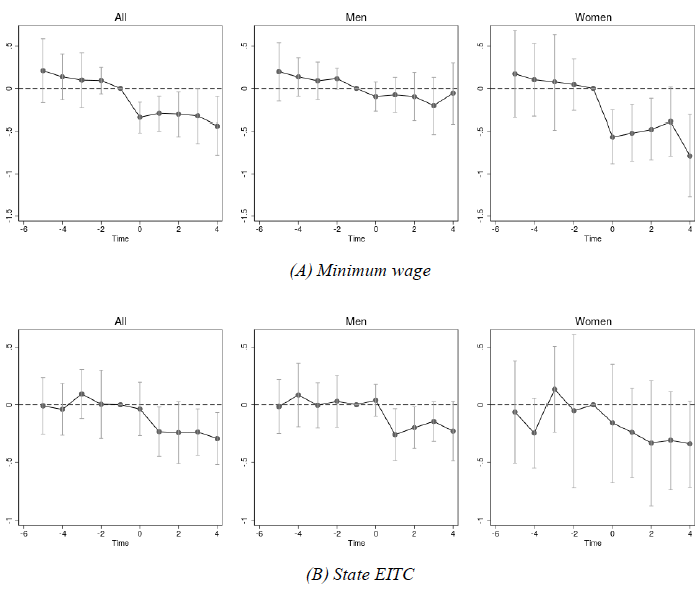
We provide strong evidence of the parallel trends assumption by estimating an event study model that captures the time path of effects around the time of minimum wage or EITC change. The intuition behind these models is that higher minimum wages or EITC rates should not have any effects on mortality in the years leading up to the policy changes, but we should observe a discontinuous shift in the outcome at the time of implementation. This pattern is shown in Figure 1 plotting the estimated effects (and their 95% confidence intervals) for the minimum wage (panel A) and EITC (panel B), each stratified by gender.

Figure 1 Event study models of non-drug suicide


Concluding remarks

Our finding that minimum wage increases and EITC expansions significantly reduce suicide rates are consistent with recent research identifying economic correlates of suicide – non-employment, lack of health insurance, home foreclosures, and debt crises (Reeves et al. 2012, Chang et al. 2013). 

More generally, these findings further an emerging body of literature examining the relationship between economic policies and related health behaviours and outcomes. For example, recent research has found that minimum wage increases lead to reduced self-reported depression among women (Horn et al. 2017), reductions in suicide (Gertner et al. 2019), and do not have harmful effects on teen alcoholism or drunk driving fatalities (Sabia et al. 2019). In general, a majority of the recent papers on the effects of minimum wages on health have identified beneficial effects, though many of these studies use questionable methods that cast doubt on their validity as credible causal analyses (Leigh and Du 2018, Leigh et al. 2019). 

Expansions of the EITC have been found to significantly improve the health of mothers and birth outcomes (Evans and Garthwaite 2014, Hoynes et al. 2015, Markowitz et al. 2017), and a recent study by Lenhart (2019) finds that EITC expansions improve self-reported health. Taken together, these findings point to a substantial public health benefit of increasing the minimum wage and expanding the EITC. 

The minimum wage and the EITC each raise incomes for low-wage workers. Economists have generally found that minimum wage policies increase income and reduce poverty, while having very little to no negative effects on employment. The new findings in this study suggest that the benefits of minimum wage and EITC policies are broader than previously thought and can help combat the high and increasing levels of deaths of despair.

References

Case, A, and A Deaton (2015), “Rising Morbidity and Mortality in Midlife among White non-Hispanic Americans in the 21st century” PNAS, 112 (49), 15078-15083. 

Case, A, and A Deaton (2017), “Mortality and Morbidity in the 21st Century” Brookings Papers on Economic Activity, 397- 477.

Case, A (2019), "Deaths of Despair and the Future of Capitalism" Haas Institute Lecture, University of California, Berkeley, March 1.

Chang, S-S, D Stuckler, P Yip, and D Gunnell (2013), "Impact of 2008 global economic crisis on suicide: time trend study in 54 countries", BMJ, 347 (2013), f5239.

Cooper, D, M J Luengo-Prado, and J A Parker (2019), “The local aggregate effects of minimum wage increases”, NBER Working Paper no. 25761.

Dow, W H, A Godøy, C A Lowenstein, M Reich (2019), “Can Economic Policies Reduce Deaths of Despair?” NBER Working paper no. 25787.

Evans, W, and C Garthwaith (2014), “Giving Mom a Break: The Impact of Higher EITC Payments on Maternal Health”, American Economic Journal: Economic Policy, 6 (2), 258-290.

Gertner, A, J Rotter, and P Shafer (2019), “Association between State Minimum Wages and Suicide Rates in the US”, American Journal of Preventive Medicine, 56 (5), 648-54.

Hedegaard, H, S Curtin, and M Warner (2018), “Suicide Mortality in the United States, 1999-2017”, NCHS Data Brief no. 330, 1–8.

Hedegaard, H, M Warner, and A Miniño (2017), “Drug Overdose Deaths in the United States, 1999-2016”, NCHS Data Brief no. 294.

Hoynes, H, D Miller, and D Simon (2015), “Income, the Earned Income Tax Credit, and Infant Health”, American Economic Journal: Economic Policy, 7 (1), 172-211.

Leigh, P, and J Du (2018), “Effects of Minimum Wages on Population Health”, Health Affairs,October 4.

Leigh, P, W Leigh, and J Du (2019), “Minimum Wages and Public Health: A Literature Review”, Preventive Medicine, 118, 122-34.

Lenhart, O (2019), "The effects of income on health: new evidence from the Earned
Income Tax Credit", Review of Economics of the Household, 17 (2), 377-410.

Markowitz, S, K A Komro, M D Livingston, O Lenhart, and A C Wagenaar (2017), “Effects of state-level Earned Income Tax Credit laws in the US on maternal health behaviors and infant health outcomes”, Social Science & Medicine, 194, 67-75.

Masters, R, A Tilstra, and D Simon (2018), “Explaining Recent Mortality Trends among Younger and Middle-Aged White Americans”, International Journal of Epidemiology, 47 (1), 81–88.

Reeves, A, D Stuckler, M McKee, D Gunnell, S-S Chang and S Basu (2012), "Increase in State Suicide rates in the USA During Economic Recession", The Lancet 380, 9856, 1813-1814.

Roux, A (2017), “Despair as a Cause of Death: More Complex Than It First Appears”, American Journal of Public Health, 107 (10), 1566–67.

Ruhm, C J  (2019), “Drivers of the fatal drug epidemic”, Journal of Health Economics, 64, 25-42.

Sabia, J J, M M Pitts, and L M Argys (2019), “Are minimum wages a silent killer? New evidence on drunk driving fatalities”, Review of Economics and Statistics, 101 (1), 192-199.


Hospitals Block ‘Surprise Billing’ Measure


By Ana B. Ibarra July 10, 2019


Citing fierce pushback from hospitals, California lawmakers sidelined a bill Wednesday that would have protected some patients from surprise medical bills by limiting how much hospitals could charge them for emergency care.

The legislation, which contributed to the intense national conversation about surprise medical billing, was scheduled to be debated Wednesday in the state Senate Health Committee.

Instead, the bill’s author pulled it from consideration, vowing to bring it back next year.

“We are going after a practice that has generated billions of dollars for hospitals, so this is high-level,” said Assemblyman David Chiu (D-San Francisco). “This certainly does not mean we’re done.”

Chiu said he and his team would keep working on amendments to the bill that address the concerns of hospitals while maintaining protections for patients.

Hospitals focused their opposition on a provision of the bill that would have limited what they can charge insurers for out-of-network emergency services, criticizing it as an unnecessary form of rate setting.


Nancy Pelosi’s renewed attacks on AOC aren’t just disrespectful, they’re dangerous


As America grows increasingly brazen in its bigotry, Pelosi should be standing up for her new colleagues – so why isn’t she?


Can progressives please shut up and listen to Nancy Pelosi? The speaker of the House, I would like to remind everyone, is a master strategist, a savvy tactician, and an experienced politician. She knows what’s best for America. And what’s best for America, apparently, isn’t standing up to Donald Trump; no, it’s ensuring four freshman congresswomen don’t get ideas above their station. It’s ensuring Alexandria Ocasio-Cortez, in particular, knows her place.

There have been long-running tensions between Pelosi and the so-called “Squad” of new progressive congresswomen, which consists of Ocasio-Cortez, Ilhan Omar, Rashida Tlaib and Ayanna Pressley. Things escalated sharply over the weekend, when Pelosi decided it would be a good idea to demean her colleagues in the New York Times. “All these people have their public whatever and their Twitter world, but they didn’t have any following,” Pelosi told the Times, referring to a border funding bill the Squad opposed. “They’re four people, and that’s how many votes they got.”

To begin with, Pelosi’s disparaging remarks about the Squad seemed like they were probably strategic. Now, however, the sustained attacks feel increasingly personal. “When these comments first started, I kind of thought that she was keeping the progressive flank at more of an arm’s distance in order to protect more moderate members, which I understood,” Ocasio-Cortez told the Washington Post on Wednesday. “But the persistent singling out … it got to a point where it was just outright disrespectful … the explicit singling out of newly elected women of color.”

AOC expanded on her comments on Thursday, telling CNN she “absolutely” doesn’t think Pelosi is racist. “It’s really just pointing out the pattern, right? We’re not talking about just progressives, it’s signaling out four individuals. And knowing the media environment that we’re operating in, knowing the amount of death threats that we get … I think it’s just worth asking why.”

As Ocasio-Cortez notes, Pelosi’s attacks aren’t taking place in a bubble; they’re taking place in a media environment where the rightwing have put a target on the Squad’s back. On Tuesday night, for example, Fox host Tucker Carlson launched a racist attack against Omar that could arguably be seen as an incitement to violence against the congresswoman. “[Omar] has undisguised contempt for the United States and for its people,” Carlson told his 3 million viewers. “That should worry you, and not just because Omar is now a sitting member of Congress. Ilhan Omar is living proof that the way we practice immigration has become dangerous to this country. A system designed to strengthen America is instead undermining it.”

America is becoming an increasingly hostile place for women and for people of color. Pelosi’s constant public attacks against the four newly elected women of color aren’t just disrespectful, they’re dangerous. Whether she means to or not, her repeated insinuations that the Squad are rabble-rousing upstarts who are undermining the Democratic party helps bolster the right’s vitriolic narratives about the congresswomen. As America grows increasingly brazen in its bigotry, Pelosi should be aggressively standing up for her freshman colleagues, not trying to tear them down. So why isn’t she?

Well, to put it bluntly, I think it’s because she’s terrified of what her progressive colleagues represent. The Squad doesn’t just consist of four people, as Pelosi condescendingly told the Times; it represents the face of a new America. It represents a challenge to the traditional power structure. That doesn’t just scare bigots like Tucker Carlson, it scares the neoliberal establishment. It scares people who would never call themselves racist (they’d have voted for Obama for a third time if they could have!) but who clearly have a problem with young women of color speaking their mind. It scares people who champion more “diversity” – as long as that diversity keeps its mouth shut or sticks to the party line.

Proud racism advocates for walls to keep brown people out of America. Polite racism builds different sorts of walls; it leverage concepts like “civility” and “unity” to make sure certain voices are kept out of power, or are dismissed as trouble-making and divisive when they try and critique power. What “civility” really means, in all of these discussions, of course, is servility. What unity really means is uniform acceptance of the status quo. Progressives keep being told we shouldn’t criticize centrist Democrats if we want any chance at beating Trump in 2020; and yet establishment figures like Pelosi seem to have no problem criticizing progressive Democrats and the millions of people they represent.

In a press conference on Thursday, Pelosi brushed away questions about her feud with the squad, grandly stating that “Diversity is our strength. Unity is our power.” Is it really? Because I don’t see any diversity or unity from where I’m looking. I just see a lot of old-fashioned hubris.


Italian court jails 24 over South American Operation Condor


Dictatorships of six countries conspired to kidnap and kill political opponents in 1970s


Lorenzo Tondo in Palermo


Mon 8 Jul 2019 13.06 EDT Last modified on Wed 10 Jul 2019 12.01 EDT


An Italian court has sentenced 24 people to life in prison for their involvement in Operation Condor, in which the dictatorships of six South American countries conspired to kidnap and assassinate political opponents in each other’s territories.

The trial, the first of its kind in Europe, began in 2015 and focused on the responsibility of senior officials in the military dictatorships of Chile, Paraguay, Uruguay, Brazil, Bolivia and Argentina for the killing and disappearance of 43 people including 23 Italian citizens.

Those sentenced on Monday included Francisco Morales Bermúdez, who was president of Peru from 1975 to 1980, Juan Carlos Blanco, a former foreign minister in Uruguay, Pedro Espinoza Bravo, a former deputy intelligence chief in Chile, and Jorge Néstor Fernández Troccoli, a Uruguayan former naval intelligence officer.

Exactly how many people died as a result of the conspiracy is unknown, but prosecutors in South America and Italy provided evidence that at least 100 leftwing activists were killed in Argentina, including 45 Uruguayans, 22 Chileans, 15 Paraguayans and 13 Bolivians.

“Operation Condor spared no one,” said Francesca Lessa, a research fellow at Oxford University’s Latin American Centre. “Refugees and asylum seekers were especially targeted, while children – illegally detained with their parents – had their biological identity stolen and replaced by that of adoptive families.”

According to a database recording the crimes of the coordinated regional repression, at least 496 people of 11 nationalities were kidnapped under the auspices of Operation Condor.

Declassified documents suggest some victims were drugged, their stomachs were slit open and they were dropped from planes into the Atlantic Ocean. Other victims’ bodies were cemented into barrels and thrown into rivers.

Monday’s verdict was the result of years of pressure from the families of those who disappeared. “For decades, the victims’ relatives have been seeking justice,” Lessa said. “In the late 1990s and early 2000s, impunity dominated South America, with former politicians and military officials involved in Condor Operation still enjoying immunity. Bringing them before a judge to take responsibility for their crimes was not a simple undertaking.”

The crimes took place in the 1970s and 1980s. “Many of the perpetrators were growing old and may never be brought to justice,” said Jorge Ithurburu, a lawyer for 24 Marzo, a Rome-based NGO. “The more time passed the more the witnesses of those atrocious crimes aged or died.”

Aurora Meloni, 68, whose husband, Daniel Banfi, was kidnapped and murdered in Buenos Aires in 1974, told the Guardian: “We’ve never given up and today we all won. Today’s ruling is not only for my husband … today’s ruling is dedicated to all the people killed and kidnapped under Condor.”

Prosecutors in the case drew on the precedent set in 2000 by the arrest in London of the former Chilean dictator Augusto Pinochet under the principle of “universal jurisdiction”.

In 2016, Argentina’s last military dictator, Reynaldo Bignone, and 16 other former military officials were sentenced to years in prison, marking the first time a court had proved the existence of Operation Condor.

Last April, a newly declassified CIA document showed that European intelligence agencies sought advice from South America’s 1970s dictatorships on how to combat leftwing “subversion”.

“Representatives of West German, French and British intelligence services had visited the Condor organization secretariat in Buenos Aires during the month of September 1977 in order to discuss methods for establishment of an anti-subversion organization similar to Condor,” the document stated.

According to the human rights prosecution office in Buenos Aires, 977 former military officers and collaborators are in jail for crimes relating to Argentina’s dictatorship.


Meet Sydney Ember, the New York Times’ Senior Anti-Bernie Correspondent


New York Times reporter Sydney Ember has a problem with Bernie Sanders — which may be why the paper has her cover him.

Ember is supposed to write reported articles, not op-eds, but she consistently paints a negative picture of Sanders’s temperament, history, policies, and political prospects in the over two dozen pieces she’s done on him. This makes sense, given the New York Times’s documented anti-Sanders bias, which can be found among both editors and reporters alike.

The paper was caught making significant changes, without acknowledging them, to a 2016 article on Sanders hours after it went up: it changed the headline (from “Bernie Sanders Scored Victories for Years via Legislative Side Doors,” to “Via Legislative Side Doors, Bernie Sanders Won Modest Victories”); deleted a positive quote from a campaign adviser; and added two negative paragraphs.

Even after the paper’s public editor chastised the Times for the practice known as stealth editing, the editors defended the changes because they “thought [the article] should say more about his realistic chances.” In its original form, the article didn’t cast enough doubt on Sanders’s viability and ability to govern, in other words.

Ember came to the New York Times with a resumé limited to the finance industry: She was an analyst for BlackRock, the biggest global investment management corporation and the largest investor in coal plant developers in the world. (Her husband, Mike Bechek, is also in the investment business; he was a senior associate consultant at Bain Capital, where his father was CEO.)

Ember was hired by the Times in 2014 to cover advertising and marketing for the paper’s business vertical Dealbook. She started covering politics in May 2018 and immediately got the enviable assignment of covering one of the leading contenders for the 2020 Democratic nomination.

Ember has a multi-prong approach to undermining Sanders: She went to great lengths to avoid calling him the frontrunner until he was “no longer” one; she attributes his political positions to attention-getting, self-serving ulterior motives; frames even his victories and the popularity of his ideas as weaknesses; cherry-picks polls; presents opinions as facts (claiming he’s “outflanked on the left by rising stars like Alexandria Ocasio-Cortez, Ayanna Pressley, and Beto O’Rourke”); and creates false equivalency between Sanders and Donald Trump.

But for the sake of time and length, this piece focuses on her selection and misrepresentation of sources, which have already drawn scrutiny. Brad Johnson, a political analyst with a background in climate science, pointed out that Ember quoted a source without mentioning that she’s a corporate lobbyist; journalist Zaid Jilani noted that Ember failed to disclose that another source was a senior advisor for a Hillary Clinton Super PAC. Education scholar Diane Ravitch devoted a blog post to the reporter’s “shameful” reporting on Sanders’s education policy, questioning the authority of her sources.

Ember’s articles on Sanders (sometimes co-written with other Times reporters) often quote as neutral authorities individuals who are on the other side of a wide ideological divide, with longstanding antipathies to Sanders’s left socioeconomic perspective. Moreover, many of these “experts” are corporate lobbyists, whose work in a particular area is not guided by academic, journalistic, or other professional standards, but by the economic and political interests of their clients. Ember spins the identity of her authorities, who are themselves professional spinners.

Quotes From the Hillary Camp

Consider Ember’s March 1 article, which opened with the kind of unflattering headline her stories often bear: “Bernie Sanders Is Making Changes for 2020, but His Desire for Control Remains.” (Headlines, of course, are chosen by editors, not reporters, but in these stories they reflect the slant of the text.)

The piece ended on a typically ominous note: “Even if Mr. Sanders does talk more about himself, his competition presents a new set of challenges that his own biography may only compound,” Ember wrote. She brings in an expert to prove her point: “‘At the end of the day, he is still an old white man,’ said Tracy Sefl, a veteran Democratic strategist.”

Sefl is hardly a disinterested authority — she’s a paid political consultant and media specialist who worked as a surrogate and senior advisor for Hillary Clinton.

Other outlets mention Sefl’s experience working for Clinton when they cite her, including the New York Times, which has identified her as someone “supporting Mrs. Clinton,” someone who “worked for Mrs. Clinton,” and a “Democratic consultant and Hillary Rodham Clinton supporter.”

New York Times story on the 2008 Clinton campaign’s relationship with the right-wing Drudge Report identified Sefl as someone “who has established a friendly working relationship with Mr. Drudge — and through whom Mrs. Clinton’s campaign often worked quietly to open a line of communication.” The paper also noted that her “fingerprints are usually impossible to spot.” Sefl admitted in an interview:

My solo consultancy doesn’t have a name, quite purposely so. I do often collaborate with other consultants, including Republicans — within reason — when the work warrants it.

Reporter Zaid Jilani caught Ember’s omission, tweeting that she didn’t “note [Sefl] was senior adviser to Ready for Hillary Super PAC or that she was a hired gun at a Republican-led firm Navigators Global.” The piece has since been updated — without notice — to describe Sefl as “a veteran Democratic strategist and formerly a senior adviser to the Super PAC Ready for Hillary.”

Sefl’s choice of phrase, “an old white man,” is surely a crude description for someone who, as he has explained, has a strong Jewish identity, shaped in part by his father’s side of the family having been “wiped out” in the Holocaust, and growing up a working-class Jew in Brooklyn. If successful, Sanders would be the first Jewish president of the United States. But Sefl’s dismissive description is consistent with the way Clinton campaign loyalists and much of corporate media continue to weaponize identity politics against Sanders, erasing not only his Jewish identity, but also his anti-racist record and his supporters of color.

Ember’s February 17 article, “Bernie Sanders Stumbled With Black Voters in 2016. Can He Do Better in 2020?,” published two days before Sanders announced his candidacy, predicted that “his weak track record with black voters — a vital base in the Democratic Party — could be a potential threat to his candidacy.” Echoing the conventional wisdom of the 2016 campaign, the piece made no mention of the CNN poll issued two months earlier that found Sanders had a higher approval rating with nonwhite voters than any other major candidate.

What’s in a Think Tank?

Ember’s March 29 article, “Bernie Sanders Says ‘No’ to Incrementalism, Highlighting Divide Among Democrats,” started with a neutral enough headline, but ended with a harsh critique by a fierce Sanders opponent, whose politics the reporter misrepresents:

“The path to the White House and to majorities has to be in a pragmatic, progressive area,” said Jim Kessler, executive vice president for Policy at Third Way, a center-left think tank. “If you go too far left, Donald Trump gets reelected and Republicans control both houses of Congress.”

“Our heads are in the clouds, but our feet are also on the ground at the same time,” he added. He cited his group’s universal healthcare plan, which he said was “just as ambitious” as Mr. Sanders’s proposed “Medicare for all.” There was, however, a key difference.

“It just doesn’t blow up the system,” Mr. Kessler said. “It builds on the existing system.”

But Third Way is a fiscally conservative, not a “center left,” think tank. Given the state of public opinion, a group that pushes to cut Social Security and Medicare, and calls raising taxes on billionaires “soaking the rich,” is to the right of centrist. In 2013, of twenty-nine trustees on Third Way’s board, twenty were investment bankers, three were CEOs, and two were corporate lawyers.

Third Way’s “about” section reads, “Our work is grounded in the mainstream American values of opportunity, freedom, and security.” They continue, “But we identify as center-left, because we see that space in US politics as offering the only real path for advancing those ideals in the century ahead.” For Third Way, identifying as “center-left” is lip service, a strategic necessity in a nation that has moved to the left and whose demographics promise a more diverse and left electorate to come.

Ember chooses the label that Third Way uses for itself, because if she accurately identified its corporatist mission and positions, she could not use one of its leaders as an objective authority on the efficacy of Bernie Sanders’s proposal of free health care for all. It would be obvious that Third Way’s health care plan was in no way as ambitious as Sanders’s, and that it was using the term “universal” to undermine single payer.

Reflecting its function as a corporate advocate for moving the Democratic Party to the right, Third Way has consistently disparaged Sanders and progressive politics in general. In a 2013 Wall Street Journal op-ed, Kessler (and Third Way co-ounder and president Jon Cowan) declared that “economic populism is dead,” urging Democrats not to follow Elizabeth Warren and Bill de Blasio “over the populist cliff.” Kessler singled out Sanders in a USA Today op-ed, declaring, “Take It From Voters, Democrats Don’t Want a Bernie Sanders.”

In October 2018, Third Way’s executive vice president Matt Bennet (who can be seen in this video refusing to disclose how much money his think tank gets from Wall Street) disqualified Sanders as a presidential candidate: “The exception is Sen. Sanders. We’re open to everybody except for him.” That would seem to make the organization an odd source to go to to evaluate Sanders’s policy proposals.

But Ember turned to Kessler again in her April 27 article, “Bernie Sanders Opens Space for Debate on Voting Rights for Incarcerated People,” to comment on Sanders’s call to enfranchise the incarcerated:

“There’s a difference between felons who are in prison for nonviolent offenses and those who are in for capital offenses,” said Jim Kessler, executive vice president for policy at Third Way, a center-left think tank. Mr. Sanders’s remarks, he added, “seemed like a bit of a stumble.”

The comment seemed like a bit of a stumble for Kessler, into an area where he has no evident expertise, and, interestingly, where Third Way hardly wades.

The Cold War Returns

Ember’s May 17 article, “Mayor and ‘Foreign Minister’: How Bernie Sanders Brought the Cold War to Burlington,” presented as problematic and incriminating the senator’s support of Nicaraguan Sandinistas and his opposition to the CIA-backed Contra rebels trying to overthrow them — whose systematic pattern of gross human rights violations in the 1980s included death squad assassination, kidnapping, rape, mutilation, and torture. In a subsequent interview, Ember’s first and apparently most pressing question to Sanders was whether he had heard an anti-American chant at a rally he and approximately 499,999 other people attended. Her second question was whether he would have stayed at the event if he had heard it.

While NBC’s Meet the Press and New York’s Jonathan Chait accepted and amplified Ember’s framing, other journalists and historians familiar with Latin American history condemned the piece as context-lacking “neo-McCarthyite,” “‘anti-American’ baiting,” “only slightly more subtle than Fox News.” Calling the piece “fundamentally ahistorical” “bothsidesism,” the Long Version’s Jonathan Katz wrote that Ember doesn’t “have much experience covering foreign affairs in general or Latin America in particular. It shows.” Journalist Ryan Cooper quipped, “Americans should be very concerned about Bernie Sanders’s record of opposing mass murder.”

For this article on Sanders’s foreign policy past, Ember thought it would be appropriate to get a quote from a significant player in the Iran/Contra scandal:

Otto J. Reich, a former special envoy for Latin America who helped oversee Nicaragua policy for the Reagan administration, said that by the middle of the 1980s a politician like Mr. Sanders “should have known better” than to fawn over Mr. Ortega.

Reagan’s “Nicaragua policy” involved illegally funding the terrorist Contras in an effort to overthrow the elected Sandinista government. And he oversaw it as director of the now defunct State Department’s Office of Public Diplomacy, working with CIA propaganda experts and Army psyops specialists, leaking hoaxes, spreading rumors, smearing, and pressuring and threatening reporters, in order to whitewash the Contras and demonize the Sandinistas.

Reich’s office was condemned by the US Comptroller General, the General Accounting Office, the Congressional Iran/Contra Committee, and a House Foreign Affairs committee for conducting “prohibited, covert propaganda activities,” including psychological operations (psyops) “beyond the range of acceptable agency public information activities.”

Ember, though, offers Reich as an expert witness on Sanders’s Cold War activities:

“He has, by virtue of these travels and associations, joined up with some of the most repressive regimes in the world,” Mr. Reich said of Mr. Sanders, alluding to his visit to Nicaragua and subsequent trips to the Soviet Union and Cuba.

Speaking of travels and associations, as well as Cuba, Ember fails to mention that Reich has worked as a lobbyist for Bacardi-Martini and Lockheed Martin, and tried to get an anti-Castro terrorist a US visa.

As historian Greg Grandin told me in an interview, “The Office of Public Diplomacy was one of the most corrupting and degrading instruments of democracy you can imagine . . . It was a destabilization and disinformation campaign. . . . People like Sydney Ember,” he noted, are “the product of that reeducation.”

Education “Activists”

Back to domestic issues, Ember ended her May 23 article, “Sanders’ Education Plan Renews Debate Over Charter Schools and Segregation,” on a predictably down note:

But while the charter-school issue might be relevant in cities, Mr. Loadholt said, it was hardly top-of-mind for voters in the state’s expansive rural areas, where charter schools are rare. “To a hammer, everything is a nail,” he said. “And to Sanders, everything is an issue created by millionaires and billionaires.”

Ember describes Jarrod Loadholt as “a Democratic strategist who has worked on education policy in South Carolina.” This obfuscating description was one of the many things that led Diane Ravitch to write her blog post, “The New York Times vs. Senator Bernie Sanders.” I’ll let Ravitch explain:

The real stinker in the Times’s article comes at the end, where the writers quote someone unfamiliar to me. I know many education activists in South Carolina, but I have never run across Jarrod Loadholt. . . . I googled. He is a lawyer and lobbyist in Washington, DC, who was born in South Carolina. I can find no evidence of any involvement by him in any education issues. His specialty seems to be consumer finance. Why was he called upon to put down Senator Sanders’s factual statement that the Waltons, the DeVos family, and hedge fund managers are behind the push for charter schools? Senator Sanders made his statement in South Carolina, and Loadholt was born there. South Carolina has dreadful education policy. When did Loadholt work on it and with what results? To the naked eye, he was called upon as a Beltway insider to cut Bernie Sanders down with a false statement. Shameful.

In fact, there are no traces of Loadholt having worked on any education policy. When I tweeted out Ravitch’s piece, he responded, “Lol. I guess if you’re a lawyer or a lobbyist, you could at no point in your life worked on ed policy in SC.” When I asked him if he had worked on education policy, he replied, “My quote speaks for itself. And it’s like a month old.” Loadholt has also tweeted that Sanders is “like a rash.”

Loadholt does have experience as a lobbyist and currently works at Pine Street Strategies, a lobbying firm whose clients include Anheuser-Busch and the National Bankers Association (NBA). It was in his capacity as an NBA lobbyist that Loadholt defended a sweeping rollback of Dodd/Frank banking regulations. Dubbed the Bank Lobbyist Act by critics, which included the NAACP, the bill made it easier for banks to discriminate against communities of color. Loadholt, however, dismissed the concerns: “[Black] banks don’t have the luxury of waiting on a perfect bill. . . . If we thought the [bill] did substantial damage to African Americans, we would not support it.”

Lobbyists as Sources

Then there’s the June 12 article, originally headlined “Sanders Delivers Defense of His Democratic Socialist Philosophy” and later renamed “Bernie Sanders Calls His Brand of Socialism a Pathway to Beating Trump,” where Ember quoted as an authority Mary Anne Marsh, whom she described as “a Democratic strategist in Boston who worked for Senators Senators John Kerry and Edward M. Kennedy.” Marsh did not mince words in her assessment of Sanders’s politics, policies, and electability:

Most Democrats running don’t subscribe to Bernie Sanders’s democratic socialism and his economic policies. Ultimately, Bernie Sanders giving this speech will appeal to his base and no one else, and it gives fodder to Trump and the Republicans.

But the woman linking Sanders’s socialist rhetoric to a Trump victory is not just a Democratic strategist. When reporters at places like the Financial TimesCNBCNPRYahoo! Business, and Jewish News Services quote her, they cite her as a principal at the Dewey Square Group, a lobbying and public relations firm.

Dewey Square’s corporate clients have included Allegiance Healthcare CorporationBlue Cross/Blue ShieldCoca-ColaCollegiate Funding ServicesCountrywide MortgageDuPontGeneral Motors Corporation, Grocery Manufacturers of America (GMA), Mortgage Insurance Companies of AmericaPurdue PharmaStarbucks, and United Health Group. The US Chamber of Commerce hired the firm to fight for caps on damages that can be paid in lawsuits; the National Restaurant Association paid them to fight against a law that made it easier for unions to organize workers and Fix the Debt, to push its austerity astroturf campaign which to cut Social Security, Medicare, and Medicaid.

When Dewey Square was caught tricking senior citizens into signing letters to the editor on behalf of its client Medicare Advantage, Marsh tried to blame the hapless victims who had been lured to events with door prizes and free food and were unaware of what they were signing, positing, “The time that elapsed between the meetings when the seniors saw the letters and the letters’ arrival at the newspaper may have clouded some memories.”

Her career as a lobbyist for many of the industries that would be most impacted by Sanders’s proposals might explain Marsh’s obvious animus against the candidate, as displayed in the May 20 edition of her weekly Fox News column, “Bernie Sanders’ Incredible Shrinking Candidacy — Why He Won’t Be Dem Nominee.” One of Sanders’s apparent insurmountable weaknesses, she wrote, is that people “remember Sanders didn’t support Clinton in the general election against Trump.” People with better memories recall that Sanders was one of the most energetic surrogates for Clinton on the campaign trail, campaigning constantly for her in battleground states.

Marsh is right when she says that “most Democrats running don’t subscribe to Bernie Sanders’s democratic socialism,” which is why he’s seen as a unique threat to those who promote rapacious profiteering in the areas of finance, health care, education, and the military. Third Way made that clear, once again, at a conference they held last week, where its co-founder Matt Bennett singled out Sanders’s vision from his opponent’s: “One is a Democratic capitalist narrative. . . . The other is a socialist narrative,” notably omitting the “Democratic” descriptor for the latter.

By presenting her sources as objective authorities, instead of paid lobbyists and austerity ideologues, Ember both conceals and advances their agenda, undermining the integrity of the Fourth Estate, our democracy, and one of the country’s most popular politicians.


'We Welcome Their Hatred': Sanders Unveils Anti-Endorsement List of Billionaire CEOs and Wall Street Bankers


"I am proud to announce the modern-day oligarchs who oppose our movement."


Asking the American public to judge his 2020 Democratic presidential campaign by both its supporters and its powerful enemies, Sen. Bernie Sanders on Wednesday unveiled an "anti-endorsement" list consisting of prominent billionaires, Wall Street bankers, and corporate CEOs who have attacked his candidacy and policies.

"You can tell who is truly fighting for working families by the enemies they make, and we've made a lot of enemies," Sanders said in a statement. "We understand that nothing will fundamentally change for working Americans unless we have the guts to take on the most powerful corporate interests in this country."

"Therefore it should come as no surprise that corporate CEOs and billionaires have united against our movement," Sanders added. "These people have a vested interest in preserving the status quo so they can keep their grip on power so they can continue to exploit working people across America. We welcome their hatred."

The Sanders campaign lists the Vermont senator's anti-endorsements on a new webpage. The page includes billionaire Democratic mega-donor Haim Saban, who attacked Sanders as a "disaster zone" in an interview published Wednesday.

The rest of the list consists of:

Billionaire Home Depot co-founder Kenneth Langone;
Former CKE Restaurants CEO Andy Puzder;
Former Verizon CEO Lowell McAdam;
JPMorgan Chase CEO Jamie Dimon;
Disney CEO Bob Iger;
Former General Electric CEO Jeffrey Immelt;
Former Goldman Sachs CEO Lloyd Blankfein;
Former Federal Reserve chairman Alan Greenspan;
Centrist think-tank Third Way;
Former Goldman Sachs partner Leon Cooperman;
Home Depot co-founder Bernard Marcus; and
Billionaire hedge fund manager Stanley Druckenmiller.

"As we fight for an agenda that guarantees basic human rights for all Americans, we will be opposed by the most powerful forces in America," Sanders wrote on his website. "I am proud to announce the modern-day oligarchs who oppose our movement. In the words of President Franklin Delano Roosevelt: 'They are unanimous in their hate for me–and I welcome their hatred.'"

"We will overcome their greed," said Sanders, "and create an economy and a government that works for all, not just the one percent.