Wednesday, March 20, 2019

Wall Street Applauds as Disney Nears Finish Line on Fox Acquisition


Wall Street is rooting for Disney as the media giant reaches the finish line this week in its 15-month quest to acquire most of Rupert Murdoch’s film and TV empire. Fox shareholders, on the other hand, are being a little more cautious.

Disney is poised to close the $71.3 billion deal that took many twists and turns last year shortly after 9 p.m. PT on Tuesday. (See timeline below). The birth of the Murdochs’ successor Fox Corporation — home of Fox Broadcasting, Fox News and Fox Sports — will also be official on Tuesday.

The completion of the historic transaction has top Wall Street analysts weighing in with a vote of confidence in Disney’s big gambit and the leadership of chairman-CEO Bob Iger. Disney shares have mostly been flat or down since the acquisition was unveiled Dec. 14, 2017, but its been trending up since mid-February in anticipation of the deal closing. The stock was up 48 cents at the close of trading Friday to $114.96. It’s up 7% for the year to date.

On Friday, Disney revealed the selections made by 21st Century Fox shareholders on whether to receive $38 in stock or cash in exchange for their Fox shares in the transaction. Slightly more than half — 51.57% — chose cash, while 36.65% chose Disney stock. The remaining 11.79% of holdings of roughly 1.8 billion shares outstanding did not make a selection by Thursday’s 5 p.m. ET deadline. Disney had projected that the compensation breakdown in cash and stock would be about 50-50.

JPMorgan analyst Alexia Quadrani offered a bullish take on Disney’s chances despite the enormous challenges ahead with a report this month projecting that its soon-to-launch Disney+ platform could over time draw as many as 160 million subscribers worldwide, including 45 million in the U.S.

“While there is little question there are more DTC services today than ultimately should survive, we have no doubt that Disney+ remains on the short list of products that should prevail longer-term,” Quadrani wrote. “Our confidence in the resilient success of Disney+ comes from the company’s unmatched brand recognition, extensive premium content and unparalleled ecosystem to market the service.”

Iger is heading into what will likely be the biggest challenge of his Disney tenure. He’s re-engineering the studio’s film and TV operations toward direct-to-consumer platforms, and at the same time the company will be juggling a massive integration process of far-flung Fox assets including the 20th Century Fox studio, FX Networks, National Geographic Partners and a vast collection of international channels. The industry is bracing for the impact of thousands of layoffs, estimated as high as 4,000, as the companies are consolidated.

Industry analysts recognize the climb ahead for Disney as it will have to soldier through a period of big losses of foregone licensing revenue for its movies and TV shows. The hit will be magnified by the need to invest even more in content overall to support the direct-to-consumer streaming platforms, which include Hulu, soon to be majority-owned by Disney, and ESPN+. Disney is banking on Fox’s content engines and deep vault of titles and IP — not to mention the management stars that come with the deal — to add heft to the content pipeline that will feed the new streaming services.

Michael Nathanson, longtime Disney watcher and analyst for MoffettNathanson, underscored the uniqueness of Disney’s opportunity to recalibrate its operations for a new era of media. Disney is fortified by the IP-rich acquisition strategy on Iger’s watch (the murderer’s row of Marvel, Pixar and Lucasfilm) and also the weight of its own considerable brand.

“Disney is a brand, not a name of a corporate holding company, and has clear, well defined and widely embraced brand strengths plus an undeniable track record of producing excellent content,” Nathanson wrote in a recent report. “The company has historically taken big swings… and won over the past few decades. From building theme parks around the world to acquiring Pixar et al., Disney has continually invested for long-term growth and sustainability. While Disney+ doesn’t have a paying subscriber yet, the company will own an unrivaled film and TV library, multiple mass marketing vehicles to activate consumer interest and a technology platform in BAMTech that seems to be ready to go.”

As of today, Iger and Co. are in the final two-day sprint to complete the Fox transaction. Here’s a timeline of key events in the deal that promises to change the face of Hollywood.

Nov. 6, 2017: CNBC’s David Faber delivers the bombshell exclusive that Bob Iger and Rupert Murdoch had been discussing a possible transaction on and off for several months.

After Faber’s report, Comcast jumps into the fray in an effort to counter Disney’s bid with an all-cash offer. Fox juggles talks with Disney and Comcast for a few weeks.

Dec. 11: Disney closes in as it becomes clear Fox’s board prefers to sell to Iger. Comcast pulls itself out of the running with a statement asserting it never got the “level of engagement” necessary to reach a deal.

Dec. 14: Disney and 21st Century Fox unveil the historic $52.8 billion transaction. Lachlan Murdoch emerges as the heir apparent for the post-sale Fox Corporation.

After the new year, rumors increased that Comcast was back to considering a new bid for 21st Century Fox. The decision would hinge on a federal judge’s ruling in the antitrust trial against the AT&T-Time Warner merger. At the same time, Comcast also began looking at mounting a counteroffer against 21st Century Fox for the satcaster Sky. Fox had been trying to buy the 61% of Sky that it did not own.

Feb. 27, 2018: Comcast unveils a detailed bid for Sky, mounts a push with analysts.

As the corporate battle unfolds, industry insiders in Hollywood become obsessed with sorting out the post-merger org chart. Speculation at Fox about who will go to Disney and who will not is rampant.

April 25: Comcast formally unveils $31 billion bid for Sky. Chatter on the Street increases about Comcast’s preliminary efforts to raise financing for another all-cash bid for Fox.

May 8: 21st Century Fox CEO James Murdoch won’t move to Disney if the deal Fox deal closes, the Wall Street Journal reports.

May 23: Comcast confirms plan to field counteroffer for 21st Century Fox. Fox’s board re-enters talks with Comcast and with Disney.

June 12: U.S. District Court Judge Richard Leon rules overwhelmingly in AT&T’s favor, clearing the path for its takeover of Time Warner.

June 13: Comcast unveils $65 billion all-cash bid for Fox.

June 20: Disney unveils revised merger agreement raising price to $71.3 billion. Comcast shifts its focus to buying Sky.

June 27: The Justice Department approves the Disney-Fox deal under the condition that Disney sell Fox’s 22 regional sports networks within 90 days of the deal closing.

July 19: Comcast formally bows out of the hunt for Fox.

July 27: Disney and 21st Century Fox shareholders resoundingly approve the deal in separate votes.

Sept. 22: Comcast lands Sky for $40 billion after outbidding Fox in a blind auction process. Disney’s Ben Sherwood confirms plan to exit post-merger.

Oct. 8: Fox’s Peter Rice and Dana Walden are set for top leadership roles at Disney’s TV division, Variety reports. FX Networks’ John Landgraf and Nat Geo’s Gary Knell will also make the transition to Disney.

Oct. 18: Fox’s Emma Watts, Fox Searchlight’s Stephen Gilula and Nancy Utley and Fox 2000’s Elizabeth Gabler are confirmed to make the transition to Disney.

Nov. 6: The European Union approves the Disney-Fox transaction on the condition Disney sell its 50% interest in select European channels owned through the A+E Networks joint venture with Hearst.

Feb. 27: Brazil approves the transaction on the condition that Disney sell off its interest in Fox Sports-branded channels in the market.

March 11: The last regulatory approval comes through from Mexico, clearing the way for Disney to trigger the shareholder election period.

March 12: Disney sets March 20 at 12:02 a.m. ET as the closing date.

March 15: Disney announces that nearly 52% of Fox shareholders elected to take $38 a share in cash while nearly 37% elected to receive Disney shares.


Tuesday, March 19, 2019

Chelsea Manning and the New Inquisition


The U.S. government, determined to extradite and try Julian Assange for espionage, must find a way to separate what Assange and WikiLeaks did in publishing classified material leaked to them by Chelsea Manning from what The New York Times and The Washington Post did in publishing the same material. There is no federal law that prohibits the press from publishing government secrets. It is a crime, however, to steal them. The long persecution of Manning, who on March 8 was sent back to jail for refusing to testify before a grand jury, is about this issue.

If Manning, a former Army private, admits she was instructed by WikiLeaks and Assange in how to obtain and pass on the leaked material, which exposed U.S. war crimes in Afghanistan and Iraq, the publisher could be tried for the theft of classified documents. The prosecution of government whistleblowers was accelerated during the Obama administration, which under the Espionage Act charged eight people with leaking to the media—Thomas Drake, Shamai Leibowitz, Stephen Kim, Manning, Donald Sachtleben, Jeffrey Sterling, John Kiriakou and Edward Snowden. By the time Donald Trump took office, the vital connection between investigative reporters and sources inside the government had been severed.

Manning, who worked as an Army intelligence analyst in Iraq in 2009, provided WikiLeaks with over 500,000 documents copied from military and government archives, including the “Collateral Murder” video footage of an Army helicopter gunning down a group of unarmed civilians that included two Reuters journalists. She was arrested in 2010 and found guilty in 2013.

The campaign to criminalize whistleblowing has, by default, left the exposure of government lies, fraud and crimes to those who have the skills or access, as Manning and Edward Snowden did, needed to hack into or otherwise obtain government electronic documents. This is why hackers, and those who publish their material such as Assange and WikiLeaks, are being relentlessly persecuted. The goal of the corporate state is to shroud in total secrecy the inner workings of power, especially those activities that violate the law. Movement toward this goal is very far advanced. The failure of news organizations such as The New York Times and The Washington Post to vigorously defend Manning and Assange will soon come back to haunt them. The corporate state hardly intends to stop with Manning and Assange. The target is the press itself.

“If we actually had a functioning judicial system and an independent press, Manning would have been a witness for the prosecution against the war criminals he helped expose,” I wrote after I and Cornel West attended Manning’s sentencing in 2013 at Fort Meade, Md. “He would not have been headed, bound and shackled, to the military prison at Fort Leavenworth, Kan. His testimony would have ensured that those who waged illegal war, tortured, lied to the public, monitored our electronic communications and ordered the gunning down of unarmed civilians in Iraq, Afghanistan, Pakistan and Yemen were sent to Fort Leavenworth’s cells. If we had a functioning judiciary the hundreds of rapes and murders Manning made public would be investigated. The officials and generals who lied to us when they said they did not keep a record of civilian dead would be held to account for the 109,032 ‘violent deaths’ in Iraq, including those of 66,081 civilians. The pilots in the ‘Collateral Murder’ video, which showed the helicopter attack on unarmed civilians in Baghdad that left nine dead, including two Reuters journalists, would be court-martialed.”

Manning has always insisted her leak of the classified documents and videos was prompted solely by her own conscience. She has refused to implicate Assange and WikiLeaks. Earlier this month, although President Barack Obama in 2010 commuted her 35-year sentence after she served seven years, she was jailed again for refusing to answer questions before a secret grand jury investigating Assange and WikiLeaks. While incarcerated previously, Manning endured long periods in solitary confinement and torture. She twice attempted to commit suicide in prison. She knows from painful experience the myriad ways the system can break you psychologically and physically. And yet she has steadfastly refused to give false testimony in court on behalf of the government. Her moral probity and courage are perhaps the last thin line of defense for WikiLeaks and its publisher, whose health is deteriorating in the Ecuadorian Embassy in London, where he has been holed up since 2012.

Manning—who was known as Bradley Manning in the Army—has undergone gender reassignment surgery and needs frequent medical monitoring. Judge Claude M. Hilton, however, dismissed a request by her lawyers for house arrest. Manning was granted immunity by prosecutors of the Eastern District of Virginia, and because she had immunity she was unable to invoke the Fifth Amendment protection against self-incrimination or to have her attorney present. The judge found her in contempt of court and sent her to a federal facility in Alexandria, Va. Hilton, who has long been a handmaiden of the military and intelligence organs, has vowed to hold her there until she agrees to testify or until the grand jury is disbanded, which could mean 18 months or longer behind bars. Manning said any questioning of her by the grand jury is a violation of First, Fourth and Sixth Amendment rights. She said she will not cooperate with the grand jury.

“All of the substantive questions pertained to my disclosures of information to the public in 2010—answers I provided in extensive testimony, during my court-martial in 2013,” she said on March 7, the day before she was jailed.

“I will not comply with this, or any other grand jury,” she said later in a statement issued from jail. “Imprisoning me for my refusal to answer questions only subjects me to additional punishment for my repeatedly-stated ethical objections to the grand jury system.”

“The grand jury’s questions pertained to disclosures from nine years ago and took place six years after an in-depth computer forensics case, in which I testified for almost a full day about these events,” she went on. “I stand by my previous public testimony.”

Manning reiterated that she “will not participate in a secret process that I morally object to, particularly one that has been historically used to entrap and persecute activists for protected political speech.”

The New York Times, Britain’s The Guardian, Spain’s El País, France’s Le Monde and Germany’s Der Spiegel all published the WikiLeaks files provided by Manning. How could they not? WikiLeaks had shamed them into doing their jobs. But once they took the incendiary material from Manning and Assange, these organizations callously abandoned them. No doubt they assume that by joining the lynch mob organized against the two they will be spared. They must not read history. What is taking place is a series of incremental steps designed to strangle the press and cement into place an American version of China’s totalitarian capitalism. President Trump has often proclaimed his deep animus for news outlets such as The New York Times and The Washington Post, referring to them as the “enemy of the people.” Any legal tools given to the administration to shut down these news outlets, or at least hollow them of content, will be used eagerly by the president.

The prosecutions of government whistleblowers under the Espionage Act, warrantless wiretapping, monitoring of the communications of Americans and the persecution of Manning and Assange are parts of an interconnected process of preventing any of us from peering at the machinery of state. The resulting secrecy is vital for totalitarian systems. The global elites, their ruling ideology of neoliberalism exposed as a con, have had enough of us examining and questioning their abuses, pillage and crimes.

“The national security state can try to reduce our activity,” Assange told me during one of our meetings at the embassy in London. “It can close the neck a little tighter. But there are three forces working against it. The first is the massive surveillance required to protect its communication, including the nature of its cryptology. In the military everyone now has an ID card with a little chip on it, so you know who is logged into what. A system this vast is prone to deterioration and breakdown. Secondly, there is widespread knowledge not only of how to leak, but how to leak and not be caught, how to even avoid suspicion that you are leaking. The military and intelligence systems collect a vast amount of information and move it around quickly. This means you can also get it out quickly. There will always be people within the system that have an agenda to defy authority. Yes, there are general deterrents, such as when the DOJ [Department of Justice] prosecutes and indicts someone. They can discourage people from engaging in this behavior.
But the opposite is also true. When that behavior is successful it is an example. It encourages others. This is why they want to eliminate all who provide this encouragement.”

“The medium-term perspective is very good,” he said. “The education of young people takes place on the internet. You cannot hire anyone who is skilled in any field without them having been educated on the internet. The military, the CIA, the FBI, all have no choice but to hire from a pool of people that have been educated on the internet. This means they are hiring our moles in vast numbers. And this means that these organizations will see their capacity to control information diminish as more and more people with our values are hired.”

The long term is not so sanguine. Assange, along with three co-authors—Jacob Appelbaum, Andy Müller-Maguhn and Jérémie Zimmermann—wrote a book titled “Cypherpunks: Freedom and the Future of the Internet.” It warns that we are “galloping into a new transnational dystopia.” The internet has become not only a tool to educate, they write, but the mechanism to create a “Postmodern Surveillance Dystopia” that is supranational and dominated by global corporate power. This new system of global control will “merge global humanity into one giant grid of mass surveillance and mass control.”

“All communications will be surveilled, permanently recorded, permanently tracked, each individual in all their interactions permanently identified as that individual to this new Establishment, from birth to death,” Assange says in the book. “I think that can only produce a very controlling atmosphere.”

“How can a normal person be free within that system?” he asks. “[He or she] simply cannot, it’s impossible.”

It is only through encryption that we can protect ourselves, the authors argue, and only by breaking through the digital walls of secrecy erected by the power elite can we expose the abuses of power. But ultimately, they say, as the tools of the state become more sophisticated, even these mechanisms of opposition will be difficult and perhaps impossible to use.

“The internet, our greatest tool of emancipation,” Assange writes, “has been transformed into the most dangerous facilitator of totalitarianism we have ever seen.”

That is where we are headed. A few resist. Assange and Manning are two. Those who stand by passively as they are persecuted will be next.


China plans multibillion-dollar investment to knock US from top spot in fastest supercomputer ranking


China and the US dominate when it comes to the world’s fastest supercomputers, owning 45.4 per cent and 21.8 per cent of the top systems globally respectively
Multibillion-dollar investment aimed at upgrading three existing supercomputer labs to the latest exascale computing technology over three-year period

Li Tao  


China is planning a multibillion-dollar investment to upgrade its supercomputer infrastructure to regain leadership after the US took top spot for the fastest supercomputer in 2018, ending China’s five-year dominance, according to people familiar with the matter.

China is aiming for its newest Shuguang supercomputers to operate at about 50 per cent faster than the current best US machines, which assuming all goes to plan should help China wrest the title back from the US in this year’s rankings of the world’s fastest machines, according to people, who asked not to be named discussing private information.

These next-generation Chinese supercomputers will be delivered to the computer network information Centre of the Chinese Academy of Sciences (CAS) in Beijing for the global Top500 rankings of the world’s fastest computers, the people said.

The ability to produce state-of-the-art supercomputers is an important metric of any nation’s technical prowess as they are widely deployed for tasks ranging from weather predictions and modelling ocean currents to energy technology and simulating nuclear explosions. Demand for supercomputing in commercial applications is also on the rise, driven by developments in artificial intelligence.

In 2015, US President Barack Obama signed an executive order to authorise the creation of the National Strategic Computing Initiative (NSCI) to accelerate the development of technologies for exascale supercomputers and to fund research into post-semiconductor-based computing.

Exascale computing refers to machines capable of at least a quintillion (or a billion billion) calculations per second.
Bottom of Form

Calls to the computer network information centre of CAS seeking confirmation of the plan were not answered and the centre did not immediately reply to an email seeking comment. Phone calls made to China’s Ministry of Science and Technology, which coordinates the country’s science and technology activities, went unanswered. The National Networking and Information Technology Research and Development (NITRD) Program that oversees the NSCI did not immediately respond to an email asking for comment on China’s plan.

China and the US dominate when it comes to the world’s fastest supercomputers, owning 45.4 per cent and 21.8 per cent of the top systems globally respectively, followed by 6.2 per cent for Japan and 4 per cent in the United Kingdom, according to the Top500 list released in November. Supercomputer rivalry between the US and China has also been reflected in trade friction between the two countries, especially since China’s rapid rise in the field.

China began to build supercomputers without US semiconductors after the Obama administration banned the sale of high-end Intel, Nvidia and AMD chips for Chinese supercomputers in 2015. The following year, China launched its Sunway TaihuLight supercomputer, powered by a Linux-based Chinese operating system and incorporating a locally developed chip called Matrix-2000. This machine became the fastest supercomputer on the Top500 list in June 2016.

“Huge information processing capability is the foundation of artificial intelligence, the industrial internet, 5G and other future industries,” said Cao Zhongxiong, executive director of new technology studies at Shenzhen-based think tank China Development Institute. “Although the US is a major competitor and it has tried to rein in China’s progress, the enormous internal demand for supercomputing capacity has forced China to solve the problems through its independent development.”

China’s planned investment, funded by the central government and respective local governments, will help the country lay out a bigger blueprint for the future development of Chinese supercomputers.

Specifically, funding will be used to upgrade three existing facilities to the latest exascale computing machines over the next three years.

The Qingdao National Laboratory for Marine Science and Technology, the National Supercomputing Centre of Tianjin and National Supercomputing Centre in Shenzhen are expected to complete their upgrade to exascale computing machines in 2020, 2021 and 2022, respectively, as part of efforts by China for “continuous leadership” in supercomputing, said the people, adding that the exascale computers in these centres should be able to perform calculations several times faster than Summit, the top US machine.

The US has its Exascale Computing Project with the goal of launching an exascale computing ecosystem by 2021.

The four other national supercomputer centres in China are located in Wuxi, Jiangsu province, Ji’nan, Shandong province, Changsha, Hunan province, and Guangzhou, Guangdong province.

Although the US has dominated supercomputing for many years, China has been No 1 on the global Top500 list since the launch of Tianhe-2 in 2013. Located in the National Supercomputer Centre in Guangzhou, Tianhe-2 was built by China’s National University of Defence Technology.

China was able to maintain No 1 spot until 2017. However, in June 2018 the US Summit supercomputer operated by the US Department of Energy became No 1 in the Top500 list, pushing Sunway TaihuLight at the National Supercomputing Centre in Wuxi into second place.

In the most recent semi-annual global contest in November last year, the Summit and Sierra US supercomputers led in the charts, while China’s Sunway TaihuLight and Tianhe-2 were in third and fourth positions.

Leading supercomputer manufacturers in China include the National Research Centre of Parallel Computer Engineering and Technology, Dawning Information Industry, and the National University of Defence Technology.


Millions of American youth attend schools with police but no support staff


By Valery Tsekov


18 March 2019


On March 4, the American Civil Liberties Union (ACLU) published a devastating report which exposed the increasingly militarized state of public schools in the United States and chronic underfunding of school support staff.

The report, “Cops and No Counselors: How the Lack of School Mental Health Staff is Harming Students” provides a state-level student-to-staff ratio of employed student counselors, nurses, psychologists, and social workers and contrasts these numbers to the increasing presence of police officers in public schools, especially in lower-income neighborhoods. The statistics revealed in this report are harrowing.

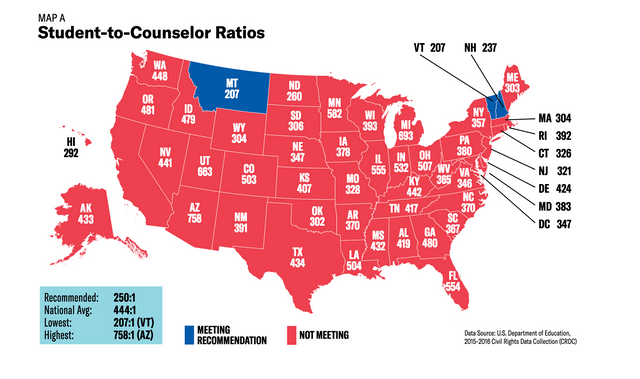
The ACLU found that over 90 percent of individual schools in the US do not meet the one to 250 counselor-to-student ratio recommended by professional standards and the US Public Health Service. On average, all of the schools in the country employ close to half of this number of counselors: one for every 444 students, with Arizona having the worst ratio in the country at one counselor for every 758 students. Only three states out of 50 meet the recommended ratio.


Student-to-counselor ratios


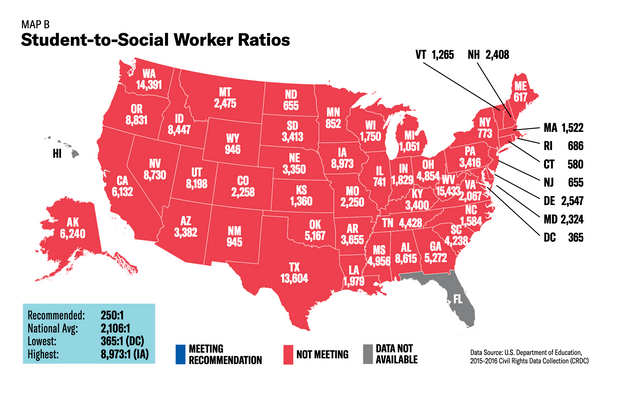
The report went on to note that there are 1.7 million students in the US who attend schools where there are police on campus but no counselors at all; 6 million students attend schools where police are present but not a single school psychologist is employed; and finally, 10 million students have police in their schools where not a single social worker is employed.

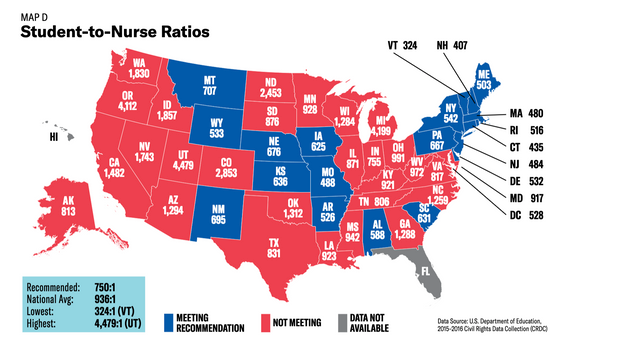
Many schools in the US do not have any nurses on campus. The nurse-to-student ratio recommended by professional standards is one nurse for every 750 students. Twenty-nine states do not meet this standard. Michigan and Oregon employ the fewest school nurses in the country. The ratios of students per nurse provided in the report for these two states are downright criminal: both are above 4,100 students per nurse. Three million children in the country attend schools where there are police officers on staff but not a single nurse.


Student-to-nurse ratios


These statistics are staggering. Even as they are being starved of much needed funds, working-class schools are being turned into armed camps replete with metal detectors, online video surveillance and even military equipment.

Examples can be found throughout the country.
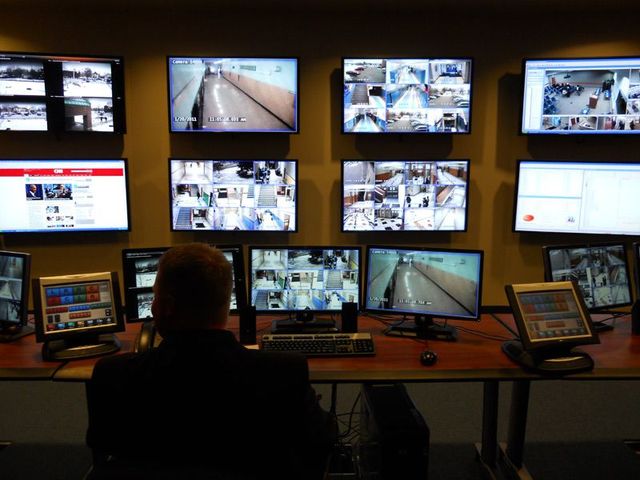
· The impoverished Detroit Public Schools spent $41.7 million on a district-wide security upgrade in 2011, creating a 23,000 square-foot Police Command Center and Headquarters for the school system.
· Just last week in Chicago at a mayoral forum, Democratic candidate and former president of the Chicago Police Board Lori Lightfoot suggested turning the city’s 38 recently shuttered schools into police-training sites.
· Capitalizing on last year’s horrific massacre at Stoneman Douglas High School in Parkland, the Florida state legislature recently passed bill allocating $58 million toward arming teachers throughout the state.


Detroit Public School Control and Command Center


While millions of dollars are easily found to militarize public schools, teachers and students are told by Republican and Democratic politicians alike that there is no money for much needed resources like nurses, counselors and other support staff. These conditions have compelled hundreds of thousands of teachers to go on strike, in a wave of teachers struggles across the US and internationally. In every case, teachers have made the demand for more support staff a central issue, and in every case the unions have facilitated the ramming through of concessionary contracts that do nothing to address the fundamental issues.

Most recently in Oakland, in a state dominated by the Democratic Party, the union rejected demands by rank-and-file teachers to include opposition to budget cuts in the strike demands, even though the district planned to pay for any pay increases by slashing millions of dollars from educational services and closing schools. The contract the union hailed as “historic” left untouched the staffing ratios for nurses in the district, which currently stand at one for every 1,350 students.


The effect of these dual processes, the chronic underfunding of education and the further militarization of schools, has devastating effects on students. The ACLU report notes that there is no research to substantiate the claim that having police present in schools has any positive effect on delinquent behavior and school safety. On the contrary, the report notes that "in many cases, [the presence of law enforcement staff in schools] causes harm. When in schools, police officers do what they are trained to do, which is detain, handcuff, and arrest. This leads to greater student alienation and a more threatening school climate."

The ACLU found that schools where police are always present have reported 3.5 times as many arrests per 10,000 students as schools without police.

To the extent that the American government invests in public schools, hiring additional police is promoted by the political establishment as a necessary response to increasingly frequent school shootings. However, filling school campuses with cops does nothing to address the underlying societal ills that are the root causes of violent and antisocial crimes committed in the first place.


Student-to-social worker ratios


Outbursts of mass violence, along with other causes of early death among teens such as drug overdoses and suicides, are bound up with the growth of social inequality and the miserable conditions under which the bulk of the working class is living. Since the economic recession of 2008 and the decline of full-time employment that followed as a result of the restructuring of many major industries under the Obama administration, economic uncertainties in working-class families have no doubt plagued millions of children in the last decade.

Children in the US today are growing up in a country that has been at war during the entirety of their lives; wars that have destroyed entire societies and whose victims are treated with callous indifference in the bourgeois media. These experiences sweep into social consciousness in innumerable ways.

In fact, the ACLU report cites a study by the Centers for Disease Control and Prevention which found that the suicide rate among children ages 10 to 17 increased by 70 percent between 2006 and 2016. Approximately 72 percent of children in the US will have experienced at least one major stressful event—such as witnessing violence, experiencing abuse, or experiencing the loss of a loved one—before the age of 18.

Under such conditions, the need for school nurses, psychologists, and counselors can quickly become life and death questions for students.

The authors of the report note the substantial amount of research done on the benefits of having health care professionals trained to work with children in schools: “School counselors, nurses, social workers, and psychologists are frequently the first to see children who are sick, stressed, or traumatized.” The report goes on to state that “schools with such services see improved attendance rates, better academic achievement, and higher graduation rates as well as lower rates of suspension, expulsion, and other disciplinary incidents.”

The data cited in the report shows that school-based mental health and special learning needs services, when made available, improve the overall safety of schools and promote student participation in interactive educational initiatives.

The resources to provide all of these services and much more exist in society. However, to secure a healthy and productive learning environment for teachers and students requires a frontal assault on the wealth of the ruling class and the social and economic system it defends, capitalism.

The defense of public education requires a fight for socialism, which above all means the establishment of a society based on social need, not private profit, in which the wealth produced by the working class is owned and controlled democratically, and in which every individual has the right to an education, a decent job, a livable income, health care, a healthy environment, and access to culture.


Median CEO pay in US tops $1 million a month


By Patrick Martin


18 March 2019


The median income for 132 CEOs of major US corporations jumped to $12.4 million in 2018, more than $1 million a month, according to an analysis published Sunday by the Wall Street Journal. The CEOs, representing about one-quarter of the S&P 500 firms for which figures have thus far been released, saw pay rises of about 6.4 percent apiece compared to 2017.

The CEO gains were driven by rising stock prices for the year, despite a sharp drop in December 2018, the worst December for the financial markets since the Great Depression. Assuming the pay rises for the remaining CEOs in the S&P 500 match those of the first group, 2018 would mark the third consecutive year of record CEO pay in the United States.

Among the biggest payouts were $66 million for Robert Iger, longtime CEO of Walt Disney Co., $44.7 million for Richard Handler, CEO of Jefferies Financial Group, and $42 million for Stephen MacMillan, CEO of medical equipment maker Hologic Inc. Patrick McHale of Minneapolis-based manufacturer Graco Corp. made $34.9 million in 2018.

Some CEOs outside the S&P 500 received even bigger windfalls, topped by the $125 million for Nikesh Arora, a former Google executive who became CEO of Palo Alto Networks, a cybersecurity company, only in June 2018.

Corporate criminals like the CEO of Boeing and the heads of the major banks suffered no consequences from the devastation that their actions have caused for their own workers and the population as a whole.

Boeing CEO Dennis Muilenburg received $23.4 million after a year that ended with the crash of a 737 Max jetliner operated by Lion Air of Indonesia, killing 189 people. Two weeks ago, a second crash of a 737 Max, this time in Ethiopia, killed 157 people and led to the worldwide grounding of all the 737 Max 8 and Max 9 jets made by the company. Boeing stock plunged 10 percent, wiping out $25 billion in stock market value.

Among bankers, Jamie Dimon of JPMorgan Chase topped the list with $31 million, while Brian Moynihan of Bank of America received $23 million. Along with Goldman Sachs, these banks played central roles in precipitating the 2008 Wall Street crash.

Wells Fargo CEO Tim Sloan saw a pay rise to $16.4 million, including his first-ever bonus, despite the company’s stock plunging 24 percent due to the scandal involving the creation of millions of false accounts for customers, leading to fines and regulatory penalties.

Ford President and CEO Jim Hackett received a 10 percent raise in 2018, raking in $17.75 million, while the company continues to slash jobs both in the United States and internationally. According to press reports, the Ford CEO received 276 times the median pay for all Ford employees. General Motors has yet to report the 2018 compensation for CEO Mary Barra, who made $21.9 million in 2017.

A study reported last month in the magazine Institutional Investor found that median CEO pay at major US corporations has soared over the past four decades—from $1.8 million in the 1980s to $4.1 million in the 1990s, reaching $9.2 million in the early 2000s.

Following a drop after the 2008 Wall Street crash, when CEO compensation was driven down by falling share prices, the combined compensation from pay, stock options and bonuses for corporate bosses has returned to the level that prevailed before the financial crisis. In contrast, most workers have seen no significant recovery.

CEO pay has risen nearly 72 percent since the low point in 2009 and is now just 3.3 percent below the record levels set in 2007, on the eve of the financial collapse. According to the study reported in Institutional Investor, CEO pay grew 17.6 percent between 2016 and 2017 alone, while average pay for workers rose by only 0.3 percent.

The ratio of CEO pay to the pay of the average worker has risen from 20-1 in 1965 to 30-1 in 1978, 58-1 in 1989, 112-1 in 1995 and a record 344-1 in 2000. After the dip following the 2008 crash, the CEO-to-worker pay ratio rose back to 312-1 in 2017.

One corporate CEO’s record pay package deserves particular attention: Daniel Loepp, CEO of Blue Cross Blue Shield of Michigan, the largest insurer in the state, covering the majority of autoworkers and other industrial workers, as well as auto retirees. Loepp has seen his annual compensation rocket from $1 million in 2006, when he became CEO, to $9 million in 2015, $13.4 million in 2017 and $19.2 million in 2018, including a staggering bonus of $16.2 million.

Loepp’s bonus was “only” $10.4 million in 2017, and the $5.8 million raise in his bonus was due to meeting “performance targets” set by the corporate board. These targets included slashing corporate expenses by $360 million over the past three years, through cuts in jobs and employee compensation. Loepp also pushed through a cut in the health care coverage for Blue Cross retirees, who had expected, having worked for a health care company, that their benefits would be secure.

Loepp is by far the best-paid chief executive officer of a company that is still nominally not-for-profit—but posted an “operating margin” last year of $605 million—and which, because of its longstanding relationship with the auto industry, the UAW and the AFL-CIO, has eight union executives on its board of directors.

These union officials approved the bonus and other compensation for Loepp and set the “targets” that Loepp had to meet, which were achieved by cutting the jobs and benefits of Blue Cross Blue Shield workers, many of them members of the UAW, as well as benefits for workers insured by the company, which is the principal health insurer for unionized workers across the state.

The Detroit Free Press contacted the eight union officials, including those from the UAW, Michigan Education Association, Michigan Building Trades Council, and Michigan AFL-CIO, to question them about the basis for Loepp’s whopping bonus and raise. Seven did not respond, while the Teamsters Union representative on the board of directors defended the $19.2 million payout.

William Black, executive director of Michigan Teamsters Joint Council 43, said in an email to the newspaper: “We at the board are sensitive to compensation issues, and we have emphasized that pay be tied to performance... His compensation is heavily weighted against company performance, as it should be. That performance has been very strong in recent years.”

This statement underscores the scurrilous and thoroughly corrupt role of the unions in supporting the profit system and the gouging of union members to enrich the capitalists and the corporate bosses. The union executives have far more in common with Loepp than with the workers they claim to represent. In institutions like the UAW Retiree Medical Benefits Trust, the union officials preside over multibillion-dollar corporate entities with salaries and bonuses that are modeled on those of the Loepps, Hacketts and Jamie Dimons.


Leaked Audio of Fox News Host's Blatant Racism


https://www.youtube.com/watch?v=fqLgiZXlXoo


Deadly flooding in the Midwest


https://www.youtube.com/watch?v=pLoNA4JU8QQ