Friday, February 15, 2019

Tuesday, February 12, 2019
Toxic masculinity can be heroic, and here are the women that prove it
In Greek mythology, Antigone
displayed all the traits we now freely criticise
Slavoj Žižek
When I try to explain to
students what “free associations” mean in the psychoanalytic treatment, I
regularly refer to the well-known saying: “Don’t throw the baby out with the
bath water!”
When a psychoanalyst asks a
patient to “freely associate”, i.e. to suspend control of the conscious ego and
say all that comes to mind, does that psychoanalyst not demand almost the exact
opposite?
The patient must throw out the
baby (the ego) and keep only the bath water of free associations. The idea is,
of course, that this “dirty water” will bring out the hidden truth of the sane
and healthy ego itself. Don’t forget that the dirt in the water comes from the
baby, not from outside!
Does the same not hold also
for many fake ecologists? They are obsessed by healthy “sustainable” dwellings
in clean green habitat, ignoring the dirty water that freely floats in the
polluted surroundings. If one wants to deal with pollution in a serious way,
the first thing to do is to focus on the dirty surroundings and to analyze how
our isolated “sustainable” habitats merely export the pollution to their
environs.
Perhaps, we should adopt the
opposite approach, along the lines of what they are doing in Japan: concentrate
as much pollution and population in big cities, so that they function as dirty
babies in (relatively) clean water.
Another example: the sheer
number of paedophiliac crimes that took
place in the Catholic church all around the world, from Ireland
and Pennsylvania to Australia. These are crimes committed by members of an
institution which propagates itself as the moral compass of our society, and
they compel us to reject the easy idea that the Church could simply throw out
the bad priests and keep the good.
There is an “institutional
unconscious”; an obscene, disavowed underside that sustains the public
institution. It is not simply for the sake of conformity that the church has
tried to hush up its pedophilia scandals; rather, in defending itself, the
church is defending its innermost obscene secret.
Perhaps the clearest example
was provided by the recent debate
on toxic masculinity. In the response to the recent Gillette ad about
making men less violent, and better, we often heard the idea that the ad was
not directed against men, just against the toxic excess of masculinity. In
short, the ad just signalled that we have to throw out the dirty bath water of
brutal masculinity.
But there are problems here.
Let’s take a closer look at the list (proposed by the American Psychological
Association) of features supposed to characterise “toxic masculinity”:
suppressing emotions and masking distress; unwillingness to seek help;
propensity to take risks even if this involves the danger of harming ourselves.
I don’t see what is so specifically “masculine” about this list.
Does this not fit much more a
simple act of courage in a difficult situation where, to do the right
thing, one has to suppress emotions, where one cannot rely on any help but take
the risk and act, even if this means exposing oneself to harm?
I know many women – as a
matter of fact, more women than men – who, in difficult predicaments, have not
succumbed to the pressure of their environment and instead set about acting in
just this way. To take the example from
Greek mythology: when Antigone decided to bury Polynices, did she not
commit exactly an act which fits the basic features of “toxic masculinity”?
She definitely suppressed her
emotions and masked her distress, she was unwilling to seek help, she took a
risk which involved great danger of harm to herself. In our age of politically
correct conformism, such a stance poses a danger.
We find traces of this
classical feminine figure of courage in today’s popular culture, notably in two
TV series, Homeland and The Killing.
The heroine of Homeland is Carrie
Mathison, a CIA officer with bipolar disorder involved in fighting terrorism.
Her strict sense of justice compels her to violate many rules and get in conflicts
with her superiors which even endanger her life. It’s similar with inspector
Sarah Lund, the heroine of the superb Danish series The Killing, another
borderline character who reacts violently to the hypocrisy of the establishment
and ends up being totally excommunicated. God give us as many of these
toxically-masculine women as possible in real life!
There is an delicious old
Soviet joke from the “Radio Yerevan”
genre: a listener asks “Is it true that Rabinovitch won a new car on
lottery?”, and the radio answers: “In principle yes, it’s true, only it wasn’t
a new car but an old bicycle, and he didn’t win it but it was stolen from him.”
Does exactly the same not hold
for toxic masculinity?
Let’s ask Radio Yerevan: “Is
masculinity really toxic?” We can guess the answer: “In principle yes, it’s
true, only this toxic content is not specifically masculine at all, plus it
stands for what is often the only reasonable and courageous way to act.”
Monday, February 11, 2019
Peter Jackson’s Cartoon War
When director-producer
Peter Jackson’s World War I film, “They Shall Not Grow Old,” which
miraculously transforms grainy, choppy black-and-white archival footage from
the war into a modern 3D color extravaganza, begins, he bombards us with the
clichés used to ennoble war. Veterans, over background music, say things like
“I wouldn’t have missed it,” “I would go through it all over again because I
enjoyed the service life” and “It made me a man.” It must have taken some
effort after the war to find the tiny minority of veterans willing to utter
this rubbish. Military life is a form of servitude, prolonged exposure to combat
leaves you broken, scarred for life by trauma and often so numb you have
difficulty connecting with others, and the last thing war does is make you a
man.
Far more common was the
experience of the actor Wilfrid Lawson, who was wounded in the war and as a
result had a metal plate in his skull. He drank heavily to dull the incessant
pain. In his memoirs “Inside Memory,” Timothy Findley, who acted with him,
recalled that Lawson “always went to bed sodden and all night long he would be
dragged from one nightmare to another—often yelling—more often screaming—very
often struggling physically to free himself of impeding bedclothes and
threatening shapes in the shadows.” He would pound the walls, shouting “Help!
Help! Help!” The
noise, my dear—and the people.
David Lloyd George, wartime
prime minister of Britain, in his memoirs used language like this to describe
the conflict:
… [I]nexhaustible vanity that
will never admit a mistake … individuals who would rather the million perish
than that they as leaders should own—even to themselves—that they were
blunderers … the notoriety attained by a narrow and stubborn egotism,
unsurpassed among the records of disaster wrought by human complacency … a bad
scheme badly handled … impossible orders issued by Generals who had no idea
what the execution of their commands really meant … this insane enterprise …
this muddy and muddle-headed venture. …
The British Imperial War
Museum, which was behind the Jackson film, had no interest in portraying the
dark reality of war. War may be savage, brutal and hard, but it is also,
according to the myth, ennobling, heroic and selfless. You can believe this drivel
only if you have never been in combat, which is what allows Jackson to
modernize a cartoon version of war.
The poet Siegfried Sassoon in
“The Hero” captured the callousness of war:
“Jack fell as he’d have
wished,” the Mother said,
And folded up the letter that she’d read.
“The Colonel writes so nicely.” Something broke
In the tired voice that quavered to a choke.
She half looked up. “We mothers are so proud
Of our dead soldiers.” Then her face was bowed.
And folded up the letter that she’d read.
“The Colonel writes so nicely.” Something broke
In the tired voice that quavered to a choke.
She half looked up. “We mothers are so proud
Of our dead soldiers.” Then her face was bowed.
Quietly the Brother Officer
went out.
He’d told the poor old dear some gallant lies
That she would nourish all her days, no doubt.
For while he coughed and mumbled, her weak eyes
Had shone with gentle triumph, brimmed with joy,
Because he’d been so brave, her glorious boy.
He’d told the poor old dear some gallant lies
That she would nourish all her days, no doubt.
For while he coughed and mumbled, her weak eyes
Had shone with gentle triumph, brimmed with joy,
Because he’d been so brave, her glorious boy.
He thought how “Jack,”
cold-footed, useless swine,
Had panicked down the trench that night the mine
Went up at Wicked Corner; how he’d tried
To get sent home; and how, at last, he died,
Blown to small bits. And no one seemed to care
Except that lonely woman with white hair.
Had panicked down the trench that night the mine
Went up at Wicked Corner; how he’d tried
To get sent home; and how, at last, he died,
Blown to small bits. And no one seemed to care
Except that lonely woman with white hair.
Our own generals and
politicians, who nearly two decades ago launched the greatest strategic blunder
in American history and have wasted nearly $6 trillion on conflicts in the
Middle East that we cannot win, are no less egotistical and incompetent. The
images of our wars are as carefully controlled and censored as the images from
World War I. While the futility and human carnage of our current conflicts are
rarely acknowledged in public, one might hope that we could confront the
suicidal idiocy of World War I a century later.
Leon Wolff, in his book “In
Flanders Fields: The 1917 Campaign,” writes of World War I:
It had meant nothing, solved
nothing, and proved nothing; and in so doing had killed 8,538,315 men and
variously wounded 21,219,452. Of 7,750,919 others taken prisoner or missing,
well over a million were later presumed dead; thus the total deaths (not
counting civilians) approach ten million. The moral and mental defects of the
leaders of the human race had been demonstrated with some exactitude. One of
them (Woodrow Wilson) later admitted that the war had been fought for business
interests; another (David Lloyd George) had told a newspaperman: ‘If people
really knew, the war would be stopped tomorrow, but of course they don’t—and
can’t know. The correspondents don’t write and the censorship wouldn’t pass the
truth.’
There is no mention in the
film of the colossal stupidity of the British general staff that sent hundreds
of thousands of working-class Englishmen—they are seen grinning into the camera
with their decayed teeth—in wave after wave, week after week, month after
month, into the mouths of German machine guns to be killed or wounded. There is
no serious exploration of the iron censorship that hid the realities of the war
from the public and saw the press become a shill for warmongers. There is no
investigation into how the war was used by the state, as it is today, as an
excuse to eradicate civil liberties. There is no look at the immense wealth
made by the arms manufacturers and contractors or how the war plunged Britain
deep into debt with war-related costs totaling 70 percent of the gross national
product. Yes, we see some pictures of gruesome wounds, digitalized into color,
yes, we hear how rats ate corpses, but the war in the film is carefully
choreographed, stripped of the deafening sounds, repugnant smells and most
importantly the crippling fear and terror that make a battlefield a stygian
nightmare. We glimpse dead bodies, but there are no long camera shots of the
slow agony of those dying of horrific wounds. Sanitized images like these are
war pornography. That they are no longer jerky and grainy and have been
colorized in 3D merely gives old war porn a modern sheen.
“When the war was not very
active, it was really rather fun to be in the front line,” a veteran says in
the film. “It was a sort of outdoor camp holiday with a slight spice of danger
to make it interesting.”
Insipid comments like that
defined the perception of the war at home. The clash between a civilian
population that saw the war as “a sort of outdoor camp holiday” and those who
experienced it led to profound estrangement. The poet Charles Sorley wrote: “I
should like so much to kill whoever was primarily responsible for the war.” And
journalist and author Philip Gibbs noted that soldiers had a deep hatred of
civilians who believed the lies. “They hated the smiling women in the streets.
They loathed the old men. … They desired that profiteers should die by
poison-gas. They prayed to God to get the Germans to send Zeppelins to
England—to make the people know what war meant.”
Military studies have
determined that after 60 days of continuous combat, 98 percent of those who
survive will have become psychiatric casualties. The common trait among the 2
percent who were able to endure sustained combat was a predisposition toward
“aggressive psychopathic personalities.” Lt. Col. David Grossman wrote: “It is
not too far from the mark to observe that there is something about continuous,
inescapable combat which will drive 98 percent of all men insane, and the other
2 percent were crazy when they got there.”
The military cliques in
American society are as omnipotent as they were in World War I. The symbols of
war and militarism, then and now, have a quasi-religious aura, especially in
our failed democracy. Our incompetent generals—such as David Petraeus, whose
surges only prolonged the Iraq War and raised the casualty figures and whose
idea to arm “moderate” rebels in Syria was a debacle—are as lionized as the
pig-headed and vainglorious Gen. Douglas Haig, the British commander in chief,
who resisted innovations such as the tank, the airplane and the machine gun,
which he called “a much overrated weapon.” He believed the cavalry would play
the decisive role in winning the war. Haig, in the Battle of the Somme, oversaw
60,000 casualties on the first day of the offensive, July 1, 1916. None of his
military objectives were achieved. Twenty thousand lay dead between the lines.
The wounded cried out for days. This did not dampen Haig’s ardor to sacrifice
his soldiers. Determined to make his plan of bursting through the German lines
and unleashing his three divisions of cavalry on the fleeing enemy, he kept the
waves of assaults going for four months until winter forced him to cease. By
the time Haig was done, the army had suffered more than 400,000 casualties and
accomplished nothing. Lt. Col. E.T.F. Sandys, who saw 500 of his soldiers
killed or wounded on the first day at the Somme, wrote two months later, “I
have never had a moment’s peace since July 1st.” He then shot himself to death
in a London hotel room. Joe Sacco’s illustrated book “The
Great War,” a 24-foot-long wordless panorama that depicts the first day of
the Battle of Somme, reveals more truth about the horror of war than Jackson’s
elaborate restoration of old film.
The military historian B.H.
Liddell Hart, who served in the war, wrote in his diary:
He [Haig] was a man of supreme
egoism and utter lack of scruple—who, to his overweening ambition, sacrificed
hundreds of thousands of men. A man who betrayed even his most devoted
assistants as well as the Government which he served. A man who gained his ends
by trickery of a kind that was not merely immoral but criminal.
The American attorney Harold
Shapiro, following World War I, examined the medical records of the Army on
behalf of a disabled veteran. He was appalled at the reality these records
elucidated and the misperception of the war within the public. The medical
descriptions, he wrote, rendered “all that I had read and heard previously as
being either fiction, isolated reminiscence, vague generalization or deliberate
propaganda.” He published a book in 1937 titled “What Every Young Man Should
Know About War.” It was pulled from circulation when the United States entered
World War II and never reissued. It was the model for my book “What
Every Person Should Know About War.”
Shapiro wrote in his chapter
“Mental Reactions”:
Q: What may happen to me after
I bayonet my enemy in the face?
You may develop an hysterical
tic—quick, sudden, convulsive spasms of twitching of your own facial muscles.
Q: What may happen to me after
I bayonet my enemy in the abdomen?
You may be seized with
abdominal contractions.
Q: What may happen to me
following particularly horrible sights?
You may be seized with
hysterical blindness.
Q: What may happen to me if I
find the cries of the wounded unbearable?
You may develop hysterical
deafness.
Q: What may happen to me
should I be detailed to burial parties?
You may develop anosmia (loss
of your sense of smell).
The German pacifist Ernst
Friedrich collected 200 photographs of gruesome wounds, piles of corpses in
mass graves, the hanging and executions of deserters—their families were told
they had “died of wounds”—and battlefield atrocities censored from the public
in his 1924 book, “WAR
Against WAR!” He juxtaposed the images against the propaganda that
romanticized the conflict. His 24 close-ups of soldiers with grotesquely
disfiguring facial wounds remain difficult to view. Friedrich was arrested
when the Nazis came to power in 1933, his book was banned and his Anti-War
Museum closed. A picture of a nearly naked soldier dead in a trench in his book
reads: “Mothers! This was the fate of your sons in the war; first murdered,
then robbed to the skin and then left as grub for animals.”
Honestly examining past wars
gives us the ability to understand current wars. But this is a herculean
struggle. The public is fed, and yearns for, the myth. It is empowering and
ennobling. It celebrates supposed national virtues and military prowess. It
allows an alienated population to feel part of a national collective engaged in
a noble crusade. The celebration of the destructive force of our weaponry makes
us feel personally empowered. All wars, past and present, are effectively
shrouded in this myth. Those who decried the waste and carnage, such as Keir
Hardie, the head of the Independent Labour Party, were jeered in the streets.
Adam Hochschild’s book “To End All Wars”
details the struggle by pacifists and a handful of journalists and dissidents
during the war to make the truth known and who were mocked, silenced and often
jailed.
“Few of us can hold on to our
real selves long enough to discover the momentous truths about ourselves and
this whirling earth to which we cling,” wrote J. Glenn Gary, a combat veteran
of World War II, in “The Warriors: Reflections on Men in Battle.” “This is
especially true of men in war. The great god Mars tries to blind us when we
enter his realm, and when we leave he gives us a generous cup of the waters
of Lethe to drink.”
Jackson closes the film with
an army ditty about prostitution. “You might forget the gas and shell,” the
song goes, “but you’ll nev’r forget the Mademoiselle! Hinky-dinky, parlez-vous?”
Tens of thousands of girls and
women, whose brothers, fathers, sons and husbands were dead or crippled, and
whose homes often had been destroyed, became impoverished and often homeless.
They were easy prey for the brothels, including the military-run brothels, and
the pimps that serviced
the soldiers. There is nothing amusing or cute about lying on a straw mat
and being raped by as many as 60 men a day, unless you are the rapist.
“Give sorrow words,” William
Shakespeare reminded us, “The grief that does not speak whispers the
o’erfraught heart and bids it break.”
It is fortunate all the
participants in the war are dead. They would find the film another example of
the monstrous lie that denied their reality, ignored or minimized their
suffering and never held the militarists, careerists, profiteers and imbeciles
who prosecuted the war accountable. War is the raison d’être of technological
society. It unleashes demons. And those who profit from these demons, then and
now, work hard to keep them hidden.
Neoliberalism, A History of How the SuperRich Stole Democracy, Doug Henwood
Today, Doug Henwood, acclaimed editor of Left Business observer, and the host of Behind the News joins us to discuss the inception of Neoliberalism and how it was a reaction against Social Democracy.
We start off discussing the difference between American Neoliberalism vs European Neoliberalism, followed by the notorious Montpelerin Conference. We finally look at how Neoliberalism infiltrated our institutions and eroded our Democracy.
Study Shows Richest 0.00025% Owns More Wealth Than Bottom 150 Million Americans
"U.S. wealth
concentration seems to have returned to levels last seen during the Roaring
Twenties."
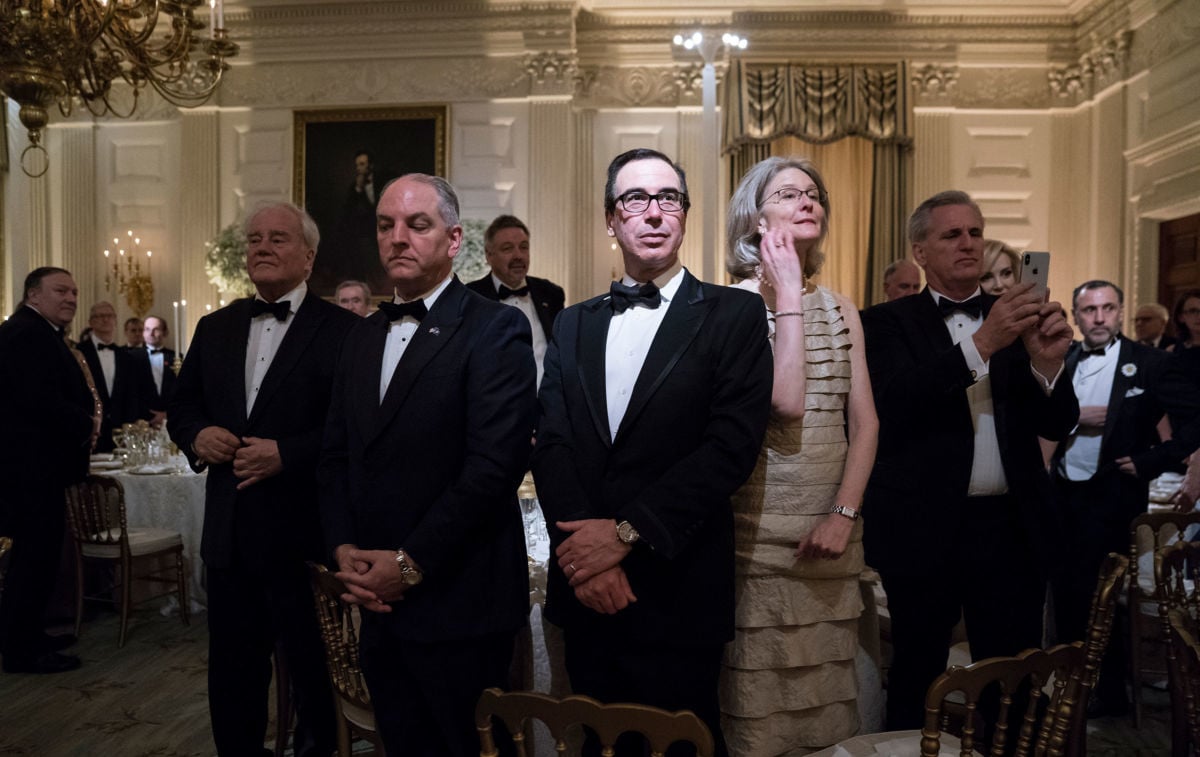
Treasury Secretary Steve Mnuchin stands with others during
a state dinner at the White House on Tuesday, April 24, 2018, in Washington,
DC. Many 2020 presidential candidates are pushing taxation on the rich to
reduce the US's staggering inequality.
As survey data continues to
show that raising taxes on the wealthy is extremely
popular among the U.S. public, new research by inequality expert and
University of California, Berkeley economist Gabriel Zucman found that the
richest 0.00025 percent of the American population now owns more wealth than
the 150 million adults in the bottom 60 percent.
Zucman, who helped Sen.
Elizabeth Warren (D-Mass.) develop her
"Ultra-Millionaire Tax" proposal, observed in a working paper (pdf)
that "U.S. wealth concentration seems to have returned to levels last seen
during the Roaring Twenties."
According to Zucman's
research, the richest 0.00025 percent—just 400 Americans—have seen their share
of America's national wealth triple since the 1980s, while the wealth of much
of the U.S. population has stagnated or declined.
As the Washington Post's
Christopher Ingraham noted in
a breakdown of Zucman's research, adults in the bottom 60 percent of the wealth
distribution "saw their share of the nation's wealth fall from 5.7 percent
in 1987 to 2.1 percent in 2014."
Consolidation of wealth at the
very top, Ingraham observes, "is eroding security from families in the
lower and middle classes, who rely on their small stores of wealth to finance
their retirement and to smooth over economic shocks like the loss of a job. And
it's consolidating power in the hands of the nation’s billionaires, who are
increasingly using their riches to purchase political influence."
Zucman's research comes as
members of Congress and 2020 presidential candidates are pushing a variety of
plans to begin reducing America's staggering wealth and income inequality by
raising taxes on those at the very top.
Sen. Elizabeth Warren
(D-Mass.), who officially
launched her 2020 presidential campaign on Saturday, has proposed an
annual tax of two percent on assets over $50 million.
Last month, Sen. Bernie
Sanders (I-Vt.)—who is reportedly close
to announcing his 2020 candidacy—introduced the
For the 99.8% Act, which would establish a 77 percent tax on all estates over
$1 billion.
And Rep. Alexandria
Ocasio-Cortez (D-N.Y.) has
suggested imposing a top marginal tax rate of 70 percent on those who
make over $10 million.
Pointing to polling
data showing that 76 percent of Americans believe the rich should pay
more in taxes, Indivisible's Chad Bolt concluded: "Raising taxes on the
wealthy isn't just good policy. It's also good politics."
Sunday, February 10, 2019
$2 Trillion lost to corruption could educate every child in the world
https://www.youtube.com/watch?v=9tu4VTfZats
Subscribe to:
Posts (Atom)