Thursday, October 18, 2018
Žižek. Capitalism and its Threats. 2018
https://www.youtube.com/watch?v=OwvpLG89lwg&feature=em-uploademail

Saturday, October 13, 2018
Tragic deaths inspire a Bosnian miracle
https://www.rt.com/op-ed/440974-zizek-bosnia-balkan-croatia/
The violent deaths of two
young men have united Bosnians, crossing rigid ethnic lines. Could something
finally be stirring in the divided Balkan country?
When we think of miracles and
Bosnia, the first association that pops up is the appearance of the Virgin Mary
a couple of decades ago in Medjugorje – an event that brought millions of
pilgrims to the area.
However, a week ago, a much
greater and more important miracle took place in Banja Luka, the capital of the
Serb part of Bosnia ("Republika Srpska"), and then also in other
Bosnian cities across the ethnic divide.
The miracle is not the
elections which took place this Sunday. As usual, Bosnian elections (with all
the accompanying irregularities) were marked by apathy and indifference, and
just confirmed the tripartite division of the state along ethnic lines.
Today, the Serb part is more
and more acting as a sovereign state, while in the Muslim Sarajevo,
Islamization progresses, evidenced by how it's more and more difficult to get a
beer in a restaurant or bar, among other things.
Meanwhile, a specific form of
the much-publicized PPP (public-private partnership) is flourishing in all of
Bosnia: local political elites intertwined with half-legal private businesses,
their rule legitimized as protectors of ethnic entities (Bosnians, Serbs etc.)
against the "enemy." In such a situation where poverty is everywhere
and young people are migrating to Western Europe in search of jobs, nationalism
thrives and defense of ethnic identity easily prevails over economic
issues.
Lessons from past
The problem facing Bosnia is
best exemplified by what took place a couple of years ago in Croatia. There,
two public protest gatherings were announced: trade unions called for a protest
against exploding unemployment and poverty (felt very much by ordinary people).
At the same time, rightist nationalists announced a gathering in order to
protest the re-introduction of the official status of Cyrillic writing in
Vukovar (because of the Serb minority there).
Of course, at the first
gathering, a couple of hundred people came, and to the second gathering, over
100,000 people came. Poverty was experienced as a daily life problem much more
than the Cyrillic threat by ordinary people, but nonetheless trade unions
failed to mobilize the masses.
Wise commentators like to
evoke such stories to cynically mock leftist claims that our goal should be to
defeat local nationalism and to bring about a transnational coalition of those
who are manipulated and exploited by the ruling ethnic elites. They patiently
explain how, especially in an area like the Balkans, "irrational"
ethnic hatred runs all too deep to be overcome by "rational" economic
concerns – meaning the transnational coalition of the exploited is a miracle
that will never happen.
Well, suddenly this miracle is
happening now. And it makes Medjugorje pale by comparison.
Human toll
David Dragicevic, a young
Serb-Bosnian hacker, disappeared in the night from March 17 to March 18 this
year, and his body was found in the vicinity of Banja Luka on March 24; it was
clear from his heavily disfigured body that he was killed by protracted brutal
torture.
From March 26, daily protests
have taken place in the main square of Banja Luka, organized by his father
Davor under the title "Justice for David." Police first declared
David's death a suicide, and only after strong public pressure began to
investigate it as a case of murder, but with no results yet.
Eventually, it became clear
that David had discovered traces of corruption and other criminal activities of
the ruling clique. So he had to disappear.
A week ago, the continuous
protests erupted into a large mass gathering, with tens of thousands
participating, and dozens of buses bringing people from all of Republika Srpska
into Banja Luka. The ruling clique reacted with panic: thousands of policemen
controlled the streets and blocked entry to the city.
Now comes the true miracle.
Unexpectedly, in a wonderful display of trans-ethnic solidarity, similar gatherings
took place in other Bosnian cities where Muslims are a majority. In Sarajevo,
the capital of Bosnia, hundreds demanded justice for a similar case that
happened in their midst: the death of Dzenan Memic, who disappeared in the
night of February 8 to February 9, 2016, which was never seriously
investigated, although his body was also disfigured by traces of torture.
Alone together
Protesters in Banja Luka,
Sarajevo, and other Bosnian cities exchanged messages and emphasized their
solidarity across ethnic divides, since they all share the same fate of being
controlled by corrupted PPP elites.
So, finally, they became fully
aware that the true threat does not come from other ethnic groups but from the
corruption in their own group, and that they can get rid of this malignant
tumor only by acting together. And then the impossible and
"unimaginable" (for cynical realists) happened.
Of course, one should not
expect too much from such explosions. A similar trans-ethnic movement against
economic poverty already took place a couple of years ago, in an echo of the
Arab Spring, and gradually dwindled.
However, the fire continues to
burn beneath the surface, and this fire is the only beacon of hope in Bosnia.
In this, it reconfirms the truth of Abraham Lincoln's old saying: You can
deceive some people all the time, you can deceive all the people for some time,
but you cannot deceive all the people all the time.
Slavoj Žižek is a cultural
philosopher. He’s a senior researcher at the Institute for Sociology and
Philosophy at the University of Ljubljana, Global Distinguished Professor of
German at New York University, and international director of the Birkbeck Institute
for the Humanities of the University of London.
Friday, October 12, 2018
Data Snapshot: Contingent Faculty in US Higher Ed
AAUP’s Data Show Weakening
Protections for Academic Freedom
Over the past few decades, the
tenure system in US higher education has eroded. At its best, the tenure system
is a big tent, designed to unite a diverse faculty within a system of common
professional values, standards, rights, and responsibilities. Tenure protects
academic freedom by insulating faculty from the whims and biases of
administrators, legislators, and donors, and provides the security that enables
faculty to speak truth to power and contribute to the common good through
teaching, research, and service activities.
The AAUP research department
has taken a look at the data around tenure and the casualization of faculty
labor. We looked at at overall trends and broke out data regarding full-time
contingent faculty and part-time and graduate-student instructors. Using data
drawn from the Integrated Postsecondary Education Data System (IPEDS), our
findings highlight the current status of the academic labor system in US higher
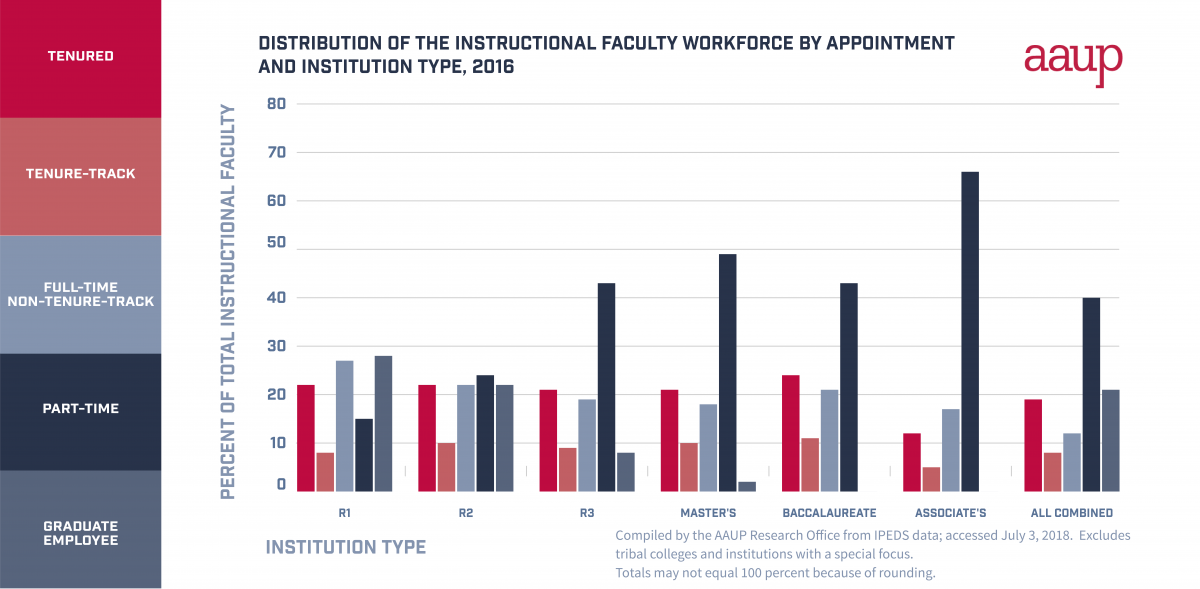
education. At all US institutions combined, the percentage of instructional positions
that is off the tenure track amounted to 73 percent in 2016, the latest year
for which data are available. The highest percentage of contingent faculty
appears at two-year institutions, where tenure-track positions make up less
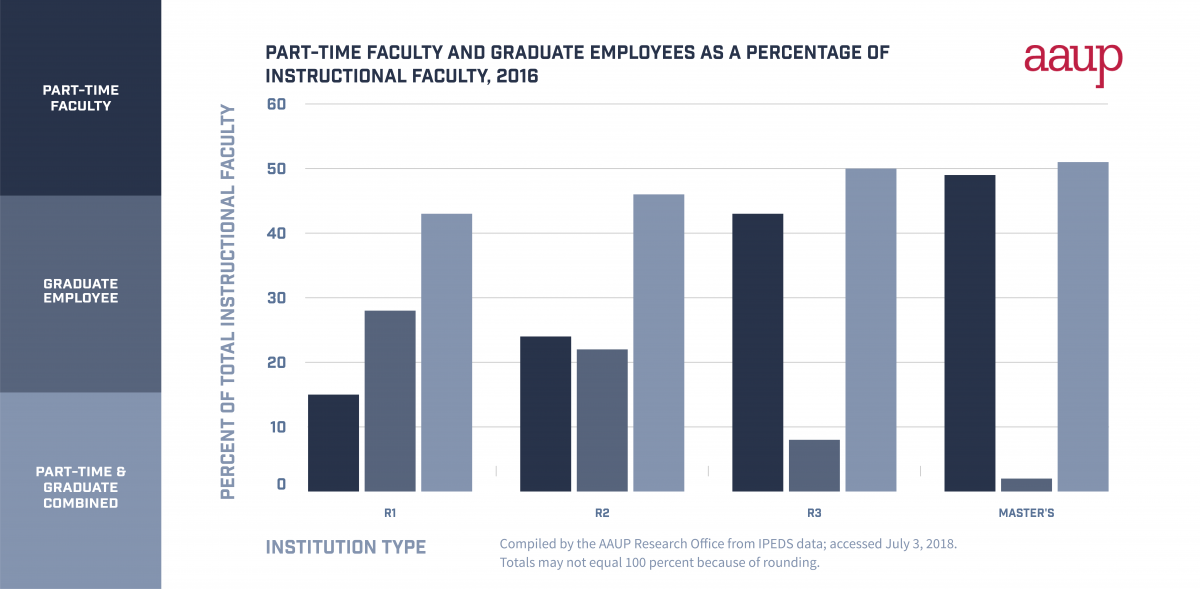
than 20 percent of faculty positions. While a little less than 50 percent of
faculty positions at master’s and baccalaureate institutions are part-time,
more than 65 percent of positions at two-year institutions are. Part-time
teaching positions tend to be the least secure and worst remunerated teaching
positions in higher education, with low per-course pay and few benefits. For
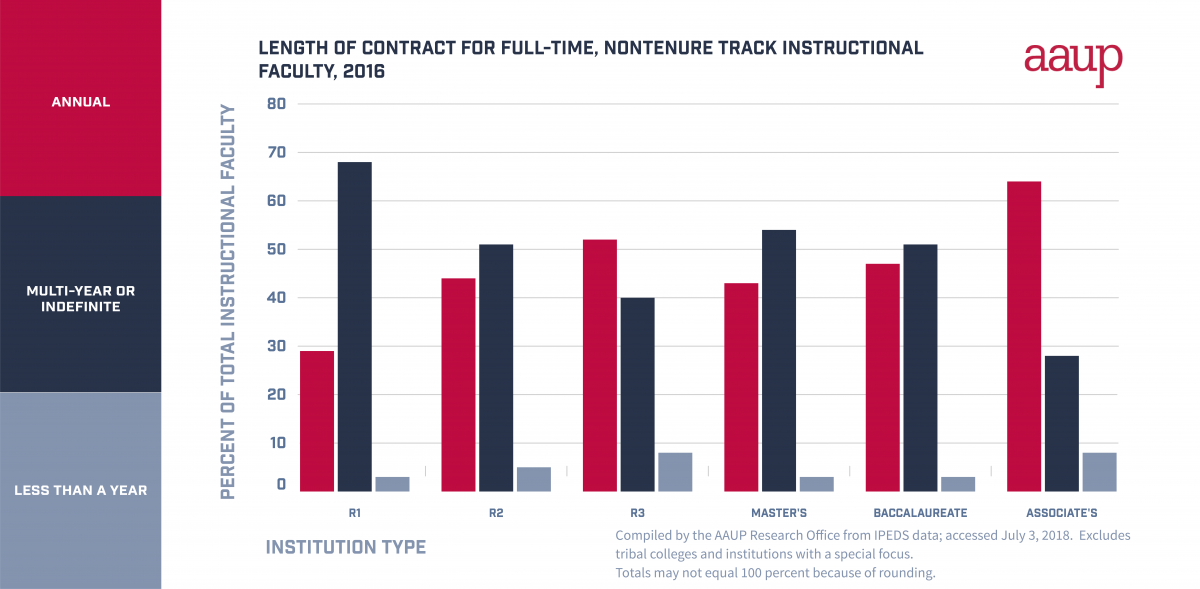
the most part, both full-and part-time non-tenure-track faculty roles are
insecure, unsupported positions with little job security and inadequate due
process protections.
Since the principal purpose of
tenure is to safeguard academic freedom, the trend toward an increasingly
contingent faculty is deeply worrisome. Free inquiry, free expression, and open
dissent are critical for student learning and the advancement of knowledge.
When faculty members can lose their positions because of their speech or
research findings, they cannot properly fulfill their core responsibilities to
advance and transmit knowledge.
Thursday, October 11, 2018
Sen. Bernie Sanders Speech at Johns Hopkins University - October 9, 2018
https://www.youtube.com/watch?v=kOlbYyJWiGE
Wednesday, October 10, 2018
FCC Approves Ajit Pai’s $2 Billion Giveaway to Wireless Carriers
https://www.youtube.com/watch?v=P8gbB5SCmS4
Tuesday, October 9, 2018
Future of Western Democracy Being Played Out in Brazil
October 9, 2018
By Pepe Escobar
in Paris
in Paris
Special to Consortium News
Nothing less than the future
of politics across the West – and across the Global South – is being played out
in Brazil.
Stripped to its essence, the
Brazilian presidential elections represent a direct clash between democracy and
an early 21st Century, neofascism, indeed between civilization and
barbarism.
Geopolitical and global
economic reverberations will be immense. The Brazilian dilemma illuminates all
the contradictions surrounding the Right populist offensive across the West,
juxtaposed to the inexorable collapse of the Left. The stakes could not be
higher.
Jair Bolsonaro, an outright
supporter of Brazilian military dictatorships of last century, who has been
normalized as the “extreme-right candidate,” won the first round of the
presidential elections on Sunday with more than 49 million votes. That was 46
percent of the total, just shy of a majority needed for an outright win. This
in itself is a jaw-dropping development.
His opponent, Fernando Haddad
of the Workers’ Party (PT), got only 31 million votes, or 29 percent of the
total. He will now face Bolsonaro in a runoff on October 28. A Sisyphean
task awaits Haddad: just to reach parity with Bolsonaro, he needs every single
vote from those who supported the third and fourth-placed candidates, plus a substantial
share of the almost 20 percent of votes considered null and void.
Meanwhile, no less than 69
percent of Brazilians, according to the latest polls, profess their support for
democracy. That means 31 percent do not.
No Tropical Trump
Dystopia Central does not even
begin to qualify it. Progressive Brazilians are terrified of facing a mutant
“Brazil” (the movie) cum Mad Max wasteland ravaged by evangelical fanatics,
rapacious neoliberal casino capitalists and a rabid military bent on recreating
a Dictatorship 2.0.
Bolsonaro, a former
paratrooper, is being depicted by Western mainstream media essentially as the
Tropical Trump. The facts are way more complex.
Bolsonaro, a mediocre member
of Congress for 27 years with no highlights on his C.V., indiscriminately
demonizes blacks, the LGBT community, the Left as a whole, the environment
“scam” and most of all, the poor. He’s avowedly pro-torture. He markets
himself as a Messiah – a fatalistic avatar coming to “save” Brazil from all
those “sins” above.
The Goddess of the Market,
predictably, embraces him. “Investors” – those semi-divine entities – deem him
good for “the market”, with his last-minute offensive in the polls mirroring a rally in
the Brazilian real and the Sao Paulo stock exchange.
Bolsonaro may be your classic
extreme-right “savior” in the Nazi mould. He may embody Right populism to the
core. But he’s definitely not a “sovereignist” – the motto of choice in
political debate across the West. His “sovereign” Brazil would be run more like
a retro-military dictatorship totally subordinated to Washington’s whims.
Bolsonaro’s ticket is
compounded by a barely literate, retired general as his running mate, a man who
is ashamed of his mixed race background and is frankly pro-eugenics.General
Antonio Hamilton Mourão has even revived the
idea of a military coup.
Manipulating the ticket, we
find massive economic interests, tied to mineral wealth, agro-business and most
of the all the Brazilian Bible Belt. It is complete with death squads against
Native Brazilians, landless peasants and African-American communities. It is a
haven for the weapons industry. Call it the apotheosis of tropical
neo-pentecostal, Christian-Zionism.
Praise the Lord
Brazil has 42 million
evangelicals – and over 200 representatives in both branches of Parliament.
Don’t mess with theirjihad. They know how to exercise massive appeal among the
beggars at the neoliberal banquet. The Lula Left
simply didn’t know how to seduce them.
So even with echoes of Mike
Pence, Bolsonaro is the Brazilian Trump only to a certain extent: his
communication skills – talking tough, simplistically, is language
understandable to a seven-year old. Educated Italians compare him to Matteo
Salvini, the Lega leader, now Minister of Interior. But that’s also not exactly
the case.
Bolsonaro is a symptom of a
much larger disease. He has only reached this level, a head-to-head in the
second round against Lula’s candidate Haddad, because of a sophisticated,
rolling, multi-stage, judicial/congressional/business/media Hybrid War
unleashed on Brazil.
Way more complex than any
color revolution, Hybrid War in Brazil featured a law-fare coup under cover of
the Car Wash
anti-corruption investigation. That led to the impeachment of President Dilma
Rousseff and Lula being thrown in jail on corruption charges with no hard
evidence or smoking gun.
In every poll Lula would win
these elections hand down. The coup plotters managed to imprison him and prevent
him from running. Lula’s right to run was highlighted by everyone from Pope
Francis to the UN’s Human Rights Council, as well as Noam Chomsky. Yet in a
delightful historical twist, the coup plotters’ scenario blew up in their faces
as the front-runner to lead the country is not one of them, but a neofascist.
“One of them” would ideally be
a faceless bureaucrat affiliated with the former social democrats, the PSDB,
turned hardcore neoliberals addicted to posing as Center Left when they are the
“acceptable” face of the neoliberal Right. Call them Brazilian Tony Blairs.
Specific Brazilian contradictions, plus the advance of Right populism across
the West, led to their downfall.
Even Wall Street and the City
of London (which endorsed Hybrid War on Brazil after it was unleashed by NSA
spying of oil giant Petrobras) have started entertaining second
thoughts on supporting Bolsonaro for president of a BRICS nation, which is a
leader of the Global South, and until a few years ago, was on its way to
becoming the fifth largest economy in the world.
It all hangs on the “vote
transfer” mechanism from Lula to Haddad and the creation of a serious,
multi-party Progressive Democratic Front on the second round to defeat the
rising neofascism. They have less than three weeks to pull it off.
The Bannon Effect
It’s no secret that Steve
Bannon is advising the Bolsonaro campaign in Brazil. One of Bolsonaro’s sons,
Eduardo, met with Bannon in New York two months ago after which the Bolsonaro
camp decided to profit from Bannon’s supposed “peerless” social engineering
insights.
Bolsonaro’s son tweeted at the
time, “We’re certainly in touch to join forces, especially against Cultural
Marxism.” That was followed by an army of bots disgorging an avalanche of fake
news up to Election Day.
A specter haunts Europe. Its
name is Steve Bannon. The specter has moved on to the tropics.
In Europe, Bannon is now
poised to intervene like an angel of doom in a Tintoretto painting heralding
the creation of a EU-wide Right Populist coalition.
Bannon is notoriously praised
to high heavens by Italian Interior Minister Salvini; Hungarian Prime Minister
Viktor Orban; Dutch nationalist Geert Wilders; and scourge of the Paris
establishment, Marine Le Pen.
Last month, Bannon set up The
Movement; at first sight just a political start-up in Brussels with a very
small staff. But talk about Boundless Ambition: their aim is no less than
turning the European parliamentary elections in May 2019 upside down.
The European parliament in
Strasbourg – a bastion of bureaucratic inefficiency – is not exactly a
household name across the EU. The parliament is barred from proposing
legislation. Laws and budgets can only be blocked via a majority vote.
Bannon aims at capturing at
least one-third of the seats in Strasbourg. He’s bound to apply tested
American-style methods such as intensive polling, data analysis, and intensive
social media campaigns – much the same as in Bolsonaro’s case. But there’s no
guarantee it will work, of course.
The foundation stone of The
Movement was arguably laid in two key meetings in early September set up by
Bannon and his right-hand man, Mischael Modrikamen, chairman of the quite small
Belgian Parti Populaire (PP). The first meeting was in Rome with Salvini and
the second in Belgrade with Orban.
Modrikamen defines the concept
as a “club” which will “collect funds from donors, in America
and Europe, to make sure ‘populist’ ideas can be heard by the
citizens of Europe who perceive more and more that Europe is not a
democracy anymore.”
Modrikamen insists, “We
are all sovereignists.” The Movement will hammer four themes that seem to form
a consensus among disparate, EU-wide political parties:
against “uncontrolled immigration”; against “Islamism”; favoring
“security” across the EU; and supporting “a Europe of sovereign nations,
proud of their identity.”
The Movement should really
pick up speed after next month’s midterms in the U.S. In theory, it could
congregate different parties from the same nation under its umbrella. That
could be a very tall order, even taller than the fact key political actors already
have divergent agendas.
Wilders wants to blow up the
EU. Salvini and Orban want a weak EU but they don’t want to get rid of its
institutions. Le Pen wants a EU reform followed by a “Frexit” referendum.
The only themes that unite
this mixed Right Populism bag are nationalism, a fuzzy anti-establishment drive
and a – quite popular – disgust with the EU’s overwhelming bureaucratic
machine.
Here we find some common
ground with Bolsonaro, who poses as a nationalist and as against the Brazilian
political system – even though he’s been in Parliament for ages.
There’s no rational
explanation for Bolsonaro’s last-minute surge among two sections of the
Brazilian electorate that deeply despise him: women and the Northeast region,
which has always been discriminated against by the wealthier South and
Southeast.
Much like Cambridge Analytica
in the 2016 U.S. election, Bolsonaro’s campaign targeted undecided voters in
Northeastern states, as well as women voters, with a barrage of fake news
demonizing Haddad and the Workers’ Party. It worked like a charm.
The Italian Job
I’ve just been to northern
Italy checking out how popular Salvini really is. Salvini defines the May 2019
European Parliament elections as “the last chance for Europe.” Italian Foreign
Minister Enzo Moavero sees them as the first “real election for the future of
Europe.” Bannon also sees the future of Europe being played in Italy.
It’s quite something to seize
the conflicting energy in the air in Milan, where Salvini’s Lega is quite
popular while at the same time Milan is a globalized city crammed with ultra-progressive
pockets.
At a political debate about a
book published by the Bruno Leoni Institute regarding exiting the euro, Roberto
Maroni, a former governor of the powerful Lombardia region, remarked: “Italexit
is outside of the formal agenda of the government, of the Lega and of the
center-right.” Maroni should know, after all he was one of the Lega’s founders.
He hinted however that major
changes are on the horizon. “To form a group in the European parliament, the
numbers are important. This is the moment to show up with a unique symbol among
parties of many nations.”
It’s not only Bannon and The
Movement’s Modrikamen. Salvini, Le Pen and Orban are convinced they can win the
2019 elections – with the EU transformed into a “Union of European Nations.”
This would include not just a couple of big cities where all the action is,
with the rest reduced to fly over status. Right Populism argues that France,
Italy, Spain, and Greece are no longer nations – only mere provinces.
Right Populism derives immense
satisfaction that its main enemy is the self-described “Jupiter” Macron –
mocked across France by some as the “Little Sun King.” President Emmanuel
Macron must be terrified that Salvini is emerging as the “leading light” of European
nationalists.
This is what Europe seems to
be coming to: a trashy, Salvini vs. Macron cage match.
Arguably the Salvini vs.
Macron fight in Europe might be replicated as Bolsonaro vs. Haddad in Brazil.
Some sharp Brazilian minds are convinced Haddad is the Brazilian Macron.
In my view he is not. His has
a background in philosophy and he’s a former, competent mayor of Sao Paulo, one
of the most complex megalopolises on the planet. Macron is a Rothschild mergers
and acquisitions banker. Unlike Macron, who was engineered by the French
establishment as the perfect “progressive” wolf to be released among the sheep,
Haddad embodies what’s left of really progressive Left.
On top of that – unlike
virtually the whole Brazilian political spectrum – Haddad is not corrupt. He’d
have to offer the requisite pound of flesh to the usual suspects if he wins of
course. But he’s not out to be their puppet.
Compare Bolsonaro’s Trumpism,
apparent in his last-minute message before Election Day: “Make Brazil Great
Again,” with Trump’s Trumpism.
Bolsonaro’s tools are
unmitigated praise of the Motherland; the Armed Forces; and the flag.
But Bolsonaro is not
interested in defending Brazilian industry, jobs and culture. On the contrary.
A graphic example is what happened in a Brazilian restaurant in Deerfield
Beach, Florida, a year ago: Bolsonaro saluted the American flag and chanted
“USA! USA!”
That’s undiluted MAGA –
without a “B”.
Jason Stanley, professor of
philosophy at Yale and author of How Fascism Works, takes us further. Stanley
stresses how “the idea in fascism is to destroy economic politics… The
corporatists side with politicians who use fascist tactics because they are trying
to divert people’s attention from the real forces that cause the genuine
anxiety they feel.”
Bolsonaro has mastered these
diversionist tactics. And he excels in demonizing so-called Cultural Marxism.
Bolsonaro fits Stanley’s description as applied to the U.S.:
“Liberalism and Cultural
Marxism destroyed our supremacy and destroyed this wonderful past where we
ruled and our cultural traditions were the ones that dominated. And then it
militarizes the feeling of nostalgia. All the anxiety and loss that people feel
in their lives, say from the loss of their healthcare, the loss of their
pensions, the loss of their stability, then gets rerouted into a sense that the
real enemy is liberalism, which led to the loss of this mythic past.”
In the Brazilian case, the
enemy is not liberalism but the Workers’ Party, derided by Bolsonaro as “a
bunch of communists.” Celebrating his astonishing first round victory, he said
Brazil was on the edge of a corrupt, communist “abyss” and could either choose
a path of “prosperity, freedom, family” or “the path of Venezuela”.
The Car Wash investigation
enshrined the myth that the Workers’ Party and the whole Left is corrupt (but
not the Right). Bolsonaro overextended the myth: every minority and
social class is a target – in his mind they are “communists” and “terrorists.”
Goebbels comes to mind – via
his crucial text The Radicalization of Socialism, where he emphasized
the necessity of portraying the center-left as Marxists and socialists because,
as Stanley notes, “the middle class sees in Marxism not so much the
subverter of national will, but mainly the thief of its property.”
That’s at the center of
Bolsonaro’s strategy of demonizing the Workers Party – and the Left in general.
The strategy of course is drenched in fake news – once again mirroring what
Stanley writes about U.S. history: “The whole concept of empire is based on
fake news. All of colonization is based on fake news.”
Right Against Left Populism?
As I wrote in a previous
column, the Left in the West is like a deer caught in the headlights
when it comes to fighting Right populism.
Sharp minds from Slavoj Zizek
to Chantal Mouffe are trying to conceptualize an alternative – without being
able to coin the definitive neologism. Left populism? Popularism? Ideally, that
should be “democratic socialism” – but no one, in a post-ideology, post-truth
environment, would dare utter the dreaded word.
The ascent of Right populism
is a direct consequence of the emergence of a profound crisis of political
representation all over the West; the politics of identity erected as a new
mantra; and the overwhelming power of social media, which allows – in Umberto
Eco’s peerless definition – the ascent of “the idiot of the village to the
condition of Oracle.”
As we saw earlier, the central
motto of Right populism in Europe is anti-immigration – a barely disguised
variation of hate towards The Other. In Brazil the main theme, emphasized by
Bolsonaro, is urban insecurity. He could be the Brazilian Rodrigo Duterte – or
Duterte Harry: “Make my day, punk.”
He portrays himself as the
Righteous Defender against a corrupt elite (even though he’s part of the
elite); and his hatred of all things politically correct, feminism,
homosexuality, multiculturalism – are all unpardonable offenses to his “family
values.”
A Brazilian
historian says the only way to oppose him is to “translate” to each
sector of Brazilian society how Bolsonaro’s positions affect them: on
“widespread weaponizing, discrimination, jobs, (and) taxes.” And it has to be
done in less than three weeks.
Arguably the best book
explaining the failure of the Left everywhere to deal with this toxic situation
is Jean-Claude Michea’s Le
Loup dans la Bergerie – The Wolf Among the Sheep – published in France
a few days ago.
Michea shows concisely how the
deep contradictions of liberalism since the 18th century – political, economic
and cultural – led it to TURN AGAINST ITSELF and be cut off from the initial
spirit of tolerance (Adam Smith, David Hume, Montesquieu). That’s why we are
deep inside post-democratic capitalism.
Euphemistically called “the
international community” by Western mainstream media, the elites, who have been
confronted since 2008 with “the growing difficulties faced by the process of
globalized accumulation of capital,” now seem ready to do anything to
keep its privileges.
Michea is right that the most
dangerous enemy of civilization – and even Life on Earth – is the blind
dynamics of endless accumulation of capital. We know where this neoliberal
Brave New World is taking us.
The only counterpunch is an
autonomous, popular movement “that would not be submitted to the ideological
and cultural hegemony of ‘progressive’ movements that for over three decades
defend only the cultural interests of the new middle classes around
the world,” Michae says.
For now, such a movement rests
in the realm of Utopia. What’s left is to try to remedy a coming dystopia –
such as backing a real Progressive Democratic Front to block a Bolsonaro
Brazil.
One of the highlights of my
Italian sojourn was a meeting with Rolf Petri, Professor of Contemporary
History at the Ca Foscari University in Venice, and author of the absolutely
essential A
Short History of Western Ideology: A Critical Account.
Ranging from religion, race
and colonialism, to the Enlightenment project of “civilization”, Petri weaves a
devastating tapestry of how “the imagined geography of a ‘continent’ that was
not even a continent offered a platform for the affirmation of European
superiority and the civilizing mission of Europe.”
During a long dinner in a
small Venetian trattoria away from the galloping selfie hordes, Petri observed
how Salvini – a middle-class small entrepreneur – craftily found out how to
channel a deep unconscious longing for a mythical harmonious Europe that won’t
be coming back, much as petty bourgeois Bolsonaro evokes a mythical return to
the “Brazilian miracle” during the 1964-1985 military dictatorship.
Every sentient being knows
that the U.S. has been plunged into extreme inequality “supervised” by a ruthless
plutocracy. U.S. workers will continue to be royally screwed as are French
workers under “liberal” Macron. So would Brazilian workers under Bolsonaro. To
borrow then from Yeats, what rough beast, in this darkest hour, slouches
towards freedom to be born?
Pepe Escobar, a veteran
Brazilian journalist, is the correspondent-at-large for Hong Kong-based Asia Times. His latest book is 2030. Follow
him on Facebook.
Subscribe to:
Posts (Atom)