Saturday, July 21, 2018

Trump, The Koch Brothers and Their War on Climate Science


https://vimeo.com/233769175


TRNN SPECIAL: Trump, The Koch Brothers and Their War on Climate Science from The Real News Network on Vimeo.


DANNY GLOVER: 2016 was the hottest year on record, topping a decade of increasingly warm years. Powerful storms, heat waves, rising sea levels, melting glaciers, declining ice caps, and droughts stalk the planet.

MICHAEL MANN: There’s anywhere from 97% to 99% consensus among the world’s scientists studying this problem, that climate change is real and human caused.

DONALD TRUMP: The office of President of the United States.

DANNY GLOVER: Yet how did a climate change denier get elected President of the United States?

CHARLIE CRAY: Trump’s win has created a fossil fuel field day.

DANNY GLOVER: Donald Trump has claimed that climate change is an expensive hoax. This summer, he announced the United States was pulling out of the Paris Climate Accord.

DONALD TRUMP: The bottom line is that the Paris Accord is very unfair at the highest level to the United States.

DANNY GLOVER: Even before that dramatic move, Trump had already signed an executive order rolling back former president Barack Obama’s climate regulations.

DONALD TRUMP: It reverses the previous administration’s Arctic leasing ban.

DANNY GLOVER: Trump wants to see a revitalization of the coal industry.

DONALD TRUMP: Over the past two years, I’ve spent time with the miners all over America.

DANNY GLOVER: He plans to scrap NASA’s climate research program and has approved the Keystone XL Pipeline, which would route oil from Alberta’s tar sands to the Gulf of Mexico.

DONALD TRUMP: When completed the Keystone XL Pipeline will span 900 miles. Wow.

DANNY GLOVER: He’s also set out to gut the Environmental Protection Agency.

DONALD TRUMP: First of all, I want to congratulate Scott Pruitt, who’s here someplace. Where is Scott?

DANNY GLOVER: Appointing the climate change denier Scott Pruitt to run it.

KENNETH VOGEL: Pruitt has been a skeptic, is the term that they like to use, of climate change.

SCOTT PRUITT: Human activity on the climate is something very challenging to do and there’s tremendous disagreement about the degree of impact, so no, I would not agree that it’s a primary contributor to the global warming that we see.

DANNY GLOVER: The fact that climate change deniers now inhabit the most powerful positions in the world’s most powerful government is no accident. Or that most Americans don’t perceive that global warming causes a catastrophic threat. This is largely the handiwork of two brothers, David and Charles Koch.

KENNETH VOGEL: The Kochs are going to have a lot more influence in any Republican administration.

DANNY GLOVER: Ken Vogel is an investigative reporter in Washington, DC. He has followed the Koch brothers for years.

KENNETH VOGEL: They’re thrilled that Donald Trump won and Hillary Clinton lost, but I think they’re even surprised by how much ability they have to shape the Trump administration.

CHARLIE CRAY: For the most part, this is going to be incredibly beneficial for the Kochs and the best major of that so far is how many people are working for the Trump administration who were, over their careers, supported by the Kochs.

DANNY GLOVER: Just who are the Koch brothers?

CHARLIE CRAY: The Koch brothers are two of the wealthiest individuals in the United States.

DANNY GLOVER: David and Charles Koch own Koch Industries, a $100 billion conglomerate based in Kansas that refines, transports, and sells oil. The company is also into chemicals, minerals, paper products, and commodities trading, employing 100,000 people in more than 60 countries. And it controls one to two million acres of Alberta’s tar sands, the third largest reserve of oil in the world.

MIKE CASEY: The Kochs are a vertically-integrated fossil fuel conglomerate and they have a vertically-integrated influence-peddling apparatus to go with it.

DANNY GLOVER: Indeed, the Kochs are more than just about selling oil. One of the goals of the Koch political network is to get Republicans elected to office, and the occasional Democrat.

KERT DAVIES: They have a vast network now, a political network that rivals the other parties. They’re bigger than the Republican party and the Democratic party, in their organizing might.

NEWS REPORT: Senator Ron Johnson will beat back a challenge from Democrat Russ Feingold, in a …

DANNY GLOVER: During last November’s election, the Kochs spent hundreds of millions of dollars on key Congressional and Senate seats.

NEWS REPORT: Republicans from all across the country are going to be marching to your door to figure out how you came from, what, a 10-point deficit …

DANNY GLOVER: Which was likely critical for the Republicans retaining control of both chambers of Congress.

ROB PORTMAN: You know, we won because of the work we did for the people of Ohio.

KENNETH VOGEL: Even as the Kochs were not a major factor in their direct spending on the presidential race, the infrastructure that they set up around the country did have an impact on getting voters, getting their type of voters, out to the polls, and that probably did have an impact on not only the Senate race, but also even in the presidential race.

CHARLIE CRAY: They supported and focused on about eight Senate campaigns, and I believe, seven of the eight that they supported won. Most of these were fairly critical Senate seats.

NEWS REPORT: This monster of a storm system is the remnants of a powerful Pacific typhoon.

DANNY GLOVER: While Trump and the Republicans, with the encouragement of the Koch brothers, are rolling back climate change measures, global temperatures keep climbing.

NEWS REPORT: Australia’s record-breaking heat wave is continuing to fuel outbreaks of wildfires across scores of thousands of hectares in the southeast of the country.

MIKE CASEY: The worst predictions keep coming true, so you’re looking at an unprecedented drought in the west, you’re looking at extreme weather all over the place.

NEWS REPORT: The water level at Oradell reservoir is nearly immeasurable.

DANNY GLOVER: Four years ago, carbon dioxide passed 400 parts per million in the atmosphere, the highest level in more than four million years. Scientists now forecast temperatures will rise 2.5 to 10 degrees Fahrenheit over the next century.

MIKE CASEY: The science around global climate disruption is 97%.

DANNY GLOVER: While NASA predicts this will mean more severe weather and impact on communities worldwide, the US Republican-controlled Congress and Senate refuse to take action, voting down the McCain-Lieberman climate change bills and refusing to vote on the Paris Agreement.

CHARLIE CRAY: United States Congress is the single biggest obstacle to the global resolution of climate change.

DANNY GLOVER: The U.S. Congress and Senate’s inaction on climate change was by design.

MICHAEL MANN: That gulf between scientific opinion and public opinion has been bought with hundreds of millions of dollars of special interest money.

MIKE PENCE: In the mainstream media, Chris, there is denial of the growing skepticism in the scientific community about global warming.

DANNY GLOVER: The campaign to sow doubt about climate change and prevent meaningful action began decades ago, particularly as the science became more certain.

CHRIS MATTHEWS: If your party wants to be credible with science, you gotta accept science, do you? Accept science.

MIKE PENCE: I always wanted to play in “Inherit the Wind”.

DANNY GLOVER: In 1988, NASA climatologist James Hansen testified in front of Congress.

JAMES HANSEN: The greenhouse effect has been detected, and it is changing our climate now.

DANNY GLOVER: Climatologists like Michael Mann at Penn State University discovered that temperatures had risen by 1.4 degrees Fahrenheit since the late 1800s. Two-thirds of that warming has occurred since 1975.

MICHAEL MANN: The observations were showing that there was a prominent warming trend in the data that was outside of what we would expect from natural climate variability.

DANNY GLOVER: Yet, long before climate scientists began raising alarm about global warming in the 1980s and ‘90s, scientists who worked with the oil industry had realized years earlier that burning fossil fuels would cause climate change.

KATHY MULVEY: From what we understand the oil industry was aware of climate impacts and climate science decades ago. Exxon Mobil in particular was actually conducting cutting-edge climate science research decades ago.

DANNY GLOVER: Exxon scientists warned the company this warming was caused by burning fossil fuels and that the consequences would be catastrophic.
But Exxon, along with other oil companies, hid this information from the public.

KATHY MULVEY: The oil industry embarked on a campaign of deception and disinformation.

NAOMI ORESKES: The whole strategy is about creating doubt, making the public, making politicians, making political leaders feel that we don’t really know for sure whether or not this is a problem.

DANNY GLOVER: Harvard University science historian Naomi Oreskes studies how the oil industry creates doubt about climate change.

NAOMI ORESKES: So, if you can create doubt in people’s minds, you can delay action. So that’s what this is all about.

ALIYA HAQ: During the ‘90s and the 2000s, Exxon Mobil and a number of oil companies were well-known for funding climate denial activities.

DANNY GLOVER: The oil industry uses the same methods and even the very same public relations firms that tobacco companies employed to spread doubt about the dangers of smoking.

NAOMI ORESKES: We do know that some of the key people who began challenging climate science, who began denying climate science in the late 1980’s had previously worked for the tobacco industry.
We know that they began to use the same strategies and tactics, often the same arguments, the same vocabulary.

DANNY GLOVER: The driving force behind spreading doubt was the American Petroleum Institute. API is the lobbying arm of the oil industry. In 1998, API wrote an internal memo that said: “Victory will be achieved when average citizens understand uncertainties in climate science.”

JANE MAYER: The industry at large spent something like over a half-billion dollars, sort of disseminating doubt and basically trying to confuse people in the United States.

DANNY GLOVER: High effort companies like Exxon eventually stopped financing climate denial groups, because of pressure from the environmental organizations.

KERT DAVIES: Exxon had to back off and in about 2005, ’06, and ’07, they stopped funding the very groups that they had been sending millions to in the years prior, and they dropped them like a hot potato. In the meantime, the Koch money came in.

DANNY GLOVER: The Koch brothers quickly filled the void with even harsher methods.

GREENPEACE VIDEO: Perhaps their greatest achievement is helping convince the world that global warming doesn’t exist.

DANNY GLOVER: Greenpeace soon dubbed the brothers’ apparatus the “Climate Change Denial Machine”.

KERT DAVIES: It’s a network of corporations and think tanks, front groups.

MIKE CASEY: They are arguably the biggest sugar daddies of the fossil fuel front groups that have gotten tremendous traction.

DANNY GLOVER: Charles Koch has said that, “Even if the planet is warming, it would not have catastrophic consequences”, and argues climate scientists’ models for future warming are faulty.

ALIYA HAQ: The Koch brothers have spent, at this point, $80 million on climate denial front groups. That money has been focused at both the federal and state level.

DANNY GLOVER: The Koch brothers politics were shaped by their father, Fred Koch, a chemical engineer who grew up in Texas, and seems to have had few scruples. Back in the 1930s, Fred invented a new kind of technology to refine oil.

JANE MAYER: He had a hard time getting work in the U.S., and so he tried to find work elsewhere in the world and ended up selling his process to very unlikely sources.

DANNY GLOVER: Jane Mayer is an investigative reporter for the New Yorker magazine in Washington, DC, and author of “Dark Money,” a bestselling book about the Koch brothers.

JANE MAYER: Quite ironically, given that Fred Koch became one of America’s most right-wing anti-communists, he made the beginning of his fortune by setting up oil refineries for Josef Stalin.

DANNY GLOVER: Another early customer for Fred’s technology were the Nazis in Germany, after 1933.

JANE MAYER: He ended up building a refinery for Adolf Hitler that had to be greenlighted specifically for Hitler after he became Chancellor in Germany. It became very important during World War II.

DANNY GLOVER: Fred eventually set up Koch Industries in Kansas, invested in oil refineries. He had four sons. Two of them, Charles and David, eventually took over running his company.

JANE MAYER: Charles Koch has always been the dominant brother in the family. He’s domineering, he’s smart, and he’s ruthless. His younger brother, David, has been more good-natured and going along with him.

DANNY GLOVER: But the brothers also embraced their father’s distaste for government regulation.

KERT DAVIES: They don’t like the government, and they want the government to be smaller and disabled. That would help their business a lot, if there was fewer regulations.

DANNY GLOVER: Still, by the 1990’s, the brothers realized they needed clout in Washington.

JANE MAYER: Koch Industries is becoming a huge company. It’s a fossil fuel company with a horrendous record for environmental violations, and it runs smack into the new regulations that are being imposed by the Environmental Protection Agency beginning in the ‘80s.

DANNY GLOVER: The Kochs wanted to change those laws.

NEWS REPORT: The 1996 presidential campaign-

DANNY GLOVER: To do that, they set their sights on influencing the Republican party.

JANE MAYER: It’s 1996. David Koch at this point goes from trashing conventional politicians to becoming the Vice Chair of Bob Dole’s presidential bid on the Republican Party ticket.
Archive Footage: You’ll get a better feel of who Bob Dole is and what he’s all about.

NAOMI ORESKES: It was a big fight within the Republican party at that time about whether or not Republicans should accept the reality of climate change and look to market base solutions to fix it, or whether they should deny it. One of the things that we know is that there was tremendous lobbying and advertising from the fossil fuel industry on the denial side.

DANNY GLOVER: At the very time of that internal debate, the Kochs built a network of at least 17 think tanks and front groups to influence the entire political system. Often referred to as “the Kochtopus”.

CHARLIE CRAY: The Kochs have created a multi-dimensional political apparatus to create a tectonic shift in American politics.

ROBERT MAGUIRE: The single most important thing to understand about the Koch network today is that it is unparalleled in its complexity.

DANNY GLOVER: Today the Kochs fund a wide range of organizations, from the National Rifle Association, the Cato Institute, Heritage Fund, US Chamber of Commerce, DonorsTrust, and the American Legislative Exchange Council, but its most powerful weapon is an organization called Americans for Prosperity.

JANE MAYER: Americans for Prosperity is now the primary political front group that the Kochs founded and fund. It’s just become a guerrilla army that is almost like a third party in the United States now.

DANNY GLOVER: Housed in this office tower in Arlington, Virginia, just across the river from Washington, DC, Americans for Prosperity strikes fear into the hearts of politicians.

KERT DAVIES: When Obama was elected, they emerged as the key force in driving the Tea Party. They grabbed it and they corporitized it.

DANNY GLOVER: And appears on Fox News regularly.

FOX NEWS REPORT: What we’re gonna have if this climate change legislation passes, this cap and trade, are gas prices through the roof today.

DANNY GLOVER: Today, the Kochs’ political apparatus spends hundreds of millions of dollars during elections.

MARCO RUBIO: Thank you very much. Thank you.

DANNY GLOVER: And puts out tens of thousands of TV advertisements to get their chosen Republicans elected.

POLITICAL AD: Kay Hagan, taking care of Washington insiders.

ROBERT MAGUIRE: The largest purpose of that money was to change control of Congress. To change control of the presidency. To elect Republicans.

DANNY GLOVER: All told, Koch money has gone to more than half of all Senators and nearly 40% of all Congressmen. While it’s still not known exactly the total they spent in the 2016 election, it’s estimated to have been more than half a billion dollars.

KENNETH VOGEL: When the Kochs estimate how much they’re going to spend, it’s always sort of a dicey proposition because they end up raising and spending a lot more money than they say is for just overt partisan politics, and they say, “This is for issue-based advocacy.”

DANNY GLOVER: Either way, it’s a huge increase from the 40 million dollars Americans for Prosperity spent in 2010 to help Republicans win control of Congress during the mid-terms.

ROBERT MAGUIRE: In 2012, it had $400 million, which was well above anything it had had prior to that.

DANNY GLOVER: And in 2014, they spent $290 million to help the Republicans win control of the Senate.

POLITICAL AD: You have sold West Virginia out. Families are suffering.

ROBERT MAGUIRE: We know that Americans for Prosperity, just to name one group, had run 33,000 ads in tight Senate races around the country.

DANNY GLOVER: The Kochs also hold conclaves twice a year, inviting fellow billionaires and hitting them up for cash.

JANE MAYER: That club grew from just a few members in 2003 to now 400-450 of the richest, most conservative businessmen and women in America, and it’s attracted all kinds of important dignitaries, too.

DANNY GLOVER: Including Supreme Court justices and Republican stars like Ted Cruz, Paul Ryan, Mitch McConnell, Marco Rubio.

MIKE PENCE: This is a great day for energy independence.

DANNY GLOVER: And Mike Pence, the current Vice President.

ROBERT MAGUIRE: So, as a major donor, you get to spend a weekend chatting with the person who’s going to be making policy that could drastically affect your bottom line.

DANNY GLOVER: One of the key purposes of this political apparatus is to ensure that no legislation is passed to curb the burning of fossil fuels.

CHARLIE CRAY: The Kochs have gotten over 170 members of the House to take a pledge that they will never support any legislation that places a tax on carbon.

KERT DAVIES: So they screwed up the entire House of Representatives for years.

DANNY GLOVER: The Kochs’ influence on the Republicans on climate change is powerful.

NAOMI ORESKES: We had period where a number of important Republican leaders again, were coming to the fore, saying this was real.

DANNY GLOVER: By 2008, leading figures in the party, such as Mitt Romney, Senator John McCain, and Republican House Leader Newt Gingrich were calling for action on global warming. Gingrich even appeared in this ad with Speaker of the House Nancy Pelosi, calling for steps to be taken.

NANCY PELOSI: We don’t always see eye to eye, do we Newt?

NEWT GINGRICH: No, but we do agree, our country must take action to address climate change.

NAOMI ORESKES: And then there was tremendous pushback from the Americans for Prosperity, which as many people know, is the Koch brothers-funded political movement.

DANNY GLOVER: Indeed, in 2011, Gingrich renounced the ad.

NEWT GINGRICH: First of all, it’s probably the dumbest single thing I’ve done.

KERT DAVIES: I think they saw that as a bigger threat than Al Gore or Bill Clinton or anything on the left.

ALIYA HAQ: And unfortunately, you saw a number of Republicans that once supported climate action, suddenly rushing that back.

DANNY GLOVER: And Republicans who refused to toe the line, such as Bob Inglis, a conservative Congressman from South Carolina, pay a heavy price. Inglis had become convinced that climate change was real.

JANE MAYER: So when the evidence was in front of his own eyes, he changed his point of view and he started speaking out about climate change.

DANNY GLOVER: In 2010, when Inglis was running again for Congress, Americans for Prosperity swung into action to win the primary.

KERT DAVIES: And he lost badly, to a very under-qualified candidate who the Koch machine brought in. So, he was then hung up in the public square as an icon of what happens when a Republican turns good on climate change.

DANNY GLOVER: Another one of those icons, for example, was climate scientist Michael Mann at Penn State University, authored the famous ‘Hockey Stick Curve’ that visibly showed how humans had impacted climate change going back centuries. In 2005, Mann was attacked by a member of Congress.

MICHAEL MANN: Joe Barton decided to use his authority as the Chair of the House Energy and Commerce Committee to hold hearings, to subpoena my personal records, all of my personal emails.

DANNY GLOVER: Yet Greenpeace soon revealed that Barton, a Republican Congressman, received money from the Kochs’ political action committee.

MICHAEL MANN: And they attempted to smear me in op-eds and conservative-leaning newspapers.

DANNY GLOVER: While the Kochs were attacking legitimate climate scientists, they were funding scientists who denied global warming was caused by burning fossil fuels.

WEI-HOCK SOON: And I’ve been receiving money from whoever that wants to give me money.

NAOMI ORESKES: One of the key strategies is to recruit either scientists or people who pretend to be scientists. Sometimes they are actually scientists but rarely scientists in the particular field.

DANNY GLOVER: One example is Wei-Hock Soon, at the Harvard Center for Astrophysics. He believes that climate change is caused by variations in the sun, and not CO2, and that more carbon in the atmosphere is good for growing plants.

KERT DAVIES: We sent a Freedom of Information Act request in to the Smithsonian and we requested who was funding him, and eventually after years of discussion, got back a list of his grants.

SPEAKER: Who is funding your grants, just in your …

DANNY GLOVER: In total, Soon received $1.2 million from the oil industry, a large portion of which have come from the Koch brothers.

NAOMI ORESKES: In the correspondence between him and the industry, he speaks specifically about deliverables, about particular products, particular papers, making particular arguments that the fossil fuel industry wants.

DANNY GLOVER: And yet Soon has no training as a climate scientist. His background is aerospace engineering.

SPEAKER: Dr. Soon has already talked about those issues on the stage today and in the past.

NAOMI ORESKES: When he was asked, he says, “Well, these are my authentic beliefs, I’m not being paid to say anything I don’t believe,” and that may well be true. The point is though that he is a complete outlier science. He has views that are shared by almost no one in the scientific community.

REPORTER: Mr. Koch. Excuse me, Mr. Koch, I have a question.

KOCH BROTHER: Come on, get to it.

REPORTER: You’re wanted for climate crimes.

DANNY GLOVER: The Kochs’ funding of climate denial has not always gone smoothly. Physicist Dr. Richard Muller of the University of California Berkeley, was a global warming skeptic who the Kochs backed. But in 2012, Muller produced a study that concluded global warming was caused by carbon dioxide.

RICHARD MULLER: I was flabbergasted. Not only was global warming real, and roughly consistent with what the previous groups had said, but the match to carbon dioxide … and the fact that solar variability was not responsible.

DANNY GLOVER: All of this activity to generate doubt is effective. According to a Yale survey, 70% of Americans believe global warming is real, but only 53% of those people think it’s caused by human activity. Just 16% think climate change is something to be very worried about.

NAOMI ORESKES: I think we have very, very strong evidence in this case to support the conclusion that these campaigns have been highly impactful. So, until quite recently, many Americans have thought that the science was unsettled, even though scientists will tell you that it’s been settled for 20 years. So why would they think that?

DANNY GLOVER: As a result, politicians are not taking action, and that includes Democrats. Even when the Democrats control both Houses of Congress, they did little to address the crisis.

NAOMI ORESKES: Most Republicans in Congress, and even some Democrats, are very, very afraid to try to do something about climate, for fear that they will be targeted by fossil fuel interests, and that they could lose their seats.

DONALD TRUMP: America will start winning again. Winning like never before.

DANNY GLOVER: The election of Donald Trump means fighting climate change in the United States has become more difficult than ever. After all, David Koch attended Trump’s election victory party. But most significantly, one-third of Trump’s transition team was made up of people who were linked to the Koch brothers’ vast political network.

KENNETH VOGEL: Some of the folks who had a pivotal role in Trump’s campaign, his transition, and now his presidency, who have Koch network ties include Donald Trump’s very first campaign manager, Corey Lewandowski, his vice president Mike Pence, his Legislative Affairs Director Marc Short, his Secretary of Education Betsy DeVos, Scott Pruitt, the EPA administrator, all the way down to Andrew Bremberg, the Domestic Policy Director who worked at Freedom Partners, actually putting together the executive orders that the Koch network would like a theoretical Republican president to sign.

DANNY GLOVER: Other important Koch-linked Trump officials include his former Chief of Staff Reince Priebus, Trump’s campaign manager and current advisor Kellyanne Conway, Attorney General Jeff Sessions, and the head of the CIA, Mike Pompeo.

SCOTT PRUITT: I believe that we as an agency, and we as a nation, can be both pro-energy and jobs, and pro-environment.

DANNY GLOVER: And already Trump and its new head, Scott Pruitt, want to cut the EPA budget by as much as 30%. Pruitt played a key role in persuading Trump to pull out of the Paris Accord.

SCOTT PRUITT: You have corrected a view that was paramount in Paris, that somehow the United States should penalize its own economy, be apologetic, lead with our chin, while the rest of the world does little.

KENNETH VOGEL: The Kochs see Scott Pruitt as someone who is going to strip away some of the climate regulations that they see as limiting job growth, and it should be said, limiting their own company’s ability to do some of the things that it wants to do.

DANNY GLOVER: And even if Donald Trump is removed from office before his term ends, waiting in the wings to replace him is Vice President Mike Pence, a strong champion of the Koch brothers’ interests.

ALIYA HAQ: This is not the way our democracy should be working. Incredibly powerful, rich people who spend this kind of money should be held accountable.

MICHAEL MANN: They have polluted our public discourse, they have skewed media coverage of the science of climate change, they have paid off politicians.

ALIYA HAQ: Considering what this means for our health, for our kids’ futures, for our planet, it is unconscionable that the Koch brothers are denying climate change and fueling this kind of anti-climate activity.

NEWS REPORT: The situation in Antarctica offers cause for concern as well.

DANNY GLOVER: Scientists now fear if action is not taken to drastically cut greenhouse emissions soon, global warming will run out of control, with major extinctions around the globe, large coastal cities such as New York and Tokyo underwater, and wars and conflict due to mass migration of people becoming the norm.

MICHAEL MANN: The number of lives that will be lost because of the damaging impacts of climate change, in the hundreds of millions. To me, it’s not just a crime against humanity, it’s a crime against the planet.

DANNY GLOVER: In October 2016, seven of the world’s top climate scientists warned the planet is on track to sail past the two degrees Celsius threshold for dangerous global warming by 2050. Even if all the countries that signed the Paris Accords fulfill their pledge, that model was created before a climate crisis denier was elected President of the United States.


Sunday, July 15, 2018

Turning Power into Money, the End of the Soviet Union – RAI with A. Buzgalin (4/12)


https://www.youtube.com/watch?v=BmVKq57O9Qc


Story Transcript


https://therealnews.com/stories/turning-power-into-money-the-end-of-the-soviet-union-rai-with-a-buzgalin-4-12


PAUL JAY: Welcome back to Reality Asserts Itself on The Real News Network. I’m Paul Jay and we’re continuing our discussion with Professor Buzgalin. Thanks for joining us again. Alexander Buzgalin is Professor of Political Economy and Director of the Center for Modern Marxist Studies at Moscow State University. So, in the last segment you said you did join the Communist Party in 1988. Gorbachev becomes leader in ‘85, so what was it about Gorbachev and perestroika, what did that period represent, and why is it a time to join the Party?


ALEXANDER BUZGALIN: Well, it was a very contradictory and very interesting period. We had transformation. And the slogan of the 1980s, late 1980s, was very beautiful. More democracy, more socialism. More humanism, more transformation towards a new society. Acceleration of development. Key slogans. 1987, special law- we must, in the Soviet Union, we must create self-management in all spheres, regions and production. This was and almost unique experiment when state enterprises, by law, was necessary to create a council of workers, of specialists, with main power to make decisions inside frameworks of plan. And to elect direct. It was a very contradictory experience, because bureaucracy was creating self-management. It’s very funny. From above, by bureaucratic methods, through terrible party and state bureaucrats, create self- management from below, and it’s like a stupid contradiction. It’s a new category of dialectic, I think, stupid contradiction. But, what can I say? And in this period, we participated as consultants, as intellectuals-


PAUL JAY: As you’re teaching at the university.


ALEXANDER BUZGALIN: Yes, but we created a special team, and we were working with relatively small, one thousand workers, and big ones, one hundred thousand workers enterprise.


PAUL JAY: So, give a specific example of what you did, how they were trying to accomplish this.


ALEXANDER BUZGALIN: So, one of the examples, it was an enterprise producing electronic equipment in Lithuania. It was enterprise producing trucks, huge trucks, Kamaz, Volger Region. In Belarus, it was enterprise producing watches, only two thousand workers. In Moscow, we didn’t participate active, but it was great enterprise producing robots, first robots in 1980s. And the idea was that self-management is impossible to build like a building, to construct. It is necessary to help to grow up from below.


PAUL JAY: What does it mean, self-management?


ALEXANDER BUZGALIN: It means enterprise has plan. But then you can decide how to minimize-


PAUL JAY: So, state says, produce so many of whatever you’re producing.


ALEXANDER BUZGALIN: Yes. For example, you must produce five thousand robots per year, and you have such and such resources. But then, it is not all your agenda. Fifty percent of your production you can cooperate directly with another enterprises. It got into state rules. But then you can decide how to produce, how to minimize costs, how to organize labor process, how to organize management how to distribute- wage was fixed, but it was surplus, plus thirty, forty percent, and this can be distributed to the collective. So, how to control bureaucrats? All this were in the hands of the worker’s collective. It was assembly, assembly-elect council, and council was a key organ, like a council of directors in a stock company.


PAUL JAY: Can you elect the manager of the company?


ALEXANDER BUZGALIN: Yes, and even the director of the company.


PAUL JAY: But who had the power, the council, the manager of the company, or the Party representative?


ALEXANDER BUZGALIN: Well, it was an experiment, and it was different forms, and the law was not completed. But there were different variants. When assembly of workers elect a director, when council had agreement with director and director was like an employee of the worker’s collective- different forms. In, let’s say, eighty percent of the cases, it was formal self- management, but in some cases, it was really working.


PAUL JAY: Well- that was my question. Did it work?


ALEXANDER BUZGALIN: In some cases, and it was only the beginning. It was two years of experiments, but the second year was in a period of the total destruction of the country. That’s why it is difficult to say, was it working or not?


PAUL JAY: So, Gorbachev brings in perestroika, it’s another Spring, the bureaucratic system was getting paralyzed, the economy wasn’t very productive. You get excited by it, you joined the Party. And then, not too many years, you’re actually on the Central Committee of the Party. How does that happen, that you just join and you’re on the Central Committee?


ALEXANDER BUZGALIN: More or less. It was a fantastic story, and still a majority doesn’t believe me, but it’s true. Central Committee is- for people who don’t know what does it mean, in Soviet Union, Central Committee of the Communist Party was more powerful than Parliament. So, to be a member of Central Committee, it was three hundred people, it was to be among the bosses of the country. And the story was falling. We had opposition inside Communist Party, and it was Bourgeois opposition who then led to the collapse of the Soviet Union inside the Communist Party. It was pro-Stalinist opposition, it’s necessary to have again, dictatorship, and stop all Gorbachev experiments.


PAUL JAY: Well, they argued that the Gorbachev experiment was naïve and would lead to the collapse of the Soviet Union.


ALEXANDER BUZGALIN: So, Stalinist opposition did not say that it will lead to the collapse of the Soviet Union, they said it is the wrong direction because it’s not the Marx, Engels, Lenin, Stalin writings. Strange logic of thinking, but it was the case. And we created so-called “Marxist Platform,” Marxist fraction in Communist Party, and the idea was, we do need more democracy, protection of human rights, but the road must be not to liberal model of economy, liberal model of political system, not road to the capitalism. It should be road to new model of socialism. It’s nearly revolution from below with assistance of maybe some bureaucrats, but a few.


PAUL JAY: Well, Gorbachev must have liked this line of argument, to put you on the Central Committee.


ALEXANDER BUZGALIN: Well, not- he and Central Committee doesn’t like this. Why? Because they had these slogans, but real intentions were not this. Really, these intentions- who started this process? Gorbachev was maybe naïve, maybe not smart enough, I don’t know. But a real motor of all these changes was a young generation of nomenklatura, of Party bureaucrats and State bureaucrats. Thirty, forty years old, sons and grandsons of the Party bureaucrats from the past. And they had very simple and a very, I can say, very terrible idea, to change power into property and money. We have power, but we have a lot of restrictions. Bureaucrats, even on the top level, had a lot of restrictions. They didn’t have a lot of privileges.


PAUL JAY: They couldn’t accumulate a lot of private wealth.


ALEXANDER BUZGALIN: No opportunities to accumulate. A lot of formal ideological restrictions, and so on. They want to be rich and to have real power without any formal restrictions. And it was real intention. And they were behind all these Gorbachev slogans, and they used these slogans partly for propaganda, partly to tell lies to realize their ideas. And partly because they had very strange consciousness, it’s- I will give you, maybe an American example. If you ask any billionaire, what is the main goal of his life, he will tell you, “To satisfy needs of the Americans. Without me, these ten, twelve, twenty thousand workers will not have opportunity to work. Without me, people will not have jackets. Without me, people will not have cars. So, I satisfy the needs of people, this is the goal of my life.” Is it true?


PAUL JAY: Yeah-


ALEXANDER BUZGALIN: Yeah, it’s true?


PAUL JAY: They’re called the “job creators.”


ALEXANDER BUZGALIN: And he is honest for himself. What is the paradox? His real aim is money, money and money and more money, but he believes that he is creating something for people. He believes in this, or she believes in this. The same with this cynical generation of nomenklatura.


PAUL JAY: But then, who gets you onto the Central Committee?


ALEXANDER BUZGALIN: Well, this is a funny story, I’ll tell you very briefly. We created this platform, and it was period of very rapid growth of social creativity from below. We published document with name, Marxist Platform, Program, and this program received, extremely quickly, big popularity- without internet, by the way. It was published-


PAUL JAY: It went viral before “viral.”


ALEXANDER BUZGALIN: Yeah, it was made in the Xerox, but it appeared everywhere in Party organizations, then it was published in one of the regional newspapers, another regional newspaper, then we made conferences. During three months, all this was done, even less. And after this conference, T.V. came, because it was freedom of speech, real freedom of speech, not like now. And then it was published in Pravda, in post we received fifteen, twenty percent of support of the Communist Party, that was nineteen million.


PAUL JAY: And what was the main point of the platform?


ALEXANDER BUZGALIN: Main point was real grassroots democracy, socialism, market as a form which can be used but under the supervision of a democratic social state, and the movement towards self-management, socialism and so on.


PAUL JAY: So, what does Gorbachev think of this?


ALEXANDER BUZGALIN: I don’t know, really, but we were not, I’ll say, supported from the top.


PAUL JAY: Okay, so how’d you get on the Central Committee?


ALEXANDER BUZGALIN: We were invited, three persons, we were invited to be guests of the Congress, 28th Congress of the Communist Party, not even delegates, we were sitting on the balcony with five thousand people, but it was microphones everywhere, it was a lot of press, and we were talking openly. And finally, we received the right to speak from the tribune, to present our platform. And it’s a funny story, I was thirty-five years old, then. At the last minute, we understood that we will speak. And then, when I was running through the long corridor from the balcony stairs, and long corridor to the presidium, I had terrible feelings in my stomach. And when I came, whole five thousand people, in stations from all over the world, not simply from the Soviet Union, it was open translation-


PAUL JAY: Doesn’t Gorbachev have to sign off to allow you to speak?


ALEXANDER BUZGALIN: Yes, because it was a requirement of the delegates. Not to me, but also to Stalinist opposition and Bourgeois opposition. And I don’t want to advertise myself, but it was four times the applause of the whole hall. After that was to interview for Central Committee, and the portrait of Buzgalin in the main square of Russia, it’s true. Not main, but on the Information Agency. And delegates proposed to elect three members of, three representatives of the Marxist Platform to the Central Committee. One lady, my friend, who was an elder, and me. So, I became one of the youngest members of the Central Committee, and it was really funny to, after two years of membership in the Party, to be a member of the Central Committee.


PAUL JAY: So, what year are we in?


ALEXANDER BUZGALIN: Oh, it was 1990.


PAUL JAY: So, 1990, you walk into your first meeting of the Central Committee, you are there with the most powerful people in the country-


ALEXANDER BUZGALIN: Yeah, but really, Central Committee didn’t have- Central Committee had power, but real power was in the hands of the political bureau and leaders. So, we received access to the media, and so on. It was very useful, but finally, it was too late. And one of the plannings of the Central Committee, where everybody was together, we had the opportunity to tell if we will not change, radically, the situation, the Communist Party, Soviet Union, will collapse. And after that, when the Soviet Union was collapsed, many people from Central Committee came and said, “Buzgalin, you’re responsible. You said that we will be collapsed.”


PAUL JAY: But if I understand it correctly, a lot of the other Stalinists and others blamed the Gorbachev reforms for the collapse.


ALEXANDER BUZGALIN: It’s true, yeah. You know, collapse was not inevitable from objective point of view. It was not so deep crisis of economy. We had zero growth, stagnation, at the end. In Russia, we had now minus two and minus ten and no collapse. In the United States you had, in 2008, minus five, and no collapse. So, it’s not an economic reason.


PAUL JAY: Yeah, the whole political system doesn’t have to fall.


ALEXANDER BUZGALIN: Yeah, I gave the image- you know, bureaucratic construction is like a steel bridge. A steel bridge is strong, it can work ten years, fifty years, one hundred years, but then construction will be tired. No bumps, and then construction, boom. Destroyed. Why? Because of tired bureaucratic construction, the same with the Soviet system. It was necessary to change radically, the system. Our system could not work more in a modern situation. But this is a long story.


PAUL JAY: But it sounds like, it wasn’t inevitable, but the choice is, either this democratization and socialism you were talking about, or privatization and actually capitalism.


ALEXANDER BUZGALIN: It was two roads towards capitalism, roads back in this direction. One of which we had, the name is shock therapy. We received the shock, but we didn’t receive therapy. So, radical Bourgeois transformation which led to the primitive accumulation of capital, criminalization, feudalization, and so one. Terrible consequences. And the decline of production, incomes, a real catastrophe. Or, it was a choice to move in the direction of Chinese, let’s say, model, with bureaucratic power, but bureaucratic power was self-destroyed. And the interest of the top officials was not to have Chinese model, where top officials, again, has restrictions, control, and can even be arrested, killed in the stadium. The idea was to receive a change for primitive accumulation of capital.


PAUL JAY: Get rich.


ALEXANDER BUZGALIN: Yeah, get rich and get powerful in another form.


PAUL JAY: What role did the Americans play in determining the outcome?


ALEXANDER BUZGALIN: Very big, but not decisive. And not Americans, but- I like Americans, by the way, I have a lot of friends among Americans. The problem is global capital and political institutions of global capital. Washington, Brussels, NATO, WTO, all these organizations had big intentions to destroy Soviet Union, of course.


PAUL JAY: Okay, we’re going to stop here, and we’ll pick up in the next section, this very decisive period. Please join us for a continuation of our discussion with Professor Alexander Buzgalin on Reality Asserts Itself on The Real News Network.


Lessons That Should Have Been Learned From NATO’s Destruction of Libya


JULY 13, 2018


The summit meeting of the North Atlantic Treaty Organization, the military alliance that is expanding its deployments of troops, combat and surveillance aircraft and missile ships around Russia’s borders, took place on July 11-12 and was a farce, with Trump behaving in his usual way, insulting individuals and nations with characteristic vulgarity.

Before the jamboree, NATO’s secretary general, Jens Stoltenberg (one of those selected for a Trumpian harangue), recounted in a speech on 21 June that “NATO has totally transformed our presence in Afghanistan from a big combat operation with more than 100,000 to now 16,000 troops conducting training, assisting and advising.”  But then he had a bit of a rethink when he was asked a question about whether NATO had learnt any lessons that might make it think about “intervening in the future.” To give him his due, Stoltenberg replied that he thought “one of the lessons we have learned from Iraq, from Afghanistan, from Libya, is that military intervention is not always solving all problems.”
He is absolutely right about that, because the US-NATO military interventions in Iraq, Afghanistan and Libya have been catastrophic.

It is intriguing that NATO’s secretary general can at last admit that military muscle doesn’t solve every problem, but he did not expand on the subject of Libya, which unhappy country was destroyed by US-NATO military intervention in 2011, and it is interesting to reflect on that particular NATO debacle, because it led directly to expansion of the Islamic State terrorist group, a prolonged civil war, a vast number of deaths, and hideous suffering by desperate refugees trying to flee from Libya across the Mediterranean.

Towards the end of the West’s seven-month blitz on Libya its leader, Muammar Gaddafi, was murdered by gangs supported by US-NATO, which caused the US Secretary of State, Hillary Clinton, to giggle “We came; we saw; he died” in an interview on CBS, which was a good indicator of how the peace-loving West approached its devastation of a country whose president had plenty of flaws but whose main mistake was to threaten to nationalize his country’s oil resources, which were in the hands of US and European oligarchs.

Gaddafi was a despot who persecuted his enemies quite as savagely as the Western-supported dictator Hosni Mubarak in neighboring Egypt, but life for most Libyans was comfortable, and the BBC had to admit that Gaddafi’s “particular form of socialism does provide free education, healthcare and subsidized housing and transport,” although “wages are extremely low and the wealth of the state and profits from foreign investments have only benefited a narrow elite” (which doesn’t happen anywhere else, of course).  The CIA World Factbook noted that in 2010 Gaddafi’s Libya had a literacy rate of 82.6% (far better than Egypt, India and Saudi Arabia), and a life expectancy of 77.47 years, higher than 160 of the 215 countries assessed. But the West was intent on getting rid of Gaddafi, and managed to fudge a UN Resolution to begin the war. (Germany, under the wise leadership of Angela Merkel, refused to have anything to do with the long-planned carnival of rocketing and bombing.)

Gaddafi was murdered on October 20, 2011, in particularly disgusting circumstances, and ten days later the US-NATO alliance ended its blitzkrieg.

The normally sane Guardian newspaper of the UK reported that the operation had demonstrated “a unique combination of military power that could set a model for future warfare” while the secretary general, Anders Fogh Rasmussen, proclaimed the end of “a successful chapter in Nato’s history.”

The “successful chapter” involved 9,600 airstrikes that amongst other destruction “debilitated Libya’s water supply by targeting critical state-owned water installations, including a water-pipe factory ... that manufactured pre-stressed concrete cylinder pipes for the Great Manmade River project, an ingenious irrigation system transporting water from aquifers beneath Libya’s southern desert to about 70% of the population.” As the Christian Science Monitor reported in 2010, “the Great Man-Made River, which is leader Muammar Qaddafi’s ambitious answer to the country’s water problems, irrigates Libya’s large desert farms. The 2,333-mile network of pipes ferry water from four major underground aquifers in southern Libya to the northern population centers. Wells punctuate the water’s path, allowing farmers to utilize the water network in their fields.”   Not any more, they don’t, and there is now a critical water shortage.

One recent observation was that “The water crisis is a powerful symbol of state failure in a country that was once one of the wealthiest in the Middle East but has been gripped by turmoil since a 2011 uprising unseated [sic] Muammar Gaddafi. For Libyans the chaos has meant power cuts and crippling cash shortages. These are often made worse by battles between armed groups vying for control of the fractured oil-rich state and its poorly-maintained infrastructure.”  Thank you, US-NATO, for liberating Libya.

Two prominent figures involved in the US-NATO war on Libya were Ivo Daalder, the US Representative on the NATO Council from 2009 to 2013,  and Admiral James G (‘Zorba’) Stavridis, the US Supreme Allied Commander Europe (the military commander of NATO) in the same period.  As they ended their war, on  October 31, 2011, these two ninnies had a piece published in the New York Times in which they made the absurd claim that “As Operation Unified Protector comes to a close, the alliance and its partners can look back at an extraordinary job, well done. Most of all, they can see in the gratitude of the Libyan people that the use of limited force — precisely applied — can affect real, positive political change.”

Well, there’s no doubt that “limited force” — if you call 9,600 airstrikes “limited” — can produce political change, but it is difficult to see how even these two twits could think for an instant that it would be “positive.”  Then Rasmussen lobbed in to Tripoli on 31 October and announced that “It’s great to be in Libya, free Libya. We acted to protect you. Together we succeeded. Libya is finally free.”

The Western mainstream media, which was so supportive of the war, has not asked the team of Rasmussen, Stavridis and Daalder how they feel about the current catastrophe in Libya that they did so much to accomplish.  There are few reports in western newspapers or TV outlets about the gravity of the shambles (search, for example, the New York Times and the Washington Post), but such organizations as Human Rights Watch keep the world informed about what is going on. Its 2018 World Report records that “Political divisions and armed strife continued to plague Libya as two governments vied for legitimacy and control of the country, and United Nations’ efforts to unify the feuding parties flagged . . . Armed groups throughout the country, some of them affiliated with one or the other of the competing governments, executed persons extra-judicially, attacked civilians and civilian properties, abducted and disappeared people, and imposed sieges on civilians in the eastern cities of Derna and Benghazi.”

Thank you US-NATO, and especially thank you, President Obama and Messrs. Rasmussen, Stavridis and Daalder, and all the brave pilots who had a wonderful blitzing shindig, and all the brave button-pressers on US and UK Navy ships whose Tomahawk missiles blasted the cities.  The country you wrecked will take decades to recover from your use of what you called “limited force,” and the amount of human suffering you caused is incalculable.

NATO’S Jens Stoltenberg seems to have learned the lesson, albeit belatedly, that military force does not solve what NATO regards as problems.  That’s to be welcomed, and what would be even more welcome would be realization that provocation and the threat of force don’t work, either, and therefore that it would be wise to stay out of wars and to draw-down the confrontational US-NATO deployments along Russia’s borders.


Who are the Justice Democrats?


Why “Democrats”? Why not just start a new party?

We want our democracy to work for Americans again as soon as possible. The best way to do this is by working to change the Democratic party from the inside out. Once Justice Democrats take power, we plan to implement electoral reform, like ranked choice voting, so third parties can have more power in our democracy.

How are you different from other Democratic groups?

We are thrilled that so many new organizations have come forward to enact change. Here are few things that set us apart from other groups:

1. We don’t endorse based on this bogus concept of “candidate viability,” which is the establishment’s way of saying “who has raised the most money” or “who has the strongest political connections.” Instead, we endorse based on who we want to see in Congress and who will best represent our values -- which you can find here.

2. All JD candidates are required to pledge not to take any corporate PAC or corporate lobbyist money. (Wondering who all these awesome people are? Check out our list of endorsed candidates here!)

3. We focus primarily on Congressional and Gubernatorial races -- but are grateful there are other organizations out there working to elect progressives at the local level too.

Who is running Justice Democrats?

The current board of Justice Democrats is Alexandra Rojas, Nasim Thompson, and Saikat Chakrabarti. Although all of our staff (aside from those who choose to volunteer) make a living wage, none of us are even close to wealthy. We’d rather invest campaign funds into better field programs than take big salaries. Don’t believe us? You can find our FEC report here.

What do you all do besides send these emails? Where does the money go?

We’re glad you asked! We use donation money to hire staff that recruits and trains candidates, runs all Justice Democrats social media, manages the Justice Democrats website, answers all incoming emails to our help desk, creates videos and other design assets that are used to promote Justice Democrats policies and candidates, handles inbound and outbound press communications, and also any other work involved with promoting Justice Democrats candidates as well as Justice Democrats issues.

In addition to promoting candidates, we also promotes issues. For example, we worked with the National Nurses United to pressure over 45 Democrats to co-sponsor Medicare for All in the House, getting H.R. 676 up to 121 co-sponsors — the most it has ever received.

One of Justice Democrats' goals is to get everyday, working people into Congress. Many of these people don't have a lot of campaign experience, and so in addition to endorsing candidates, Justice Democrats can help nascent campaigns get off the ground with the resources they need. These resources include a distributed field program in which candidates can opt-in to get access to an auto-dialer for voter contact, a texting tool for event turnout, a volunteer portal, and other general help on their field program. We also help candidates with recruiting campaign managers, message training, press, creative work, and a host of other services that campaigns require.

And it works! Alexandria Ocasio-Cortez was one of the Justice Democrats who took full advantage of all of these resources, and together, we were able to pull off one of the biggest upsets in modern political history!

How can I support Justice Democrats?
Justice Democrats is powered by small dollar contributions from folks all across the country, at an average donation of less than $16. If you can afford it, we’d love for you to chip in to help support the work and resources listed above!


Pruitt’s Replacement Andrew Wheeler Will Be ‘Much Smarter’ Threat, Environmentalists Fear


When President Donald Trump announced the resignation of scandal-plagued EPA Administrator Scott Pruitt via tweet on Thursday, he also introduced his successor, current Deputy Administrator Andrew Wheeler, who was approved by the Senate in April.

"I have no doubt that Andy will continue on with our great and lasting EPA agenda. We have made tremendous progress and the future of the EPA is very bright!" Trump tweeted.

Unfortunately, Wheeler's staunch dedication to Trump's deregulatory environmental agenda is expected by both the president and green groups.

Wheeler is a former government staffer and coal lobbyist with decades of DC experience, which critics and allies agree could aid him in implementing Trump's agenda without the distractions posed by Pruitt's soundproof phone booth or unorthodox rental arrangementsPOLITICO reported.

"Wheeler is much smarter and will try to keep his efforts under the radar in implementing Trump's destructive agenda," Vice President for Political Affairs at the Environmental Defense Fund Jeremy Symons told POLITICO. "That should scare anyone who breathes."

Wheeler began his DC career at the EPA as a special assistant in the pollution prevention and toxics office, according to his EPA bio. He has now been in DC for more than 20 years, and followed up his EPA post by working for infamous climate change denier and Republican Oklahoma Senator James Inhofe, The New York Times reported. Inhofe once even threw a snowball on the Senate floor to assert that global warming wasn't happening, according to Vox.

Wheeler is one of several former Inhofe staffers, known as the "Inhofe mafia," who have risen to prominent environment or energy positions in the Trump administration or work with influential lobbying firms, according to The New York Times.

After leaving government work, Wheeler worked at a law firm that lobbied for the coal industry, NBC reported. His firm's biggest client was Murray Energy Corp., whose CEO, Robert E. Murray, donated $300,000 to Trump's inauguration fund and provided Trump with a wishlist of environmental policies he wanted changed to benefit coal plants, The New York Times reported.

As a lobbyist, Wheeler also pressed the government to open parts of Bears Ears National Monument to uranium mining, NBC reported.

Environmental groups are concerned about the legacy Wheeler brings with him as he prepares to lead the EPA.

"He fought against safeguards to limit mercury poisoning. He fought against protections to limit the amount of ozone in our skies. He fought against air pollution from neighboring states. He's a climate denier. So, sadly, he fits in well with EPA leadership," Sierra Club Executive Director Michael Brune told POLITICO.

Critics are also concerned that Wheeler's decades of experience, and reputation as a rule follower, will mean his deregulatory efforts will stand up to legal scrutiny more effectively than Pruitt's rushed attempts at rollbacks.

"The problem with the Pruitt approach is it's like a sugar high," Democratic lobbyist and former Energy Department staff member Jeff Navin told POLITICO. "It feels really, really good for a moment, but if you're not following rules and procedure, not laying down substance for the decision you're making, you're not going to last very long."

But that is not Wheeler's style. "He will be similar to Pruitt in terms of the agenda—he understands the Trump administration and will carry out the agenda," Matthew Dempsey, who worked for Inhofe alongside Pruitt, told The New York Times. "But he's been around Washington a long time. He knows how DC works and he does things by the book."

However, it is not known how long Wheeler will head the EPA before Trump nominates a permanent replacement for Pruitt. Trump might suggest Wheeler for the role, but The New York Times reported that Wheeler himself has said he does not want the job. He also wrote a Facebook post critical of Trump during the 2016 election, which might dissuade the president from selecting him.

Other possible permanent replacements for Pruitt include Donald Van der Vaart, a senior environmental official from North Carolina who Pruitt appointed to an EPA scientific advisory board, The New York Times reported.


Saturday, July 14, 2018

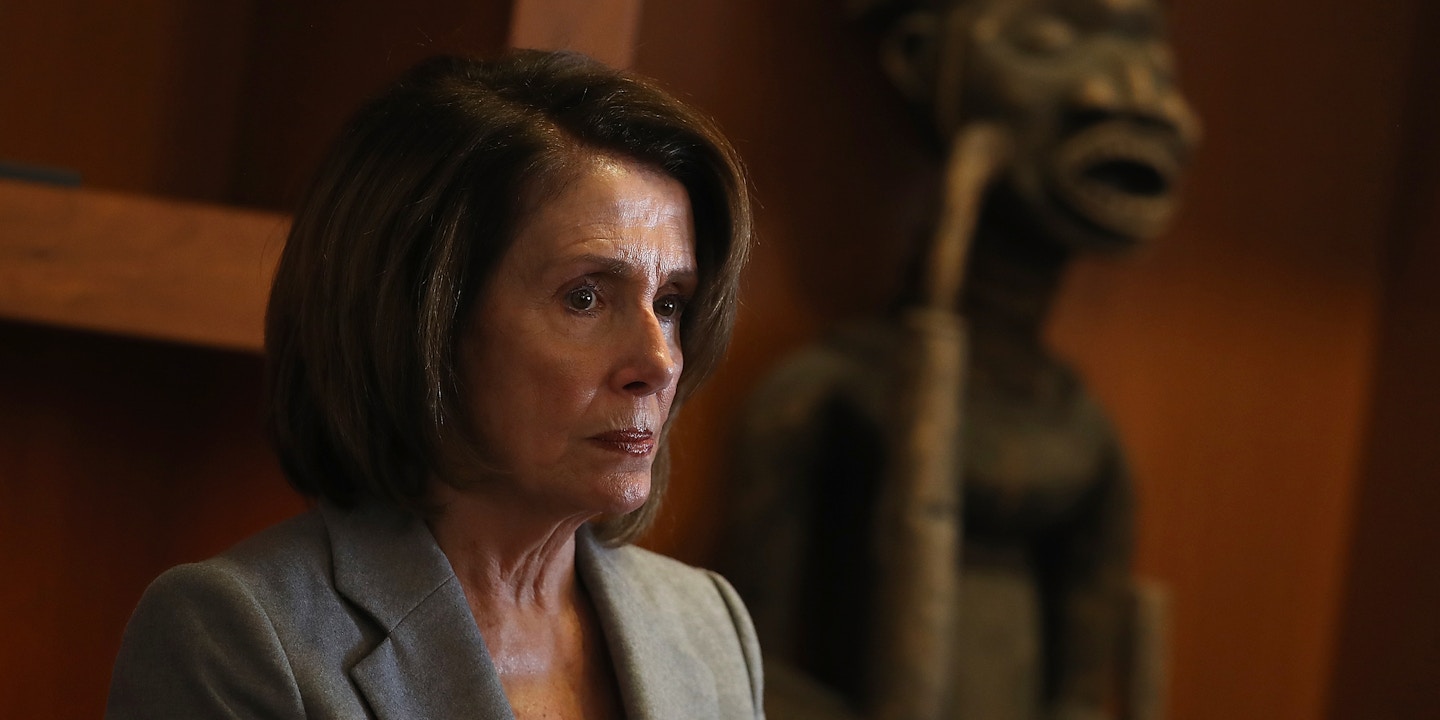
Why Is Nancy Pelosi So Afraid of Socialism?


https://theintercept.com/2018/07/06/nancy-pelosi-democratic-socialism/


IS DEMOCRATIC SOCIALISM now in the “ascendant” in the Democratic Party? That was the question posed by a reporter to House Minority Leader Nancy Pelosi last week, in the wake of democratic socialist Alexandria Ocasio-Cortez’s shock primary victory in New York’s 14th Congressional District.


And Pelosi’s response? “No.”


Elaborating a bit, she qualified that “it’s ascendant in that district perhaps. But I don’t accept any characterization of our party presented by the Republicans. So let me reject that right now.”


Who is she kidding? Ocasio-Cortez, a “Democratic giant slayer” (New York Times) who “rocked the political world” (CBS News), is now a household name. From the pages of Vogue to the studios of ABC’s “The View” and CBS’s “Late Show,” the Democrats’ newest star has been eloquently explaining — and detoxifying — democratic socialism to millions of apolitical Americans. “No person should be too poor to live,” she told Stephen Colbert, to cheers and applause, when asked to define her ideology.


Then there’s Bernie Sanders. Who’d have imagined that a self-proclaimed democratic socialist from the state of Vermont, who was pilloried for going on “honeymoon” to the Soviet Union, would become the most popular politician in the United States?


Not Pelosi, that’s for sure. Democratic leaders of her generation are accustomed to seeing political messaging from a defensive posture only. So it wasn’t surprising that Pelosi would reject democratic socialism as a “characterization of our party presented by the Republicans,” when the characterization is being presented, in reality, by Democrats themselves.


So here’s a question for the House minority leader: If socialism isn’t “ascendant” in her party, why did 16 Democratic senators join with Sanders in September 2017 to introduce his Medicare For All Act, a bill “enthusiastically” endorsed by the Democratic Socialists of America? Lest we forget, only four years earlier, Sanders introduced a similar bill in the Senate that had zero Democratic co-sponsors.


Here are a couple of other questions for Pelosi to consider: If socialism isn’t “ascendent” in her party, why did nearly six in 10 Democratic primary voters in 2016 say it has a “positive impact on society” and four in 10 Democratic caucus-goers in Iowa describe themselves as socialists? Why did the New York Times publish a piece in April that was headlined, “‘Yes, I’m Running as a Socialist.’ Why Candidates Are Embracing the Label in 2018”?


Of course, this isn’t socialism of the totalitarian or even Marxist variety. Even by European standards, it’s pretty tame: Neither Sanders nor Ocasio-Cortez is echoing British Labour Party leader and proud socialist Jeremy Corbyn’s call for the nationalization of public utilities. “Many socialist candidates sound less like revolutionaries and more like traditional Democrats,” acknowledged the New York Times. “They want single-payer health care, a higher minimum wage, and greater protections for unions.” (Although Ocasio-Cortez did pay homage to Corbyn in her viral campaign ad, intoning that “a New York for the many is possible,” a phrase Corbyn himself borrowed from Percy Shelley.)


Nevertheless, leading Democrats have, for many decades now, run a mile from the socialist label. “We’re capitalists, and that’s just the way it is,” Pelosi told a CNN town hall audience last year, when confronted by a student who asked her if the Democrats “could move farther left to a more populist message.” An anxious Barack Obama once called a reporter who had asked him whether he was a socialist to say it was “hard … to believe that you were entirely serious about that socialist question.” Hillary Clinton recently complained that her embrace of the label “capitalist” during the campaign “probably” hurt her in the 2016 campaign among Democrats.


Yet the modern, liberal, progressive America that is so cherished by Obama, Pelosi, and the rest of the Democratic Party elites might not exist today — were it not for socialists!


TAKE THE NEW Deal. “FDR’s borrowing of ideas about Social Security, unemployment compensation, jobs programs and agricultural assistance from the Socialists was sufficient to pull voters who had rejected the Democrats in 1932 into the New Deal Coalition that would sweep the congressional elections of 1934 and reelect the president with … the largest Electoral College win in the history of two-party politics,” writesJohn Nichols in his book “The S Word: A Short History of an American Tradition…Socialism.”

Elsewhere, Nichols cites a 1954 New York Times profile of Norman Thomas, six-time presidential candidate for the Socialist Party of America, which described him as having made “a great contribution in pioneering ideas that have now won the support of both major parties,” including “Social Security, public housing, public power developments, legal protection for collective bargaining and other attributes of the welfare state.”

How about the war on poverty?


In 1962, socialist intellectual Michael Harrington — who would later go on to found the Democratic Socialists of America — published “The Other America: Poverty in the United States” and it became an instant classic. “Among the book’s readers, reputedly, was John F. Kennedy, who in the fall of 1963 began thinking about proposing anti­poverty legislation,” wrote Harrington’s biographer Maurice Isserman. “After Kennedy’s assassination, Lyndon Johnson took up the issue, calling in his 1964 State of the Union address for an ‘unconditional war on poverty.’ Sargent Shriver headed the task force charged with drawing up the legislation, and invited Harrington to Washington as a consultant.”


Then there is the civil rights struggle.


The 1963 March on Washington for Jobs and Freedom, at which Martin Luther King Jr. delivered his “I Have a Dream” speech, was organized by proud democratic socialists Bayard Rustin and A. Philip Randolph. King himself would later remark that “something is wrong … with capitalism” and “there must be a better distribution of wealth.” “Maybe,” he suggested, “America must move toward a democratic socialism.”


Go beyond politics, too.


“It’s kind of ironic,” Nate Silver once remarked, “American sports are socialist.” Consider the NFL, which operates a strict salary cap for players, while also ensuring that each NFL team receives an equal share of the league’s revenue from TV deals. To quote Art Modell, the late owner of the Cleveland Browns, the league is run by “a bunch of fat-cat Republicans who vote socialist on football.”


To recap: The most popular politician in the United States today is a socialist; the most admired American of the 20th century had a soft spot for socialism; and the most popular sport in the country is basically a “government-sanctioned socialist utopia.” So much for socialism, then, being somehow un-American or some sort of foreign import.


It is also worth noting that while the “s-word” may still bother a majority of Americans, especially older Americans, socialist policies are pretty popular across the board — including with plenty of Republicans. Writing for New York magazine’s Daily Intelligencer, and citing a poll from the Kaiser Family Foundation, Eric Levitz points out that “a majority of voters in Indiana, Michigan, Ohio, Iowa, Wisconsin, and Pennsylvania would all support a socialist takeover of the health-insurance industry (so long as you didn’t put the idea to them in those terms).” He also observes that the “most radical economic policy on Ocasio-Cortez’s platform — a federal job guarantee — meanwhile, actually polls quite well in ‘flyover country.’”


So, what is Pelosi so afraid of? The way in which Republicans have turned “socialist” into a smear and a slur? Who cares? They’ve done the same to “liberal” — yet that hasn’t stopped Pelosi from identifying herself as one.


At the very minimum, even if the House minority leader doesn’t agree with the chair of the Democratic National Committee that democratic socialist Ocasio-Cortez represents “the future of our party,” she should stop being so defensive. Perhaps Pelosi could learn a lesson from President Harry Truman. The conservative Democrat and proud Cold Warrior was dubbed — yes, you guessed it — a “socialist” by his GOP opponents in 1950. “Out of the great progress of this country, out of our great advances in achieving a better life for all, out of our rise to world leadership, the Republican leaders have learned nothing,” responded a defiant Truman. “Confronted by the great record of this country, and the tremendous promise of its future, all they do is croak, ‘socialism.’”


HEALTH CARE BLUNDER REVEALS MICHIGAN CANDIDATE FOR GOVERNOR’S “PROGRESSIVE” BRANDING IS FALSE ADVERTISING


https://theintercept.com/2018/07/11/shri-thanedar-michigan-single-payer-health-care/


ALEXANDRIA OCASIO-CORTEZ’S unexpected victory has made it clear that the progressive movement activated by Bernie Sanders in 2016 is far from dead.

Policies like single-payer health care and a $15 minimum wage have become the rallying cries of ambitious Democratic politicians, and they increasingly find support among the general public. One poll commissioned last year found that even a plurality of self-identified Republicans now think that public colleges and universities should be tuition-free.

So it’s no surprise that all manner of Democratic politicians are now rushing to portray themselves as progressives.

In Michigan, businessperson Shri Thanedar has spent millions of dollars on television ads casting himself as “the most progressive Democrat running for governor,” and promising that he would bring single-payer health care to Michigan.

“Health care is not a privilege; it is our fundamental right. I will bring single-payer health care to Michigan,” Thanedar says in a TV commercial. “Agree? Vote for Shri.”

But there’s reason to be skeptical.

Over the last year, investigations by The Intercept have revealed many facts which cast doubt on Thanedar’s progressive branding. He donated thousands of dollars to Sen. John McCain’s presidential campaign, he was spotted clapping and nodding approvingly at a Marco Rubio presidential rally, and several Michigan political consultants have claimed that Thanedar once consulted them about possibly running as a Republican.

Now, an interview with The Intercept reveals that Thanedar’s much touted single-payer health care “plan” appears to be nonexistent.

In a conversation I had with Thanedar this spring, the candidate made it clear that, if elected, he would push the federal government to establish a single-payer plan. But when asked what he would do if a national single-payer plan failed, Thanedar struggled to offer a viable, state-level solution.

When I pressed him on what a Michigan state single-payer system would look like, Thanedar’s answer reflected a troubling ignorance about the difference between federal and state programs. He replied: “I would expand the Medicare and allow people to buy into it.”

“But Medicare is a federal program,” I pointed out, which a governor has no authority to expand.

Moreover, even if a governor did have that authority, Medicare expansion is not the same as single-payer health care. The former would create a competitive, government-run insurance option that individuals could buy into, and which, in theory, would drive down private insurance prices. But a single-payer system entails a government-run health system that would cover everyone automatically, like Medicare does for seniors. Although he claimed to support a single-payer system, Thanedar was actually describing a public option.

“It is, it is,” he conceded when I pointed out the discrepancy.

“So what would you do in Michigan?” I once again followed up.

“Well you know, Massachusetts did it at the single state level, on which the Obamacare is based on. But my commitment is there I would get together experts and make it happen and work with that. It’s not an easy thing,” he replied. “It’s a complex thing. There are cost issues, there are a number of other issues that need to be dealt with. But I’m very convinced in the long run, it will save us money and it’s the right thing to do.”

I then asked him if there would still be private insurance under a statewide single-payer plan. Typically, private insurance is relegated to a supplemental role in a single-payer system.

“Again, I’m not prepared to, you know, give you a full, you know, this is all still things to be thought about,” he replied.

“And so you’re fine putting everybody in Michigan into one government plan and not having private insurance in Michigan?” I once again prodded. The answer to this question is politically relevant, since access to private insurance options has become a stalking horse for conservatives who oppose single-payer.

“I’m not saying that,” he insisted.

“But that’s what single-payer is though by definition, right?” I followed up, emphasizing the marginal role private insurance plays in a single-payer system.

“It is. It is,” he conceded.

Finally, Thanedar concluded that the system is complex, and explained that what he’s offering is to provide the leadership necessary to achieve a state single-payer system if a national plan doesn’t emerge “in a reasonable time.”

“I am for single payer. It’s a complex system. It needs to be all worked out. We need to get experts. We need to draft a proposal and some great number of details in it. And all of that needs leadership and a commitment by the leadership. And I’m not coming in with a solution to every complex problem Michigan has,” he said. “But I’m coming in with a commitment to provide leadership.”

Thanedar has since come out in support a plan to extend universal health care coverage to all Michiganders under 19 years old by strengthening the state’s “Healthy Kids” health care program, which currently provides support to certain pregnant women and children.

Listen to the full interview here:

When asked to comment on this piece, Thanedar again affirmed that he would do everything in his power to pass a national single-payer program, and explained that “if it cannot be done at the national level, I will work tirelessly to implement a single-payer healthcare system in Michigan with a goal to cover every Michigander.”

ONE OF HIS opponents, former Detroit Public Health chief Abdul El-Sayed, is also running on establishing single-payer. But unlike Thanedar, El-Sayed has a detailed strategy for how to accomplish it. Last month, he released a plan to establish “Michicare,” which would levy payroll and business taxes to establish state-funded public coverage for all Michigan residents. El-Sayed is not shy about the fact that he would raise taxes in order to finance the system, but he estimates that the average Michigan family, earning an income of $48,432, would save around $5,000 a year in costs by switching to “Michicare” from their private health insurance provider.

Abdul El-Sayed was recently interviewed on the Intercepted podcast about his plan to create a single-payer health care system in Michigan, among other topics. Listen to the segment beginning at 24:55.

But despite having a more well-developed plan, El-Sayed’s middle-class background means he does not have the same resources to advertise his health care plan as does Thanedar, who, not without controversy, made a fortune in the chemical testing industry.

As a result, there’s a real risk that the public might be misled.

In a race where single-payer health care has become an important campaign issue, Thanedar’s vague, but well publicized, commitment to single-payer may undercut El-Sayed’s campaign, and derail the only detailed plan for a state-based single-payer program. The most recent polling on the Michigan race has Thanedar in a statistical dead heat with El-Sayed, with both men trailing former Senate Democratic leader Gretchen Whitmer by a considerable margin. The votes that Thanedar is pulling would theoretically be enough to put El-Sayed — who has hired a stable of Bernie Sanders alumni to run his campaign — in a competitive race with Whitmer.

But by coopting a progressive message and splitting the progressive vote, Thanedar has helped Whitmer, an establishment candidate, take a comfortable lead.

Whitmer is the daughter of former Blue Cross Blue Shield CEO Richard Whitmer. She’s the only Democratic candidate in the race who does not back single-payer, saying that it’s not “realistic” in Michigan at this time. BCBS Michigan lobbyists threw a fundraiser for Whitmer earlier this year. And she’s currently taking heat from an unidentified group who have paid for ads attacking her from accepting “big money” from insurance companies.

In this context, casting oneself as a progressive has become an important way to distinguish oneself from establishment politicians like Whitmer, and all the connotations of corporate corruption that come up with them — even if the label doesn’t fit.

Already, potential 2020 candidates for the Democratic nomination have taken postures designed to do just that. For instance, a number of senators have pledged to stop taking corporate political action committee money. But as several campaign finance experts explained to The Intercept, this move is mostly a “cheap gesture.” Many of these senators never took much corporate PAC money to begin with — instead, they raked in the bulk of their fundraising from large individual donors, including both corporate lobbyists and executives.

Given the increasing marketability of “progressivism,” it’s unlikely that Thanedar will be the last politician to don that mantle without adopting the policies to match. As long as progressive and populist policies are well-received by the general public, candidates for higher office have incentive to adopt sloganeering designed to appeal to this growing portion of the electorate. As a result, progressive voters may be increasingly unable to take politicians’ claims of “progressivism” at face value.