Saturday, July 14, 2018

ANDREW CUOMO’S BIGGEST DONORS RAKE IN MILLIONS FROM ICE


ANDREW CUOMO HAS a glaring conflict of interest when it comes to the politics of abolishing ICE. Luxury landlords across the state collect millions in rent from the agency — money they have turned around and funneled to Cuomo’s political campaigns, according to a new report by the New York-based watchdog group Public Accountability Initiative.

Cuomo, meanwhile, hasn’t joined other New York politicians — from likely incoming Rep. Alexandria Ocasio-Cortez to 2020 hopeful Sen. Kirsten Gillibrand — in calling to dismantle Immigration and Customs Enforcement, instead telling NY1 recently that the agency “should be a bona fide law enforcement organization that prudently and diligently enforces the law.”

Looking largely at publicly available data from the General Services external lease database, PAI researchers have documented extensive financial ties from Cuomo donors and members of his inner circle to ICE and Customs and Border Protection — the main agencies tasked with carrying out America’s increasingly brutal immigration policies. Since his first run for governor in 2011, PAI found that Cuomo has accepted at least $807,483 from companies, individuals, and the relatives of people who rent space to federal immigration authorities, and furnished many of them with positions in state government.

Rob Galbraith, PAI’s senior research analyst, told me by phone, “We saw that a lot of people were investigating the private-sector actors benefiting from immigration policy. We found that there is a significant overlap [between] those actors and the landlords and real estate interests that have close ties to the Cuomo administration.”

Cuomo’s primary challenger, Cynthia Nixon, who has called for abolishing ICE, wrote in an emailed statement that “while its reprehensible that Governor Cuomo has profited from ICE’s existence, it’s hardly surprising. … Many have been bewildered by the Governor’s continued support for ICE as its atrocities mount and so many other New York leaders have called for ICE’s abolition. Now we have an explanation: the Governor won’t call to abolish Trump’s rogue deportation force because his donors don’t want him to.”

In Manhattan, the iconic Starrett-Lehigh Building — co-owned by RXR Realty and Blackstone Group — has for 16 years been home to an ICE Homeland Security Investigation field office, which pays $12.4 million a year to lease part of the sprawling property overlooking the Hudson River, which bills itself as “a place to create, to influence and to succeed.” ICE’s fellow Starrett-Lehigh tenants include period-proof underwear brand Thinx and the offices of Martha Stewart’s multifaceted lifestyle brand.

The agency that handles leasing for federal agencies is the U.S. General Services Administration. Asked about standard procedures for federal agency leasing, GSA Regional Public Affairs officer Alison Kohler said over email that GSA “leases space from private entities when it is the best solution to meet the space requirements of GSA’s federal agency customers.”

In the case of the Starrett-Lehigh Building, GSA — using eminent domain or “condemnation” — relocated federal immigration enforcement offices there after 9/11, when the World Trade Center offices of several agencies that would eventually be consolidated into the Department of Homeland Security were destroyed. “GSA used its condemnation authority for immediate occupancy, and then executed a 10-year lease in November 2002 with renewal options. GSA exercised one option in 2013,” Kohler said.

Top executives at both RXR Realty and Blackstone, which acquired its stake in the building in 2015, have close ties to the Governor’s Mansion.

The chair and CEO of RXR Realty is Scott Rechler, whose family has donated at least $613,000 to Cuomo’s various runs for office. In exchange, Cuomo appointed Rechler to the board of the Port Authority of New York and New Jersey, a post he held from 2011 to 2016. In 2017, Cuomo tapped him again, this time for a seat on the board of the notoriously dysfunctional Metropolitan Transportation Authority that he still holds. A New York Times investigation found that Rechler and several other Cuomo appointees continued to give to the governor after taking their state jobs, despite a 2007 executive order from former Gov. Eliot Spitzer that sought to prohibit such arrangements. On top of his government posts, Rechler is also a member of the Real Estate Board of New York, an influential trade lobby for developers in the city whose other members have also given generously to Cuomo.

In a statement over email, Rechler said, “While I have the utmost respect for the career professionals at the Department of Homeland Security and within ICE, as an American, I do find certain federal policies set by the current Administration relating to immigration, including family separation, to be disturbing and inhumane. It is my hope that we rethink our nation’s approach to immigrants and immigration more broadly.”


PRIVATE EQUITY GIANT Blackstone Group is helmed by Trump booster Stephen Schwarzman, but the company has a bipartisan workforce. Senior Blackstone advisor William Mulrow, who does not work in the company’s Real Estate division, helped form a PAC to raise money for former New York Gov. Mario Cuomo’s prospective foray into national politics in 1987, and in the early 2000s, served as vice chair and chair of the New York State Democratic Party. In the midst of a lucrative career on Wall Street, he left Blackstone in 2015 to serve as Andrew Cuomo’s secretary and top adviser. He returned to the private equity firm in April 2017 after leaving his job at the governor’s office, and is now chair of Cuomo’s re-election campaign, responsible mainly largely for courting new, big-dollar donors.

Mulrow was featured in a New York Magazine profile of his Wall Street fraternity, Kappa Beta Phi, performing one-half of what author Kevin Roose calls a “bizarre two-man comedy skit,” in which he was “dressed in raggedy, tie-dye clothes to play the part of a liberal radical,” with his counterpart “playing the part of a wealthy baron. They exchanged lines as if staging a debate between the 99 percent and the 1 percent.” In 2012, Cuomo appointed Mulrow as chair of the New York State Housing Finance Agency and the State of New York Mortgage Agency, just after his stint from 2005 to 2011 as a senior executive at Citibank Inc., one of the architects of the subprime mortgage crisis.

Mulrow’s office did not agree to provide a statement on the record.

Upstate in Buffalo, 726 Exchange Street houses offices and a Port of Entry for CBP, which pays $1.42 million each year for the roof over its head to a shell company (an LLC) of Western New York real estate mogul Howard Zemsky’s Larkin Development Group. Zemsky and his wife, Lesley, have given $125,000 to Cuomo. In 2015, Cuomo nominated him to be the CEO of Empire State Development and commissioner of the New York State Department of Economic Development, making a total salary from the state of $1 a year. Kohler says that CBP — via GSA — had a prior lease with the Zemsky-owned LLC, and that GSA then “executed a follow-on lease through the Other than Full and Open Competition procurement method,” as opposed to a competitive bidding process. That lease became effective in 2015.

According to the New York Times, all of Lesley Zemsky’s $95,000 in donations to Cuomo were given after her husband’s appointments. Zemsky himself stopped donating to Cuomo after taking those positions, though that didn’t stop Cuomo from bringing him along to an at least $1,000-a-seat fundraiser for his campaign last summer, attendees to which very likely included executives at companies that Zemsky has the power to award contracts and tax breaks to through his controversial upstate development plans. To fortify the pair’s friendship, Zemsky paid an estimated $5,000 last summer to charter a private plane for Cuomo to and from Buffalo to officiate his daughter Kayla’s wedding. “Obviously, I am not going to ask him to come across the state at taxpayer expense, so I provided transportation,” Zemsky told the New York Daily News.

After publication, Jason Conwall, spokesperson for Empire State Development, emailed the following statement:

The CBP lease dates back more than a dozen years and the location was selected through the General Services Administration’s standard procurement process. The CBP is one of more than 20 tenants in the same building in Larkin Square, an area of Buffalo that has experienced an incredible economic turnaround because of Mr. Zemsky’s redevelopment efforts. Mr. Zemsky’s record and ethics are beyond reproach, and for the past four years he has served as a public servant for the salary of one dollar. To allege or insinuate any impropriety would be categorically false and irresponsible to print.

On whether Zemsky and Cuomo have spoken about immigration policy, Conwall wrote, “Mr. Zemsky serves as the Governor’s chief economic advisor.”

Another Western New York landlord, Uniland Development, collects $1.95 million per year from ICE and $562,756 from CBP in rent, in Buffalo and Cheektowaga, respectively. Uniland and the family that controls it,  the Montates, have altogether donated at least $39,500 to Cuomo’s campaigns. Both of these properties, GSA writes, were obtained via a competitive bidding process for a federal contract that Uniland won.

The PAI report goes on to list several other ICE and CBP lessors that have given to Cuomo in smaller amounts. Researchers also note that Cuomo attended a $5,000-a-plate fundraiser in a private box at Mets stadium for the lobbying firm Constantinople & Vallone, which represents private prison and immigration detention center contractor GEO Group.

Staff from Cuomo’s offices did not return The Intercept’s requests for comment. A spokesperson for ICE refused to comment on leasing, directing us to submit a FOIA request. A spokesperson from CBP referred us to GSA.


AS NATIONAL ATTENTION has gravitated toward the southern border, Cuomo has ramped up his rhetoric around immigration. In a New York Times op-ed, he called the Trump administration’s “zero tolerance” and family separation policies “a human tragedy and a threat to our values,” stating that “New York will not remain silent. Our state has always served as a beacon of liberty and opportunity for the world.” He also mentioned his announcement earlier in the week that New York would file a multiagency lawsuit for family reunification.

Cuomo’s critics say he could be doing much more — starting with forsaking his conflicts of interest on the issue. Javier H. Valdés, co-executive director of Make the Road Action, which organizes in immigrant communities around the state, said Cuomo “should return these campaign funds immediately.”

“It’s deeply concerning that while Andrew Cuomo continues to say he stands with immigrants — and even mistakenly claims he is an immigrant and undocumented — that he is also continuing to hold campaign cash from those profiting from ICE and CBP,” referencing a statement the governor made in April.

As governor, Cuomo has very little say over the future of ICE, a federal agency. Valdés and other immigration rights advocates around the state, however, argue that he could help ensure more undocumented New Yorkers stay out of its facilities.

Among the biggest demands from immigrant rights’ groups is for the state to pass legislation allowing undocumented New Yorkers to obtain driver’s licenses — something that 12 other states already do. The dangers of the policy became apparent last month in the case of 35-year-old delivery driver Pablo Villavicencio Calderon. Attempting to deliver a pizza to an Army base at Fort Hamilton, Calderon presented his IDNYC, meant to provide undocumented city residents with a form of identification in dealing with various agencies. Military police at the gates of the base refused to accept the ID and demanded a driver’s license. Calderon didn’t have one and in response, the officer on duty called ICE to take him into custody. He now faces deportation.

Driving while undocumented presents other dangers, as well. Getting pulled over is often a premise for local law enforcement to call on ICE and trigger deportation proceedings, something that’s all the more likely when a driver can’t get something as simple as a new license plate because they don’t have a license. Unlicensed driving is a particular concern for immigrant communities in rural and suburban areas, where — absent robust public transportation — cars are one of the only ways to access work and schools.

It was former Gov. George Pataki who issued a 2001 executive order to restrict licenses only to New Yorkers who could prove they were in the country legally. Cuomo’s critics argue that he could use the same powers to roll back the decision. “ICE is now routinely using minor traffic violations as justification to tear apart families. Cuomo should restore access to driver’s licenses for all New Yorkers, regardless of status. He has the authority to sign a driver’s licenses executive order today to immediately protect immigrant communities,” Valdés told The Intercept over email.

Make the Road and other groups also argue that Cuomo could leverage more political capital to pass the New York state DREAM Act, which would give undocumented students access to the same financial aid and in-state tuition available to U.S. citizens. He’s added it as a line item to the state’s annual budget in the past, but Republican control over the New York state legislature — thanks to the Independent Democratic Caucus, a group of rogue Democrats who caucus with Republicans — has left the measure as one of many progressive priorities that pass through the Assembly only to languish in the Senate.

For now, the question is whether Cuomo’s donations from ICE and CBP landlords will continue to languish in his campaign’s coffers.


BRETT KAVANAUGH, WHO HAS RULED AGAINST CAMPAIGN FINANCE REGULATIONS, COULD BRING AN AVALANCHE OF BIG MONEY TO ELECTIONS


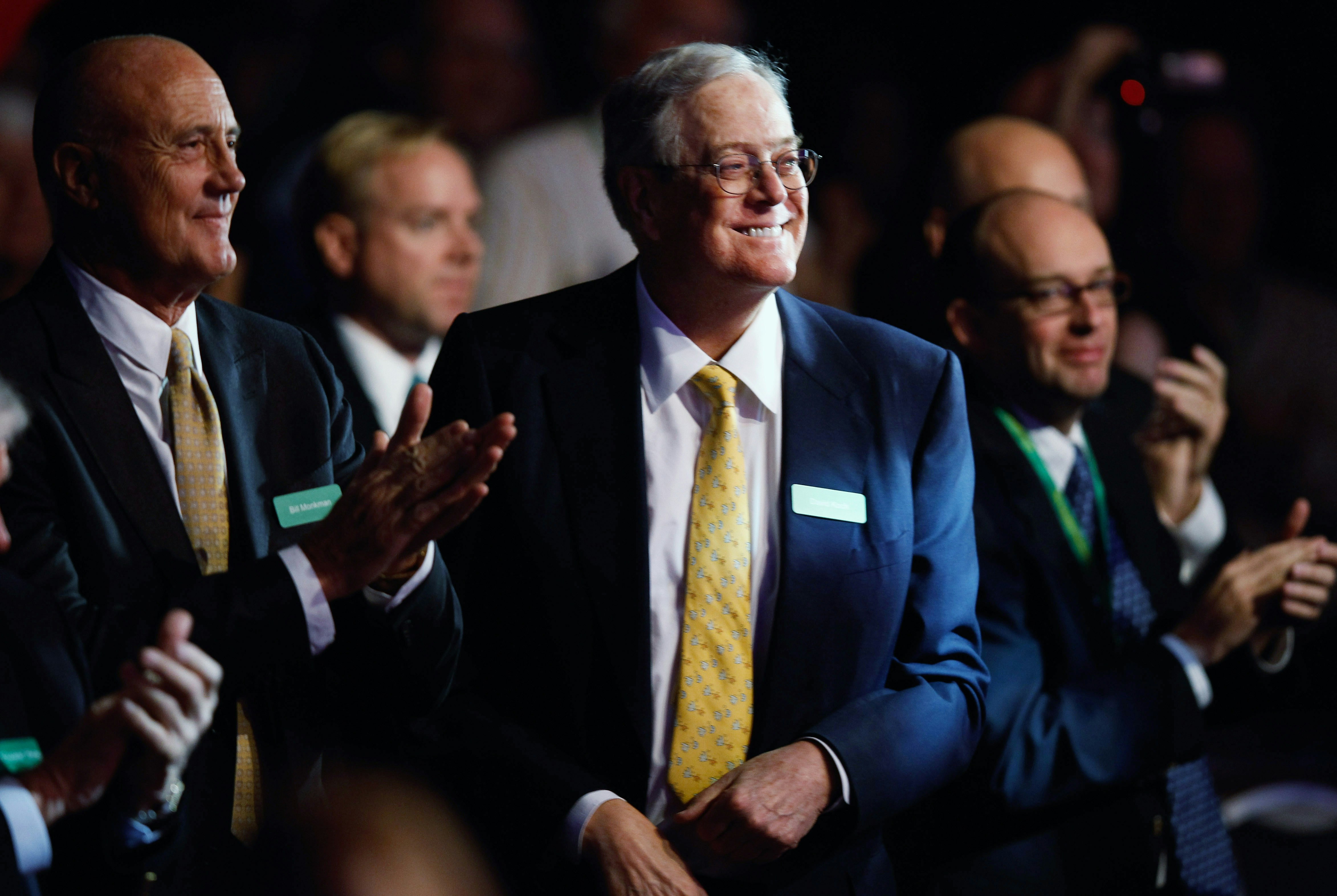
Americans for Prosperity Foundation Chair and Koch Industries Executive Vice President David H. Koch, center, at the 'Defending the American Dream' Summit on Nov. 4, 2011, in Washington, D.C.
Photo: Chip Somodevilla/Getty Images


July 12 2018, 6:31 a.m.


THE ELEVATION OF D.C. Circuit Court Judge Brett Kavanaugh to the Supreme Court could have a profound impact on the rules governing the American democratic system.

In recent years, the Supreme Court has swiftly remade the landscape of American politics, gutting 1960s-era civil rights laws restricting voter suppression, sharply weakening labor unions, and deregulating the campaign finance system to allow for wealthy individuals and corporations to exercise greater influence over elected representatives. With President Donald Trump’s pick for the Supreme Court, that influence is poised to grow.

Kavanaugh’s appellate court decisions and public comments suggest that he will accelerate the trend toward a political system dominated by wealthy elites — often operating in the shadows, without any form of disclosure.

In the minds of conservative legal strategists, the First Amendment’s protections for free speech can be harnessed to justify virtually any intervention in politics. This expansive view of free speech has been used to oppose or undo any campaign finance regulation, any rule enhancing the political strength of organized labor, any requirement for donor disclosure, or any prohibition on the transfer of billions of dollars into the political system.

In decision after decision, Kavanaugh has embraced this theory and wielded the First Amendment as a cudgel to unravel decades of laws designed to ensure that ordinary Americans are not squeezed out of the electoral process by organized economic power.

At a March 2016 event at the American Enterprise Institute, a neoconservative Washington think tank, Kavanaugh was asked point-blank if he believes that “money spent during campaigns does represent speech, and therefore deserves First Amendment protection.” His answer: “Absolutely.

In 2009, Kavanaugh authored an opinion in a case called EMILY’s List v. Federal Election Commission, a decision that paved the way for the unlimited corporate spending in the election system. The EMILY’s List case challenged campaign regulations designed to impose contribution limits on nonprofits engaging in direct election advocacy. The rules were crafted in the wake of the 2004 presidential election, in which certain nonprofit organizations — known as “527” groups for the relevant section of the tax code — were created to circumvent limits on large donations for election purposes.

“The First Amendment, as interpreted by the Supreme Court, protects the right of individual citizens to spend unlimited amounts to express their views about policy issues and candidates for public office,” wrote Kavanaugh, overturning a previous district court decision.

OVER THE YEARS, one of the most aggressive groups dedicated to litigating against campaign finance rules in support of unlimited private donor power has been the Center for Competitive Politics, a nonprofit led by Republican legal scholars. Embracing the latest trend of weaponizing the First Amendment, the organization rebranded last year and is now known as the Institute for Free Speech.

In a statement posted this week, the group extended a strong endorsement to Trump’s pick. In the past, Kavanaugh has appeared alongside Institute for Free Speech leader Brad Smith, moderating a Federalist Society panel on the importance of donor secrecy. But it is Kavanaugh’s long record of campaign deregulation that earned him high praise. Kavanaugh’s opinion in the EMILY’s List decision, the institute gushed in a post on its site, “foreshadowed the Citizens United and SpeechNow.org opinions” — two federal court cases that relied on free speech principles to upend limitations on corporate and private campaign spending.

While Citizens United formally legalized unlimited corporate, union, and individual spending in the election system, the SpeechNow.org decision in its immediate wake allowed the creation of expenditure-only committees, also known as Super PACs. That decision, which Kavanaugh joined in ruling against the Federal Election Commission, held that “the government can have no anti-corruption interest in limiting contributions to independent expenditure-only organizations.”

Kavanaugh’s work, however, was far from done — much to the Institute for Free Speech’s delight. The group proudly lists a number of cases in which Kavanaugh has struck down FEC rules following the EMILY’s List decision.

Advocates for a well-regulated campaign finance system largely echo the Institute for Free Speech’s contention that Kavanaugh’s record shows that he is likely to rule in favor of more unrestricted political spending.

“Kavanaugh has fully embraced the notion that money is indistinguishable from speech, and his record shows a willingness to go out of his way to narrow or question laws designed to limit the influence of the ultrawealthy over our political system,” says Brendan Fischer, director of the federal reform program at the Campaign Legal Center. “It appears that Kavanaugh’s approach to campaign finance law has been to elevate the rights of those who already have the greatest power and privilege, with little regard for the consequences to our democracy.”

Even in cases in which Kavanaugh has upheld campaign finance rules, he has opened the door to more deregulation. In 2010, he authored an opinion supporting existing FEC rules limiting contributions to political parties, but noted that such limits were simply consistent with longstanding Supreme Court precedent — the sort of precedents he will now be in a position to overturn.

Speaking at an event two years ago, Kavanaugh suggested that the Supreme Court should revisit the limit on political party contributions. Asked generally about campaign finance jurisprudence, Kavanaugh discussed the role of limits to candidates and political parties in the age of Citizens United. The case, he said, had created an environment in which “the political parties and candidates can’t raise money and outside groups can.” He added that he doubted the Supreme Court would reverse the cap on contributions to candidates, but said that the court might consider revising the rules on political party donations.

If confirmed to the Supreme Court, Kavanaugh might get an opportunity to make such a change. Last month, the D.C. Circuit certified Libertarian National Committee v. FEC, a case that challenges donation limits to political parties on the grounds that such restrictions are a violation of the First Amendment, and that the structure of existing limits on a variety of types of party funds effectively imposes content-based restrictions on a political party’s free speech.

In another decision generally viewed as supporting extant campaign finance regulations, Kavanaugh hedged by crafting his opinion to leave the door open to future deregulation.

In Bluman v. FEC, a case challenging the prohibition of foreign election spending, Kavanaugh wrote an opinion upholding the longstanding law. His opinion, however, narrowly defined the ban only to apply to “express advocacy,” rather than general issue expenditures. “This statute, as we interpret it, does not bar foreign nationals from issue advocacy — that is, speech that does not expressly advocate the election or defeat of a specific candidate,” he wrote.

That distinction is critically important. Increasingly, a tidal wave of campaign spending has concealed itself as “issue advocacy.” Issue advocacy advertisements allow donors to avoid FEC election rules if the ads do not explicitly call for the election or defeat of a candidate. To any ordinary person, though, these ads — like a television commercial telling voters to call a Democratic lawmaker and tell him how they feel about the supposed “Ground Zero Mosque” — can appear to be campaign advertisements, even if they do not use the magic words “elect” or “vote for.”

Rick Hasen, an election law expert at the University of California at Irvine, has noted that while Kavanaugh’s opinion in Bluman “might look like a ruling against deregulation, in fact, it is not.” Most of the Russian social media advertising flagged by Special Counsel Robert Mueller’s investigation, for example, would qualify as issue advocacy rather than express advocacy, Hasen has argued, meaning that much of the hubbub about so-called Russian interference would, by Kavanaugh’s lights, be perfectly legal campaign spending.

“I believe that a Justice Kavanaugh could well vote with a new SCOTUS majority to hold that laws effectively limiting foreign influence in our elections violate the First Amendment,” Hasen wrote.

ACROSS HIS YEARS on the D.C. Circuit, there are many cases in which Kavanaugh has used the First Amendment to enshrine the privileges of the powerful. In 2015, as In These Times reported, Kavanaugh ruled that a casino was simply exercising its First Amendment rights by calling the police on its own workers who were engaged in a peaceful demonstration — for which they had a permit. He also ruled that net neutrality rules to protect an open internet were a violation of the First Amendment rights of cable companies and other internet service providers to limit bandwidth for certain content.

The next case that may reshape the political landscape could be on donor disclosure. The 9th Circuit Court of Appeals is currently hearing a case concerning whether the state of California can collect the major donor lists of advocacy groups such as Americans for Prosperity Foundation, the lobbying and campaign arm of the billionaire Koch brothers’ political machine.


In this arena, Kavanaugh’s record again suggests that he may side with secrecy for the billionaires spending untold sums to influence public policy and election campaigns.

The Institute for Free Speech, in its reviews of his jurisprudence, also pointed to Kavanaugh’s opinion in Independence Institute v. FEC as an example of the judge’s sterling campaign finance record. The case revolved around the Independence Institute, a nonprofit that does not disclose its donors, and its attempts to purchase campaign season radio advertising. The ads mentioned a Democratic senator during his re-election campaign, ostensibly about a legislative concern rather than as an election issue.

The use of such ads in close proximity to an election are often attempts by campaign donors to conceal their identity under the guise that they are merely informing voters of important issues, rather than attempting to persuade their ballot choices. The FEC, recognizing this tactic, had developed rules on such communications around an election season, requiring some minimal donor disclosure for election season advertising.

A district court judge had dismissed the Independence Institute’s case, noting that even the Citizens United ruling had maintained support for donor disclosure. But the group appealed, and Kavanaugh supported the institute’s request for a three-judge panel to hear the challenge to the FEC disclosure regulation. Although he did not rule explicitly in favor of the institute’s arguments opposing disclosure requirement, Kavanaugh suggested that the institute’s nonprofit status could afford the group an exemption and that the case was worthy of further review. (The panel of judges eventually sided with the FEC.)

The Independence Institute, like Americans for Prosperity Foundation, is a 501(c) nonprofit group; both are highly engaged in policy debates. While its unclear exactly how Kavanaugh might rule on the Supreme Court on such issues, his confirmation may depend on the very same secret-money groups. The Judicial Crisis Network and Americans for Prosperity are part of a coalition of conservative 501(c) nonprofit groups that are planning to spend $10 million on advertisements to pressure the Senate into confirming Kavanaugh. Neither organization discloses its donors.


As 'Petulant' Democratic Elites Howl in Protest, DNC Panel Gives Plan to Gut Power of Superdelegates Final Approval


The plan has widespread party support, but corporate lobbyists who "think their vote is more important" are desperately working to undermine it


"Many prioritize corporate interests over those of everyday people and thus automatically support the less progressive candidate."
—Alex Kotch, investigative reporter


In the face of fervent opposition from Democratic elites who "think their vote is more important" than the will of the party's base, the Democratic National Committee's (DNC) Rules and Bylaws arm cleared a major hurdle in the fight to curtail the power of superdelegates on Wednesday by approving a plan that would end their ability to cast votes for the presidential candidate on the first ballot at the party's convention.

"The activists that have been concerned that superdelegates will overturn the will of the voters should feel good about this," DNC member Elaine Kamarck said in a statement.

While the plan to gut the influence of superdelegates—who have been free since 1984 to put their weight behind any candidate no matter how the public voted—has received broad support from Democrats and Sen. Bernie Sanders (I-Vt.) as an important first step toward making the party's process more "open and transparent," establishment figures who stand to lose power if the plan is implemented are staging a last-minute "revolt" to block the rule change.

As investigative reporter Alex Kotch noted in a Twitter thread on Wednesday, at least two of the Democratic insiders who are clinging desperately to their undue influence as superdelegates happen to be corporate lobbyists—a fact that Politico neglected to mention in its reporting on the party elites' "longshot bid to block the measure."

"They don't realize it but they're proving the point of Sanders and everyone else who's opposed to superdelegates," Kotch writes. "Many prioritize corporate interests over those of everyday people and thus automatically support the less progressive candidate."

Responding to Politico's story on the superdelegates' last-ditch attempt to undermine the push to curtail their power, The Humanist Report offered an alternative headline:

Wednesday's vote in favor of the plan to ensure superdelegates cannot overturn the will of voters on the first ballot of the presidential nomination process was the final step before the proposal heads to a vote before the full DNC next month.

"Any attempt to derail the rules changes at the summer convention is thought to be a long-shot," concluded Astead Herndon of the New York Times.


Israel kills child as Gaza marks 100 days of protests


13 July 2018


Israeli snipers killed a child on Friday and fatally wounded a second person as Palestinians marked more than 100 days of Great March of Return protests in Gaza.

Uthman Rami Hillis, 14, was killed by live fire, according to the human rights group Al Mezan.

Hillis, from the neighborhood of Shujaiya, was shot by Israeli forces stationed across the boundary east of Gaza City, the group stated.

On Saturday, the health ministry in Gaza announced that 20-year-old Muhammad Nasir Shurab had died of injuries he suffered the day before when he was shot by snipers east of Khan Younis.

More than more 100 people across Gaza were injured, 65 with live ammunition.

Defense for Children International Palestine shared a video said to show the moment Hilles was shot. It shows the boy climbing on the separation fence along the Gaza-Israel boundary, but presenting no direct or mortal threat to anyone at the moment he was killed.

Palestinian media circulated this photo of Hillis following news of his death.

Media also shared images of Hillis being carried on a stretcher after he was shot:

Video showed distressing scenes as relatives mourned over Hillis’ body at the morgue of al-Shifa hospital in Gaza City.

Before Hillis’ death on Friday, the UN humanitarian monitoring agency OCHA reported that 21 children were among the nearly 150 Palestinians killed by Israeli forces in Gaza since 30 March, the vast majority of them during protests. More than 4,000 others have been wounded by live fire.

During the same period, four Israelis have been injured.

Standing with Khan al-Ahmar

For the 16th Friday in a row thousands of Palestinians headed towards Gaza’s eastern boundary.

Since 30 March, Palestinians have been mounting protests against Israel’s 11-year siege of Gaza and to call for the right of refugees to return to lands from which they were expelled and are excluded by Israel because they are not Jews.

Israel has responded by deploying snipers with orders to shoot unarmed civilians including children – killings and maimings the International Criminal Court prosecutor has warned could lead to Israeli leaders being tried for war crimes.

The theme of this Friday’s protest was solidarity with Khan al-Ahmar, a Bedouin village near Jerusalem which faces imminent demolition by Israel – a war crime – to make way for more Jewish settlements in the occupied West Bank.

Many Palestinians in Gaza addressed messages to the people of Khan al-Ahmar through local media.

“We are here today in solidarity with our brothers and sisters in Khan al-Ahmar,” one man said. “All of Gaza is with you.”

This image shows a Palestinian waving the Irish flag in honor of the Irish senate’s passage earlier this week of a bill to ban the import of goods from Israeli settlements.

Israel tightens siege

As Palestinians in Gaza sustain their revolt against the siege despite the devastating cost, Israel is responding by tightening the blockade even further.

On Monday, Israel announced the closing of Gaza’s only commercial goods crossing.

Israel is also reducing the distance Gaza fishers are allowed out to sea from nine to six nautical miles.

The steps are collective punishment against Gaza’s two million people for incendiary kites and balloons that Palestinians have launched, setting fire to fields on the Israeli side of the boundary.

Israel’s technologically advanced military has proven unable to counter the kites and balloons.

So once again, occupation authorities are inflicting more of the suffering that has spurred revolt against a situation in which the population in Gaza – half of them children – can only choose between dying by Israel’s bullets and bombs, or being reduced quietly to desperation and death by the siege.

Israel says it will allow in “humanitarian” supplies such as food and medicine, but UN officials are warning that the closure of the commercial crossing will make the situation in Gaza much worse.

The closure “can be expected to have profound and far reaching consequences for already desperate civilians,” Chris Gunness, spokesperson for UNRWA, the UN agency for Palestine refugees, stated on Thursday.

Gunness pointed out that among the imports banned by Israel were building materials for UN education, health, water, sanitation and hygiene projects.

Gaza’s water and sanitation systems are already near collapse following years of Israeli blockade and military attacks.

Inflicting suffering

Gisha, an Israeli human rights group that monitors the blockade of Gaza, said that Israel is banning all building materials, not just those destined for UN projects – which will quickly bring all construction in Gaza to a halt.

Already struggling businesses will also suffer huge losses.

Farmer Suleiman Zurub was waiting to ship 2,000 crates of sweet potatoes out through the crossing. That crop will now likely spoil. “Farmers are the big losers from this decision,” Zurub said, according to Gisha.

Hasan Shehadeh, who owns a clothing company, also faces huge losses as he is unable to ship goods to customers in Israel, the occupied West Bank and China.

“If things stay this way, I’ll suffer huge financial losses, because in my contracts I’ve signed a commitment to pay for every item left in my factory,” Shehadeh said, according to Gisha.

Shehadeh is also worried about the 200 people he employs. “Israel’s decision will affect them too, of course,” he said.

Early warnings

UNRWA’s Gunness predicted that the latest closure would lead to an increase in demand for UNRWA services.

This would come at a time when the agency, which provides emergency rations, health and education to hundreds of thousands of people in Gaza, faces an unprecedented financial crisis following the freezing of US contributions earlier this year.

Nearly 80 percent of Gaza’s population is already forced to rely on humanitarian assistance and the unemployment rate is close to 50 percent.

In June, UNRWA warned that it may have to make deep cuts to its already stretched services.

Even before the latest Israeli restrictions, UN officials pointed to signs of a sharply deteriorating situation.

From January 2017 to June this year, the percentage of essential drugs at a zero stock level in Gaza has risen steadily from one-third to one-half, according to OCHA – meaning there is less than a one-month supply for those medicines.

In June, the average number of hours of electricity per day was 4.5 hours, close to an all-time low since January 2017.

Meanwhile, over the past year, the number of people who have had to borrow money or food from family or friends rose from about one in three to nearly half.

International complicity

The European Union, which rarely criticizes Israel and has failed to condemn its massacres of civilians in Gaza, said on Friday that it “expects Israel to reverse” the decision to close the commercial crossing.

The statement from Brussels made no reference to Israel’s obligations as an occupying power to abide by international law, including the prohibition on collective punishment.

The EU even tacitly justified Israel’s action by including a demand that “Hamas and other actors in Gaza must cease and refrain from violent actions and provocations against Israel, including the launching of incendiary kites and balloons.”

By contrast, Gisha has called Israel’s resort to “collectively punishing nearly two million people in Gaza” by closing the goods crossing “both illegal and morally depraved.”

The Palestinian human rights group Al Mezan deplored “the international community’s continued tolerance of the collective punishment of the population of Gaza in violation of its legal obligations under international humanitarian law.”

Al Mezan warned that Gaza is witnessing “a social and economic collapse” and is heading towards an “explosion.”

Air attacks

Overnight Friday to Saturday, and again on Saturday, Israel carried out air strikes across Gaza.

Israel began the attacks Friday night “in response to an Israeli army officer sustaining wounds after a locally-made bomb was thrown at him at the borders of the Gaza Strip,” Ma’an News Agency reported, citing Israeli media.

The newspaper Haaretz reported that an Israeli officer “was moderately wounded by a hand grenade that was launched at him from the northern Gaza Strip” on Friday.

Israel claimed it attacked tunnels and sites used for the preparation of incendiary kites and balloons.

Palestinian resistance factions returned fire towards Israel by launching dozens of rockets.

On Saturday, Israel resumed bombing Gaza and claimed to have carried out the biggest daytime attacks on the territory since its 2014 assault.

According to Haaretz, the Israeli “army said the attacks on Saturday were “in response not only to the launches” of retaliatory rockets from Gaza, “but also to Hamas’ activities along the border and the incendiary balloons and kites.”

On Saturday, Haaretz reported that one rocket “exploded near an Israeli border community,” but that there had been no injuries.

The health ministry in Gaza said that by Saturday evening one person had suffered moderate injuries due to the ongoing Israeli air attacks.

On social media, Palestinians in Gaza reported loud explosions from bombing that appeared calculated to terrorize the population.

This article has been updated since initial publication.


The NATO Summit Wasn’t a Victory for Trump—It Was a Victory for Militarism


Major media outlets are so focused on Russiagate they are missing the dangerous international military buildup taking place.


BY BRANKO MARCETIC


http://inthesetimes.com/article/21302/Donald_Trump_NATO_Summit_Russia_Cold_War_Media


For most major media outlets, the events of the past week have yielded a straightforward narrative: Donald Trump, at the behest of his puppet-master in the Kremlin, tried and failed to destroy the NATO alliance and bring down the post-war liberal world order, the latest in a series of treasonous actions that will culminate in his meeting with Vladimir Putin in Helsinki on Monday.


But there is another interpretation. Instead of viewing events through the prism of the murky “Russiagate” scandal, or according to whether or not Trump managed to score some kind of “win,” the press must grapple with the real result of the NATO summit: The Western world continues to hurtle toward an ever scarier military confrontation with the country that holds the world’s largest nuclear arsenal.


As the dust settles from the tumultuous NATO summit, its actual outcome is unclear. Trump first announced that he had secured promises of major military spending increases from the other 28 NATO member states, only for the leaders of the same member states to then publicly deny they had agreed to any such thing. “[The communique] reaffirms a commitment to 2 percent [of GDP] in 2024. That is all,” said French President Emmanuel Macron, referring to the contents of an agreement first made by NATO countries in 2014.


Most pundits alternated between mocking Trump for taking credit for something that would have happened regardless, or declaring the whole episode proof that Trump is in the pocket of the Kremlin. “Can we just admit that Trump is captured by the Russians?” asked the Washington Monthly, citing Trump’s skeptical rhetoric toward NATO.


It is true that NATO members had already committed during the Obama administration to raise their defense spending to 2 percent of GDP, an already over-the-top figure that explains why only five countries have managed to meet this goal thus far. But there is evidence that Trump’s intemperate demands have placed renewed pressure to ratchet up military spending. According to Foreign Policy — hardly a bastion of anti-establishment thinking — current and former European officials have said that Trump’s threats to “go it alone” at a closed-door meeting during the summit pushed NATO members to pledge more military spending. NATO Secretary-General Jens Stoltenberg said at the post-summit press conference that Trump’s “message is having an impact,” and that because of him, Canada and the European states will spend an added $266 billion between now and 2024.


Could Stoltenberg simply be buttering up Trump? Absolutely. But European officials like Macron also have reason to save face by publicly playing down the idea they were bullied by Trump.


There’s also the case of Germany, which has faced sustained pressure from Trump to raise its military spending. Last year, Trump reportedly handed German Chancellor Angela Merkel a mocked-up invoice for $374 billion for NATO, and Germany was one of eight countries Trump sent personal letters to in June demanding higher payments. Days before the summit, Merkel’s government delivered a budget that put $4.6 billion extra toward the military, revising an earlier budget that focused more on domestic spending. Canada likewise announced a 70 percent increase in its defense budget over the next ten years a month before the summit.


Then there are the actual results of the summit, which, for all the complaints of sabotage by Trump, resulted in the announcement of several new military commitments. The communique pledged, among other things, a NATO Readiness Initiative, made up of “an additional 30 major naval combatants, 30 heavy or medium manoeuvre battalions, and 30 kinetic air squadrons, with enabling forces, at 30 days’ readiness or less,” as well as an “enhanced exercise program” for “maritime warfighting skills.” The communique also affirmed that NATO will “fully implement” the terrorist-fighting action plan it agreed to last year, and embraced a new member in Macedonia— the latest Eastern European state to join the alliance, an act further isolating Russia.


Meanwhile, Canada is set to head a new training mission in Iraq, while the United Kingdom announced it will send 440 more troops to Afghanistan. It is no wonder that former military officials told Foreign Policy that, from their perspective, there were “some important wins that were overshadowed by the noise.”


Nonetheless, U.S. outlets have claimed in the aftermath that the proceedings “could help Putin,” who was “the big winner of the NATO summit.” Such coverage focuses on Trump’s allegedly contemptuous rhetoric towards NATO, emphasizing Trump’s personal behavior rather than tangible outcomes—a trend in reporting on Trump since his inauguration.


In what could be the surest sign that these concerns are overblown, nominally anti-Trump neoconservatives are taking Trump’s side. “Trump isn’t wrong to expect more from Germany,” wrote Eli Lake, warning that “if you care about NATO,” you have to be worried about Germany’s military decline. David French of the National Review, after dispensing with the obligatory criticisms of Trump’s rhetoric, wrote that Trump was “absolutely, positively right to be upset at the state of the German military.” The Weekly Standard likewise criticized Trump’s “foolish and unhelpful” rhetoric before affirming that “despite the deep paranoia, Trump’s criticisms are not entirely mistaken,” and that European states needed to build up their militaries to confront “Russian expansionism.”


If helping ensure a more militarily aggressive NATO is a “win” for Trump, it is certainly not a win for global stability and peace. Lost in this coverage are any voices of skepticism over what the further expansion of NATO and a large military build-up might mean for already tense relations with Russia.


A Poison in the Antidote


This increasingly militaristic atmosphere is epitomized by the bipartisan rallying around NATO in reaction to Trump’s criticisms of the alliance. This trend dates to least January 2017 when Trump, in keeping with his habit of co-opting left-wing talkings points, labelled NATO “obsolete.”


The statement swiftly elicited widespread shock and horror, much of it from liberal sources warning the remarks could end the U.S. position as the “world’s sole superpower,” lead to the collapse of the European Union, “increase the risk of military escalation and war in Europe,” and constitute a “direct assault on the liberal order” that’s been in place since 1945. More than a few commentators suggested that the remarks were a reflection of Trump’s unseemly mind meld with the powers-that-be in Russia.


These same talking points were resurrected over the past weeks, when Trump’s hostility to NATO elicited apocalyptic predictions, often from liberal circles. Dan Shapiro, Obama’s ambassador to Israel, warned that “most damaging is that [Trump’s] rhetoric is building up hostility to NATO among his supporters.” The Washington Post editorial board charged that Trump is “poisoning NATO.” Vox, arguably the flagship news outlet for modern American liberalism, published a pieceexplaining “why you should give a shit about NATO,” and why Trump is wrong to call it “obsolete.” The New York Times even ran several non-editorial, reported piecesdefending the importance of NATO and advancing the idea of Russia as an expansionist aggressor that needs to be rebuffed with military might.


This rush to defend NATO and affirm its importance pushed any criticisms of the alliance out of the sphere of legitimacy. As much as Trump’s verbal attacks on intelligence agencies have served to rehabilitate their standing among a previously more skeptical public, his attacks on NATO have insulated the alliance from critique.


This is too bad, because there are legitimate criticisms to be made of NATO, including that it’s a relic of a bygone time. In 1998, William J. Perry and Ash Carter—secretaries of defense for Bill Clinton and Obama, respectively—argued that “its founding purpose of deterring attack from the Warsaw Pact has been fulfilled.” As late as 2001, with the Cold War long over, there was serious discussion about NATO’s seemingly purposeless existence. It was only after the September 11 attacks that NATO, in its own words, “turned tragedy into opportunity” by transitioning to a focus on terrorism.


NATO stopped being a bulwark against Russian expansionism and turned into an instrument of the flawed, military-based “war on terror” of the Bush and Obama years, a role that’s remained key to centrist-liberal defenses of the alliance’s relevance today. NATO forces have been heavily involved in Afghanistan nearly from the start of that never-ending war.

The alliance’s other high-profile 21st century “success” was the 2011 bombing of Libya and subsequent ouster of dictator Muammar Gaddafi, a foreign policy blunder second only to the Iraq War, and one whose reverberations can still be felt.


The trouble is, the idea of ending NATO is now being rendered unthinkable by establishment opinion-makers who view Trump as some kind of anti-lodestar. As Nation editor Katrina vanden Heuvel recently put it, “Trump is so cruel, is so odious, that what he says taints the possibility often of real debate,” making it impossible to critique NATO at the same time that Trump does.


All Roads Lead to War


Lurking behind all of this is the steadfast and widely held belief that Trump has been compromised by the Kremlin — that he is quite literally an “agent” or an “asset” being directly manipulated by Putin.


This sensational and evidence-less claim has long been thrown around, as when former Director of National Intelligence James Clapper (who once committed perjuryto protect the NSA from public scrutiny) charged that Putin was handling Trump like an “asset” because he had thanked him over the phone for a CIA tip-off about a potential terrorist attack in Russia.


But the allegation has increasingly made the rounds in respectable, mainstream opinion over the past week or so, from Stephen Colbert’s show to Chris Hayes’ program on MSNBC. Jonathan Chait has, in his column for New York magazine, recently advanced the idea that Trump has been an intelligence asset for the Kremlin since 1987, and that Putin “installed” him in the White House after he rose to political popularity in 2015.


Yet, these claims rarely deal with the actual actions taken by the Trump administration, which have been markedly aggressive towards Russia. The administration forced RT, the state-funded Russian news channel, to register as a foreign agent, which met retaliation from the Kremlin.

It expelled more Russian diplomats over the Skipral poisoning than Obama did in response to the alleged Kremlin interference in the election.


Trump not only bombed Syria, a Russian ally, but shot down a Syrian warplane, leading Russia to issue a strict and worrying threat to the US in response. Trump’s tariffs are hugely damaging to Russian trade—and inspired Russia to respond tit for tat with its own tariffs. The administration has repeatedly widened anti-Russian sanctions. Most alarmingly, Trump approved the sending of weapons to Ukraine, an escalation of the U.S. role in that conflict that Obama resisted for years, and which was cheered on by the Washington Post editorial board.


It’s true that such stories are also sometimes paired with contradictory rhetoric from Trump, or even reports of reluctance from the president. But even if one grants the extraordinary idea that Trump is indeed compromised by Putin, this track record seems to suggest such compromise hasn’t had much of an impact.


Meanwhile, the upcoming Trump-Putin summit has been the subject of much conspiracizing. Yet the meeting is entirely routine, given that Russia is a UN Security Council member and well-stocked nuclear power, and that the two will discussreducing their nuclear stockpiles. Trump, furthermore, has taken much longer to have such a meeting than previous presidents: Bush and Obama both met Putin within the first six months of their presidencies.


For all these reasons, diplomats on both sides say that relations between the two countries are lower than they’ve ever been in recent memory. Meanwhile, Russian journalists are at best skeptical and at worst embarrassed at the majority of current U.S. media coverage involving Russia and Putin.


The reflexive need to cheer on the opposite of whatever Trump is doing in any given situation, coupled with the all-encompassing nature of the obsession over “Russiagate,” has created a stifling media landscape that leaves little-to-no room for voices criticizing the increasingly aggressive posturing toward Russia by the Trump administration and its European allies. For much of the mainstream press, the spectrum of permitted opinion seems to include only cheering on military confrontation with Russia, or criticizing Trump for not being sufficiently supportive of such a confrontation. To stop the world from hurtling towards a worrying military standoff, U.S. society must engage in rigorous debate about policy towards Russia. But the media first must permit it to take place.