Wednesday, June 27, 2018

Free Assange


JUNE 27, 2018


Last week, rallies in support of Julian Assange were held around the world. We participated in two #AssangeUnity events seeking to #FreeAssange in Washington, DC.

This is the beginning of a new phase of the campaign to stop the persecution of Julian Assange and allow him to leave the Ecuadorian Embassy in London without the threat of being arrested in the UK or facing prosecution by the United States.

The Assange Case is a Linchpin For Freedom of the Press and Freedom of Information in the 21st Century

The threat of prosecution against Julian Assange for his work as editor-in-chief of WikiLeaks will be a key to defining what Freedom of the Press means in the 21st Century. Should people be allowed to know the truth if their government is corrupt, violating the law or committing war crimes? Democracy cannot exist when people are misled by a concentrated corporate media that puts forth a narrative on behalf of the government and big business.

This is not the first time that prosecution of a journalist will define Freedom of the Press. Indeed, the roots of Freedom of the Press in the United States go back to the prosecution of John Peter Zenger, a publisher who was accused of libel in 1734 for publishing articles critical of the British royal governor, William Cosby. Zenger was held in prison for eight months awaiting trial. In the trial, his defense took its case directly to the jury.

For five hundred years, Britan had made it illegal to publish “any slanderous News” that may cause “discord” between the king and his people. Zenger’s defense argued that he had published the truth about Cosby and therefore did not commit a crime. His lawyer “argued that telling the truth did not cause governments to fall. Rather, he argued, ‘abuse of power’ caused governments to fall.” The jury heard the argument, recessed and in ten minutes returned with a not guilty verdict.

The same issue is presented by Julian Assange — publishing the truth is not a crime. Wikileaks, with  Assange as its editor and publisher, redefined reporting in the 21st Century by giving people the ability to be whistleblowers to reveal the abuses of government and big business. People anonymously send documents to Wikileaks via the Internet and then after reviewing and authenticating them, Wikileaks publishes them.  The documents sometimes reveal serious crimes, which has resulted in Assange being threatened with a secret indictment for espionage that could keep him incarcerated for the rest of his life.

This puts the Assange case at the forefront of 21st Century journalism as he is democratizing the media by giving people the power to know the truth not reported, or falsely reported, by the corporate media. Breaking elite control over the media narrative is a serious threat to their power because information is power. And, with the internet and the ability of every person to act as a media outlet through social and independent media, control of the narrative is moving toward the people.


In this environment, the internet-based news is becoming more dominant and WikiLeaks is a particular threat to media monopolization by the elites. Research is showing that independent and social media are having an impact on people’s opinions.

The threats to Julian Assange are occurring when dissent is under attack, particularly media dissent; the FBI has a task force to monitor social media. The attack on net neutralityGoogle using algorithms to prevent searches for alternative media and Facebook controlling the what people see are all part of the attack on the democratized media.

The Astounding Impact of WikiLeaks’ Reporting

The list of WikiLeaks’ revelations has become astounding. The release of emails from Hillary Clintonher presidential campaign, and the Democratic National Committee had a major impact on the election.

People saw the truth of Clinton’s connections to Wall Street, her two-faced politics of having a public view and a private view as well as the DNC’s efforts to undermine the campaign of Sen. Bernie Sanders. People saw the truth and the truth hurt Hillary Clinton and the Democrats.

Among the most famous documents published were those provided by Chelsea Manning on IraqAfghanistan, the Guantanamo Prison and the US State Department. The Collateral Murder video among the Manning Iraq war documents shows US soldiers in an Apache helicopter gunning down a group of innocent men, including two Reuters employees, a photojournalist, and his driver, killing 16 and wounding two children. Millions have viewed the video showing that when a van pulled up to evacuate the wounded, the soldiers again opened fire. A soldier says, “Oh yeah, look at those dead bastards.”

Another massive leak came from Edward Snowden, the NSA whistleblower who exposed massive NSA spying in the United States and around the world. This was followed by Vault 7, a series of leaks on the Central Intelligence Agency’s activities, and Vault 8, which included source code on CIA malware activities.

WikiLeaks has also published documents on other countries, e.g. WikiLeaks published a series of documents on Russian spying.  WikiLeaks has been credited by many with helping to spark the Tunisian Revolution which led to the Arab Spring, e.g., showing the widespread corruption of the 23-year rule of the Ben AliForeign Policy reported that “the candor of the cables released by WikiLeaks did more for Arab democracy than decades of backstage U.S. diplomacy.” WikiLeaks’ publications provided democracy activists in Egypt with information needed to spark protests and provided background that explained the Egyptian uprising. Traditional media publications like the New York Times relied on WikiLeaks to analyze the causes of the uprising.
WikiLeaks informed the Bahrain public about their government’s cozy relationship with the US, describing a $5 billion joint-venture with Occidental Petroleum and $300 million in U.S. military sales and how the U.S. Navy is the foundation of Bahrain’s national security.

John Pilger describes WikiLeaks’ documents, writing, “No investigative journalism in my lifetime can equal the importance of what WikiLeaks has done in calling rapacious power to account.”

Assange Character Assassination And Embassy Imprisonment

Julian Assange made powerful enemies in governments around the world, corporate media, and big business because he burst false narratives with the truth. As a result, governments fought back, including the United States,  Great Britain, and Sweden, which has led to Assange being trapped in the embassy of Ecuador in London for six years.

The root of the incarceration were allegations in Sweden. Sweden’s charges against Assange were initially dropped by the chief prosecutor, two weeks later they found a prosecutor to pursue a rape investigation. One of the women had CIA connections and bragged about her relationship with Assange in tweets she tried to erase. She even published a 7-step program for legal revenge against lovers. The actions of the women do not seem to show rape or any kind of abuse. One woman held a party with him after the encounter and another went out to eat with him.  In November 2016, Assange was interviewed by Swedish prosecutors for four hours at the Ecuadorian embassy. In December 2016, Assange published tweets showing his innocence and the sex was consensual. Without making a statement on Assange’s guilt, the Swedish investigators dropped the charges in May 2017. The statute of limitations for Swedish charges will be up in 2020.
As John Pilger pointed out, “Katrin Axelsson and Lisa Longstaff of Women Against Rape summed it up when they wrote, ‘The allegations against [Assange] are a smokescreen behind which a number of governments are trying to clamp down on WikiLeaks for having audaciously revealed to the public their secret planning of wars and occupations with their attendant rape, murder, and destruction… The authorities care so little about violence against women that they manipulate rape allegations at will.’”

Assange is still trapped in the embassy as he would be arrested for violating his bail six years ago. But, the real threat to Assange is the possibility of a secret indictment against him in the United States for espionage. US and British officials have refused to tell Assange’s lawyers whether there was a sealed indictment or a sealed extradition order against him. Former CIA Director, now Secretary of State, Mike Pompeo has described WikiLeaks as a non-state hostile intelligence service and described his actions as not protected by the First Amendment. In April 2017, CNN reported, “US authorities have prepared charges to seek the arrest of WikiLeaks founder Julian Assange.” The Obama Justice Department determined it would be difficult to bring charges against Assange because WikiLeaks wasn’t alone in publishing documents stolen by Manning but the Trump DOJ believes he could be charged as an accomplice with Edward Snowden.

When the president campaigned, Trump said he loved WikiLeaks and regularly touted their disclosures. But, in April 2017, Attorney General Jeff Sessions said that Assange’s arrest is a “priority.”

Time To Stop The Persecution Of Julian Assange

The smearing of Assange sought to discredit him and undermine the important journalism of WikiLeaks. Caitlin Johnstone writes that they smear him because “they can kill all sympathy for him and his outlet, it’s as good for their agendas as actually killing him.”

Even with this character assassination many people still support Assange. This was seen during the #Unity4J online vigil, which saw the participation of activists, journalists, whistleblowers andn filmmakers calling for the end of Assange’s solitary confinement and his release. This was followed a week later by 20 protests around the world calling for Assange’s release.

Julian Assange has opened journalism’s democracy door; the power to report is being redistributed, government employees and corporate whistleblowers have been empowered and greater transparency is becoming a reality. The people of the United States should demand that Assange not face prosecution and embrace a 21st Century democratized media that provides greater transparency and accurate information about what government and business interests are doing. Prosecuting a news organization for publishing the truth, should be rejected and Assange should be freed.

You can support Julian Assange by spreading the word in your communities about what is happening to him and why. You can also show support for him on social media. We will continue to let you know when there are actions planned. And you can support the WikiLeaks Legal Defense Fund, run by the Courage Foundation*, at IAmWikiLeaks.org.


Tips For Staying Civil While Debating Child Prisons


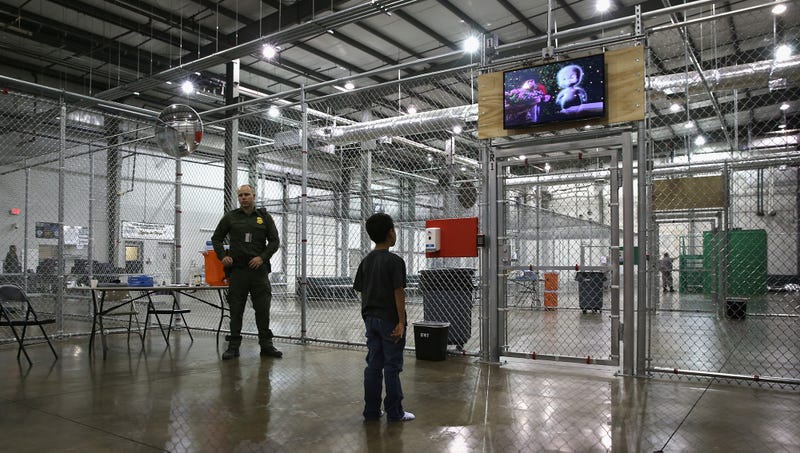
Recent incidents of Trump officials being confronted in public for their role in the administration’s separation and imprisonment of immigrant families have driven renewed concern about the lack of civility in U.S. politics. The Onion presents tips for staying civil in a debate about child prisons.


Avoid unkind generalizations like equating the jailing of ethnic minorities with some malevolent form of fascism.


Consider that we all have different perspectives stemming from things like age, ethnicity, or level of racism.


Recall that violently rejecting a tyrannical government goes against everything our forefathers believed in.


Find common ground by recognizing that some kids are huge assholes.


Make sure any protests are peaceful, silent, and completely out of sight of anyone who could actually affect government policy.


Give your political opponents the benefit of the doubt by letting this play out for 20 years and seeing if it gets any better on its own.


Realize that every pressing social issue is solved through civil discourse if you ignore virtually all of human history.


Remind yourself that you’re just two people having a cocktail at the same D.C. party and that politics is a game to you.


Avoid painting with a broad brush. Not everyone in favor of zero-tolerance immigration wants to see children in cages—it’s more likely that they just don’t care.


Tuesday, June 26, 2018

'Electrogeochemistry' captures carbon, produces fuel, offsets ocean acidification


June 25, 2018

University of California - Santa Cruz

Limiting global warming to 2 degrees Celsius will require not only reducing emissions of carbon dioxide, but also active removal of carbon dioxide from the atmosphere. This has prompted heightened interest in 'negative emissions technologies.' A new study evaluates the potential for recently described methods that capture carbon dioxide from the atmosphere through an 'electrogeochemical' process that also generates hydrogen gas for use as fuel and creates by-products that can help counteract ocean acidification.


Limiting global warming to 2 degrees Celsius will require not only reducing emissions of carbon dioxide, but also active removal of carbon dioxide from the atmosphere. This conclusion from the Intergovernmental Panel on Climate Change has prompted heightened interest in "negative emissions technologies."

A new study published June 25 in Nature Climate Change evaluates the potential for recently described methods that capture carbon dioxide from the atmosphere through an "electrogeochemical" process that also generates hydrogen gas for use as fuel and creates by-products that can help counteract ocean acidification.

First author Greg Rau, a researcher in the Institute of Marine Sciences at UC Santa Cruz and visiting scientist at Lawrence Livermore National Laboratory, said this technology significantly expands the options for negative emissions energy production.

The process uses electricity from a renewable energy source for electrolysis of saline water to generate hydrogen and oxygen, coupled with reactions involving globally abundant minerals to produce a solution that strongly absorbs and retains carbon dioxide from the atmosphere. Rau and other researchers have developed several related methods, all of which involve electrochemistry, saline water, and carbonate or silicate minerals.

"It not only reduces atmospheric carbon dioxide, it also adds alkalinity to the ocean, so it's a two-pronged benefit," Rau said. "The process simply converts carbon dioxide into a dissolved mineral bicarbonate, which is already abundant in the ocean and helps counter acidification."

The negative emissions approach that has received the most attention so far is known as "biomass energy plus carbon capture and storage" (BECCS). This involves growing trees or other bioenergy crops (which absorb carbon dioxide as they grow), burning the biomass as fuel for power plants, capturing the emissions, and burying the concentrated carbon dioxide underground.

"BECCS is expensive and energetically costly. We think this electrochemical process of hydrogen generation provides a more efficient and higher capacity way of generating energy with negative emissions," Rau said.

He and his coauthors estimated that electrogeochemical methods could, on average, increase energy generation and carbon removal by more than 50 times relative to BECCS, at equivalent or lower cost. He acknowledged that BECCS is farther along in terms of implementation, with some biomass energy plants already in operation. Also, BECCS produces electricity rather than less widely used hydrogen.

"The issues are how to supply enough biomass and the cost and risk associated with putting concentrated carbon dioxide in the ground and hoping it stays there," Rau said.

The electrogeochemical methods have been demonstrated in the laboratory, but more research is needed to scale them up. The technology would probably be limited to sites on the coast or offshore with access to saltwater, abundant renewable energy, and minerals. Coauthor Heather Willauer at the U.S. Naval Research Laboratory leads the most advanced project of this type, an electrolytic-cation exchange module designed to produce hydrogen and remove carbon dioxide through electrolysis of seawater. Instead of then combining the carbon dioxide and hydrogen to make hydrocarbon fuels (the Navy's primary interest), the process could be modified to transform and store the carbon dioxide as ocean bicarbonate, thus achieving negative emissions.

"It's early days in negative emissions technology, and we need to keep an open mind about what options might emerge," Rau said. "We also need policies that will foster the emergence of these technologies."


Story Source:

Materials provided by University of California - Santa Cruz. Original written by Tim Stephens. Note: Content may be edited for style and length.


Journal Reference:

Greg H. Rau, Heather D. Willauer, Zhiyong Jason Ren. The global potential for converting renewable electricity to negative-CO2-emissions hydrogen. Nature Climate Change, 2018; DOI: 10.1038/s41558-018-0203-0


Sunday, June 24, 2018

The eurozone isn’t ready for the next big shock


MADRID — The return to economic growth in the eurozone has produced a dangerous sense of complacency on the Old Continent, especially in the richer countries of the north. But Italy’s flirtation with an exit from the euro under a populist government is a stark reminder that, if left unaddressed, the deep structural weaknesses that plague the single currency could trigger an existential crisis across the EU. It would be a mistake, therefore, to believe we can drive along in business-as-usual mode, or just take a few small steps toward more European integration.

This week’s Meseberg Declaration signed by Angela Merkel and Emmanuel Macron, although a step in the right direction, is part of a collective denial about what needs to be done. You don’t need to be a populist to recognize that Europe’s monetary union is dysfunctional and in dire need of more substantial reforms that those proposed by Germany and France.

To keep the single currency alive, it needs two major structural improvements.

First, it needs to reduce the fragmentation in Europe’s banking system that has caused the Continent to experience more severe crises than other parts of the world — most notably in comparison to the U.S.

Second, it has to develop a streamlined and legitimate decision-making process to respond quickly and boldly to the next major recession.

The next crisis is likely to hit some countries harder than others. The problem is that the only tools at the eurozone’s disposal to tackle these recessions are internal devaluations — which invariably lead to income cuts and job losses.

The European Commission, academics and national governments broadly agree on this diagnosis. The problem is that there is no consensus on the way forward.

Some argue that eurozone countries should take on more responsibility when it comes to prevention and reform. That means putting public finances in order, boosting the solvency of banks — by reducing the incidence of non-performing loans — and reforming their labor and product markets.

Action at EU level, according to this view, should only become an option when each country has taken the necessary measures to get their house in order. In other words, risks should be minimized before they are shared among the group.

But the experience of Spain and others shows that this approach, although it may work in normal times, tends to produce unnecessary economic damage during a crisis. The strategy of placing most of the burden on crisis-stricken countries under the adjustment logic of the so-called troika can — in the long run — prove to be politically unsustainable and undermine European citizens’ confidence in the euro. We saw it in Greece. We are now seeing it in Italy.

Yes, Germany carried out successful reforms in the early 2000s. But their success owes much to the fact that other European countries were sustaining demand for German goods and services. What might be good for one country can be damaging if several countries act at the same time.

We need to be more ambitious than simply proposing a eurozone budget. Designing a relatively well-sourced fiscal capacity, managed by a central fiscal authority at the European level will be crucial to offset country-specific shocks.

This can take several forms: a Europe-wide fund to be mobilized depending on a country’s circumstances, an investment fund; or an unemployment reinsurance system that tops up national schemes. What matters is that it can be quickly activated in the event of a major shock and that there are safeguards to avoid irresponsible behavior.

This eurozone budget — which should be closer to €100 billion than the €10 billion presently foreseen — would smooth macroeconomic shocks and fund pan-European projects to increase growth potential, ensure sufficient public investment, reduce inequality, protect the borders and facilitate debt sustainability.

It would be an ambitious measure, and it can only happen if there is trust among member countries and a willingness to pool more fiscal sovereignty. For it to work, every member country would need the backing of its citizens.

Merkel and Macron neglect this point in their declaration. But the truth is that reform will be politically impossible without first explaining to voters why their government needs to contribute to a eurozone-wide fund, when it should be activated and how it should be deployed. The eurozone is, after all, a public good. Politicians have a responsibility to make a convincing case for why it needs a eurozone budget to sustain it.

They must also address the concern — common in northern member countries — that creating a central fiscal capacity will encourage some to misbehave and overspend.

This can be avoided with the right incentives. The new framework should be set up in a way that ensures that only countries that stick to fiscal prudence and commit to structural reforms will receive support.

The question of what happens when a member country misbehaves must also be answered. Introducing formal sovereign debt restructuring in the eurozone to ensure market discipline ex ante — as Merkel has suggested — is problematic.

As long as the central fiscal capacity is not large enough — and it won’t be for some time — sovereign debt restructuring will be both traumatic and destabilizing for Europe as a whole. Instead, a member country should be able to obtain financial support from the central fiscal authority, while relinquishing its fiscal sovereignty temporarily, and signing a memorandum of understanding of macroeconomic reforms.

This fiscal authority would have to represent the interests of the eurozone as a whole and not the sum of the individual members, as is now the case with the European Stability Mechanism as well as the future European Monetary Fund proposed by Merkel and Macron.

To ensure this, the permanent head of the central fiscal authority should be put forward by the Eurogroup and ratified by a newly established euro committee in the European Parliament.

The bottom line is simple. For the eurozone to be successful, we need to inject more democratic legitimacy into how it is governed.


Miguel Otero-Iglesias is senior analyst at Elcano Royal Institute and professor at the IE School of International Relations. Raymond Torres is director for macroeconomic and international analysis at FUNCAS. They are co-authors of the paper “Quit kicking the can down the road: A Spanish view of EMU reforms.”


The POLITICO Global Policy Lab is a collaborative journalism project seeking solutions to pressing policy problems. Join the community


An Increasing Number of Struggling Americans Are Turning to Check Cashers and Payday Loans


There’s an idea in America that if you are “financially literate,” there is a specific way you bank: You have a checking account and a savings account at a big-name bank. You have your checks from your employer directly deposited every two weeks, like clockwork, and you save at least 10 percent out of every check, until you have enough saved to cover living expenses for six to eight months. You contribute to a 401k your employer matches, and your health insurance—which your employer pays for—offers full coverage for you and your family with, perhaps, a $30 co-pay.

The problem with this scenario is that, increasingly for a growing segment of the American population, it is a total myth.

The reality is that a growing number of Americans don’t have this type of employment. Mainstream banks are expensive to use. And the middle class has been rapidly pushed—well, down.

Enter Lisa Servon, a professor and chair in the Department of City and Regional Planning at the University of Pennsylvania. She’s also the author of The Unbanking of America, an at-times startling look at the way Middle America is surviving in an increasingly tumultuous U.S. economy.

Servon started her research on specifically how the middle class is using check cashing and payday loans when she started reading about how low-income people didn’t know any better. The theory—which you are probably familiar with—says that the poor and people of color don’t use mainstream banks because they aren’t financially savvy. They are, the insinuation goes, stupid about money.

“Something struck me as off,” with that theory, Servon told the Independent Media Institute in a phone interview. “I knew people weren’t stupid. Or wasting money.”

So, Servon started looking at how, and why, people use check cashing and payday loans.

In a nutshell: Most people are using them because they’re not making a high enough minimum wage, and the economy is unstable—the perfect environment for the “alternative financial services” industry to flourish in.

The mainstream often sees this type of financial model as “something that’s wrong with the person using it,” Servon says. “I think there has been a belief people start as unbanked [not using mainstream banks] and move to banked and then they stay there.”

“The job of policymakers,” she says, “is to get them to be banked and to stay there.”

The problem with that is, of course, life, and employment, in the U.S. is more like a jungle gym than the traditional ladder of success that was popularized nearly a century ago. The ladder model is archaic.

Today, people are working at gig economy jobs more and more—they no longer know how much money they’ll make next month or next year, let alone next week.

Adding to the uncertainty is that health insurance is costly and comes with expensive co-pays that policies didn’t have just a few years ago. While it might not have cost much to give birth in a hospital (for someone gainfully employed and with health insurance) just a few years ago, the cost—even if the employer hasn’t changed—has gone up: What cost a few hundred dollars before is suddenly $3,000. That same family might have to turn to a payday loan just to have a baby.

Using these alternative financial services, then, “is not really a function of intelligence,” says Servon. It’s a part of surviving.

Therefore, says Servon, the idea that “If they only knew how to do things right, they would bank the way we think they should,” is not what’s happening.

“People who are taking payday loans are people who make $50,000, $60,000, $70,000 a year, own their homes and have a college education. That’s the fastest-growing group. It’s not people who ‘don’t know better.’”

Banks have become more expensive, says Servon, making more of their money from fees, and that automatically excludes people who can’t afford it.

There are three other primary reasons for the switch of the middle class from big banks to check cashers and payday loans: The increase in income volatility—people making different amounts of money week to week. “Income volatility has doubled in the last 30 years, so we have twice as much instability today. People’s ability to predict what is coming into the household has changed radically,” says Servon.

Additionally, since the 1970s, people have been making less money. “We see productivity rising, but the benefit of that is being accrued to a smaller number of people,” Servon adds.

Finally, Servon says we’ve experienced what’s known as the “great risk shift”: Decades ago, the public and corporate sector took on more of the risk of being sick or retiring early. Today, she says, “people’s employment comes with less insurance, less benefits. All that risk is now shifted on to individuals.”

All of this, she says, puts the middle class into a much more precarious situation.

According to her best estimation, nearly 30 percent of the U.S. population now uses alternative financial services. While check cashing specifically will decline as more and more people use technology to make payments, there will still be growth in the industry, such as with loans.

“People aren’t stupid,” says Servon. “It’s not just the poor and people of color, but one of your kids teachers, your dental hygienist. We have so much shame about money, people aren’t comfortable talking about it.”

So what’s to be done?

For one, we need more, and better, regulation of banks, she says.

Even though she acknowledges that might not be realistic right now, “You can’t give up,” she says. “You need to be ready,” so when the time comes, you’re prepared to take action to push for the right change.

In the interim, she supports educating people of all kinds of what better financial options are, such as shifting from a bank to a credit union. (Credit unions are non-profit.)

People can also find a community bank or a bank that is social justice–oriented.

Another point Servon stresses: “It’s not just low-income people suffering.” For her, it’s important people understand the people suffering from the current economic climate are those they can relate to.

After all, check cashing and payday loans or lack of financial literacy aren’t the source problems. Rather, these types of systems are symptoms of an unhealthy economic climate overall.

“Even if you could completely change the financial services, it doesn’t address poverty,” Servon says. Higher minimum wages are an important component, along with better health care, child care, and “all the things that make people more stable… We need to keep arguing for those things.”


Will US lose global influence after Human Rights Council pullout?


https://www.youtube.com/watch?v=TcwLYYfKT3E


Žižek’s Less Than Nothing: Chapter 6 - Not Only As Substance, But Also As Subject (Part 1)


https://www.youtube.com/watch?v=4SGIuW7bfPg