Monday, May 7, 2018

The water war that will decide the fate of 1 in 8 Americans


By Eric Holthaus on May 2, 2018


Lake Mead is the country’s biggest reservoir of water. Think of it as the savings account for the entire Southwest. Right now, that savings account is nearly overdrawn.

For generations, we’ve been using too much of the Colorado River, the 300-foot-wide ribbon of water that carved the Grand Canyon, supplies Lake Mead, and serves as the main water source for much of the American West.

The river sustains one in eight Americans — about 40 million people — and millions of acres of farmland. In the next 40 years, the region is expected to add at least 10 million more people, as the region’s rainfall becomes more erratic.

An especially dismal snowpack this past winter has forced a long-simmering dispute over water rights to the fore, one that splits people living above and below Lake Mead.

It’s a messy, confusing situation, so here’s an overview of who’s involved and what’s at stake:

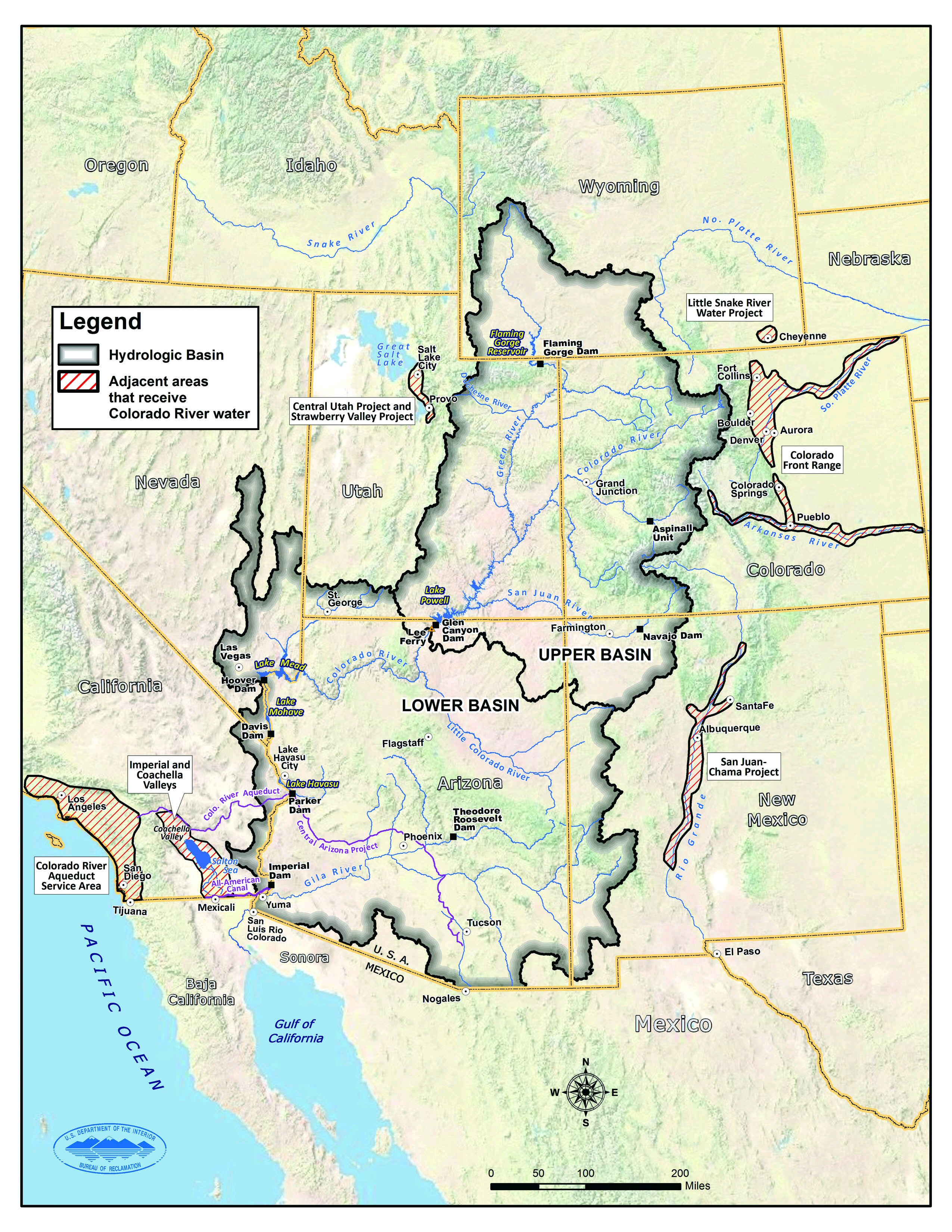
Users of Colorado River water below Lake Mead — including the cities of Phoenix, Los Angeles, Las Vegas (collectively referred to as the “lower basin”) — rely on the reservoir as a lifeline. The people in the lower basin exist partly at the mercy of what happens in the upper basin, an area encompassing the snowcapped peaks of Wyoming, Utah, Colorado, and northern New Mexico, the source region of the river.

Big water users in the upper basin — Salt Lake City, Denver, Albuquerque, among others — are also getting nervous because snowpack in the Rockies has been dwindling, and there’s no physical way for them to store the water they depend on. There are no big reservoirs in the Rockies.

In recent weeks, tensions are rising after states in the upper basin sent a strongly worded letter to one of the river’s biggest users, the Central Arizona Water Conservation District, or CAWCD, which supplies water to Tucson and Phoenix. The upper basin states accused the utility of manipulating the complex system that governs Lake Mead in order to get more water. The Arizona utility denied the charges.

An upper basin city — Pueblo, Colorado — then pulled out of a regional conservation program, further threatening the spirit of long-term cooperation throughout the Colorado River basin. Denver has threatened to do the same. The quick escalation shows just how fragile the system really is.

In an email to Grist, Kathryn Sorensen, director of Phoenix’s Water Services Department, says the city “does not and has never supported CAWCD’s attempt to draw additional water” from the Colorado River. She said that the only way forward “is through collaboration among all stakeholders in the basin.”

The whole thing feels like the beginnings of a water war fought with cryptic, wonky tweets. As longtime Western water journalists Luke Runyon and Bret Jaspers recently wrote, “public shaming is how water managers police themselves.”

What’s happening could be seen as the slow death of an era of easy living, the unwinding of a nearly 100-year-old series of multi-state compacts (collectively called “The Law of the River”) that’s been widely viewed as too permissive. Over-reliance on the Colorado River has helped pave the way for rapid population growth across the region, from Southern California to Denver, which may now, ironically, begin to pose a threat to those same cities.

For many reasons, Arizona is last in line for the Colorado River’s water, and the state is already preparing for the mandatory restrictions that could be less than two years away. The latest official projections from the U.S. Bureau of Reclamation, the federal agency that manages the Colorado River system, shows that Lake Mead is likely to dip below the critical threshold of 1,075 feet above sea level late next year. That could trigger the first official “call on the river” — a legally-mandated cutback for certain users aimed at avoiding an all-out free-for-all.

In Phoenix, a worst-case scenario is now looking more and more likely. In just a few years from now, if (or, when) Lake Mead dips below 1,075 feet, the city may find itself in a position where it stops building new subdivisions, the state’s agricultural economy comes crashing to a permanent halt, and a fit of well-drilling begins to deplete the local groundwater.

And then there’s always climate change. On the world’s current emissions trajectory, sharply warming temperatures boost the odds of a megadrought in the Southwest sometime later this century to more than 99 percent. Such a drought would last a generation. Nearly all trees in the Southwest could die. The scale of the disaster would have the power to reshape the course of U.S. history.

For now, the spat over the Colorado River offers a glimpse into water politics in an era of permanent scarcity. The low snowpack in the upper basin states means that inflows into Lake Mead will be just 43 percent of normal this year, raising the stakes for conservation programs throughout the West. In the midst of long-running drought, 2017 was the most successful year for water conservation in decades — which is evidence that when there’s less water around, people can make things work.

“We must all find a way to collectively use less water while respecting the Law of the River,”Sorensen says. “That’s of course a tricky proposition because the Law of the River is basically the most complex governance structure ever created by human beings.”


Tyler Cowen, Koch Brothers Funding, Mercatus Center, George Mason University, and Academic Freedom


By Jerri-Lynn Scofield


It’s not exactly breaking news to assert that big donors– such as the Koch Brothers– spend money to manipulate public policy. Some expenditures take the form of political contributions, while other funding seeks to shape the production and dissemination of ideas– either through the media or in academia.

Last week, documents released during discovery in a lawsuit filed against George Mason University provide a window into the details of how this influence is exerted. The suit was filed by the activist group Unkoch My Campus, and out to compel George Mason University (GMU) to release donor agreements, citing Virginia public disclosure laws. Emails and supporting documentation are found here.

Wowsers! Let the games begin.

Antonin Scalia Law School, Federalist Society, Corrupt Admissions Decisions

The NYT (here and here), WaPoTruthout all featured coverage last week of the disclosures. I found Truthout most useful for distilling the salient points about donor influence at the recently renamed Antonin Scalia Law School, following a $30 million anonymous donation. I’ll address the law school situation first.

The Truthout account discusses the role of the Federalist Society for Law and Public Policy Studies– the rightwing organisation that has had an outsize impact on judicial selection for decades, most recently in the appointment of Neal Gorsuch to the Supreme Court– in how the law school will use its windfall:

In the newly released emails between Federalist Society leaders, the dean of the law school and other top officials plot out additional ways to use the donation, communicating about a “five-year plan” for the law school and candidates for new professorships, potential students and judicial clerk positions.

So far, really nothing out of the ordinary, this is business as usual for the Federalist Society.  Some further details from the Grey Lady story, What Charles Koch and Other Donors to George Mason University Got for Their Money:

Emails disclosed by the university show that Federalist Society officials were also involved in hiring discussions and had suggested a student for admission. In turn, a professor at the law school wrote the society asking for help securing recommendations for prestigious federal judicial clerkships for students active in the society.

As is far from unusual in such situations, the problem only arose with the cover-up, When asked by the faculty what conditions applied to this anonymous donation, the provost tried to obfuscate. Over to Truthout:

At a faculty senate meeting on April 6, 2016, George Mason University Provost S. David Wu told faculty and university officials that the donations came with “no strings attached, and the scholarship decisions are made by GMU. The entire $30M is for scholarships for students and nothing else.”

The story may have held– until last week’s document dump. Oops! Truthout again:

The emails between donors and the law school that were disclosed on Monday tell a different story. The emails, which law school alumna Allison Pienta requested and then released through UnKoch My Campus, show Leo and Butler sharing information about faculty hiring, prospective law students, judicial law clerk suggestions, allocation of the grant money and even about faculty taking leave to work in the Trump administration.

We all know this goes on, of course. Does anyone think that these extreme libertarian and right-wing ideas are so widespread because they’re actually better ideas? No, I don’t think so. If you do, I have some old Tsarist bonds I’d like to sell you.

But first, allow me a brief aside: kudos to the people– largely students– who’ve organised to UnKoch their university.  Just like the students responsible for the gun movement, they’re actually trying to address, do something to change things– rather than throwing up their hands in despair — or capitulating to cynical realism– and saying that’s just the way of the world, folks.

Restricting Academic Freedom: Mercatus and the Economics Faculty

NC is primarily an economics and finance blog, so what I’m most interested in discussing in this post is not the goings on at the law school, but just how donor influence shaped academic hiring and retention decisions, in the economics faculty and at the Mercatus Center, described by WaPo as “a free-market research group that is based at the university but is an independent organization.” In particular, I will note the role of economist and Mercatus Center Director Tyler Cowen in at minimum signing off on these funding agreements with the Kochs and other funders. Cowen’s  prominently highlighted in both the press release and underlying supporting documents, but curiously — ahem– absent in both the NYT and WaPo accounts.

These documents show Cowen– in his role as general director of the Mercatus Center– signing off on agreements creating Mercatus Center/Economics Professorships (see, e.g.,2003 Mercatus Smith Chair July 14, 2003;2007 Mercatus Smith/Koch Professorship June 11, 2007; 2007 Mercatus BB&T professorship (Boettke) June 11, 2007; 2007 Mercatus Smith Bastiat Professorship June 11, 2007; 2007 Mercatus BB&T Professorship Leeson (June 11, 2007): 2007 Mercatus Tullock Black Professorship  August 8, 2007; 2007 Mercatus Fullinwider ProfessorshipAugust 8, 2007; 2009 Mercatus Charles Koch Professorship month unclear/3/9; 2011 Mercatus BB&T Professorship (Boettke)

That these agreements violate standard academic norms was conceded almost immediately after the documents were released in an email GMU president Ángel Cabrera sent on April 27, 2018:

As a result of a FOIA request, last week I was made aware of a number of gift agreements that were accepted by the university between 2003 and 2011 and raise questions concerning donor influence in academic matters. The gifts were in support of faculty positions in economics and granted donors some participation in faculty selection and evaluation. Except for the most recent one, these agreements have expired.

The agreements did not give donors control over academic decisions, and all but the earliest of these agreements explicitly stated that the final say in all faculty appointments lies in university procedures. Yet these agreements fall short of the standards of academic independence I expect any gift to meet. [ Jerri-Lynn here: my emphasis.]

Since I arrived at Mason in 2012, I have made it a priority to have all gift agreements clearly uphold our commitment to academic independence. As I have stated before, gifts may be earmarked for programs, scholarships or faculty support, but donors may not determine what is taught, what student is funded, or what professor is hired. If these terms are not acceptable to donors, the gifts are kindly declined.

Two points: first, this is as clear an admission as one could possibly expect from a university president that norms of “academic independence” have been violated at his/her institution.

Second, Cabrera asserts that the problem has been corrected since he arrived at GMU. It’s hard to say whether to credit this denial. The date of the latest disclosed agreement pis 2011. Absent access to subsequent agreements, we simply cannot know whether Cabrera is telling us the truth. It’s a cliche but no less true that it’s difficult to prove a negative. In the case of the law school (discussed above), what the provost said the agreements said was simply not true. I suppose we’ll have to wait to see how the litigation pays out before we know whether there will be any more such agreements disclosed.

I’d like to delve a bit further into just exactly how “these agreements fall short of the standards of academic independence I expect any gift to meet.”

I’m no expert on the sort of contract. But what leapt out at me was the role allowed for donors on the selection committee– that set the initial shortlist of candidates; and the advisory committee– whose members were drawn from the selection committee, and who evaluated the professor’s work, and could recommend dismissal. As to the second point, whether there were donors present or not, the role of the advisory committee in annually assessing a professor’s work set off screaming alarm bells for me.

Let’s start with selection. Each of the 2007 and 2009 agreements specified:

2. Selection Committee. The Selection Committee shall have five (5) members. The decision-making rule for the Selection Committee shall be majority vote, except in the case of changing or providing additional objectives or requirements, in which case the decision-making rule shall be by unanimous vote. The members of the Initial Selection Committee (i.e., the Selection Committee that chooses an Initial Professor as defined in Section4,infra) will be: the President or Executive Director of Mercatus or the most closely corresponding position, two (2) members designated by the two donors that initiated the challenge, one of whom must be a member of the GMU faculty, the Chair of the GMU department where it is anticipated the Professor will receive the majority or all of his appointment, and one (1) member of the same department, to be designated by the department Chair. In addition to the Selection Committee, candidates will also interview with specific members of Mercatus staff appointed by Mercatus General Director (2007 Mercatus Smith/Koch Professorship June 11, 2007; [Jerri-Lynn here. My emphasis.I’m quoting here from one of the agreements I linked to above. The other 2007 and 2009 agreements are similar– if not identical.]

Boiling this down “two donors that initiated the challenge” means the donors– the challenge the agreement refers to is the fundraising goal. This agreement gives the donor control over two out of five members who do the initial selection of  the candidate.  Now, it may be true, that the final selection is done according to the normal academic norms of the institution. But by then, the fix would have been in, and the selection committee would have enormous influence over who was ultimately elected– simply by virtue of being allowed to make the initial selection.

Now for more interesting stuff.  Okay, so the donor selects the candidate. Suppose that candidate keeps his or her head down, and waits until s/he’s appointed to pursue academic inquiries, without fear or favour. How would the donor exercise subsequent control over the professor’s work?

I’m glad you asked.

Section 4 of the agreement provides just exactly how an advisory committee– comprised of a subset of that selection committee with two donor-approved members–  will post facto sign off on the professor’s work, as laid out below.

4. Advisory Board. An Advisory Board shall be created and made up of three members of the selection committee to be appointed by the Mercatus executive director to receive an annual summary of the activities, accomplishments, and expenditures of the Professorship and to review the administration of the agreement and a budget and plan for the subsequent academic year. In doing so, it shall have the right to:

Consult with the Selection Committee or the Mercatus Center or the grantor regarding the qualifications of candidates for the Professorship;

Discuss with the Grantees and their representatives/affiliates, their administrative officers or trustees, the appointment of an occupant of the Professorship and any other matters relating to carrying out the purposes for which the Professorship is established;

Ensure compliance with the terms of this agreement through appropriate administrative or legal channels;

Make periodic assessments of the Professor’s performance and/or activities; an

Make a determination (based on the individual’s performance or otherwise) that the professor filling the Professorship is no longer qualified to do so, and upon this determination will submit in writing to GMU and to Mercatus a recommendation that the professor be removed from the Professorship (2007 Mercatus Smith/Koch Professorship).

The Advisory Board shall have no authority or control, either directly or indirectly over the administration of the Professorship or the selection of the occupant of the Professorship except through its determination of an occupant’s continued qualification to fill the professorship and shall only act as a body that has a continuing interest in seeing that the terms and conditions of this agreement.

In Uncovering Koch Role in Faculty Hires, Inside Higher Ed identifies in precisely what respect these agreements are unusual (to say the least):

It is of course common for donors who support professorships to specify the academic field or subfield. So while the Koch family’s extensive giving to antiregulatory causes in politics is controversial, it is not necessarily controversial that they fund professorships in economics and even free-market economics. But academic values have long held that donors don’t get to pick who holds chairs, or evaluate them.

Indeed. I have nothing to add so I won’t make this post any longer than it needs to be.

The Bottom Line

For the last word in what’s at stake here, let me turn again to the WaPo account, quoting a GMU professor:

“It’s now abundantly clear that the administration of Mason, in partnership with the Mercatus Center and private donors, violated principles of academic freedom, academic control and ceded faculty governance to private donors,” said Bethany Letiecq, an associate professor of human development and family science at George Mason.

Letiecq, who is president of George Mason’s chapter of the American Association of University Professors, said she was bothered by language that indicated donors had power in faculty hiring and a voice in decisions about whether professors remain at the school.

“These are all gross violations of academic freedom,” she said. “Faculty hiring and faculty retention are not the business of donors, in any way, shape or form.”

What Is To Be Done?

To answer this question, let me permit me turn to Letiecq again:

But Letiecq, the George Mason professor, said faculty members have been pushing Cabrera for information for years, trying to figure out whether academic freedoms were being violated at the school.

“And now we clearly understand that they were,” she said. “And so, the next question is, what are they going to do about it?”

That, my friends, is the question.


Sunday, May 6, 2018

Should Donald Trump get the Nobel Peace Prize?


Slavoj Žižek


Donald Trump should not receive the Nobel Peace prize. But will he? The French have a beautiful expression, "voyons voir," which can be roughly translated as "let's wait and see what happens."

Four US presidents have already been awarded with the Nobel Peace Prize: Theodore Roosevelt, Woodrow Wilson, Jimmy Carter (after leaving office), and Barack Obama in 2009 for his "extraordinary efforts to strengthen international diplomacy and cooperation between people." Now, this explanation was complete fakery, and it merely expressed the hope that Obama would act like that going forward.

As unbelievable as the proposal for Trump to get the Nobel Peace Prize is, we should nevertheless react to it in three ways.

First, we should bear in mind that the great compromise which enabled the breakthrough towards a peaceful resolution of the Korean crisis was made not by Trump but by Kim Jong-un. It was Kim who made the key concession, which means any prize should be directed to the pair jointly. And the weakness of this idea is obvious – it would invite ridicule to hand the Nobel Peace Prize to the head of arguably the most oppressive regime in the world.

Second, remember how, a little while ago, Trump was competing with Kim about the buttons to trigger nuclear missiles that they have at their disposal, with the American claiming his button is bigger than that of his counterpart in Pyongyang.

As such, the extreme oscillations in the public perception of the Korean crisis are significant. One week, we are told we are on a brink of nuclear war; then there is a week of respite, then the war threat explodes again.

Different vibes

When I visited Seoul in August 2017, my friends there told me there is no serious threat of a war because the North Korean regime knows it cannot survive it. Yet, the South Korean authorities have often prepared their population for a nuclear war.

And, lately, our media has reported on the more and more ridiculous exchange of insults between Kim Jong-un and Donald Trump. But the irony of the situation is that, when we get (what appears to be) two immature men letting go of their rage and hurling insults at each other, our only hope is that there is some anonymous and invisible institutional constraint preventing their rage to explode into a full-on war.

Usually, we tend to complain that in today's alienated and bureaucratized politics, institutional pressures and constraints prevent politicians from expressing their personal visions. But, in this case, we hope such constraints will prevent the expression of all too crazy personal visions.

Thus, should Donald and Kim really be rewarded just for performing a sudden U-turn and not acting as crazy as we feared?

Third, the unpleasant truth (for leftist liberals) is that, far from being just the bellicose crazy US leader, Trump hasn't turned out so bad in comparison with Hillary Clinton.

Indeed, asked by The Guardian whether she truly believes Clinton would be more dangerous than Trump, the actress Susan Sarandon responded: "I did think she was very, very dangerous. We would still be fracking, we would be at war [if she were president]. It wouldn't be much smoother.

"Look what happened under Obama that we didn't notice. She would've done it the way Obama did it, which was sneakily. He deported more people than have been deported now. How he got the Nobel Peace Prize, I don't know," she added.

Indeed, we should thus always bear in mind that, at his worst, Trump is mostly just continuing the politics of his predecessors.

Close shave

Who, then, really deserves the Nobel Peace Prize? Probably, those who, for sure, will never get it. Try to recall a frightening detail from the Cuban missile crisis: only later did we learn how close to nuclear war we were during a naval skirmish between an American destroyer and a Soviet B-59 submarine off Cuba on October 27, 1962.

The destroyer dropped depth charges near the submarine to try to force it to surface, not knowing it had a nuclear-tipped torpedo. Vadim Orlov, a member of the submarine crew, told the conference in Havana that the submarine was authorized to fire if three officers agreed. The officers began a fierce shouting debate over whether to sink the ship. Two of them said Yes and the other said No.


"A guy named Arkhipov saved the world," was a bitter comment of a historian on this accident.

Do we not all silently count on something similar in the heated exchange between the US and others – that, at a decisive moment, a single individual will find strength to cut short the mad circle of nuclear threats and counter-threats?

A similar act, much less known, was also committed in the Soviet Union in an even darker time. Sophia Karpai was the head of the cardiographic unit of the Kremlin Hospital in the late 1940s. Her (accidental) misfortune was that it was her job to take twice the electrocardiogram of Andrei Zhdanov, on July 25 1948 and on July 31, days before Zhdanov's death, due to heart failure.

The first ECG, taken after Zhdanov displayed some heart problems, was inconclusive (a heart attack could be neither confirmed nor excluded), while the second one surprisingly showed a much better picture (the intraventricular blockage disappeared, a clear indication that there was no heart attack).

Doctor's plot

In 1951, she was arrested on charges that alleged, in a conspiracy with other doctors treating Zhdanov, she falsified the data, erasing the clear indications that a heart attack did occur, thereby depriving Zhdanov of the special care needed by a victim of cardiac arrest. After harsh treatment, including a brutal beating, all the other accused doctors confessed. "Sophia Karpai, whom her boss doctor Vinogradov had described as nothing more than 'a typical person of the street with the morals of the petty bourgeoisie,' was kept in a refrigerated cell without sleep to compel a confession. However, she did not confess." (Jonathan Brent and Vladimir P. Naumov, Stalin's Last Crime, New York: HarperCollins 2003, p. 307) And the impact and significance of her perseverance cannot be overestimated: her signature would have dotted the 'i' on the prosecutor's case on the "doctor's plot," immediately setting in motion the mechanism that, once rolling, would lead to the death of hundreds of thousands, maybe even to a new European war (according to Stalin's plan, the "doctor's plot" should have demonstrated that the Western intelligence agencies tried to murder the top Soviet leaders, and thus served as an excuse to attack Western Europe).

She persisted just long enough for Stalin to enter his final coma, after which the entire case was immediately dismissed. And her simple heroism was crucial in the series of details which, "like grains of sand in the gears of the huge machine that had been set in motion, prevented another catastrophe in Soviet society and politics generally, and saved the lives of thousands, if not millions, of innocent people." (Op.cit., p. 297)

This simple persistence against all odds is ultimately the stuff true heroes are made of. We learn about such cases only sometimes and only years later. So, if there is to be a minimal justice in who gets the Nobel Peace Prize, it should be given neither to active politicians for their present acts (i.e., for just no being as brutal as one expected them to be) nor to politicians for their future expected acts; the prize should be given retroactively, to nameless heroes like Arkhipov and Karpai.


I Know Which Country the U.S. Will Invade Next


By the end of this column, it will be clear which country the United States will invade and topple next. Or failing that, it will be clear which country our military-intelligence-industrial complex will be aching to invade next.

We all want to know why America does what it does. And I don’t mean why Americans do what we do. I think that question still will be pondered eons from now by a future professor showing his students a video mind-meld of present-day UFC fighters booting each other in the head while thrilled onlookers cheer (not for either of the fighters but rather for more booting in the head).

But we all seem to assume that America—the entity, the corporation—has some sort of larger reasoning behind the actions it takes, the actions put forward by the ruling elite. And almost all of us know that the reasons we’re given by the press secretaries and caricature-shaped heads on the nightly news are the ripest, most fetid grade of bullshit.

We now know that the invasion of Iraq had nothing to do with weapons of mass destruction. We now know that the crushing of Libya had nothing to do with “stopping a bad man.” If one does even a cursory check of what dictators around the world are up to recently, you’ll find that the U.S. doesn’t care in the slightest whether they are bad or good, whether they’re using their free time to kill thousands of innocent people or to harmonize their rock garden. In fact, the U.S. gives military aid to 70 percent of the world’s dictators. (One would hope that’s only around the holidays though.)

So if it’s not for the stated reasons, why does the U.S. overrun, topple and sometimes occupy the countries it does? Obviously, there are oil resources or rare minerals to be had. But there’s something else that links almost all of our recent wars.

As The Guardian reported near the beginning of the Iraq War, “In October 2000, Iraq insisted on dumping the U.S. dollar—the currency of the enemy—for the more multilateral euro.”

However, one example does not make a trend. If it did, I would be a world-renowned beer pong champion rather than touting a 1-27 record. (I certainly can’t go pro with those numbers.)

But there’s more. Soon after Libya began moving toward an African gold-based currency—and lining up all its African neighbors to join it—we invaded it as well, with the help of NATO. Author Ellen Brown pointed this out at the time of the invasion:

[Moammar Gadhafi] initiated a movement to refuse the dollar and the euro, and called on Arab and African nations to use a new currency instead, the gold dinar.

John Perkins, author of “Confessions of an Economic Hitman,” also has said that the true reason for the attack on Libya was Gadhafi’s move away from the dollar and the euro.

This week, The Intercept reported that the ousting of Gadhafi, which was in many ways led by President Nicolas Sarkozy of France, actually had to do with Sarkozy secretly receiving millions from Gadhafi, and it seemed that his corruption was about to be revealed. But, the article also noted, “[Sarkozy’s] real military zeal and desire for regime change came only after [Hillary] Clinton and the Arab League broadcasted their desire to see [Gadhafi] go.” And the fact that Gadhafi was planning to upend the petrodollar in Africa certainly provides the motivation necessary. (It doesn’t take much to get the U.S. excited about a new bombing campaign. I’m pretty sure we invaded Madagascar once in the 1970s because they smoked our good weed.)

Right now you may be thinking, “But, Lee, your theory is ridiculous. If these invasions were about the banking, then the rebels in Libya—getting help from NATO and the United States—would have set up a new banking system after bringing down Gadhafi.”

Actually, they didn’t wait that long. In the middle of the brutal war, the Libyan rebels formed their own central bank.

Brown said, “Several writers have noted the odd fact that the Libyan rebels took time out from their rebellion in March to create their own central bank—this before they even had a government.”

Wow, that sure does sound like it’s all about the banking.

Many of you know about Gen. Wesley Clark’s famous quote about seven countries in five years. Clark is a four-star general, the former head of NATO Supreme Allied Command, and he ran for president in 2008 (clearly he’s an underachiever). But it’s quite possible that 100 years from now, the one thing he’ll be remembered for is the fact that he told us that the Pentagon said to him in 2002: “We’re going to take down seven countries in five years. We’re going to start with Iraq, then Syria, Lebanon, then Libya, Somalia, Sudan. We’re going to come back and get Iran in five years.”

Most of this has happened. We have, of course, added some countries to the list, such as Yemen. We’re helping to destroy Yemen largely to make Saudi Arabia happy. Apparently our government/media care only about Syrian children (in order to justify regime change). We couldn’t care less about Yemeni children, Iraqi children, Afghan children, Palestinian children, North Korean children, Somali children, Flint (Michigan) children, Baltimore children, Native American children, Puerto Rican children, Na’vi children … oh wait, I think that’s from “Avatar.” Was that fiction? My memories and 3-D movies are starting to blur together.

Brown goes even further in her analysis of Clark’s bombshell:

What do these seven countries have in common? … [N]one of them is listed among the 56 member banks of the Bank for International Settlements (BIS). That evidently puts them outside the long regulatory arm of the central bankers’ central bank in Switzerland. The most renegade of the lot could be Libya and Iraq, the two that have actually been attacked.
What I’m trying to say is: It’s all about the banking.

So right now you’re thinking, “But, Lee, then why is the U.S. so eager to turn Syria into a failed state if Syria never dropped the dollar? Your whole stupid theory falls apart right there.”

First, I don’t appreciate your tone. Second, in February 2006, Syria dropped the dollar as its primary hard currency.

I think I’m noticing a trend. In fact, on Jan. 4, it was reported that Pakistan was ditching the dollar in its trade with China, and that same day, the U.S. placed it on the watch list for religious freedom violations. The same day? Are we really supposed to believe that it just so happened that Pakistan stopped using the dollar with China on the same day it started punching Christians in the nose for no good reason? No, clearly Pakistan had violated our religion of cold hard cash.

This leaves only one question: Who will be next on the list of U.S. illegal invasions cloaked in bullshit justifications? Well, last week, Iran finally did it: It switched from the dollar to the euro. And sure enough, this week, the U.S. military-industrial complex, the corporate media and Israel all got together to claim that Iran is lying about its nuclear weapons development. What are the odds that this news would break within days of Iran dropping the dollar? What. Are. The. Odds?

The one nice thing about our corporate state’s manufacturing of consent is how predictable it is. We will now see the mainstream media running an increasing number of reports pushing the idea that Iran is a sponsor of terrorism and is trying to develop nuclear weapons (which are WMDs, but for some strange reason, our media are shying away from saying, “They have WMDs”). Here’s a 2017 PBS article claiming that Iran is the top state sponsor of terrorism. One must assume this list of terror sponsors does not include the country that made the arms that significantly enhanced Islamic State’s military capabilities. (It’s the U.S.)

Or the country that drops hundreds of bombs per day on the Middle East. (It’s the U.S.) But those bombs don’t cause any terror. Those are the happy bombs, clearly. Apparently, we just drop 1995 Richard Simmons down on unsuspecting people.

Point is, as we watch our pathetic corporate media continue their manufacturing of consent for war with Iran, don’t fall for it. These wars are all about the banking. And millions of innocent people are killed in them. Millions more have their lives destroyed.

You and I are just pawns in this game, and the last thing the ruling elite want are pawns who question the official narrative.


If you enjoyed this article, please share it, and check out Lee Camp’s free weekly podcast, “Common Censored.”


The Fed Boosts Wall Street, Not Main Street


When Federal Reserve Chair Janet Yellen left her post in 2018, she secured a spot at the Brookings Institution, a century-old research “think-tank” in the heart of Washington, D.C. Naturally, she also hit the speaking circuit. Her entrée into the upper echelons of revolving-door politics came with a hefty fee.

At a swanky locale in the ultra-expensive Tribeca neighborhood in New York City, Yellen soothed a bunch of A-list elites, saying that inflation wasn’t so high and that rate increases wouldn’t come too quickly. In doing so, she was simply following in the footsteps of her predecessor, Ben Bernanke. After leaving the same post, Bernanke launched his speaking career with, among others, a speech in the United Arab Emirates for which he was paid $250,000. This topped his yearly income at the Fed by 25 percent in one go.

While Bernanke scored big in the Middle East, Yellen’s talk was closer to home. Welcome to Wall Street, Janet.

There was a reason for her landing in downtown Manhattan. She assured the well-coifed pack of 1 percenters that she could speak only for herself—it was important to distinguish that she would not be a brand ambassador on behalf of her successor (and once-upon-a-time number two guy) Jerome Powell. Yet, she knew that somehow her words would escape into the public ether.

They would be comforting words for the financial moguls. For the top 10 percent of the country that own 84 percent of the stock market, her remarks invoked confidence that the status quo of cheap money flowing from the Fed would be preserved. The boat would not be rocked. They could continue enjoying their meteoric rise from the depths of the financial crisis and know their money would remain safe after a decade of the Fed’s “quantitative easing” (QE) policies.

And let’s face it, the event went largely unnoticed. For Washington, the “Trump Show” is in town now. For Wall Street, even during the recent volatility waves, times are still relatively good. That’s why, especially now, understanding what is brewing inside and outside the Fed matters.

From the left to the right of the American political spectrum, few are questioning what the connection between the Fed’s largesse and the financial markets really means. The biggest banks have been experiencing largely unregulated, unlimited, support in the form of Fed policy that has nothing to do with saving, or helping, the Main Street economy.

You can look no further than the latest trend over the last year. The sheer record number of stock buybacks since the financial crisis from the banking sector and other corporate sectors is explosive. Heady stock market levels converted an influx of cheap money into a new kind of share value, one predicated on conjured capital.

Last year, the Fed blessed record stock buybacks for its members (private banks) without a word, let alone a demand, about using that money for true Main Street pursuits. The current Fed leader, Jerome Powell, and other incoming high-level Fed appointees have taken that a step further. They have now indicated that they want to further loosen the rules over what banks can do.

This year alone, the ongoing central bank policy (even with a few rate hikes along the way) is on pace to fuel over $1 trillion worth of U.S. S&P 500 corporate stock repurchases. This signals that if a bank—or major company—obtains minimal interest rates when borrowing money, they will borrow more.

They have and will continue to use that fresh debt to buy their own stocks, catapulting their CEOs and executives to ever higher compensation levels. Meanwhile, the taxpayers of America are left with a shrinking middle class and diminished economic upward mobility.

The Shaky Feeling of Being Left Behind

All of this central bank fabrication and market-focused abundance hasn’t reached the masses. According to a new report by Morning Consult, more than half of all Americans are still feeling a squeeze that they attribute to—as I like to call it, post-financial crisis stress syndrome (PFCSD). The middle-class respondents feel the impact the most.

And who did they blame for the recession and economic anxiety? It was nearly a tie—with 73 percent of respondents blaming the politicians and a smidge more than 72 percent blaming the big banks. Contrary to the cheery economist prognosis from the Trump administration and the Fed, 65 percent of those Americans surveyed were worried about another near-future downturn. As a result, they were trying to keep a lid on their own debt accumulation. But for average Americans, debt comes at a far greater cost than it does for banks and corporations.

The scary thing is that household debt is hovering near record highs. The likelihood of a negative impact to people already living on the edge has been baked into the cake of 10 years of emergency cheap money policy that ignited credit card use to make up for stagnant wages and jobs with low benefits.

Central Bank Collusion

The polices that major global central banks—led by the U.S. and embraced by Europe, Japan and England in particular—enacted in the wake of the 2008 financial crisis represented no free lunch. Everything has a price. The issue now is: Who pays? You can rest assured it won’t be the mega banks. Wall Street banks gamed the system, received bailouts, inhaled cheap money, paid minimal fines and carried on with business as usual.

By fabricating trillions of dollars to lavish on the banking system, the consequences (some unintended, or willfully ignored) have real-world repercussions. Central banks became the world’s largest portfolio managers. They boosted asset prices by falsifying demand as a new class of buyers for them.

The prices of those assets rose, and the amount of debt-oriented assets created to fill the demand of those that wanted to purchase them increased as well. Conjured money inflated our asset bubble world. Bubbles can do two things—grow or pop.

Central bank leaders deemed their policies positive for the broad economy. Yet, reports over the years indicated that inequality has grown since QE began. The top 10 percent of income earners have become wealthier and more invested in bubble assets, while the bottom 90 percent have not.

Easy Money Makes Bankers Friends, Life Harder for Others

Since QE went global, the Bank of England, for one, has often had to defend itself from accusations that its policies have increased inequality. A recent study concluded that “nine years of asset purchases that pumped 375 billion pounds ($527 billion) into a faltering world economy didn’t widen inequality after all.”

Although the British central bank does acknowledge that some measures of inequality arose, it stressed that accommodative monetary policy had only a “marginal impact” on that rise. The analysis simply misses the point. Net wealth at the top increased as asset bubbles fueled by QE inflated further.

By sheer math, we can see that those who had access to QE rode the policy to greater gains while everyday citizens struggling to get by did not. They were not a part of the magical relationship between central banks, private banks and markets. That’s the definition of inequality. The rich get richer and everyone else—doesn’t.

In the U.S., the top 10 percent hold about half of their wealth in financial assets, such as stocks and bonds, whereas the bottom 25 percent of the population has more debt than assets. Even the Fed acknowledged that the distribution of wealth has “grown increasingly unequal in recent years.”

In addition, a major recent study from the Bank for International Settlements (or BIS, the central bank of central banks) only confirmed these results. The BIS found that U.S. has become more economically divided, partly because QE has driven financial asset levels higher. That drastic rise in financial assets outpaced the values of savings or median-priced homes, which are critical to lower- and middle-income household wealth accumulation.

Central banks highlight the fact that inflation in the major developed economies hasn’t gone off the charts yet. By making such a claim, they can justify their policies of keeping rates low. But, there has been inflation—in the cost of living versus wages, the cost of health care, education and rents—as well as in those asset values inflated by reams of cheap money.

Meanwhile, not only were big Wall Street banks saved in the wake of the financial crisis, but they’ve clawed back from the abyss and made a killing. Last quarter, most of them posted record profits to kick off the latest earnings season.

Not only that, their profits weren’t just attributable to all the money from the Fed. They got another gift from Washington packaged in the tax law President Trump signed in December 2017.

The new tax law collectively allowed the Big Six banks to save an estimated $3.59 billion during the first three months of 2018. Whereas the average person might have noticed a small drop, or none at all, in tax cuts, the big banks took stellar advantage of what JPMorgan’s Jamie Dimon refers to as another round of QE.

A Reversal Could Be Bad, Too

The major central banks have collectively bought $21 trillion worth of assets over the past decade in their quest to keep rates low and asset prices high.
The distortive effect of that injection of fabricated money has a multiplying effect. Its biggest trigger has been the borrowing wave.

The Fed’s QE defense—from Ben Bernanke to Janet Yellen to Jerome Powell (the first two from the Obama, and last from the Trump, administration)—is that their actions prevented a Great Depression. They converted a Great Recession into near “full” employment, which should be an income inequality reducer. But, near full employment measures today belie the quality and stability of jobs as well as this bubble effect and grossly subsidized financial system.

Artificially stimulated markets are dangerous because they are built on flimsy foundations that rely on a constant supply of cheap money. Companies that borrowed money in order to buy stocks didn’t have to worry about demonstrating concrete signs of strength. They took on loans and borrowed cheap funds without a real, growth-oriented plan. They had no concern for building higher wages, providing better employee benefits or focusing on business development and long-term stability.

The Fed Is Wrong

The BIS has noted the link between the QE of its own central banks and inequality for some time. In March, 2016, the body reported that:

Our simulation suggests that wealth inequality has risen since the Great Financial Crisis. While low interest rates and rising bond prices have had a negligible impact on wealth inequality, rising equity prices have been a key driver of inequality. A recovery in house prices has only partly offset this effect. Abstracting from general equilibrium effects on savings, borrowing and human wealth, this suggests that monetary policy may have added to inequality to the extent that it has boosted equity prices.

The Fed and other central banks remain in denial. To best understand this negligent position, we can look at the banker who was in charge during the crisis. “The degree of inequality we see today is primarily the result of deep structural changes in our economy that have taken place over many years,” said former Fed Chair Ben Bernanke at a Brookings Institute symposium in 2015.

The statement came just before the Fed began raising rates as slowly as possible—to not upset the asset bubble equilibrium. Bernanke added: “By comparison to the influence of these long-term factors, the effects of monetary policy on inequality are almost certainly modest and transient.”

It’s true that economic inequality didn’t start at the 2008 crisis, and other factors continually bear upon it. But what the central banks did exacerbated the problem over the past decade—as concluded by the Fed’s own analysis.

The Fed and central banks have colluded in the most grandiose fashion. They have set the stage for a more devastating collapse the next time around, because it will be from a higher height of fabricated money. Sadly, it will also give way to even greater inequality than before.

When these institutions reverse their policies, or the financial system implodes again under the weight of risky practices in a largely unreformed banking system, it will be those at the bottom that suffer the most. All the while, those at the top—and their supposed regulators—will again manifest a solution for conjuring money, one that secures their own future at our expense.

Today, central bank collusion is nothing more than a massive “trickle down” subsidy for the financial system and promises for the masses. Only the money doesn’t trickle down, it remains confined to the private banks, central banks and the markets.