Sunday, September 10, 2017
Bernie Savages Hillary’s Blame Game: ‘Does Anybody Really Believe That'
https://www.youtube.com/watch?v=naaXcSEPvOA

Trump's day as a Democratic president enraged Republicans – but peril for Dems too
An Oval Office decision to
side with the opposition in order to strike Trump’s first legislative deal has
bewildered and alienated those in his own party
Sabrina Siddiqui
and David Smith
Washington
Saturday 9 September 2017 08.18 EDT
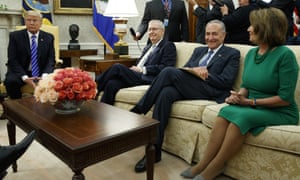
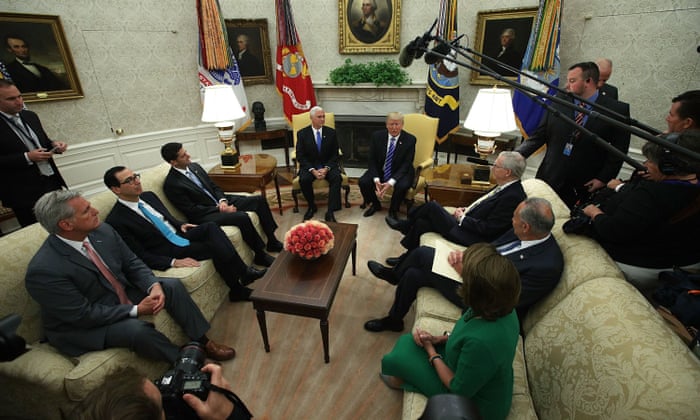
It was time to deal. Donald Trump and
Mike Pence sat before the fireplace in the Oval Office. On a sofa to their left
were Mitch McConnell, Chuck Schumer and Nancy Pelosi. On a sofa to their right,
Paul Ryan, Steven Mnuchin and Kevin McCarthy, with Trump’s budget hawk Mick
Mulvaney in a lone chair behind. Watching the tableau were the busts of Sir
Winston Churchill and Martin Luther King.
There would also be an early
afternoon cameo from Trump’s daughter Ivanka, dropping in to “say hello”,
according to a Democratic aide. “The meeting careened off topic. Republican
leaders were visibly annoyed by Ivanka’s presence.”
But that would soon be the
least of their worries. The president would eventually side with the Democrats
against his own party, striking his first legislative deal and once again
shaking the kaleidoscope of Washington. Congressional Republicans reeled,
some with fury, while Democrats weighed the risks of a dance with the devil.
The Republican congressional
leaders, Ryan, McConnell and McCarthy, had entered the White House just before
noon on Wednesday with an agreed plan. With fiscal deadlines approaching to
raise the debt limit and pass a spending bill, and with an urgent need to dispatch
emergency funding to deal with the devastation caused by Hurricane Harvey, they
would tie the debt limit to the $7.8bn of initial disaster relief requested by
the president.
The House of Representatives
had overwhelmingly approved the standalone Harvey funding as Republican leaders
arrived at the White House. Senate Republicans were poised to attach an
18-month debt limit hike to the bill, thus ridding themselves of the debt
ceiling issue until after the 2018 midterm elections, before kicking the bill
back to the House.
But Democrats Schumer and
Pelosi had begun floating a proposal of their own to instead advance a
three-month debt limit extension, an idea that Ryan blasted as “ridiculous” and
“disgraceful” hours before he sat alongside the other leaders in the Oval
Office. Republicans also had the backing of treasury secretary Mnuchin.
As Democrats held firm on a
three-month extension, Republican leaders signalled some room to negotiate.
They put forward a 12-month extension, even caving at one point to six months,
as Trump mostly looked on and listened.
A source briefed on the
meeting said “basically everyone with an R behind their name” insisted on a
longer term extension, resulting in a standstill and congressional leaders
concluding they would “agree to disagree”.
As Mnuchin sought to make the
case once more to Trump, the president unexpectedly cut off the treasury
secretary and went with Schumer and Pelosi. “Everybody was happy,” he claimed,
having overruled and humiliated Ryan and McConnell in front of their political
foes.
Later Trump referred to them
as “Chuck and Nancy”, and even acceded to Pelosi’s request to tweet a message
of reassurance to “Dreamers” that they will not be deported in the next six
months. The House minority leader Pelosi said: “This is what I asked the
president to do and, boom boom boom, the tweet appeared.”
Meanwhile Trump flew to North
Dakota on Air Force One with senator Heidi Heitkamp, a Democrat facing a tough
re-election battle in 2018. At an event to promote tax reform, he even invited
her on stage, announcing that he wants to work with her on the issue and
describing her as “a good woman”.
The spirit of bipartisanship
was as sudden as it was bewildering.
The most lurid reaction
reportedly came from an
unnamed Republican, who said of Trump: “He fucked us.”
Other Republicans went public
with their disdain, dubbing the agreement the “Pelosi-Trump-Schumer-deal –
PTSD”.
Michael Steel, who served as
an aide to former House speaker John Boehner, said: “Senator Schumer and
Representative Pelosi walked in holding a pair of deuces and the president
handed them a jackpot.
“I don’t know whether the
president wanted to make a deal of some sort and he didn’t really care about
the details, I don’t know whether he understood how much leverage he was giving
away, I don’t know if he was simply frustrated at congressional Republican
leaders.”
For Republicans seeking to
make headway on tax reform, and still eyeing ways to dismantle Barack Obama’s
healthcare law, it was yet another reminder that they could not count on
Trump’s support.
“The president is unique in
American history,” Steel added. “He seems to pride himself on unpredictability
and unreliability. I think it makes it harder to build a foundation of trust to
work together on big issues.”
There were push and pull
factors behind Trump’s thinking this time. On the push side, the sheer delight
of putting a cat among the pigeons, along with a history with Schumer in
particular: Trump has reportedly donated around $9,000 to his fellow New Yorker
over the years and once claimed, “I was close to Schumer in many ways”. Pelosi
told a press conference afterwards that Schumer “could speak New York to the
president”.
This interpretation was echoed
by Michael Steele, former chairman of the Republican national committee. “You
had a moment where you had two New Yorkers who are enjoying the opportunity,”
he said. “If you look at Trump’s face and Schumer’s face, they are much more on
the same page than Trump was on the same page as Ryan or McConnell.”
Then there was the pull factor
of giving Ryan, and especially McConnell, a bloody nose after a series of
perceived slights and their failure to pass healthcare legislation this year.
Steele said: “This was his way of reminding them he didn’t like what they did
in August. All roads don’t lead through the Republican caucus for this
president.”
Budget director Mulvaney
effectively confirmed this in an interview on the Fox Business Network. Asked
if the president was annoyed with the Republican leadership, he said: “He
probably is. And believe me, as a Republican, so am I. As a citizen, I am too.
I was promised that they would have repealed and replaced Obamacare by now.”
The relationship has been in
freefall for months. After all, Trump was a long-time Democrat who lived most
of his life in New York City, a stronghold for the party, and ran against
Republicans as a shape-shifting outsider and opportunist. Along with his
primary rival senator Ted Cruz, Steele predicted then that Trump would reach a
point where he concluded that he could not work with Republicans and seek to
cut deals with Pelosi and Schumer instead. He said: “Trump is agnostic on all
the things important to Republicans. It boggles the mind that Republican
leadership think they can change him to a Republican.”
Relations between Trump,
McConnell and Ryan are unlikely to improve much, Steele added. “Everyone can
get to a point where they accommodate each other. You don’t recover from this.
You get to a position where you agree not to talk about it but it doesn’t
heal.”
But the president will expect
something in return from Wednesday’s agreement, he believes. “Democrats are in
just as much of a pickle as Republicans as to what they stand for. That’s why
this was an easy deal for him to cut. If he is careful and calculating, he can
probably get Democrats on board for things they wouldn’t otherwise get on board
for. There will be a price to pay because there always is.”
Indeed, as Democratic leaders
basked in the headlines of how they crafted what one Republican senator dubbed
“the art of the steal”, some of their members were left unimpressed.
Luis Gutierrez, a congressman
from Illinois, said Trump was a “serial liar” and warned Democrats against
taking him at his word. “The Democratic caucus is not in sync with making this
agreement with the president of the United States of America,” Gutierrez told
MSNBC host Chris Hayes.
Gutierrez voiced particular
frustration at Democratic leaders for not using their leverage in the meeting
with Trump to force an immediate vote to grant legal status to young,
undocumented immigrants left hanging in the balance by Trump’s
decision to rescind Obama’s Deferred Actions for Childhood Arrivals (Daca)
policy.
“Remember the Democratic Party
has to stand for something,” Gutierrez said, while highlighting Microsoft
president Brad Smith’s vow to protect Daca recipients from the Trump
administration. “It’s a sad day for the Democratic Party in this nation
when the CEO of a multinational corporation is standing firmer with the
Dreamers than our own Democratic caucus.”
For Democrats, working with
Trump poses a unique dilemma. At the start of his presidency, Democrats were
conciliatory over the prospect of a massive infrastructure bill and potential
comprises over paid maternity leave, child tax credits, and restructuring
certain trade agreements. But the tone was set at the conclusion of Trump’s
very first week in office, when he signed a travel ban barring entry to
immigrants from seven Muslim-majority countries and suspending the entire US
refugee programme.
Since then Democrats have
openly questioned his fitness for the office and suggested he is guilty of
impeachable offenses over his conduct around the Russia investigation. Last
month, when Trump drew moral equivalence between white supremacists with
leftwing protesters in Charlottesville, Virginia, a group of House Democrats
pushed for a resolution to formally censure the president.
Jim Manley, a 21-year veteran
of the US Senate, said Democrats should tread cautiously after branding Trump
as “radioactive”.
“Trump’s so unpredictable that
any Democrat has to be very careful,” he said. “Where he is one day doesn’t
mean that’s where he is the next day. Hope springs eternal, but I for one don’t
believe that there’s a new era of deal-making in the Senate.”
Pointing out that Republicans
still control both chambers of Congress, Manley said it remained unlikely that
Democrats could exert much influence on issues like tax reform. If this week
underscored anything, he added, it was Trump’s utter disregard for the
Republicans who helped elect him and who have loyally defended him often at the
expense of their own reputations.
“They’ve allowed this
president to degrade their party, the party of Lincoln, and now they’re paying
the price for it,” Manley said. “Karma can be a real pain in the ass.”
The agreement – passed by the
House on Friday despite 90 “no” votes from Republicans – sets the stage for a
major showdown in December when the debt ceiling would be reached and
government funding would expire.
Trump is reportedly having
conversations with Democrats about the possibility of permanently ending the
need for Congress to authorize increases to the debt ceiling, which is the
authorisation for the federal government to borrow money up to a certain limit.
Again, Ryan opposes such a move. More generally, there is widespread doubt
about the prospects for Bill Clinton-style triangulation.
Rory Cooper, a Republican
strategist and former aide to ex-House majority leader Eric Cantor, said:
“Calling the Trump-Schumer-Pelosi agreement a deal infers [sic] that both sides
got something, when in fact Trump ceded to every Democratic demand within 30
seconds of opening a negotiation. He got nothing but a very tough December with
less leverage and fewer Republican allies.
“Trump may have caved into
Schumer and Pelosi to try to regain some popularity in the middle but it will
never work. Democratic voters view themselves as the resistance, so no amount
of appeasement will ever make up for any losses he takes with the right or
centre right.”
Charlie Sykes, a conservative
author and broadcaster who has known Ryan since he was first elected to the
House in 1998, suggested that Trump rarely displays long-term strategy. “It’s
probably less complicated than it looks. It’s less a pivot than an impulse on
his part. It gives him a win, so what’s not to like, but I’m not sure he’d
thought through the implications for December.
“Politics is about alliances
and trust. If Wednesday was not a divorce, it was a trial separation. It’s like
a very unhappy couple who might stay together for the sake of the children.
This is is another low point and it’s hard to imagine it getting much better.”
Additional reporting by Ben
Jacobs
Hurricane Irma Churns Toward Florida
By CAMILLA SCHICK, ROBIN
LINDSAY and CHRIS CIRILLO

Hurricane Irma churned toward
Florida on Saturday, leaving a trail of death and destruction across the
Caribbean and prompting officials to direct 6.5 million Florida residents to
leave their homes in one of the largest emergency evacuations in American history.
On Saturday evening, Gov. Rick
Scott of Florida warned that the state could get as much as 18 inches of rain,
with the Florida Keys getting up to 25 inches.
Southwest Florida could see a
storm surge of 15 feet above ground level, and entire neighborhoods stretching
northward from Naples to Tampa Bay could be submerged.
“If you have been ordered to
evacuate, you need to leave now,” Mr. Scott said at a 6 p.m. news conference.
“This is your last chance to make a good decision.”
The National Hurricane Center
said on Saturday evening that the eye of Irma was beginning to slowly move away
from the coast of Cuba as it headed northwest toward Florida.
As of 5 p.m. Saturday, the
center said the core of Irma would reach the Florida Keys on Sunday, with
“major hurricane force winds” expected at daybreak. By Saturday night, parts of
Florida were feeling the early effects of Irma.
The westward track, which was
a change from earlier expectations, left some residents and officials
scrambling to find shelter.
Irma made landfall in Cuba on
Friday evening as a Category 5 hurricane, lashing the island’s northern coast
with a direct hit. It became the first Category 5 hurricane to make landfall in
Cuba since 1924.
The hurricane was downgraded
to Category 3 on Saturday but still had winds of 125 miles per hour, the center
said. It was expected to strengthen before making landfall in Florida.
Here’s the latest:
• At least 25 people were
confirmed dead in areas affected by the storm.
• In addition to an evacuation
order in Miami, one of the country’s largest evacuations, 540,000 people were
told to leave the Georgia coast. Alabama, North Carolina and South Carolina
have declared states of emergency.
• At 1 p.m., the National
Hurricane Center said a weather station in Ciego de Ávila, Cuba, reported a
wind gust to 159 m.p.h.
• Mr. Scott said more than 385
shelters were open in Florida and more would open on Saturday night. More than
76,000 people were without electricity, he said.
• Hurricane Jose was passing
farther north of the Leeward Islands than initially predicted, and St. Martin
and St. Bart’s have downgraded hurricane warnings to tropical storm warnings.
Check out our
maps tracking the storm.
• Hurricane Katia, which made
landfall on Mexico’s eastern coast, was downgraded to a tropical depression,
with winds of 35 m.p.h. Two people died in a mudslide
in the state of Veracruz after the storm hit, The Associated Press reported.
Sign up for the Morning
Briefing for hurricane news and a daily look at what you need to know to
begin your day.
Residents and officials
scramble for shelters
The storm’s sudden drive to
the west prompted last-minute orders for evacuation in Collier and Lee Counties
in Florida, leaving little time for residents to pack up and find shelter.
“We thought we were safe,” said
a spokeswoman for Collier County who declined to give her name because she was
not authorized to discuss the situation. “We thought we were safe like 36 hours
ago.”
The spokeswoman said that a
forecast at 5 p.m. on Thursday caused county officials to react, readying
shelters and helping residents seeking to evacuate.
Starting on Saturday morning,
lines that were several blocks long formed outside of shelters such as the
Germain Arena, as residents jammed inside.
In Fort Myers, which is in Lee
County, buses that were transporting people to shelters stopped running at 3
p.m. to allow the drivers to seek safety, potentially leaving people who had
not left their homes in time.
By late Saturday afternoon,
all of the shelters in Collier County were at capacity, according to local
news reports. Because of the imminent storm surge, officials told people
living in one-story homes to try to enter shelters anyway, and people in
two-story homes to seek shelter upstairs.
In Miami-Dade County, some
people who had flocked to shelters were reassessing their situation on Saturday
afternoon after learning that the brunt of the hurricane would most likely be
felt farther west.
“We’re going home,” Virginia
Lopez, an administrative assistant at Barry University, said as she loaded her
5-year-old poodle mix, Princess, into her Mazda outside a shelter at Highland
Oaks Middle School after spending the night there with her daughter and
son-in-law. “We decided half an hour ago. The storm has moved to Tampa, so
we’re going to get a lot of rain but it won’t be as bad. I don’t feel so
scared.”
Inside, dozens of people lay
on cots and blankets in the building’s hallways amid a stench of perspiration
and vomit. Some were packing to leave but most seemed resigned to remaining
until the storm blows through.
Florida gets an early feel for
what’s to come
As Hurricane Irma steered its
way toward the Florida Keys on Saturday night, Florida began to feel its
approach. The ocean began rising in Key West, spilling into hotel parking lots
and roads. In the Keys to the north, water levels toppled over the banks of
canals.
In Miami-Dade, tree branches
tumbled and fast-moving bands of powerful rain and wind occasionally made it
hard to walk. Orange County issued a mandatory evacuation for all mobile homes.
[…]
Subscribe to:
Posts (Atom)