Wednesday, July 12, 2017

At NYT, Fantasy of Bill Clinton’s Centrism Saving the Dems Never Gets Old


Gather round, boys and girls! The New York Times has a fairy tale it wants to tell you—about the magical land of Centrism and how it needs to be saved from the sinister Lefties….

Oh, you’ve heard this story before? Yes, it’s true—the Times has been telling this same story for years, always with the same thrilling leaps of logic (Extra! Update, 6/04; Extra!, 7–8/06; FAIR.org, 1/11/11, 5/27/15, 5/23/16).

This time (New York Times op-ed, 7/6/17), it’s told by Mark Penn—identified as a “pollster and senior adviser to Bill and Hillary Clinton,” not as a PR consultant for corporations like Microsoft, Merck, Verizon, BP and McDonald’s—and Andrew Stein, identified as a “former Manhattan borough president and New York City Council president,” rather than as a Trump supporter and convicted tax cheat.

Shh! They’re coming to the good part now:

After years of leftward drift by the Democrats culminated in Republican control of the House under Speaker Newt Gingrich, President Bill Clinton moved the party back to the center in 1995 by supporting a balanced budget, welfare reform, a crime bill that called for providing 100,000 new police officers and a step-by-step approach to broadening healthcare. Mr. Clinton won a resounding re-election victory in 1996 and Democrats were back.

The Democrats were back! It’s true that Bill Clinton won re-election in 1996—with 49 percent of the vote in a three-way race—but Democrats, in the real world, lost the House in 1994 as a result of Clinton’s right-leaning policies, particularly NAFTA, and Republicans held it for the next 12 years. Republicans took back the Senate in 1994 and controlled it for the remainder of Clinton’s administration, with the Democrats never having more than 50 seats until 2009. When Clinton took office, Democratic governors outnumbered their GOP counterparts, 30–18—and when he left office, it was 30–18 the other way.

If that’s coming back, I’d hate to see staying away.


Secret Memo Reveals How Trump Plans to Deport Millions of Immigrants


https://www.youtube.com/watch?v=kdCjYikWV48


The Problem With Centrism Is That It Might Get Us All Killed


http://inthesetimes.com/article/20308/centrists-mark-penn-andrew-stein-climate-change-new-york-times


From left, former Secretary of State Hillary Clinton, House Minority Leader Nancy Pelosi, D-Calif., and Senate Majority Leader Mitch McConnell, R-Ky., attend portrait unveiling ceremony for retiring Senate Minority Leader Harry Reid, D-Nev., in Russell Building's Kennedy Caucus Room, December 08, 2016. (Photo By Tom Williams/CQ Roll Call)


The ExxonKnew Iceberg: Name It After the 'Climate Criminals,' Says Group


'We need to make sure their role in causing the climate crisis is not forgotten,' reads a petition from 350.org


Climate campaigners have a name proposed for a huge iceberg researchers say is about to break off from an ice shelf in Antarctica: the #ExxonKnew Iceberg.

The calving, as the break-off is called, is happening on the Larsen C ice shelf in West Antarctica. According to the U.K.-based Project Midas, which is keeping track of the rift's progress, it could be one of the largest icebergs on record.

According to 350.org, the soon-to-be Delaware-sized iceberg presents an excellent opportunity to remind the public of Exxon's role in fueling climate change.

"With one of the world's biggest ice shelves at a breaking point, this destruction should bear the name of its greatest perpetrator: Exxon," said Aaron Packard, 350.org's Climate Impact Coordinator. "People deserve to understand the devastation of Exxon's decades of climate deception, and realize fossil fuel companies for the climate criminals they are."

The group's petition to the U.S. National Ice Center—the body that names icebergs—says the fossil fuel company "deceived the public, misled their shareholders, and robbed humanity of a generation's worth of time to reverse climate change," referring to the ExxonKnew scandal.

"We need to make sure their role in causing the climate crisis is not forgotten," says the petition, which the group says has garnered over ten thousand signatures. 350.org also posted this video to accompany the petition:

Writing Friday, Project Midas said that "the iceberg remains attached to the shelf by a thin band of ice," adding: "When it calves, the Larsen C Ice Shelf will lose more than 10 percent of its area to leave the ice front at its most retreated position ever recorded; this event will fundamentally change the landscape of the Antarctic Peninsula."

Still, "we do not need to press the panic button for Larsen C," says Helen Amanda Fricker, a glaciologist at Scripps Institution of Oceanography:

Large calving events such as this are normal processes of a healthy ice sheet, ones that have occurred for decades, centuries, millennia—on cycles that are much longer than a human or satellite lifetime.

At the same time, she noted:

There is plenty going on that merits concern: Antarctic ice shelves overall are seeing accelerated thinning, and the ice sheet is losing mass in key sectors of Antarctica.

Added Jonathan Kingslake, an assistant professor at the Lamont-Doherty Earth Observatory: "Warming on the Antarctic Peninsula is linked to human activity and probably triggered the collapse of two more northerly ice shelves." Larsen A and Larsen B collapsed in 1996 and 2002, respectively, after icebergs broke off.

As Packard sees it, "The Antarctic Peninsula is a window into a distressingly plausible, not-so-distant, future where the relatively stable climate the earth has thrived on enters meltdown mode. "


This work is licensed under a Creative Commons Attribution-Share Alike 3.0 License


Share This Article


'We're flowing toward the path' similar to time before Great Depression, analyst says


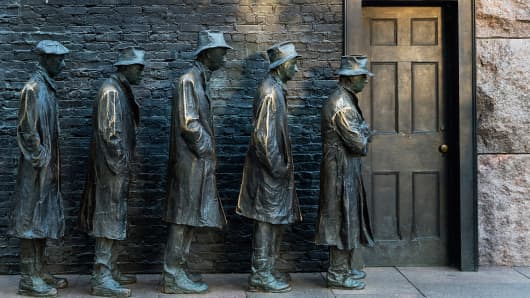
'The Bread Line' sculpture by George Segal depicting the Great Depression, Franklin Delano Roosevelt Memorial at the National Mall.
John Greim | LightRocket | Getty Images
'The Bread Line' sculpture by George Segal depicting the Great Depression, Franklin Delano Roosevelt Memorial at the National Mall.


"I have this belief that we're flowing toward the path of 1928-29 when Hoover was president," said Mark Yusko, CEO of Morgan Creek Capital.


Yusko points to evidence of declining growth as well as that fall is a weak time traditionally for the U.S. economy as people return from vacation.


Although the economy has been steady this year, at least one analyst has dire predictions, comparing the current period to the buildup to the Great Depression and warning that this fall is when things will come to a head.

Mark Yusko, CEO of Morgan Creek Capital, has been predicting bad news for the economy since January and he is sticking by that, saying Monday on CNBC's "Power Lunch" that he believes too much stimulus and quantitative easing has resulted in a "huge" bubble in U.S. stocks.

"I have this belief that we're flowing toward the path of 1928-29 when Hoover was president," Yusko said. "Now Trump is president. Both were presidents with no experience who come in with a Congress that is all Republican, lots of big promises, lots of things that don't happen and the fall is when people realize, 'Wait, it hasn't played out the way we thought.'"


He points to evidence of declining growth as well as that fall is a weak time traditionally for the U.S. economy as people return from vacation.

"[By the fall], we'll have a lot more evidence of declining growth. Growth has been slipping," he said.

However, it was not all gloom and doom as Yusko said the emerging markets were still strong places to invest.

"Growth is where you want to invest," he said. "All the growth is in the emerging markets, the developing world. It's really tough if you look around the developed world." he said profits in the United States are the same as they were in 2012.

Yusko said at the beginning of the year "every single analyst" said emerging markets were going to underperform the U.S. "That hasn't been the case," he said.

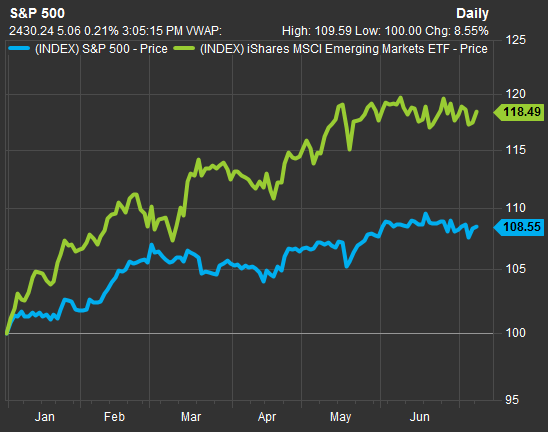
Indeed, in 2017 the iShares MSCI Emerging Markets ETF (EEM) has been up more than 18 percent while the S&P 500 index has risen more than 8 percent.

S&P 500 (blue) vs iShares MSCI Emerging Markets ETF (green) in 2017

Source: FactSet

He also sees trends that are going to push interest rates down, making growth harder to find and emerging markets more attractive.

Those trends are the killer D's, according to Yusko: bad demographics in the U.S., Europe and Japan and too much debt and deflation.