http://www.nakedcapitalism.com/2016/11/one-more-myth-about-clintons-defeat-in-election-2016-debunked.html?
Talking Point: Sexist
BernieBros were one reason Clinton lost election 2016.
[FINNEY:] I think given the
level of sexism and misogyny that we saw come to the surface and be very
public, I think that supports the fact that in this country we are going to
have to have a real conversation about that….
And I will be really honest
[hoo boy], and some of my colleagues won’t like this, but I think even in the
primary, some of what we saw with the Bernie bros
had a real chilling effect on a lot of women, young women in particular.
We learned about during the
primary there were a number of these secret Facebook groups of young
progressive women who were supporting Hillary but frankly, they didn’t want to
deal with the backlash online from some of the Bernie bros. So again, I think,
you know, there’s a lot of pieces to sort of tease out in this conversation.
(Ugh. A “conversation.”
Twice.) So, we have a number of things to look at. First, we need to assess
Finney’s Facebook anecdote. Second, we need to ask how significant “a lot of”
really was. Third, we need to examine the category: Is #BernieBro even a thing?
And finally, we need to ask who Sanders supporters really were, and whether
#BernieBro can be used as a synecdoche
for them. (Note the subtle smear in the midst of Finney’s blather: When she
says “some of the Bernie bros” I read that
as implying that all Sanders supporters are bros, although some are less
obnoxious than others.)
Normally, I’d define the term
#BernieBro (Know
Your Meme has a fine discussion of the history of the term, along with a
valiant attempt at definition.) However, anticipating point three, it has no
taxonomic value; in fact, its very vagueness contributed to its virulent
spread.
First, Finney’s claim of
#BernieBros on Facebook has little support, even at the anecdotal level. It
does seem to be true that some Facebook users complained about users they
termed “Bernie Bros.” J.M. of Somerville wrote the Boston Globe’s advice
columnist, Miss Conduct:
I try to be open-minded and
tolerant of everyone’s views. A longtime Hillary Clinton backer, I limit my
political commentary to supporting my candidate, not trashing others.
So am I wrong, or is it really
rude for a rabid Bernie Bro to post Hillary-hostile links directly onto my
Facebook page? What is an appropriate response to this?
Personally, I think it’s rude
to post anything onto anyone else’s Facebook page no matter the topic, but let
that pass. If behavior like posting links onto a Facebook page, even on a mass
scale, affected the outcome of election 2016, then the Clinton campaign was more
fragile than anybody ever imagined. (Note again the same sleight of hand that
Finney used: All Sanders supporters are bros, although some are “rabid.”)
Did offensive #BernieBro
behavior occur on a mass scale on Facebook? If so, I would expect it to show up
on Twitter, since that’s where operatives go to propagate talking points, and
media types go to pick up on said talking points. So I searched the Twitter on “#BernieBro Facebook” (All,
From everyone, From everywhere) between January 1, 2016 and October 1, 2016;
time enough #BernieBro-dom to really get rolling, if it existed, and cutting
off when the general was well underway. I found 42 responses (and you can use
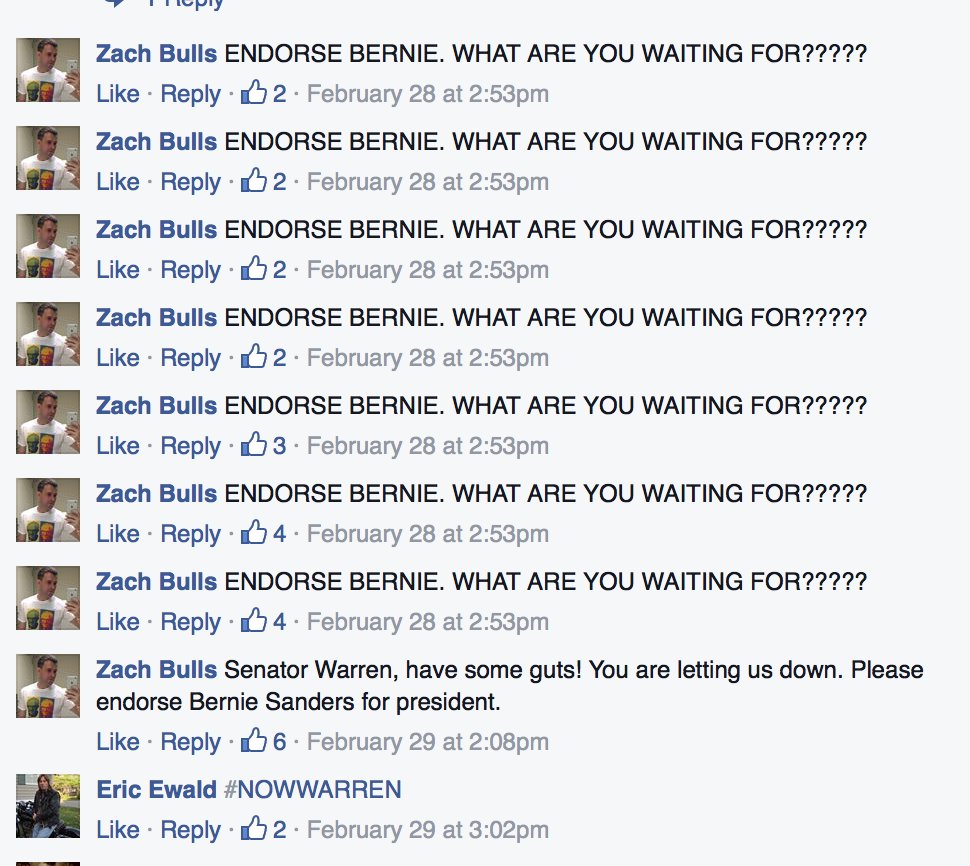
the link to check for yourself). Here’s a typical tweet about Facebook:
[IMAGE 1]
Quelle horreur! And here is
the worst one I can find:
[IMAGE 2]
Obviously some poor lost soul.
Again, if this can swing an election, the Clinton campaign was in terrible
trouble[1].
Second, Online #BernieBro-dom
has no statistical significance. Rebekah Tromble and Dirk Hovy did a study of
Twitter data in February 2016, again, plenty of time for the phenomenon to have
gotten rolling. The Washington Post:
In the end, we found that 23
of the 30 gendered slurs were directed at Clinton. However, out of a total
52,181 tweets mentioning @HillaryClinton, just 606, or 1.16 percent, contained
these insults. While these slurs only represent one particularly overt form of
sexism, the fact that so few were present in these tweets is remarkable.
Are Bernie Bros [if indeed
they exist, which the writers take for granted] behind the slurs?
This is quite a small number.
But any such slur is troubling. And we still need to know who is responsible
for the invective.
Therefore, in the final stage
of analysis, we coded whether each slur originated from a Bernie Sanders
supporter (as determined by their Twitter bios or corpus of tweets) and, among
verifiable Sanders supporters, whether the sender was male, female, or unknown.
The vast majority of the slurs
were associated with Twitter users on the right — particularly self-identified
Trump supporters. But 14.7 percent came from those backing Sanders. Among
Sanders supporters, 60.6 percent tweeting gendered slurs were men, 29.2 percent
women, and 10.1 percent unknown. Most slurs are used by both genders, but some
seem more specific: in the data, “whore” was used as an insult mostly by female
Sanders supporters.[2]
Thus, while we do find some
evidence of Bernie Bros’ bad behavior, abuse against Clinton by Sanders
supporters — both male and female —seems relatively limited. Clinton certainly
faces a barrage of negativity and a heavy dose of sexism on Twitter. But that
mostly appears to come from the right.
And though any and all
instances of sexist slurs deserve condemnation, Sanders’
keyboard warriors accounted for just 89 such tweets during the New
Hampshire primary. That is a mere 0.17 percent of all the tweets mentioning
@HillaryClinton that we examined.
89 tweets have a “chilling
effect”? It’s like the S.S. Clinton sank after striking an ice cube![3]
[T]he term’s definition, as
Elizabeth Bruenig of The New Republic notes,
has reached “critique drift”, stretched to the point of utter meaninglessness.
The definition has morphed into basically: “Sanders supporters whose argument I
don’t wish to engage”. In fact, the following non-sexist, non-bro-y examples
have been labeled “Bernie Bros”:
A fake account for a fake US Congressmen that was used as evidence in several
pieces on the “Bernie Bro” phenomenon.
And now a new addition to the
Bernie Bro catch-all has come from Paul Krugman, who has pre-emptively leveled the term at critics of Clinton who
think her exorbitant Wall Street speaking fees are potentially corrupting:
Certainly taking a harder line
on the corruption of our politics by big money is important — and no, giving some paid speeches doesn’t disqualify her from
making that case. (Cue furious attack from the Bernie bros.)
Certainly, this argument by
Krugman could solicit criticism from a whole cross-section of people; including
women, non-bro men, Clinton supporters, Marxists, Republicans, and
Independents. Yet here we are: the term “Bernie Bro” is knee-jerkingly used to
dismiss a very valid criticism that Clinton’s $2.9 million in speaking fees from Wall Street
may undermine her independence when it comes to regulating Wall Street.
In this sense, those still holding
on to the idea that the label of “Bernie Bro” has any taxonomic value that
helps define something urgent and relevant should vehemently oppose its ever
expanding use.
O reader, hear my plea: I am
the victim of semantic drift.
Four months ago, I coined the
term “Berniebro” to describe a phenomenon I saw on Facebook: Men, mostly my
age, mostly of my background, mostly with my political beliefs, were hectoring
their friends about how great Bernie was even when their friends wanted to do
something else, like talk about the NBA.
In the post, I tried to gently
suggest that maybe there were other ways to advance Sanders’s beliefs, many of
which I share. I hinted, too, that I was not talking about every Sanders
supporter. I did this subtly, by writing: “The Berniebro is not every Sanders
supporter.”
Then, 28,000 people shared the
story on Facebook…. [N]ow that the Berniebro lived in the world, it started to
grow and change, and I remained its Dr. Frankenstein. In November, Rebecca
Traister used Berniebro to refer to leftist writers who expressed their grievances
with Hillary Clinton in sexist ways. Then other writers employed it to other
ends. “Berniebro” came to imply that some men only supported Sanders because he
was male. Then it stood in for the roving horde of Twitter users who respond to
any sufficiently prominent skepticism about Bernie with outrage, alarm, and
hate.
So here I am: The prodigal
father has returned. And I think I have a solution to all this—or, at least, to
the Berniebro problem. The Berniebrosplosion doesn’t betray a unique crisis in
civility, nor a long-term problem for the Democratic base. It signifies,
rather, something much simpler: category collapse.
The Internet is impoverished
of vocabulary. People want to describe the emerging Sanders coalition, yet when
they reach their hands behind the veil of language, they come out grasping only
“Berniebro.”
So we’re back to synecdoche,
aren’t we? When “people” (who?) wish to describe all Sanders supporters, they
“grasp” for some: “bros.” Odd. I wonder why?[4]
Fourth, Sanders had significant
support among women, especially young women. CNN:
CNN’s Polling Director
Jennifer Agiesta analyzed the age and gender breakdown in 27 states where CNN
conducted exit and entrance polls during the primaries — and found that
overall, Clinton led Sanders 61% to 37% among women.
But when she analyzed the age
and gender breakdown across those 27 states, Sanders led Clinton by an average
of 37 percentage points among women 18 to 29 — a stunning result given
Clinton’s emphasis on the historic nature of her candidacy.
Support for Clinton rose as
the age of women went up. Women who were 30 to 39 were more likely to support
Clinton by an average of 53% for Clinton and 46% for Sanders. And among older
women, Clinton dominated Sanders by huge double-digit margins.
At Clinton rallies, a number
of older women were critical of the younger generation, arguing that they are
not backing the former secretary of state’s candidacy because they never faced
the kind of discrimination that women of Clinton’s era did.
But in interviews during the
final days of the California campaign, many young women at Sanders rallies said
they would never vote on the basis of gender. They cited trust and integrity
issues as the reason they weren’t voting for Clinton, and said their support
for Sanders’ platform and policies trumped any notion that they should back a
candidate angling for a historic first.
Remember that Karen Finney pointed
specifically to young women as having been intimidated by Bernie Bros. Again,
if that was sufficient to cause a 24 point difference in women 18-29, the
Clinton campaign was terribly fragile. That would also imply that
forty-something years of feminism has made no headway whatever (which I do not
believe to be true at all).
So, for this talking point to
be true, we have to believe that many young women have been harassed on
Facebook by #BernieBros even though there are few anecdotes to be found where we
would expect to find them, that sexist Tweets from male Sanders supporters on
the scale of two digits amount to a bro-dom sufficient to affect election
outcomes, that #Berniebros is a term instead of an vague epithet, and that the
behavior of #BernieBros was so powerful as to effect a 24% differential between
Sanders and Clinton support among young women.
Conclusion
I think, actually, that is is
a lost cause, even though it makes me crazy. I sometimes now see random Sanders
supporters un-self-consciously describing themselves as bros; and perhaps “bro”
will go the way of “guy,” once gendered, but now no longer. Perhaps the rapid
spread of the original meme — aided not only by its virulence but by the highly
tendentious Clinton campaign — has also led to its attenuation. One can only
hope.
NOTES
[1] Here is an article in Cosmopolitan giving anecdotes about #BernieBro harrassment
on Twitter. Make of it what you will, but I discount it for several reasons:
First, the main source for the story, Clara Jeffreys, was in essence a Clinton
campaign operative operating under deep cover as an Editor (at Mother Jones).
Second, complaining about tone on Twitter is like complaining about the dietary
habits of lions in the Roman Coliseum. I draw the line at doxxing, as in the
GamerGate case, and I’ve beaten up on a fair number of trolls myself, but
Twitter is as good as the blocking tools it has (which have been improved,
helpfully). Third, Twitter is a rough neighborhood anyhow. Neera Tanden, after
all, used Twitter to give a thumbs-down to a writer, getting him
fired. Finally, hearing well-paid public figures of any gender complain
about online behavior leaves me unsympathetic. Have your assistant screen the
tweets!
[3] This is Twitter, not
Facebook, but Twitter, again, is a rough neighborhood, so I think it’s a
reasonable proxy for online behavior in general.
[4] Meyer concludes: “The
Berniebro, as originally conceived, was a tragic figure; his loyalty and
dudeish certainty made him a poor proxy for his favorite candidate. But what’s
tragic about some Hillary voters is not really gendered in the same way or at
all. The tragic Hillary voter, the truly pitiable figure, is the Democrat who
would love to line up behind Bernie’s sunny ideals but knows that he just isn’t
electable. I speak, of course, of the Hillarealist.” That was written in
February 2016. It reads differently now, eh?