Friday, February 6, 2015

Art & Radical-emancipatory Movements
the French Revolution:


the Haitian Revolution:


VIDEO SEGMENT: Revolutions in the Americas
Enlightenment ideas also had dramatic effects in both the Caribbean and in South America. This segment uses the examples of the Haitian revolution and the independence movements led by Simon Bolivar to explore these effects. In Haiti, Enlightenment ideas — especially as reflected by the French Revolution — were received differently by the different social groups on the island. While whites tended to interpret Enlightenment ideals in terms of better colonial representation or greater social equality between whites, free blacks interpreted them in terms of racial equality. Meanwhile, slaves interpreted Enlightenment ideas in terms of emancipation.
These competing interpretations led to conflict, and in 1791 slaves and free blacks engineered a massive revolt. Toussaint L'Ouverture, a free black, emerged to lead the struggle. Although L'Ouverture himself died in a French prison in 1801, his followers eventually defeated the French and declared themselves citizens of the new republic of Haiti — the first nation in history to grant full citizenship to former slaves.
Enlightenment ideals also influenced Simon Bolivar, a wealthy South American plantation owner, who became committed to freeing the region from Spanish control. Bolivar, who like Benjamin Franklin traveled widely in European Enlightenment circles, sought to adapt Enlightenment ideas to the particular situation of the South American colonies. Bolivar did not trust the masses to rule, and in any case he believed that the class and racial divisions between Europeans, Native Americans, and blacks in South America would doom republican-style governments to failure. Instead, he chose a combination of representative government and authoritarian leadership — which in turn created a unique social and political landscape in South America.
[...]
Venezuela's revolution against Spain:


the 1917 Russian Revolutions:


images from the Spanish Civil War


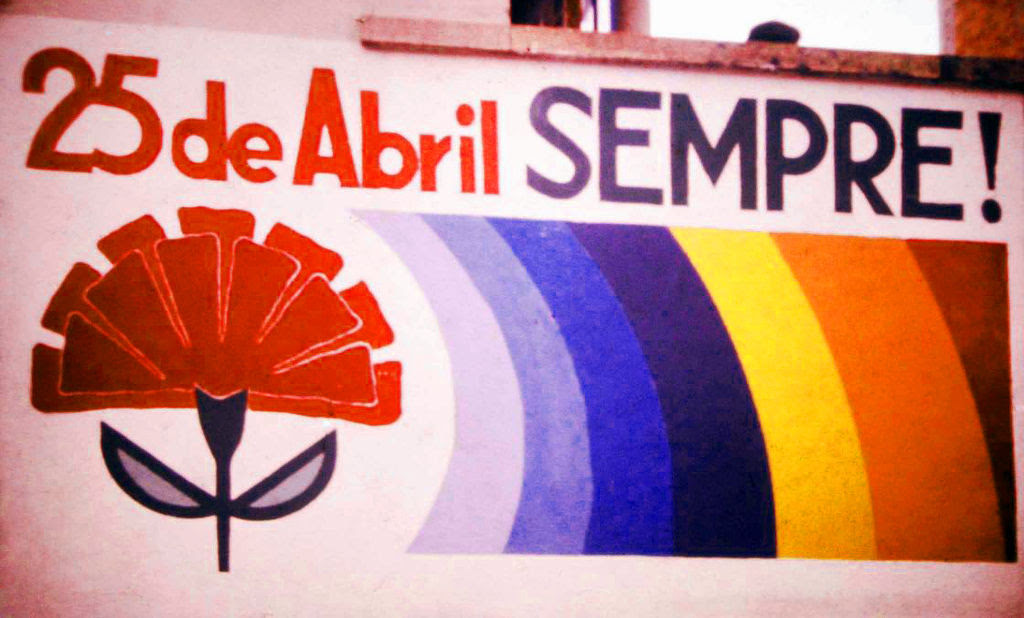
The Carnation Revolution (Portuguese: Revolu
The name "Carnation Revolution" comes from the fact that almost no shots were fired and when the population took to the streets to celebrate the end of the dictatorship and war in the colonies, carnations were put into the muzzles of rifles and on the uniforms of the army. The Portuguese celebrate the national holiday of Freedom Day on 25 April every year to celebrate the revolution.
[...]
Si, we can! How the left-wing Podemos party is rattling the Spanish establishment
(As the Spanish election
approaches, a surge in support for the party has set the clock ticking.)
http://www.newstatesman.com/politics/2015/02/si-we-can-how-left-wing-podemos-party-rattling-spanish-establishment
“Tick-tock, tick-tock”, chanted
the huge crowd in the centre of Madrid last Saturday as they marched in support
the new Podemos (“we can”) party. Counting out what they – and many others
around Europe – expect to be the last days of the existing Spanish political
order, Podemos supporters take heart from recent polls and the Syriza victory
in Greece. The party came from nowhere to win over a million votes and
take 5 seats in the European parliamentary elections last May. According to
some polls almost 30 per cent of Spaniards could vote Podemos at the next
general election – 5 points clear of their nearest rivals, the leftist PSOE.
Given that PSOE, founded in 1879, is one of Europe's oldest social democratic
parties while Podemos has only just celebrated its first birthday, this is a
remarkable result.
Like Syriza in Greece, Podemos
is often pigeon holed as “anti austerity”, “radical left” and “Marxist”. Those
labels may work for some of its policies but does not begin to describe the
movement’s broad social base. The Podemos upsurge is far from a revolt of the
crisis-hit poor and huddled masses. In fact, much of the party’s support comes
from the well-healed, tech-savvy and most educated. Data from the official
sociological research institute (CIS) and leading polling agencies all tell the
same story: this is largely a movement of the middle class and the young. The
latest CIS data reveals that support for the party amongst the upper middle
classes, for example, nearly doubled last year and that 25 per cent of them now
say that they will vote Podemos at the next election. Astonishingly, this is
almost 10 points above the traditional choice of the Spanish bourgeois, the
governing centre right Popular Party (PP). The professional middle
classes and graduates are also turning to Podemos in greater numbers as are
skilled manual workers – around one in five of both groups now identify
themselves as Podemos supporters. By contrast there are two groups where
the party appears to be making little headway: the unskilled working class and
those without any qualifications. Youth is another key constituency for
Podemos. A quarter of 18-35 year olds look likely to vote Podemos as will
around one in five of those in their 30s, 40s or early 50s. Amongst pensioners,
however, support slumps to single figures.
The irony of a left-wing party
harnessing middle-class support is even more evident when compared with what is
going on in Britain. This year “outsider” parties will mount serious
electoral challenges to the political establishment in both Britain (Ukip) and
in Spain (Podemos). Yet the two are very different not only in their policies
but in their core vote. While the right wing Ukip is drawing support from
older, unskilled working class voters without formal qualifications the reverse
is true for the left wing insurgents of Podemos in Spain who are tapping into a
middle class vote.
Despite being tagged as
‘radical left’ Podemos is actually fighting hard for centre ground votes.
Around 40 per cent of Spaniards define themselves as “moderate” and in the ideological
centre of Spanish politics. Podemos is now the preferred choice for a third of
this group – level pegging with the number who say they will support PSOE and
twice the number of those who say they will support the PP. It has been a
golden rule of post Franco democratic Spanish politics that elections are won
by the party which commands most support in the centre. On the current data
Podemos are well on their way to consolidating exactly the level of support
they need amongst moderate Spaniards to win the next election.
The reasons for Podemos’
success goes way beyond an anti-austerity message. One of the party’s most
successful attack lines is against what they call la casta (the caste or
the class). The phrase resonates with many Spaniards and describes the
over cosy relationship between politicians, oligopolistic business interests
and an inert bureaucracy which is protected by some of the weakest freedom of
information laws in Europe. The British equivalent of la casta might be
the “Westminster elite” but this translation does not really do the job. Anger
at the entrenched elite in Madrid is also directed toward the leaders of
Spain’s powerful, de-centralised regions which are frequently dominated by
local political cliques.
Simmering discontent with the
system has been evident for years. Ordinary Spaniards complained about an
“extractive” government class while international reports on the Spanish
economy from the OECD and others highlighted shortcomings which arise from the
bureaucratic quagmire, low levels of investment and poor productivity.
All this came to head with the
economic crisis. Unemployment has soared whilst the living standards for many
of those in work – including, of course, the middle class – have been hit hard.
But one issue above all others has fuelled support for Podemos: corruption.
Spanish courts are now awash with cases of bankers, politicians and even
members of the royal family accused of ripping off the public during the boom
years. Corruption ranks alongside the economy as the issue which most concerns
Spaniards and the old political parties are struggling to respond because it
happened on their watch.
Whether Podemos can sustain
their momentum depends on several factors some of which are beyond their
control. If the new Syriza government in Greece fails it will contaminate the
Podemos brand in Spain. The Spanish economy is picking up slowly and this may
be enough for some voters to withdraw their gamble on Podemos. And there
internal questions to be settled too – several key policies have not been
thought through. It is also far from clear whether the party has the logistical
muscle to mobilize a large number of first time voters and polls suggest many
voters may simply abstain. Yet the Spanish establishment is rattled and rightly
so. The Spanish middle class is angry and the clock really is ticking.
David Mathieson is a former
adviser to the late Robin Cook. He is on Twitter as @mathiesonmadrid
Subscribe to:
Posts (Atom)