Saturday, November 24, 2012

Giacomo Matteotti


http://en.wikipedia.org/wiki/Giacomo_Matteotti

Giacomo Matteotti; 22 May 1885 – 10 June 1924) was an Italian socialist politician. On 30 May 1924, he openly spoke in the Italian Parliament alleging the Fascists committed fraud in the recently held elections, and denounced the violence they used to gain votes. Eleven days later he was kidnapped and killed by Fascists.

Political career

Matteotti was born a son of a wealthy family, in Fratta PolesineProvince of Rovigo in Veneto.

A graduate in law from the University of Bologna and from early on an activist in the socialist movement and the Italian Socialist Party, he opposed Italy's entry into World War I (and was interned in Sicily during the conflict for this reason).

He was elected deputy three times: in 1919, 1921 and 1924.

As a follower of Filippo Turati, Matteotti became the leader of the United Socialist Party in the Italian Chamber of Deputies after the scission of the Socialist Party. He openly spoke out against Fascism and Benito Mussolini, and for a time was leader of the opposition to the National Fascist Party (PNF). Since 1921 he denounced fascist violence in a pamphlet titled Inchiesta socialista sulle gesta dei fascisti in Italia (Socialist enquiry on the deeds of the fascists in Italy).

Murder

He was murdered on 10 June 1924, after the publication of his book The Fascisti Exposed: A Year of Fascist Domination and two fierce and lengthy speeches in the Chamber of Deputies denouncing Fascism.[1]

During a kidnap attempt, he was bundled into a car and stabbed several times with a carpenter's file as he was struggling to escape. His corpse was found near Riano, 20 miles from Rome, on 16 August 1924, after an extensive search.

Five men (Amerigo Dumini - a prominent member of the Fascist secret police, the Ceka, Giuseppe Viola, Albino Volpi, Augusto Malacria and Amleto Poveromo) were arrested a few days after the kidnapping. Only three (Dumini, Volpi and Poveromo) were convicted and shortly after released under amnesty by King Victor Emmanuel III; one, Filippo Panzeri, escaped before the arrests of his accomplices.

Before the trial against the murderers, the High Court of the Senate started a trial against general Emilio De Bono, commander of the MVSN, but he was discharged.

After the Second World War, in 1947, the trial against Francesco GiuntaCesare Rossi, Dumini, Viola, Poveromo, Malacria, Filippelli and Panzeri was re-opened. Dumini, Viola and Poveromo were sentenced to life imprisonment.

In none of these three trials was evidence found of Mussolini's involvement.[2]

Mussolini's alleged involvement

The involvement of Mussolini in the assassination is much debated.

Historians suggest some different theories. The main biographer of Mussolini, Renzo De Felice, was convinced that the Duce was innocent. Even Aurelio Lepre and Emilio Gentile thought that Mussolini did not want the death of Matteotti.

The former socialist and anti-fascist journalist Carlo Silvestri in 1924 was a harsh accuser of Mussolini; later, when he joined Italian Social Republic, he affirmed that Mussolini showed him Matteotti Case's papers,[3] and eventually he changed his mind.[4] Silvestri became a strong defender of Mussolini's innocence in Matteotti's murder, and suggested that the socialist was killed by a plot, in order both to damage Mussolini's attempt to raise a leftist government (with the participation of Socialists and Popolari) and to cover some scandals in which the Crown (with the American oil company Sinclair Oil) was involved.
De Felice argued that maybe Mussolini himself was a political victim of a plot, and almost surely he was damaged by the crisis that followed the murder. Many fascists left the Party, and his government was about to collapse. Moreover, his secret attempt to bring Socialists and Populars into a new reformist government was ruined.

On the other hand, other historians of the time, including Justin Pollard and Denis Mack Smith, thought Mussolini was probably aware of the assassination plot but that it was ordered and organized by someone else.

Mauro Canali suggests that Mussolini probably did order the murder, as Matteotti uncovered and wanted to make public incriminating documents proving that Mussolini and his associates sold to an American oil company—Sinclair Oil—exclusive rights to all
Italian oil reserves.[5]

Consequences of the murder

The death of Matteotti sparked widespread criticism of Fascism. A general strike was threatened in retaliation.

Since Mussolini's government did not collapse and the King refused to dismiss him, all the anti-fascists (except for the Communist Party of Italy) started to abandon the Chamber of Deputies. They retired on the "Aventine Mount", like ancient Roman plebeians. They thought to force the Crown to act against Mussolini, but on the contrary this strengthened Mussolini. After a few weeks of confusion, Mussolini gained a favourable vote by the Senate of the Kingdom, and tried to defuse the tension with a speech.

Despite pressure from the opposition, Victor Emmanuel III refused to dismiss Mussolini, since the Government was supported by a large majority of the Chamber of Deputies and almost all the Senate of the Kingdom. Moreover, he feared that compelling Mussolini to resign could be considered a coup d'état, that eventually could lead to a civil war between the Army and the Blackshirts.[6]

But during the Summer, the trial against Matteotti's alleged murders and the discovery of the corpse of Matteotti once again spread rage against Mussolini: newspapers launched fierce attacks on him and the fascist movement.

On September the 13th, a right-wing fascist deputy, Armando Casalini, was killed on a tramway as retaliation to Matteotti's murder by the anti-fascist Giovanni Corvi.
During the Autumn of 1924, the extremist-wing of the Fascist Party threatened Mussolini with a coup, and dealt with him on the night of San Silvestro of 1924. Mussolini devised a counter-manoeuvre, and on the 3rd of January 1925 he pronounced in a famous speech,[7] both attacking anti-fascists and confirming that he, and only he, was the leader of Fascism. He challenged the anti-fascists to prosecute him, and claimed proudly that Fascism was the "superb passion of the best youth of Italy" and grimly that "all the violence" was his responsibility, because he had created the climate of violence. Mussolini concluded with a menace: Italy needs stability and Fascism would assure stability to Italy in any manner necessary.

This speech is considered the very beginning of the dictatorship in Italy.

Works

1924 The Fascisti Exposed: A Year of Fascist Domination, (1969)

Excerpt from Orwell's "Homage to Catalonia"


Homage to Catalonia
by George Orwell
1938


IN THE Lenin Barracks in Barcelona, the day before I joined the militia, I saw an Italian militiaman standing in front of the officers’ table.

He was a tough-looking youth of twenty-five or six, with reddish-yellow hair and powerful shoulders. His peaked leather cap was pulled fiercely over one eye. He was standing in profile to me, his chin on his breast, gazing with a puzzled frown at a map which one of the officers had open on the table. Something in his face deeply moved me. It was the face of a man who would commit murder and throw away his life for a friend—the kind of face you would expect in an Anarchist, though as likely as not he was a Communist. There were both candour and ferocity in it; also the pathetic reverence that illiterate people have for their supposed superiors. Obviously he could not make head or tail of the map; obviously he regarded map-reading as a stupendous intellectual feat. I hardly know why, but I have seldom seen anyone—any man, I mean—to whom I have taken such an immediate liking. While they were talking round the table some remark brought it out that I was a foreigner. The Italian raised his head and said quickly:
‘Italiano?’

I answered in my bad Spanish: ‘No, Inglés. Y tú?’

‘Italiano.’

As we went out he stepped across the room and gripped my hand very hard. Queer, the affection you can feel for a stranger! It was as though his spirit and mine had momentarily succeeded in bridging the gulf of language and tradition and meeting in utter intimacy. I hoped he liked me as well as I liked him. But I also knew that to retain my first impression of him I must not see him again; and needless to say I never did see him again. One was always making contacts of that kind in Spain.

I mention this Italian militiaman because he has stuck vividly in my memory. With his shabby uniform and fierce pathetic face he typifies for me the special atmosphere of that time. He is bound up with all my memories of that period of the war—the red flags in Barcelona, the gaunt trains full of shabby soldiers creeping to the front, the grey war-stricken towns farther up the line, the muddy, ice-cold trenches in the mountains.

This was in late December 1936, less than seven months ago as I write, and yet it is a period that has already receded into enormous distance. Later events have obliterated it much more completely than they have obliterated 1935, or 1905, for that matter. I had come to Spain with some notion of writing newspaper articles, but I had joined the militia almost immediately, because at that time and in that atmosphere it seemed the only conceivable thing to do. The Anarchists were still in virtual control of Catalonia and the revolution was still in full swing. To anyone who had been there since the beginning it probably seemed even in December or January that the revolutionary period was ending; but when one came straight from England the aspect of Barcelona was something startling and overwhelming. It was the first time that I had ever been in a town where the working class was in the saddle. Practically every building of any size had been seized by the workers and was draped with red flags or with the red and black flag of the Anarchists; every wall was scrawled with the hammer and sickle and with the initials of the revolutionary parties; almost every church had been gutted and its images burnt.

Churches here and there were being systematically demolished by gangs of workmen. Every shop and cafe had an inscription saying that it had been collectivized; even the bootblacks had been collectivized and their boxes painted red and black. Waiters and shop-walkers looked you in the face and treated you as an equal. Servile and even ceremonial forms of speech had temporarily disappeared. Nobody said ‘Señor’ or ‘Don’ or even ‘Usted’; everyone called everyone else ‘Comrade’ and ‘Thou’, and said ‘Salud!’ instead of ‘Buenos dias’. Tipping was forbidden by law; almost my first experience was receiving a lecture from a hotel manager for trying to tip a lift-boy. There were no private motor-cars, they had all been commandeered, and all the trams and taxis and much of the other transport were painted red and black. The revolutionary posters were everywhere, flaming from the walls in clean reds and blues that made the few remaining advertisements look like daubs of mud. Down the Ramblas, the wide central artery of the town where crowds of people streamed constantly to and fro, the loudspeakers were bellowing revolutionary songs all day and far into the night. And it was the aspect of the crowds that was the queerest thing of all. In outward appearance it was a town in which the wealthy classes had practically ceased to exist. Except for a small number of women and foreigners there were no ‘well-dressed’ people at all. Practically everyone wore rough working-class clothes, or blue overalls, or some variant of the militia uniform. All this was queer and moving. There was much in it that I did not understand, in some ways I did not even like it, but I recognized it immediately as a state of affairs worth fighting for. Also I believed that things were as they appeared, that this was really a workers’ State and that the entire bourgeoisie had either fled, been killed, or voluntarily come over to the workers’ side; I did not realize that great numbers of well-to-do bourgeois were simply lying low and disguising themselves as proletarians for the time being.

Together with all this there was something of the evil atmosphere of war. The town had a gaunt untidy look, roads and buildings were in poor repair, the streets at night were dimly lit for fear of air—raids, the shops were mostly shabby and half-empty. Meat was scarce and milk practically unobtainable, there was a shortage of coal, sugar, and petrol, and a really serious shortage of bread. Even at this period the bread-queues were often hundreds of yards long. Yet so far as one could judge the people were contented and hopeful. There was no unemployment, and the price of living was still extremely low; you saw very few conspicuously destitute people, and no beggars except the gipsies.

Above all, there was a belief in the revolution and the future, a feeling of having suddenly emerged into an era of equality and freedom. Human beings were trying to behave as human beings and not as cogs in the capitalist machine. In the barbers’ shops were Anarchist notices (the barbers were mostly Anarchists) solemnly explaining that barbers were no longer slaves. In the streets were coloured posters appealing to prostitutes to stop being prostitutes. To anyone from the hard-boiled, sneering civilization of the English-speaking races there was something rather pathetic in the literalness with which these idealistic Spaniards took the hackneyed phrases of revolution. At that time revolutionary ballads of the naivest kind, all about proletarian brotherhood and the wickedness of Mussolini, were being sold on the streets for a few centimes each. I have often seen an illiterate militiaman buy one of these ballads, laboriously spell out the words, and then, when he had got the hang of it, begin singing it to an appropriate tune.

All this time I was at the Lenin Barracks, ostensibly in training for the front. When I joined the militia I had been told that I should be sent to the front the next day, but in fact I had to wait while a fresh centuria was got ready. The workers’ militias, hurriedly raised by the trade unions at the beginning of the war, had not yet been organized on an ordinary army basis. The units of command were the ‘section’, of about thirty men, the centuria, of about a hundred men, and the ‘column’, which in practice meant any large number of men. The Lenin Barracks was a block of splendid stone buildings with a riding-school and enormous cobbled courtyards; it had been a cavalry barracks and had been captured during the July fighting. My centuria slept in one of the stables, under the stone mangers where the names of the cavalry chargers were still inscribed. All the horses had been seized and sent to the front, but the whole place still smelt of horse-piss and rotten oats. I was at the barracks about a week. Chiefly I remember the horsy smells, the quavering bugle-calls (all our buglers were amateurs—I first learned the Spanish bugle-calls by listening to them outside the Fascist lines), the tramp-tramp of hobnailed boots in the barrack yard, the long morning parades in the wintry sunshine, the wild games of football, fifty a side, in the gravelled riding-school. There were perhaps a thousand men at the barracks, and a score or so of women, apart from the militiamen’s wives who did the cooking. There were still women serving in the militias, though not very many. In the early battles they had fought side by side with the men as a matter of course. It is a thing that seems natural in time of revolution. Ideas were changing already, however. The militiamen had to be kept out of the riding-school while the women were drilling there because they laughed at the women and put them off. A few months earlier no one would have seen anything comic in a woman handling a gun.

The whole barracks was in the state of filth and chaos to which the militia reduced every building they occupied and which seems to be one of the by-products of revolution. In every comer you came upon piles of smashed furniture, broken saddles, brass cavalry-helmets, empty sabre-scabbards, and decaying food. There was frightful wastage of food, especially bread. From my barrack-room alone a basketful of bread was thrown away at every meal—a disgraceful thing when the civilian population was short of it. We ate at long trestle-tables out of permanently greasy tin pannikins, and drank out of a dreadful thing called a porron. A porron is a sort of glass bottle with a pointed spout from which a thin jet of wine spurts out whenever you tip it up; you can thus drink from a distance, without touching it with your lips, and it can be passed from hand to hand. I went on strike and demanded a drinking-cup as soon as I saw a porron in use. To my eye the things were altogether too like bed-bottles, especially when they were filled with white wine.

By degrees they were issuing the recruits with uniforms, and because this was Spain everything was issued piecemeal, so that it was never quite certain who had received what, and various of the things we most needed, such as belts and cartridge-boxes, were not issued till the last moment, when the train was actually waiting to take us to the front.

I have spoken of the militia ‘uniform’, which probably gives a wrong impression. It was not exactly a uniform. Perhaps a ‘multiform’ would be the proper name for it. Everyone’s clothes followed the same general plan, but they were never quite the same in any two cases. Practically everyone in the army wore corduroy knee-breeches, but there the uniformity ended. Some wore puttees, others corduroy gaiters, others leather leggings or high boots. Everyone wore a zipper jacket, but some of the jackets were of leather, others of wool and of every conceivable colour. The kinds of cap were about as numerous as their wearers. It was usual to adorn the front of your cap with a party badge, and in addition nearly every man wore a red or red and black handkerchief round his throat. A militia column at that time was an extraordinary-looking rabble. But the clothes had to be issued as this or that factory rushed them out, and they were not bad clothes considering the circumstances. The shirts and socks were wretched cotton things, however, quite useless against cold. I hate to think of what the militiamen must have gone through in the earlier months before anything was organized. I remember coming upon a newspaper of only about two months earlier in which one of the P.O.U.M. leaders, after a visit to the front, said that he would try to see to it that “every militiaman had a blanket’. A phrase to make you shudder if you have ever slept in a trench.

On my second day at the barracks there began what was comically called ‘instruction’. At the beginning there were frightful scenes of chaos. The recruits were mostly boys of sixteen or seventeen from the back streets of Barcelona, full of revolutionary ardour but completely ignorant of the meaning of war. It was impossible even to get them to stand in line. Discipline did not exist; if a man disliked an order he would step out of the ranks and argue fiercely with the officer. The lieutenant who instructed us was a stout, fresh-faced, pleasant young man who had previously been a Regular Army officer, and still looked like one, with his smart carriage and spick-and-span uniform. Curiously enough he was a sincere and ardent Socialist. Even more than the men themselves he insisted upon complete social equality between all ranks. I remember his pained surprise when an ignorant recruit addressed him as ‘Senor’. ‘What! Senor? Who is that calling me Senor? Are we not all comrades?’ I doubt whether it made his job any easier. Meanwhile the raw recruits were getting no military training that could be of the slightest use to them. I had been told that foreigners were not obliged to attend ‘instruction’ (the Spaniards, I noticed, had a pathetic belief that all foreigners knew more of military matters than themselves), but naturally I turned out with the others. I was very anxious to learn how to use a machine-gun; it was a weapon I had never had a chance to handle. To my dismay I found that we were taught nothing about the use of weapons. The so-called instruction was simply parade-ground drill of the most antiquated, stupid kind; right turn, left turn, about turn, marching at attention in column of threes and all the rest of that useless nonsense which I had learned when I was fifteen years old. It was an extraordinary form for the training of a guerilla army to take. Obviously if you have only a few days in which to train a soldier, you must teach him the things he will most need; how to take cover, how to advance across open ground, how to mount guards and build a parapet—above all, how to use his weapons. Yet this mob of eager children, who were going to be thrown into the front line in a few days’ time, were not even taught how to fire a rifle or pull the pin out of a bomb. At the time I did not grasp that this was because there were no weapons to be had. In the P.O.U.M. militia the shortage of rifles was so desperate that fresh troops reaching the front always had to take their rifles from the troops they relieved in the line. In the whole of the Lenin Barracks there were, I believe, no rifles except those used by the sentries.

After a few days, though still a complete rabble by any ordinary standard, we were considered fit to be seen in public, and in the mornings we were marched out to the public gardens on the hill beyond the Plaza de Espana. This was the common drill-ground of all the party militias, besides the Carabineros and the first contingents of the newly formed Popular Army. Up in the public gardens it was a strange and heartening sight.

Down every path and alley-way, amid the formal flower-beds, squads and companies of men marched stiffly to and fro, throwing out their chests and trying desperately to look like soldiers. All of them were unarmed and none completely in uniform, though on most of them the militia uniform was breaking out in patches here and there. The procedure was always very much the same. For three hours we strutted to and fro (the Spanish marching step is very short and rapid), then we halted, broke the ranks, and flocked thirstily to a little grocer’s shop which was half-way down the hill and was doing a roaring trade in cheap wine. Everyone was very friendly to me. As an Englishman I was something of a curiosity, and the Carabinero officers made much of me and stood me drinks. Meanwhile, whenever I could get our lieutenant into a corner, I was clamouring to be instructed in the use of a machine-gun. I used to drag my Hugo’s dictionary out of my pocket and start on him in my villainous Spanish:

‘To sé manejar fusil. Mo sé manejar ametralladora. Quiero apprender ametralladora. Quándo vamos apprender ametralladora?’

The answer was always a harassed smile and a promise that there should be machine-gun instruction mañana. Needless to saymañana never came. Several days passed and the recruits learned to march in step and spring to attention almost smartly, but if they knew which end of a rifle the bullet came out of, that was all they knew. One day an armed Carabinero strolled up to us when we were halting and allowed us to examine his rifle. It turned out that in the whole of my section no one except myself even knew how to load the rifle, much less how to take aim.

All this time I was having the usual struggles with the Spanish language. Apart from myself there was only one Englishman at the barracks, and nobody even among the officers spoke a word of French. Things were not made easier for me by the fact that when my companions spoke to one another they generally spoke in Catalan. The only way I could get along was to carry everywhere a small dictionary which I whipped out of my pocket in moments of crisis. But I would sooner be a foreigner in Spain than in most countries. How easy it is to make friends in Spain! Within a day or two there was a score of militiamen who called me by my Christian name, showed me the ropes, and overwhelmed me with hospitality. I am not writing a book of propaganda and I do not want to idealize the P.O.U.M. militia. The whole militia—system had serious faults, and the men themselves were a mixed lot, for by this time voluntary recruitment was falling off and many of the best men were already at the front or dead. There was always among us a certain percentage who were completely useless. Boys of fifteen were being brought up for enlistment by their parents, quite openly for the sake of the ten pesetas a day which was the militiaman’s wage; also for the sake of the bread which the militia received in plenty and could smuggle home to their parents. But I defy anyone to be thrown as I was among the Spanish working class—I ought perhaps to say the Catalan working class, for apart from a few Aragonese and Andalusians I mixed only with Catalans—and not be struck by their essential decency; above all, their straightforwardness and generosity. A Spaniard’s generosity, in the ordinary sense of the word, is at times almost embarrassing.

If you ask him for a cigarette he will force the whole packet upon you. And beyond this there is generosity in a deeper sense, a real largeness of spirit, which I have met with again and again in the most unpromising circumstances. Some of the journalists and other foreigners who travelled in Spain during the war have declared that in secret the Spaniards were bitterly jealous of foreign aid. All I can say is that I never observed anything of the kind. I remember that a few days before I left the barracks a group of men returned on leave from the front. They were talking excitedly about their experiences and were full of enthusiasm for some French troops who had been next to them at Huesca. The French were very brave, they said; adding enthusiastically: ‘Más valientes que nosotros’—‘Braver than we are!’ Of course I demurred, whereupon they explained that the French knew more of the art of war—were more expert with bombs, machine-guns, and so forth. Yet the remark was significant. An Englishman would cut his hand off sooner than say a thing like that.

Every foreigner who served in the militia spent his first few weeks in learning to love the Spaniards and in being exasperated by certain of their characteristics. In the front line my own exasperation sometimes reached the pitch of fury. The Spaniards are good at many things, but not at making war. All foreigners alike are appalled by their inefficiency, above all their maddening unpunctuality. The one Spanish word that no foreigner can avoid learning is mañana—‘tomorrow’ (literally, ‘the morning’). Whenever it is conceivably possible, the business of today is put off until mañana. This is so notorious that even the Spaniards themselves make jokes about it. In Spain nothing, from a meal to a battle, ever happens at the appointed time. As a general rule things happen too late, but just occasionally—just so that you shan’t even be able to depend on their happening late—they happen too early. A train which is due to leave at eight will normally leave at any time between nine and ten, but perhaps once a week, thanks to some private whim of the engine-driver, it leaves at half past seven. Such things can be a little trying. In theory I rather admire the Spaniards for not sharing our Northern time-neurosis; but unfortunately I share it myself.

After endless rumours, mañanas, and delays we were suddenly ordered to the front at two hours’ notice, when much of our equipment was still unissued. There were terrible tumults in the quartermaster’s store; in the end numbers of men had to leave without their full equipment. The barracks had promptly filled with women who seemed to have sprung up from the ground and were helping their men-folk to roll their blankets and pack their kit-bags. It was rather humiliating that I had to be shown how to put on my new leather cartridge-boxes by a Spanish girl, the wife of Williams, the other English militiaman. She was a gentle, dark-eyed, intensely feminine creature who looked as though her life—work was to rock a cradle, but who as a matter of fact had fought bravely in the street-battles of July. At this time she was carrying a baby which was born just ten months after the outbreak of war and had perhaps been begotten behind a barricade.

The train was due to leave at eight, and it was about ten past eight when the harassed, sweating officers managed to marshal us in the barrack square. I remember very vividly the torchlit scene—the uproar and excitement, the red flags flapping in the torchlight, the massed ranks of militiamen with their knapsacks on their backs and their rolled blankets worn bandolier-wise across the shoulder; and the shouting and the clatter of boots and tin pannikins, and then a tremendous and finally successful hissing for silence; and then some political commissar standing beneath a huge rolling red banner and making us a speech in Catalan. Finally they marched us to the station, taking the longest route, three or four miles, so as to show us to the whole town. In the Ramblas they halted us while a borrowed band played some revolutionary tune or other. Once again the conquering-hero stuff—shouting and enthusiasm, red flags and red and black flags everywhere, friendly crowds thronging the pavement to have a look at us, women waving from the windows.

How natural it all seemed then; how remote and improbable now! The train was packed so tight with men that there was barely room even on the floor, let alone on the seats. At the last moment Williams’s wife came rushing down the platform and gave us a bottle of wine and a foot of that bright red sausage which tastes of soap and gives you diarrhoea. The train crawled out of Catalonia and on to the plateau of Aragon at the normal wartime speed of something under twenty kilometres an hour. 
[…]

Federico Garcia Lorca


http://www.poets.org/poet.php/prmPID/163

Federico García Lorca

Federico García Lorca is possibly the most important Spanish poet and dramatist of the twentieth century. García Lorca was born June 5, 1898, in Fuente Vaqueros, a small town a few miles from Granada. His father owned a farm in the fertile vega surrounding Granada and a comfortable mansion in the heart of the city. His mother, whom Lorca idolized, was a gifted pianist. After graduating from secondary school García Lorca attended Sacred Heart University where he took up law along with regular coursework. His first book, Impresiones y Viajes (1919) was inspired by a trip to Castile with his art class in 1917.

In 1919, García Lorca traveled to Madrid, where he remained for the next fifteen years. Giving up university, he devoted himself entirely to his art. He organized theatrical performances, read his poems in public, and collected old folksongs. During this period García Lorca wrote El Maleficio de la mariposa (1920), a play which caused a great scandal when it was produced. He also wrote Libro de poemas (1921), a compilation of poems based on Spanish folklore. Much of García Lorca's work was infused with popular themes such as Flamenco and Gypsy culture. In 1922, García Lorca organized the first "Cante Jondo" festival in which Spain's most famous "deep song" singers and guitarists participated. The deep song form permeated his poems of the early 1920s. During this period, García Lorca became part of a group of artists known as Generación del 27, which included Salvador Dalí and Luis Buñuel, who exposed the young poet to surrealism. In 1928, his book of verse, Romancero Gitano ("The Gypsy Ballads"), brought García Lorca far-reaching fame; it was reprinted seven times during his lifetime.

In 1929, García Lorca came to New York. The poet's favorite neighborhood was Harlem; he loved African-American spirituals, which reminded him of Spain's "deep songs." In 1930, García Lorca returned to Spain after the proclamation of the Spanish republic and participated in the Second Ordinary Congress of the Federal Union of Hispanic Students in November of 1931. The congress decided to build a "Barraca" in central Madrid in which to produce important plays for the public. "La Barraca," the traveling theater company that resulted, toured many Spanish towns, villages, and cities performing Spanish classics on public squares. Some of García Lorca's own plays, including his three great tragedies Bodas de sangre (1933), Yerma (1934), and La Casa de Bernarda Alba (1936), were also produced by the company.

In 1936, García Lorca was staying at Callejones de García, his country home, at the outbreak of the Civil War. He was arrested by Franquist soldiers, and on the 17th or 18th of August, after a few days in jail, soldiers took García Lorca to "visit" his brother-in-law, Manuel Fernandez Montesinos, the Socialist ex-mayor of Granada whom the soldiers had murdered and dragged through the streets. When they arrived at the cemetery, the soldiers forced García Lorca from the car. They struck him with the butts of their rifles and riddled his body with bullets. His books were burned in Granada's Plaza del Carmen and were soon banned from Franco's Spain. To this day, no one knows where the body of Federico García Lorca rests.

A Selected Bibliography

Poetry

Canciones (1927)
El poema del Cante Jondo (1932)
Impresiones y viajes (1918)
In Search of Duende (1998)
Lament for the Death of a Bullfighter and Other Poems (1937)
Libro de poemas (1921)
Llanto por Ignacio Sanchez Mejias (1935)
Poeta en Nueva York ("Poet in New York") (1940)
Romancero Gitano ("The Gypsy Ballads") (1928)
Selected Poems (1941)

Drama

Amor de Don Perlimplin con Belisa en su jardin (1931)
Bodas de sangre ("Blood Wedding") (1933)
El malificio de la mariposa (1920)
La casa de Bernarda Alba ("The House of Bernarda Alba") (1936)
La zapatera prodigiosa ("The Shoemaker's Marvelous Wife") (1930)
Mariana Pineda (1927)
The Comedies (1955)
Yerma (1934)

Friday, November 23, 2012

Monday, November 19, 2012

If You Want to Commemorate the Murder of an Anti-Fascist in Petersburg, Police Will Treat You Like Scum


http://chtodelat.wordpress.com/2012/11/18/if-you-want-to-commemorate-the-murder-of-a-anti-fascist-in-petersburg-police-will-treat-you-like-scum/

The Term, Episode 1121: Anniversary of a Death

Saint Petersburg anti-fascists marked the seventh anniversary of the death of their comrade Timur Kacharava. After the sanctioned action was over, police demanded that the friends of the deceased man remove all the flowers laid at the site of Timur’s death.

The friends refused, so the police got a homeless man to do it.

Just a little taste of a life in a city where, once upon a time, over a million people perished during a Nazi siege.

Timur Kacharava was stabbed to death by neo-Nazis in broad daylight in downtown Petersburg on November 13, 2005. The murder took place just a stone’s throw away from an obelisk erected to mark the Soviet Union’s victory over Nazi Germany in World War Two.

Thursday, November 15, 2012

1871: The Paris Commune


http://libcom.org/history/1871-the-paris-commune

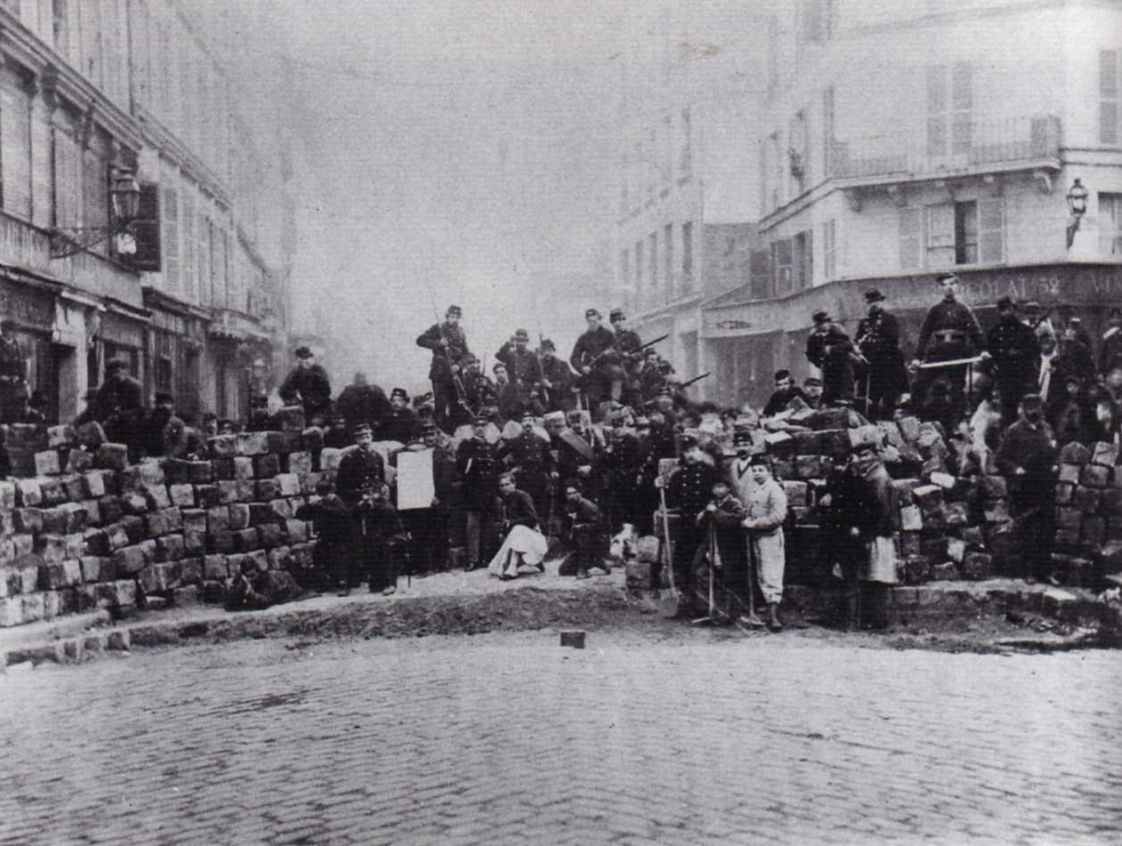
A barricade during the Paris Commune, 1971.


A brief history of the world's first socialist working class uprising. The workers of Paris, joined by mutinous National Guardsmen, seized the city and set about re-organising society in their own interests based on workers' councils. They could not hold out, however, when more troops retook the city and massacred 30,000 workers in bloody revenge.

The Paris Commune is often said to be the first example of working people taking power. For this reason it is a highly significant event, even though it is ignored in the French history curriculum. On March 18 1871, after France was defeated by Prussia in the Franco-Prussian war, the French government sent troops into Paris to try and take back the Parisian National Guard’s cannon before the people got hold of it. Much to the dismay of the French government, the citizens of Paris had got hold of them, and wouldn't give them up. The soldiers refused to fire on their own people and instead turned their weapons on their officers.

The PNG held free elections and the citizens of Paris elected a council made up mostly of Jacobins and Republicans (though there were a few anarchists and socialists as well). The council declared that Paris was an independent commune and that France should be a confederation of communes. Inside the Commune, all elected council members were instantly recallable, paid an average wage and had equal status to other commune members.

Contemporary anarchists were excited by these developments. The fact that the majority of Paris had organised itself without support from the state and was urging the rest of the world to do the same was pretty exciting. The Paris Commune led by example in showing that a new society, organised from the bottom up, was possible. The reforms initiated by the Commune, like turning workplaces into co-operatives, put anarchist theory into practice. By the end of May, 43 workplaces had become co-operatives and the Louvre Museum was a munitions factory run by a workers’ council.

The Mechanics Union and the Association of Metal Workers stated “our economic emancipation . . . can only be obtained through the formation of workers' associations, which alone can transform our position from that of wage earners to that of associates." They also advised the Commune’s Commission on Labour Organisation to support the following objectives: “The abolition of the exploitation of man by man... The organisation of labour in mutual associations and inalienable capital.” 

Through this, it was hoped that within the Commune, equality would not be an “empty word”. In the words of the most famous anarchist of the time, Mikhail Bakunin, the Paris Commune was a “clearly formulated negation of the state”.

However, anarchists argue that the Commune did not go far enough. Those within the Commune didn’t break with the ideas of representative government. As another famous anarchist, Peter Kropotkin said:

“if no central government was needed to rule the independent Communes... then a central municipal government becomes equally useless... the same federative principal would do within the Commune”

As the Commune kept some of the old ideas of representative democracy, they stopped the people within the Commune from acting for themselves, instead trusting the governors to sort things out for them.

Anarchists argued for federations of directly democratic mass assemblies, like the people of Paris had done just over a hundred years previously (must be something in the water!).

The council became increasingly isolated from those who’d elected it. The more isolated it got, the more authoritarian it got. The council set up a “Committee of Public Safety” to “defend [by terror]” the “revolution”. This Committee was opposed by the anarchist minority on the council and was ignored by the people who, unsurprisingly, were more concerned with defending Paris from invasion by the French army. In doing so, they proved right the old revolutionary cliché of ‘no government is revolutionary’!

On May 21st, the government troops entered the city and were met with seven days of solid street fighting. The last stand of the Communards took place at the cemetary of Montmartre, and after the defeat troops and armed members of the capitalist class roamed the city, killing and maiming at will. 

30,000 Communards were killed in the battles, many after they had surrendered, and their bodies dumped in mass graves.

The legacy of the Commune lived on, however, and "Vive la commune!" ("Long live the Commune!" was painted over on the walls of Paris during the 1968 uprising, and not for the last time we can be sure...

not thinking instead of acting, but both thinking and acting


V. I. Lenin
Eleventh Congress Of The R.C.P.(B.)[1]
March 27-April 2, 1922

Written: 16 March, 1922
First Published: 1925; Published according to the manuscript
Source: Lenin’s Collected Works, 2nd English Edition, Progress Publishers, Moscow, 1965, Volume 33, pages 237-242
Translated: David Skvirsky and George Hanna
Transcription\HTML Markup: David Walters & R. Cymbala
Copyleft: V. I. Lenin Internet Archive (www.marx.org) 2002. Permission is granted to copy and/or distribute this document under the terms of the GNU Free Documentation License

1
Speech In Opening The Congress March 27

[…]
Indeed, the sermons which...the Mensheviks and Socialist-Revolutionaries preach express their true nature: 'The revolution has gone too far. What you are saying now we have been saying all the time, permit us to say it again.' But we say in reply: 'Permit us to put you before a firing squad for saying that. Either you refrain from expressing your views, or, if you insist on expressing your political views publicly in the present circumstances, when our position is far more difficult than it was when the white guards were directly attacking us, then you will have only yourselves to blame if we treat you as the worst and most pernicious white guard elements.'


Žižek, “Repeating Lenin”
http://www.marxists.org/reference/subject/philosophy/works/ot/zizek1.htm

My personal experience is that practically all of the “radical” academics silently count on the long-term stability of the American capitalist model, with the secure tenured position as their ultimate professional goal (a surprising number of them even play on the stock market). If there is a thing they are genuinely horrified of, it is a radical shattering of the (relatively) safe life environment of the “symbolic classes” in the developed Western societies. Their excessive Politically Correct zeal when dealing with sexism, racism, Third World sweatshops, etc., is thus ultimately a defense against their own innermost identification, a kind of compulsive ritual whose hidden logic is: “Let’s talk as much as possible about the necessity of a radical change to make it sure that nothing will really change!”

[…]

Here are some details of the daily life of Lenin and the Bolsheviks in 1917 and the following years, which, in their very triviality, render palpable the gap from the Stalinist nomenklatura. When, in the evening of 24 October 1917, Lenin left his flat for the Smolny Institute to coordinate the revolutionary takeover, he took a tram and asked the conductress if there was any fighting going on in the center that day. In the years after the October Revolution, Lenin was mostly driving around in a car only with his faithful driver and bodyguard Gil; a couple of times they were shot at, stopped by the police and arrested (the policemen did not recognize Lenin), once, after visiting a school in suburbs, even robbed of the car and their guns by bandits posing as police, and then compelled to walk to the nearest police station. When, on 30 August 1918, Lenin was shot, this occurred while he got in a conversation with a couple of complaining women in front of a factory he just visited; the bleeding Lenin was driven by Gil to Kremlin, were there were no doctors, so his wife Nadezhda Krupskaya suggested someone should run out to the nearest grocer’s shop for a lemon... The standard meal in the Kremlin kantina in 1918 was buckwheat porridge and thin vegetable soup. So much about the privileges of nomenklatura!

[…]

the kernel of the Leninist “utopia” arises out of the ashes of the catastrophe of 1914, in his settling of the accounts with the Second International orthodoxy: the radical imperative to smash the bourgeois state, which means the state AS SUCH, and to invent a new communal social form without a standing army, police or bureaucracy, in which all could take part in the administration of the social matters. This was for Lenin no theoretical project for some distant future — in October 1917, Lenin claimed that “we can at once set in motion a state apparatus constituting of ten if not twenty million people."32 This urge of the moment is the true utopia. One cannot overestimate the explosive potential of The State and Revolution — in this book, “the vocabulary and grammar of the Western tradition of politics was abruptly dispensed with.”33 What then followed can be called, borrowing the title of Althusser’s text on Machiavelli, la solitude de Lenine: the time when he basically stood alone, struggling against the current in his own party. When, in his “April Theses” from 1917, Lenin discerned the Augenblick, the unique chance for a revolution, his proposals were first met with stupor or contempt by a large majority of his party colleagues. Within the Bolshevik party, no prominent leader supported his call to revolution, and Pravda took the extraordinary step of dissociating the party, and the editorial board as a whole, from Lenin’s “April Theses” — far from being an opportunist flattering and exploiting the prevailing mood of the populace, Lenin’s views were highly idiosyncratic. Bogdanov characterized “April Theses” as “the delirium of a madman,"34 and Nadezhda Krupskaya herself concluded that “I am afraid it looks as if Lenin has gone crazy."35

[…]

Today, Lenin appears as a figure from a different time-zone: it’s not that his notions of the centralized Party, etc., seem to pose a “totalitarian threat” — it’s rather that they seem to belong to a different epoch to which we can no longer properly relate. However, instead of reading this fact as the proof that Lenin is outdated, one should, perhaps, risk the opposite conjecture: what if this impenetrability of Lenin is a sign that there is something wrong with OUR epoch? What if the fact that we experience Lenin as irrelevant, “out of sync” with our postmodern times, impart the much more unsettling message that our time itself is “out of sync,” that a certain historical dimension is disappearing from it?69

[…]

The greatness of Lenin is that he WASN’T AFRAID TO SUCCEED — in contrast to the negative pathos discernible from Rosa Luxembourg to Adorno, where the only authentic act is the true failure, the failure which brings to light the antagonism of the constellation (what, apropos of Beethoven, Adorno says about the two modes of the artistic failure — the unauthentic, due simply to the authors subjective deficiency, and the authentic, which brings to light the limitation of the very objective social constellation — bears also on his own politics71). In 1917, instead of waiting for the right moment of maturity, Lenin organized a preemptive strike; in 1920, finding himself in a position of the leader of the party of the working class with no working class (most of it being killed in the civil war), he went on organizing a state, i.e. he fully accepted the paradox of the party organizing-creating its base, its working class.

Nowhere is this greatness more palpable than in Lenin’s writings of 1917, which cover the span from his initial grasp of the unique revolutionary chance (first elaborated in the “Letters From Afar”) to the “Letter to Central Committee Members,” which finally convinced the Bolshevik majority that the moment to seize power has arrived. Everything is here, from “Lenin the ingenious revolutionary strategist” to “Lenin of the enacted utopia” (of the immediate abolishing of the state apparatuses). To refer to Kierkegaard, what we are allowed to perceive in these writings is Lenin-in-becoming: not yet “Lenin the Soviet institution,” but Lenin thrown into an OPEN situation. Are we, within our late capitalist closure of the “end of history,” still able to experience the shattering impact of such an authentic historical openness?

[…]


“I am a Leninist. Lenin wasn’t afraid to dirty his hands. If you can get power, grab it”