Saturday, November 24, 2012

Federico Garcia Lorca


http://www.poets.org/poet.php/prmPID/163

Federico García Lorca

Federico García Lorca is possibly the most important Spanish poet and dramatist of the twentieth century. García Lorca was born June 5, 1898, in Fuente Vaqueros, a small town a few miles from Granada. His father owned a farm in the fertile vega surrounding Granada and a comfortable mansion in the heart of the city. His mother, whom Lorca idolized, was a gifted pianist. After graduating from secondary school García Lorca attended Sacred Heart University where he took up law along with regular coursework. His first book, Impresiones y Viajes (1919) was inspired by a trip to Castile with his art class in 1917.

In 1919, García Lorca traveled to Madrid, where he remained for the next fifteen years. Giving up university, he devoted himself entirely to his art. He organized theatrical performances, read his poems in public, and collected old folksongs. During this period García Lorca wrote El Maleficio de la mariposa (1920), a play which caused a great scandal when it was produced. He also wrote Libro de poemas (1921), a compilation of poems based on Spanish folklore. Much of García Lorca's work was infused with popular themes such as Flamenco and Gypsy culture. In 1922, García Lorca organized the first "Cante Jondo" festival in which Spain's most famous "deep song" singers and guitarists participated. The deep song form permeated his poems of the early 1920s. During this period, García Lorca became part of a group of artists known as Generación del 27, which included Salvador Dalí and Luis Buñuel, who exposed the young poet to surrealism. In 1928, his book of verse, Romancero Gitano ("The Gypsy Ballads"), brought García Lorca far-reaching fame; it was reprinted seven times during his lifetime.

In 1929, García Lorca came to New York. The poet's favorite neighborhood was Harlem; he loved African-American spirituals, which reminded him of Spain's "deep songs." In 1930, García Lorca returned to Spain after the proclamation of the Spanish republic and participated in the Second Ordinary Congress of the Federal Union of Hispanic Students in November of 1931. The congress decided to build a "Barraca" in central Madrid in which to produce important plays for the public. "La Barraca," the traveling theater company that resulted, toured many Spanish towns, villages, and cities performing Spanish classics on public squares. Some of García Lorca's own plays, including his three great tragedies Bodas de sangre (1933), Yerma (1934), and La Casa de Bernarda Alba (1936), were also produced by the company.

In 1936, García Lorca was staying at Callejones de García, his country home, at the outbreak of the Civil War. He was arrested by Franquist soldiers, and on the 17th or 18th of August, after a few days in jail, soldiers took García Lorca to "visit" his brother-in-law, Manuel Fernandez Montesinos, the Socialist ex-mayor of Granada whom the soldiers had murdered and dragged through the streets. When they arrived at the cemetery, the soldiers forced García Lorca from the car. They struck him with the butts of their rifles and riddled his body with bullets. His books were burned in Granada's Plaza del Carmen and were soon banned from Franco's Spain. To this day, no one knows where the body of Federico García Lorca rests.

A Selected Bibliography

Poetry

Canciones (1927)
El poema del Cante Jondo (1932)
Impresiones y viajes (1918)
In Search of Duende (1998)
Lament for the Death of a Bullfighter and Other Poems (1937)
Libro de poemas (1921)
Llanto por Ignacio Sanchez Mejias (1935)
Poeta en Nueva York ("Poet in New York") (1940)
Romancero Gitano ("The Gypsy Ballads") (1928)
Selected Poems (1941)

Drama

Amor de Don Perlimplin con Belisa en su jardin (1931)
Bodas de sangre ("Blood Wedding") (1933)
El malificio de la mariposa (1920)
La casa de Bernarda Alba ("The House of Bernarda Alba") (1936)
La zapatera prodigiosa ("The Shoemaker's Marvelous Wife") (1930)
Mariana Pineda (1927)
The Comedies (1955)
Yerma (1934)

Monday, November 19, 2012

If You Want to Commemorate the Murder of an Anti-Fascist in Petersburg, Police Will Treat You Like Scum


http://chtodelat.wordpress.com/2012/11/18/if-you-want-to-commemorate-the-murder-of-a-anti-fascist-in-petersburg-police-will-treat-you-like-scum/

The Term, Episode 1121: Anniversary of a Death

Saint Petersburg anti-fascists marked the seventh anniversary of the death of their comrade Timur Kacharava. After the sanctioned action was over, police demanded that the friends of the deceased man remove all the flowers laid at the site of Timur’s death.

The friends refused, so the police got a homeless man to do it.

Just a little taste of a life in a city where, once upon a time, over a million people perished during a Nazi siege.

Timur Kacharava was stabbed to death by neo-Nazis in broad daylight in downtown Petersburg on November 13, 2005. The murder took place just a stone’s throw away from an obelisk erected to mark the Soviet Union’s victory over Nazi Germany in World War Two.

Friday, November 16, 2012

1871: The Paris Commune


http://libcom.org/history/1871-the-paris-commune

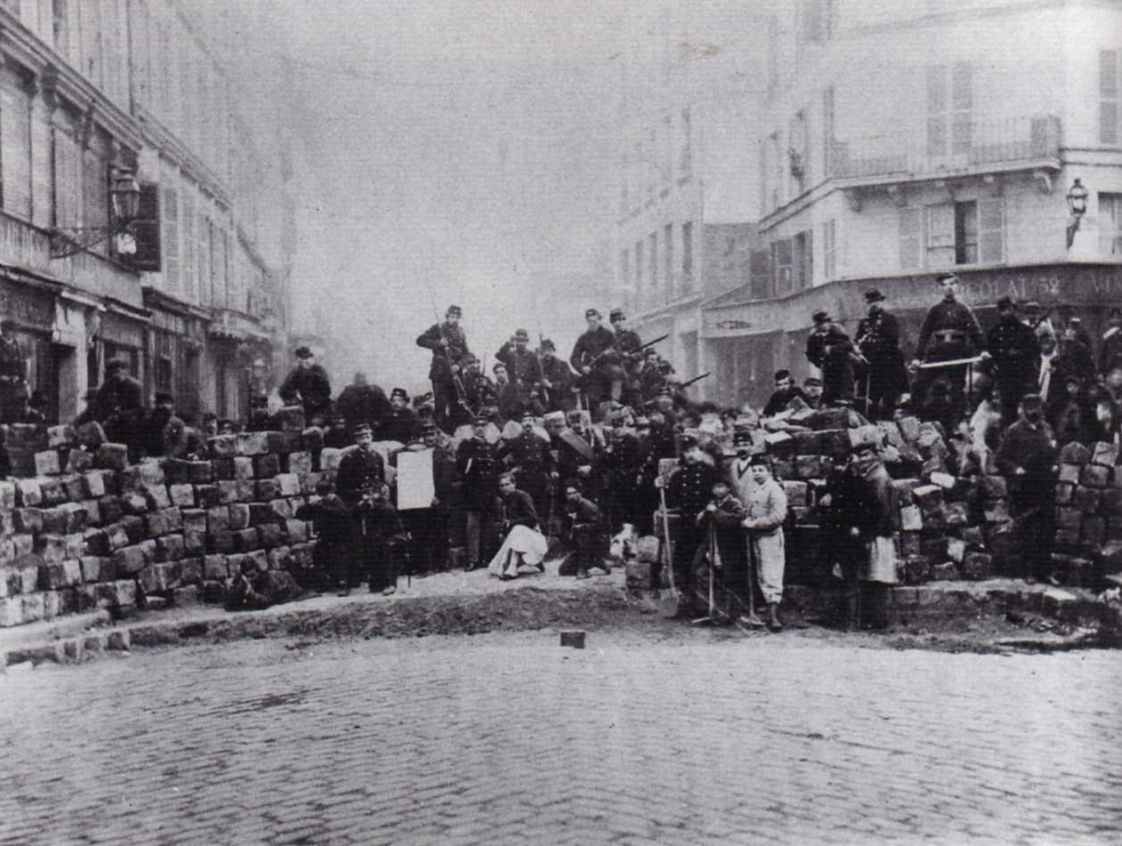
A barricade during the Paris Commune, 1971.


A brief history of the world's first socialist working class uprising. The workers of Paris, joined by mutinous National Guardsmen, seized the city and set about re-organising society in their own interests based on workers' councils. They could not hold out, however, when more troops retook the city and massacred 30,000 workers in bloody revenge.

The Paris Commune is often said to be the first example of working people taking power. For this reason it is a highly significant event, even though it is ignored in the French history curriculum. On March 18 1871, after France was defeated by Prussia in the Franco-Prussian war, the French government sent troops into Paris to try and take back the Parisian National Guard’s cannon before the people got hold of it. Much to the dismay of the French government, the citizens of Paris had got hold of them, and wouldn't give them up. The soldiers refused to fire on their own people and instead turned their weapons on their officers.

The PNG held free elections and the citizens of Paris elected a council made up mostly of Jacobins and Republicans (though there were a few anarchists and socialists as well). The council declared that Paris was an independent commune and that France should be a confederation of communes. Inside the Commune, all elected council members were instantly recallable, paid an average wage and had equal status to other commune members.

Contemporary anarchists were excited by these developments. The fact that the majority of Paris had organised itself without support from the state and was urging the rest of the world to do the same was pretty exciting. The Paris Commune led by example in showing that a new society, organised from the bottom up, was possible. The reforms initiated by the Commune, like turning workplaces into co-operatives, put anarchist theory into practice. By the end of May, 43 workplaces had become co-operatives and the Louvre Museum was a munitions factory run by a workers’ council.

The Mechanics Union and the Association of Metal Workers stated “our economic emancipation . . . can only be obtained through the formation of workers' associations, which alone can transform our position from that of wage earners to that of associates." They also advised the Commune’s Commission on Labour Organisation to support the following objectives: “The abolition of the exploitation of man by man... The organisation of labour in mutual associations and inalienable capital.” 

Through this, it was hoped that within the Commune, equality would not be an “empty word”. In the words of the most famous anarchist of the time, Mikhail Bakunin, the Paris Commune was a “clearly formulated negation of the state”.

However, anarchists argue that the Commune did not go far enough. Those within the Commune didn’t break with the ideas of representative government. As another famous anarchist, Peter Kropotkin said:

“if no central government was needed to rule the independent Communes... then a central municipal government becomes equally useless... the same federative principal would do within the Commune”

As the Commune kept some of the old ideas of representative democracy, they stopped the people within the Commune from acting for themselves, instead trusting the governors to sort things out for them.

Anarchists argued for federations of directly democratic mass assemblies, like the people of Paris had done just over a hundred years previously (must be something in the water!).

The council became increasingly isolated from those who’d elected it. The more isolated it got, the more authoritarian it got. The council set up a “Committee of Public Safety” to “defend [by terror]” the “revolution”. This Committee was opposed by the anarchist minority on the council and was ignored by the people who, unsurprisingly, were more concerned with defending Paris from invasion by the French army. In doing so, they proved right the old revolutionary cliché of ‘no government is revolutionary’!

On May 21st, the government troops entered the city and were met with seven days of solid street fighting. The last stand of the Communards took place at the cemetary of Montmartre, and after the defeat troops and armed members of the capitalist class roamed the city, killing and maiming at will. 

30,000 Communards were killed in the battles, many after they had surrendered, and their bodies dumped in mass graves.

The legacy of the Commune lived on, however, and "Vive la commune!" ("Long live the Commune!" was painted over on the walls of Paris during the 1968 uprising, and not for the last time we can be sure...

not thinking instead of acting, but both thinking and acting


V. I. Lenin
Eleventh Congress Of The R.C.P.(B.)[1]
March 27-April 2, 1922

Written: 16 March, 1922
First Published: 1925; Published according to the manuscript
Source: Lenin’s Collected Works, 2nd English Edition, Progress Publishers, Moscow, 1965, Volume 33, pages 237-242
Translated: David Skvirsky and George Hanna
Transcription\HTML Markup: David Walters & R. Cymbala
Copyleft: V. I. Lenin Internet Archive (www.marx.org) 2002. Permission is granted to copy and/or distribute this document under the terms of the GNU Free Documentation License

1
Speech In Opening The Congress March 27

[…]
Indeed, the sermons which...the Mensheviks and Socialist-Revolutionaries preach express their true nature: 'The revolution has gone too far. What you are saying now we have been saying all the time, permit us to say it again.' But we say in reply: 'Permit us to put you before a firing squad for saying that. Either you refrain from expressing your views, or, if you insist on expressing your political views publicly in the present circumstances, when our position is far more difficult than it was when the white guards were directly attacking us, then you will have only yourselves to blame if we treat you as the worst and most pernicious white guard elements.'


Žižek, “Repeating Lenin”
http://www.marxists.org/reference/subject/philosophy/works/ot/zizek1.htm

My personal experience is that practically all of the “radical” academics silently count on the long-term stability of the American capitalist model, with the secure tenured position as their ultimate professional goal (a surprising number of them even play on the stock market). If there is a thing they are genuinely horrified of, it is a radical shattering of the (relatively) safe life environment of the “symbolic classes” in the developed Western societies. Their excessive Politically Correct zeal when dealing with sexism, racism, Third World sweatshops, etc., is thus ultimately a defense against their own innermost identification, a kind of compulsive ritual whose hidden logic is: “Let’s talk as much as possible about the necessity of a radical change to make it sure that nothing will really change!”

[…]

Here are some details of the daily life of Lenin and the Bolsheviks in 1917 and the following years, which, in their very triviality, render palpable the gap from the Stalinist nomenklatura. When, in the evening of 24 October 1917, Lenin left his flat for the Smolny Institute to coordinate the revolutionary takeover, he took a tram and asked the conductress if there was any fighting going on in the center that day. In the years after the October Revolution, Lenin was mostly driving around in a car only with his faithful driver and bodyguard Gil; a couple of times they were shot at, stopped by the police and arrested (the policemen did not recognize Lenin), once, after visiting a school in suburbs, even robbed of the car and their guns by bandits posing as police, and then compelled to walk to the nearest police station. When, on 30 August 1918, Lenin was shot, this occurred while he got in a conversation with a couple of complaining women in front of a factory he just visited; the bleeding Lenin was driven by Gil to Kremlin, were there were no doctors, so his wife Nadezhda Krupskaya suggested someone should run out to the nearest grocer’s shop for a lemon... The standard meal in the Kremlin kantina in 1918 was buckwheat porridge and thin vegetable soup. So much about the privileges of nomenklatura!

[…]

the kernel of the Leninist “utopia” arises out of the ashes of the catastrophe of 1914, in his settling of the accounts with the Second International orthodoxy: the radical imperative to smash the bourgeois state, which means the state AS SUCH, and to invent a new communal social form without a standing army, police or bureaucracy, in which all could take part in the administration of the social matters. This was for Lenin no theoretical project for some distant future — in October 1917, Lenin claimed that “we can at once set in motion a state apparatus constituting of ten if not twenty million people."32 This urge of the moment is the true utopia. One cannot overestimate the explosive potential of The State and Revolution — in this book, “the vocabulary and grammar of the Western tradition of politics was abruptly dispensed with.”33 What then followed can be called, borrowing the title of Althusser’s text on Machiavelli, la solitude de Lenine: the time when he basically stood alone, struggling against the current in his own party. When, in his “April Theses” from 1917, Lenin discerned the Augenblick, the unique chance for a revolution, his proposals were first met with stupor or contempt by a large majority of his party colleagues. Within the Bolshevik party, no prominent leader supported his call to revolution, and Pravda took the extraordinary step of dissociating the party, and the editorial board as a whole, from Lenin’s “April Theses” — far from being an opportunist flattering and exploiting the prevailing mood of the populace, Lenin’s views were highly idiosyncratic. Bogdanov characterized “April Theses” as “the delirium of a madman,"34 and Nadezhda Krupskaya herself concluded that “I am afraid it looks as if Lenin has gone crazy."35

[…]

Today, Lenin appears as a figure from a different time-zone: it’s not that his notions of the centralized Party, etc., seem to pose a “totalitarian threat” — it’s rather that they seem to belong to a different epoch to which we can no longer properly relate. However, instead of reading this fact as the proof that Lenin is outdated, one should, perhaps, risk the opposite conjecture: what if this impenetrability of Lenin is a sign that there is something wrong with OUR epoch? What if the fact that we experience Lenin as irrelevant, “out of sync” with our postmodern times, impart the much more unsettling message that our time itself is “out of sync,” that a certain historical dimension is disappearing from it?69

[…]

The greatness of Lenin is that he WASN’T AFRAID TO SUCCEED — in contrast to the negative pathos discernible from Rosa Luxembourg to Adorno, where the only authentic act is the true failure, the failure which brings to light the antagonism of the constellation (what, apropos of Beethoven, Adorno says about the two modes of the artistic failure — the unauthentic, due simply to the authors subjective deficiency, and the authentic, which brings to light the limitation of the very objective social constellation — bears also on his own politics71). In 1917, instead of waiting for the right moment of maturity, Lenin organized a preemptive strike; in 1920, finding himself in a position of the leader of the party of the working class with no working class (most of it being killed in the civil war), he went on organizing a state, i.e. he fully accepted the paradox of the party organizing-creating its base, its working class.

Nowhere is this greatness more palpable than in Lenin’s writings of 1917, which cover the span from his initial grasp of the unique revolutionary chance (first elaborated in the “Letters From Afar”) to the “Letter to Central Committee Members,” which finally convinced the Bolshevik majority that the moment to seize power has arrived. Everything is here, from “Lenin the ingenious revolutionary strategist” to “Lenin of the enacted utopia” (of the immediate abolishing of the state apparatuses). To refer to Kierkegaard, what we are allowed to perceive in these writings is Lenin-in-becoming: not yet “Lenin the Soviet institution,” but Lenin thrown into an OPEN situation. Are we, within our late capitalist closure of the “end of history,” still able to experience the shattering impact of such an authentic historical openness?

[…]


“I am a Leninist. Lenin wasn’t afraid to dirty his hands. If you can get power, grab it”

Thursday, November 15, 2012

Millions Without Power Following Election


http://www.theonion.com/articles/millions-without-power-following-election,30247/

WASHINGTON—According to widespread reports, roughly 314 million Americans across the country have been left without any power following Tuesday’s devastating presidential election.

As many struggle to cope amidst the continued outage, experts have predicted that due to the severity of the presidential contest, which cut a wide swath of carnage throughout the entire United States, it’s very possible that power won’t be fully restored to the general public for at least another four years, if ever.

“By our estimates, power is out in roughly 150 million homes throughout the country, and many residents—especially the poor, the middle class, and ethnic minorities—will have no power for a long, long time,” said Cornell University political scientist Dr. Paul Kucharski, adding that the power infrastructure, which was originally put in place in 1789, has become increasingly problematic and unreliable over the past 200 years.

“Given that we have an outdated system that is so prone to failure, an outage of this magnitude was inevitable.”

“At this point,” he continued, “with the number of citizens whose lives have been completely devastated by this election, I think it’s fairly clear that the whole system needs a complete overhaul.”

[…]

Gatsheni and the bleeding lessons from Marikana


by Dinizulu Mbikokayise Macaphulana

http://www.newzimbabwe.com/opinion-9543-The+bleeding+lessons+from+Marikana/opinion.aspx

A PART of the good reason why Slavoj Zizek has been titled “the most dangerous philosopher in the West,” is his courage and obscene honesty.

Speaking and writing from the West, in his light and entertaining manner, the Slovanian failed actor and successful philosopher has pronounced that, in spite of the anger, the denialism, the depression and occasional acceptance, Eurocentric capitalism is tittering towards a cataclysmic collapse.

Drowning in the global financial and social crisis, the self-confessed political prefects of the world and patrons of Western modernity have no clue as to the way forward, hence the new scramble for Africa disguised in the grammar of human rights, democracy, peace and other gifts from the Greeks that have seen Africa being the new focus of attention as dramatised in Libya and the murder of Muammar Gaddaffi recently.

It takes a good sense of danger and that of humour to tell bad news to the owners of power. There is a price for telling bad news, however true. From Zizek to Julius Malema and from Frantz Fanon to Patrrice Lummumba, the penalty is either a label of idiocy, an accusation of insanity or a clear dismissal as a noise maker of no categorical consequence, if not death.

Yet, what has kept Zizek above the wave and off the sink, to the point of being an intellectual celebrity, is the undeniable truths he tells about a society that he belongs to, and which he still intelligently defends.

Undeniable and ordinarily pricey truths is what impressed the crowd, most of whom travelled far to listen to Professor Sabelo Gatsheni Ndlovu's “Decolonising Development Studies” lecture that he gave on October 16, in acceptance of his full professorship at the University of South Africa and which coincided with his assumption of the leadership of the Archie Mafeje Institute of Research.

Used to the usual inaugural lecture, most of us expected a romantic narrative of how the toddler Professor Gatsheni hunted squirrels in the woods and chased rabbits in bare foot before he thought about school, or some other intellectual rags to riches rendition involving favourite primary school teachers, witches and wizards, blessings and curses or such other usualities that accompany the rituals of inaugural lectures as we have become used to them.

Away from the usual mundanities, Gatsheni delivered an hour of what Professor Peter Stuart, the discussant and the head of the school of Development Studies said “has left development studies and development theory in tatters.” And what fundamentally did Gatsheni say or do that left an entire academic discipline like Development Studies and a total province of thought like development theory “in tatters”?  The answer is the subject of this short article.

What has been called “the African condition” by African scholars like Ali Mazrui, and the “African curse” by others in the Afropessimist school or the “African predicament,” by some historians is the troubling paradox where Africa is rich in natural resources and industrial raw materials, richer than most continents, but the people of Africa constitute the definition and name of poverty, disease and misfortune under the sun.

Not only that but as Eric Williams says, “every brick that built Western civilisation is cemented with Negro blood” and sweat. In slavery, mercantilism, colonialism and neo-colonialism Africa built the West, the West that Zizek has warned of collapse. And the West that is the hegemonic power in the globe as we experience it now.

Contributing to a growing family of ideas generated by combative African intellectuals in the shape of the late Arhibald Mafeje, the departed Dani Wadada Nabudere and the insightful Paul Tiyambe Zeleza and Adebayo Olukoshi to name but a few, Gatsheni asked and answered such questions as to why “Western modernity  has created” for the world “modern problems for which it has no modern solutions,” and why the West has promised to Africa and the rest of the global South, civilisation, development, economic prosperity, peace, human rights and heaven, but in place of all these grand “sugar-candy” promises it has delivered illusions and no realities.

In raising the question of illusions that currently occupy the space of realities within the African political and economic condition, Gatsheni tore into the curtain that continues to hide the true challenge that confronts Africa but has eluded scholars including the grand fathers of African liberation like Kwame Nkrumah and Julius Nyerere. The African experience continues to be the experience of coloniality in its racial, ethnic, gender and social manifestations.

Nkrumah’s “seek yeh first the political kingdom and all other things will be added unto you” dictum was one of the most poetic mistakes of the African decolonisation project that sold to Africans one of the most stubborn illusions to date. Africans sought the political kingdom, they earned the right to vote, replaced white leaders with black ones, designed beautiful flags and sang new melodious national anthems but for money or for love, nothing has been added unto them.

The 44 dead bodies of poor black miners in Marikana, gunned down by a squad of equally black and equally poor police officers on the orders of those who control platinum in South Africa, using their black mouthpieces in the government, should jolt all serious Africans to hard thinking about the continuing reality of apartheid that is disguised behind the illusions of “a rainbow nation” and a “South Africa that belongs to all who live in it.”

The political theatre in Zimbabwe is even more illusory than the one in South Africa. Robert Mugabe and Zanu PF are bearing the brunt of the stick from the West in form of sanctions and threats of prosecution for crimes against humanity. On the other hand, Morgan Tsvangirai and MDC-T are eating the carrot of rich sponsorship and funding to fight the tyranny of Mugabe and Zanu PF. Through their stick and their carrot, the Euro-American alliance are still the owners of the game in Zimbabwe, except for many slogans and wishes to the contrary by a ruling party and an opposition political party that are entangled and imbricated in a web of Western puppetry and coloniality.

In their fight, Zanu PF and MDC-T have provoked such a dust and arrested so much media attention and kept SADC and AU without sleep. There is nothing to be gained by ordinary bread eaters in Zimbabwe. As this happens, the knowledge is in the public domain that the Chinese are harvesting the bounty of diamonds in Zimbabwe and in the global diamond black market America and her allies still buy Zimbabwean diamonds in prices far cheaper than they would be in the formal market, never mind that “Zimbabwe will never be a colony again!”

In addressing his lecture to the presence of illusions instead of realities of independence and development in Africa and the entire global South, Gatsheni was inviting serious thinking about such paradoxes that are symptomatic of the African condition like the Marikana massacre and the illusory political and economic stalemate in Zimbabwe.

So much African intelligence and energy is expended in pursuit of illusions while realities lie unattended to. Using decolonial thought as his spectacles with which to scrutinise the world, Gatsheni was deploying a combative liberatory school of thought  whose geneology is traceable to world systems philosopher Immanuel Wallerstein and Latin American liberation philosopher Anibal Quijano and their students, among them activist scholars Ramon Grosfoguel and Nelson Maldonado-Torres.

Decolonial thought as a way of looking at the world and life, is a school of thought that refuses to swallow impressions and illusions but is only satisfied with the smell behind the perfume. Together with the African Decolonial Research Network (ADERN), a group of young scholars in development studies, political science and political communication, Gatsheni is geared to contribute to a wealth of insights on where African liberation movements went wrong in the decolonisation of Africa and how Africa can be recovered from coloniality and navigated back to realities of economic and political independence.

His forthcoming book, 'Empire, Global Coloniality and African Subjectivity'will be a must read. The path of Gatsheni and ADERN, like the paths of other Afrocentric scholars before him is going to be a thorny one. There is no consesus in African scholarship on where Africa should go. The fierce debates over issues concerning the African destiny that clashed Ali Mazrui with Archie Mafeje, Wole Soyinka and Ali Mazrui have not gone away.

There are still some professors in the African academia who are megaphones of Western stereotypes of Africa who regard combative Afrocentric scholarship as a pursuit of “the power of the false” as Achille Mbembe has offensively argued. The ground is fertile for fierce intellectual tussles, but away from university seminar rooms and comfortable hotels, the painful lessons about the true African condition of coloniality and enduring subjection are the blood of Marikana and the politics of illusions and myths that occupies many in Zimbabwe and the rest of Africa where ruling parties and their rivals in the opposition still remain tools of the same Empire.