Thursday, July 2, 2020

New York City transit worker suffers miscarriage on the job
https://www.wsws.org/en/articles/2020/07/01/nyct-j01.html?pk_campaign=newsletter&pk_kwd=wsws
By Sam Dalton
1 July 2020
On June 27, reports emerged that a pregnant Metropolitan Transportation Authority (MTA) subway conductor had given birth at a train yard. Initially workers reported that the baby appeared to have been safely delivered but later that evening coworkers familiar with the mother’s situation revealed the baby had in fact died.
The responsibility for this tragedy falls squarely not only on the shoulders of the Democratic administration of Governor Andrew Cuomo, which runs the MTA, but also on the Transport Workers Union (TWU), the organization that falsely claims to represent over 41,000 workers, primarily in the New York City subways and buses. The death of the child is a part of a pattern of systematic and deliberate neglect of workers’ basic health and safety needs by the union for many years.
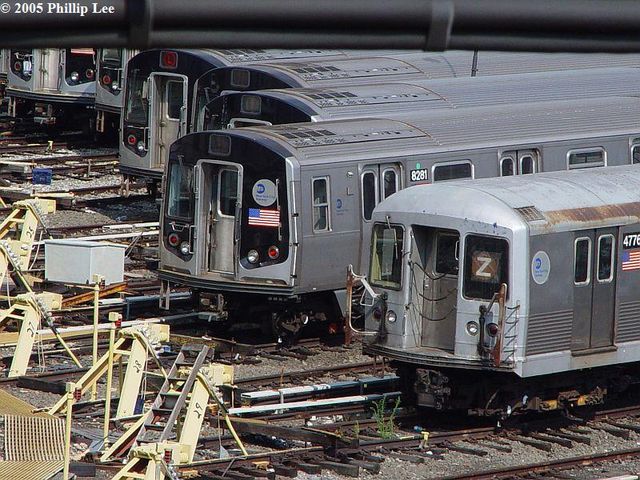 East New York subway yard (Photo by Phillip Lee)
The worker’s miscarriage takes place as the number of COVID-19 deaths among New York’s transit workers has exceeded 140. As New York state and city authorities, headed by the Democratic Party, continue their deadly drive to reopen businesses during the pandemic, this number will only increase in the coming weeks and months.
The mother had filed a written request for special accommodation on June 24 because of her advancing pregnancy. Even though an appointment was scheduled on June 29 at the MTA’s Medical Assessment Center to review her responsibilities, she was forced to come into work on June 28. Following the death of her child, the MTA has granted the worker the standard two weeks paid maternity leave.
The mother was a second-generation New York City conductor. At the time of the incident the mother was six months pregnant and she was assigned to moving switches on the subway tracks. At the notoriously outdated East New York (ENY) yard, this job requires the strenuous pulling of heavy levers to switch over tracks, the continuous crossing of electrically charged third rails, climbing of ladders on and off trains and walking over uneven ballast.
Furthermore, the East New York yard is raised, therefore, to come in and out of work every day workers must scale multiple flights of stairs. Strenuous and dangerous even at the best of times, during a pregnancy these conditions severely endanger the lives of both mother and child.
The worker’s coworkers are understandably outraged at the news. On Facebook, one worker wrote, “As a dad of four and a granddad of two (so far), I hold a special place in my soul for children, and I can say unequivocally that the murder of that newborn baby, committed by Transit officials, at ENY yard yesterday, has hit me the hardest …”
Another commented, “It’s time that the MTA start realizing we are more than just employee numbers.”
This death was not an unfortunate accident, but the immediate consequence of strenuous work on the mother and child. In turn, these conditions are the outcome of decades of attacks on the social rights of transit workers in New York City and across the world. Across the globe, unions claiming to defend the rights of workers have been complicit in attacks that are driving working conditions back to those of the 19th century.
It is unconscionable that a pregnant worker was forced to carry out heavy labor of this kind. This is, however, the norm and not the exception for pregnant workers at the MTA. Workers are not only given a meager two weeks maternity leave but must exhaust all other vacation days and paid time off before they are granted longer unpaid leave. For many, this is simply impossible, and workers are often forced to work late in their pregnancies.
Workers have raised concerns over the conditions facing pregnant colleagues for many years. An MTA worker, who wished to be referred to as Lisa, who gave birth to a child late last year, told the WSWS, “She isn’t the only woman who had an injury while working while pregnant down here either. When I was pregnant another train operator slipped off a train at 7 months pregnant in the yard. There are tons of other incidents as well.”
Lisa continued, “I recently had my baby and worked my entire pregnancy. Lots of us are forced to use our sick time during this period as well, which is incredibly unfair because it either depletes the sick time or lowers it. This means when we come back it is at zero and it’ll be counted against us when we come up for promotion. During my pregnancy, I took a leave of absence and was denied when I tried to add some additional time.”
The pandemic has also posed difficulties to workers with children and families. Thousands of MTA workers have worked under the constant fear that they will contract the virus and spread it among their families. The closure of schools also left many workers with children at home, forcing them to take fewer shifts or find expensive childcare. Lisa explained, “I came back to work at the beginning of the pandemic. Finding childcare has been hectic. I feel that mothers should get at minimum six months.”
As the MTA’s financial crisis intensifies—the agency has accumulated not only $46 billion in debt for capital expenses but also $12 billion in operating expenses during the pandemic—the agency’s chairman Pat Foye assured the agency’s bondholders, “We’re not asking for forgiveness from our creditors.”
The MTA’s orientation to Wall Street—at the behest of the Democratic-run state government under Governor Andrew Cuomo, who is the effective head of the agency—is, in fact, the overriding reason for its deadly neglect of transit workers throughout the pandemic. While ultra-rich speculators trade MTA bonds for billions, workers will be left to bear the brunt of cost-cutting measures taken in attempts to save the agency.
The criminality of the MTA has only been abetted by the complicity of the TWU. The contract pushed through by the union in January cut workers’ access to health care in other ways beside limiting them to the inadequate two-weeks maternity or paternity leave.
In the last contract, the union and MTA also agreed to inaugurate a Women’s Committee “to address issues relating to female employees.” Such window-dressing is typical of the union’s bait-and-switch approach, in which it tries to distract workers with meaningless concessions while green-lighting the MTA’s continuing attacks on its workforce.
During contract discussions the union proposed shifting its members to New York state’s 2014 legislation on parental leave requirements for private companies. Despite granting 12 weeks of leave, this legislation only guarantees full pay for the first two weeks, meaning that workers, many of whom are living paycheck to paycheck, would still be forced to return to work prematurely.
In a statement over the weekend, TWU Local 100 President Tony Utano said about the worker’s miscarriage, “This is a terrible and tragic loss. Our hearts go out to our union sister and her family, and we will do whatever we can to assist them at this difficult time.”
The TWU’s hypocritical statement has angered workers. On Facebook, one worker responded, “Have you no shame? Why on earth in 2020 do we have such horrible maternity rights and light duty rights for women by a multi-billion-dollar agency? Why instead of asking for these things from Transit, you are not just straight up demanding them? The ball is in our court, and the power is in our hands, and yet time and time again, you do nothing. You just offer up more ‘thoughts and prayers.’”
Workers must insist on every pregnant woman’s right to safeguard her own well-being as well as that of her child. This includes the right to safe housing, high-quality medical care, and full pay during maternity leave. The length of leave should be determined with the health of mother and child as first priority and should extend for a period after the birth that gives ample time for the mother to physically recover and care for her newborn child. Workers should also insist on similar rights for paternity leave. Workers must also put forward wider demands for workers’ protection from the ongoing COVID-19 pandemic.
The life-and-death struggle for these rights cannot be conducted by anyone other than workers themselves. Appeals to the MTA or attempts to reform the TWU are worse than useless in this struggle.
Following the lead of autoworkers in Detroit, to protect their lives New York City transit workers must form their own rank-and-file safety committees. With the pandemic in resurgence, no time can be lost. The Socialist Equality Party and WSWS will provide full assistance to workers’ efforts to take these vital protective measures.
As COVID-19 infections explode in the US, Fauci warns of 100,000 new cases a day
https://www.wsws.org/en/articles/2020/07/01/pand-j01.html?pk_campaign=newsletter&pk_kwd=wsws
By Barry Grey
1 July 2020
With daily coronavirus infections in the US continuing to rise at record rates, pushing health care systems in many states to the breaking point, Dr. Anthony Fauci, the leading American expert on infectious diseases, warned Tuesday that the daily infection rate could rapidly rise to 100,000.
Testifying before the Senate Health, Education, Labor and Pensions Committee, Fauci, the director of the National Institute of Allergy and Infectious Diseases, said:
I’m very concerned about what is going on right now, particularly in the four states that are accounting for about 50 percent of the new infections … we’re going in the wrong direction … so we really have to do something about that, and we need to do it quickly.
We can’t just focus on those areas that are having the surge. It puts the entire country at risk. We’re having 40-plus thousand new cases a day. I would not be surprised if we go up to 100,000 new cases a day if this does not turn around.
Asked to give an estimate of the likely death toll, Fauci said he could not give a number, but added, “I think it is important to tell you and the American public that I’m very concerned because it could get very bad.”
Fauci's testimony underscored the grim reality that the pandemic in the US is now far more widespread than it was at its previous height in late March and early April, when states across the country imposed lockdowns to contain the spread of infections and deaths. A major factor in the imposition of the lockdowns was a series of wildcat strikes by autoworkers in the US and Canada, who refused to risk infection and death to continue pumping out profits for the Detroit Three auto companies.
Once the bipartisan CARES Act was passed on a near-unanimous vote in Congress, putting in place a multitrillion-dollar bailout of Wall Street and the corporations, both Trump and media outlets aligned with the Democrats, particularly the New York Times, began demanding the "reopening" of the economy and the forced return of workers to the factories and workplaces.
This was carried out by the governors and mayor of both parties. It was done without any serious system of testing, contact tracing and quarantining in place. Now, just weeks later, the virus is raging out of control. Reported infections in the US are above 2.6 million and the death toll has topped 127,000.
Last week saw the highest daily average rise in new cases over a seven-day period: 39,000 per day. Last Friday set a new record of over 47,000 cases, and Monday saw an increase of more than 44,700. The number of infections is rising in between 26 and 38 states, depending on the data source.
Eleven states had an average daily increase in cases of over 100 percent over the past 14 days. These include Florida (237 percent), Texas (165 percent), Arizona (128 percent) and Oklahoma (176 percent). California's average daily increase is 70 percent; Ohio is up by 69 percent.
Not only are new cases up sharply, the percentage of positive tests is rising, and hospitalization rates are going up in 12 states.
The situation is so dire that 16 states have either paused or partially rolled back their reopening plans. None, however, have even suggested a shutdown or curtailment of nonessential production, despite the rise of infections and deaths of workers in meatpacking, auto, logistics and many other workplaces.
This was the context for Tuesday's hearing, which took testimony from Dr. Robert Redfield, director of the Centers for Disease Control and Prevention (CDC), Adm. Brett Giroir, assistant secretary of health at the Health and Human Services Department (HHS), and Dr. Stephen Hahn, commissioner of the Food and Drugs Administration, in addition to Fauci.
Among the Republicans on the Senate panel, there was little in the way of a direct attempt to defend the response of the Trump administration to the pandemic, which is so badly discredited that many Republicans are fearful of losing control of the chamber in this November's election. The day before, Trump's White House press secretary, Kayleigh McEnany, had sought to defend Trump’s denigration of masks and his moves to curtail testing by downplaying the scale of the surge, saying, “We’re aware that there are embers that need to be put out.”
The Democrats jumped at the chance to attack the easy target of Trump, who most crudely and nakedly promotes a policy with which, in all essentials, they agree. The common theme on both sides was how to “safely” and more efficiently carry through the reopening of the economy. The focus was on empty proposals to step up testing and contact tracing, with no discussion of allocating the needed resources, along with pleas to Trump to begin wearing a mask and speculation on the development of a vaccine.
The underlying premise on both sides was that the back-to-work drive would continue unabated, nothing would be done to impede the flow of profits to the corporations and banks, and the limitless flooding of the financial markets with cash from the Federal Reserve would proceed unhindered. Nothing, however, would be done to halt and reverse the catastrophic upsurge of the disease currently underway.
The ranking Democrat, Patty Murray of Washington state, set the tone in her opening remarks. Declaring that “a leadership crisis is raging in the White House,” she spoke in vague terms of ramping up testing and developing a comprehensive national vaccination plan.
Not a single Democrat on the committee, including Bernie Sanders and Elizabeth Warren, called for a suspension of nonessential production or noted the spread of disease and death among workers forced to work under unsafe conditions.
Sanders, supposedly the scourge of the pharmaceutical giants and the “billionaire class,” used his five minutes of questioning to urge that an eventual vaccine be made available to all regardless of income, in the course of which he said, “Our tax dollars are going to the tune of billions of dollars to drug companies to help develop this vaccine and that’s OK.”
In a speech on the pandemic on Tuesday, former Vice President Joe Biden, the presumptive Democratic presidential candidate, chose to attack Trump in militaristic terms. “Back in March,” Biden said, “he called himself a wartime president … Now it’s almost July and it seems as if our wartime president has surrendered.”
Biden actually underestimated the severity of the current situation, characterizing it as “half recovering and half getting worse,” when, in fact, infections are soaring across the bulk of the country. He outlined a five-point plan, which consisted merely of increased testing, more personal protective equipment for front-line workers, the development of treatments and vaccines, uniform national standards for economic reopening and special attention to the elderly and people of color—none of which either he or the Democratic Party intends to carry out.
He said nothing of the back-to-work drive that is being imposed by threatening workers with a cutoff of unemployment benefits, made no mention of the wildcat actions by autoworkers and others against unsafe working conditions, ignored the Depression-era levels of unemployment and impoverishment triggered by the pandemic, and indicated, by his silence, his support for the massive bailout of Wall Street.
The real concerns of those sections of the ruling class that are backing Biden were indicated when he suggested that increased testing would give “every worker called back to the job … confidence that they and their fellow workers are not infected,” that is, create an illusion of safety to contain the mounting opposition of workers. Similarly, he warned that Trump’s incompetent and callous handling of the pandemic was “making Americans lose even more faith in our government.”
This, in a nutshell, is the policy of the Democrats: Do nothing that cuts across the crass profit interests of the corporate-financial oligarchy, continue the basic policy of “herd immunity” being carried out by Trump, but do a better job of concealing the class interests driving the ruthlessly anti-working class response to the pandemic.
Record 47.2 percent of working-age Americans without jobs
https://www.wsws.org/en/articles/2020/07/01/jobs-j01.html?pk_campaign=newsletter&pk_kwd=wsws
By Shannon Jones
1 July 2020
According to newly released Bureau of Labor Statistics (BLS) figures, 47.2 percent of working-age Americans were without work in May, the highest level recorded since the end of World War II.
The numbers are based on the BLS employment-population ratio, which states the proportion of the total labor force who are actually working. It is a more accurate measure of joblessness than the monthly unemployment report, which counts only those actively seeking work.
At the end of May the employment-population ratio stood at 52.8 percent; it stood at 61.2 percent at the start of the year. The employment-population ratio reached a postwar high of nearly 65 percent in 2000.
Citing Torsten Slok, the chief economist at Deutsche Bank, CNBC said it would take the creation of an additional 30 million jobs to bring the employment-population ratio back to January levels.
The report comes ahead of the release of the official jobless statistics for June later this week. They are expected to reflect a marginal decline in the official unemployment rate from 13.3 percent in May to 12.4 percent in June. It is not known if the June figures will correct the previous undercount in the numbers of May and April, when millions of workers were incorrectly classified. This resulted in the official jobless percentages being about 3 percent lower in May and 5 percent lower in June.
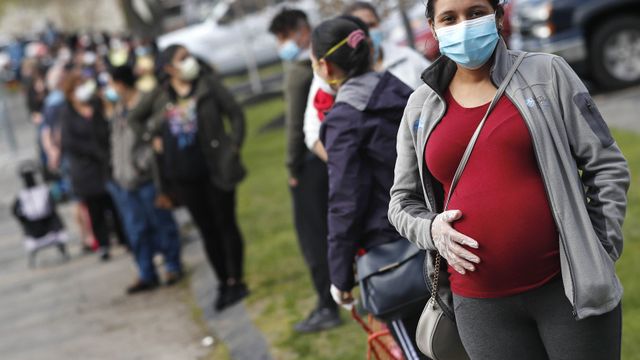 A pregnant woman waits in line for groceries with hundreds during a food pantry, sponsored by Healthy Waltham for those in need due to the COVID-19 virus outbreak, at St. Mary's Church in Waltham, Mass. (AP Photo/Charles Krupa)
The official unemployment rate remains at Great Depression levels in a number of states. Nevada, hard hit by the shutdown of the gaming industry, had an unemployment rate of 25.3 percent in May compared to 4.0 percent one year earlier. Hawaii stood at 22.6 percent in May compared to just 2.7 percent one year earlier, while Michigan registered 21.2 percent compared to 4.2 percent in May 2019. In California and Massachusetts, unemployment stood at 16.3 percent in May.
Joblessness was the highest in the leisure and hospitality sector, 35.9 percent. Retail was at 15.1 percent, construction at 12.7 percent and manufacturing at 11.6 percent. Among young people age 16–19, 29.9 percent were unemployed and 23.2 percent of workers age 20–24 had no work.
Despite the reckless early reopening of state economies during the course of June, there were around 1.5 million new claims each week for unemployment benefits. Many workers do not have a job to come back to. This is particularly the case for those employed at small businesses, such as restaurants, which could not survive the shutdown. A further wave of larger bankruptcies is also expected.
The full impact of this economic collapse will hit toward the end of July when the temporary weekly increase of $600 in unemployment benefits enacted in the CARES bill ends. The cutoff, scheduled for the week ending July 25, will slash income by about two-thirds for 20 million workers and will lead to a surge in hunger and evictions.
Personal income dropped 4.2 percent in May, despite the supplemental payments. The cutoff will be particularly devastating for low-wage workers, since regular unemployment benefits cover half or less of weekly pay.
The moratorium on evictions from federally subsidized housing contained in the CARES Act is also set to expire at the end of July, meaning that millions of families could soon confront the possibility of being in the street. According to the latest US Census Bureau Household Pulse Survey, 30 percent of renters had little or no confidence that they could meet housing payments for the next month.
A patchwork of state and local temporary bans on evictions are expiring or are being challenged by landlord associations. A statewide eviction ban was set to expire in Florida on July 1, barring a last-second extension by the governor. A statewide ban in Virginia expired June 29. In San Francisco, a citywide ban is being challenged in court. Earlier this month, an eviction ban expired in New York City, leading to warnings that 50,000–60,000 eviction cases could soon be filed in housing courts.
Andy Winkler of the Bipartisan Policy Center issued a warning reported in Politico of a “tsunami” of evictions following the expiration of the $600 unemployment supplement.
It is clear that corporations are using the crisis caused by the pandemic to carry out a major restructuring, including the permanent elimination of huge numbers of jobs. According to the International Monetary Fund, the world economy will contract by five percent in 2020, with US GDP down by eight percent. The GDPs of Mexico and Europe are expected to decline 10 percent, while China will show no growth. The second quarter in the US is expected to show the largest quarterly contraction since the end of WWII.
In an indication of what is to come, Airbus announced 15,000 job cuts worldwide by 2021 as it restructures its operations, an 11 percent reduction. Ten thousand job losses will be in Germany and France alone.
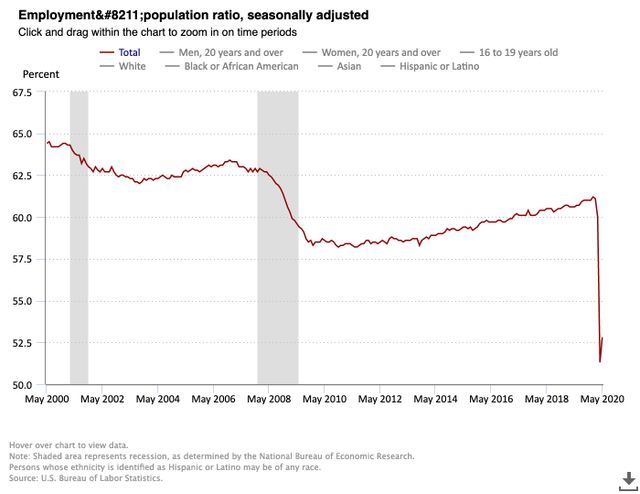 Graph showing the sharp fall in the employment-population ratio
In recent years, spokesmen for the ruling class have been bitterly complaining that record low unemployment had created “tight labor markets” and demands for rising wages. The destruction of tens of millions of jobs will now be used by corporations as a hammer to demand a new wave of wage and benefit cuts from workers. This has already been seen in the airlines and among public-sector workers.
Amidst this devastation, the US stock market closed June with one of the best quarterly rises in history. The Dow Jones Industrial Average rose 216 points Tuesday. For the second quarter, the Dow Jones rose 16 percent, erasing most of the losses of the first quarter of 2020. Apple, Home Depot, Dow and Microsoft were among those making the strongest gains. The S&P 500 showed a 19.1 percent gain for the quarter, while the Nasdaq is up 11 percent for the year.
The rise in the markets comes as COVID-19 cases surge in the United States, with record numbers of new infections, following the lifting of all attempts by federal and state governments to control the virus. The stock rise has been fueled not by an improving real economy, but the unlimited infusion of cash by the US Federal Reserve. Like a heroin addict, the markets rely on ever-greater injections of liquidity to maintain their inflated levels. Meanwhile, the attacks on workers’ jobs and living standards become ever more ferocious as the corporate oligarchy attempts to claw back the money from the hides of workers.
Workers should not accept that they shoulder the economic burden for the criminal and inept response of the capitalist authorities to the coronavirus pandemic. The massive resources going to the financial markets must be redirected to meeting pressing human needs. Workers made jobless by the spread of the virus and necessary health measures must have their incomes and livelihoods protected. This requires the independent political mobilization of the working class on the basis of a socialist and internationalist program.
Pandemic profiteering: Gliead Sciences cashes in on COVID-19
https://www.wsws.org/en/articles/2020/07/01/pers-j01.html?pk_campaign=newsletter&pk_kwd=wsws
1 July 2020
Pharmaceutical giant Gilead Sciences announced Monday that it will charge $3,120 for a five-day course of its coronavirus therapeutic remdesivir for the vast majority of the US population, including those on Medicare and Medicaid. A single vial of remdesivir, containing a tenth of a gram of the drug, will cost $520, a hundred times more expensive than its weight in gold.
This is nothing less than the extortion of the American public amid the COVID-19 pandemic. The price is estimated to be 400 times higher than what the drug needs to be profitable. Gilead is expected to make $1.3 billion from private payers by the end of the year.
Gilead’s announcement sends a clear message: American pharmaceutical companies plan to make billions off the COVID-19 pandemic, which has infected more than 10.5 million people and killed at least 513,000 worldwide. Notably, Wall Street surged 800 points over the past two days on the news.
The revulsion felt toward Gilead in the aftermath of its press release was put most forcefully by AIDS Health Foundation President Michael Weinstein. “Gilead Sciences unmasked itself today as both a war profiteer and greedy bastards—a depressing feat and spectacularly tone-deaf response to a global pandemic that has so far killed over half-a-million people worldwide, including more than 120,000 deaths in the US.”
In an attempt to justify the company’s price-gouging, Gilead Chairman and CEO Daniel O’Day released an open letter. Basing himself on data that was preliminary and not statistically significant, O’Day claimed that remdesivir “shortened time to recovery by an average of four days,” which, according to him, saves hospitals “approximately $12,000 per patient.”
The company’s executives thus generously “decided to price remdesivir well below this value." He continued, "To ensure broad and equitable access at a time of urgent global need, we have set a price… which equates to $2,340 per patient.” In O’Day’s opinion, this would allow “all patients [to] have access” to the therapeutic and balance the firm’s “longer-term responsibilities.”
The letter does not spell out what these “longer-term responsibilities” are, but they are not toward coronavirus patients. A report from the Institute for Clinical and Economic Review shows that the raw materials needed to make remdesivir cost only about $10 for a ten-day treatment, and the therapeutic has been priced at $600 by generic producers in Bangladesh and India, a quarter of the “broad and equitable” price boasted of by O’Day.
Moreover, while the cost of the therapeutic will be borne by their insurance for many millions in the United States, many millions more depend on the CARES Act funding for coronavirus treatments. They will have few options once that money pool runs dry, especially as even before the pandemic hit nearly 40 percent of the population was unable to afford an emergency $400 expense, much less one that is six or eight times that amount.
In a rational world, Health and Human Services (HHS) Secretary Alex Azar would have demanded that Gilead end its blatant price-gouging immediately. Instead, he hailed the drug as “life-saving” and pledged HHS to buy up to $1.56 billion worth of the drug.
Azar himself has many ties to the pharmaceutical industry. He was the president of the major drug enterprise Eli Lilly and Company before being tapped to be US President Donald Trump’s HHS secretary. He was also a director of the lobbying group Biotechnology Innovation Organization. He has been denounced by whistleblower Rick Bright, the ousted director of the government agency overseeing the development of a coronavirus vaccine, for seeking to downplay the pandemic when it first emerged in China in December and January.
It is also unclear whether remdesivir is actually effective in treating the novel coronavirus. Gilead had tested the efficacy of the remedy against the severe acute respiratory syndrome (SARS) and Middle East respiratory syndrome (MERS) coronaviruses, which led the company to suspect it might work against the pandemic virus, SARS-CoV-2. Doctors in China began treating patients with it in January.
Since then, medical studies on remdesivir’s effectiveness in treating COVID-19 have shown that it does not significantly reduce the death rate for those with the disease. Research by the National Institute of Allergy and Infectious Diseases (NIAID) in March and April concluded that, “given high mortality despite the use of remdesivir, it is clear that treatment with an antiviral drug alone is not likely to be sufficient.” In that context, billions of dollars are being spent to acquire a drug that, by the science available, doesn’t work.
The research did not stop National Institute of Allergey and Infectious Diseases (NIAID) Director Anthony Fauci from declaring, when the preliminary results were released: “The data shows that remdesivir has a clear-cut, significant positive effect in diminishing the time to recovery… We think it is opening the door to the fact that we now have the capability of treating [the coronavirus].”
Fauci’s support helped drive Gilead’s stock to new heights. Since the beginning of the year, the company’s market capitalization has increased by $20.1 billion to $96.5 billion, largely by promoting remdesivir as an effective treatment for the pandemic. This mirrors the fortunes of drugmaker Moderna, which has grown by more than 200 percent to a net worth of nearly $25 billion after proclaiming work on its own vaccine.
Moderna board member Moncef Slaoui, tapped by Trump to head the government’s “warp speed” vaccine development drive, became $2.4 million richer as a result of the media frenzy surrounding the announcement that Moderna had made progress toward a vaccine.
Beyond pumping up the share prices of the pharmaceutical giants, the media has promoted remdesevir and Moderna’s vaccine as “miracle drugs” to boost the campaign to get workers back on the job in factories and workplaces that have been hotbeds of COVID-19.
Wall Street sees the pandemic as a potential profit bonanza. The big banks and major corporations have received at least $6 trillion since March in bailouts and are going to make billions more holding the American and world population hostage by overcharging for potentially lifesaving coronavirus treatments.
Gilead is only one example of the lawlessness of corporate enterprises in the United States. The recent past has seen the poisoning of Flint, two Boeing 737 Max crashes, the opioid epidemic fueled by the pharmaceutical giants and the California wildfires caused by PG&E. No executive has ever gone to jail for these crimes. As Barack Obama’s attorney general told Congress in 2013, these modern-day robber barons are “too big to jail.”
The disastrous response of American capitalism to the COVID-19 pandemic makes clear the need to put an end to capitalism and the subjugation of human health to private profit. This means mobilizing the entire working class to expropriate the pharmaceutical giants and every major industry and transform these monopolies into publicly-owned and democratically-controlled utilities. The dictatorship of corporate interests over the working class must be abolished and economic life must be placed in the hands of the workers themselves.
Bryan Dyne
Local Unions Defy AFL-CIO in Push to Oust Police Unions
Several local unions have moved to oust police unions, despite the federation's approach that collective bargaining can be used for police reform.
June 30, 2020 Rebecca Rainey and Holly Otterbein POLTICO
https://portside.org/2020-06-30/local-unions-defy-afl-cio-push-oust-police-unions
The nation’s labor movement is splitting over police reform in the wake of George Floyd’s death.
Local unions are defying leaders of the AFL-CIO, who have rejected calls to cut ties with the labor federation's law enforcement arm and stressed the importance of collective bargaining instead to counter the use of excessive force. Several local unions, including those affiliated with the AFL-CIO, have moved to oust police unions within their locals and remove officers from schools and other workplaces. They argue that police have used their bargaining power to resist reform and protect those who have killed unarmed African Americans.
The vastly different approaches to solving what has become a major election year issue have not only exposed the rift within the labor movement but also threaten to diminish law enforcement unions in liberal cities and could even affect the behind-the-scenes race to succeed AFL-CIO President Richard Trumka.
“There are a lot of unions that are very concerned about police brutality,” said Lowell Peterson, executive director of Writers Guild of America-East, which adopted a resolution calling on the AFL-CIO to disassociate itself from the International Union of Police Associations, the federation’s police union affiliate. “There’s definitely a lot of talk in the labor movement about, ‘Why is this happening and what can we as unions do about it?’”
The nation’s second-largest teachers’ union, United Teachers Los Angeles, last week voted to eliminate police in Los Angeles public schools and “redirect funding to mental health and counseling” for students. The Chicago school board voted down a similar measure to cancel a $33 million contract with city police that was backed by the Chicago Teachers’ Union in protests and rallies throughout the week.
The Martin Luther King County Labor Council, a body of labor organizations representing more than 100,000 workers in the Seattle area, voted to expel the Seattle Police Officers Guild earlier this month. The Association of Flight Attendants, which sits on the AFL-CIO’s executive council, passed a resolution demanding that police unions embrace change “or be removed from the labor movement.”
Even the leader of the Service Employees International Union, the second largest union in the country, which itself represents some law enforcement employees, has expressed openness to the idea of ejecting police unions from the movement, though she has stopped short of endorsing the move.
“That's an option,” said SEIU President Mary Kay Henry of the Seattle federation’s decision to oust the police union. "I think another option is to use the union structure and leadership to educate and engage every member” in “re-imagining policing and criminal justice."
That would have been unheard of just months ago — and demonstrates how much has changed since Floyd’s death at the hands of a Minneapolis cop sparked nationwide protests against police brutality.
While labor activists say it is unlikely that Trumka would ever support efforts to expel law enforcement unions from the labor movement, the push from locals and some national unions to ostracize the police, as well as the larger Black Lives Matter movement, could drive more modest change.
Police unions have fought back, saying that no one forced local governments to sign collective bargaining agreements that contain provisions protecting police and warning that attacks on law enforcement unions are part of a pattern of going after organized labor.
“No contract is rammed down the throat of a city or jurisdiction. They signed it, they negotiated it, they agreed to it,” said Jim Pasco, executive director of the National Fraternal Order of Police.
Sam Cabral, the president of the International Union of Police Associations, slammed Trumka’s response to the unrest, writing in a June 12 letter that the federation's comments regarding America’s “history of racism and police violence against black people” were “inflammatory and patently false.” Cabral said he wouldn’t be willing to sit down with those who “have already indicted” law enforcement “based on one horrible incident.”
California’s largest police unions ran an ad in the Washington Post earlier this month calling for a national use of force standard, misconduct registry and “ongoing and frequent” training. Trumka also wrote in a recent op-ed that the labor movement is calling on Congress to adopt reforms including a chokehold ban and demilitarization.
Still, AFL-CIO leaders have maintained that the best way for the group to address the issue of police brutality is to “engage” its affiliates “rather than isolate them.”
Randi Weingarten, president of the American Federation of Teachers, an affiliate of the federation, said many members of the movement believe it’s important to have a conversation with police unions, “to the extent that they were willing to have it, for them to change and for us to change the criminal justice system.”
At the same time, the AFT recently passed a resolution calling to remove police from schools and instead train security personnel as “peace officers.”
Part of the solution, SEIU’s Henry suggested, is changing police collective bargaining practices.
“The role of the labor movement is to be a vehicle for the structural change that the Movement for Black Lives is demanding in policing and criminal justice all over this country,” she said.
Some progressives say those collective bargaining agreements often help shield officers accused of misconduct.
Dozens of city police departments, including in Minneapolis, have added provisions to their contracts that delay officer interrogations after suspected misconduct, according to a 2017 study. Agreements with police agencies in Austin, Baltimore, Chicago and Washington, D.C., have included language that mandated the removal of disciplinary records from personnel files over time.
As more local unions choose to step away or distance themselves from the police, the pressure to break with law enforcement unions has generated an internal debate over the issue within the AFL-CIO executive council itself in recent weeks.
Color of Change, a racial justice organization, said it has discussed the possibility of ejecting police unions with at least five labor groups in the AFL-CIO.
Weingarten said “a couple members of the council raised it” during a three-day meeting in June. In a call earlier this month, American Postal Workers Union leader Mark Dimondstein brought up the matter, according to a person on the line.
The federation’s general board released several recommendations on June 9 for affiliate unions to address police violence but declined to drop the International Union of Police Associations as requested by the WGAE.
The debate could affect the quiet race to succeed Trumka, who is expected to step aside. The election won’t be held until the federation’s convention in October 2021, but Flight Attendants union president Sara Nelson, whose organization has taken one of the most progressive stands on the question, and AFL-CIO secretary-treasurer Liz Shuler are both rumored to be interested in taking the role.
In June, Nelson publicly accused AFL-CIO leadership of misleadingly attributing a statement opposing the ouster of the IUPA to the entire general board.
“To be clear, this issue was not discussed by the General Board today and there was no vote on the resolution put forward by WGAE,” she tweeted. “Also, collective bargaining empowers workers; it is not a means to oppress workers’ rights.
Tim Schlittner, the AFL-CIO's communications director, disputed the claim. He said Trumka referred to the WGA-East’s resolution but that no one offered a motion on it.
The labor movement has successfully ousted unions in the past that didn’t abide by its principles. The Congress of Industrial Organizations expelled 11 member unions around 1950 due to their alleged links to the Community Party. The AFL-CIO also cut ties with three unions in 1957 over corrupt behavior. And throughout the Civil Rights movement in the 1950s and ’60s, the AFT moved to expel local unions that were racially segregated.
Police unions, meanwhile, insist that any efforts to oust them will blow back on all of labor.
“Those who are looking to kick police officers out of the union movement should be very careful," said Patrick Lynch, president of the Police Benevolent Association of New York. "The rhetoric that they are using now is the same rhetoric that has been used to strip union protections from teachers, bus drivers, nurses and other civil servants across this country."
Subscribe to:
Comments (Atom)