Michael Markus, known as Rattler, had mixed emotions when he heard that a federal judge had ordered the Dakota Access Pipeline to stop pumping oil because it had been built unlawfully. "This would heal," Markus wrote to Rural America In These Times. At the same time, he wrote, "It's hard not to be heartbroken." Markus sent the message from Sandstone federal prison in Minnesota, where he's serving a three-year sentence for trying to stop the pipeline from being built in the first place. Olive Bias, member of the NoDAPL Political Prisoner Support Committee, put it this way: "People have got to recognize that people are still putting their bodies on the line in prison to stop this pipeline."
The agrochemical giant was ordered to pay hundreds of millions of dollars for crop damage from its potent herbicide. But it's not done trying to sell the stuff.
BY JENNY MORBER Sorry Sonny: National Forests Are Not Crops Secretary of Agriculture Perdue has prioritized logging, mining, drilling and grazing on the National Forests. BY ADAM RISSIEN
One week ago, Rusten Sheskey, a seven-year veteran of the Kenosha, Wisconsin, police department, fired at least seven shots at the back of a Black man named Jacob Blake as he opened his car door, leaving the 29-year-old father of five probably paralyzed from the waist down.
After protests erupted, self-appointed armed militia or vigilante-type individuals rushed to Kenosha, including Kyle Rittenhouse, a white 17-year-old who traveled there and then, appearing on the streets with an AR-15 assault rifle, killed two people and wounded a third.
To be re-elected Trump knows he has to distract the nation from the coronavirus pandemic that he has flagrantly failed to control – leaving more than 180,000 Americans dead, tens of millions jobless and at least 30 million reportedly hungry.
So he’s counting on the reliable Republican dog-whistle. “Your vote,” Trump said in his speech closing the Republican convention Thursday night, “will decide whether we protect law-abiding Americans, or whether we give free rein to violent anarchists, agitators and criminals who threaten our citizens.”
“We will have law and order on the streets of this country,” Vice President Mike Pence declared the previous evening, warning “you won’t be safe in Joe Biden’s America.”
Neither Trump nor Pence mentioned the real threats to law and order in America today, such as gun-toting agitators like Rittenhouse, who, perhaps not coincidentally, occupied a front-row seat at a Trump rally in Des Moines in January.
Pence lamented the death of federal officer Dave Patrick Underwood, “shot and killed during the riots in Oakland, California,” earlier this year, implying he was killed by protesters. In fact, Underwood was shot and killed by an adherent of the boogaloo boys, an online extremist movement that’s trying to ignite a race war.
Such groups have found encouragement in a president who sees “very fine people” supporting white supremacy.
The threat also comes from conspiracy theorists like Marjorie Taylor Greene, the recently nominated Republican candidate for Georgia’s 14th congressional district and promoter of QAnon, whose adherents believe Trump is battling a cabal of “deep state” saboteurs who worship Satan and traffic children for sex. Trump has praised Greene as a “future Republican star” and claimed that QAnon followers “love our country.”
And from people like Mary Ann Mendoza, a member of Trump’s campaign advisory board, who was scheduled to speak at the Republican convention until she retweeted an antisemitic rant about a supposed Jewish plan to enslave the world’s peoples and steal their land.
Clearly the threat also comes from hotheaded, often racist police officers who fire bullets into the backs of Black men and women or kneel on their necks so they can’t breathe. Needless to say, there was little mention at the Republican convention of Jacob Blake, and none of George Floyd or Breonna Taylor.
And the threat comes from Trump’s own lackeys who have brazenly broken laws to help him attain and keep power. Since Trump promised he would only hire “the best people,” 14 Trump aides, donors and advisers have been indicted or imprisoned.
Trump’s personal lawyer Rudy Giuliani – who ranted at the Republican convention about rioting and looting in cities with Democratic mayors – has repeatedly met with the pro-Russia Ukrainian parliamentarian Andriy Derkach, whom American intelligence has determined is “spreading claims about corruption … to undermine former Vice President Biden’s candidacy and the Democratic Party.”
In addition, federal prosecutors are investigating Giuliani’s business dealings in Ukraine with two men arrested in an alleged campaign finance scheme.
Trump’s new postmaster general, Louis DeJoy, who had been a major Trump campaign donor before taking over the post office, is being sued by six states and the District of Columbia for allegedly seeking to “undermine” the postal service as millions of Americans plan to vote by mail during the pandemic.
Not to forget the secretary of state, Mike Pompeo, who spoke to the Republican convention while on an official trip to the Middle East, in apparent violation of the Hatch Act, which prohibits officials of the executive branch other than the president and vice-president from engaging in partisan politics.
You want the real threat to American law and order? It’s found in these Trump enablers and bottom-dwellers. They are the inevitable excrescence of Trump’s above-the-law, race-baiting, me-first presidency. It is from the likes of them that the rest of America is in serious need of protection.
With jobless Americans growing increasingly desperate and furious at congressional Republicans for skipping town for summer recess without approving Covid-19 relief, House Speaker Nancy Pelosi on Thursday ripped the Trump White House for "abandoning" tens of millions of workers and children after her brief conversation with White House Chief of Staff Mark Meadows yielded zero progress.
The call represented the latest failed attempt to jumpstart relief negotiations that collapsed earlier this month after White House negotiators refused to budge from their trillion-dollar price ceiling and opposition to the $600-per-week federal unemployment supplement, which officially expired on July 31."This conversation made clear that the White House continues to disregard the needs of the American people as the coronavirus crisis devastates lives and livelihoods," the California Democrat said in a statement after speaking with Meadows, an ultra-conservative former congressman, by phone for less than half an hour Thursday afternoon.
The House and Senate aren't expected to return to Washington, D.C. until after Labor Day, allowing another rent due date to pass without approving relief for the 40 million Americans facing possible eviction.
"The administration's continued failure to acknowledge the funding levels that experts, scientists, and the American people know is needed leaves our nation at a tragic impasse," said Pelosi. "Over 100 days after House Democrats passed the Heroes Act, another 4.4 million Americans have becomes sick and over 90,000 have died. Yet, Republicans continue to turn their backs on the American people."
In her statement, Pelosi proceeded to slam the White House and GOP for: Abandoning healthcare workers, teachers and other frontline workers by rejecting our call for robust support for state, local, tribal, and territorial governments and saying that they should just go bankrupt; Abandoning teachers and children and their families by bullying many schools into reopening before it is safe to do so, which creates new vectors for the virus to spread; Abandoning the 14 million hungry children in America by ignoring the priority of food insecurity, offering just $250,000 when experts estimate that tens of billions are needed; Abandoning families, workers and small businesses by offering a grossly insufficient $16 billion for testing and tracing, when scientists say that at least $75 billion is needed to crush the virus and safely reopen schools and the economy, and not supporting OSHA protections for workers; Abandoning working families by providing nothing for rental assistance, when millions are at risk of eviction and homelessness; and Abandoning voters and our democracy by refusing to agree to the funding needed to ensure that no one has to choose between their health and their vote this November.
The effort to revive Covid-19 relief talks comes as the U.S. economic recovery is showing signs of faltering and millions of unemployed workers are worried about meeting basic needs in the absence of enhanced unemployment benefits, housing assistance, and additional nutrition aid. Late last month, nearly 30 million Americans reported not having enough food to eat.
Shawn Gabriel, a single father of two in Ohio, slammed members of Congress for failing to come to an agreement in an interview with the Washington Post.
"Most of them are rich. They don't struggle. They get paid," said Gabriel. "I blame Mitch McConnell the most. At least [Pelosi] was trying four months ago."
Earlier this month, after Congress and White House negotiators failed to strike a stimulus deal, President Donald Trump signed several legally dubious directives purportedly aimed at providing rapid relief by extending the federal unemployment benefit boost at $300 per week—half the previous level—and staving off evictions.
"When I figured out that executive order wasn't going to mean squat for me, I cried," Stephanie Hightower, an out-of-work home caregiver in Indiana, told the Post. Because Hightower is currently receiving just $75 per week in state unemployment benefits, she does not qualify for the $300 federal supplement.But as of Friday, just five states—Arizona, Texas, Louisiana, Missouri, and Tennessee—have begun paying out benefits under Trump's makeshift unemployment program, which deliberately leaves out the poorest Americans by denying relief to those currently receiving less than $100 per week in state unemployment aid.
Hightower said she supported Trump in the 2016 election but is now undecided.
In a blog post Thursday after the U.S. Labor Department reported that 1.4 million more Americans filed unemployment claims last week, Heidi Shierholz of the Economic Policy Institute wrote that Trump's unemployment directive "is doing more harm than good" and urged Congress to urgently revive the $600-per-week supplement.
"The extra $600 was supporting a huge amount of spending by people who now have to make drastic cuts," Shierholz wrote. "The spending made possible by the $600 was supporting 5.1 million jobs. Cutting that $600 means cutting those jobs."
Kyle Herrig, president of watchdog group Accountable.US, said in a statement Thursday that "millions more Americans are teetering on the edge of poverty and facing real danger of hunger, eviction, and crippling debt—yet Trump's Senate allies want to keep playing a dangerous game of chicken with the economy."
"The best they can muster from their vacation homes," Herrig added, "is half-hearted half-measures that will simply not meet families' needs during a worsening health crisis and recession."
Donald Trump continually breaks multiple laws. Yet the serial lawbreaking, lying Trump is playing the “law and order” card against street protestors reacting to fatal cases of police brutality. Armed pro-Trump provocateurs are attending civic protests and generating casualties and property damage, as was the case recently in Kenosha, Wisconsin. Trump uses such mayhem to attack Joe Biden and his hyped “radical leftists.” This is grotesque, but then that is how corrupt, dangerous, devious Donald operates when cornered by falling polls, and growing opposition from leading retired military leaders and national intelligence officials. Trump’s attack on the U.S. Postal Service is also producing a nationwide backlash and even red-state conservatives are troubled by delays in deliveries of medicine and Social Security checks.
Devious Donald has a practice of doing exactly what he mostly falsely accuses his opponents of doing. It is puzzling, though not surprising, that the Democrats have not repeatedly restated the highlights from corrupt Donald’s rap sheet. Shining a spotlight on Trump, with specific indictments, would demonstrate that his actions suspend law and order in favor of dictates.
Every day Trump is committing crimes and civil violations of federal law. Every day Trump is violating the Constitution with serious impeachable offenses (December 18, 2019, Congressional Record H-12197). Do the Democrats think that the American people do not care about the rule of law and observing the Constitution that are the bulwarks against destructive dictatorial power by an ego-obsessed delusional wannabe monarch?
Yesterday’s acceptance speech to the Republican Party by Trump turned the White House into a federal crime scene. The Hatch Act states that having federal employees enable, with federal property, the political campaigns of the President is a criminal violation with serious jail time. Why? Because Congress did not want the power of the federal government to be used to further an incumbent’s political objectives against challengers. When Trump ordered Treasury Department staff to place his signature on the memo line of millions of relief checks, that was also a criminal violation of the Hatch Act. Attorney General William Barr, a Trump toady, is not about to prosecute. Barr refuses to respond to demands that he investigate this and other Trump administration violations of law.
But lawless Donald has gotten away with more serious violations such as seizing, unconstitutionally and illegally, the Congressional power of the purse and the power to tax in our Constitution. Trump moves money for purposes, not approved by Congress, from one agency to another, as for building the wall, thereby violating the Anti-Deficiency Act, which carries a criminal penalty.
Trump has defied over 100 Congressional subpoenas and more formal demands for his subordinates to testify. These are first-class impeachable offenses. The Founding Fathers provided Congress with the power to compel the disclosure of information that is critical to all other Congressional authorities.
President Richard Nixon was on the way, in 1974, to being impeached and convicted in the Senate, during the Watergate scandal, for defying just one subpoena and one count of obstruction of justice. Trump obstructs justice, the processes of law enforcement, all the time, as documented in part by the Mueller Report.
Trump talks about supporting law enforcement on the streets, while inciting his supporters to violence, yet he fires and intimidates prosecutors and Inspectors General who investigate or expose violations of law by Trump and his Trumpsters. Both his current government and personal businesses, as well as his previous ongoing personal business and taxation entanglements are under investigation by federal and state prosecutors.
The list goes on. Trump unlawfully nullifies statutory mandates by executive orders. His failure to enforce environmental, health, worker safety, and consumer protection laws is a direct violation of federal laws and the Constitution. He is dismantling these protections, driving out civil servants and scientists, and abandoning law and order for corporate crooks by defunding the corporate crime police.
Trump’s outlaw regime brags about destroying controls on pesticides (especially harmful to children), coal ash, and other sickening emissions that will attack the health of all Americans. Trump and his henchman also recently shredded controls on the release of methane, a global warming gas many times worse than carbon dioxide.
Why don’t the Democrats use what even the Wall Street Journal has regularly exposed about Trump’s riddance of law and order to allow runaway big businesses to cheat, pollute and overcharge people, as well as to defraud the federal government big time with procurement rackets? Trump is pushing for 20 million Americans to lose their health insurance, with no substitute proposal, and weakening nursing home safety regulations – in the middle of a giant pandemic!
One answer may be that the Democrats have done some similar things when in power, especially in the area of unauthorized wars and mass surveillance of the people. However, Trump sinks to utterly unprecedented levels of outlawry and openly embraces the monarchical boast that “I have an Article II, where I have the right to do whatever I want as president.”
The daily tweeting, lying King, the man who boasted about abusing women, and behaving as a sexual predator, is a ruler who brings out the worst from this country. Trump deliberately divides America and stokes conflict and disruption. Trump is a reality denier and chaotic bungler who is aiding and abetting the climate crisis and preventing scientists and public health managers from controlling Covid-19, the cause of the worst global pandemic in our lifetimes. He is also blocking relief for a crashing economy and still escapes accountability.
The Democrats are not matching Trump’s own or his Party’s propaganda. In 2004, author, and former prominent Republican political analyst Kevin Phillips, argued that the Democrats go for the capillaries while the GOP goes for the jugular. By not going full force against dictator Trump, the Democrats are not overwhelmingly countering the most criminally, unconstitutionally culpable, vulnerable, and dislikable president in US history. With just over two months until the November 3rd election, a strong, independent, civic drive to oppose and vote out Trump/Pence is required. Standing on the sidelines hoping that the Democrats will retire the failed gambling czar didn’t work in 2016 and it won’t work in 2020 either.
THE VIDEOS that preceded Anthony Huber’s killing on the streets of Kenosha, Wisconsin, are jarring. Among the most chilling is one from the parking lot of an auto repair shop. Several shots ring out. In the distance, you see the gunman in jeans and a green T-shirt. A man rushes up behind him. The gunman turns. More shots ring out and the man collapses to the ground. The gunman circles a parked car, then comes back to the man laid out on the pavement. He looks down at him and pulls out his cellphone. “I just killed somebody,” the shooter says, before jogging off. The man on the ground twitches and stares up at the sky, gasping deeply as bystanders work desperately to put pressure on his wound. Some cry, others yell for someone to call the police.
In a second video, the gunman can be seen jogging down the center of a two-way street as bystanders yell that he just shot someone. He falls to the ground. A handful of men run toward him; Huber is one of them. The 26-year-old swings his skateboard at the shooter and reaches for his rifle. The shooter pulls the trigger. Huber staggers back, then collapses in the street. A second man, appearing to hold a handgun, takes a bullet in the arm. The gunman rises to his feet and jogs, then walks, toward a column of approaching emergency vehicles. Again, bystanders yell that he just shot people. The gunman, with his hands in the air, is seemingly ordered out of the way and the police move on. In a third video, shot before the killings took place, the same young gunman is seen interacting with law enforcement in an armored vehicle, accepting a bottle of water as thanks for the efforts he and others in a group of armed vigilantes were putting in. An officer in the vehicle says over a loudspeaker: “We appreciate you guys. We really do.”
Hours after the videos were taken, 17-year-old Kyle Rittenhouse, the suspected shooter, was arrested on charges of first-degree intentional homicide. By that point, he was miles away, in Antioch, Illinois, despite the fact that he had approached police and several bystanders identified him as the gunman whose shots law enforcement were ostensibly responding to. Rittenhouse is accused of killing Huber and Joseph Rosenbaum, a 36-year-old father who leaves behind a fiancée and young daughter, and wounding Gaige Grosskreutz, a volunteer street medic. The killings came on the third night of protests over the police shooting of Jacob Blake, an unarmed Black man who was left paralyzed after being shot in the back in front of his children. Like other moments around the country, the response to the police violence has featured large-scale peaceful demonstrations, vandalism, and property damage. Blake remains hospitalized and, according to his father, has been shackled to his bed despite being unable to move.
Heidi Beirich, the chief strategy officer at the Global Project Against Hate and Extremism, said she was unsurprised when she woke up to the news of violence in Kenosha Wednesday morning. The summer of 2020 has already seen the targeting of Black Lives Matter protesters with a bomb plot in Nevada, the targeted killing of a federal court security officer and the murder of a sheriff’s deputy by a suspected right-wing extremist in California, and a Ku Klux Klan leader driving his car into a crowd of police brutality protesters in Virginia.
“As we’re approaching the election and Trump is hyping fear over the protests and ginning these people on with all this of law order stuff, it’s going to get worse,” Beirich told The Intercept. “I don’t expect this, unfortunately, to be the end of it.”
At a press conference Wednesday, Kenosha County Sheriff David Beth offered no explanation as to why Rittenhouse was permitted to leave the scene of the shootings; in addition to being identified as a shooter out after curfew, the 17-year-old was not old enough to legally carry the weapon he did. “I don’t have a clue,” the sheriff told reporters, later adding, “I don’t even know the man’s name.” When asked why law enforcement gave armed vigilantes bottles of water, the sheriff said it was common practice. “Our deputies would toss a water to anybody.”
Hours before the shootings took place, the Kenosha Guard, a local militia group, issued a “call to arms” on Facebook, amplified by the conspiracy theory website InfoWars, urging armed citizens to come out in defense of private property. At Wednesday’s press conference, Beth indicated that the group had sought to be deputized by his office — a request that the sheriff claims he rejected. Violent Pro-Trump Militias
The events in Kenosha are the latest in a long line of cases in which self-styled vigilantes have gathered under the banner of the “thin blue line” — a flag and movement devoted to the defense of law enforcement and the president — and engaged in violence with counterprotesters while police stood back.
Days before the killings in a Wisconsin, a so-called Back the Blue rally in Gilbert, Arizona, saw armed pro-police demonstrators beating counterprotesters while law enforcement looked on. In the run up to the confrontation, which are now a weekly event, supporters of the rally posted violent fantasies online and death threats against their critics. Days later, police in Portland stood by as gun-toting men waving “thin blue line” flags brawled with leftist protesters in the city’s streets. The clash came just weeks after Portland authorities acknowledged that a former Navy SEAL who had boasted about infiltrating “ANTIFA” was under investigation in connection with the detonation of an explosive device near protesters. Pro-police protests New York have also devolved into violence.
Mike German, a former FBI agent who went undercover in far-right groups in the 1990s and who is now at the Brennan Center for Justice, noted that law enforcement’s tendency to back off in the face armed right-wing protests was evident in altercations during Trump’s 2016 run for office, and has continued throughout his administration. “To see the police continuing to treat these far-right militants as friendlies is troubling,” he said. During the 1990s, German explained, law enforcement understood that the most violent members of right-wing groups, those with criminal records that exposed them to risk of arrest, did not show up at public protests. That’s no longer the case.
“There are people who have been engaged in protests in Portland for years now,” German said. “They’re well identified. I know them and I don’t live in Portland. Several of them are under court orders not to attend another protest because of the violence they’ve already perpetrated. And yet, they can engage with the police as if they’re auxiliaries. It’s really astonishing — people can point guns at people in broad daylight and not be arrested.”
Data collected by the Center for Analysis of the Radical Right and shared with HuffPost Friday charted nearly 500 instances of right-wing extremists gathering in response to Black Lives Matter protests since the police killing of George Floyd in late May, leading to 64 cases of simple assault, 38 vehicle assaults, and nine cases of shots fired at demonstrators resulting in three deaths.
Among the myriad factors contributing to the political violence and unrest the country is now witnessing is an inversion of the relationship between some elements of the armed right and the federal government, Beirich argued. “The anti-government movement is no longer anti-government in the sense that the federal government is no longer its enemy,” she said. “Trump has changed that calculation — the militias, the larger anti-government world, is essentially a pro-Trump political formation.” German, who published a report this week on extremist infiltration of law enforcement agencies, described the increasingly public alignment of the far right, police on the ground, and the White House as “a widening of the umbrella” for extremist groups.
“The president has identified the Black Lives Matter protests and so-called antifa as the enemy and that sends a message to the police as to who to go after but also to these groups,” he said. “So these groups and the police seem to have aligned on a common enemy, but law enforcement is making a very big mistake if they think that because they are enemies of your enemies, they are your friends. They are not your friends, as they have demonstrated and as they will continue demonstrating as law enforcement tries to regulate their violence.” Alan Swinney, a member of the right-wing extremist group Proud Boys, fires sting-ball grenades as far-right demonstrators, many armed, clash violently with Black Lives Matter counterprotesters, in Portland, Ore., on Aug. 22, 2020.
Photo: John Rudoff/Anadolu Agency via Getty Images
A Surge of Far-Right Extremism
The election of Barack Obama was followed by a surge in right-wing extremist activity that then exploded under President Donald Trump, Beirich explained. “There’s been this slow drumbeat of one white supremacist attack or militia anti-government attack, and then another, and then another,” she said. “It just kept accelerating into the explosion that we’ve seen lately.”
In Obama’s second term, the surge in right-wing activity became intermingled with a visible pro-police movement that took hold in response to the Black Lives Matter movement. Rittenhouse came of age during this critical moment. On Wednesday, BuzzFeed News reported that the teenager had a front-row seat at a rally Trump held in January, and was part of a cadet program at a local police department that provided ride-alongs and firearms training. Speaking to Vice News on Thursday, former classmates described Rittenhouse as a “ride or die” Trump supporter who loved “triggering the libs.”
If the notice to appear drawn up by the Antioch Police Department is accurate, Rittenhouse was born on January 3, 2003, late in the 18-month window between the September 11 attacks and the invasion of Iraq. He came into the world just a few weeks before the Department of Homeland Security, and he was likely still in elementary school when the “thin blue line” flag that he included in the background of his Facebook profile became the symbol of a movement forged in reaction to Obama-era police brutality protests.
Posts Rittenhouse made on social media indicate that his worldview was drenched in a militarized culture that has animated large swaths of the country after nearly two decades of war and the emergence of law enforcement as a powerful cultural and political constituency. Embedded in that worldview is a “tactical” community with its own symbols and language, built around the idea of constant threat, good guys versus bad guys, and the sacred role of guns in maintaining social order. In a video taken before Tuesday’s killings, the teenaged Rittenhouse can be heard articulating his role at the protest in terms that echo the language of modern American police, which consistently strives to center police officers’ willingness to run toward danger.
“People are getting injured and our job is to protect this business, and a part of my job is to also help people,” Rittenhouse told a reporter from the right-wing website Daily Caller. “If there’s somebody hurt, I’m running into harm’s way. That’s why I have my rifle because I need to protect myself, obviously, but I also have my med kit.”
If Rittenhouse forged his political identity online in the past half decade, and it appears he did, he would have encountered a largely unchecked universe of blended pro-police and right-wing ideas, memes, and imagery, Beirich noted. “Just remember that none of the social media companies in this kid’s lifetime had really dealt with the issue of militias on their system,” she said. “He would have been exposed to every militant idea — the need for war, arming yourself — all that stuff would have been widespread where kids like this guy lived.”
Online support for Rittenhouse has exploded since his arrest, with fundraisers and “Free Kyle” memes spreading widely against the backdrop of a profoundly fraught political moment. Enrique Tarrio, chair of the Proud Boys, speaks with a police officer during the End Domestic Terrorism rally at Tom McCall Waterfront Park on Aug. 17, 2019, in Portland, Ore.
Photo: Karen Ducey/Getty Images
From the beginning, Trump courted the hard-right edge of American law enforcement, gathering endorsements in his 2016 run for office from unions representing Border Patrol agents, ICE officers, and the Fraternal Order of Police. That courtship has continued into 2020, with the NYPD’s Police Benevolent Association, which represents 24,000 officers, throwing its support behind the president. In Philadelphia earlier this summer, a meeting between Vice President Mike Pence and the local police union also featured members of the Proud Boys, a right-wing street-fighting gang that often shows up at pro-police protests to brawl with leftists.
The killings in Kenosha came one day after a couple from St. Louis, Missouri, who used guns to threaten a Black Lives Matter protest outside their mansion, appeared as speakers at the Republican National Convention. The couple’s message, and the message of the Republicans and the Trump administration as the president seeks reelection, is that the protests that have roiled the country are a threat and that Americans, when threatened, are entitled to defend themselves. “How shocked are we that 17-year-olds with rifles decided they had to maintain order when no one else would?” Fox News host Tucker Carlson told his millions of viewers Wednesday night. Referring to Rittenhouse on Twitter, Ann Coulter, the far-right commentator whose political views Donald Trump is known to consider as bellwether for his base, added: “I want him as my president.”
“That’s the message that’s going to be pounded every day until November 3,” Beirich said — and it should be deeply troubling. “When political figures and public figures take advantage of fraught situations in this way it always ends in violence.” Beirich added, “I can’t think of anything more irresponsible than what the RNC and Trump are doing. It’s unbelievable.”
The bullet that took Anthony Huber’s life pierced his heart, tearing through his aorta, his pulmonary artery, and his right lung. On Wednesday night, Huber’s partner, Hannah Gittings, put out a call to friends to meet at the local skatepark in Kenosha; a GoFundMe launched in his name soon raised thousands of dollars for the family he left behind. In addition to being a talented and known figure in the local skate scene, Huber’s friends remembered him as a “peaceful person” and a “defender” who “put his life on the line for others.” Gittings told a local CBS affiliate that he was the smartest, kindest, and most loving man she ever knew.
WHEN TUCKER CARLSON set off a firestorm of criticism on Wednesday — by describing a 17-year-old Trump supporter who opened fire on protesters in Kenosha, Wisconsin on Tuesday, killing two, as a well-meaning kid who decided he “had to maintain order” in the Democrat-run state because “no one else would” — the Fox News host was surfacing an idea that had already spread widely on the far-right.
“The chaos that began with the first George Floyd protests on Memorial Day has reached its inevitable and bloody conclusion,” Carlson told viewers tuning in for his buildup to the Republican National Convention, which had featured, on its first night, two speakers lionized for threatening to shoot Black Lives Matter protesters outside their mansion in St. Louis.
“Last night, three people were shot on the streets of Kenosha, Wisconsin. Two of them have died. Police say they’ve charged a 17-year-old with murder,” Carlson reported, without revealing that the suspect, Kyle Rittenhouse, was not the anti-fascist radical his viewers might have been led to expect, but a conservative vigilante who had posted video from the front row of a Trump rally in January, and written “BLUE LIVES MATTER” and “Trump 2020″ on his TikTok bio, as Buzzfeed first reported.
Rittenhouse was reportedly charged with six crimes on Thursday, including first-degree intentional homicide, first-degree reckless homicide, two counts of first-degree recklessly endangering safety, attempted first-degree intentional homicide and possession of a dangerous weapon by a person under 18.
The incident came after a third night of protests in Kenosha over the shooting of Jacob Blake, a Black father who was critically wounded by a police officer who fired seven shots into his back, but throughout his report on the fatal shootings Carlson pretended, as he has for months, that there were no non-violent protests over police violence against communities of color, just “riots.”
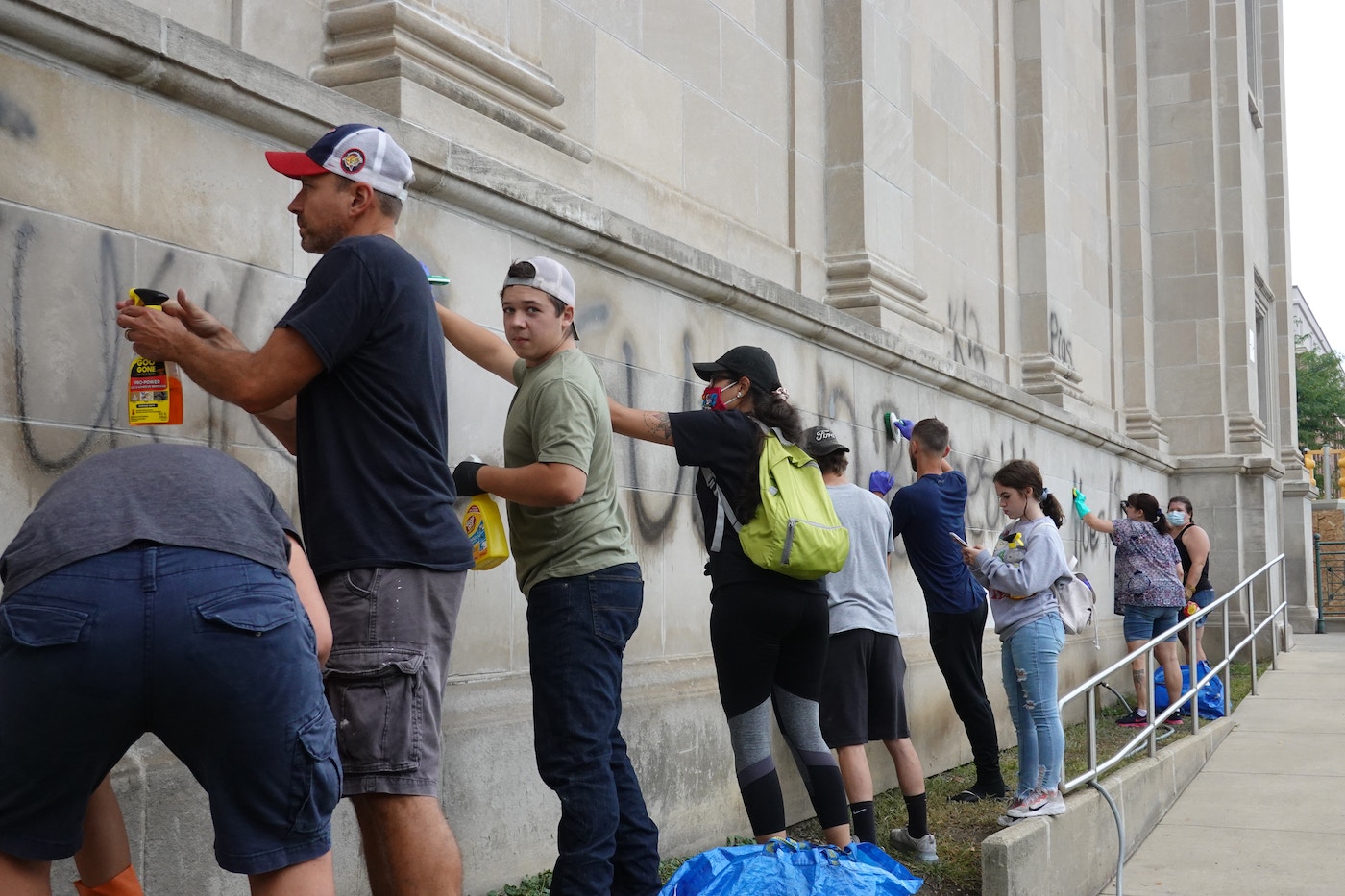
In Carlson’s telling, the moral of the story was not that Rittenhouse — who was photographed and caught on video from multiple angles shooting three men — had provoked trouble by responding to a militia group’s Facebook call for “patriots willing to take up arms and defend” the city from “evil thugs,” but that he was something closer to a victim, prodded to fill a vacuum by the misrule of the city’s Democratic mayor, John Antaramian, and the state’s Democratic governor, Tony Evers. Kyle Rittenhouse was photographed hours before the shootings on Tuesday, among a group of volunteers who cleaned anti-police graffiti from a high school in Kenosha.
Photo: Scott Olson/Getty Images
“Kenosha has devolved into anarchy because the authorities in charge of the city abandoned it,” Carlson told Fox viewers unaware that the city had not, in fact, collapsed into chaos just because they were being shown isolated scenes of violence on a loop.
“People in charge, from the governor of Wisconsin on down, refused to enforce the law. They stood back and they watched Kenosha burn,” Carlson claimed, oblivious to the fact that video recorded by witnesses to Tuesday’s events showed Rittenhouse and other heavily armed young vigilantes had spent most of the night standing close to armored police vehicles outside a business they appointed themselves to guard.
At one point in a livestream broadcast that night, a police officer could be heard offering water to the militiamen, including Rittenhouse, and telling them: “We appreciate you guys, we really do.”
Later that night, after Rittenhouse wandered a short distance away and got into a confrontation with a man he shot in the head, video recorded by a pro-Trump YouTuber, Drew Hernandez, seemed to show Rittenhouse running back down the street in the direction of the police vehicles. As he retreated from the scene, the video appeared to catch Rittenhouse telling someone on his phone: “I just killed somebody.”
According to the police complaint against Rittenhouse, released on Thursday evening, his friend Dominic Black told a detective that he received a call from his friend Kyle at 11:46 pm on Tuesday, in which the gunman stated that he shot someone.
A subsequent analysis of the video by the New York Times visual investigations unit suggested that, moments before Rittenhouse opened fire, a single gunshot was fired into the air for unknown reasons by someone standing near the parking lot where the confrontation took place.
Shelby Talcott, a video journalist for the Daily Caller, a conservative site founded by Carlson, captured footage of Rittenhouse fleeing the scene of the first shooting, as protesters shouted that he had shot someone.
Video shot by another pro-Trump YouTuber, Brendan Gutenschwager, appeared to show Rittenhouse pursued by several protesters who suspected him of carrying out the first shooting. After he tripped and fell, just a block away from the police, two of those men attempted to disarm him, one by kicking him and another by hitting him with a skateboard.
Rittenhouse fired at both of them, apparently killing the skateboarder, Anthony Huber, with a shot to the chest as they struggled for the rifle, and then shooting a third protester, Gaige Grosskreutz, causing a gaping wound in his arm. Grosskreutz, a member of a social justice group who was wearing a hat with the word “paramedic” emblazoned on it, also appeared to be armed with a handgun.
In a remarkable scene at the end of Gutenschwager’s video, Rittenhouse can be seen walking with his hands up, apparently trying to surrender to the police officers he had been chatting with earlier in the evening, as a bystander shouts that he shot the protesters, but the officers drive right past him in the direction of the men he shot.
While all of this footage was available to Carlson before he went on air, later in his monologue he professed to have no idea what exactly had happened or whether — because the men who had attempted to disarm the vigilante after he had shot someone in the head could be seen kicking and hitting Rittenhouse — a jury might ultimately decide that he had acted in self-defense.
In this, Carlson was closely following a consensus explanation that had formed during the 24 hours after the shooting by pro-Trump YouTubers, bloggers, and commentators, who decided, after studying slow-motion imagery and still photographs, that the young man who had traveled to Kenosha from his home in neighboring Illinois to defend the city from residents enraged by the shooting of Jacob Blake, was merely acting in self-defense.
Rep. Paul Gosar, a Republican from Arizona, suggested on Twitter that the slow-motion video convinced him that the killings were “100% justified self defense.” Hours before Carlson went to air, Gosar also blamed the violence on Kenosha’s local government. “Armed citizens defending themselves will fill the vacuum,” he wrote.
One of Rittenhouse’s defenders was Elijah Schaffer, a freelance producer for Glenn Beck’s BlazeTV and a pro-Trump political activist who released a misleading account of a fight involving Black Lives Matter protesters in Dallas in May. Writing on Twitter on Wednesday, Schaffer described the Turkish journalist Tayfun Coskun’s photograph of the protesters attempting to disarm the gunman as Rittenhouse “being attacked by #BLM rioters.”
“One of the attackers,” in Schaffer’s words, was “about to assault him with a skateboard.”
That “assault” by the skateboarder Anthony Huber ended with his failed effort to wrest the gun away from Rittenhouse and being fatally shot in the chest.
Schaffer also thought a 20-second interview he did with Rittenhouse before the shootings provided important “context” as to what took place later, since the vigilante did not say anything racist or political in that third of a minute.
As Jamelle Bouie, a New York Times opinion columnist, noted on Twitter, an obvious flaw in the conservative argument that Rittenhouse was just defending himself from the second and third men he shot is that they were only “attacking” him because he had just shot someone else in the head.
Carlson’s defense of Rittenhouse also hinged on the false idea that he had taken to the streets to oppose a phantom movement of violent radicals using the protests as cover. “The Justice Department could have stopped all of this months ago,” Carlson ranted over footage of Kenosha recorded by another of the conservative gonzo video bloggers who descended on the city this week, searching for images of chaos to discredit the protest movement. “If federal prosecutors had treated the organizers of BLM and antifa the way they treated Roger Stone, our cities wouldn’t look like Kosovo tonight.”
Another conservative journalist who interviewed Rittenhouse earlier in the evening was Richie McGinniss, who directs video for the Daily Caller, the website that was once used to smear Trayvon Martin, the Florida teenager who was shot and killed by George Zimmerman, a neighborhood watch volunteer.
McGinniss appeared on Carlson’s show on Wednesday to discuss what happened in Kenosha and his own effort to save the life of the first man shot and killed by Rittenhouse, who was later identified as Joseph Rosenbaum.
What made Carlson’s interview with McGinniss odd, however, was that the Daily Caller videographer repeatedly referred to Rittenhouse as “the alleged shooter,” even though he was standing just six or seven feet away from Rosenbaum when he was shot and seemed to have been filming the confrontation at the time.
It is unclear if McGinniss has video of Rittenhouse shooting Rosenbaum, but he told Carlson that he witnessed the crime at close range. Even so, Carlson failed to ask him directly if he could say for certain that Rittenhouse did shoot Rosenbaum in the head and cause his death. Instead, McGinniss offered what sounded like testimony to the gunman’s good character. “The 17-year-old who I interviewed earlier in the night, he actually mentioned that he was there to maintain peace, in the absence of police,” McGinniss said.
“It’s just hard to believe this is America,” Carlson said. “We can’t put up with this.”
When the complaint against Rittenhouse was released late Thursday, it said that McGinniss told a police detective that he did clearly see the teen shoot Rosenbaum at close range as the victim reached for the rifle. Footage recorded earlier in the evening showed that Rosenbaum was incensed by the presence of the armed militia members in the neighborhood.
The complaint cited a coroner’s report which “indicated that Rosenbaum had a gunshot wound to the right groin which fractured his pelvis, a gunshot wound to the back which perforated his right lung and liver, a gunshot wound to the left hand, a superficial gunshot wound to his lateral left thigh, and a graze gunshot wound to the right side of his forehead.”
As the momentum to excuse Rittenhouse’s crimes as justified spread online Thursday, amplified by far-right figures around the globe, Jamelle Bouie called it “the single most ominous development of the year.”
The journalist Matt Prigge noted that the increasingly obscene lionization of Rittenhouse echoed the wave of praise in 1970 for the National Guardsmen who killed four anti-war protesters at Kent State, documented by the historian Rick Perlstein in his book, “Nixonland.”
At a news conference on Friday, Kenosha County Sheriff David Beth said that he did not want armed volunteers like Kyle Rittenhouse on the streets during protests.
“This group of people that are carrying weapons here, if they’re in their house — and again, I support the Second Amendment — if they’re in there protecting their property, I have no issue with that,” the sheriff said. “The people that have been here carrying guns, they haven’t been arrested because it’s a right that they have. Have we asked for them to come? Are we asking for them to come in and support things? I’m not.”
“You could clearly see the situation escalated Tuesday night because a 17-year-old boy carrying what appears to be an assault rifle, who has no idea how to handle a situation like this,” Beth added. “I don’t care if he had the right intentions or not, two people are currently dead, and one almost had his arm blown off.”
Last Updated: Friday, Aug. 28, 10:07 p.m. PDT This article was updated to add new information on Thursday and Friday, including the formal police complaint against Kyle Rittenhouse, and to note the participation of Mark and Patricia McCloskey, the St. Louis couple facing weapons charges for brandishing guns at protesters, in the Republican National Convention the night before Rittenhouse traveled to Kenosha to join a volunteer militia patrolling the streets.
China’s recent economic growth constitutes a major challenge to the dominance of US capitalism. As a result, hostility to China is now a bipartisan priority for the US ruling class. In addition to increasing military tensions and the imperialist contest over countries in Africa and elsewhere, this has recently been expressed in the relationship between the US and Chinese tech sectors, supported by their respective governments.
Specifically, tensions have escalated around TikTok, a Chinese-developed social media service where users upload and share looping videos. TikTok is owned by a parent company, Beijing-based Bytedance, and headed by an American CEO, the former Head of Streaming for Disney. The service became influential in the US market after merging with Musical.ly—another Chinese firm with a large US presence. Absorbing Musical.ly profiles and user data in 2018 was critical to establishing their user base in the US, which is now sizable—an estimated 30 million out of 800 million active users worldwide.
This is a classic pattern of monopoly expansion, whereby increasingly massive firms absorb their competitors in order to secure privileged access to both economic supply and demand. And this is the same pattern Trump is now attempting to facilitate in the interests of the US tech sector.
On August 3, Trump issued a statement in a White House meeting with US tech workers, in which he declared that TikTok would “be out of business in the United States” by September 15 unless it was bought by a US company. As of now, the most likely US firm to fill this role appears to be Microsoft. Then, on August 7, Trump issued an executive order banning US transactions with Bytedance, claiming these transactions threaten “to allow the Chinese Communist Party access to Americans’ personal and proprietary information—potentially allowing China to track the locations of Federal employees and contractors, build dossiers of personal information for blackmail, and conduct corporate espionage.”
Since the executive order was issued, the Wall Street Journal has reported that the idea for attacking TikTok was informed by a private dinner Trump had with Facebook CEO Mark Zuckerberg, who argued that Chinese firms presented a large threat to US businesses. This dinner was part of a broader effort by Zuckerberg to raise alarms about supposed threats by the Chinese tech sector, which happened to coincide closely with congressional antitrust hearings investigating the monopoly behavior of US firms including Facebook.
TikTok has now filed a lawsuit contesting Trump’s executive order, arguing that it “is not rooted in bona fide national security concerns.” This claim gets at the root of the issue—how the ruling class understands “national security,” and how this offers no security to workers, either in the US or in China.
Both parties of the US capitalists, the Democrats and Republicans, are aligned on this issue. Democratic Senator Chuck Schumer has publicly stated his support for the acquisition of TikTok by a US firm. For both parties of the US ruling class, “security” is broadly tied to the protection and expansion of US monopoly capitalism.
The revenue model of the tech behemoths—who have looted historic concentrations of wealth during the ongoing crisis triggered by COVID-19–is largely concerned with gathering user data, and then using or selling that data to other profit-driven firms, often for marketing purposes—the term “adtech” is used to describe this model. The result is a profit-based marketplace for user information, combined with technical and social products that are intended to collect as much of this information as possible, all funded and supported by the financial system, and increasingly, protected by the state. Further, recently leaked police documents show that TikTok regularly shares user information with US law enforcement, and that American police used TikTok to monitor individuals’ activities during this summer’s BLM protests. For US workers, the most imminent threats to their safety don’t come from Chinese capitalists accessing their data, but from US capitalists.
In the final analysis, TikTok’s US user base is a business asset, alienated from both workers and consumers, that the US state aims to capture on behalf of the US capitalists so as to increase their profits in that marketplace. The principal value of TikTok’s user base will primarily be used to further enrich the US interests that stand to seize it—in other words, to preserve and expand the economic security of this class. But rather than taking an interest in the machinations of one country’s ruling class against another’s, workers’ real interests are threatened by the penetration of capitalism itself into their lives, now greatly accelerated by technology.
American capitalists are pursuing this updated approach due to the changing conditions they face. Throughout the 20th century, the United States ruling class had an unprecedented level of dominance in the world economy, which informed their preference for open markets. When all flows of global capital inevitably enriched US coffers, this economic reasoning was straightforward. Today, however, the economic weight of Chinese capitalism changes this calculus.
While the US is still certainly the most powerful force on the planet, it is no longer guaranteed to be the most powerful force in any particular situation or locality. This has contributed to the relative decline in popularity of capitalist “free trade,” in favor of a resurgence of protectionist ideas.
So-called “economic nationalism” combines protectionism with monopolism. Rather than protecting nascent American industries, the goal is to protect giant conglomerates with extensive connections to the state. The dynamics Lenin identified over 100 years ago—of ever-greater integration of the capitalist state in concert with the expansion of monopolies, and the division of the world economy between the monopolies of the main powerful nations—are sharper today than ever. Ultimately, neither protectionism nor “free trade” will resolve the crisis facing world capitalism—and the working class will be squeezed either way.
But as Lenin also explained, US and Chinese workers have no interests in common with either the US or Chinese capitalist classes—they have a world to win by working together to bury capitalism and imperialism once and for all.
Women with Alzheimer's live longer than men with the disease, and scientists at UC San Francisco now have evidence from research in both humans and mice that this is because they have genetic protection from the ravages of the disease.
By virtue of having a second X chromosome, women get two "doses" of a protective protein from a gene that only exists on this female sex chromosome. Some people, both male and female, have an especially potent variant of this gene, which is called KDM6A, that gives them even more protection. But, because of the way sex chromosomes work -- women have two X's, but men only have one -- women have two copies of this gene churning out the protective protein.
The new study offers a first look at how sex chromosomes affect vulnerability to Alzheimer's. And it helps explain why women survive longer and with less severe symptoms than men during early stages of the disease, even when they have comparable levels of toxic Alzheimer's proteins in their brains.
"This finding challenges a long-standing dogma that women are more vulnerable to Alzheimer's," said Dena Dubal, MD, PhD, associate professor of neurology at UCSF and senior author of the study, published August 26, 2020, in Science Translational Medicine. Dubal is the David Coulter Endowed Chair in Aging and Neurodegenerative Disease, and a member of the UCSF Weill Institute for Neurosciences. "More women than men have Alzheimer's because they survive to older ages, when risk is highest. But they also survive with the disease for longer."
While much of a female's second X chromosome is "silenced" by an outer layer of non-coding RNA, a small number of genes escape this process, in both mice and humans, giving females twice the dose of the proteins coded for by those genes. The researchers zeroed in on one of these active genes, KDM6A, which is already known to be involved in learning and cognition: when this gene malfunctions, it causes Kabuki syndrome, characterized by developmental delay and mild to severe intellectual disability.
Combing through public databases of gene expression studies, the scientists discovered an especially active variant of KDM6A that is carried by about 13 percent of women and 7 percent of men around the world. Because women have two X chromosomes, they have a greater chance of carrying at least one copy of this variant, and some women carry two copies.
When the scientists looked at several long-term studies of older people, many of whom already had mild cognitive impairment, they could see that women with one copy -- or even better, two copies -- of the variant appeared to progress more slowly toward Alzheimer's. It's not yet clear if the same holds true for men who carry the variant on their X chromosome, since there may have been too few of them in the study to see any effects.
Little is known about the ways that genetics drive differences in how diseases affect men and women, said Jennifer Yokoyama, PhD, an associate professor of neurology at the UCSF Memory and Aging Center and member of the Weill Institute, who analyzed the KDM6A variant in the new study. "Because the X and Y chromosomes are hard to compare to one another, the big genome-wide association studies have all been done on non-sex chromosomes," Yokoyama said. "Perhaps our study will highlight the fact that there could be something pretty interesting on the X chromosome after all."
The gene expression studies showed that women in general had more KDM6A protein in their brains than men. They also showed that people with Alzheimer's had more of the protein in brain regions that get damaged early in the disease. The researchers theorized that neurons in these regions may produce more of the protein to protect against the disease, although the data they analyzed could only identify associations, and not prove causes.
To get closer to this causal question, the scientists performed experiments in mice. First, they looked inside the brains of female mice and confirmed that both copies of Kdm6a were actively transcribing RNA to make protein. Female mice had significantly higher levels of this protein in a brain region called the hippocampus, which is critical to learning and memory and gets damaged early in Alzheimer's.
Then they bred mice which model human Alzheimer's by producing toxic amyloid beta in their brains, so their male offspring produced amyloid and also carried two X chromosomes like females.
With a second X chromosome, the male mice did better on cognitive tests, and they also lived longer, despite the toxic proteins in their brains. To be sure it was the second X that provided protection, rather than the absence of a Y chromosome, scientists deleted the second X from female Alzheimer's mice. And just like males, these female mice were more cognitively impaired and died faster.
In further tests, when the scientists exposed neurons from male and female mouse brains to increasing doses of amyloid beta, the male neurons died faster. But this difference was eliminated when the scientists used a gene editing technique to reduce Kdm6a protein levels in the neurons from females' brains and increased it in the neurons from male mouse brains.
The researchers built on these findings by increasing Kdm6a in a region of the hippocampus called the dentate gyrus, which is involved in spatial learning and memory, in male Alzheimer's mice. One month later, the male mice had as much of the gene's protein in that brain region as the female mice. These males also did significantly better on tests of spatial memory than male mice without the added Kdm6a.
"Our study reveals a new role for sex chromosomes," Dubal said. "This protective mechanism on the X chromosome opens the possibility that we could increase resilience to Alzheimer's and other neurodegenerative disorders by boosting Kdm6a or other X factors in both men and women."
Journal Reference: Emily J. Davis, Lauren Broestl, Samira Abdulai-Saiku, Kurtresha Worden, Luke W. Bonham, Elena Miñones-Moyano, Arturo J. Moreno, Dan Wang, Kevin Chang, Gina Williams, Bayardo I. Garay, Iryna Lobach, Nino Devidze, Daniel Kim, Cliff Anderson-Bergman, Gui-Qiu Yu, Charles C. White, Julie A. Harris, Bruce L. Miller, David A. Bennett, Arthur P. Arnold, Phil L. De Jager, Jorge J. Palop, Barbara Panning, Jennifer S. Yokoyama, Lennart Mucke, Dena B. Dubal. A second X chromosome contributes to resilience in a mouse model of Alzheimer’s disease. Science Translational Medicine, 2020; 12 (558): eaaz5677 DOI: 10.1126/scitranslmed.aaz5677
In the aftermath of the covid outbreak and in a moment of Black Lives Matter national organizing in response to police brutality the issue of racial justice has lit up cities and towns across the country. Racist policing practices have had a huge impact on public opinion, with polling data showing that even more white suburban voters favor policy reforms. The shift has been public, sudden, and potentially electorally-decisive during this political season.
What remains less visible are racialized and racist choices to deepen state disinvestment in institutions critical to the health and welfare of Black and brown communities, what we term racialized austerity.
Austerity policy-making over the past 50 years has been racialized, withering services in public agencies ranging from K-12 schooling to hospitals to higher education. Matters of race must be made more visible and placed at the very center of both past and present austerity decisions and policy-making.
Disinvestment in and privatization of public services incorrectly assumes three things: 1) the state can no longer afford earlier levels of public investment in public services; 2) increased progressive taxation is not a solution to austerity because the wealthy can and will migrate themselves and their money elsewhere; and 3) the reduced quality of services matters little because basic access to public services rather than the content and quality of those services is the most important factor in assessing the worth of public goods in a democracy.
Reliance on public services by Black and brown communities grew at exactly the moment austerity policies produced one wave after another of public disinvestment. The conjunction, for example, between shifts in the composition of the student body at CUNY from largely white to Black and brown, which began in the 1970s, and deepening public disinvestment in CUNY cannot simply be explained solely as a specific byproduct of fiscal austerity. The roots of racialized austerity policy-making also grew out of choices about the degree to which specific groups are deserving of public investment.
Over the past 50 years there have been periods of economic expansion in the United States that have produced sharply-growing wealth and income inequality. Despite growth in wealth and income in the top tier of earners, redistributive tax policies have been deemed all but off the table. These political decisions have not been driven alone by austerity policy making to cut public budgets but also by the concerted political opposition of dominant economic interests to any kind of new taxation. Politicians of both major parties have made and continue to make real choices, deferring to the needs and desires of powerful economic interest groups, rather than embrace policies for the common good.
The issue of race, although not the only factor driving austerity, is central to these fiscal decisions. What has been created over the past half-century is the latest iteration of “separate but (un)equal” policy-making. Basic access to public services is consistently privileged over higher public investment to assure the quality of those public services. The policies of “separate but (un)equal” as seen through the prism of the defunding of the City University of New York reveals a regime of racialized austerity. CUNY: Race And Austerity
Despite the city’s commitment in 1847 to provide free tuition for all New York City residents, a commitment it maintained for nearly 130 years, the student body in the municipal colleges remained overwhelmingly white and increasingly middle class until the 1970s. Even in the decade after CUNY was formally created in 1961, the city’s policy of providing free tuition proscribed its ability to respond to the vocal demands of the city’s growing Black and Puerto Rican population for increased access to CUNY’s senior and community colleges.
The Brooklyn College student body in the tumultuous year of 1968 was still 96 percent white and middle class. CUNY as a whole remained overwhelmingly white and middle class until the spring of 1969, when student-led struggles for “Open Admissions” erupted across the system. Over the next half-dozen years CUNY became the model of how a major public university system could rapidly diversify its student population.
By 1971, CUNY’s Black and Puerto Rican overall student population had already more than doubled to 24 percent. Half-a-dozen years after open admissions, however, the state forced the city, in the midst of a fiscal “crisis,” to impose tuition for the first time on CUNY students in exchange for enhanced state support of the system. While the student population of CUNY continued to be radically recomposed racially over the next three decades, students of color, unlike the largely white student body that had preceded them, had to pay tuition for the privilege of attending the city’s public colleges.
On the basis of data collected by CUNY about 70 percent of CUNY’s student body is students of color and almost 60 percent of all CUNY students’ family annual incomes are below $30,000. Current tuition at CUNY’s senior colleges is almost $7,000 annually while at its community colleges it is nearly $5,000, exclusive of student fees.
The changes in the composition of CUNY’s student body and rising tuition have been accompanied for decades by the steady erosion of public funding support from New York state government (which has provided the lion’s share of CUNY funding since 1976) and New York City government (which supports the system’s seven community colleges). Between 2008 and 2020 there has been a 21 percent reduction in the full-time student equivalent (FTE) investment by the state adjusted for inflation in CUNY senior colleges, according to the Professional Staff Congress (PSC) of the City University of New York (the faculty and staff union of CUNY) .
The state’s level of disinvestment in CUNY has resulted in larger class sizes, a growing number of courses taught by underpaid and overworked part-time faculty, the decay of much of the physical plant, labs that cannot meet even the most basic needs of science students, and ever greater reliance on too-large online classes. As a point of comparison, California’s three-tier public university system, which is similarly racially stratified from top tier (the UC system) to the bottom tier (the state’s community colleges) as CUNY’s senior and community colleges are, has experienced a striking differential level of public investment based on race.
In our book, Austerity Blues: Fighting for the Soul of Public Higher Educations, we showed that California’s community colleges, which have the highest concentration of Black and brown students (nearly 45 percent), state aid per FTE student in 2011-12 was less than $4,000 while in the UC schools (where only 21 percent of students are Black and brown) FTE student aid is more than $7,200. This associative relationship between race and disinvestment is highly suggestive and compelling in both New York’s and California’s public university systems. Yet race has essentially been ignored by policy makers in California and New York as even a partial explanation for declining investment in public higher education.
Unsurprisingly, economic explanations, absent race, have dominated the discourse about CUNY.
What has remained consistently positive in the public discussion and perception about CUNY is its role in raising its students out of poverty and into the middle class. According to Raj Chetty’s 2017 national study of higher education CUNY moved more students out of poverty than every Ivy League school, MIT, and the California Institute of Technology combined. The ability of CUNY to fulfill this part of its historic mission is in jeopardy, however, as deepening state and city budget cuts undermine the quality of instruction and support services like counseling and advising. COVID And CUNY: The Intensified Fallout Of Budget Cuts On Black And Brown Students
In the midst of the intensifying economic and health crisis triggered by COVID-19, CUNY management announced it was laying off 2,800 part-time faculty members. The budget cut was not a consequence of revenue loss but rather the anticipation of that loss.
Institutional Stimulus 3 (the federal CARES Act) money totaling $132 million publicly allocated to CUNY has been reserved, according to CUNY management, as a revenue buffer despite its stated purpose to sustain employment for university faculty and staff. As estimated by the CUNY Professional Staff Congress the cost of retaining the 2,800 faculty members is estimated to be $30 million annually, or a fraction of the $132 million in CARES Act funds allocated to the university system. Equally important for CUNY’s future, additional money may be dedicated to CUNY as part Stimulus 4, currently before Congress.
The implication of this decision is significant, both economically for the CUNY part-time faculty who have been “non reappointed” and lost their health insurance in the middle of a pandemic, and educationally for the largely Black and brown student body of CUNY. Laying off 2,800 part-time faculty represents a loss of about 25 percent of the adjunct faculty workforce at CUNY, which already comprises nearly 60 percent of the overall teaching workforce in its senior colleges.
CUNY courses will almost certainly be fully online during the upcoming fall semester and perhaps even through the spring semester in 2021. The cuts ensure that the size of online classes will grow substantially. During the Spring 2020 semester, a survey of campuses by faculty chairs of the PSC estimated that many of CUNY’s online classes will average about 29 students. The standard for online course sizes nationally is 12 students per class because of the greater pedagogical and other teaching and learning demands of virtual classrooms as compared to in-classroom learning. in-classroom learning. The course enrollment ceilings for online classes at CUNY are likely to rise as high as 35 students per class or almost three times the national suggested ceiling.
For every CUNY student this is part of a continuing, historic degradation of their learning environment at CUNY. The opportunities to build working relationships with faculty, empirically validated as a key indicator of students’ academic development, will become even less available. Equally important, larger online classes are less able to meet students’ basic needs to develop competency in areas ranging from basic writing to scientific exploration and experimentation.
To enact policies that dramatically reduce CUNY’s instructional workforce is at best short-sighted and at worst underscores a lack of will by CUNY management and state and city leaders to protect instructors’ jobs and students’ quality of education. Other courses of action including, but not limited to, reallocating institutional dollars to protect the instructional workforce, utilizing Stimulus 3 money to close the budget gap, or short-term borrowing against Stimulus 4 monies as a hedge against workforce disruption might have been taken while awaiting both state and federal budget decisions.
Shortly after New York City became the epicenter of COVID-19 infection and while Governor Cuomo was delivering politically-popular daily national briefings on the spread of the infection, the governor simultaneously announced there would be deep budget cuts (as high as 20 percent) to state-supported public services in the absence of federal aid. The game of “Who blinks first?” between Cuomo and the Feds continues.
For three months New York State public agencies have been faced with both huge prospective cuts and the governor’s decision to delay state distribution of public revenues to localities. At the same time, many groups have pressed state leaders to tax the very wealthy to close the state budget gap of $15 billion. Cuomo has repeatedly indicated his opposition to imposing additional taxes on the very wealthy despite mounting pressure from a cross-section of unions, non-profit agencies, and more than 100 state legislators, among others.
This is only the most recent example of state and institutional policy-makers choosing to compromise the quality of Black and brown students’ higher education rather than commit additional public funds. It is important to reiterate that these decisions have occurred historically in both good and bad economic times. They occur despite CUNY’s stellar record of moving students out of poverty and into the middle class. They occur as the proportion of Black and brown students in CUNY’s student body has grown to nearly 70 percent. Policy-makers laud the greater access of students of color to CUNY at the same moment that they choose to unravel the basic fiscal underpinnings of what is needed to provide the kind of quality education students need and deserve. These contradictions are profound and race is a critical, if not the critical, factor in these decisions.
It is time to name these policies and choices and their relationship to race. The disinvestment in CUNY is influenced by many factors. But we should not allow complexity to cloud the fundamental relationship of the past 50 years between race and public disinvestment. These trends are not specific to CUNY. Across the country, spikes in Black and brown college attendance have been accompanied by similar levels of public disinvestment. To call these policies anything other than racialized austerity is at best a misnomer and at worst a calculated evasion of the forces driving such public policy and fiscal choices. A New Deal For CUNY
What might an alternative approach to racialized austerity at CUNY look like? A New Deal for CUNY, with significant new investment of state and city tax funds over a five-year period, would help to bring CUNY back from two decades of systematic erosion of public funding. This New Deal for CUNY would be justified as part of New York City’s, New York State’s, and the nation’s long overdue response to the fundamental need of all students attending public universities for a quality, fully-funded public good.
A New Deal for CUNY would have an immediate and positive impact on all of our 275,000 students, especially the 70 percent who are students of color, and 60 percent who have annual family incomes below $30,000. Despite the state’s Tuition Assistance Program, many CUNY students presently pay full or partial tuition. Expanded investments in CUNY would also require:
-Increasing the ratio of full-time faculty to students; dedicating a substantial number of new full-time positions and making them available to adjunct faculty; and incentivizing the hiring of a new generation of faculty of color across the system; creating new labor standards for part-time faculty that ensure a livable wage.
-Expanding the number of academic advisors and mental health counselors to support all CUNY students.
-Eliminating all student tuition and fees, returning CUNY to its tuition-free roots.
-Providing a significant increase in capital renewal and investment across the 25-campus system to allow CUNY to modernize its facilities and make them fully safe and accessible.
Spread over five years we believe a New Deal for CUNY will help to overcome decades of racialized austerity, fundamentally returning CUNY to its 1847 founding ideal of creating a public institution of higher learning that is by and for “the children of the whole people.”